Jaquar, the bathroom and lighting company introduces, Jaquar Qloud, the hybrid touch shower. The ad film is conceived and executed by Crescent Communication.
Said Sandeep Shukla, CMO of the Jaquar Group: “Behind the elegant interface of Jaquar Cloud lies a robust system engineered to withstand tough Indian operating conditions and provide dependable performance. From hardy sensors to super-responsive electronic valves, every aspect of Sloud is designed to enhance your showering pleasure.”
Added Rajesh Laikh, Executive Vice President, Crescent: “Touch is not just a sensation; it’s a gateway to our world. It connects us, empowers us, and makes the virtual tangible. With Jaquar Qloud, this power is harnessed to redefine your showering experience. Imagine stepping into your shower and effortlessly controlling your showering environment with just a gentle touch.”
Dish TV has launched ‘Dish TV Smart+’ Services offering TV and OTT on any screen, anywhere.
Commenting on the new proposition, Manoj Dobhal, CEO of Dish TV India Limited, said: “Since its inception, Dish TV has transformed the entertainment consumption landscape, pioneering new ways for people to enjoy their favourite content. With this new proposition, we are poised to make an even greater difference, setting a new standard for immersive and accessible entertainment experiences. The launch of ‘Dish TV Smart+’ Services represents more than just a proposition; it embodies the vision to redefine entertainment consumption in India, which is getting smarter and bigger. In a market flooded with options, customers often find themselves overwhelmed. We aim to simplify their choices by offering a holistic and complete entertainment solution. We firmly believe that both traditional television and OTT platforms are indispensable in today’s age, and with our proposition, we aim to reaffirm their equal importance.”
Added Sukhpreet Singh, Corporate Head of Marketing, Dish TV & Watcho: “With ‘Dish TV Smart+’ Services, we’re not just introducing a new proposition; we’re leading a paradigm shift in entertainment consumption. Through our multi-channel marketing approach, we are committed to directly engaging with consumers, ensuring broad awareness and adoption. As a brand, we prioritize staying ahead of trends and adapting to evolving audience preferences. Customer satisfaction is at the heart of our strategy, and we are committed to delivering unparalleled entertainment experiences that cater to their diverse preferences and lifestyles.”
Criticism of Narendra Modi is now seen as… Okay strike that sentence. Try this: Anything that is possibly, elliptically, circuitously, remotely, vaguely critical of Indian Prime Minister Narendra Modi is unacceptable in the ‘Mother of Democracy’ as Modi ji himself likes to refer to the electoral autocracy of his own making.
In pure democratic behaviour, one more foreign journalist is asked to leave India because her reported “crossed a line”. Avani Dias works with the Australian Broadcasting Corporation (ABC) and it was a programme on allegations of possible Indian involvement in the assassination of pro-Khalistani activists in Northern America which riled the Modi government.
At least 30 foreign journalists who work in India have written an open letter asking the Indian government to facilitate their work, rather than target them: “Foreign journalists in India have grappled with increased restrictions on visas for journalism permits for those holding the status of Overseas Citizen of India. The circumstances of Ms Dias’s departure are further cause for concern.”
What are these lines which may not be crossed?
We see in the ongoing elections that Modi and the BJP to some extent but mainly Modi have no restrictions and no lines. All the restrictions set by the Election Commission and its Model Code of Conduct apply to Opposition parties. Oddly though, some of the lies and misinformation put out by Modi on the campaign trail have been fact-checked and corrected by “new” channels which normally bow down at the mere sound of his name. I have heard from reliable sources that Sudhir Chaudhary of Aaj Tak broke from the norm and exposed Modi’s lies about former Prime Minister Manmohan Singh. This is totally out of character for him and his channel.
Other “news’ channels sent their TV stars out to interview people on the street and were forced to hear some unpalatable opinions about their dearest Prime Minister. The poor TV stars, so used to endless praise of their lord and master, had to cover their outrage with pasted-on embarrassed smiles against an angry electorate.
I am not suggesting anything at all here, so please don’t suggest that I have crossed any lines. Rather, I’m carefully tiptoeing along because I know very sensitive we are about everything and anything that may hurt our sentiments.
But it is odd is all I’m saying…
Luckily for sanity, the general trend of worship continues. The more the PM lies and misrepresents, the more the media carries his words verbatim, minus context or correction. His statements get more and more outrageous: The Congress will steal your mangalsutra, the Congress will take away your money and give it to Muslims, the Congress will introduce inheritance tax, the Congress will sell the country… it doesn’t matter what he says, the media is unlikely to question him. So in the larger perspective, it’s business as usual. Which in a way makes the aberrations even more difficult to comprehend. You cannot even accuse them of being influenced by “cross the line” foreign journalists, because there is hardly any anger amongst this section of the journalistic community when journalists are treated badly by Government. Now if Rahul Gandhi and nowadays even anyone from AAP is even rude to a journalist, we have huge conniptions and angry explosions.
Meanwhile, our outrage specialists are so caught up in the elections, that terrible news is ignored. Of course I am being unfair, no one really cares about the environment. But the recent report about Himalayan glaciers melting from the World Meteorological Organisation means chilling consequences for India’s Himalayan states and for our water future. But global warming and climate change are only worth discussing when everyone hops off to some foreign land to make large promises and smooth excuses.
If you’re voting today, please stay hydrated and keep your head covered. Next time, the media can maybe petition the Election Commission to use a little brain matter and schedule the elections better.
Ranjona Banerji is a senior journalist and commentator. She writes on MxMIndia on Tuesdays and Fridays. Her views here are personal.
Goafest 2024 has announced the opening of delegate registrations for the three-day event scheduled to take place from May 29 to May 31 at the Westin Powai in Mumbai. Early bird rates are valid until May 15, 2024.
Sam Balsara
Said Sam Balsara, Chairman of the Delegates Committee – Goafest 2024: “Goafest is a unique platform that brings together industry leaders, creative minds, and aspiring talents to celebrate creativity, exchange ideas, and shape the future of advertising in India. We are excited to welcome delegates from across the country to join us for three days of inspiration, learning, and networking. This year with the event moving to Mumbai, we are sure there will be a substantial increase in delegates from Mumbai.”
The Ad Club Bangalore has announced the launche of the Inspiration Room, a new initiative designed to inspire and educate the advertising and marketing community. This series of thought leadership programmes will offer a wide range of formats fostering a dynamic exchange of ideas.
Said Laeeq Ali, Founder of Origami Creative and President of Ad Club Bangalore: “We are very excited to launch the Inspiration Room series. This initiative is conceived to be a series of high-quality masterclasses, talk shows, discussions and workshops, where creative professionals will get to hear from the experts and interact with the best.”
The first programme in the Inspiration Room series was a roundtable discussion focusing on Generative AI.
The Prime Minister of India is “interviewed” by three people who work for News18, one of India’s top TV channels which occasionally succumb to showing a bit of news. To call it an interview is a bit of a stretch. All right, I am unfair. Questions were asked, sort of, and long monologues were received in response. But an interview by journalists? Now that’s another sort of an animal. Compare an encounter between a caged tiger in a zoo and a tiger in the wild. The News18 interview was between a cage and a Master of Manipulation and Deflection. No contest. Or context for that matter, which was what I typed as the last word in the last sentence and then corrected.
I heard one worthy ask Narendra Modi the secret of his strength. I didn’t bother to listen to the answer but he did say that he was placed here by God so some such soon after the question. This was early on in the interview. Aah, you might of thought to yourself, the interviewer was soft-soaping the victim, trying to lull him into being comfortable before pouncing.
.
.
.
.
.
Sorry, I had to stop and laugh at my own stupidity for a bit. Forgot my own cage metaphor there.
Anyway, Modi made his usual claims of his own greatness (God-given, duh) and of the various nefarious ways in which the Congress and the opposition was going to destroy India if they ever came to power. He reiterated his oft-repeated lie about how the Congress was going to steal the gold and jewellery of women. Not one of the other three people questioned him on this claim or asked him where this appeared in the Congress manifesto.
Much as manifestoes have become a bit of joke in the last few elections in India, the Congress manifesto for Lok Sabha 2024 has been much discussed. By contrast almost no one has had much comment on the BJP manifesto. I suspect that’s because the manifesto is Modi himself. But still, not one of three questioned Modi about his lies. He was essentially therefore not interviewed. He spoke, they listened and made a few anodyne comments.
Meanwhile, a horrific story has emerged about serial sexual abuse and assault of hundreds of women by a Janata Dal (Secular) Lok Sabha candidate, Prajwal Revanna. The JD (S) has tied up with the BJP in Karnataka – this is former PM Deve Gowda’s party and Revanna is his grandson. Revanna has apparently run from India and is now in Germany. Investigations by The News Minute has shown how gag orders were used stop reporting of the many complaints by women against Prajwal Revanna. There is a pen drive doing the rounds of these very disturbing videos of serial rape and assault. A letter by a member of the BJP advising against giving a ticket to Revanna for this very reason has also emerged.
Would this not be something to question the BJP about, if not the Prime Minister himself? But apparently not. Some obscure remark by Rahul Gandhi (or any of his ancestors), some past transgression by Arvind Kejriwal, some law and order issue in Bengal under Mamata Banerjee, these are all far more important than anything the BJP does and does not do, lies about, covers up…
If Modi and the BJP can brazen through, it is thanks to the media.
O, I forgot to mention Manipur. It’s still there. Remember that place? Because the mainstream media’s pretty much forgotten about it.
Ranjona Banerji is a senior journalist and commentator. She writes on MxMIndia on Tuesdays and Fridays. Her views here are personal.
Biryani By Kilo, the biryani and kabab chain, has collaborated with cricketer Shivam Dube. This partnership aims to celebrate the spirit of the Indian Premier League with the flavours of the brand’s culinary delights and elevate the matchday experience.
Said Vishal Jindal, Co-Founder & Co-CEO, Biryani By Kilo: “Cricket holds a special place in the hearts of Indians, and each year, the IPL unites everyone in a celebration of passion and skill. We are thrilled to partner with Shivam Dube, a true icon of Indian cricket, who perfectly complements the thrill of the IPL season. Just as Shivam brings ‘dumdaar’ power to the field, our biryanis are infused with ‘dumdaar’ flavours and authentic ingredients. Through this, our aim is to offer cricket enthusiasts delectable match day moments that combine the excitement of the game with the unmatched flavours of our signature dishes.”
has been awarded Agency of the Year 2024 at the Festival Of Media Asia-Pacfic awards for 2024. Mindshare won several metals and titles for campaigns with 2 Grand Prix, 7 Gold, 6 Silver and 4 Bronze awards across various categories like Campaign of the Year, Best Branded Content, Best Response Campaign, Best Cause Campaign, Best Viral Campaign, Best Use of Audio, Video, Creative Use of Media, Best Use of eSports or Gaming, etc. In addition to this Mindshare India grabbed the Agency of the Year title.
Said Amin Lakhani, CEO of Mindshare South Asia: “We are absolutely thrilled and grateful to be recognized as the Agency of the Year at FOMA 2024. This achievement is even more special as it comes from multiple award-winning campaigns across various categories. It’s a testament to the hard work and dedication of our team, and I’m proud to see them being recognized for their efforts. This is a great moment for us, and we look forward to continuing to deliver innovative solutions and drive good growth for our clients in the future.”
From India, Wavemaker and EssenceMediacom, have also brought seven metals each.
Tata Motors has rolled out a new digital campaign titled ‘Karo Business Tension Free’. The campaign aims to create awareness on the benefits of an Annual Maintenance Contract (AMC) service that allows customers stress free operations through systematic maintenance of vehicles.
Commenting on the campaign, Shubhranshu Singh, Chief Marketing Officer, Tata Motors Commercial Vehicles, said: “Our campaign highlights Tata Motors’ commitment towards not only delivering superior vehicles but also solutions that promise customers total peace of mind. The ‘Karo Business Tension Free’ campaign seamlessly blends emotive storytelling with relatable scenarios, with each film distinctively highlighting how AMC guarantees hassle free business operations—an often overlooked aspect in after-sales service. We aim for our campaign to instill confidence in customers, encouraging them to opt for AMC as an ideal solution for their long term business needs.”
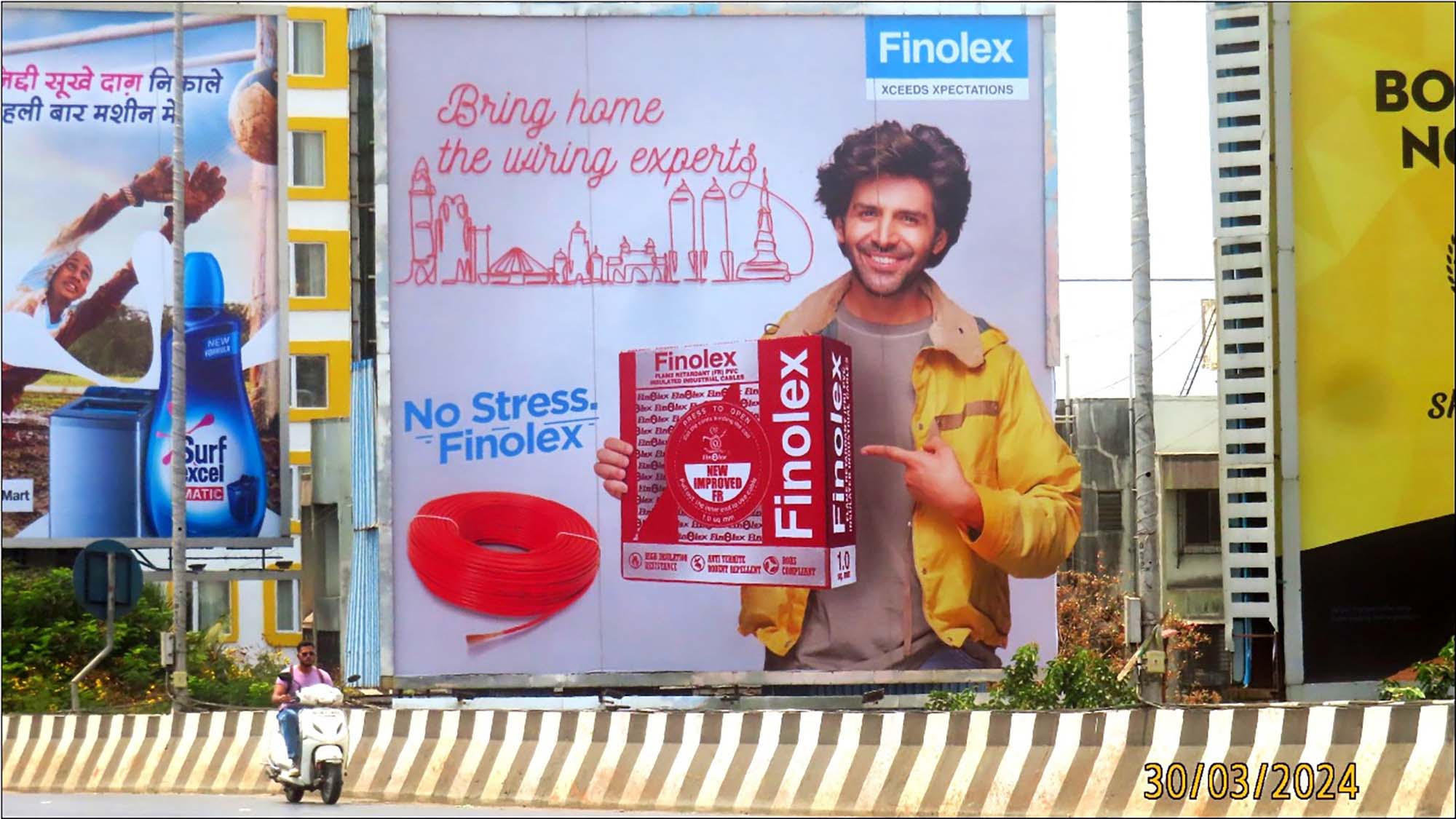
Laqshya Media Group has unveiled an Out-of-Home (OOH) campaign for Finolex Wiggle ES BLDC Fans and wiring solutions across key cities.
Said Amit Mathur, President-Sales & Marketing, Finolex Cables Ltd: “In today’s fast-paced digital world, capturing consumer attention requires innovation and creativity. Our ‘No Stress. Finolex’ campaign exemplifies this ethos, with standout hoardings showcasing our dedication to innovation and reliability. These hoardings are not just advertisements; they’re symbols of our brand’s commitment to standing out and making a meaningful connection with our audience. Coupled with our comprehensive 360-degree approach across various channels and marketing activities, we’re confident that Finolex Cables will continue to resonate with consumers, driving brand awareness and engagement.”
Added M Amarjeet Singh Hudda, COO of Laqshya Media Limited: “This campaign goes beyond mere visuals; it’s about crafting experiences that leave a lasting impression. By seamlessly integrating motion into our OOH strategy, we grab attention and foster meaningful engagement with our audience. The fusion of technology and creativity has enabled us to create a campaign that resonates with the audience across multiple touchpoints.”
Pallavi Chakravarti, Founder and CCO of Fundamental, Raj Kamble, Founder & CCO of Famous Innovations and Mayuri Nikumbh, Head of Design at Conran Design, will join as Jury Chairs for the Abby Awards 2024.
Chakravarti has been appointed Jury Chair in the Diversity, Equality and Inclusion category, Kamble will be Jury Chair for the Out of Home and Ambient category. Nikumbh will Jury Chair in the Design Category.
Social media apps regularly present teens with algorithmically selected content often described as “for you,” suggesting, by implication, that the curated content is not just “for you” but also “about you” – a mirror reflecting important signals about the person you are.
All users of social media are exposed to these signals, but researchers understand that teens are at an especially malleable stage in the formation of personal identity. Scholars have begun to demonstrate that technology is having generation-shaping effects, not merely in the way it influences cultural outlook, behavior and privacy, but also in the way it can shape personality among those brought up on social media.
The prevalence of the “for you” message raises important questions about the impact of these algorithms on how teens perceive themselves and see the world, and the subtle erosion of their privacy, which they accept in exchange for this view.
Teens like their algorithmic reflection
Inspired by these questions, my colleagues John Seberger and Afsaneh Razi of Drexel University and I asked: How are teens navigating this algorithmically generated milieu, and how do they recognise themselves in the mirror it presents?
In our qualitative interview study of teens 13-17, we found that personalized algorithmic content does seem to present what teens interpret as a reliable mirror image of themselves, and that they very much like the experience of seeing that social media reflection.
Teens we spoke with say they prefer a social media completely customized for them, depicting what they agree with, what they want to see and, thus, who they are.
If I look up something that is important to me that will show up as one of the top posts [and] it’ll show, like, people [like me] that are having a nice discussion.
It turns out that the teens we interviewed believe social media algorithms like TikTok’s have gotten so good that they see the reflections of themselves in social media as quite accurate. So much so that teens are quick to attribute content inconsistencies with their self-image as anomalies – for instance, the result of inadvertent engagement with past content, or just a glitch.
At some point I saw something about that show, maybe on TikTok, and I interacted with it without actually realising.
When personalised content is not agreeable or consistent with their self-image, the teens we interviewed say they scroll past it, hoping never to see it again. Even when these perceived anomalies take the form of extreme hypermasculine or “nasty” content, teens do not attribute this to anything about themselves specifically, nor do they claim to look for an explanation in their own behaviors. According to teens in our interviews, the social media mirror does not make them more self-reflective or challenge their sense of self.
One thing that surprised us was that while teens were aware that what they see in their “for you” feed is the product of their scrolling habits on social media platforms, they are largely unaware or unconcerned that that data captured across apps contributes to this self-image. Regardless, they don’t see their “for you” feed as a challenge to their sense of self, much less a risk to their self-identity – nor, for that matter, any basis for concern at all.
The human brain continues to develop during adolescence
Shaping identity
Research on identity has come a long way since sociologist Erving Goffman proposed the “presentation of self” in 1959. He posited that people manage their identities through social performance to maintain equilibrium between who they think they are and how others perceive them.
When Goffman first proposed his theory, there was no social media interface available to hold up a handy mirror of the self as experienced by others. People were obligated to create their own mosaic image, derived from multiple sources, encounters and impressions. In recent years, social media recommender algorithms have inserted themselves into what is now a three-way negotiation among self, public and social media algorithm.
“For you” offerings create a private-public space through which teens can access what they feel is a largely accurate test of their self-image. At the same time, they say they can easily ignore it if it seems to disagree with that self-image.
The pact teens make with social media, exchanging personal data and relinquishing privacy to secure access to that algorithmic mirror, feels to them like a good bargain. They represent themselves as confidently able to tune out or scroll past recommended content that seems to contradict their sense of self, but research shows otherwise.
They have, in fact, proven themselves highly vulnerable to self-image distortion and other mental health problems based on social media algorithms explicitly designed to create and reward hypersensitivities, fixations and dysmorphia – a mental health disorder where people fixate on their appearance.
Given what researchers know about the teen brain and that stage of social development – and given what can reasonably be surmised about the malleability of self-image based on social feedback – teens are wrong to believe that they can scroll past the self-identity risks of algorithms.
U.S. Surgeon General Vivek Murthy discusses the harms teens face from social media
Interventions
Part of the remedy could be to build new tools using artificial intelligence to detect unsafe interactions while also protecting privacy. Another approach is to help teens reflect on these “data doubles” that they have constructed.
My colleagues and I are now exploring more deeply how teens experience algorithmic content and what types of interventions can help them reflect on it. We encourage researchers in our field to design ways to challenge the accuracy of algorithms and expose them as reflecting behavior and not being. Another part of the remedy may involve arming teens with tools to restrict access to their data, including limiting cookies, having different search profiles and turning off location when using certain apps.
We believe that these are all steps that are likely to reduce the accuracy of algorithms, creating much-needed friction between algorithm and self, even if teens are not necessarily happy with the results.
Getting the kids involved
Recently, my colleagues and I conducted a Gen Z workshop with young people from Encode Justice, a global organisation of high school and college students advocating for safe and equitable AI. The aim was to better understand how they are thinking about their lives under algorithms and AI. Gen Zers say they are concerned but also eager to be involved in shaping their future, including mitigating algorithm harms. Part of our workshop goal was to call attention to and foster the need for teen-driven investigations of algorithms and their effects.
What researchers are also confronting is that we don’t actually know what it means to constantly negotiate identity with an algorithm. Many of us who study teens are too old to have grown up in an algorithmically moderated world. For the teens we study, there is no “before AI.”
I believe that it’s perilous to ignore what algorithms are doing. The future for teens can be one in which society acknowledges the unique relationship between teens and social media. This means involving them in the solutions, while still providing guidance.
Nora McDonald, Assistant Professor of Information Technology, George Mason University. This article is republished from The Conversation under a Creative Commons license. Read the original article.
 Criticism of Narendra Modi is now seen as… Okay strike that sentence. Try this: Anything that is possibly, elliptically, circuitously, remotely, vaguely critical of Indian Prime Minister Narendra Modi is unacceptable in the ‘Mother of Democracy’ as Modi ji himself likes to refer to the electoral autocracy of his own making.
 Laqshya Media Group has unveiled an Out-of-Home (OOH) campaign for Finolex Wiggle ES BLDC Fans and wiring solutions across key cities.