Category: Big Story

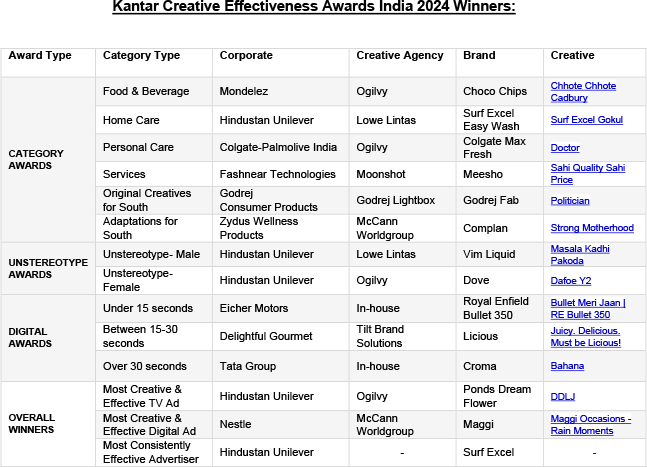
  • HUL stars in Kantar Creative Effectiveness Awards India

    HUL stars in Kantar Creative Effectiveness Awards India

    Kantar, the leading marketing data and analytics company, unveiled the ads that were most effective and creative across India in 2023.  The company tested more than 12,000 creatives for its clients around the world in 2023. Over 11% (1,400+) of those creatives were tested in India. Today,


    In the awards, consumers are the jury. The India report shortlists close to 300 ads, tested across categories, markets, TG’s and media channels.


    The winners list has doubled from last year, with Kantar awarding 10 standout performers in the television ads category and 4 in the digital ads category.


    Television categories include Food & Beverage, Home Care, Personal Care, Services and Unstereotype. New categories introduced include ‘Original Creatives for South’, ‘Adaptations for South’, Most Creative & Effective TV Ad (overall) and Most Consistently Effective Advertiser. Creatives for Digital continue to grow this year as well, with Kantar awarding standout performers in 4 categories- 3 based on ‘Ad Length’ format and one for the Most Creative & Effective Digital Ad, for bringing to life the exciting storytelling possibilities in the digital world.


    All ads exemplify essential characteristics of being creatively engaging and landing persuasive stories that enhance brand sales, notes a communique.


    Commenting on this year’s findings, Soumya Mohanty, Managing Director & Chief Client Officer- South Asia, Insights Division, Kantar said: “Earlier this year, Kantar launched the Blueprint for Brand Growth– a breakthrough understanding of how businesses build strong & profitable brands. One of the growth accelerators for building strong brands is to pre-dispose more people. Great advertising builds pre-disposition and loads the dice in favour of the brands. Creative content can and should punch above its weight”.


    Added Prasanna Kumar, Head of Creative Domain & Executive Vice President- South Asia, Insights Division, Kantar: “Truly creative ads are the ones that are effective. The journey from being just creative to being effective starts by including your key stakeholders – your target consumers, into the process by pre-testing your ads. This year we have seen some original creative ideas shine through by ensuring that they have brand and consumer at their heart.”


    Key highlights from this year’s report: 

    1. Learnings from Kantar’s Blueprint for Brand Growth indicate that great advertising is rocket-fuel for building predisposition: growing meaningfully different brands in a more effective and efficient way. Creative quality, second only to brand size, greatly influences campaign profitability, with double the impact that reach does on brand salience.


    1. Kantar research emphasizes that ads must persuade and convey messages that are novel, credible, relevant, and different to enhance short-term sales. But high-quality ads, which leave a lasting impression, generally perform well in both short-term sales and long-term brand-building (Kantar LINK database), thus reducing the need to spend money on performance marketing.


    1. Beyond brand recognition, generating a strong emotional response is key, because emotion helps build strong memory structures, and most advertising effects are not immediate. Emotion plays a critical role in effective creative- and not just in TV content. 


    Ad learnings from 2023: 

    1. Make purpose personal: 65% of Indians will buy brands that stand for something they can identify with. While purpose or value led creatives open possibilities for highly emotively engaging creatives, the effective ones execute it in a manner such that it becomes personal to the consumers.


    1. License to surprise: Consumers are open to original creative ideas- ones that are hyper creative or break existing category codes. The reward for the brand lies in the ability to integrate the persuasive and meaningful impressions into the creative idea. Pre-testing helps identify the possible risks of comprehension and resonance.


    1. Going Native: Only 28% Indians (vs Global average 75%) have watched any ‘foreign’ content. Over 25 years of Kantar Link™ ad evaluation reveal a striking truth- ad transference across Indian regions is just about a third. This challenges the assumption that a single pan-India creative approach, even with universal and validated consumer insight, will yield positive returns on objectives. Brands are now refreshingly taking on the challenge and opportunity of engaging the Southern consumers differently from Hindi-speaking markets. Investing in original creatives, by going native on multiple dimensions- insights, creative idea & treatment and execution ensures maximizing of reward for the brand.


    1. Go deep & wide: The most efficient route to optimize budgets for creating ads that effectively crossover the transference challenge across the many India’s, is to create regional adaptions by playing with backdrop, celebrity, casting, product window visualization, slogan etc. Go deep and wide is about taking a campaign pan India by starting with a pan India insight, creative idea & treatment but execute with some nativity elements to amplify the resonance with the regional markets. Pre-testing helps to identify whether the mix of insight, story & elements work together as intended and identify opportunities for improvement.


    1. Embed the Brand: The value of creativity starts with the brand. While executional elements like distinctive brand assets and consistency in advertising style are undeniable aids in ensuring that the brand takes credit for the impressions left behind by the creative, it’s potential is amplified when the brand is integral to the story.

    **In our top quartile ads compared to the bottom quartile ads, we observed more consistency (+49%), greater use of established branding devices (+14%), and the inclusion of related music (+26%).


    1. Weave in the product story: Executions that can creatively integrate the specific competitive reasons to consider the brand into the narrative tend to be impactful. The role of creativity is thus not just to entertain but also leave behind vivid impressions that make the brand more meaningful to the consumers.


    1. Specific learnings for the digital landscape: 
    1. Precision targeting is officially giving way to mass media avatar of Digital and there’s an increasing recognition of the importance of brand marketing on digital platforms. Creative Quality getting increasingly critical for ensuring ROI for digital- could unlock 35%+ incremental sales per impression.
    2. Effective content on TV does not automatically mean success in digital – Ads that perform well in TV have only a ~50% chance of performing well in digital.
    3. Emotional resonance significantly enhances digital advertising’s impact on brand building. Ads that evoke stronger emotions are 3x more likely to drive long-term brand equity and 2.75x more likely to generate impact compared to those with weaker emotional connections.


  • Fantasy cricket apps & brand-building- A lesson for advertising agencies?

    Fantasy cricket apps & brand-building- A lesson for advertising agencies?

    With apologies to none at all

    Vikas MehtaBy Vikas Mehta

    My last column titled ‘Why are we building products and not brands’ seemed to have sparked off many reactions. Some raw, I dare say. The questions ranged from differentiation to personality to digital. But one question stood out. I was asked if all new age brands are just products? Is there anyone building a brand?

    The answer was not difficult, but I will take the liberty of using this column to explain how a brand is being built by a new age product. Disclaimer first: I have nothing to do with the brand except I know the founder of the communication company which is spearheading the brand-building exercise. This is totally an outsider’s perspective.

    I am talking about Dream 11.

    Not many know that the brand was launched in 2008. The fantasy cricket app which is what they are all about today was launched in 2012 and by 2014 they had a million registered users. This figure rose to around 45 million around 2018, just when serious brand-building efforts started and today, the figure stands at around 150 million. I am deliberately starting with numbers because this is a brand which has been successful by all standards.

    The brand started advertising during the Indian Premier League (IPL) around 2018 or so. It had a simple positioning. The cricketers, who play for India, back Dream 11. It was decidedly an endorsement but an endorsement done with a positioning, personality and differentiation in mind.

    First, they aligned with the best Indian cricketers. Dhoni, Rohit, Pant, Bumrah, Hardik, Ashwin, Dhawan. Dhoni dropped out after a season or two but the core has remained the same. One of the first campaigns I remember was using Dhoni which was about khelo dimaag se. Dhoni was always an astute cricketer and the brand used his personality to show that it was a game of skill and not luck. This was required at the time because Indian laws did not allow any game which could be seen as betting or lottery. So khelo dimaag se, worked for the brand in more ways than one.

    And then the brand took off. It decided that its personality needs to be light fun, cricket humour, and showing the human face of the Indian cricketers.

    The positioning evolved into snippets of Indian street cricket as portrayed by star Indian cricketers. It was not too focused, neither too narrow. It did not get bogged down by a consistent tagline. I am not saying that consistent tagline is bad but the positioning is not just what the brand says in a tagline. Positioning is what the consumer stores in his mind. A tagline is static, positioning needs to evolve. Not change but evolve. Dream 11 did it brilliantly.

    Yeh apna game hai

    Yeh main kar leta hoon tum Dream 11 pe team banao

    Dream big. Dream 11

    Sab khelenge

    Team se bada kuch nahin.

    And each one of these taglines had a story. An emotion.

    Weaved into the game as played by Indians everyday. Using the Indian stars.

    Remember, pehle main batting karoonga kyonki bat mera hai, leaving Rohit stumped. Yeh apna game hai. Watch here

    Or the film stars like Amir challenging the cricketers who are acting in ads.  Sab khelenge. Watch here.

    Pant’s dream of becoming a singer or Bumrah acting as a romatic hero. Dream Big. Watch here.

    Or even magnifying the role of seemingly insignificant people. Ashwin’s soup wallah. Or the groundsman who prepared pitches for Rohi. Allowing them to Dream big. Watch here.

    And Sharmaji ka beta. Team se bada kuch nahin. Watch here.

    The brand owned cricket. And how.

    For IPL, it focused on team or club rivalry which overtook national rivalry. So even cricketers from other nationalities were used. Even family members. Sunil Shetty for example.

    For World Cups there was collectiveness, national pride. Ek se dikhoge toh best kheloge. The Mummyjee ad.

    This was brand building at its best.

    Dominate cricket. Own cricket. Emotionally own the category.

    And they did many other things too. If one searches for Dream 11 on YouTube there are many videos made by the brand which are not brand-building but which support brand-building. Stories of ordinary people who won big. Videos of how easy it is to play the app. Videos made by influencers on why winning is so easy. Or videos on how Dream 11 employees have grown…… Watch here

    And you know what. The competition too did all these. My circle 11. MPL. They too have such videos. They have big offers. Rs one crore prize everyday. An SUV to win everyday. They too talk about the big winners. They too have influencers in you tube videos. They have also used some Indian stars like Shubhman, Rinku, even Sourav Ganguli in the past.

    But what they don’t have is a brand.

    That is distinct.

    That differentiates. Emotionally.

    That dominates the category.

    Chances are that if you want to play fantasy cricket you will first download Dream 11.

    Because you remember it.

    Because you connect with it.

    Because it seems to dominate cricket.

    In a category where big prize matters.

    Where spends are high

    And where quantitative parameters are easy to judge by.

    So how much you spend where, gets immediate results or not can be the sole criteria to judge success.

    In such a category, Dream 11 has built a differentiating, preferred and leadership brand.

    So, should we still focus on products?

    And ignore brand-building?

    In my mind that is the role of advertising agencies.

    Build brands.

    That is the focus which the agencies have lost.

    And that is why they are struggling.

    Agencies need to start reemphasizing the need to build a brand.

    Do not tell me that clients do not want it.

    Do agencies explain it to them?

    Do the agencies explain what the brand idea is?

    How it can be differentiating and can be sustained long term.

    The agencies are trying to do what the clients want.

    Not what the brands need.

    Agencies need to create a niche.

    And they will find it is much beyond a niche.

    Do you agree?


  • Rohit Sharma, Jasprit Bumrah rule T20 WC chatter

    Rohit Sharma, Jasprit Bumrah rule T20 WC chatter

    The ICC Men’s Cricket T20 World Cup garnered unprecedented social media chatter, reports Interactive Avenues, the digital arm of IPG Mediabrands India which  released its “‘apturing the Glory: A Social Listening Report on #T20WorldCup’ report on Monday.


    The report is based on data gathered from social platforms such as Twitter, Reddit, and popular cricket forums and reveals  insights on player popularity, most appreciated performances, most talked about matches, top brand partnerships and more.


    Commenting on the report, Shantanu Sirohi, COO, Interactive Avenues, said: “The Cricket T20 World Cup has once again proven the unparalleled ability of cricket to captivate audiences. This tournament has set new benchmarks for player popularity, with stars like Rohit Sharma and Jasprit Bumrah leading the conversations. Our comprehensive social listening report not only highlights the staggering number of mentions and engagements, but also delves into the elements that drove these numbers.”


    Key findings of the report:

    Social chatter highlights:

    • Overall, the tournament garnered 55.9Mn mentions and drove 461Mn engagements.
    • Rohit Sharma emerged as the most talked about player and batsman (5.5Mn mentions). Jasprit Bumrah was the most popular bowler (1.2Mn mentions), and Hardik Pandya was the top all-rounder (1.1Mn mentions).
    • The finale between India and South Africa was the most talked about match (2.2Mn mentions), followed by India vs. Pakistan (1.7Mn mentions).


    Most thrilling moments:

    • Suryakumar Yadav’s stunning catch which clinched the T20 World Cup title for India got 209K mentions.
    • Afghanistan beating Bangladesh in a low-scoring thriller to seal their semi-final spot drove 156K mentions
    • India’s victory against Pakistan by 6 runs in the low-scoring group stage match garnered 122K mentions.


    Most popular players:

    • Powered by consistently stellar performances, India’s Rohit Sharma (5.5Mn mentions), Virat Kohli (4.1Mn mentions), Suryakumar Yadav (1.3Mn mentions), Jasprit Bumrah (1.2Mn mentions) and Hardik Pandya (1.1Mn mentions) emerged as the most popular players on social media.


    Top emerging players:

    • Making their debut in a T20 World Cup, players from USA topped the popularity charts among emerging talent. Saurabh Netravalkar led the roster (163K mentions), followed by Ali Khan (67K mentions), Aaron Jones (49K mentions), and Monank Patel (30K mentions).


    Top emotional moments:

    • Rohit Sharma and Virat Kohli’s ‘bromance’, including videos of their journey together, resulted in 7.1Mn engagements.
    • Rohit Sharma and Virat Kohli announcing their retirement from T20 international matches drove 4.1Mn engagements.
    • Rohit Sharma kissing Hardik Pandya in an emotional moment after India won the cup garnered 2.3Mn engagements.


    Biggest comeback story:

    • After being booed at every match venue during IPL 2024 (92% negative mentions), Hardik Pandya made a spectacular comeback with 88% positive mentions during T20 World Cup 2024.


    Top brand partnerships:

    • Brands across diverse industries leveraged T20 CWC-based partnerships to drive engagement. Maruti got 258K mentions, Amul garnered 200K mentions, and ICICI Bank got 145K mentions.
    • Nandini Milk witnessed a whopping 390% increase in average monthly engagement, while BPCL’s “Snap The AD” contest drove a 191% spike in average monthly engagement.
  • Olympics 2024: what new social media guidelines mean for athletes and their sponsors

    Olympics 2024: what new social media guidelines mean for athletes and their sponsors

    Representative pic: person taking a selfie. Courtesy: pickpik.com (Creative Commons Licene)


    By Layckan Van Gensen

    Cellphone cameras are ubiquitous at modern sporting events. Whether it’s a school swimming gala, the local rugby club squaring off against their bitter rivals or a national team fighting for tournament glory, every moment is a potential photograph.

    The Olympic Games are no exception. More than 10,000 athletes from 200 countries or regions are set to compete in 32 sports in this year’s host city, Paris, giving fans ample opportunity to fill their camera rolls with images of their favourite sporting heroes.

    And participants, too, will be able to memorialise their time in Paris – far more freely than ever before. This comes after the Games’ governing body, the International Olympic Committee (IOC), unveiled new social media guidelines in December 2023.

    Most of the guidelines are aimed at athletes; some relate to “accredited individuals other than athletes” such as coaches, technical staff and countries’ Olympic committee representatives.

    As a legal scholar specialising in sports law, with a focus on image rights, I’ve been closely following the IOC’s stance on athletes’ use of social media – especially photographs and videos. Image rights are a broad bundle which may include rights over the use of the individual’s still, moving and animated images, name, signature recorded voice, catch phrases, associated iconic acts, logos, trademark and brands.

    These rights can be worth a lot of money. For example, Indian cricketer Virat Kohli can earn anything between US$2 million and US$2.7 million per social media post.

    Overall, it appears that the IOC has tried to strike a balance between protecting the media rights holders while still recognising the value of a participant’s image rights. It allows them to show more content than before and, more importantly, to acknowledge their personal sponsors, who play an important role in commercialising their images and building their brands. Loyal fans will get a fuller picture of their favourite athletes’ Olympic journeys than they’ve been able to before.


    Social media at the Olympics

    Vancouver’s 2010 Winter Olympics have been described as “the first social media games”, marking the first time that the IOC created social media guidelines. These were refined for the London 2012 Summer Olympics.

    At the last Summer Olympics, hosted by Tokyo in 2020, athletes were not allowed to:

    • share any content from accredited areas used for a sporting competition or ceremony
    • post about their personal sponsors.

    These restrictions were designed, the IOC said at the time, to protect media rights-holders such as TV stations and other big media organisations.


    What’s changed

    Under the new guidelines accredited participants can share their experiences far more freely on social media platforms during what the IOC calls the “game period”, from 18 July to 13 August.

    They may:

    • take photographs and record audio and video inside and outside the accredited areas
    • share photographs on their personal social media platforms up to one hour before the start of the competition they’re taking part in, and after they have left the doping control areas
    • share posts from the training and practice areas, the opening and closing ceremonies and the Champions Park, where athletes gather after their competitions to meet and interact with fans.

    Of course there are still some restrictions.

    Videos may not be live streamed, may not be longer than 2 minutes and may not include actual competitions. So, coaches can’t film an athlete in action and then share the video or photos. Athletes also can’t record another athlete training, or post highlights from their personal competition on social media. They can only share such images or videos from official media rights-holders’ accounts.

    Perhaps most intriguingly, photographs and videos that use artificial intelligence may not be shared. It’s unclear how the IOC intends to police this rule.


    Not for commercial purposes

    Media rights-holders aren’t left completely unprotected by the new guidelines. Participants are not allowed to post for commercial purposes throughout the game period.

    A post will be regarded as “for commercial purposes” if its purpose is to generate financial profit or promote any third party or products or services.

    One of the main goals of the new social media guidelines is to balance the rights of media holders and those of the participants. This attempt at a balancing act can be seen in the new rules for non-Olympic partners – those who don’t sponsor or have official merchandise licensing contracts with the IOC.

    Brands or companies in this category may run generic advertising during the game period as long as it hasn’t been especially designed for the Olympics and has already been in the public eye for at least 90 days before the tournament starts. Advertisements in this category can’t be run more frequently during the Games than they have been previously. The IOC will apply these rules flexibly to enable “business-as-usual” campaigns.

    Participants are allowed to provide one “thank you” message to each of their non-Olympic partners during the games period but it may not include a personal endorsement.The Conversation


    Layckan Van Gensen is Junior Lecturer in Mercantile Law, Stellenbosch University. This article is republished from The Conversation under a Creative Commons license. Read the original article.

  • How accurate media representation can promote empathy and acceptance of diversity

    How accurate media representation can promote empathy and acceptance of diversity

    Shruti PushkarnaJuly is Disability Pride Month. It started initially in 1990 when the landmark legislation, Americans with Disabilities Act (ADA) was signed into a law. Since then, it’s celebrated every year to honour the achievements, experiences as well as struggles of those living with some form of disability. Typically, you’ll see Instagram, X (Twitter) and LinkedIn flooded with posts from disability advocates, rights activists and people with disabilities in general, sharing their stories and lived experiences through this month.

    Interestingly, disability has been in the news for the past couple of months. And this is not confined to conversations within the disability rights groups. Cinema and OTT are rife with it.

    On May 10, a film inspired by the real life of visually impaired industrialist Srikanth Bolla was released in theatres. Rajkumar Rao plays the lead role of Srikanth, showcasing on screen the various odds stacked up against a person with blindness in the mainstream world. It is one of the few exceptional portrayals without any inspiration porn or pitiful pathos around the character’s disabling condition.

    Srikanth is born blind into a farmer family in Andhra Pradesh. His uneducated parents were urged by relatives and surrounding community to bury the blind child as they would be burdened by his lifelong dependency. Of course they decided otherwise. The boy perseveres myriad challenges to end up becoming the first international visually impaired student at Massachusetts Institute of Technology (MIT). Today, he runs a Rs 150 crore company, Bollant Industries, also employing other persons with disabilities.

    My favourite part, there are several moments in the film where I feel Srikanth is annoyingly arrogant. He is just as human as anyone else. There is nothing ‘divyang’ about him. He is a relatable guy who made it big with his hard work and determination, also with immense support from his teacher. But he has his follies. And that’s good representation. Life as it is, with or without disability.

    Also, last I checked, the film had grossed Rs 59.58 crore in India and 3.34 crore internationally. Inclusion not only makes sense for sensitisation but also has the potential to make bucks!

    Another recent film with a disabled protagonist is Chandu Champion. Starring Karthik Aryan, the movie recounts the story of Muralikant Petkar who survived nine bullets in the 1965 Indo-Pak war and won India’s first Paralympic gold medal.

    Muralikant grew up in a small village in Maharashtra with an ambition to win a gold medal for India in the Olympics. He is mocked for his dream by fellow schoolmates, neighbouring community and even his own father. But life takes its own turns, and Petkar ends up in the Army, where he trains for boxing. Unfortunately, while on duty, he is injured in an air raid which leaves him with multiple gashes and a spinal cord injury. Olympics might be out of bounds but his coach introduces him to Paralympics and some world renowned para champions. After rigorous training, Petkar builds a world record and bags gold for 50m freestyle swimming in 1972 Germany Games.

    Yet another account of aspiration, grit and acceptance. Also, entertaining. The film amassed Rs 59.1 crore in India by the third week since its release.

    Srikanth was born with a disability. Muralikant acquired one on the job. The direction their lives took were a mere outcome of their defiance and commitment towards mastering everything they were initially denied.

    I’m currently watching an American detective TV series (Monk) on Netflix which first aired in 2002. It follows Adrian Monk, a private detective with multiple phobias and obsessive compulsive disorder which are heightened after his wife’s murder. A case he is unable to resolve. There are several episodes which have a complex interplay of disability, race and other diverse identities. There is often an exaggeration of the condition to generate humour but it’s undercut with Monk’s brilliant curiosity, attention to detail and ability to close cases.

    Two decades later, when neurodiversity is a household term and mental illness is no longer belittled, a series involving ADHD, OCD, anxiety disorder et cetera is being consumed with a different (refined) lens altogether.

    The evolving representation of disability in media is indicative of the progress society has made towards inclusivity and awareness. As nuanced stories like these reach wider audiences, they not only promote empathy and understanding but also underscore the potential for commercial success when inclusion is prioritised.


    Wondering why MxMIndia publishes a disability advocacy column? Well, we strongly feel that the media can dramatically transform the world for persons with disabilities. This series attempts to help bring forth issues that the media must champion to create a truly inclusive and accessible India. Writing  this column is Shruti Pushkarna, a former journalist and now a disability inclusion advocate based in New Delhi. Her views here are personal. To access the archives of her 95-plus columns, please visit: https://www.mxmindia.com/category/ columns/shruti-pushkarna/


    If you have a view on the issues raise or would like to align with MxMIndia on this cause, write to us at editor [at] mxmindia.com.

  • Food For Thought: TV’s Pop Culture Problem

    Food For Thought: TV’s Pop Culture Problem

    Shailesh KapoorScrolling through TV ratings reports a couple of weeks ago, I could not help noticing Laughter Chefs. The show, launched on Colors on June 1, 2024, is doing better numbers than most reality shows, including established franchises, have managed in the last year or so. A rating of 1.5 on the weekends, over a duration of 1.5 hours (sometimes longer), is no mean feat in a category where 1.5 is now seen as a successful number even for mainline fiction content. And here’s a low-cost non-fiction show that comes without much fanfare, and manages to score very well, largely on account of engagement (time spent).

    I ended up watching an episode, and then a few more. The show is irresistibly unapologetic about its loose format, which is in itself a loose adaptation of the iconic Tamil show Cooku With Comali, which created the most unlikely hybrid TV genre ever – comedy-based cooking competition! In Laughter Chefs, a string of TV stars, recognised via their work in fiction series, comedy shows and/or Bigg Boss, take part in a cooking competition, where the rules are limited to the bare minimum.

    There’s nothing here that can add to your knowledge, or inspire you, nor strike an emotional chord. It’s pure fun, but a lot of it at that, if you find cheesy Hindi comedy in the mainstream format palatable (all puns intended). I particularly liked the specific use of Bollywood songs in the background to enhance the comedy. It’s not a lazy selection of popular songs, but songs across the decades, including many from the 90s, that have been handpicked to dial up the humor at that very moment. I almost wanted to watch more just for this reason.

    Why is this show not being spoken about more? A search on social media only gives you fan posts, where fanbases of stars in the show are propping their favorites. But there is no media coverage in the trade media on this show, and its unexpected numbers. There’s no analysis on non-fiction comedy finally delivering in the prime-time, after The Kapil Sharma Show had faded away a couple of years ago.

    This absence of coverage is TV’s growing problem. As it is, not too many GEC properties are managing to make any impact whatsoever. But when one does, it has to rely on native channel marketing and organic buildup of word-of-mouth. There’s no social media or general media narrative at all. In an age of extreme content clutter, a worthy property may never find some of its potential audience, because television has moved out of the pop culture even for the most ‘mass’ audiences, it seems.

    Marketing departments at TV networks should be focusing on this as one of their objectives. Because programme, or even channel, marketing will only take you so far, if you are not relevant to the prevailing zeitgeist.

  • THE NRI SENTIMENT

    THE NRI SENTIMENT

    Kunal SinhaAbout one month after the election results were announced and the new government took charge, what do non-resident Indians feel, and what are their expectations?


    I spoke to several senior executives in Indonesia and China about their wishlist from the new government.


    Political participation and cooperation

    NRIs seek greater inclusion in the political process. They expect the right to vote in Indian elections without having to be physically present in India, ensuring their voices are heard even from abroad. However, only about 118,000 NRIs registered to vote in the Lok Sabha 2024 elections, out of which 12,000 were eligible voters, predominantly from Kerala.

    The logistical challenges of traveling back to India to vote means many NRIs cannot participate directly in the electoral process. Additionally, they desire representation in legislative bodies or advisory councils, allowing them to voice their concerns and interests directly. Engagement in policy-making processes that affect the diaspora is also crucial, as it ensures that their unique perspectives and needs are considered in the governance of India.

    Poonam Sagar, Founder of Indoindians, Jakarta says, “OCI/PIO are said to have all rights as an Indian citizen except to vote & own agricultural land – however in reality there are many differences in policies, paperwork and taxation.”

    Soumen Biswas, Founder, Smartfactory4u, Shanghai, says, “Since moving to China in 2006, I’ve seen India’s global reputation soar during Modi’s tenure. As an NRI, I would be thrilled to see India-China relations improve even more rapidly.” According to many Indian business folk resident in China, the potential for India China trade is immense, and mutually beneficial as the balance of world power tilts eastwards.


    Business and Investment

    In fiscal year 2023- 24, the Indian diaspora, scattered across the globe, set a record by sending more than $100 billion in remittances to their families back home in India. This figure not only surpassed the previous milestone but also emphasised the key role of the Indian diaspora in India’s financial inflows.

    It’s worth noting that these remittances exceeded the combined net Foreign Direct Investment level and portfolio investment amounting to $54 billion. The scale at which Indians received their remittances in 2023 even exceeded the GDP of 11 countries recorded in 2022.

    While NRIs have been repatriating such large sums back to India, they find it almost impossible to raise funds for their own ventures overseas.

    Bipin Mishra, Founder and CEO, Ketitik.com, makes an appeal to policymakers in India. “As an Indian national running a startup in Indonesia, we would love if grants and support provided by Government of India is passed to us as well.  It has become very difficult for Indians to invest in Non Indian startups, if an exemption can be made for Indians to invest in Indian-owned foreign based start-ups, it will be a great”.

    Sagar would like the government to ease the repatriation of money from NRE accounts to NRIs, as well as make it easier for NRIs to invest in various financial schemes in India. “NRI’s need to maintain an active Indian phone number to manage their bank accounts etc in India – despite the advances in technology, this is still an issue. Aadhar card is required for most transactions in India, but it is difficult to get for NRI’s who have been overseas for many years and for OCI/PIO. Also, property sale TDS should be at par with resident Indians; after all NRI’s are also Indian citizens,” she explained.


    Connectivity and fostering cultural ties

    In December 2019, India and China were connected through 539 direct passenger flights. Now there are none.

    IndiGo and Air India had operated flights to China while Air China, China Southern Airlines, and China Eastern Airlines, had connected Beijing, Shanghai, and Guangzhou to Indian cities.

    The two countries suspended these flights during the Covid-19 pandemic and subsequent border clashes in June 2020. Flights have not resumed four years on. In the absence of direct flights, travelers between India and China must rely on connecting flights through third countries, such as Hong Kong, Bangkok, and Singapore. The detour adds time and cost.

    The lack of direct flights between the two nations poses major challenges for hundreds of Indians who study in China as well as the families of many Indians, including businessmen, who began to work in China after travel restrictions were lifted by both countries in 2022.

    Low levels of air connectivity are also a hindrance to trade and tourism between India and Indonesia. The island nation’s Hindu heritage can be leveraged for enhancing traffic into India, and much more can be done to promote various Indian destinations amongst the Indonesian population. “Tourism in India is underdeveloped while it has a massive potential. With safety measures and promotions, I would love to have more of my Indonesian friends travel and marvel at India,” says Mishra.


    Personal and family

    Many NRIs maintain close ties with their home country, and eventually wish to return. They expect the government to make that return smooth and hassle free. Sagar would like to see an enhanced duty-free allowance upon transfer of residence, and an increase in health insurance coverage. There also needs to be opportunities for NRI children to participate in national level entrance exams through satellite examination points at the Indian embassy in different countries.

    Biswas says: “Religious and communal harmony is the most important for Indians living in India. However, it gets more crucial for Indian expats. It has the ability to impact their survival in some parts of the world. Hence. I hope that the government continues to ensure that religious harmony remains intact.”

    He added: “I wish to see the government put significant effort into improving civic sense in our society. Great nations are built on the foundation of responsible and thoughtful citizens. Promoting civic awareness through social media, educational videos, and campaigns at transport hubs, schools, and workplaces can foster a more conscientious and responsible society, helping to build a stronger nation.”


    Kunal Sinha is a senior strategy and foresights executive based in Kuala Lumpur, Malaysia. He is the author of several books including The Future of India’s Rural Markets and Raw – Pervasive Creativity in Asia. He writes for MxMIndia every other Monday. His views here are personal.


  • Google, Tata Motors, Amazon, Jio & Apple Most Inclusive Brands in India

    Google, Tata Motors, Amazon, Jio & Apple Most Inclusive Brands in India

    Leading marketing data and analytics firm Kantar has launched its Brand Inclusion Index (BII), a global study which reveals that 75% of consumers say that a brand’s diversity and inclusion reputation influences their purchase decisions.


    A staggering 68% Indians claim to have been discriminated against, and in majority of cases in commercial places and brand touchpoints, which is substantially higher than the global figure which stands at 46%. The study also showcases that DEI is important for an overwhelming majority of Indians, both in life and while making brand choices, with 86% of respondents.


    The first edition of India Brand Inclusion Index study explores skincare, banking, automotive and Technology categories. In its Index of the world’s most inclusive brands, Kantar ranked Google, Amazon, Nike, Dove and McDonald’s in its global top five while in India, it is Google, Tata Motors, Amazon, Jio and Apple. The brands were recognised by consumers for setting a positive example by demonstrating a genuine commitment to diversity, equity, and inclusion (DE&I).


    The study identifies that inclusive marketing is a significant opportunity to drive brand growth. It is clear that brands who fail to address discrimination, risk alienating a significant portion of their customer base. Despite progress made by some brands, the Brand Inclusion Index 2024 reveals a significant inclusion gap that businesses must address. This gap is the difference between the proportion of people in a market who have experienced discrimination and the percentage who believe in the importance and influence of diversity and inclusion.


    Kantar’s Brand Inclusion Index 2024 is a survey of more than 23,000 people in 18 countries, the India leg comprises 1000-plus respondents with an inclusive demographic which is gender expansive, disability, socio-economic class, religion etc.


    The findings of the Brand Inclusion Index sit in the context of preliminary research from the Unstereotype Alliance with Oxford University’s Saïd Business School, using data from Alliance members including Kantar. This study has found that progressive, inclusive advertising drives a significant sales uplift of over 16% when compared with less progressive ad content and has a significant impact on consumer loyalty, buying intentions and a brand’s pricing power. Respondents assess brands on different dimensions – brave brand DEI strategy, diversity, equity, and inclusion – from the absence of negative actions, to the presence of positive initiatives.


    Key findings:

    • There’s an urgent need for brands to address DE&I failures: A staggering, 68% Indians claim to have been discriminated against, and in majority of cases in commercial places and brand touchpoints, which is substantially higher than the global figure which stands at 46%. The study also showcases that DEI is important for an overwhelming majority of Indians, both in life and while making brand choices with 86% respondents
    • Consumer expectations are high, globally: 75% of consumers globally say that diversity and inclusion – or a lack thereof – influence their purchase decisions
    • DEI is yet to make its mark on Indian advertising:
      • More women are seen in Indian ads than global average but they remain bound by traditional roles of homemakers and mothers (7% women are featured in non-traditional roles)
      • Fairness of skin may have transitioned to glow but skin colourism continues to exist in creatives
      • Sizes remain slim and small. (7% diverse body shapes)
      • Ageism dominates with 40+ women represented in less than one out of five ads (15% in India vs 26% globally)
    • Underrepresented groups are most vulnerable: Ad protagonists and characters in India are painted in broad strokes of what they, their homes, beliefs and lifestyles look like, ignoring ethnic minorities, LGBTQ
    • Ads that successfully portray people positively provide greater predicted ROI for advertising investment. There has been growth in the industry in positive portrayal of Males over the last year, but a drop in Female portrayal since last 2 years
    • Globally, people with disabilities and LGBTQ+ individuals report the highest rates of discrimination (81% and 62% respectively), emphasising the need for targeted efforts to create more inclusive environments and content
    • Google, recognised as most inclusive brand in India as well as globally. It emerges as a beacon of hope, ranked by Kantar as the most inclusive brand globally. Consumers, particularly in marginalised communities, praised Google for its unwavering commitment to DE&I in its internal policies, products and marketing, its authentic representation of people from all walks of life and its leading-edge innovation for inclusion
    • Alongside Google, Tata Motors, Amazon, Jio and Apple emerged in the top five winners in India. Category wise, the India top Brand Inclusion Index scorers are – Google (Technology), Tata Motors (Automotive), SBI (Banking), Dove (Skincare).


    Said Valeria Piaggio, global head of diversity, equity and inclusion at Kantar: “It’s a myth that inclusion marketing is about marketing to minorities. Inclusion marketing is expansive marketing. One of the fundamental ways to grow your brand is to predispose more people to it. Yet when brands exclude consumers – whether that’s because people don’t feel welcomed when shopping in stores or their advertising doesn’t reflect diverse communities – it’s an easy miss.


    “Millennials and Gen Z prioritise diversity and inclusion even more than other groups, and as these populations grow in size and buying power these issues will carry more weight. Brands will be rewarded if they stand by their values – especially in the face of vocal communities which stoke the culture wars by pitting minority groups against one another.”


    Said Soumya Mohanty, Managing Director & Chief Client Officer- South Asia, Insights Division, Kantar: “In a country of India’s size, the term under-represented groups can be misleading for brands to use as a guiding light. Minorities can translate into millions of people who may choose or not choose to buy your brand, based on how well they feel seen, heard and voiced in your brands. It is a business imperative for brands to prove that they are serious and committed about DEI. The Brand Inclusion Index – our breakthrough study on brand inclusion – gives clear indications of how to achieve the inclusivity imperative. Our analysis of what’s behind the most inclusive brands is that they all have three things: a well-thought-out DEI strategy that stems from company actions and is committed long-term, impeccable creative execution, and bravery. The element of bravery will be increasingly important. As in other moments in history, when there’s significant social change, there are groups of society that seek to maintain the status quo, feel threatened, and as a result, react loudly,” adding: “To avoid backlash, brands today need to be extra careful. Full inclusion needs to work at both ends of the spectrum: reaching out to underrepresented populations and making them count, while avoiding negative reactions from people who are used to seeing themselves well-represented by brands and don’t want to be left behind. This study brings understanding of how people perceive brands based on their DEI efforts, focusing on populations that tend to be excluded, underserved, or misrepresented. The Brand Inclusion Index gives marketers clear benchmarks for brand inclusion and inspiration from brave brands that are seen as diverse, fair, and inclusive.”

  • Digital Transformation 1-2-3 with Sanjay Mehta: Part 1

    Digital Transformation 1-2-3 with Sanjay Mehta: Part 1

    Few people in the advertising and marketing ecosystem are better equipped than Sanjay Mehta to lead this online Masterclass on Digital Transformation. In our discussions with him, we were inspired to ask Sanjay Mehta to formulate a three-part series aimed at motivating founders and owners of mid-sized businesses in India to embrace digital transformation. 

    While Digital Transformation is a much-touted (and often incorrectly used) buzzword in Indian business circles, Sanjay Mehta’s series highlights the real growth potential that comes with the right retooling. This insightful series, ‘Digital Transformation 1-2-3 with Sanjay Mehta’, will culminate in a Zoom-based webinar on Wednesday, August 7, at 3 pm IST. The webinar is exclusive to 40 professionals on a first-come, first-served basis.

     Masterclass #1: July 17, 2024 – Boards and Founders need to see “outside the box” for the multiplier effect

    Masterclass #2: July 24, 2024 – Exploiting Opportunities, Overcoming Challenges

    Masterclass #3: July 31, 2024 – The Specific Nature of the Beast

    Masterclass #4: August 7, 2024 – Live webinar (Registration will open on July 31)


    By Sanjay Mehta

     Over the years, working with many companies, working with their top management or with their teams, what comes out clear is that the top focus of senior management is growth. India coincidentally happens to be poised at a very opportune phase. By and large, one sees increased demand and most businesses of good caliber are seeing good progress in their businesses.

    In India, we also have a base of some good-sized businesses that are home-grown and run by the original founder families, after multiple decades. They are absolutely sharp in their own business. Often, we see the next gen also joining the business, often educated and trained abroad, in their respective field, and adding to the strength in the business.

    That said, growth continues to remain a key motivator and driver for the owners and while they are doing all that they know to drive the said growth, are they genuinely tapping the business to its full potential?

    At any point in time, a business may have multiple potential growth multiplier factors. Some of these are known to the business and efforts may be going on. Some others are known, but these are either not prioritised for the moment, or there is a recognition that they don’t have the right skills or resources, to take those up.

    And then there are the third kind of growth multipliers about which the company is not aware of at all. Simply because these may fall outside their areas of competence of experience. Some could be technology-based, some could be through other means.

    It is because of the second and third kind of opportunities that exist, and which are not being addressed, that a company or its Board or the Founders, need to keep an open eye and think “outside the box” to tap these.

    In this case, the term “outside the box” can be a little literal also! To say that, at times, the understanding of the opportunity to multiply growth levels, may not be available at the existing Board level or with the team in the company. And that the Board must be open to consider outside expertise, either by bringing that into the board, as additional/ external/ independent directors, or as strategic advisors.

    Once a strategic approach is defined well, an action plan is laid out, a monitoring and review mechanism is in place, the execution itself, may be something that the company’s internal team, or their existing partners/ vendors could manage. However, since the strategy comes from a level of experience, knowledge and skills that may not be available internally, that is where there is a need to be open to outside help.

    As an example, let’s consider a very simple situation on first principals’ basis. Let’s understand this: that, a company’s revenues are a multiple of their number of customers, the number of transactions that the customers do annually, and the average value of each transaction.

    So, if the company must grow revenues, they need to focus on:

        • Growing the number of customers
        • Increasing the frequency of the customers’ transactions with them
        • Increasing the ticket size of each transaction

    Maybe the company has high focus and skills on new customer acquisitions and they are addressing that first point well.

    However, has anyone truly focused to figure how to bring the customer back to purchase more frequently?

    Has anyone figured as to how we could drive the average ticket size of the transaction higher?

    If asked, there is a good chance that team members will affirm that all these efforts are being done. But whether it is so, in reality? Whether the right skills and opportunities have been exploited to do so? Whether for example, data has been used well to enable this?

    So yes, there is a role that data and technology could be playing, and maybe that is the limitation within the team. That they do not know the potential of data or technology for that purpose, or they don’t have the skills to comprehend potential benefit and ROI of such efforts.

    Be that as it may be, this is just to bring to the fore, the idea that Boards and Senior Teams in companies may be lacking certain areas of skills and knowledge, and in their efforts to do better for the company, they need to be open to change with the times. And where today, there are maybe specialists for audit and legal or around the business itself, on their boards, maybe the next additions to the boards, or at a strategic advisory level, need to be people with subject matter expertise in newer areas that the company current lacks, such as technology and innovation, say, and utilize such persons to provide the further impetus of growth multipliers.


     Next week (Wednesday, July 24, 2024):

    Masterclass #2: Exploiting Opportunities, Overcoming Challenges


    Sanjay Mehta is one of the pioneers in the digital world in India, having founded and spearheaded several companies: HomeIndia, Mirum (earlier SocialWavelength before WPP took it over) to name a few. He is also an author and commentator on all things digital, and beyond. He is an investor, mentor and also helps organisations – large and small – in their process of digital transformation. He tweets @sm63. Linkedin.com/in/spmehta

  • Transform or Bust – Advertising Agencies in 2030

    Transform or Bust – Advertising Agencies in 2030

    Source: https://ccnull.de. Published under Creative Commons Licence

    This image shows the year 2030 in gold numerals on a blue-toned, textured background


    Ashoke AgarrwalLately, I have been forecasting the future of the Indian economy as part of a consulting assignment.

    It was interesting to consider the future of my first love, the advertising agency business.

    Everyone in the advertising agency business knows that the future is not what it used to be.

    The rise of digital advertising, the increasing value of data, and the transformative role of adtech are reshaping the advertising landscape.

    New advertising behemoths have sprung up while long-established agency groups are losing importance.

    Today’s advertising business is vastly different from 10 years ago.

    Budgets have already shifted substantially towards digital. Within digital, programmatic prevails and automated processes increasingly replace human skills in advertising placement.

    Adtech is becoming an increasingly important part of the business. Deloitte estimates that the global ad software market reached USD 16 billion in 2018. Consumers are becoming more demanding and less patient about advertising. They want ads to offer a clear added value—highly relevant or entertaining. If not, they skip them.

    One constant of the modern world is not just change but rapid change.

    What will the advertising agency business look like in 2030?

    The advertising business has five major players:

    • Digital Platforms facilitate online interactions between brands and consumers. Google and Facebook are examples. They act as content aggregators with high reach and direct consumer access. Their technology competence and data ownership are the basis of solid analytics capabilities.
    • Media companies produce relevant content for consumers. They adapt to the digital world by transforming their offerings, distribution, and business models. Advertising alongside paid content is an important revenue source.
    • Agencies and agency networks nurture competencies ranging from creativity to media space transactions. New agencies with comprehensive tech skills have arisen in the digital advertising world.
    • Advertisers are the payers in the ad ecosystem. Increasingly, they are internalising advertising skills, especially in technology.
    • Consumers increasingly avoid advertising that does not meet their rising expectations regarding relevance and entertainment.

    A wide range of factors will impact the future of the advertising business. A seminal factor will be the depth and strength of regulations regarding data privacy and the use of data for ad targeting.

    This factor will determine the emerging scenario in the ad business and, thus, the role of ad agencies.

    One scenario is that Big Tech, by and large, wins its war against the regulators on data privacy. An important reason this would happen is that a new generation is much less sensitive to data privacy.

    In such a case, transactional marketing will become a norm. Advertising will use data to predictably target consumers with highly relevant ads on the right channel at the right time to effectuate a shopping transaction. Advertising content will be designed to be informative rather than appealing. The large digital platforms will become all-powerful in the advertising business. Advertisers will play by the rules of digital platforms as brands battle for attention and suffer from decreasing brand loyalty. Media companies will increasingly depend on paid content, and advertising agencies will disappear in their current form.

    In the second scenario, Big Tech is highly regulated, and marketing and advertising shifts to interactive, permission-driven targeting of individual consumers based on first-party data owned by brands. This will spark a creative renaissance with advertising campaigns tilting towards a form of content marketing. Advertising will evolve into personalised entertainment that uses emotional formats and creates strong relationships between consumers and brands. A new creative sector will emerge, and it will be a tug-of-war between media companies on who wins this new sector. The erstwhile agencies will offer their brand advocacy skills with their newly integrated content creativity skills, and media companies will compete with their established content creation mastery with newly acquired brand advocacy skills.

    Both scenarios may coexist, with some geographies and consumer segments becoming driven by transactional marketing and others by interactive content marketing.

    Either way, the advertising agency business is primed for a major upheaval in the next few years.

  • Difficult times for Direct-to-OTT films

    Difficult times for Direct-to-OTT films

    Shailesh KapoorEarlier this week, Ormax Media released the mid-year streaming report, on the top original content on OTT in India, in the first half of the year (link). The report is on expected lines, with Panchayat S3 and Heeramandi being the two most-watched OTT originals in the first half of 2024 in India (Mirzapur S3 was released in July and is not covered in this report). However, the decline of the direct-to-OTT film format stands out as a key streaming trend in 2024 so far.

    Only four direct-to-OTT films across languages (though all four happen to be Hindi films) have crossed an estimated viewership of 10 Million in the first half of the year: Amar Singh Chamkila, Murder Mubarak, Ae Watan Mere Watan, and Maharaj. In contrast, nine fiction series (8 Hindi and The Boys S4 from Hollywood) and four unscripted shows (reality/documentary formats) have managed to achieve this mark.

    The direct-to-OTT film format gained immense traction in 2020-21, during the lockdowns, when theatrical films were forced to release directly on the medium. This led to many films being commissioned for OTT, and many films that were originally conceived for a theatrical release curtail their ambition, and opt for a safer, invariably profitable, OTT release.

    Last year’s viewership report had Prime Video’s Bawaal at more than 20 Million estimated viewers in India, despite the film getting mixed reactions from the audience and the critics. Those numbers seem like a distant dream now. No film has touched the 13 Million mark in the first half of this year, and from what it looks like, we may not have one in the second half either.

    Platforms are not keen on commissioning direct-to-OTT films anymore. These films must be marketed as standalone properties, compared to theatrical releases, which come pre-marketed. Theatrical films dwarf direct-to-OTT films on viewership, and carry much higher potency to generate new subscriptions too. Direct-to-OTT films don’t offer the scope for franchise building either, like a series would do. Franchise shows dominate the viewership charts for all platforms.

    This spells bad news for cinema that lacks a certain minimum scale needed to make it big-sreeen worthy. With big films continuing to get bigger (Kalki 2898 AD alone accounted for 15% of India box office in the first half of 2024), the smaller, more intimate films, that rely on realistic storytelling rather than larger-than-life portrayals, were beginning to find a good destination on OTT. But that’s no longer the case.

    Where do such films go? If they release theatrically, they carry the tag of a flop when they come on streaming. They invariably underperform, and this creates further doubts at the platform end, on whether such films are worth spending money on.

    We may well be entering a phase when such cinema, that cannot appeal to the theatrical audience’s post-pandemic taste, will phase itself out. The makers would try and tell the same stories through series instead. But it’s not as if the series business is flourishing in 2024 either.

    The streaming honeymoon in India is clearly over. And the decline of the direct-to-OTT film format in 2024 is a telltale sign.

  • Is customer service just a cost centre?

    Is customer service just a cost centre?

    With apologies to none at all

    By Vikas Mehta


    Vikas MehtaOver the past few months, I noticed that while buying stuff from e-commerce sites, specially stuff made by small players, mostly new entrepreneurs, I would get an unusual request. It would be in the form of a leaflet or a visiting card which would request the buyer to get in touch with them directly if there were any issues with product quality or delivery etc. One or two of them would even request not to complain to Amazon or give a negative feedback. They would reassure of sorting out the problems. There would be a phone number or a WhatsApp number and also an email id. The products I bought were either accessories or small electrical or electronic devices. This is an example of the same when I bought a phone cover recently.

    Frankly, I hardly noticed or gave a second thought to such messages till one day, I actually faced some quality issues with a mini UPS I had got for my broadband router. I found the card with the contact details. I tried calling the number, which was a mobile number, but got no response. I send an email and still had no response. So, after three days I finally got in touch with Amazon who got my product replaced as it was in the warranty period.

    This set me thinking. First, the trend of brazenly asking not to report any problems and not to give a negative feedback. Some may say that it could reflect confidence in the quality of the stuff so if by any chance there is a problem they can handle it, but I think it’s exactly the opposite. It’s the worry that too much of negative feedback will lower the rating score. It also tells me that ratings score is an important parameter that contribute to the sales of the smaller unknown brands or products. I do follow rating scores and was not sure if buyers take it seriously, but this type of communication tells me that they do.

    Secondly, this raises a question whether this is just a gimmick with the sole purpose of avoiding lower ratings and bad publicity? Because if the sellers are genuinely interested in building good consumer relationship then they would respond to complaints. In my case, what happened was that my complaint was finally resolved but the seller escaped as I did not give any negative feedback on Amazon. I am sure Amazon took them to task or lowered some metric because of my complaint but the seller managed to avoid a public complaint from me.

    Which brings me to two simple questions? One, why do we still have a jugaad mindset? Why are we being smart in a negative way and not using the smart to build a strong brand or a better customer relationship. Second, is customer relationship seen as a cost centre or as a sales promotion tool?

    Let me explain the second point with a very recent example.

    I am an e commerce addict and do not hesitate to buy even large ticket items like TVs or AC etc online. I find the process easy. I am able to compare across brands sitting at home and rating points gives me a fair idea of consumer feedback and experience. Exchange allows me to dispose off old products and even get some value out of them. Not to mention the thrill of discounts and the psychological feeling of getting a good deal.

    Three years ago, during Covid while using my Dell Laptop I faced some issues. Given the fact that it was Covid time I was not too keen to go to a service centre. So, when I discovered a Dell store close to my residence, I visited it. The salesperson, was very helpful. Thankfully, the issue was software related so he set it right in 10-15 minutes. Not once did he ask me to visit a service centre. In fact, he gave me his mobile number and asked me to call him if I face any more issues. He did not make any sale nor did I promise him one.

    But a few months later when I was looking to replace my laptop with a new model, my thoughts turned to the helpful salesperson. I did my homework on Amazon and then approached him with my shortlist. I asked him to match the discounts. He actually showed me another model which was not in my shortlist and explained to me why it could be a better choice. I was not totally convinced but just his effort impressed me. Ultimately, I ended up buying a laptop from him. Even though it was slightly more expensive. It was as if his helpfulness, his going out of the way and his efforts in making me feel important was an extra feature to which I was assigning some value.

    And he became our go to guy on anything technical in electronics. My wife had a different brand but he did not hesitate in helping out with any issue with that too. He would even volunteer to come over if the need arose.

    In the last more than three years as a family we have bought three new laptops. And no surprises in guessing that all three have been bought from this one person. More than any celebrity he has been the influencer or endorser for Dell for us. I am even sticking out my neck to say that if he shifts to any other brand, I would follow suit.

    It’s not just the first experience with him but also subsequent experiences. Whenever we have bought a laptop, he has undertaken it on himself to transfer all data to the new laptop. Mostly from cloud but some from old laptop too. And this includes ppts, word documents, images, videos; everything. My trust in him is so strong that I leave the old laptop with him to transfer the stuff. Sometimes, he comes over and does the work. Any issue and he is available to sort it out.

    And every laptop that I have bought from him, I could have got it cheaper online. I could have saved 3-5,000 rupees each time.

    What has happened is simple. The customer service has not been a cost centre. It has become an additional feature. One, which makes me shell out extra or in plain words pay a premium.

    That’s something that new startups or small entreprenuers must understand.

    Do not look at customer service as a cost.

    It could be your extra product benefit.

    It could be a tangible value addition.

    It could be your differentiator.

    Neglect customer service and treat it like a gimmick at your own peril.