
With apologies to none at all
By Vikas Mehta
 Over the past few months, I noticed that while buying stuff from e-commerce sites, specially stuff made by small players, mostly new entrepreneurs, I would get an unusual request. It would be in the form of a leaflet or a visiting card which would request the buyer to get in touch with them directly if there were any issues with product quality or delivery etc. One or two of them would even request not to complain to Amazon or give a negative feedback. They would reassure of sorting out the problems. There would be a phone number or a WhatsApp number and also an email id. The products I bought were either accessories or small electrical or electronic devices. This is an example of the same when I bought a phone cover recently.
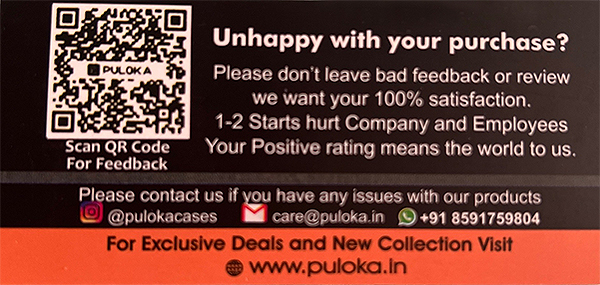
Frankly, I hardly noticed or gave a second thought to such messages till one day, I actually faced some quality issues with a mini UPS I had got for my broadband router. I found the card with the contact details. I tried calling the number, which was a mobile number, but got no response. I send an email and still had no response. So, after three days I finally got in touch with Amazon who got my product replaced as it was in the warranty period.
This set me thinking. First, the trend of brazenly asking not to report any problems and not to give a negative feedback. Some may say that it could reflect confidence in the quality of the stuff so if by any chance there is a problem they can handle it, but I think it’s exactly the opposite. It’s the worry that too much of negative feedback will lower the rating score. It also tells me that ratings score is an important parameter that contribute to the sales of the smaller unknown brands or products. I do follow rating scores and was not sure if buyers take it seriously, but this type of communication tells me that they do.
Secondly, this raises a question whether this is just a gimmick with the sole purpose of avoiding lower ratings and bad publicity? Because if the sellers are genuinely interested in building good consumer relationship then they would respond to complaints. In my case, what happened was that my complaint was finally resolved but the seller escaped as I did not give any negative feedback on Amazon. I am sure Amazon took them to task or lowered some metric because of my complaint but the seller managed to avoid a public complaint from me.
Which brings me to two simple questions? One, why do we still have a jugaad mindset? Why are we being smart in a negative way and not using the smart to build a strong brand or a better customer relationship. Second, is customer relationship seen as a cost centre or as a sales promotion tool?
Let me explain the second point with a very recent example.
I am an e commerce addict and do not hesitate to buy even large ticket items like TVs or AC etc online. I find the process easy. I am able to compare across brands sitting at home and rating points gives me a fair idea of consumer feedback and experience. Exchange allows me to dispose off old products and even get some value out of them. Not to mention the thrill of discounts and the psychological feeling of getting a good deal.
Three years ago, during Covid while using my Dell Laptop I faced some issues. Given the fact that it was Covid time I was not too keen to go to a service centre. So, when I discovered a Dell store close to my residence, I visited it. The salesperson, was very helpful. Thankfully, the issue was software related so he set it right in 10-15 minutes. Not once did he ask me to visit a service centre. In fact, he gave me his mobile number and asked me to call him if I face any more issues. He did not make any sale nor did I promise him one.
But a few months later when I was looking to replace my laptop with a new model, my thoughts turned to the helpful salesperson. I did my homework on Amazon and then approached him with my shortlist. I asked him to match the discounts. He actually showed me another model which was not in my shortlist and explained to me why it could be a better choice. I was not totally convinced but just his effort impressed me. Ultimately, I ended up buying a laptop from him. Even though it was slightly more expensive. It was as if his helpfulness, his going out of the way and his efforts in making me feel important was an extra feature to which I was assigning some value.
And he became our go to guy on anything technical in electronics. My wife had a different brand but he did not hesitate in helping out with any issue with that too. He would even volunteer to come over if the need arose.
In the last more than three years as a family we have bought three new laptops. And no surprises in guessing that all three have been bought from this one person. More than any celebrity he has been the influencer or endorser for Dell for us. I am even sticking out my neck to say that if he shifts to any other brand, I would follow suit.
It’s not just the first experience with him but also subsequent experiences. Whenever we have bought a laptop, he has undertaken it on himself to transfer all data to the new laptop. Mostly from cloud but some from old laptop too. And this includes ppts, word documents, images, videos; everything. My trust in him is so strong that I leave the old laptop with him to transfer the stuff. Sometimes, he comes over and does the work. Any issue and he is available to sort it out.
And every laptop that I have bought from him, I could have got it cheaper online. I could have saved 3-5,000 rupees each time.
What has happened is simple. The customer service has not been a cost centre. It has become an additional feature. One, which makes me shell out extra or in plain words pay a premium.
That’s something that new startups or small entreprenuers must understand.
Do not look at customer service as a cost.
It could be your extra product benefit.
It could be a tangible value addition.
It could be your differentiator.
Neglect customer service and treat it like a gimmick at your own peril.