Times Internet (TIL), the digital arm of the Times of India Group, has entered into a strategic partnership with America’s business news site to launch Business Insider India. The partnership will combine Business Insider’s news with editorial expertise of TIL and deliver global and localized content for the Indian audience.
Times Internet will be Business Insider’s exclusive partner in India for content development, events, monetization, and syndication. The unique alliance will help TIL give Indian users an access to international news covering a wide range of subjects ranging from business trends & strategy, career skills, digital trends, industry reports, white papers, advertising and much more. TIL intends to use The Times Group’s multimedia resources to help develop and evangelize the brand locally.
Satyan Gajwani, CEO, Times Internet, said, “Business Insider is one of the most successful digital-first news organizations in the world, with a pioneering combination of original reporting, aggregation, and dynamic social engagement tools. Their bold and direct editorial perspective grips readers, and already today attracts a strong loyal following within India. We can’t wait to expose them to a larger audience and increase their relevance and prominence in India.”
Henry Blodget, Founder & Editor-in-Chief of Business Insider, said, “We have many loyal readers in India, so making it the site of the latest international version of Business Insider makes a lot of sense for us. We’re thrilled to be partnering with Times Internet – which has such a storied history, and breadth of editorial resources and acumen – and we look forward to working with them to engage readers in India with a Business Insider that’s more tailored to them.”
Times Local Partners (TLP) is a recent initiative by Times Internet to partner with global digital companies to launch, build and grow in India. Two months ago, TLP announced a partnership with Gawker Media to bring Gizmodo and Lifehacker to India. TLP intends to launch local versions of these sites in April 2013, with a similar hybrid model of local and global content, curated and tailored for the Indian market, which will leverage Times Internet’s position.
After its successful foray with an Australian version earlier this month, the Indian version will further help Business Insider expand its presence in the Asian sub continent. The site already has a wide user base and fetches a good traction in the country.
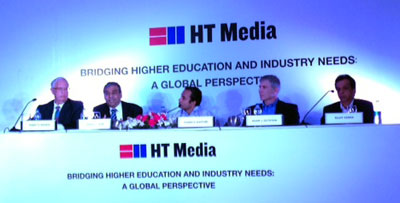
(L-R) Professor Henry Bienen, Professor Dipak Jain, Charu Sudan Kasturi, Adam Gutstein and Rajiv Verma
By Ananya Saha
After launching Studymate tuition centre for Class IX-XII in association with MT Educare in the year 2010, HT Media has announced another JV in the education sector. India Education Services Pvt Ltd is a JV between HT Media Ltd and Apollo Global, Inc. (USA).
To address the skills gaps in India, IESPL is planning to enter Higher Education with the Bridge School of Management. Bridge School of Management has been conceived to address the ’employability’ gap to help India’s rapidly growing Service and Manufacturing Industry educate and empower employees for a 21st century global workplace. Leveraging the best-in-class knowledge, experience, expertise and technology from Apollo Global, Inc. (USA), Bridge will aim to provide an innovative learning environment and industry focused management programs for working adults to boost their career.
To announce the launch, IESPL held a panel discussion on ‘Bridging higher education and industry needs: A Global Perspective’ recently in Delhi. The panelists in the discussion included experts from the academic and corporate world – Professor Henry S. Bienen, former President of Northwestern University, Professor Dipak Jain, Chaired professor of Marketing and former Dean, INSEAD, Adam J. Gutstein, Principal and Management Consultant Leader PwC, USA, and Rajiv Verma, CEO, HT Media Ltd.
Mr Verma said, “I strongly believe that it is possible for an enterprise to ‘do well’ and ‘do good’ and these are not mutually exclusive goals. Thus for HT as a company we realised that there is an opportunity, since there are many young adults looking to improve their skill sets in accordance with the needs of the industry, we decided to enter this space where we can’t only ‘do well’ but also ‘do good’. ”
The panel discussed how most management institutes today focus only on theoretical learning with outdated content irrelevant in today’s competitive world, which results in an ‘education-employment mismatch’. As high as 44% of recruiters find it difficult to find the right talent in the 4- to 8-year-experience bracket. On the other hand, there are millions of working adults who are unable to fulfill their need for career enhancement and higher income due a mismatch in the skills and competencies that they have and what industry needs. Forty percent try and upgrade their qualifications while making a career shift.
Speaking to MxMIndia, Mr Verma informed, “There is a lot of intricacies involved in this project. We are working with academicians and corporate industry to gauge the scene, We are also mapping the kind of courses we should offer. However, we do plan to open the institute in a year. Delhi is definitely one of the markets we will be present in.”
Talking about education needs and India in particular, Professor Henry S. Bienen said, “The world keeps changing, so what becomes important is to provide people with continuous learning and in a heterogeneous country like India, a lot of different institutional forms need to be developed to meet the needs of a highly differentiated population.”
Said Professor Dipak Jain, “When students graduate from American institutions they feel a need to ‘give-back’. This is the kind of culture we need to develop in India, where the students feel that the school made a difference to them. The most important aspect of an MBA education is the sharing of knowledge between teachers and students. It is equally important for teachers to learn from their students as we, in the education profession, are in the business of lifelong learning.”
According to Mr Gutstein, what is really required in management curriculums is the “focus on developing these sector specific skills”. “Additionally, there is a big need to take advantage of today’s technology and educational institutions need to remain abreast with technology as much as the corporate,” he said
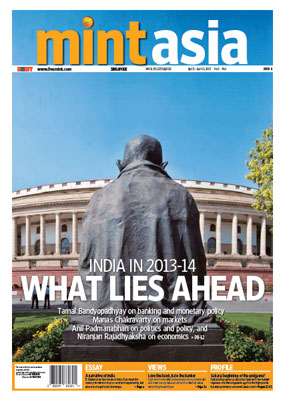
HT Media’s business daily – Mint has forayed into the global market with the launch of MintAsia, a weekly business paper, in Singapore. To be retailed at 6SGD, the newspaper will hit stands every Friday. The first edition was unveiled on April 6 at the IIMPact alumni event in Singapore by Dr. Raghuram Rajan, Chief Economic Advisor to the Government of India and R Sukumar, Editor, MintAsia.
“Our readers are not only highly affluent but also of a global outlook and have gone beyond the shores of India. Singapore is home to a large Indian diaspora, belonging to the Mint reader mindset, actively seeking insights into the Indian business market,” said Vivek Khanna, Business Head, Mint and Head- Strategic Partnerships, HT Media told MxM India. Targeting over 10 percent population of NRIs in Singapore, Mint Asia’s in-depth analysis and sharp insights will keep the global audience abreast of developments shaping the Indian economy and markets, according to Mr Khanna. The content of the paper will be distributed into various sections including banking and finance, policy and corporate affairs, opinions and views of experts across industries and a lifestyle section, offering insights into the Indian business market.
In an official communique, Rajiv Verma, CEO, HT Media Ltd, said, “When we conceptualized Mint, we were always very clear that it would be a regional media brand and I am delighted that, with this launch in Singapore of MintAsia, we have started on that journey. This is amongst the first for an Indian media company.”
Said Mr Sukumar, “Singapore is one of the world’s foremost financial centres and many decisions regarding investments in India happen here. With our unique Web First approach and a weekly print offering, both backed by an integrated newsroom we will try and cater to the India-specific information needs of the discerning Singapore reader.”
While MintAsia would be editorially managed from India, it will be printed in Singapore. The initial circulation would be around 3,000 copies. The first edition has 40 pages, and has a healthy mix of content and advertisements. “We have had a very encouraging response from the readers and advertisers for the very first issue,” remarked Mr Khanna. On the rationale behind launching a weekly, he said, “Mint is more about the analysis of how a financial event can impact you, which cannot be done for a 10-15 minute read. And since all information is now globally available, the monthly would have been too dated. Hence, we decided on a weekly based on our research.”
Currently, the Singapore print market is robust and is dominated by The Strait Times. The business weekly The Edge also has a good hold on the market. “We are sure that with our content and right proposition for our target group, we will become a good vehicle for advertisers and a great product for readers,” Mr Khanna asserted. The only challenge MintAsia might face would be to address the audience present in another market from here. “Yes, it is a challenge. Every new market is the same challenge. But to address Singapore readers, and since you are not sitting in the same market will be challenging.”
MintAsia will be unveiling a multiple-media campaign soon, but Mr Khanna refuses to divulge details. For the record, Mint started its journey on February 1, 2007 in India with the premise of bringing ‘Clarity in Business News’.
MK Venu has resigned his post as Managing Editor of Financial Express. Currently serving his notice period, he is heading to The Hindu from May-end as Executive Editor, Delhi.
Mr Venu, who had joined FE in October 2009, confirmed the news and said, “I will be looking after The Hindu’s expansion in the North.”
Responsible for over 10 editions of FE across the country, he was in charge of the overall editorial management and other administrative aspects of the newspaper. Mr Venu has been a journalist for close to three decades and has previously worked in various capacities at The Economic Times, Hindustan Times, Business Standard, The Statesman and Patriot.
Goafest 2013 saw agencies, big and small, make a beeline with their coveted entries at the Zuri White Sands in Goa. The hope was that the absence of the number one agency would lead to high possibility of others winning some metal at the festival. To everyone’s surprise, the number of entries that were submitted at the festival was the maximum ever entered so far.
While the deserving entries across categories were awarded their share of merit at the festival, it was not just the teams from agencies who were rejoicing at the wins. They were joined in spirit and body by clients who were as excited in seeing their brand make an impact in the marketplace.
While clients now acknowledge the uniqueness that the forum offers and make it a point to attend the festival, there is still not enough done from their end in recognizing the efforts put in by the workforce across agencies. Sensing an opportunity, print major Dainik Bhaskar Group showed its appreciation by unveiling the second edition of their much-appreciated work, Mosaic at Goafest.
Through Mosaic, the Dainik Bhaskar Group lends recognition to and establishes a platform for creative agencies to showcase their best print work. Grander than its previous edition, Mosaic 2012 features 121 print campaigns across 105 brands from 31 top agencies. This number is significantly higher than the first edition where works by 70 brands created by 23 leading creative agencies in India was curated by the Dainik Bhaskar group. In fact, this year is more special as it features additional inclusion of select regional print work and the personal favourites section wherein industry experts offer their insight on what makes a print ad work.
Â
Highlighting the experience witnessed in compiling the second edition, Sanjeev Kotnala, VP – Brand & Marketing, Dainik Bhaskar Group said, “The second edition has more campaigns and brands in it. And yes, this time we do see a decent inclusion of regional – language work too. Also, the favourites have been picked by a mix of seniors from marketing and media.”
Mr Kotnala added, “The entries featured in the book are by invitation only. We have, in consultation with our partner Afaqs, invited large agencies well-known for their creative to submit their work – agencies that have in the past won awards.”
The book features creatives handpicked by creative heads across agencies. While each agency has submitted 5 entries, an exception has been made with DDB Mudra that sent 12 campaigns. Said Mr Kotnala on this decision, “The team looking through the entries found that all the entries submitted by them should be included for their excellence. Dropping any one would have been wrong in this case.”
As was the case with the first edition, the second edition also contains a section – A different point of view – which sees seven industry heads select their favourites among the lot. Manish Vyas of VIP industries, Manisha Lath Gupta of Axis Bank, Santosh Desai of Future Brands, CVL Srinivas of Group M, Lara Balsara of Madison World, Mallikarjundas CR of Starcom Mediavest and Shripad Kulkarni of Allied Media have all presented their favourites from the list.
The book was unveiled on the sidelines of Goafest along with the Dainik Bhaskar-sponsored IAA Debates by media industry captains: Prasoon Joshi, Vikram Sakhuja, Partha Sinha, Monica Tata, Anupriya Acharya, and Srinivasan Swamy. Industry stalwarts like Sam Balsara, Shashi Sinha, Nakul Chopra, Jishnu Sen, Alok Lal, Sanjay Naik, Bobby Pawar and KV Sridhar among others were present too.
On the response that the book has managed to elicit so far, Mr Kotnala said, “The second edition has been appreciated and we had enough people at Goafest coming and asking for it. It is too early, but last year we had more than 8,500 downloads and more than 4,500 copies distributed. We expect the second edition to obviously fare better.”
In fact Mr Kotnala and team are already brainstorming on what the third edition of the book should look like. On his expectations from agencies for the third edition he said, “Agencies qualify themselves for it. And we do not have any preference or bias but hopefully we would see more work being produced in languages.”
And it’s no surprise where the third edition of the book will be launched. Asserted Mr Kotnala, “We shall, like this year, bring out Mosaic III before or during Goafest.”
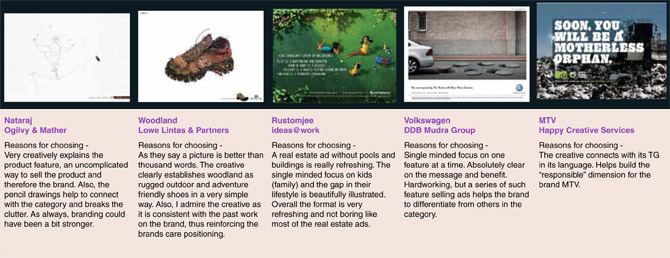
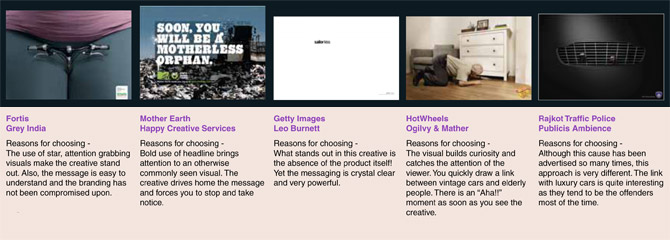
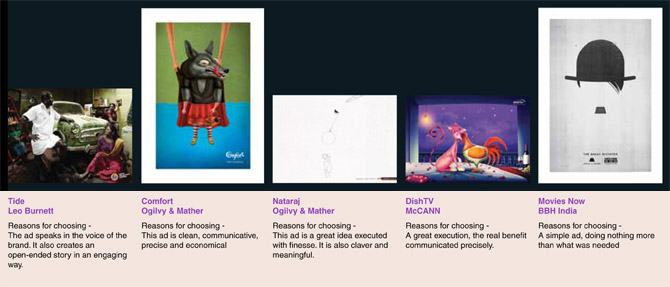
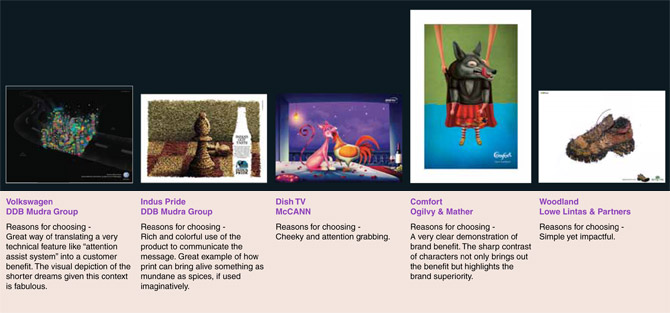
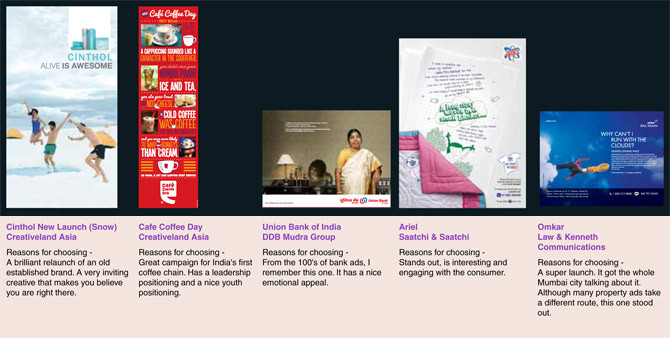
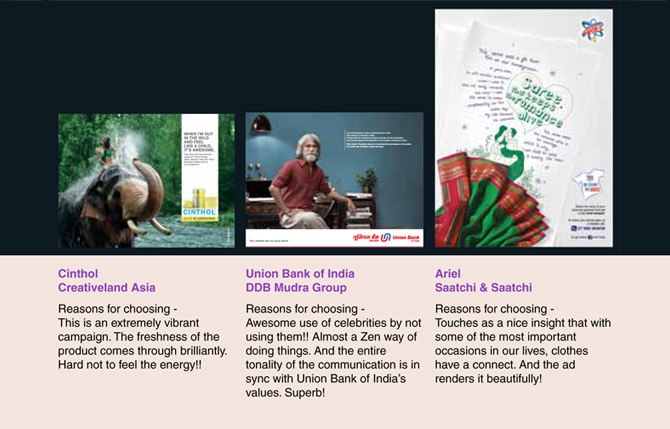
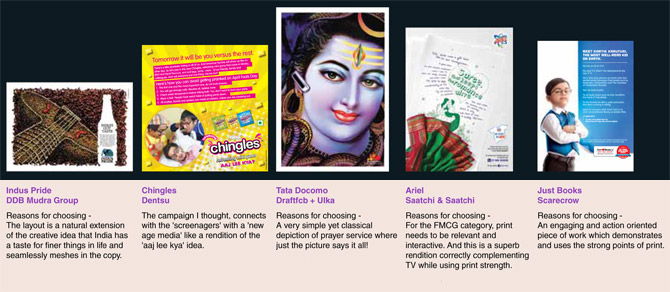
MxMIndia presents glimpses of some of the creatives shortlisted by experts…
Manish Vyas
Vice President – Marketing, VIP Industries Ltd.
“A great initiative to bring together some of the best work in the industry. I am sure it will inspire many greater campaigns in the future.”
Top 5 choices
Click on the image for larger view
Manisha Lath Gupta
Senior Vice President and Chief Marketing Officer, Axis Bank
“This book is a great study, as there is so much to learn from this collection of print ads. Many of them inspire marketers to think differently and take more risky decisions on creative.”
Top 5 choices
Click on the image for larger view
Santosh Desai
Managing Director and Chief Executive Officer, Future Brands Ltd.
“Its a good initiative but needs more real work to become truly meaningful.”
Top 5 choices
Click on the image for larger view
CVL Srinivas
Chief Executive Officer – South Asia, GroupM
“Hats off to Dainik Bhaskar for continuing this initiative. This compilation is adequate proof that print as a medium can be as effective as any other.”
Top 5 choices
Click on the image for larger view
Lara Balsara
Executive Director, Madison World
“Great idea to further the cause of print. Can become a collector’s item.”
Shripad Kulkarni
Chief Executive Officer, Percept Media”An excellent initiative which can probably be taken to a higher plane and level to address the serious concern of lack of support to print from ‘creatives’ in a more holistic manner.”
Top 5 choices
Click on the image for larger view
Text and images published with permission of the Dainik Bhaskar group. The e-book can be downloaded from http://www.bhaskar.com/mosaic/
The six-edition Daily News & Analysis (DNA) is set to launch an edition in Delhi on Monday, May 13.
May 13 is also Akshay Trittiya, a day normally considered auspicious for starting new projects or buying gold, automobiles or property. The editorial team at DNA is in place with Saikat Datta as Resident Editor. An aggressive marketing plan is scheduled give the newspaper prominence in a market dominated by Hindustan Times and The Times of India.
In the last quarter, under the leadership of Dr Bhaskar Das, group CEO, News Cluster, DNA has gone in for a new look – in the paper as well as in the team bringing it out and running the company. The subscription offer has been withdrawn and the emphasis is on profitability without compromising on editorial quality.
DNA is now owned and managed by the Zee group. With the Delhi launch, the newspaper will have editions in seven centres. Currently, while Mumbai, Bengaluru and Pune are managed by DNA, the Ahmedabad, Jaipur and Indore editions have been franchised to the Dainik Bhaskar group, which co-owned the paper until a few years back. The Delhi edition will be managed by the Zee-owned DNA.
Is the print market looking at bad times ahead? The recent IRS figures do compel one to think on those lines. Most of the print categories, including national and regional publications, have registered declining AIRs. Print Media witnessed a growth of 0.8 percent CAGR from 2012 Q2 to 2012 Q4. Though an increase, it is the least when compared to other media during the same period: TV (5.2%), Cable and Satellite (8.9%), Radio (1.9%), Cinema (11.6%), and Internet (24.2%). The 0.8 percent growth seems much less when literacy has increased at 3.7 percent CAGR during the said period.
What the IRS says
Jagran and Dainik Bhaskar, the top two Hindi dailies to lead in the Top 10 publications, have lost AIRs, going from 16.47 lakh in Q3 to 16.37 lakh in Q4 and 14.49 lakh in Q3 to 14.41 lakh in Q4 respectively. The only AIR gainers in the category are Dainik Bhaskar, Hindustan, Malayala Manorama and Rajasthan Patrika. Of the Top 10 Hindi Dailies, six show a decline in readership. The publications that saw a dip in AIRs include Dainik Jagran (1.04 lakh AIRs), Dainik Bhaskar (75,000 AIR), Amar Ujala (1.02 lakh AIR), Punjab Kesari 41,000 (AIR), Navbharat Times (6,000 AIR) and Nai Dunia (1.95 lakh AIR).
TOP 10 PUBLICATIONS
Publication
Language
Periodicity
2012 Q3
2012 Q4
DainikJagran
Hin
D
16474
16370
DainikBhaskar
Hin
D
14491
14416
Hindustan
Hin
D
12242
12246
MalayalaManorama
Mal
D
9752
9760
Amar Ujala
Hin
D
8536
8434
The Times Of India
Eng
D
7653
7615
Daily Thanthi
Tam
D
7417
7334
Lokmat
Mar
D
7409
7313
Rajasthan Patrika
Hin
D
6818
6837
Mathrubhumi
Mal
D
6415
6334
The Times of India maintained leads the Top 10 English Dailies category but has registered negative growth and lost 38,000 AIRs: from 76.53 lakh in Q3 2012 to 76.15 lkah in Q4. On the second position, Hindustan Times has added 34,000 readers going from 37.86 lakh to 38.20 lakh readers. While the third daily in the category The Hindu has lost numbers, The Telegraph at fourth position has added AIRs. DNA, Mumbai Mirror and The Tribune have added AIRs while Deccan Chronicle, The Economic Times and The New Indian Express have seen a dip in readership.
Top 10 English Dailies(AIR numbers; All figures in ‘000)
Publication
2012 Q3
2012 Q4
The Times Of India
7653
7615
Hindustan Times
3786
3820
The Hindu
2258
2164
The Telegraph
1254
1265
Deccan Chronicle
1051
1020
DNA
962
972
Mumbai Mirror
807
819
The Economic Times
753
735
The Tribune
653
671
The New Indian Express
664
652
Top 10 Language Dailies(AIR numbers; All figures in ‘000)
Publication
Language
2012 Q3
2012 Q4
MalayalaManorama
Mal
9752
9760
Daily Thanthi
Tam
7417
7334
Lokmat
Mar
7409
7313
Mathrubhumi
Mal
6415
6334
Eenadu
Tel
5957
5972
Ananda Bazar Patrika
Ben
5788
5750
Sakshi
Tel
5343
5379
Gujarat Samachar
Guj
5153
5114
Dinakaran
Tam
4912
4816
Daily Sakal
Mar
4403
4469
Â
The cause
Sundeep Nagpal, Founder-Director of Stratagem Media, blames the decline on new media. Unsurprised by the degrowth he said, “Time has caught up with print media. Not-so-young people have been hooked onto tablets since nobody sees value in print media. I am not surprised by the figures.”
A S Raghunath, senior print media brand consultant based in New Delhi NCR, disagreed and said, “The degrowth that one interprets on the basis of a quarter is not right. There is always a seasonality associated with print, and hence one should not look only at quarterly figures. There are seasons like monsoons or June-July when readership drops since people travel due to school holidays, or during exams etc.” According to him, due to new publications in a certain language, the universe of readers does migrate or changes. “According to the CAGR of one year, print has grown by one percent, and this is good news.” The worry should only be when the readers of a certain language decrease.
English dailies have added 3.38 lakh readers in the last one year, and smaller dailies that have entered new regions have gained readers. In the past one year, the reigning leader The Times of India has lost readers while Hindustan Times has added readers. Hindi dailies have added 9.70 lakh readers in the last one year. Assamese, Oriya, Tamil, Telugu, Kannada dailies have added readers to its universe. However, Malayalam has lost the biggest chunk of 8.44 lakh readers in the last one year. The Bengali market, which saw the entry of TOI’s regional paper Ei Samay and ABP’s Ei Bela, has lost 5.16 lakh readers. “The reason could be the entry of new players or disenchantment with the existing dailies. Once the IRS figures of Ei Samay are out, only then would the reason be ascertained,” reasoned Mr Raghunath.
One can say that new publications make the readers migrate from one product to another in a certain language universe but the losing readers is definitely a cause to worry. “For regional newspapers, the newer generation is not adapting to it. For them, news is not to be found in print or language paper. Obviously, there is a problem,” remarked Mr Nagpal.
But Mr Raghunath is positive despite the figures. He maintained, “Major languages are doing well. For the languages that are losing readers, it is because the readers are migrating to newer platforms. News consumption, per se, has not gone down. News media cannot be threatened, individual platforms can be threatened.”
Are the advertisers losing interest?
The traditional media of print and TV has always managed to catch the fancy of an advertiser. While we are questioning the advertisers’ interest in internet and other new media, the loyalties to traditional media might also be undergoing a shift. Mr Nagpal reasoned, “Advertisers are also simultaneously moving to new medium since readers are moving. On the internet, ad dosage can be course-corrected according to usage. B2C believes in TV as a medium, so print loses out. Lots of categories are more internet-oriented. Hardly any e-commerce site has advertised in print.”
Targeting a certain TG on the internet might obviously seem more cost-efficient and would also deliver ROI than advertising in print, which costs much more. Also, with the penetration of new devices such as phablets, tablets, smartphone, the lure of advertising in print media is shifting. What also needs to be considered is, that most of the news and in-depth news analysis (similar to as seen in print) available over internet, is English-based, and the universe of regional and Hindi news sites is still very small.
Going forward
Can print media revert to the days of glory? When magazines and newpapers did not fear the onslaught of online media? When digital was not a challenge? “Whatever print media could do to resurrect itself it has done. Anything more does not have cost benefit attached to it. The print has done lots of new things such as circulation schemes et al but it has not resulted in anything positive, given that revenues for newspapers are ad-driven. I cannot imagine change how and why it would change,” said Mr Nagpal.
As Mr Raghunath sees it, the challenge for print is how to make news stand out for existing consumers and it is also a challenge for conventional journalists. While the signs do say that print media is facing tough times, the newer print publications are keeping the hope alive. Only if the degrowth story stops, will the picture be brighter.
His interest and expertise in the world of watches is now well-known. In fact he has used this to even co-own a consultancy firm called The Horologists. His full-time vocation though is that as Publisher and President of the Chitralekha Group. He also creates content for television and is an active vice-president of the Association of Indian Magazines. Meet Mitrajit Bhattacharya, now also a first-time author.
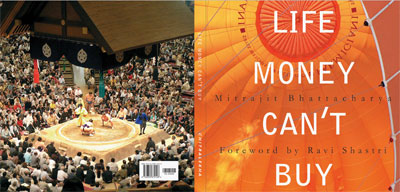
Mr Bhattacharya has shared his experiences through various professional and personal engagements that transported him into worlds which would constitute, as the the title of his book tell us, Life Money Can’t Buy….
The book is a compilation of voyages — from being enchanted by a mermaid frolicking around a yacht in the waters off the coast of Capri to flying a jet in Switzerland, from cheering on a game of polo with Maharajas for company to having his own ‘wonderland’ moment with the Great Wall of China as the backdrop.
Obviously, this book is Mitrajit’s expression of the fascinating adventures he has encountered while pursuing his assignments.
Cricket commentator and former India captain Ravi Shastri has written the foreword to the book, which will be released by actor Shabana Azmi at an event in Mumbai tomorrow (April 16).
Excerpts from a short interview with Mr Bhattacharya:
What prompted you to put your impressions in book form?
Being closely associated with the luxe industry for over a decade now, I have led a life which has allowed me to do crazy things across the world. One fine day last year it dawned on me that putting together these experiences will make a great read, hopefully. Hence the book.
In many ways, the book’s title reminds one of the Mastercard ad. Which of these was, according to you, the most priceless?
Most of these experiences are unique and very few in the world have access to. Hence all are priceless. Moreover, all journeys are different from each other and can’t be compared.
If you were given an opportunity to relive one of these experiences, what would it be?
I would like to undertake newer journeys, may be share those in my next book.
The struggle and hesitation is max for the first book. Now that you have passed that, what next?
We have just placed the book in key bookstores and the response so far has been positive. When I am ready with more to share, another book will follow.
Mumbai-based DNA is reportedly galloping ahead towards the capital. Launched on July 30, 2005, in Mumbai, DNA (short for Daily News & Analysis) is an English broadsheet daily owned by Diligent Media Corporation, now an Essel Group company. With presence in Mumbai, Bangalore, Pune, Ahmedabad, Jaipur and Indore, the recently refreshed daily is scheduled to be in Delhi on May 13. While NCR is seen as a battleground for the English heavyweights Times of India and Hindustan Times, many English dailies do not boast of good readership numbers in this market. Does the Delhi market need yet another English daily?
Sundeep Nagpal
“I don’t think there is too much room for another English daily in Delhi, at least in terms of readership,” says Sundeep Nagpal, Founder-Director of Stratagem Media, an independent media agency. “The English daily readership as a category, went up by about 5% around the turn of the last decade, but it’s back to the level that it was at, in 2008. However, what seems to be happening in most major markets, is that they seem to be able to absorb additional circulation to some extent. So, basically this suggests fragmentation,” Mr Nagpal adds.
Anwesh Bose, Senior Vice President- Media, DDB Mudra is of the view that DNA is launching Delhi more with an image perspective in mind than revenues, for now. “With the Delhi launch they would be able to call themselves a national daily, finally,” he said. DNA has plans to eventually be present in all the four metros, and then launch its financial daily too in these markets. The Ahmedabad, Jaipur and Indore editions are franchised to the Dainik Bhaskar group, formerly joint venture partner of Zee in Diligent Media.
Anwesh Bose
But to capture readers and advertisers in Delhi, DNA would have to be aggressive in its positioning, and promotions, and adopt a push and pull strategy. As Mr Nagpal viewed it, DNA will have to create a market of its own and that would mostly happen in terms of a share of time spent on reading, and not as much in terms of new readers. Meanwhile, DNA has firmed up its team in Delhi with senior journalist Saikat Datta being appointed as the Resident Editor.
Mr Bose said, “DNA would have to step into Delhi with deep pockets as they need to sustain for a long period of time before they can see profitability. Their strategy ideally should be of first of all establishing themselves as a brand that stands for something.” The new daily, according to him would have to come up with interesting ways of increasing their circulation, since the old methods of free gifting on long-term subscription does not hold any value anymore.
While DNA is planning to enter Delhi, the capital’s compact daily newspaper – Mail Today – is getting set for a Mumbai launch this year. Mumbai has seen a reasonable healthy growth of 40 percent in readership of English dailies over the last six years, whereas Delhi has been at about 18 percent only, vis-a-vis 2005, asserts Mr Nagpal.
Having launched in Chandigarh recently, Mail Today will have to compete with Mid-Day and Mumbai Mirror in Mumbai.
AS Raghunath
AS Raghunath, a senior print media brand consultant based in the capital, is of the view that Mail Today will be able to carve the niche in Mumbai. He said, “The Chandigarh and Delhi editions of Mail Today usually have a front ad jacket. So they do have a permanent source of revenue. Content-wise, Mail Today is a mixed bag and carries an ‘exclusive’, usually every day, which no other daily has. Even Twitter and Facebook communities quote Mail Today. Also, given the fact that Mumbai is a multi-newspaper market with English, Hindi, Telugu, Tamil, Gujarati dailies and publications, I am sure Mail Today will be able to carve a niche for itself.” He further added that while size will not be a challenge for Mail Today, any daily going in Mumbai would probably not add numerically to the market.
On Mail Today’s stint in Delhi, Mr Bose remarked, “Mail Today is by no measure a success in Delhi… although, they have tried their best. It is bought more on relationship with the India Today Group than because of its content differentiation.” Mr Nagpal concurs that for a large cross-section of advertisers, Mail Today did not offer a unique/significant enough benefit.
According to Mr Nagpal, “Mumbai Mirror (MM) has been able to create a huge dent in the market”. “It has stalled other competitors right where they were in their tracks and even eaten away their share considerably over the last five years, so I think MM is quite a success. But that does not mean that every new tabloid will do as well” he added. Mr Bose, however, holds a different view. He said, “Even with the might of TOI behind it, Mumbai Mirror could not make a huge dent, therefore it will be an uphill task for Mail Today to achieve success.” Mr Nagpal is of the view that Mumbai ought to be an easier market for Mail Today, for a whole lot of other reasons such as being more cosmopolitan, more adaptable, etc.
The advertisers, obviously, would watch with interest as to the direction in which each of these publications grow in the respective markets. “It is sure that a lot of advertisers would get free space or space at a very marginal cost to begin with as the publications would want the advertisers to sample their product as well as it becomes a talking point with other advertisers for the publication. Also, there would be a lot of freebies during the circulation drive, so the consumer is going to make merry,” opined Mr Bose.
Success or not, only time will tell. But it is sure a sign of healthy growth for the print sector. As Mr Bose concluded, “Print has seen a growth in 2012, where it grew by 9 percent compared to 2011. This year print would gain more as a lot of TV-friendly categories have shown interest in print, primarily to drive sales in a period of slowdown.”
North American children’s magazine publisher Highlights for Children and Delhi Press have collaborated to bring Highlights Champs and Highlights Genie magazines to India.
Highlights Magazine (http://www.highlights.com/) uses stories, poems, and activities to engage children in early learning and helps them to develop a strong sense of curiosity, creativity, confidence, and caring. From its beginning in the 1940s, the magazine has celebrated children’s experiences in many different cultures and religions around the world.
Highlights Champs is designed for children aged 6-12, and includes a mix of fiction, poetry, science, craft and readers’ contributions. It also features beloved content from Highlights magazine such as Hidden Pictures, the Timbertoes and Goofus and Gallant. Highlights Genies targets children aged 2-6 and uses stories, poems and activities to engage children in early learning and help them to develop a strong sense of curiosity, creativity, confidence and caring.
“Parents in India place a high value on education and care deeply about helping their children develop strong learning skills at an early age. With a blend of Highlights’ exceptional content for children and Delhi Press’ unique understanding of the market, Highlights Champs and Highlights Genies will be ideally positioned to fulfill the needs of both parents and children,” said Paresh Nath, Editor-in-Chief and Publisher of Delhi Press.
Highlights CEO Kent Johnson said, “When my great-grandparents started Highlights in 1946, one of the things they hoped to do in the pages of the magazine was celebrate children’s experiences in many different cultures around the world. I think they would be so pleased – and maybe astonished too – to see how far their ‘Fun with a Purpose’ magazine has travelled.”
Highlights Champs and Highlights Genies will be available through subscriptions as well as in newsstands and books stories throughout India.
TELiBrahma, mobile advertising solutions company specializing in augmenting real world context with digital engagements, has announced its partnership with Sandesh – to bring interactive print content LIVE on readers’ mobile.
The partnership will allow Sandesh to augment their editorial content across all editions. Sandesh is one of the most widely read Gujarati newspaper. Sandesh Smart, powered by point of TEliBrahma is a visual recognition technology for the publishing house. By integrating augmented reality, Sandesh will be the first and only Gujarati daily to bring interactivity to static print pages with 3D models, videos, slideshows, social media connect, links to download content and emphasize the importance of connecting print publications with digital engagements through mobile.
“This partnership will allow static print content come Live on readers’ mobile,” said Parthiv Patel, Managing Director- Sandesh, adding, “It will definitely add excitement to print content; we see a great opportunity for brands to leverage the same too. TELiBrahma has helped us develop a robust application with one of the best user experience.”
PR Satheesh, Principal, TELiBrahma said, “We are extremely excited to partner with Sandesh, one of the leaders in the print media space and we believe this will add tremendous value to their readers. Sandesh Smart app powered by POINT of TELiBrahma is a way to connect physical world with exciting digital engagements.”
Crowdsourcing, a technique being increasingly employed by marketers, has been used to create logos, movies, books, etc. Femina’s ‘Made by You’ issue is a move to get readers to develop and execute the editorial and design content for the entire issue.
Marketing is inbuilt into the publishing of this issue, and every author is a potential word of mouth marketer. Femina Made by You is thus a bridge in terms of being able to merge the world of publishing and marketing.
Tarun Rai
Tarun Rai, CEO, Worldwide Media, said, “Worldwide Media has grown at a furious pace. From just four magazines four years ago, we now have 13. And as a publishing house we have been leading from the front. Femina Made By You is another first for the magazine industry. A crowd-sourced issue, at the scale we have visualized it, is unprecedented. And it is only appropriate that it is Femina that is bringing it out as there is no other English women’s magazine with the stature and readership that Femina has.”
Tanya Chaitanya, Editor, Femina said, “Femina Made by You is exactly what it promises to be. An issue made by the real women who have always been our core focus. A Mumbai reader’s take on relationships, a Delhi girl’s hunt for the latest It bag, a Kolkata woman’s expertise in the kitchen, a Chennai career girl’s tips on being a 9-to-5 ninja – it’s all trending here.”
DDB Mudra used simple techniques for crowdsourcing and keeping the technology in the background while developing this issue. The techniques included Facebook, Twitter, Pinterest. To start with, a Facebook app – “Made By You Issue” – was created on the Femina Facebook page. The app focused on a simple idea that ‘If you’ve got a story, we’ve got the space’.
The second initiative was to introduce the contributors to the Femina India editorial team. The team ‘met’ select authors via Google Hangouts. The objective of this meet was to bring women from different corners closer and give them a single platform to discuss and share their ideas. Finally a filtering process was used for the entries that would finally get featured in this magazine. Here the Femina India editorial team led by the editor, Tanya Chaitanya, was involved.
Besides receiving entries from metros in India, there was participation from non-metros as well including Dehradun, Panchkul, Jalandhar, Pune, Hyderabad, Chandigarh, Jaipur, Lucknow, Ahmedabad, Ludhiana, Indore, Guwahati, Jalandhar, Bhopal, Kanpur, Nagpur, Amritsar and Surat.
Statistics:
Facebook
1.Daily people talking about Femina: 1,20,394(total)
 By Ananya Saha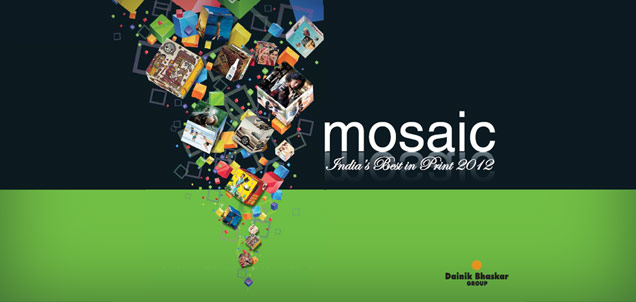








 His interest and expertise in the world of watches is now well-known. In fact he has used this to even co-own a consultancy firm called The Horologists. His full-time vocation though is that as Publisher and President of the Chitralekha Group. He also creates content for television and is an active vice-president of the Association of Indian Magazines. Meet Mitrajit Bhattacharya, now also a first-time author.
 The book is a compilation of voyages — from being enchanted by a mermaid frolicking around a yacht in the waters off the coast of Capri to flying a jet in Switzerland, from cheering on a game of polo with Maharajas for company to having his own ‘wonderland’ moment with the Great Wall of China as the backdrop.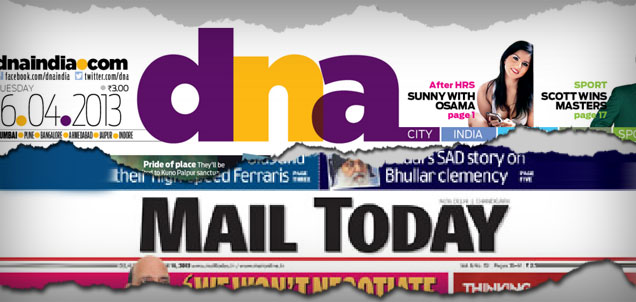


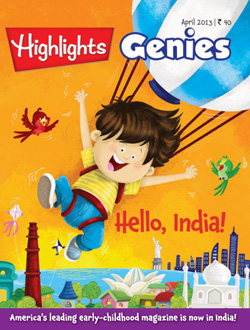 North American children’s magazine publisher Highlights for Children and Delhi Press have collaborated to bring Highlights Champs and Highlights Genie magazines to India.