Category: PRINT MEDIA

  • IMC 2013: Being creative and loving it

    By A Correspondent


    While brands do acknowledge the big role that the medium of print essays in getting them to speak to their audience, the task has become more daunting in recent times what with the advent of multiple mediums. At such times, being innovative and creatively unique is what may make them stand out from the clutter.


    In the session on ‘Advertising Creativity and Magazine Media’ at the Indian Magazine Congress 2013, the panellists took turns presenting their viewpoints on how print could still remain a preferred medium for brands going forward.


    Lutz Kothe, Chief General Manager, Marketing & PR, Volkswagen, India began by saying that advertising in India has come a long way. “While for the magazine industry 2013 is about niche and genre-based publishing, the times are also changing and turning out to be challenging. The onset of several new mediums especially digital has provided an array of choices for the advertiser to choose from. In a couple of years from now, integration with digital technology will be the way forward. But while 360 degree would be the way forward, an important thrust would continue to be given to magazines.”


    Josy Paul

    Josy Paul, CCO & Chairman, BBDO India compared a magazine to that of an infant as he said it is all about touch, feel and involving sensorial feelings. He went on to demonstrate some examples of some fine print ads that captivated the attention of the audiences. But he also agreed that the ad agencies of today did not resort to using the medium as effectively as it could and rather depended heavily on other mediums like television and digital.


    Satyaki Ghosh, Director, Consumer Products, L’Oreal India said that his organisation was highly appreciative of the medium of print. While we are the seventh largest advertiser on the medium of television, our percentage of spends on the medium of print is still high. Print is the only medium that enables us to educate our audiences and also gives us the premium that we desire. “But what I expect from the medium especially magazines is partnerships that would allow us to make our core idea bigger.” Ghosh also cautioned the publishers that they should not engage in innovation for the sake of it; the readers should not be confused with what we are trying to tell them.”


    When asked on how open his organisation is to incorporating new ideas, Ghosh said “We are open to ideas from wherever it comes but usually it is the domain of the creative agency, and even the media agency to transform thought into reality.”


    Kothe had a slightly different approach as he said that it doesn’t matter from where the ideas come as long as it is effective. “Where magazines are concerned, we do get ideas from the editorial teams as well and if we like it we go ahead and incorporate them.”


    As for Josy Paul, it is all about looking at how they can maximise media and the answer lies with innovation. The other aspect that readers look forward to from magazines is for it to deliver news-worthy content.


    Sonal Dabral
    Sonal Dabral

    Sonal Dabral, Chairman & CCO, DDBMudra, put forth his observation as he said that each time he is confronted with a problem there are chances of finding part-solutions to it. Where the medium of magazines is concerned he said, “The medium of magazines allows us to write or explain stories, something that that the television or other mediums do not offer. With the onset of multiple mediums the going will be a bit challenging going forward.”


    The panellists agreed that the way forward would be for creative firms to work alongside brands and produce work that would be educative, appealing and informative.


  • Is Digital eroding relevance of TV and Print?


    By A Correspondent


    The traditional media of print and television are under siege, as it were. Though they are still dominant media, they are seeing a sea change in the way they are being consumed. The explosion of new media also threatens their relevance and hold. Or so it is believed. But is it an overreaction and does digital not pose that much of a threat to TV and print?


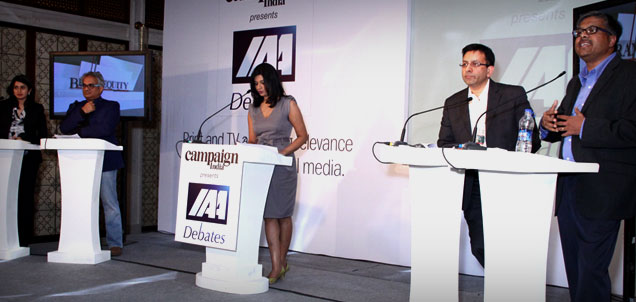
    To find out, the India chapter of IAA organised a debate in Mumbai on Monday (Feb 18) on whether television and print are losing relevance with the growth of digital in India. The debate series is being sponsored by Campaign India and the co-chairs of the IAA debates initiative are Partho Dasgupta and Neville Taraporewalla.


    Seasoned professionals Virginia Sharma of IBM and Mahesh Murthy of Pinstorm (and Seedfund) argued for the motion while Sanjay Gupta of Star TV and Arunabh Das Sharma of The Times of India group argued against the motion. The debate was moderated by Sonali Krishna, Anchor of Brand Equity show of ET Now. A cross-section of industry professionals were in attendance. As were some representatives from MxMIndia.

    We bring you some of the highlights of proceedings. Note, this is only a part of what was discussed.


    Mahesh Murthy: If you look at the Census report, if you see rural India there are just 33 percent homes that have television vis-a-vis 54 percent that have mobile phones. Overall if one compares, urban plus rural, TV used to take 32 percent penetration in 2001 which has grown and is at 47 percent at the moment. But mobile has grown from 9 percent in 2001 to 56 percent today. Mobile today is 24 percent larger in Indian households especially rural where the number is about 50 percent more.

    If you look at the numbers further, television has about 111 million viewers whereas mobile has about 133 million users – which further consist of 400 million users of SMS, 900 million SIM cards, etc. When one compares the publication number of The Times of India that is at 3-4 million which is dwarfed by 18 million users of Facebook every day in India.

    If you look from the consumer’s POV the three most desired audiences from an advertiser’s perspective is the 15-24 yr-old youth that barely reads a paper or watches TV and is highly digital-savvy; 25-34 yr-old females – Facebook alone has 11 million of those and I do not think any other medium in India can give you that kind of access to this age group; and finally 35+ age group – it will be hard-pressed to reach a CEO today as long as he is on his tablet or i-Pad or email, etc.

    When we move on to the advertisers, all of two years ago digital was all of two percent of the ad pie which has now become about 8.5 percent, meaning that digital has grown by 400 percent while the share of television or print has gone down.

    If you look at how digital has been explored by other people like politicians who have more than 200 people to handle just the digital medium, which I do not think is the case with other media. Even when one looks at the credibility factor, Nielsen states that the most credible medium is word-of-mouth, followed by what strangers write online followed by what is written on websites and then comes print.

    So what we are seeing is that print and television are not going zero; while they still have relevance they are losing their relevance because of the advent of digital. I’d like to end by requesting each one to ask themselves as to where do you see yourself in the future – whether five years from now you’ll be seeking a job in a company that does not do digital. The honest answer will decide where your preferences will skew towards the end of this discussion.


    Arunabh Das Sharma: I’d like to begin by saying that what we are discussing here is relevance. Is it about ad dollars; is it about ‘x’ percent more mobile penetration or is it about what these media have stood for the longest time – which is curated content. What digital has done is created a proliferation of choice and when that happens big becomes bigger. In such a situation everything grows. I’d like to share here an example of how the growth of social media has fuelled the growth of television and print and how they the two mediums are getting healthier now that the investment in content is becoming stronger and stronger.

    In the 1950s, it was said that radio was going to kill the medium of print and was followed in the 1970s where it was said that television would kill the medium of radio… none of that happened. There is a reason why different media play different roles in our lives. A recent study by research firm Ipsos talks about what are the global rules that different screens play in your life. So while the mobile screen is a lover, the computer screen is a sage while the tablet is a wizard but the fact of the matter is that you need a lover, wizard and a sage; the fact of the matter is that every medium has a special role to play and we ourselves will be very myopic if we assume that television is linked to a cathode ray tube or that a newspaper is linked to a piece of paper.


    Virginia Sharma: Is your motion that TV and print continue to be relevant or that they are growing in relevance?


    Arunabh Das Sharma: I think the topic needs to be redefined whether print and TV are losing relevance but whether digital will ever gain relevance? In fact I’d like to say here that 2012 saw some of the biggest gains in stock prices of print companies because of one aspect – they had figured out their business model. The issue was that in 1992 when the readership started dropping they had to figure out a business model which wasn’t to be.


    Virginia: Do you have any comparable stats to validate your observation?


    Arunabh: It doesn’t even show on the scale for India. I’d like to add here that a lot of people wouldn’t know about this but a gentleman in the US just brought a bunch of regional newspapers with the assumption that the growth of print will happen through hyper-local and regional papers, which is exactly what will happen here too.


    Virginia Sharma: I’d like to start off by answering the question, ‘What does relevance mean?’ In today’s world relevance means business impact. The fact that it was said that digital does provide a platform of choice is correct; also the fact that social as a medium has grown is also correct.


    Arunabh: If relevance is defined as business impact, are we talking the same scale in that sense in India?


    Virginia: What I am saying is business relevance to advertising agencies…


    Arunabh: But I thought it was also about ad dollars…


    Virginia: No ad dollars is about expense. Business relevance is about business outcomes and about what the CEO measures, particularly the RoI. To quote numbers from a CEO study that was conducted, the use of social and web from 11 percent to 48 percent for social and from 37 to 49 percent for the web in the primary way to interact with the customers.  That for me is business impact and what the boss sees this as a way to engage the audience. What do most brands like Coca Cola, Pepsi, ICICI, HDFC etc have in common – it’s their innate belief that this medium is relevant and their investment in this medium is not just what the ad agency says it is.

    So, two big cases. First, the primary metric of the CEO study for marketers for success is RoI. You can measure RoI based on the ability to understand customers and target them with what they need. You can only measure digital better than you can measure print and television. Therefore the future for marketing where RoI is concerned as a primary measure for success has got to be digital if you want to make the case.


    Arunabh: I think the challenge is not about measurement but about conversion and that’s how a medium works. Measurement that you are saying is how many people have seen the ad not how many people because they have seen the ad went and watched something.


    Virginia: Measurement for me is actually measuring consumer behaviour and doing it successfully. To sum up, the business case is very simple, if you want a good RoI you have to use digital as a key medium to be able to feature consumers and that ultimately is going to be key.


    Sanjay Gupta: When I started working 20 years ago I thought print is going to die and today print is about Rs 14,000 crore from Rs 6,500 crore it was a decade ago. For television the growth has been from 5,000 crore to 16,000 crore. The key points that I’d like to present here are that firstly, consumers love television and it is thriving. The thing is that if you find something relevant you spend time with it. Around 700 million people in this country spend three hours every day watching TV. When they start it is for two hours, which then picks up to three hours. Also in the last one year, 70 million new people have started watching television. That’s more than the number of people who watch digital in any given point in a month. The same is the case in developed countries like the UK and the US where the time spent is around 4-5 hours every day.


    The other thing is that big is becoming bigger on television. The belief is that proliferation of choice will make users fragment. A recent example I’d like to share is of the movie ‘Dabangg’ which was watched by 150 million people. Even shows like Balika Vadhu etc aggregate about 40-50 million viewers in that half an hour. The point I’d like to make is that social media is actually helping the business become bigger and better. The people fall in love with our characters and they do that only on television and not anywhere else.


    Mahesh: So essentially your point is that even TV uses digital…


    Sanjay: TV does use digital. To quote an example our show Satyamev Jayate was the biggest show that we did and we used the channel of social media to make people come and watch it. It was in fact the highest trending topic on Twitter. So what I am saying is that digital is driving our business to do better.


    Virginia: Is it content that drives behaviour and interest or is it the medium?


    Sanjay: It is content. To cite figures, in the UK people watch about 80 minutes of video and out of that 80 percent is either pornography or YouTube – that’s the power of that medium there. Whereas if you provide good content it makes the viewer keep coming back to watch more and more.


    As to what is changing, digitization is changing the way television companies do business. Till now only 20 percent of the revenues from digital medium came to the broadcaster but the transparency with DTH that number is moving from 20 to 100 percent. So subscription revenues of TV companies have grown five times and what does it give us – the power to invest in content. That is what will make it even more relevant in the future.


    Murthy: So your point is that television is using DTH or rather digital to deliver itself to homes?


    Sanjay Gupta: The point I am making is that the medium is powerful, profitable and is growing. The fact is that people will not consume any one or two mediums, they will consume all the mediums. The question is: how do we use the power of each of these mediums as they have to be relevant.  So print and TV will not lose their relevance they will continue to grow. The real question is that we need content aggregators and devices. Digital as a medium is just an aggregator of content and fundamentally the question we need to answer is how meaningful can this content get on the medium if it has to grow even further.


    Arunabh: Statistics do give us a picture. The fact of the matter is that both these media are huge and growing. If they were not then we could have turned around and said that it is not but like all new media they are finding newer ways – whether through a screen, a mobile, an app – of growing the medium. We are not here to debate whether one medium is better than the other, the fact is that we as consumers love to consume media and do it the way we want to. It is not about whether x, y or z is losing relevance, the fact is it is bigger and it is growing. In fact the next round of growth is already visible to us – it is coming from regional markets. Because of our infrastructural issues it will take digital some time to pick up speed but until such time our friends in the digital world would do really well to figure out what kind of content creates stickiness and what kind of content keeps readers going for 175 years. The day one of these digital mediums complete a 175 years in the form and fashion from what they started then we can talk about it further.


    Virginia: I think the four of us together have made a very compelling case for the growing relevance of digital and that it is powerful, profitable and here to stay. Such a combination would make this medium indeed relevant. Print and TV is going digital, decision-makers are going digital, politicians are going digital… the big question is, which side do you want to sit on? And no, digital does not want to be the medium it was 175 years ago, it wants to keep up with the times as well as the generation it is catering to and it will constantly evolve and is eager to change. It will make money regardless of the shape it will take. The question is, are you ready for the future – digital?


    The debate was won by the team against the motion. Before the debate started, 44 people from the audience were against the motion and 31 were for it. After the debate ended, the numbers were 42 against and 34 for.

  • Digital is changing the publishing game: IMC panel

    By A Correspondent


    There is a revolution happening in India, and publications have to ride the wave. This has been the dominant theme ever since the digital eruption began, and the urgency has only grown. The message was echoed at the panel discussion on ‘The State of Digital Publishing – Challenges and Opportunities’ on the second day of the Indian Magazine Congress.


    Kirthiga Reddy, Director, Online Operations, and India Head, Facebook, said that according to the Indian Readership Survey, digital media has been growing faster and bigger than print media, and its drivers are technology and changing consumer behaviour.


    On the technology side, India has the highest growth rate in internet adoption. “We are in the midst of a smartphone, tablet, featurephone revolution,” she said. “On the consumer side, consumers want to find exactly what they want, when they want it, as the pressure of time is intensifying, and this is changing how people are doing things.”


    There are three big opportunities in social media, Ms Reddy said. One is reach, the second is two-way interaction, and third is using that interaction for unprecedented personalization. “On the Facebook platform for example, you can reach one billion people globally. Marketers need to think about platforms including the lowest end feature phones, as well as using the range of regional languages.”


    People do not just want to consume information, they want to interact and share it, she said. This desire to share is higher in India than the global average. Some best practices are to have a content strategy that leverages the power of each platform, it’s not about one content strategy for all. The most effective use of social media is when the company thinks of social media as part of everything that they do; it is not something separate.


    Moving on to personalization, Ms Reddy said that in five years from now, it will be unthinkable that an individual goes to a website and sees the same thing as other individuals. Consumers are going to demand personalization. No one is going to have the time to flip through pages and pages of matter which is irrelevant to them. One challenge to highlight at this time, she said, is education to help people navigate the new world of new and social media.


    Umang Bedi, Managing Director, South Asia, Adobe, said the global trend is to put digital first, and India has to keep in step. The way the world looks at content strategy is about taking content into a digital format first, giving the flexibility of creating content any time anywhere, and rendering that content and distributing it. Then it is about optimizing, personalizing and monetizing the content, breaking down the traditional silos. Adobe, he said, is very close to a solution for meeting the consumer need of personalized customization.


    “Mobile traffic has exploded in India, and everyone wants to put content in digital format. And every time someone goes online and interacts, they leave a digital set of signals. Brands need to listen to these signals, assimilate data and make decisions based on these observations which are tailored to each individual. Conversions grow by 4x or 5x when brands are able to differentiate themselves in this way,” Mr Bedi said.


    Punitha Arumugam, Director, Agency Business, Google India said that thinking about digital has to go beyond desktop and mobile, but the context is likely to become one comprehensive device – the Google Glasses – as early as by the end of the year. Adapting publishing to existing digital devices has to include developments of the future such as this, she said, which will change the way consumers interact.


    The advent of technology has ended up making consumers increasingly lazy, she said, and this also influences the way brands reach them. She cited the example of pizza company Red Tomato, which has a fridge-magnet application that can be used to order pizza instantly based on previously ordered choices. However, when reading a magazine online, consumers behave the same way as they do with magazines in hard copy, she said. Which is, they stop at pages, stop at ads, etc, in contrast with other online behaviour which is search-oriented.


    In the publishing space, magazines need to be frenemies rather than enemies, Ms Arumugam said, highlighting that collaboration can help the industry as a whole, and thereby benefit individual brands as well. She also added that measurement needs to include online readership as well as the traditional offline numbers, and the next IRS, in collaboration with Google, would be tuned to reflect this.


    The discussion was moderated by Pradeep Gupta, Chairman and Managing Director of Cybermedia.


  • Media biggies in Odisha tomorrow for M&E conclave

    By A Correspondent


    All roads (or air routes) lead to Bhubaneshwar as leading Odiya daily Sambad is  set to present a one-day national conclave on media and entertainment in the Odisha capital tomorrow (Feb 22).


    The media conference will be inaugurated by Odisha CM Naveen Patnaik. The guest of honour is Arun Kumar Sahu, Odisha Minister for Energy, Information and Public.  Aritra Sarkar, VP-Strategy, ABP; K.Z. Magdoom Mohamed, Managing Director WAN – IFRA South Asia; K K Goenka, Managing Director NPHL (Prabhat Khabar); and Srimoy Kar, Resident Editor, The New Indian Express will debate on ‘How does print media tackle low readership among current generation’.


    Prashant Pandey, Chief Executive Officer, ENIL-Radio Mirchi; Nisha Narayanan, Senior Vice President, Programming and Projects, Red FM and Susmit Chandra, Cluster Head East, Reliance Broadcast Network will discuss ‘Expansion of FM radio in Small Cities’. ‘TV as a medium will be relevant only for demonstration Purposes’ will see Rajiv Mishra, Chief Executive, Lok Sabha TV; Paritosh Joshi, India TV, Strategist; Sampad Mohapatra, Journalist, NDTV and Jajati Karan, Chief of Bureau, CNN-IBN debating the issue.


    The panel on social media comprises  Shashi Sinha, CEO, IPG Mediabrands India; Srinivas K Swamy, Chairman & MD, RK Swamy BBDO, and Ravi Kiran, Co-founder & Managing Partner, Friends of Ambition. Ameve Sharma, President, Shree Baidyanath Ayurved Bhawan; Nalin Sood, EVP, Indian Snack Category, Pepsico India and Madan Mohan Mohapatra Head – Media & Marketing, Future Group would reason why ‘Today, Brands are created to be sold’.


    Sambad, from the house of Eastern Media Ltd, is Odisha’s widely read and circulated daily. Other media brands from the group include Radio Chokolate, Kanak TV, Manjari TV, Eastern Media Entertainment and Sambad School of Media and Culture.


    Monica Nayyarr Patnaik

    Monica Nayyarr Patnaik, JMD, Eastern Media Ltd, said, “Odisha as a market is expanding exponentially. The idea stemmed from the fact that nothing has happened in Eastern India per se, so the idea was to get the people here to tell them what Odisha is all about. The idea was to get all the people under one roof for all the verticals that we have. There have been conclaves before, but a national conference on this has never happened in Odisha. The conferences keep happening in metros, so i wanted to get panelists here in Odisha.” According to her, the attendees would gain insight from panel discussions and their insights about various verticals.


  • IMC 2013: E-commerce, the way to meet digital challenge

    By A Correspondent


    Presenting a case study on ‘What India Can Learn From The World’ on the second day of the Indian Magazine Congress, Stefan Gneuss, COO of Gruner + Jahr International, said e-commerce is one key way for brands to meet the digital challenge. Paid offerings and paid content is most important, he said, as a means to give readers value added content, services and products.


    Media consumption is inevitably shifting to digital, Mr Gneuss said, and print is shrinking. He observed that the erosion of print had first happened in the 1980s, when print consumption dropped due to television. It has happened again from the late 1990s, with the advent of digital. The most important trend is social media, which brands cannot afford to take lightly. He said brands should be active on social networks, and should offer more to the user leveraging on the strengths of the medium. “Offer videos as an advertising format, for example,” he advised, citing figures to show that time spent on online video consumption is on the rise. Similarly, mobile content should be offered for mobile consumers. E-commerce should be utilized from lead generation to the full-value chain.


    Moreover, as users become even more involved with the content they consume, brands must go with the trend and use social networks to create communities of interest and encourage user-generated content. “Own your segment,” he said, giving the example of brands in Europe which do this.


    Learnings

    Mr Gneuss highlighted takeaways from the changing publishing scenario.

    – Decreasing ad spends in the magazine business are a given.

    – Cost discipline is necessary for sustainable profitable business.

    – Brands must identify key assets for digital.

    – Develop additional business models.

    – Anticipate the consequences of mobile.


    5 theses for India

    – Your brands are king.

    – Work on costs and overflows for a sustainable profitable business.

    – Develop towards being a multi-channel content provider with technology as the basis.

    – ‘Online first’ was yesterday’s priority. Today, it is ‘mobile first’.

    – Attract talent. You can only survive if you have the best people on board.


  • Marketing in the Rural


    There isn’t anything unique or different about marketing in rural. We apply almost the same techniques, use almost the same forms and expect results the same way. All that we need to understand is how the same old techniques can be improvised in an innovative manner and what form can be more significant towards marketing in rural.


    There is no specific scientific formula to plan marketing for the rural, no specific statistics that may allow you to generalize your plans, and no guarantee that the history of previous success will repeat itself. A very successful marketing campaign of the past may not work well the next time around. It is only a deep understanding of the complex characteristics that make up the people and the markets in rural India that will help corporate groups in finding their niche and do business there.


    All marketing theories ever framed

    Newer and promising forms of social congregations have redrawn the broad lines of marketing in the rural. The concepts, the ideas, and the strategies that were effective about a decade ago are almost redundant today. Each visit to the hinterland presents a new sign of change, hinting to a marketer that he will have to restrategize his promotions plan, before he visits again.


    Go direct

    It has to be conceded that no promotional campaign can match the one-on-one interaction of a brand with its target. If one can knock at every door in the village, talk in the villagers’ language, and make them appreciate the need or the significance of the product or service in question, he can term his effort as a successful direct marketing activity.


    However, there are many factors that render the simple-sounding direct marketing a complex affair, one that has its own requirements for inventiveness.


    Findings by Association of Direct Marketing Co-operatives (ADMC) suggest that direct marketing can be successfully used for effective brand-building initiatives in rural areas with a population of around 10,000. Direct marketing tools are generally impactful visuals and designs as well as engaging and simulating technology applications with less written content. They appeal to the rural audience due to the visual ease and also the capability to convey the message.


    To measure the impact of direct marketing on rural folk, ADMC had taken a sample population from the lower and middle income economic strata in the rural and also at the urban end. All of them were simultaneously exposed to mass media campaigns, and catalogues and brochures were directly handed over to them.


    When asked to jot down their impressions of the messages, most of the control group from the rural territories recorded their impressions more in favour of the brochures and catalogues in comparison to the mass media advertisements. This reinforced the proposition that direct marketing is a cost-effective way of conveying a single-minded proposition about the brand to consumers.


    Influencer marketing

    Influencer marketing is the most important new approach to marketing in a decade for those professionals trying to influence decision-making. It shows that key decision-makers in all major markets operate within communities of influencers. These “ecosystems” are full of important individuals, whose impact on purchasing decisions is both pivotal and misunderstood. Key influencers do not buy, are not obvious, and start off neutral, which is why their potential to affect sales is so great.’


    Basically, influencer marketing is all about common sense. Identify the one whose opinion matters and who has the power to influence the decisions of others. Once identified, market through him, market with him, or let him inde-pendently market for you.


    Considering the general innocence and vulnerability of rural folks as compared to their urban counterparts, influencer marketing has a larger impact in the hinterland. Many individuals, including elders and women, across rural India look up to educated and well-placed individuals for advice on all matters of any consequence.


    Herd in the mind

    Some regular, peak-hour commuters on the Delhi Metro have a unique seat-grabbing strategy. They board a metro moving in the opposite direction so that they are assured of seats when the train turns around. Over time, the number of such commuters increased to such an extent that the strategy no longer worked for most.


    Stephen J Dubner, co-author of Freakonomics, gives a similar example of his bus travel in New York and says that people may not like being part of a herd, but psychologically they are somehow comforted by it. They succumb to such mentality easily, and unthinkingly tag along, because if everyone else is doing it, it must be the thing to do.


    This human psychology is as prominent among the rural folks of India. There is the phenomenon of hordes of farmers joining the rush to grow expensive cash crops that are in vogue, only for most of them to realize that the value of a given crop was based on its rarity, a quality that is naturally lost as everybody starts growing it.


    The herd mentality is as pronounced in the rural as it is anywhere else. The rich guy in some remote village paid all cash and bought a flashy motorbike; in no time, the guy who is not so rich also bought it, and then another guy got it financed through a bank; soon, the village had more than a few of these flashy motorbikes. All of them were the same models of the same brand. The ‘if he has it, so must I’ mentality is manifestly ubiquitous.


    One’s neighbours, relatives, and peer group can serve to reinforce the group mentality with various degrees of influence. It is general predisposition to want to possess everything that the next-door neighbour owns, or even what the relatives have. Another strong influence source is the peer group; it not only acts as the pressure group that dominates decision making but also sets trends since one wants to adopt whatever his peers do.


    In 2008, Maruti, the brand that is appreciated for having penetrated deepest into the rural, created a unique campaign targeting influencers in rural hubs. The automobile company offered its cars at discounts of up to Rs 5,000 to over 2.1 million functionaries in panchayats, considered to be influential governing bodies. The offer, titled ‘Mera Sapna, Meri Maruti’, was extended to the brand’s affordable entry-level vari-ants including Maruti 800, Alto, and Omni.


    In the same year, General Motors (GM) announced limited-period discounts of up to Rs 62,000 on various models, to both central and state govern-ment employees. Under the scheme, government employees could get a discount of Rs 31,000 on Chevrolet U-VA and Rs 62,000 on Chevrolet Spark, inclusive of all discounts and special offers that already existed. Similarly, Ford zeroed in on teachers as major influencers and offered special discounts to them on its cars.


    All of these brands had a common purpose: Get their cars driven around by major influencers, so the ones who aspire to be like them will aspire for the cars, too.


    Durables major BPL identifies NGOs that operate in the hinterland. NGOs are major influencers as villagers trust them for the humanitarian and development works that they do in the rural.


    Targeting school children, who may influence parents to buy them a bicycle, TI Cycles undertook the responsibility of putting up the boards of schools and put their product branding on it.


    Focusing on groups

    A group of housewives, a group of mar-ginal farmers, a group of youth or kids, and a group of the elderly, together they all make for the larger village commu-nity. If even 5 to 10 per cent individu-als of the large groups can understand the message, they automatically become messengers among their own groups.


    For instance, an interaction with or a demonstration in the presence of 10 to 15 housewives from the same income group may be enough to spread the message among an entire group of housewives.


    BP has smartly explored the focus-group marketing idea to promote its Oorja stoves. The functionality and significance of Oorja, a small pellet stove that produces substantially fewer emissions than the traditional wood-burning stoves, had to be explained to rural women. BP realized that effec-tive communication was possible only through the medium of their focus group, specifically the village house-wives.


    BP recruited women from within the villages and asked them to conduct small social gatherings of housewives wherein they could talk about Oorja as they cooked sweets on the stove and distrib-uted the same among themselves. Much like middle-class housewives in urban India compete to outfit their kitchens with the latest European trappings (we all know of the Tupperware business model), a set of rural women are now becoming entrepreneurs selling stoves, while others are transforming their kitchens with them. These business-women, named Jyoti by the company, make a slender commission on the Rs 675 metal stoves. Jyotis have also played a vital role in educating BP about the challenges of rural marketing in a cultur-ally diverse nation.


    Mobile marketing

    We know about the potential of mobile phones and also understand how in another 3-4 years they will be available probably in the remotest parts of the country. Apart from merely being tools to connect one person to another, the mobile device also becomes an interesting communication platform for mar-keters. With text messages, generation of interesting content especially in the form of ring tomes and caller tunes has already become a trend. A newer concept that is picking up is a ‘missed call for entertain-ment’, wherein a caller makes a missed call at a particular number and gets a call in return giving him multiple option of entertainment to choose from – songs, movie dialogues or conversations.


    At the end of each such entertaining call, marketer inserts its ‘commercial’ message. A case in point is Khushiyon Ki Doli. ‘Khushiyon Ki Doli’ a rural marketing initiative of Hindustan Unilever Limited (HUL) that was launched in March 2010. Apart from using of traditional symbols such as the palki or doli (palanquin), or conducting live demos for small focused groups to increase engagement, HUL for the first time implemented a mobile marketing strategy. Considering the number of mobiles in rural, the response was commendable. While people got free entertainment on their cellphones, the purpose of the marketer – club marketing message within entertaining content – was also met.


    Interestingly, today’s famer is getting all farming-related information on his mobile. Be it updates on what to sow when and how, or what will fetch him what price in what market… all such queries of farmers are being answered through text messages, multimedia mobile content or a call to one of the helplines.


    Marketing and CSR

    Of late, a newer model is being embraced by the corporate world to strengthen brand positioning in the rural market. Companies are introducing ‘responsible’ campaigns, which also exhibit the potencies and the values that a brand holds as its own.


    Campaigns    that    revolve    around corporate social responsibility (CSR) help in the creation of a positive brand image and also start valuable word-of-mouth publicity in the area where the social activity or the campaign is conducted. Through CSR, corporate groups indi-cate their interest in the society and how concerned they are for their customers, employees, shareholders, communities, and the environment. Organizations voluntarily take steps to improve the quality of life of the community they operate in and also of the society at large.


    Colgate’s project Oral Health Month, the hygiene drive conducted along with Indian Dental Association, is credited with reaching about 60 lakh people in 20,000 villages, of which 15,000 villages had no earlier experience of the availability of toothpaste and tooth powder. The drive helped in spreading awareness about oral hygiene among the less aware people in rural regions.


    HUL, as its CSR initiative to help the rural populace, joined hands with the state-owned Khadi Board through an advisory relationship with the govern-ment of Madhya Pradesh. It helped the board to brand local produce from villages and tribal areas, such as natural honey collected from forests in the state, under the umbrella name Vindhya Valley. The product range includes edible products like papads, pickles, masala, and turmeric.


    HUL provided corporate expertise, marketing acumen, and quality param-eters, while the state government bore the marketing expenses for the brand building. The ultimate benefit went to the people of the Vindhya valley who were involved in making all the prod-ucts.


    ITC is also known for its CSR programmes. In addition to creating substantial employment opportuni-ties, it has been instrumental in various development programmes as well. Primarily, it is the CSR initiatives that are the foundation of ITC’s rural divi-sion. The company has various ongoing programmes targeted towards forestation, soil and water conservation, community development, health and sanitation, and education. In the long run, the investments in CSR activities pay back in the form of faith and loyalty of consumers.


    Nevertheless, the practise of CSR, with all its inherent goodness, has been a subject of debate and criticism. It is alleged that corporations do CSR only with eventual profit in mind. However, businesses have started to appreciate the CSR benefits with a perspective broader and longer than their own immediate, short-term profits.


    Excerpted with permission of the publishers from ‘Marketing Sarpanch’ by RC&M, a leading experiential and rural marketing firm.

    Pages 180, hardbound

    Price:  not stated

    Email: info@rcmindia.com

     

  • Vijayavani makes an impressive debut

    By A Correspondent


    Anand Sankeshwar

    In the six-month period from July to December 2012, the Audit Bureau of Circulations figures show that Kannada daily Vijayavani has reached a circulation of more than 2.21 lakh, within the first nine months of its launch.


    Since its inception on April 1, 2012, Vijayavani launched nine editions in just 90 days. Most recently, a new printing centre has been established at Belgaum.


    Vijayavani’s operations are planned and executed by the hands-on managing director of VRL Media Ltd, Anand Sankeshwar.


  • Mid-Day CEO Manajit Ghoshal exits

    By A Correspondent


    Manajit Ghoshal

    Jagran Prakashan Limited has announced the exit of Mid-Day CEO and Managing Director Manajit Ghoshal.  JPL is the holding company of the Mid-Day group of publications. A letter from Jagran group CEO Sanjay Gupta was sent to all employees to intimate this on Friday, March 1.


    Although MxMIndia could not reach either Messrs Gupta and Ghoshal, the parting is said to be with immediate effect. Old Mid-Day hand Cyriac Mathew will hold charge.


    Mr Ghoshal saw a steady rise in the organization. Elevated to CEO in 2008 from his position of the CFO, he was also appointed Managing Director of Mid-Day Infomedia in 2009. When the Jagran group acquired the print and digital business of Mid-Day, Mr Ghoshal continued to hold charge of operations even as he reported to the JPL management.


    “The old and new management of the news company reposed much faith in him,” said a former colleague, commenting on Mr Ghoshal’s well-spirited reign and how he raised the bar for his colleagues.


  • DNA’s KU Rao joins HT as consultant

    By A Correspondent


    KU Rao has joined Hindustan Times as a consultant. Mr Rao had joined DNA in October 2006 as CEO. In November 2012, he stepped down as CEO and was assigned a corporate role in the Zee Group as incharge of the Siti Cable business after former Times of India group President Dr Bhaskar Das took charge of the Zee’s news business late last year.


    Mr Rao, who joined DNA from Shell, helped the transition from the paper’s management by the Dainik Bhaskar group to Zee in 2008. An MBA alumni from Andhra University, Mr Rao commands a varied experience of 30 years in media and management.


    Mr Rao joins HT at a time when it has also engaged Sujoy Ghosh, former Director at Bennett Coleman & Co Ltd as a Consultant.


    Although MxMIndia couldn’t reach HT for a comment, it is learnt that while Mr Rao will work full-time with the HT Media, Mr Ghosh’s engagement is restricted to that of an external consultant for sales.


  • Over 3800 participate in DNA’s women half-marathon

    By A Correspondent


    Actor Akshay Kumar with radio jockey Malishika and fitness expert Mickey Mehta

    All roads in India’s new corporate district of the Bandra Kurla Complex led to the flag-off of the DNA women’s half-marathon on Sunday. It was the festive day of Mahashivratri, but that didn’t deter the 3800+ women who participated in the three runs (21km, 10km and 5km) which were part of the Stayfree Women For Change DNA I Can Women’s Half Marathon.


    Just the second edition of the event, the half-marathon drew participation from regulars in the running circuit as well as first-timers. Actor Akshay Kumar led a committed showbiz contingent at the event. While cheering participants, he said his key to fitness was getting to early to bed and rising early.


    Uttarakhand’s Kiran Tiwari from Western Railway won the Half marathon in 1 hour, 24 minutes. Ms Tiwari won a bronze medal in 2009 Asian Championships in China in the 3000 metre staple race. The others who followed Ms Tiwari were: Nilam Rajput (1:28:3), Nikite Nagpure (1:29:1), Rashmi Gurnule (1:33:6) and Sunite Wasghmode, (1:36:2).  In the 10 km run, the winners were: Supriya Patil (38:35:7), Heena Mali (39:10:9) and Priyanka Patil (40:43:0). And in the 5 km run, the winners were:  Teja Naik (21:22:7), Mrudula Bhande (24:37:5) and Rekha Haldipur (25:25:0) (Info source: DNA news report)


    Johnson & Johnson’s Stayfree was presenting sponsor along with a host of partners and associates. SportzConsult executed the event.


  • Jaldi 5 with Sorbojeet Chatterjee: Events like half-marathon deepens bond with readers

    It’s been a hectic fortnight for DNA’s vice-president – marketing, Sorbojeet Chatterjee. The women’s half-marathon was a show of strength for the newspaper and one wrong move could lead to much embarrassment. But, as those who visited the event tell us, there is much reason to cheer for Sorbo, as the CMO is better known as, since not only was the event a big success but it also offered reason to cheer as a positive rub-off to the newspaper brand and as a successful sports-cum-cultural property. He took some time off to respond to MxMIndia’s questions a day after the event.


    01.  It’s been an all-new team at the helm at DNA… organizing a successful event like the half-marathon must be a marathon effort?

    A new team also brings in some fresh thinking and added dynamismThis year the mandate was to scale up on all fronts.


    Since the event has been fully sponsored, wouldn’t it have been nicer for the entire entry fee to have gone in to the charity cause selected?

    We are the only half-marathon of stature that contributes 50% of the registration fees to charity. Going forward we plan to make the scale bigger by adding more NGOs and a larger corpus


    02.  From the point of view of the benefit to the brand, would you say DNA benefitted?

    A newspaper brand needs to be a relevant and integral part of the local milieu. Marquee events like a women’s half-marathon allow us to create special engagement opportunities that deepens the bond with our readers. Besides differentiated and innovative offerings are the best way to widen the reader family. Thus a one-off women’s half marathon will add some value to the brand, but the larger objective is to create a steady flow of events and engagement platforms that will strongly seed the brand in the “DNA” of our readers.


    03.  We’ve seen events run by publications becoming big and standalone properties of the publishing company (eg Filmfare, Femina awards). Do you see the Stayfree I Can Women’s Half-Marathon also becoming that?

    ‘I Can’ is an extremely powerful ethos and the long-term strategy is to extend it to various round the year engagement opportunities for women across multiple interest areas. There will be always be a finite limit to how much one standalone event can grow. However, the moment we create a strong umbrella brand the opportunity to scale up is infinite


    04.  We know it’s too early, but a couple of things that you would like to do to make it bigger and better next year?

    We would definitely like to grow in scale in terms of participants in the existing market as well as expand to newer markets. While we have almost doubled the registrations this year – there still exists a tremendous potential that can be tapped. Besides, every year we have been looking at ways of bettering the “runner experience”. We need to continue to innovate to further broadbase participation.


    05.  DNA is also published from other cities. Will you take this to other publishing centres (like Bengaluru, Pune, Ahmedabad etc)?

    This is only the second year. This year the focus was in terms of scaling up the event in Mumbai. The integration with Zee TV helped get national awareness. The logical step is to take it to the other ‘DNA’ markets in due course.


    It’s unfortunate that other media vehicles do not report on what their competition is doing… even if it’s for a good cause. Your comments?

    This year the media coverage for the event has been fantastic. Every news channel has covered it extensively. They realize that if an event is an integral part of the city – they must be true to their consumers and cover it.


  • ET launches campaign against half knowledge

    By A Correspondent


    While there is nothing as beneficial as knowledge, there is nothing more harmful than a lack of it or, what is commonly referred to as Half Knowledge. Half Knowledge is all around us – in office corridors, on the train commute back home, in conference room meetings. Sometimes it provides us a laugh or two by making a blunder. But most other times, it can be damaging in the way it steers conversations with dangerous consequences. Not only is it contagious but hinders an individual’s growth.


    The Economic Times is proud to stand up against Half Knowledge by launching a campaign to draw attention to this malaise, thereby helping arrest its growth. ET provides incisive and analytical coverage of developments, and is rightly positioned to take on Half Knowledge.


    This campaign contextualizes Half Knowledge situations in people’s daily lives, and will be seen extensively across mass media in print, TV, outdoor, radio, digital, social media, corporate parks and coffee shops.


    Lowe Lintas + Partners conceived the campaign. Arun Iyer, NCD said that, “While we started thinking upon the campaign, we hit upon this thought that the most subtle evil that exists in Corporate India is Half Knowledge. And this Half Knowledge is masked usually with over-confidence. There are opinions and very firm ones at that, flying all around us. We feel that the biggest contribution that ET can make to this country is to increase the depth of knowledge. Because the more we know, the more we grow as individuals and as a country.”


    Ravi Dhariwal, CEO – Bennett Coleman & Co. Ltd. said, “This initiative has been launched to highlight the pitfalls of Half Knowledge. ET has always focused on providing readers with the complete picture on every news story so that they never take decisions based on superficial intelligence. And, in that endeavor, lies our commitment to fight Half Knowledge.”