Category: PRINT MEDIA

  • Times aren’t good, but print media should not give up: Paresh Nath, Delhi Press


    By Ananya Saha


    Delhi Press has been on a growth path and much in the news lately: whether it was the acquisition of two-decade-old BS Motoring for an undisclosed amount or tie-up with US-based Highlights to launch two new children’s magazines. Delhi Press has been around since 1939, and has grown steadily from one magazine in 1940 to 35 titles in 2013. According to recent reports, Delhi Press is in talks to buy Man’s World and Rolling Stone magazine, though they prefer not to comment on this.

    MxMIndia interviewed Paresh Nath, Editor-in-Chief and Publisher of Delhi Press to know more.


    These are said to be tough times for the media, and magazines (in print) in particular. Why is Delhi Press then on an expansion spree (organic and inorganic)?

    Yes, times are not good for print media but one should not give up. We at Delhi Press think that the literacy rate is growing and with more money in pockets the will to purchase magazines is still there.

    If magazines seem to be in poorer state, it is because the cover prices of other print product, the daily newspapers, thanks to government advertising subsidy, are low. Magazines are, therefore, not able to distribute free and hence have lower readership. Otherwise interest in magazines will continue to be there and we hope it will grow with increase in literates.


    Delhi Press currently has 34 magazines under its fold. How are the magazines doing?

    Magazines are stable despite cover price increase. We think that the magazines are medium of choice and one has to make an effort to get one and that is why it is read and taken more seriously than other media. That is our strength. We have no plan to shut any magazine as of now.


    Delhi Press has had a rich past… right from the days it was set up pre-Independence, in 1939. How has it been since you’ve taken charge?

    Delhi Press had been steadily growing ever since inception. From one magazine in 1940 to 35 magazines now it had been a long and fulfilling journey and members of family and others have contributed to its growth.


    How has the magazine reader changed over the years?

    Like the society, the readers have also changed. Delhi Press has however been a step ahead. We had started opposing orthodox believes right from beginning and have even faced numerous cases because of our rational and modern approach. For us the change in readers has not been a shock as we had been urging him/her to change all the time. We welcome the change.


    Delhi Press already has two titles in its fold that are aimed at kids and young adolescents. Highlights Champ and Highlights Genies were also recently added. Would the magazines not compete with each other (more so, in terms of advertisers)?

    It is true that there will be some duplication and overlapping but Champak is in an Indian product and Highlights are foreign magazines. Those with more international outlook might prefer an International brand. In Champak, characters are Indian in Indian background but in Highlights these are more Western. We are sure that the two can survive simultaneously.


    For the titles that have regional as well as national language presence, which language is witnessing more growth?

    All languages are growing more or less uniformly. As far as our case is concerned we are doing better in Gujarati, Marathi, Kannada, Telugu and Bangla.


    The recent IRS does not show much promise when it comes to magazines. Grihshobha and Champak have shown degrowth as well. Are Indian magazines facing tough times?

    We do not have trust in the readership methodology. A Rs 3 publication is being equated with a Rs 30 or Rs 60 publication with no weight being given to the fact that the dailies are thrown around free all over while magazines cannot be as they do not get government money in the form of advertising. Not only that dailies that seem to have grown in recent years, actually grew because these entered into newer geographical territories. Methodology of readership survey is kept secret like nuclear technology. Yes as the magazines do not get government support, these find more difficult to fund money for promotion to retain and gain readers. There is pressure to improve paper and print quality in case of magazines while newspapers continue to be printed on the same newsprint. Indian magazines will continue to suffer as long as there is widespread discrimination.


    How is Delhi Press preparing itself for the online reader?

    Online readers have not started paying for content as yet and we do not know how to handle this. Content is king but kings do not come free and that seems to be the mantra of on line content. Now new technology is being developed where the content creator is making money and as soon as it is perfected we will jump into it.


    Tell us about the the strategy behind the BS Motoring acquisition?

    We did not have a lifestyle magazine in our group and this may be a good start.


    What are the changes that one would see in this magazine?

    Changes will happen but gradually and according to the need. The magazine as it is is well produced and Delhi Press will give it wider spread.


    Apart from acquiring, which categories is Delhi Press looking at to launch its own titles?

    We are likely to launch language editions of some of our magazines.


    When entering into new categories or new titles, what are the challenges that even an established player such as Delhi Press faces?

    Challenges are plenty. The advertising is now dispersed and pie has to be shared with dailies and electronic medium. It is not easy to convince the generation used to SMS and Facebook that the real reading is not from screen but from paper where you can pay more attention and do real serious thinking.


    How is Caravan doing? In terms of impact and mindspace it has picked up a fair bit… but we don’t see too many ads in it?

    We are very satisfied with the progress The Caravan has made. Its editorial team works very hard and has given a good challenge to established players. We miss some ads because of our editorial ethics that we will not promote alcohol, cigarette and pan masala at any cost. Ours is a highly independent group and has no industrial or political connections or financing. Commercial ads will take some time as the advertisers realise that this is no coffee-table magazine and that the reader returns to it again and again.


  • Economic Times stands up against ‘Half Knowledge’

    By Ananya Saha


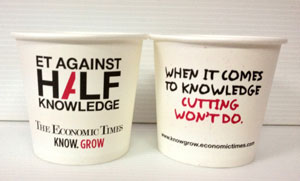
    As part of its ongoing campaign against Half Knowledge, ET launched a unique activity targeting working professionals at tea stalls outside corporate parks. Called Tea with ET, it is an unusual tea-stall act over three cities. Nearly two lakh corporate executives who visited any of 120 tea stalls in and around corporate parks in the three cities over three days were greeted with a custom-designed tea cup. The messages included lines like ‘When it comes to knowledge, cutting won’t do’; adapted for Bengaluru as, ‘When it comes to knowledge, by 2 won’t do’ etc.


    The teacup activity was experienced by executives across tea vendors at major corporate campuses such as Peninsula Corporate Park, Express Towers, Kamla Mills in Mumbai; Global Business Park (Gurgaon), International Trade Tower, Statesman House in Delhi and IBC Knowledge Park, ITPL, Salapuria Infinity in Bengaluru. This was part of The Economic Times’ latest marketing campaign Against Half Knowledge. The objective of this particular activity was to engage with India Inc’s young workforce in casual settings with a whacky yet serious message.


    Conceived by Lowe Lintas + Partners, the campaign – ET Against Half Knowledge “seeks to connect with young corporate executives wherever we can find them – at corporate parks, in our newspapers, on TV, radio, in coffee houses, on Facebook and other Internet channels, on the road, in cinema houses. We are using all channels that connect them with us,” said Ravi Dhariwal, CEO, BCCL. The campaign uses humour, colour and illustrations in an otherwise serious category. Much of the campaign rides on media channels owned by BCCL and Group companies.


    Multi-media approach

    The print campaign exposes the various stereotypes of half-knowledge people, in office and outside. “With a compelling combination of colourful illustrations and witty lines, the ads bring out the reasons why we need to arm ourselves with relevant, continual knowledge and ward off half knowledge. Some of the lines include: ‘Half Knowledge is always very loud, never necessarily clear’; ‘A visit to the auto expo and Half Knowledge becomes an auto expert’; ‘Half Knowledge has an answer to every question, even before it is asked’,” said Mr Dhariwal.


    Lodestar handled Media Planning, Indigo Consultant & Technology for Website outreach, Windchimes was involved with Social media engagement and several other agencies such as Fountainhead, Hungama Digital Services, Elevate and Candid Marketing have executed on-ground activations.


    “The trio of TV spots is a fresh jab at short film-making and a creative introduction to three Half Knowledge stereotypes. “In just 30 seconds, we are introduced to a body-painted “Corporate Explorer”, who, in turn, introduces us to Half Knowledge stereotypes in the form of Last-Mile Repeaters; Elevator-Leeches; and Watering-Hole Hunters. The satirical narrative exposes Half Knowledge types that bump into us in our private and professional lives every other day. Those that are waiting to find the opportune moment to try and sound intelligent, offer suggestions that are mostly wrong, and feed off opinions that aren’t their own,” he said. The TVC is currently playing on Times channels (Movies Now, Times Now, ET Now), besides Star Movies, HBO and National Geographic Channel. Apart from this, three catchy jungles dedicated to Half Knowledge types were run on Radio Mirchi and additionally onRadioCityin Bengaluru, Big FM inDelhiand Red FM in Mumbai where listeners were invited to dedicate the Half Knowledge jingle to anyone in their office or peers. The campaign was launched with its own microsite – www.knowgrow.economictimes.com – and Facebook page – www.facebook.com/etagainsthk. Both sites also run a series of contests that invite consumers to win some cool merchandise by sharing their views and stories on Half Knowledge. Airports and some strategic locations were taken up in Mumbai,Delhiand Bengaluru for a period of a month to amplify the message.


    In a partnership with Cafe Coffee Day, 24 cafes inDelhi, Mumbai and Bengaluru carried tent-cards busting common Half Knowledge myths. Branded newsstands carried the day’s copies of ET for visitors to sample and read the newspaper and dispel other such myths. Media planners, Creative Directors, CMOs and CEOs of about 204 companies (creative agencies, media agencies, top marketers in FMCG, Auto, BFSI, Luxury), were sent a bright green box, which instructed them to prick a balloon (with an elegant pin placed inside) and burst a Half Knowledge myth – that ET is only about finance and stock markets.


    In the first week of April, over 80 percent of the 2,000-plus attendees at GoaFest were rapping at the ‘ET Against Half Knowledge’ booth. A graffiti wall invited them to doodle and have their say on the subject. A Balloon Wall was burst with darts and revealed ET’s depth of coverage such as Business of Brands, Worldview, Personal Technology etc. And a specially made song Against Half Knowledge saw people rap to the lyrics.


    Participation

    The campaign has witnessed over 1.6 lakh active participants on digital and on-ground media in a span of a month, besides the engagements that we have generated with millions of consumers in mass-media – print, TV, radio, outdoors. The thought behind this campaign was to start a dialogue with young corporate executives, but in an unconventional manner.


    “Everybody knows The Economic Times as a knowledge powerhouse and an essential catalyst for professional success. So just saying so would have gone unnoticed, elaborated Mr Dhariwal, adding, “At the same time, we found a growing trend of 2-minute experts (like 2-minute noodles) mushrooming everywhere around us, but being particularly disturbing in corporate life because of their potential for harm. This gave us the chance to experiment with a lateral thought – half knowledge and how it comes in the way of your growth, hence staying in touch with ET everyday for continual learning and professional growth.”


    The campaign, which has been rolled out nationally, will run in phases through the year.


  • Maxim India creates augmented reality experience through TELiBrahma

    By A Correspondent


    The November issue of Maxim India decided to bring the Cover Page to life by using the most successful augmented reality technology of TELiBrahma. It enables Augmenting the real world with digital engagements in order to deliver unique and interactive experience for the readers.


    Maxim India joined hands with TELiBrahma to take the print editorial to the next level by using intARact app – World’s lightest augmented reality browser available across iOS, Android, Windows, Blackberry, Symbian and Java mobile phones.


    When users scan the cover page of the Maxim India from their camera enabled feature phones, smartphones or Tablets using the intARact app, the cover page editorial comes alive into an interactive experience. Through this users will be directed to exclusive videos and slide shows of Lisa Haydon. Users would also be directed to mobile site; social media connect and watch the previous cover page videos of Maxim.


    Commenting on the tie up Piyush Sharma, CEO, Maxim India said “Maxim being the ultimate celebration of being a guy, and being young at heart blends seamlessly with a strong personal medium such as mobile. And our alliance with TELiBrahma is a natural alliance of two leaders in complementing industries. We definitely are expecting great results for both our brands and above all the end users. We strongly believe that going forward our association will go beyond providing robust and measurable engagement and ultimately together we will be able to deliver our advertisers a total performance oriented return on their investment. I would like to congratulate entire TELiBrahma team for their great foresight and perfect first execution with the augmentation of our November 2012 issue.”


    Narasimha Suresh

    “We are happy to partner with Maxim India. Augmented reality allows traditional forms of media to life by driving them into exciting fresh digital content. It also offers a unique opportunity for media houses to integrate static print communication with the digital content, thereby making print as the real spring board for Digital ++.It also allows the publisher to retain continued interest in the print product throughout the shelf life of the product,” said Narasimha Suresh, CEO & Founder, TELiBrahma.


  • Aaj Tak upbeat on social media

    By A Correspondent


    Hindi news Channel Aaj Tak has crossed the one-million mark on Facebook. The channel boasts of more than a million fans in the digital world. Aaj Tak on Facebook has been actively engaging with the audience by using various tools and mediums such as debates, polls, issues & news. Social media is a high interaction platform where the communication is between both the parties. The channel has been raising issues on the digital platform.


    The digital platform at Aaj Tak is currently managed by the in-house team. Salil Kumar, CEO – India Today Group Digital said that it is critical for a news channel to be present on social media. He said, “In today’s environment the audience we cater to is always on the move, their content consumption devices and hence the patterns have evolved and will continue to do so. He is connected to the world, almost 24 X 7. He not only is someone who consumes content (consumer), but has also become a contributor (social editor) and a disseminator (publisher / share), and a critic (feedback / dislike).  He seeks news not only through hard core news sites / channels but also through his social network. Hence FB and its community is a critical part of our overall strategy.”


    Aaj Tak is also monetizing its FB page, though Mr Kumar did not divulge further details.


    Going forward, the channel plans to leverage the social media connect aggressively. “The social media connect will always remain an integral part of Aaj Tak. Going forward, I would like to leverage the social connect to build a large collaborative community helping us interact and  stay connected with our audience and will be a permanent place holder on the second screen,” concluded Mr Kumar.


  • MxM Monday: Paid news – yes or no?


    By Ananya Saha


    Mediaah! Are disclaimers enough to pass off paid content?

    Readers expect the content in the newspaper to be published based on the decision of the editor, and not an advertiser paying for it, writes Pradyuman Maheshwari. Read more…


    Paid content such as Medianet has gained much ground. Despite flak from different quarters, it appears that buyers are still willing to pay for space that resembled news and features. And readers may never know the difference. More media houses have begun indulging in paid content, but surely that does not make it right?


    We ask industry folks to weigh in with their views.


    Arun Anant, CEO, The Hindu Group of Publications

    People may not know that some newspapers carry paid-for articles, and some people do not care either. That does not make it right. If an article is paid for by an advertiser, it should be made clear that there is an interested party that has paid for it.


    Ranjona Banerji in ‘Freaking News’
     

    :: Medianet mars an otherwise trendsetting paper

    :: Not too late for TOI to correct practices


    Santosh Desai, MD, Future Brands

    Globally, it has become a phenomenon where sponsors pay for news. There needs to exist a clear difference between journalism and an act of promotion. If not kept separate, the line of demarcation will blur between the two. However, what is more dangerous is that when news is influenced by a transaction. Many do not care about Page 3, so if you have paid for it, it does not matter. The issue arises about hard news, when you do not know who has paid for it. MediaNet in itself not a wrong thing as long as you are announcing it who is paying for it. For instance, if you are reporting about a policy being announced and you do know which political party or a corporate house has paid for it. What is a much bigger issue is the corporate ownership of the media houses. There has to be a divide between news and advertisement: and how do you tell it? How do you divide ownership and journalism: and do you – that is more serious threat than MediaNet, in my opinion. The bigger point is about trusting the ‘news’.


    Bharat Kapadia, Chairman, Whatuwant Solutions, and Founder at ideas@bharatkapadia.com

    Using Medianet is completely unethical – whether readers do not seem to notice it or whether they do not care. There are two parts to it: the publisher and the readers. The publisher has been doing it for a much longer time than visible, especially at the time of elections. The readers, unless told, would not know which news is being paid and which is not. When, it all began, Bombay Times used to mention with a small symbol that it is paid news. Now even that is gone. People buy or consume news media trusting for a fair perspective. Now, if this perspective can be influenced, it is definitely not fair.


    Anamika Mehta, COO, Lodestar UM

    My personal point of view is, for a newspaper or any other medium, there are different and more questions about paid content. It happens globally in various forms but of course, it is not a good practice. A lot of brands and advertisers have jumped on this wagon, yes, but as a responsible media one should know where to draw the line. If one considers Page 3, where you can pay to get featured, it is all for entertainment. So one does not seem to mind. The moment it starts entering news or motivate political, business or economic sentiment, then it is a problem.


    One can see that business pages also carry small snippets or news that might sway the reader into investing in a particular stock, or to create impact. Some of the brands do MediaNet for promotion. However, a line needs to be drawn. The reader should not be misled, and motivated information should be kept under check.


  • TOI celebrates ‘dodransbicentennial’; to launch TV channels & radio stations

    By A Correspondent


    This year, The Times of India celebrates 175 years of existence (dodransbicentennial is the word). To celebrate and mark the occasion, the year for Bennett Coleman & Company Ltd began with film awards event TOIFA. And the celebrations will continue through the year.


    To kickstart the journey, Vineet Jain, MD addressed all the employees of BCCL and TTN through the Live Video Streaming on Monday, April 22, 2013, simultaneously in 13 offices around the country. Ravi Dhariwal, CEO-Publishing, BCCL and Shrijeet Mishra, COO, BCCL joined Mr Jain on the scope of the year-long programme.


    While addressing the employees, Mr Jain said that the group will be launching more television channels and radio stations soon. The television channels would be in the genre of general entertainment and regional channels. Mr Jain also shared the history of the group with the employees.


    In a signed full-page editorial, editor Jaideep Bose writes: “Like India, The Times of India too is a mass of niches, and like India, we’ve become adept at managing and marrying contradictions. This big-tent philosophy opens us up to all kinds of criticism. We have been accused of being “hard” and “soft” on the same government; of being “too negative” and “too positive ” in our coverage; of being obsessed with cricket, crime and cinema — and yet being preoccupied with politics. (We have also been accused of being “too commercial”, but how many of our readers know that several companies and governments have stopped advertising with us because we wrote something they didn’t want us to, or we didn’t write something they wanted us to. Our refusal to bend to their will has cost us hundreds of crores.)”


    Meanwhile, a TVC starring actor Ranbir Kapoor drives home the message of the celebrations. The emphasis is clearly on attracting the youth. In fact the footnote of a front-page ad created by Taproot states that: “As we complete 175 years, we don’t just look back at what we have achieved but also look ahead at what we hope to do. We aim to begin an intensive year-long programme of initiatives to mobilise the youth and make changes at the grassroot level. And we prepare to not just write, but shape the story of a better, more powerful India.”


  • Lifestyle content in Braille via ‘White Print’

    By Ananya Saha


    Upasana Makati

    India is home to 12 million visually impaired people of which 56 lakh are literate. While we do have loads of literature to read, the literate visually impaired people have to depend on audio books, screen-reading software or radio for entertainment. This is the thought that motivated 24-year-old Upasana Makati to launch White Print, an English lifestyle magazine in Braille. The first issue will debut in May.


    A graduate in Mass Communication, Ms Makati wanted to do something on her own. The home-grown initiative was born to cater to the needs of the visually impaired community and be a source of information and entertainment at the same time. Printed at the National Association for the Blind (NAB) in Mumbai, the monthly magazine will consist of 64 pages and will feature stories about common man, review of audio books, gadgets, travel and hospitality and food related columns. It also comprises information pertaining to politics, art and culture from across the globe.


    “When one thinks of visually impaired people, we think that their lifestyle must be totally different. But in reality it is not so. When I thought of this magazine, I did a lot of research. It took me eight months to get the title, so I spoke to a lot of visually impaired people. It was very clear that they want such content, but did not have access to it. White Print is an effort to provide the visually impaired community a companion while they are on the go or sitting by the coffee table on a Sunday afternoon. A magazine that is a source of information and entertainment was long over due and we hope we are able to make a difference in even a small way,” Ms Makati stated.


    Currently, Ms Makati’s team of friends is contributing the articles but the magazine invites young authors to write short stories for it. The articles once received are converted in Braille format at NAB. Priced at Rs 30, the magazine will be circulated throughout the country but will be subscription-driven. NAB will also manage the distribution of the magazine. “The cost of the magazine is less than half of the production of the magazine. I am depending on advertisers, which I hope grow, for revenues. Though very low and subsidized, we also have to pay NAB for its services,” informed Ms Makati who is the founder and publisher of the magazine.


    The magazine cannot carry the conventional printed advertising. Hence, it does text-heavy advertisements. “We just carried a five-page descriptive advertorial of Raymond’s Spring-Summer collection,” she said, adding, “Grand Hyatt Goa has shared one recipe with us. Since I am a first in this space, a lot of advertisers are enthusiastic about this product. But yes, it is also a challenge getting them on board.” Ms Makati makes it clear that it is not a charity that she is doing, and expects the revenues to grow.


    White Print has tied up with Radio City for promotions, apart from making individual calls and sending mailers to their database of visually impaired people. The magazine’s first print run will be 500 copies.


  • Does editorial content need an eye in the sky?


    By Ananya Saha


    Recently, The New York Times set up a news analytics team with the aim of establishing a better understanding of how editorial content is consumed – to know if the content being created is actually working, and if they’re publishing the news the right way, and where and how can they fix the gaps.


    With more and more people consuming and sharing news in real time, do media houses in India too need analytics team to make data-driven decisions? Would it help the editorial decisions? Do Indian media houses need it yet? While Sriram Kilambi of Bloomberg preferred to not comment since Bloomberg is considering it, the industry thinks it is the right time to employ data analytics for editorial decisions.


    Mitrajit Bhattacharya, President-Publisher, Chitralekha Group

    Different media houses have their own methods of assessing the efficacy/ response to their content. We religiously go through the traditional letters and emails from our readers. The feedback is very sharp on new media like Facebook. Based on continuous feedback from our readers we decide to make changes in our edit mix. It’s a continuous process though. Use of analytics is always welcome. It just makes the feedback process bias-free and scientific.


    Niteen Bhagwat, Executive Director & CEO – Asterii Analytics

    The data analytics and its role in news and journalism was the tipping point in US market after the Obama election campaign. Nate Silver, an analyst had predicted that Obama would win even when expert commentators had predicted that Romney might win. However, Silver’s prediction was right since he based his theory on data available. He made an editorial comment based on marketplace. Now, that was the tipping point. There is a lot of data around that can be used. Even the US papers moved to data-based journalism from opinion-based journalism.


    There are three kinds of journalists in a news room: traditional, social media or digital-friendly journalists, and quant or quantitative-oriented journalists. Quant journalists are the ones who can make sense of huge amount of data. Now, whether it is journalism, corporate communication or PR, we will need people in all three buckets or people who have all three qualities.


    The second point is, NYT is one of the 100 publications that have a metered payment gateway. And it has registered more subscription revenue than advertising revenue. This makes the publications enjoy more freedom when it comes to content. With data analytics in place, one can understand the online reading habit – can know the demography, or which part of the publication is being consumed more, which will allow more tailor-made content.


    Shantanu Bhanja, VP (Marketing), HT Media Ltd

    Yes, for sure. While the editorial judgment is paramount, analytics are valued inputs to that judgment. Our analytics team helps us give the editors a pulse of the consumer, as well as feedback on our news offerings in real time as well as over periods of time. The final editorial decisions are taken solely by the editorial team. However, an analytics team provides the reader interface. We carry out various studies, both online and offline some continuous (with different periodicity) and some as and when the need arises.


    Projit Chakrabarti, Head – Marketing Services, NDTV Limited

    Well certainly for genres of news that fall into the category of ‘information’ or ‘news you can use’; with more and more 360-degree targeting to the consumer  becoming increasingly relevant, data and analytics will drive the dissemination of certain kinds of news and information. It will most certainly help from a contextual and utilitarian point of view but may be not so much from an editorial point of view. Indian media houses definitely need it.


    Ashish Pherwani, Partner, Advisory Services, Ernst & Young

    At the end of the day, a media house (whether TV, print, radio, website, whatever) provides audiences to advertisers.  With the growth of digital distribution channels and the proliferation of lower-cost hardware options, audiences are changing the manner in which they consume content.  Hence, media houses now not only need to provide their content to their audiences in the manner and format of their choice, but also keep using analytics to understand changing audience preferences, to better cater to them.


    Analytics will also enable better sales efficiency – enabling ad sales teams to sell in a more targeted manner. And of course, editorial teams, to understand what type of content do their audiences prefer, at what time and how it must be packaged. Hence, analytics leads to (1) better serving the audience and (2) better monetization of the audience.


  • Growing to No1, ethically: Maheshwer Peri


    By Ananya Saha


    After spending 18 years as the publisher of the Outlook group, Maheshwer Peri launched Pathfinder in 2009 with the aim of making it India’s largest and most credible career counsellor in five years’ time. While still a mentor with Outlook, he has been associated full-time with Pathfinder since April 2012. Mr Peri rewrote the plans for the magazine, closed a publication, injected positive energy and weaned out negative energy.


    With an aim to reach students on a platform-agonistic way, Pathfinder’s magazine Careers 360 offerings are available in print, web and mobile. And it is succeeding. The webpage of the magazine has recently overtaken the more established portals, becoming India’s largest education and career portal.


     In a freewheeling conversation with MxMIndia, Maheshwer Peri, Chairman and Founder, Pathfinder Publishing, talks about the publication and the high digital notes it has been striking. And whether his ethical standards have come in the way of advertising.


    How has the journey of Careers 360 shaped up?

    It has been fantastic for one simple reason: there was no one who was competition. There was no one who approached the genre at all in terms of journalism, content and student. Everything you had in the market till that point in time was marketing or advertorial features that were coming up because there was an advertiser waiting. There was no one who made a model which is to say that student will buy this product, which is suited for the student and not for the institute. From that perspective, it was a complete paradigm shift.

    Even today, the content that you see is created because there is an advertiser around. They are advertising and marketing features. This is a first product that has been created with student in our mind. That is why the journey has been good, since there was no one as competition.


    Does the magazine attract a different set of advertiser then?

    The advertiser had multiple options. In any business, or publishing business, you need to create something that attracts readers. Once the reader is there, the advertiser follows. In any niche, if you are to create content because of which a set of loyal readers follows you, the advertiser follows. They cannot avoid us – that is the stage at which we are.


    Has the print run of the magazine increased as well?

    The initial print run was very high earlier, of the English and Hindi magazines of Careers 360. It was about 1,80,000 but today we print about 1,30,000-1,40,000 copies. We sell about 1,20,000-1,25,000 copies of which 30,000-40,000 are school and college libraries.


    Have you broken even yet?

    No. It’s an investment phase. The reason why I think it is a case study… there has never been a case in India that a single stream of content has been monetised over multiple platforms. The articles that we do are backed by data. And that data has to be complete. So we decide how much of that should be put into the magazine, and the balance we put on the web. There are journalists who create content, which is suitable for the magazine, for our almanacs and guidebooks and for the website, and going from there to the physical career workshops that we do.

    The challenge is if I were to say if the magazine would break even, it would not. Because I am still going though the phase of seeing how many more platforms I can grow to and keep investing in those platforms also. It is definitely going as per my plans and projections.

    On the digital space, we are the No 1 website in the country. One or one-and-a-half-year ago, when I started this journey, I had 4,000 students on the site each day. Today we have guaranteed 100,000+ each single day.

    Now the challenge for me is; since I have become the largest website in the country, the largest website has 10 crore of ad revenues and sitting on 5 crore of data. And I do that, yes, I will make money. That is the next step for me. Now that I have got the audience, I will monetise that.


    What are the factors responsible for the growth of the web presence of the magazine?

    I realized that the content we are creating for the magazine is not being leveraged. It is just limited to the magazine, so for me the challenge is how I invest myself in a way that the content I create can reach out to plenty more audience.

    Today 2-2.5 million students come to my portal every month. That is 30 percent of the audience of that category. Today if 1.4 million students have opted for engineering, and one million students have come to my portal, it captures 70-80 percent of the students. For each of the verticals, I need to say that I reach out to more than 30-40 percent students. And that is with the guidebooks, almanacs, counselling workshops, magazine, and digital portal.

    If you look at the content creators in the country, we are the largest content creators. There is no one who comes close to even 10 percent of what we do in the marketplace. The reason why student come to us, they have more and enough value to add to their decision-making.


    Has the strategy for magazine changes over the year?

    Strategy has changed to the extent that the moment we talked about digital. The typical thing that journalist does is goes and collects information, edits it, and puts out a 1,000-word story. This is not exactly career-driven journalism thing here. It is actually lot of data also. We are not just advisors; we are counsellors to the students. And counselling means two-fold integrity for us: financial integrity where no one is able to influence the way I right. The other big part of integrity is that we have covered everything so that student makes an informed decision, which means I have not omitted anything because of lack of research. It is important that the student does not suffer because you did not inform him of a very good option, which he otherwise should have known.


    Are you considering any brand extensions in the near future?

    Online we have lots of products. There is student space. There is mock counselling on our Engineering page. Each student pays Rs1,499 to take our advice. It is based on the data and information that we have collected in the magazine for our website. If a student comes and asks, ‘I have got a JEE rank of 11,000, what should I do?’ I give him seven options because I have cut off of all colleges in the country, which no one has. All that information that we research, collate is sitting with us. In my opinion, we are the best position advice student what to do. if the student’s choice if for five, I will make it eight. We optimize students’ choices, include one or two that he doesn’t know or remove what I think are bad for him. It is for him to decide where he wants to join, because I am not an agent.


    And is the counselling handled in-house?

    We have counsellors. We appointed a BPO company in Bangalore, which created all data for us. So the data is for more than 6,000 colleges and it cost a lot of money to create the data. I cannot do the data myself. We have journalists, a set of digital content creators, and data people, which is a BPO, working from Bangalore. Increment in further content creation would take 1x cost to become 1.5-or-1.8x cost. But the 1y of revenue can become 3y. That is the whole objective here: how do you add 10-20 percent investment in cost to add another stream of revenue that gives you one more ‘x’.


    You also closed down Competition 360. Why?

    When I moved from Outlook, I actually had three publications: Careers 360 English and Hindi and Competition 360. Competition 360 was dealing with competitive exam in the market like Competition Success Review or Pratiyogita Darpan. What I realised was there were many who were doing far better job than me, whereas in career-side, there was no one who was doing it. It is important for me to focus on something that I see as my path. So today my path is that I want to be India’s largest career counsellor; I want to be hand-holder for this country’s biggest student community. The moment that is decided, I am not getting into the job space and competition space. I am not going there because there are people who are already doing wonderful job out there and they will continue to do that. It doesn’t need me.


    You’ve been asked this earlier, but in the light of the strides you’ve taken: Outlook was going great guns under your leadership so what prompted you to start Careers 360?

    At some level, there are many people who will do Outlook. Aspirationally, Outlook is there. In India, and it has nothing to do with me or Outlook, you will see a lot of people getting into mainstream media or celebrity media. You would not see anyone coming into a morbid area, which is education. It’s standardized and regulated. But if you look at the demographic dividend that India has, the biggest demographic dividend would be when you handhold the students to nurture them otherwise it will become a nightmare. Someone has to handhold them otherwise we are sitting on a time bomb.


    What exactly is your role at Outlook now, and has it changed in the past one year?

    I am still the Mentor and Publisher. In fact, in March it was to get over but it got extended I am continuing for one more year. Me and my promoters have a fantastic equation. I will not influence that they remove my name. As long as they want, I will be around. Whenever they call me, I will be there. Period.


    Who handles the sales and marketing for Careers 360, now? Is it being handled by Outlook still?

    There are 4-5 people in my team, two of them were in Outlook. One, I always had arrangement with Outlook that I will never poach a single person from there. And I have stuck to it, and will even going forward. But these were people who were handling Careers 360 in Outlook. And they have moved with me.


    What is your next target for Careers 360?

    Within the next two years, Careers 360 would be India’s largest career counsellor. I would want to say that about 20 percent of students in India take a decision because Careers 360 influenced them. The day I start influencing the decision, and already we are doing it and handhold the students and also tell the institutes what students think about it: I have done my job. In India, regulators want to control without giving freedom to the private guys and institutions do not want any control. The balance is between them: the regulators need to give bit of freedom while institutes need to understand that their freedom is going to be limited by what regulation would want.

    We are aiming to achieve this balance.

    In a larger sense, this country has to start invest in its youth. And I hope more mainstream publications understand. Health, religion and education and jobs are the biggest things for people in India. In every mainstream media, these are supplemented by marketing activities. People like us come in because mainstream media has somewhere ignored it.

    Apart from the great things that Careers 360 is doing, you are also becoming very ‘activistey’.

    As Outlook, whatever I say was Outlook. It was a news media. There is no identity as Maheshwar Peri; it was only an Outlook publication. My view need not be Outlook’s view. In certain positions, you don’t have your own voice. It is the position that carries the voice. And I did not want any confusion between Outlook’s voice and my voice, so I was never active then. I was very conscious of the fact that whatever I speak is going to be taken as voice of Outlook. And now that the burden of Outlook is not with me, I have my own voice, which is what is coming out.


    Given your ethical stands on many things, has your advertising suffered?

    Yes, but that is again a conscious call. Whenever you take a stand, there are bound to be a set of people who will not stand with you. The current market situation is: I will give you an ad what will you give me in return. Not that is much more prominent in education sector. All these institutions are colleges are looking for ratings and rankings and some kind of coverage. And there are people who do that in the market. But again I say that once you create the content, which makes the reader stick to you, the best of the advertisers cannot avoid you; and then the other follow because the best advertisers are with you. There is a change that you need to crack. It takes a lot of time, perseverance and stamina. That is something I always had. When I launched it, I said I will create a DNA where nobody can change the credibility of the magazine or question the credibility of the magazine.

    So initially, when people were saying “Why don’t we have those guys and these guys”, I said, “Let’s create a DNA first, come what may”. It means lot of cost, money, time. But all those things are fine. Once we create the DNA, even when we go out unless we go to a new advertiser, the old advertisers know that they cannot bend us.


    Very recently, I went to an advertiser in the northern part of India. He looked at the magazine, and said, “Obviously, we cannot buy you.” So I was very intrigued and asked him what made him say so. He said, “Typically when we give an ad, our ranks are very high. In your magazine, we have given our ads in your magazine, but our ranks are very low.” That is the image that has reached the advertiser, for each time and every time, and I think we have managed to do that.



  • Sunil Mutreja bids adieu to Amar Ujala

    By A Correspondent


    Sunil Mutreja, Executive Director at Amar Ujala has decided to move on. He confirmed the development to MxMIndia. However, his next destination is still unknown, though industry sources tell us he’s mulling entrepreneurial as well as job options.


    Having joined the company in 2007 as President, Marketing; he was elevated to as ED in 2011. Prior to joining Amar Ujala, he was the CEO of Advertising International Corporation LLC (ADINC) Y&R for a year in Muscat. He began his career, which spans over three decades, with The Times of India in 1989. He was associated with the company for four years. He also became AVP at Times TV for a year. He has also worked with Dainik Bhaskar, and as CEO with Channel Nine Entertainment as well.


  • Hindu’s ‘Undumb India’ campaign awarded at INMA World Congress

    By A Correspondent


    The Hindu has won the award for digital audience usage and engagement for their ad campaign ‘Undumb India’ at the 83rd Annual INMA World Congress, New York. The award recognised The Hindu’s successful strategy that was adapted to print, outdoors and radio in a 360-degree campaign that placed it firmly at the top, as far as credible journalism goes. While the campaign went viral on social media last year, the television commercial took a humorous route to show young Indians the importance of being informed about current events. The campaign message ‘Stay ahead of the times’ caught on as readers became evangelists for the brand.


    The campaign that was posted on YouTube reached audiences of over 1 million within a matter of days.


  • Kyoorius launches awards with D&AD and IAA as partners, to be held at Design Yatra in Goa

    By A Correspondent


    Design and communications publication Kyoorius has announced the launch of the Kyoorius Awards. The awards are in partnership with D&AD and the International Advertising Association (India Chapter).


    Conceptualized with the aim of recognizing and rewarding excellence, innovation and originality; the Kyoorius Awards ceremony will be held at the 9th annual Kyoorius Design Yatra in Goa on August 29.


    With nine categories spanning print, packaging, digital, retail and design for good, the Kyoorius awards will not only recognize professionals but give real focus to young talent with the student awards.


    The student awards will bring together some of the biggest names in the industry to create real briefs that students will work on – providing them a chance to showcase capabilities in real-world scenarios. A jury comprising of some of the best creative minds from across the world has been carefully selected by D&AD together with Kyoorius. Rather than online, the jury panel will fly down to India for a discussion-based jury session to judge all submitted entries.


    Rajesh Kejriwal, Founder CEO, Kyoorius said, “At Kyoorius we are working every day to ensure that talent is nurtured and fresh ideas see the light of day. Kyoorius Awards aim to recognize and honour outstanding creative work in India. We are thankful to our esteemed partners D&AD and IAA (India Chapter) for coming on board to support this initiative.”


    The D&AD Yellow Pencil is recognized the world over as the most prestigious amongst creative awards. Tim Lindsay, CEO of D&AD said, “At a time when global creative industries face continuing tough economic challenges, delivering outstanding creative work worthy of an award can be a valuable point of differentiation. Excellence in creativity inspires higher quality work, raises the bar and delivers success for business.”


    Mr Lindsay added, “Joining hands with Kyoorius works in tandem with the objectives of D&AD, which aims to inform, educate and inspire those who work in and around the creative industries. Together, we aim to support and nurture creative professionals throughout their careers and across the world.”


    Kaushik Roy, immediate past president – IAA India Chapter, said, “We know the power of design and it is crucial that we support and award the best creative minds in India. We, at IAA are excited about the partnership with Kyoorius and D&AD and feel this platform will futher IAA’s work in supporting and helping grow the creative industry in India.”


    Entries close on June 18, 2013. More information is available at awards.kyoorius.com.