Category: PRINT MEDIA

  • IRS 2011 Q2: Top 10 Magazines

    Top 10 Hindi Magazines

    Only Grehalakshmi and Grihshobha have seen a loss of readership from Q1 to Q2 in the Hindi magazine space.

    (All figues in 000s)

    Publication Periodicity 2011 Q1 2011 Q2
    Pratiyogita Darpan M 2027 2154
    Saras Salil F 1945 2039
    Cricket Samrat M 984 1213
    Meri Saheli M 1100 1174
    India Today W 1137 1144
    Grehlakshmi M 1031 1010
    Grihshobha F 1061 1008
    Champak F 843 873
    Vanitha M 707 764
    Nirogdham Q 711 763


    Top 10 English Magazines

    Ooops! General Knowledge Today and Competition Success Review have seen a degrowth as have Filmfare and Stardust. It appears interest in current affairs is waning.

    (All figues in 000s)

    Publication Periodicity 2011 Q1 2011 Q2
    India Today W 1650 1724
    Readers Digest M 960 998
    General Knowledge Today M 1002 977
    Competition Success Review M 684 654
    Outlook W 438 456
    The Week W 325 396
    Filmfare F 382 366
    Stardust M 352 342
    Femina F 337 339
    Business Today F 309 333


    Top 10 Language Magazines

    Malayala Manorama, Mathrubhum iArogya Masika, Ananda Vikatan, Mathrubhumi Thozil Vartha and Kungumam have seen some degrowth from Q1 to Q2.

    (All figues in 000s)

    Publication Language Periodicity 2011 Q1 2011 Q2
    Vanitha Mal F 2653 2671
    Malayala Manorama Mal W 1413 1393
    Kumudam Tam W 1066 1066
    Karmakshetra Ben W 894 916
    Mathrubhum iArogya Masika Mal M 929 914
    AnandaVikatan Tam W 879 847
    Balarama Mal W 812 818
    MathrubhumiThozhilVartha Mal W 816 790
    Karmasangsthaan Ben W 686 738
    Kungumam Tam W 725 722

    All figures are in Average Issue Readership. Like media buyers, MxMIndia only endorses Average Issue Readership as the currency for readership measurement. Please note that these are only topline figures which have officially been supplied to the media. Sensible buying and planning happens when more data is available.

  • IRS 2011 Q2: Top 10 Dailiies

    Top 10 Hindi Dailies

    There is no change in the pecking order here. Dainik Jagran rules, Bhaskar is second and Hindustan is #3. Amar Ujala, Rajasthan Patrika, Punjab Kesari occupy the fourth, fifth and sixth slot respectively. Navbharat Times, Prabhat Khabar, Nai Dunia and Hari Bhoomi are #s 7-10. Rajasthan Patrika, Punjab Kesari and Nai Dunia have degrown from Q1 to Q2 as per the topline figures posted by Hansa Research.

    (All figues in 000s)

    Publication 2011 Q1 2011 Q2
    Dainik Jagran 15910 16393
    Dainik Bhaskar 14016 14174
    Hindustan 11810 11985
    Amar Ujala 8747 8891
    Rajasthan Patrika 7033 6941
    Punjab Kesari 3479 3414
    Navbharat Times 2589 2650
    Prabhat Khabar 1812 1893
    NaiDunia 1762 1714
    HariBhoomi 1418 1437


    Top 10 English Dailies

    Mount Road MahaVishnu ‘The Hindu’ has degrown and so have Mumbai Mirror and The Tribune, albeit insignicantly.

    (All figues in 000s)

    Publication 2011 Q1 2011 Q2
    The Times Of India 7442 7471
    Hindustan Times 3692 3737
    The Hindu 2095 2077
    The Telegraph 1203 1209
    DeccanChronicle 1035 1088
    DNA 822 824
    The Economic Times 769 785
    Mumbai Mirror 780 758
    The Tribune 569 567
    The New Indian Express 550 559


    Top 10 Language Dailies

    As per the topline figures put  by Hansa Research and MRUC, Matrubhumi, ABP, Gujarat Samachar and Daily Sakal have all lost out in Q2 vis-a-vis Q1.

    (All figues in 000s)

    Publication Language 2011Q1 2011Q2
    Malayala Manorama Mal 9938 9962
    Lokmat Mar 7486 7595
    Daily Thanthi Tam 7187 7290
    Mathrubhumi Mal 6800 6690
    Ananda Bazar Patrika Ben 6118 6063
    Eenadu Tel 5991 6032
    Gujarat Samachar Guj 5276 5220
    Dinakaran Tam 5123 5167
    Sakshi Tel 5042 5106
    Daily Sakal Mar 4568 4448

    All figures are in Average Issue Readership. Like media buyers, MxMIndia only endorses Average Issue Readership as the currency for readership measurement. Please note that these are only topline figures which have officially been supplied to the media. Sensible buying and planning happens when more data is available.

  • Join the MxMIndia Monday Debate: Are our papers and channels scared of taking on Big Biz?

    The Monday News Debate @MxMIndia

    The news media today is an exciting place – not just because of phenomenal growth but also because of all the questions that this growth throws up. The advent and massive expansion of television and now the explosion of the internet pose new challenges every day to traditional precepts and practices of journalism. The Radia tapes, the Murdoch revelations, the Anna Hazare movement all led to much discussion and even heat within and outside the media.

    Keeping this in mind, MxMIndia announces a new feature – a series of debates (and discussions) on issues which affect, concern or threaten the news media. Some of these will be by invitation but we also invite our readers to participate by suggesting issues that need taking up and contributing to the debates.

    We are starting out with the news media, but will in addition move to areas of marketing, advertising and the media later.

    Here’s how it will go. Each month, we will tackle one issue. So October will be Big Business and the News Media.

    It’s an old problem and one that never seems to go away: how does a media house reconcile between the principles of journalism and the need to make money? In today’s context of paid news and adspace-for-equity deals, is the media frightened to take on big business for fear of losing revenue? Are they not therefore, in the long run, depriving the reader of legitimate news which may well make a difference to their lives? We foresee an exciting discussion in the making. Did someone say slanging match?


    If you have a view on Big Business and the New Media, email us at editor@mxmindia.com with the subject line BBNM. On every Monday in the month of October, we’ll carry your views as well as those of commentators whom we invite to write.


    MxM News Debates will be coordinated by Ranjona Banerji, senior journalist and Contributing Editor, MxMIndia.

  • IRS 2011Q2 | State Watch: Dailies

    By Ritu Midha

    A quick look at data for top 10 dailies in a handful of states brings out a few interesting observations. Do write to us at editor@mxmindia.com with your own observations and insights.

    Bihar: All the newspapers show a positive growth vis-a-vis the previous quarter. Even when compared with the same quarter previous year, all the publications show a good growth except I Next. Interestingly English dailies too have grown – and in case of Times of India, it has maintained the same level as the previous year same quarter.

    Jharkhand: When it comes to its neighbour and a part of Bihar till recently it is quite a different story – six out of top 10 dailies show a negative growth – and it is across Hindi & English dailies.

    UP: Just like Bihar, UP too has shown a growth in all the publications as compared to the previous year with the exception of DLA. Amar Ujala compact is growing the fastest with readership increasing to double in comparison to same quarter previous year.

    Uttaranchal: Uttaranchal too shows growth in all the publications but one, when compared to the previous quarter. Interesting thing however is that Amar Ujala compact that shows the fastest growth figures in UP, here shows a drop of 61%, as compared to same quarter last year.

    MP: If one compares data for Q2, 2011 with Q2, 2010, Nava Bharat (MP) and Raj Express are the only two publications that shows a fall. Another interesting factor here is that The Times of India is the only English publication in the top 10, unlike UP and Bihar where there is almost an equal number of Hindi and English Publications.


    Chattisgarh: In case of Chattisgarh, there are three English dailies in the top 10, however all three show a negative growth when compared to the previous quarter. Though, in case of The Times of India, if compared with Q2, 2010, figures show a 27.3% growth.


    Himachal Pradesh: Six out of top 10 dailies show a negative growth when compared with the same quarter in 2010. Amar Ujala, on the surface, seems to have gained at the cost of Punjab Kesai, while in case of The Hindustan Times, it is at the expense of The Times of India. A deeper analysis, perhaps, can throw more light on it.


    Haryana: In case of Haryana, q2 2010 to Q2 2011, three publications show a downturn, but when it comes to Q1 2011 vs Q2, the downturn is seen in seven publications – all the three English papers in the top 10 show a percentage fall when compared to the previous quarter.


    Punjab: In case of Punjab, only two publications of the top 10 have witnessed positive growth when compared to Q2, 2010 – These are Ajit and Dainik Bhaskar. However, if one compares Q2 2011 with Q1, 2011 even The Times of India and The Tribune show positive growth.


    Maharashtra: In Maharashtra’s top 10 dailies, Times of India and its co-publication Mumbai Mirror are the only two English dailies. Market, as expected, is dominated by Marathi dailies. Deshonatti is the only daily that sees a double digit growth when compared to Q1, 2011 – however, that too shows a 17% fall when compared to Q2, 2010.


    Gujarat: Gujarat too has just one English daily in its top 10 – The Times of India, and it shows good growth in both quarters. Other non Gujarati daily in the top 10 shows a growth of 83.9%, when compared to Q2, 2010.

    To be continued…

  • Mohit Sainani quits Mid-Day, joins Star India

    By Shubhangi Mehta

    Mr Mohit Sainani who was working as the marketing head, Mid Day for the past four years, has quit and moved to Star India.

    Industry sources confirm that Mr Sainani’s designation at Star has not been decided yet but he will be working closely with Mr Neville Bastawalla, AVP marketing,Star India Pvt Ltd. It may be recalled that Mr Bastawala had joined Star India as Head of Marketing for Star World and Star Movies. He too was previously with Mid-Day as Head of Marketing for a little over three years from where he exited early in December 2010.

    Prior to Mid Day, Mr Sainani had a stint with Compass BPO as a Marketing Manager where he reported into the CEO. Before that he worked with Times of India as Assistant Manager and as Relationship Manager with Citibank NA.

    Star India, the leading media and Entertainment Company in India has the highest reach among the country’s broadcasters, beaming to over 140 million people every week across India and over 65 countries across the globe. Its portfolio includes 33 channels in eight languages spanning the household brands Star Plus, Star One, Star Gold, Channel [V], Star Jalsha, Star Pravah, Star World, Star Movies, Star Utsav; along with the joint venture channels Asianet, Asianet Plus, Star Vijay, Suvarna, Star News, ESPN and Star Sports.

    Star India also manages a portfolio of business ventures including DTH operator Tata Sky; cable system Hathway, channel distributor Star Den, news channel operator MCCS, the film production and distribution business Fox Star Studios India and Star CJ Home Shopping.

  • IRS 2011: Metro watch and State watch

    By Ritu Midha

    This article is an attempt at a quick observation of  combined readership of eight metros: Mumbai, Delhi, Kolkata, Chennai, Bangalore, Ahmedabad, Pune and Hyderabad.  The combined data indicates a fall in readership for three publications: Anand Bazar Patrika, Hindustan and Lokmat over Q2, 2010.  All other publications except Daily Thanthi show a single digit growth. Daiy Thanthi shows a sturdy growth of 10 percent.

    If we look at eight metros – The Times of India emerges as the market leader – however, if we look at each metro in isolation, The Times of India leads only in Greater Mumbai. Publications presence in all metros, and that too in the top five, helps it in maintaining leadership position.

    Ananda Bazar Patrika, the number two publication in 8 metros, interestingly, is present in top 10 dailies only in Kolkata – where it is top of the pack.

    Hindustan Times, the number three daily in eight metros leads in Delhi and is number five in Mumbai. It is not in top 10 in the other six metros.

    Navbharat Times, the number four daily is at number three in Delhi and Number nine in Mumbai – it is not there in the top ten in rest of the metros

    Gujarat Samachar is at number five in eight metros  – it is at number two in Ahmedabad and number four in Gujarat. It, too has no presence in top 10 list of any other metro.

    Daily Thanthi leads in Chennai, and is at number eight in Bangalore – and this brings it at number 6 position in eight metros.

    Lokmat at number 8 in Mumbai, is at number 2 in Pune, and occupies number 7 slot in top 10 dailies in eight metros

    Daily Sakal leads in Pune with a big margin, and by its virtue sits on number eight slot in eight metros

    Hindustan Number 4 paper in Delhi is at number 9 in eight metros

    DIvya Bhaskar, the market leader in Ahmedabad completes the top 10 list


    DNA, in the top 10 in Mumbai, Bangalore and Ahmedabad does not find a place in top 10 eight metros.


    Mumbai: In terms of percentage growth – Hindustan Times show the sturdiest growth – a 27.2 percent jump vis-a-vis same quarter previous year. Interestingly all the Marathi publications show a negative growth, while all the English dailies grow positively. However, when compared with previous quarter seven publications show a negative growth.  Top three publications in the city are from The Times of India stable.


    If we look at Mumbai vs Maharashtra – readership patterns are quite different – Punya Nagri, Pudhari and Daily Sakal – among the top 10 in Maharashtra are not there in Mumbai. In its place are DNA, Navakal and Navbharat Times. While in Mumbai, three of the top five dailies are English. One is Gujarati and the other Hindi, in Maharashtra the picture is very different with  The Times of India being the only English daily in top five – and the other four being Marathi publications.


    Delhi: The gap between the market leader Hindustan Times and the Challenger The Times of India narrows as Hindustan Times sees a marginal fall of 0.7 percent, while The Times of India grows by 1.3 percent from Quarter 2, 2010. Nai Duniya needs a special mention as it has grown by 117 percent, though on a small base. Navbharat Times has also shown a double digit growth – some of it, perhaps at the expense of Hindustan, which has gone down by 3 percent.


    Bangalore: The top five publications have shown a positive growth. On the percentage basis growth over quarter 2, 2010, by English Dailies The Times of India (33.9 percent), Deccan Herald (22.6 percent) and Bangalore Mirror (151.6 percent)is much higher than the language counterparts.


    Bangalore and Karnataka top 10 have seven common publications – and the top two remain the same. However, three publications in Bangalore (two of which are English dailies) : Daily Thanthi, Deccan Chrocle and DNA are missing in Karnataka, and in their place are Samyukta Karnatak,  Sanjavani and Tarun Bharat.


    Hyderabad: Hyderabad is the only metro, where all the top dailies have shown a negative growth over the same quarter previous year. Interestingly, on Q on Q basis Daily Munsif is the only daily showing a negative growth, all the other publications show positive growth there, though not enough to cover the shortfall witnessed earlier.


    Andhra Bhoomi and Andhra Prabha are the two publications in the top 10 list of Andhra Pradesh, which are missing in the top 10 of Hyderabad. In their place are The Munsif and The Economic Times


    Chennai :  Six dailies show negative growth, three positive while one remains unchanged. Daily Thanthi, the market leader shows a healthy growth of 8.5 percent and is ahead of number two Dinakaran with a big margin.


    Chennai and Tamilnadu share the top nine dailies – though not necessarily in the same order. There is a change on the tenth position where Malayala Manorama is present in Chennai, while for Tamil Nadu it is, Tamizh Murasu.


    Pune: In Pune market leader Daily Sakal is ahead of its closest competitor Lokmat by a margin of 40 percent – it shows a 10 percent growth vis-a-vis Q2 previous year.  Most noteworthy growth is recorded by Maharashtra Times at a whopping 638.5 percent.


    Pune and Maharshtra, meanwhile have seven publications in common. Three in Maharashtra which are missing in Pune are Deshonatti, Gujarat Samachar and Mumbai Mirror. In its place Pune has Prabhat ka Anand and Samna.


    Ahmedabad: In Ahmedabad, all the English Dailies except DNA show robust growth over Q2, 2010– The Times of India grows by 44.2 percent, Ahmedabad Mirror by 32.1 percent, The Economic Times by 50 percent, and The Indian Express by 66.7 percent. Market leader Divya Bhaskar grows by 6.5 percent and is ahead of Gujarat Samachar by close to 20 percent.

    In Ahmedabad and Gujarat, the top four publications remain same, with Divya Bhaskar and Gujarat Samachar interchanging top two slots.  However three English publications that find a place in Ahmedabad – DNA, The Economic Times and The Indian Express are missing in Gujarat. Only English publication in both Gujarat and Ahmedabad is The Times of India.


    Kolkata: Market leader Ananda Bazar Patrika shows negative growth of 3.8 percent over same quarter previous year. However, in spite of it, it continues to be ahead of Bartaman, the number two daily by more than 100 percent margin. Five Bengali dailies show a negative growth in this duration. Of the English dailies only The Times of India shows a negative growth – of 4.3 percent.

    Kolkata is highly representative of West Bengal as eight publications are same in the capital and the state. Interestingly, the top three are at the same rank. Only two changes are The Statesman and Prabhat Khabar in Kolkata which are replaced by Uttar Banga Sambad and Sambad in West Bengal


    State Watch: Dailies – IRS Q2, 2011

    Here is MXM’s quick observation of the remaining states:

    Rajasthan:  Dainik Bhaskar and Dainik Navjyoti show a healthy growth over Q2, 2010. In spite of 0.9 percent drop when compared quarter on quarter Rajasthan Patrika continues to be the leader, with Dainik Bhaskar close on its heels. Of English dailies Hindustan Times shows the largest percentage growth at 64.1 percent when compared with same quarter in 2010. Five publications show a negative growth over previous quarter. Q on Q, Daininik Navjyoti, Punjab Kesari and Hindustan Times show a healthy double digit growth.


    West Bengal: Moving eastwards, seven of the top ten publications show negative growth over the same quarter previous year. Of these seven Ganashakti is the only one which shows a positive growth over  the previous quarter.  In spite of a 7.3 percent drop in readership over the same quarter previous year, Ananda Bazar Patrika continues to be the leader with a huge margin. Of the English dailies, The Telegraph shows a 1.2 percent growth and continues to be number three in the overall ranking for the state.

    Assam: Only Assam Tribune of 10 leading publications show a positive growth, over the same quarter previous year.  Both the new publications Dainik Jugasankha and Ajir Asom– surveyed from IRS Q1, 2011 also show a negative growth Q on Q.  Asomiya Pratidin, in spite of showing negative growth in both quarters continues to be the market leader with more than three times the size of number two publication Asomiya Khabar.

    Orissa: Unlike other states in East and North East, four English publications find place in the top ten – however The Telegraph is the only English publication to show a positive growth over the same quarter previous year – though on a small reader base. Seven out of 10 leading publications show a negative growth both Q on Q, and over the  same quarter previous year – and fall in numbers is quite substantial in case of Orissa. Sambad, the leader, shows a drop of 6.4 percent as compared to Q2, 2010. Meanwhile, number two, Dhaitri has shown a 10.1 percent growth in the same duration – closing the gap with the number One publication.

    Andhra Pradesh: Moving down South, in Andhra Pradesh, eight out of 10 publications show a down turn over the same quarter previous year.  Sakshi and Andhra Bhoomi are the only two publications to show a positive growth. Market leader Eenadu shows a drop of 2.3 percent over the same quarter previous year. Sakshi, the number two clocks a growth of 9 percent in the same duration – reducing the gap with the market leader.

    Tamil Nadu: Tamil Nadu emerges as an interesting market from a media watcher’s perspective. While six publications show a negative growth over the same quarter previous year, when it comes to quarter on quarter numbers, The Hindu is the only publication to show a negative growth. Daily Thanthi, in spite of a drop of 2.3 percent over the same quarter previous year continues to lead the pack with a massive margin.

    Kerala: Biggest blow in Kerala comes for The Hindu, which shows a percentage drop of 67.8 percent, over the same quarter previous year. Malayala Manorama with a positive growth continues to be the market leader. Five publications show a negative growth over the same quarter previous year.

    Karnataka: Karntaka emerges as the market with most positive growth figures. Nine of the 10 dailies show a positive growth over the same quarter previous year. Only publication to show negative growth is Tarun Bharat with a 36.1 percent fall in readership in this time duration. However, when compared Q on Q, the number of publications with fall in readership goes up to five. Viay Karnataka with a growth of 5.2 percent over the Q2, 2010 continues to be the market leader – however number two daily Prajavani grows at a much faster pace of 31.3 percent and closes the gap with the market leader.

  • Santosh Menezes joins Images Group as AVP

    By Akash Raha

    Santosh Menezes has recently joined Images Group as Associate Vice President Publications – West, at the Mumbai Regional office. Images Group has several leading and trade business media magazines such as Images Retail, Images Retail Middle East, Images Business of Fashion, Images Business of Beauty, Images Franchise, Food Service, Shoes and Accessories Shopping Centre News, Progressive Grocer, Food Service, Sportswear International etc. Mr Menezes’ role in Images will be to consolidate the titles in the respective category, increase revenue and activate opportunities through customized solutions.

    Earlier, he worked with The Times of India Group as Senior Manager and team head. He was a part of selling broadsheets, special features, activating events, and annual properties such as ET 500, Brand Equity Quiz Specials, launch of Best Wishes bridal special, Bombay Times and Westside Plus core teams.

    Thereon, he went on to join DNA to be a part of the core launch team, as Senior Chief Sales Manager. He worked there for two years being a part of ME Women weekend magazine and then heading the Andheri Office. Also, he was a brand custodian of weekly compact Sunday offering Ya Young Adults and retail weekly DNA Westcoast.

    He also had a stint in Dubai where he was Divisional Head (Sales and Alliances) at Concept
    Media for International magazines like Millionaire and Retail ME and as  Director (Sales and Marketing) with Spear Publishing, Dubai heading titles Emirates Parent Plus and Aailati ( My Family) in Arabic, consumer  Events like Family A’fair. Mr Menezes shared the information and details about his new work profile over an email interaction with MxM India.

  • Puja with The Telegraph in Bengal

    By Akash Raha

    Durga Puja, by far the biggest festival in West Bengal, is the event of the year. Festivities touch dizzy heights in Kolkata where more than 2,000 pujas take place in neighbourhoods, not counting pujas in apartment complexes/RWAs, which touch about 500.

    West Bengal’s top English daily The Telegraph is all set to activate three big initiatives during this period so as to enable its readers to make the most of this festive season. It also partners with clients to set up meaningful interaction opportunities with relevant target audiences and help create a special bond through the festive route.

    Speaking about the initiatives Mr Dhruba Mukherjee, Associate Vice President, The Telegraph said, “Durga Puja is the most important festival of Bengal and being Bengal’s favourite English daily, we wanted to do something for the city. Our activities, even though fun, take up a social cause and exemplify our responsibility towards the city.”


    True Spirit Puja

    More than 300 neighbourhood pujas participate in this initiative, the objective of which is to make the Puja experience safe, happy and meaningful. Organizing committees are judged on the basis of their display of civic consciousness, social contribution and safety measures. After a preliminary judging round a panel of celebrities visit the shortlisted pujas to rate them. Based on the ratings the pujas are accorded stars from five stars to one star. Thereafter one puja is given the model puja status.

    Each star rated puja is given a fund to undertake a development project in their locality. This initiative is now in its ninth year and is co-partnered from the beginning by Calcutta Electric Supply Corporation (CESC) of the RP Sanjiv Goenka Group. It is also supported by Kolkata Police, Kolkata Municipal Corporation, West Bengal Fires Services and NGO – The Bengal.  It is extensively promoted editorially in the pages of The Telegraph.

    Hand in Hand

    Here, The Telegraph ties up with 100 SEC A apartment complexes/RWAs, each with a minimum of 100 flats. Overall about 20,000 flats participate in this initiative. During the five days of festivities The Telegraph helps the societies to organize various cultural programmes and fun activities for residents, and also arranges for prizes. Some of the activities organized are antakshari, sit and draw, dhunuchi dance, recipe contest and so on. The Telegraph through this also creates an engagement opportunity for various other interested clients to interact with the target audience through the Hand in Hand pavilion it sets up within societies. This activity is in its seventh year and is the centre of puja celebrations for apartment blocks in Kolkata. The entire proceeding is amplified in a big way using the pages of The Telegraph as well as TV, radio and web. This year the event is being presented by Lewis Berger and associate partners are Bajaj Almond Hair Oil and Reliance 3G.

    Festival of Joy

    This initiative, in its second year, is modelled on the ‘True Spirit Puja’ concept and is executed only for apartment societies/RWAs. The idea is to promote civic, social and safety consciousness among residents of these societies. This in turn ensures that their cause of celebration does not become a cause of concern to the environment around. In its second year this is rapidly gaining ground and has already seen participation from about 50 apartment societies/RWAs this year. A panel of celebrity judges visits the shortlisted apartments and accords ratings. Each rated apartment is given a funding for a development project in their locality. The whole activation is supported editorially in The Telegraph to amplify the just cause it intends to promote. This year the event is being presented by the Eureka Forbes group.

  • Freaking News | When newspapers twisted facts to suit themselves

    By Ranjona Banerji

    This weekend was dedicated to – surprisingly, not Mahatma Gandhi – but to the poor people of India. Of course this was a matter very close to Gandhi’s heart and perhaps more important to a commemoration of his 142th birth anniversary than cursory lip service paid to his legacy, as has become our wont.

    So TV channels and newspapers discussed the Planning Commission and its inexplicably odd expenditure cut-off of Rs 32 a day being above the poverty line in cities and Rs 26 a day in villages. As TV anchors, activists and the general public fretted and fumed, some analysts – in print and on screen — tried to explain it all statistically and economically to us idiots. Little of that was fully comprehensible and regardless of the contempt for a middle class which has only recently woken up to social issues, it goes without saying that the Planning Commission’s figures seem to be absurd.

    The imminent fall of the government continued to be a matter of discussion, especially for the BJP as the UPA scrambled to convince everyone that the dissent within them was normal and all was hunky-dory. But the BJP itself appeared to be a house divided with much speculation over Gujarat chief minister Narendra Modi’s perceived snub to both the party headquarters as well as to party stalwart LK Advani.

    **

    Weekends on TV are usually news-free as news channels fill their space with car, food and Bollywood shows. We also occasionally get interviews with artists and writers. Presumably, this satisfies our need for culture, both popular and otherwise.

    International news channels however manage to slip in a bit of news as well, with the Eurozone crisis, the unrest in Libya, Syria and Yemen, the US economy and the US fight with Pakistan sharing space.

    **

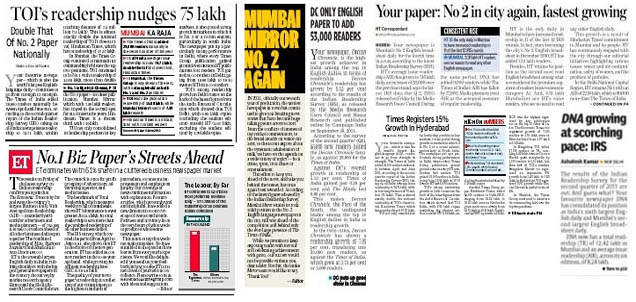
    The fun quotient for the end-of-the-week as far as Indian newspapers were concerned was the release of readership figures for the quarter by the Indian Readership Survey. Every newspaper managed to twist the figures to suit themselves and this means that readers of multiple papers would have been in a state of happy confusion. In Mumbai for instance, both Hindustan Times and DNA claimed the number two spot, while the Times of India claimed number 1 for itself and number 2 for its free tabloid Mumbai Mirror. The figures support Mirror as 2 and Hindustan Times as 3, but then given that Mirror comes free with Times of India which has a huge lead over the others, this leads to a few questions. It also effectively puts DNA at either 3 (if you discount Mirror) or a distant 4. Mid-Day also saw a readership increase, bucking its own trend over the last couple of quarters.

    In Delhi, both Times and Hindustan Times claimed a rise in readership and the number 1 spot – or so it seemed to me. Across the country, this chest-thumping continued. I’m guessing readers know what they read and that advertisers will be suitably impressed – the whole point of this operation.

    **

    Am I the only one tired of every newspaper and news channels calling itself “your paper” and “your channel”? I “own” so many newspapers and channels now that am considering getting an investment consultant to cope!

  • Claims and counter-claims start after IRS 2011Q2 release


    By A Correspondent

    The claims and counter-claims have begun. In Mumbai, Mumbai Mirror said it’s No 2 again. So did Hindustan Times. Both weren’t incorrect: Mirror may have the second-largest readership, next only to The Times of India, but Hindustan Times is the second-most read broadsheet English daily. DNA’s report too says it’s the second-largest broadsheet daily.

    Sadly, the conferences which the Market Research Users Council and Hansa Research Group would conduct to release every round of the Indian Readership Survey have been done away with. The detailed dump is curiously no longer handed out to the trade media.

    Consequently, what the MRUC and Hansa expect the trade media to do is to either carry unverified claims of various media entities. Or depend on friendly publications and agencies to give out data.

    MxMIndia.com requested veteran media consultant Sundeep Nagpal and his firm Stratagem Media to dig a little deeper and help us come up with a variety of insights given IRS 2011 Q2 data.

    For instance: the DNA report quotes a total readership (TR) figure for itself which most media agencies do not recognise. Media agencies and MxMIndia recognise Average Issue Readers (AIR) as currency. Interestingly,  when you look at the numbers for Greater Mumbai, while DNA is a distant third amongst English language broadsheets vis-a-vis The Times of India, it’s difference with #2 English broadsheet Hindustan Times is just 63,000. For HT of course the growth story in Greater Mumbai is tremendous: 27.2% year-on-year and 4.1% in the second quarter.

    We asked Strategem for the following:

    1. Given the toplines mailed to us by IRS, could we analyse it vis-a-vis the Q1 data for 2011 as well as the Q2 data for 2010 so that we can do a year-on-year analyses?

    2. Can we also similary analyse the data region-wise – Hindi belt and North, West, South and East and North East?

    3. Can we look at the numbers for the 8 metros combined and separately?


    Stratagem has provided us this data, and we present these to you as follows:


    First, take a look at the table withe the Top 10 publications across the country – urban and rural India.


    Publications

    IRS 2011 Q2

    IRS 2011 Q1

    % growth in IRS 11 Q2 over 11 Q1

    IRS 2010 Q2

    % growth in IRS 11 Q2 over 10 Q2

    Est. Individuals (000s)

    889070

    885122

    0.4

    871443

    2.0

    Dainik Jagran

    16393

    15910

    3.0

    15925

    2.9

    Dainik Bhaskar

    14174

    14016

    1.1

    13303

    6.5

    Hindustan

    11985

    11810

    1.5

    10143

    18.2

     Malayala Manorama (Daily)

    9962

    9938

    0.2

    9841

    1.2

    Amar Ujala

    8891

    8747

    1.6

    8417

    5.6

     Lokmat

    7595

    7486

    1.5

    7402

    2.6

     The Times Of India

    7471

    7442

    0.4

    7088

    5.4

     Daily Thanthi

    7290

    7187

    1.4

    7402

    -1.5

    Rajasthan Patrika

    6941

    7033

    -1.3

    6900

    0.6

     Mathrubhumi

    6690

    6800

    -1.6

    6566

    1.9


    Let’s also look at the combined numbers for the eight metros of Mumbai, Delhi, Kolkata, Chennai, Bengaluru, Hyderabad, Pune and Ahmedabad.


    Combined 8 metros-Mum,Kol,Ahm,Bang,Pune,Chen,Del,Hyd

    Publications

    IRS 2011 Q2

    IRS 2011 Q1

    % growth in IRS 11 Q2 over 11 Q1

    IRS 2010 Q2

    % growth in IRS 11 Q2 over 10 Q2

    Est. Individuals (000s)

    73117

    72672

    0.6

    71138

    2.8

     The Times Of India

    5114

    5073

    0.8

    4879

    4.8

     Ananda Bazar Patrika

    2708

    2725

    -0.6

    2821

    -4.0

     Hindustan Times

    2690

    2675

    0.6

    2566

    4.8

     Navbharat Times

    2392

    2349

    1.8

    2216

    7.9

     Gujarat Samachar

    1606

    1641

    -2.1

    1503

    6.9

     Daily Thanthi

    1365

    1319

    3.5

    1233

    10.7

     Lokmat

    1224

    1268

    -3.5

    1295

    -5.5

     Daily Sakal

    1175

    1213

    -3.1

    1089

    7.9

     Hindustan

    1128

    1142

    -1.2

    1167

    -3.3

     Divya Bhaskar

    1124

    1129

    -0.4

    1039

    8.2


    The growth story is undoubtedly that of Hindustan which has grown 18.2 percent over the second quarter of 2010, though the growth in the second quarter of this year has now steadied at 1.5 percent. But the winner of the quarter from the toplines of 2011Q2 for across the country is undoubtedly Dainik Jagran with a 3% growth. On a base of 1.59 crore this is big.  The other stories of the big players is also noteworthy. Bhaskar 6.5% y-o-y, Amar Ujala 5.6% y-o-y and The Times of India too at 5.4% y-o-y. Jagran’s y-o-y is 2.9% and Lokmat has grown 2.6 percent over 2010 Q2.
    We urge you to click on the links below (these will come up later in the day) for detailed numbers.It is important to note that the numbers thrown up in the above table are not truly indicative of the power of the various publications. Remember, these ratings are only for metros, and the picture is dramatically different for an ABP in West Bengal, and Gujarat Samachar in Gujarat or Thanthi in TN and Sakal and Lokmat in Maharashtra. Ditto with Hindustan and Bhaskar.

    Links:

    IRS Q2 2011 Hindi Belt & North


    IRS Q2 2011 – South


    IRS Q2 2011 – East


    IRS Q2 2011 Maharashtra & Gujarat

    Information courtesy:


  • Anil Thakraney’s Hard Knocks: Are newspaper owners in sleep mode?

    The latest IRS figures are in. And as usual, newspaper edits get busy boasting about rise in readership. Or, they’ll work out ingenious ways to interpret the findings, to keep their board of directors and advertisers in good cheer. By the way, I often wonder if everyone’s readership is healthy, who’s taking the fall? Anyway, that’s not the point of my article. And neither do I wish to discuss IRS’s methodology.


    What I want to say is this: Newspaper proprietors in India should be thrilled even if there is no growth for their brands. India is that unique nation where dailies continue to thrive even as they struggle to survive in the rest of the world. And that’s purely because, as Indian Express chief Shekhar Gupta said to me in an interview for GQ mag, and I quote: “India has more space for media than most societies. People read multiple newspapers. We may see a shakeout, but not in the near future. Simply because of the demographics. India is adding nearly three crore literate people to the market every year. That’s the size of a large European country.”


    Shekhar is right. India’s large population base and rise in education will sustain newspapers for a pretty long time. But the proprietors will do well not to get complacent and sit on their laurels. Because the global trends will sooner or later catch up with India. Soon the tech revolution will hit India hard, and many newspaper brands will be compelled to shut shop.


    And innovations and out-of-the-box thinking must start NOW before it’s too late. Sadly, I haven’t seen any signs of that so far. Almost every single news that gets ‘broken’ on the covers of our dailies, I have already been made aware of the previous night by TV and/or Twitter.


    So people, do gloat if you wish on the IRS figures. But also do take care to smell the coffee.


    ***


    PS: I badly wanted to stay inside the Bigg Boss house this time. But couldn’t think of anyone to kill, rape, molest, abuse or cheat. So I didn’t qualify. The loss is all mine.

  • Dainik Jagran is Publication #1 in IRS 2011Q2

    By A Correspondent

    The numbers from the latest round of the Indian Readership Survey are out as the Media Research Users Council and Hansa Research announced the findings of the second quarter of 2011.

    Top 10 Publications 

    (All figues in 000s)

    Publication Language Periodicity 2011 Q1 2011 Q2
    DainikJagran Hin D 15910 16393
    DainikBhaskar Hin D 14016 14174
    Hindustan Hin D 11810 11985
    MalayalaManorama Mal D 9938 9962
    AmarUjala Hin D 8747 8891
    Lokmat Mar D 7486 7595
    The Times Of India Eng D 7442 7471
    Daily Thanthi Tam D 7187 7290
    Rajasthan Patrika Hin D 7033 6941
    Mathrubhumi Mal D 6800 6690


    Top 10 Dailies

    (All figues in 000s)

    Publication Language Periodicity 2011 Q1 2011 Q2
    DainikJagran Hin D 15910 16393
    DainikBhaskar Hin D 14016 14174
    Hindustan Hin D 11810 11985
    MalayalaManorama Mal D 9938 9962
    AmarUjala Hin D 8747 8891
    Lokmat Mar D 7486 7595
    The Times Of India Eng D 7442 7471
    Daily Thanthi Tam D 7187 7290
    Rajasthan Patrika Hin D 7033 6941
    Mathrubhumi Mal D 6800 6690


    Top 10 Magazines

    (All figues in 000s)

    Publication Language Periodicity 2011 Q1 2011 Q2
    Vanitha Mal F 2653 2671
    PratiyogitaDarpan Hin M 2027 2154
    SarasSalil Hin F 1945 2039
    India Today Eng W 1650 1724
    MalayalaManorama Mal W 1413 1393
    Cricket Samrat Hin M 984 1213
    MeriSaheli Hin M 1100 1174
    India Today Hin W 1137 1144
    Kumudam Tam W 1066 1066
    Grehlakshmi Hin M 1031 1010

    There is no change in the rankings of the various publications among the Top 10 in terms of Average Issue Readership. The Top 3 slots are taken by Hindi dailies. Dainik Jagran rules with 16,393,000 followed by Dainik Bhaskar which is at 14,174,000. Hindustan is at #3 with 11,985,000. Malayala Manorama is at #4 at 9,96,2000 while Amar Ujala and Lokmat are in the fifth and sixth positions with an average issue readership of 8,891,000 and 7,595,000 resepectively. The Times of India, the only English newspaper in the Top 10, has an average readership of 7,471,000.

    The others in the Top 10 publications are: Daily Thanthi with 7,290,000, Rajasthan Patrika with 6,941,000 and Mathrubhumi at 6,690,000. The last two being the only publications in the Top 10 which have fallen in comparison to the first quarter numbers.