Category: Digital

  • Starcom’s SMG Convonix tracks Wimbledon online chatter

    By A Correspondent


    SMG Convonix, a division of Starcom MediaVest Group (SMG), has implemented a social dashboard to measure global online buzz and chatter around Wimbledon 2013, the annual tennis tournament currently on in England.


    The dashboard (http://www.convonix.com/wimbledon), powered by Iristrack, SMG Convonix’ proprietary social listening and online brand monitoring platform, measures buzz around matches, identifies trending players, monitors fan support and more.  Thus far, the dashboard has logged more than 1.5 million Wimbledon related online conversations from around the world.


    “Tennis is a truly global sport, and we at Convonix are watching the world watch Wimbledon,” said Vishal Sampat, CEO, SMG Convonix. “Our unique social dashboard gives us the ability to deliver real time insights on social chatter as it happens all around the world.”


    Wimbledon 2013 is scheduled to draw to a close on Sunday, July 7.


  • Ormax to track online buzz for films

    By A Correspondent


    Media insights firm Ormax Media has further strengthened its position in the film insights space with the launch of Ormax Online Quotient (OOQ), a product that tracks the performance of the online campaign of a film in social media and public platforms.


    Film studios can use OOQ to track week-on-week performance of their films in the online space, and benchmark it against their online targets. The product reports various parameters, including Online Buzz (number of mentions) and Online Sentiment (positive or negative slant of the mentions). Data can be seen for the film, as well as its individual components, such as stars, director, songs, etc.


    Shailesh Kapoor

    Speaking about OOQ, Shailesh Kapoor, CEO – Ormax Media, said: “Internet and social media are becoming increasingly relevant for film marketing. We have conclusive data to prove that social media has more influence on a film’s opening than outdoor, for example. With OOQ, we hope to bring science and measurement to the otherwise qualitative concept of ‘online buzz’.”


    OOQ will arm film studios will weekly reports that they can use to take corrective action in their online campaigns, in turn improving their prospects of a higher opening weekend of the film at the box office, both domestic and internationally.


    OOQ has been created in collaboration with its technology partners Germin8, a company that specializes in online brand tracking and analytics. Speaking about the association, Ranjit Nair, CEO – Germin8, said: “OOQ is the marriage of Germin8’s technology prowess in the fields of Natural Language Processing and Big Data Analytics and Ormax Media’s vast domain expertise in media insights. The end result will allow film marketers make their campaigns more effective.”


  • Indian internet economy to touch US$ 100 bn by 2015

    By A Correspondent


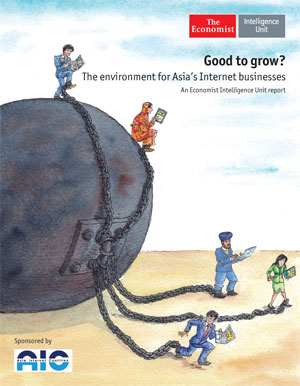
    India’s Internet Economy that stands at 1.6% of GDP is slated to touch US$ 100 billion by 2015. This was announced at the global launch of a report “Good to Grow: The Environment of Asia’s Internet Business” by Economist Intelligence Unit in New Delhi. The report is sponsored by the Asian Internet Coalition.


    One of the key factor that will drive the internet economy in India is digital and mobile advertising. At present, advertising revenue in India is at 7%. But, of the US$ 410m being spent online, 60% goes to Google and Facebook, with only the remaining 40% going to other online players. While online advertising in Asia is forecast to grow at a modest pace (from 24% of worldwide online advertising in 2010 to 26% by 2015) the mobile advertising market is really taking off. By 2015 Asia is expected to account for one-third of the mobile advertising market globally.


    But the report also reveals the dark side of India’s online payment and credit card penetration. On both fronts, India stands at an abysmally low penetration of 2% compared to South Korea, Taiwan and Singapore. The report also comes down heavily on internet censorship that is acting as an impediment to growth. The report states, “Asia is still finding its way with respect to governance and regulation of the Internet. In some markets such as Vietnam regulation is mostly undeveloped, which can be seen as a blessing since it allows companies to move quickly and freely. In others, such as South Korea, there are stricter regulations which operators say hamper their business. The one area where ample regulation is in place is around liability for carrying content that either contravenes laws or is otherwise frowned upon. These often poorly worded or confusingly interpreted pieces of legislation create uncertainty for business owners, as well as high administrative costs in order to put safeguards in place. India, Thailand and Malaysia stand out as places where censorship is on the rise.”


    Speaking at the launch of the report, Laurel West of Economist Intelligence Unit said, “India’s regulatory environment has considerable room for improvement. While the Ministry of Communications and Information Technology is responsible for the frequent issue of laws relating to Internet governance, there is no specific regulatory body for content and platform creators. Some, particularly smaller operators, take this as a good thing, since it means fewer barriers to entry, particularly compared with manufacturing and other over-regulated industries. But the downside is that there is no central avenue for communication with businesses that will be affected by changes in the law”.


  • Bigg Boss, OMG top Whats-On-India’s TV Trends

    By A Correspondent


    Given the popularity of our report on the TV Trends weekly report that we carried last week (http://www.mxmindia.com/2012/11/in-tams-absence-whats-on-india-search-rankings-show-some-trends/), we bring you Whats-On-India’s weekly TV Trends report for Week 47 (November 18-24, 2012).


    TV Trends has been built using specialist and proprietary algorithms that collate, analyze and compute millions of observations across multiple platform. It provides cues and powerful insights on the potential consumption and intention-to-view of content by Indian TV viewers.  The sources from where observations are aggregated include What’s On India platforms like:  Web, Mobile portal, Apps (Android, iPhone, iPad, Blackberry, Windows Mobile, Nokia Ovi), EPG-on-the-Cloud (MobileTV and IPTV).


    It’s been a little over a month since TAM Media Research stopped releasing its weekly ratings following a decision taken jointly by broadcasters, advertisers, advertising agencies and TAM, that the release of the data will be held back until December 19 given that it would take some time for the mandatory digitization process to settle down.


    The report gives the Top 5 Programmess of the Week for the following genres:  English Movies, Hindi Movies, English TV Shows, Hindi TV Shows, Regional TV Shows, Regional Movies, Sports and Kids, Documentaries, Lifestyle & Food.


  • Linking In with Nishant Rao @ IAA Webinar


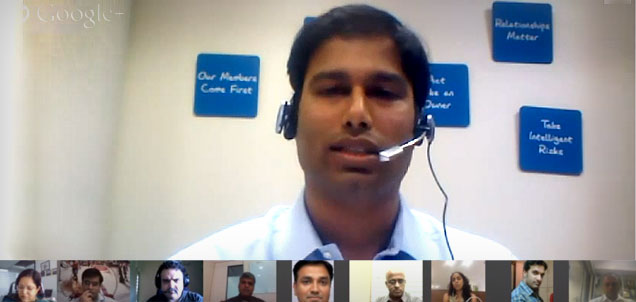
    The International Association of Advertisers (India Chapter) conducted its third webinar on Thursday, June 27 with Nishant Rao, Country Manager, Linked In India.. The IAA Webinar series with the theme ‘World Goes Digital’ is spearheaded by Abhishek Karnani and director, Free Press Journal group and Manish Advani, head – marketing and public relations, Mahindra Special Services Group as co-chairs. *


    The panellists included:  Manish Advani, (Mahindra Special Services Group), Gaurav Mendiratta (Sociosquare), Deepali Naair (L&T General Insurance), Sheran Mehra (Mahindra Holidays), Vinay Krishna (JigServ), Ramakrishnan Laxman (MCCS, ABPNews group) and Suraj Lokare (Xanadu Consulting).  Pradyuman Maheshwari, Editor-in-chief and CEO, MxmIndia moderated the event. Other than the panellists, some questions that came in from the public in response to our announcements on social networks were also posed to Mr Rao.


    Excerpts from the Q&A:

    Opening Remarks by Nishant Rao:

    As consumers, we’re getting tonnes of information at our disposal and what avenues like Social are creating is a way to have a voice and participate in that and create our own information. So as this information floats what becomes super important is its relevance to us. What LinkedIn is trying to solve is help each professional to be more productive and successful. And we are trying to do that by ensuring those relevance because we know who you are based on your industry, your function and the sort of things you have mentioned on your profile we can try and make sure that there are insights that are relevant to you. So that’s a big part of our consumer-value proposition in addition to having a critical mass of professionals that we can collaborate and communicate with. With so much information being created we see an opportunity for companies and brands to play a part in making our members more productive and successful. The way we are doing that is by tapping into a lot of insights that are being shared by consumers on LinkedIn whether it is their opinion on news or opportunities etc we are using those signals to help understand what their unique needs are and allowing brands and companies to play a part in getting them their relevant information and content so that they help these professionals in whatever way they can. So fundamentally, what the internet has enables is because of this explosion of information it is changing not only how we collaborate and communicate but also how companies can play their part in making us more productive and successful in this hyper-competitive and super-charged environment.


    In the last few years, news seems to have become an important focus area especially for portals like LinkedIn. Could you share what’s the percentage that news as a domain contribute to the overall traffic on your website. Also, most content on your website in US-based, are we going to see content being updated from India as well?

    Nishant Rao: As we analysed as to what kind of information helps make the consumer more productive news is definitely one of those things that all of us professionals look to update ourselves with because it is so important. The broader vision is for LinkedIn to become a professional publishing platform for individuals and part of that is generating insights that are relevant to a news article or content piece…but overall this is a shift in direction to make sure that we move away from being just a static profile to being a more holistic representation of who you and I are as members. So the starting point is to have some content so that people can share their opinions. Where news is concerned, we are making it a point to have more integrated channels with it. For example, a leadership channel which could come from some influencer content or some news content or from some individual writing a post. So that’s an overall direction that LinkedIn is taking.


    As for the question on percentage share, we do not report site metrics at that level but what I can say is that LinkedIn is catapulted to becoming the largest source of a lot of news sites. So we respect the IPs of the news sites out there and so when we find a news article and click on that it’s actually a page view that gets generated and because of that we have become one of the largest routers of traffic of different sites and that gives you a sense of impact that LinkedIn is having in this space. As for content, we are trying to take the approach where be it a global influencer or somebody else they will offer views and insights from an overall perspective and gradually we will be having more local news and local influencers having local relevance. So we are in the process of making that happen.


    Personal networking platforms have really taken off in India and if one were to compare LinkedIn to these websites, it is slightly on the backfoot and the fact that Twitter stopped the feed to you didn’t help at all. From a consumer behaviour perspective, if one wants to attract the B2C customers, could you help us understand what LinkedIn does on that front apart from using your platform to update their profiles?

    Nishant Rao: We started our business about a decade ago and around that time we were more of a profile-update or looking-out-for-jobs offering. What we seen in the US about 3-4 years ago and which we are starting to see in India also is that people have stopped updating their profile just when they are looking for jobs and that is really when what’s enabled a lot of magic to happen. People are realising that their profiles are kind of their conduit to other factors. If you think about the three types of content that consumers are saying they want from the sites are information on connections and opportunities, looking for updates on brands that help make them more productive and successful and they are looking for information which is relevant to current affairs. What people are also realising is that the more you fill your profiles and keep it fresh the more the opportunities that are presented. In fact according to a research that we conducted, jobs was the No 5 out of top 5…so that’s the kind of shift that we have experienced especially in markets like US and are now seeing it in India as well. Eventually we believe that the more information you give us the more we can make it more relevant.


    As for the demographics, we think of our site as being for ‘prosumers’ – professional consumers. These TG are skewed towards being an educated, affluent audience in comparison to other larger sites that are there around. That just comes from the bias that LinkedIn has on the professional context. It’s a self-selection mechanism; we do not aspire to be a site where one comes for entertainment reasons or just to hang out. TNS did this survey for us which helped us codify the difference between a personal networking platform and a professional networking platform. The genesis of what they found is that people go to personal networks to spend time and they go to professional networks to invest time. So each consumer can have these different personas and as a result these different sites give you a manifestation of this. I use FB, Twitter, LinkedIn but I am a different person across each of these platforms. So the professional context has really helped us in terms of not playing the same game as the other networks; we want professionals to come and not have diluted conversation but aspirational and productive comments on the site. The numbers are a manifestation of that and I would say even in India where we have more than 20 million users the ratio of number of users on LinkedIn versus the personal networks is closing fast and that gives you a sense of the value that people see on our site.


    One has to come up with new ideas and strategies on a daily basis and when one talks of strategies on LinkedIn one feels very restricted because it has been a kind of a closed network when it comes to APIs in building applications. While it is kind of opening up now, is there a conscious decision behind what you decide to do?

    Nishant Rao: As a company, part of our hesitation to completely open up APIs is making sure that the member experience is not compromised as a result of that. We are constantly straddling the line between making sure that we are fostering innovation as well as making sure that our members have a good experience on our network. We have seen a tremendous increase in the number of members using our APIs and are realising the power of our APIs that are available. So we do have a large set of APIs for people to use and I think part of our philosophy of taking care of our members’ concern has helped us keep our context to a professional level. Also, we are helping marketers leverage some of these APIs in a more creative way. Sometimes there is a disconnect between the creative ideas that one has and which APIs do you use. So sometimes it becomes more of an educational exercise than anything else. It’s not like we are trying to make a monetisation play on building up those APIs as propriety to us… but we are helping give them that mindshare or the education needed to harness the full power of LinkedIn.


    Big Data seems to be the buzzword these days. How much of it is LinkedIn leveraging in India?

    Nishant Rao: I agree with you that Big Data has become one of those buzzwords that everyone wants to do something with it but I came across an observation where it was revealed that about 68 per cent of the companies have some sort of a data warehousing BI solutions but only 8 per cent used it. So that gives you a sense of disconnect that exists. This is something that LinkedIn had to take into consideration seriously because of the volume of data that is seen. The way we use it is that we are moving on to having unstructured information using technologies like Hive etc. We’ve also taken it further to use those insights and pull it back into our product processes. For example, when we launched our iPad application it was a single mirror image of our website but we observed a spike in the usage at coffee time in the morning between 7-9am and again in the evening called as the couch time where people were catching up on what they missed out. So that insight we used to get another reiteration out so we integrated a calendar for the morning time where people get sort out their agendas and meetings and for the evening we added the news element where people could catch up on what they missed the whole day. So that was an example where we used Big Data to funnel back into product.


    LinkedIn charges vendors to reach out to candidates, is there a way this accessibility that can made more user friendly?

    Nishant Rao: If you compare LinkedIn to some of the other talent firms they take a different approach by publishing phone numbers and email addresses and stuff like that. But it’s our philosophies to not such things as we do not like doing it because we value our members first. One can even message a person if he is not in connection and it is up to that person to realise that it is important to him and thus respond to the message or to the connection. So the power rests with the members to make those decisions rather than in some sense bastardize the concept of a connection.


    How can small and midsize businesses (SMBs) leverage best from a platform like LinkedIn both from a hiring and outreach perspective?

    Nishant Rao: For us at LinkedIn, we see enterprises playing a big role in enriching the lives of our members. So we are looking at transforming the way companies hire, market and sell by making it more relevant. If there is a relevant job for the member it is better for the member as well as the company because you are moving on from quantity-based to quality-based processes. So for SMBs in particular, we are seeing in particular that LinkedIn is a platform rather than a one-off point solution. LinkedIn provides SMBs to provide your TG in a manner that you want to target them. We even have an option for SMBs to display ads to the relevant TG that they wish to online.


    Hs LinkedIn thought about using Verified Accounts?

    Nishant Rao: We haven’t announced anything on those lines as yet and our belief is that verification may not be unique to any given person. We’d like to think about verification as the network verifying for you though we already have tools out there that are free and for public use. Also, we always encourage our customers when they are making a hiring decision to tap into the fact that a person is not a single person but there is a network around him and more likely than not there could be a lot of common factors between the two.


    As for the question of verification, we haven’t picked up any noise as yet about profiles being inaccurate or factually wrong. Maybe that’s the reason why it hasn’t bubbled up to the top list of priorities that we have. But we have seen a lot of traction in these other more dispirit verification sources.


    How can regional players look at integrating with what LinkedIn has to offer to its members?

    Nishant Rao: What we’ve realised is that consumers can wield a lot of power from our network. It goes back to what is the business problem that one is trying to solve. If it’s a business problem then we do have consumer-based solutions or enterprise-based products that can drive there. As we’re able to get local relevance from that content they can use it as their traffic source and use it to build awareness about his products. They can even use it to solve talent solutions. So it all depends on the problems that regional players are looking to solve.


    Would we see a comeback of LinkedIn Events online?

    Nishant Rao: We used to have LinkedIn Events and we are in the process of sun-setting a lot of things that were individual features into a larger amalgamation. I wouldn’t be able to tell on what’s the immediate future on that and fundamentally that’s because we have so many features running on our site. We are always looking to see where our members are seeing for traction.


    LinkedIn is trying to make a paradigm shift in Sales as well. We have a Sales Navigator as a premium subscription product that’s there where the premise is that of we can take cold calls and convert them into warm prospects it is a win-win for everybody. We are always looking at opportunities for making the lives of our members productive and successful.


    *Disclosure: MxMIndia has partnered the IAA (India chapter) Webinar series



  • HT Media gets more ‘social’ with Webitude

    By A Correspondent


    HT Mobile Solutions, the mobile solutions organization from HT Media Ltd. has announced the acquisition of Webitude, a social media organization based in Gurgaon. With this, the company has announced its intention to offer strong digital solutions that leverage the combined power of mobile and social media, under an umbrella brand Digital Quotient that will operate with the mantra ‘Go Mobile, Get Social.’


    As per Vinish Kathuria, COO, HT Mobile Solutions, ‘The Indian digital marketing landscape can be summarized by 3 megatrends – explosive growth in mobile usage, social media and videos consumption. As Digital Quotient, we’re going to be able to offer our clients a rich array of solutions across mobile and social media, and leverage the power of multimedia to help establish a strong, meaningful connect with consumers.’


    Santosh Kumar, Co-founder, Webitude said ‘We are looking forward to leveraging the scale and the mobile acumen of the HT group to take our offerings to the next level. While we will retain our identity as Webitude and continue to operate our agency business, we will now also operate as part of the larger group Digital Quotient – where social and mobile will together drive exponentially higher value.’


    Girish Mahajan, Co-founder, Webitude said: “For our existing team, who have made Webitude the recognizable name it is, this opens a whole new world of possibilities. It also means growth on a personal level, just as the business grows.”


  • 1 Minute View: Linking in with LinkedIn

    Getting your profile updated on LinkedIn is a near-must-have for every professional. There are of course many who don’t do it fearing that their bosses and organizations would think they are looking for a job. Over the years though, and in the words of its country manager for India Nishant Rao, LinkedIn has moved on from being a “looking-out-for-jobs offering” to being used for a variety of other things.


    “What people are also realising is that the more you fill your profiles and keep it fresh, the more the opportunities that are presented. In fact according to a research that we conducted, jobs was the No 5,” Mr Rao said at the International Association of Advertisers (India Chapter) webinar held last month.


    Professional networking platforms like LinkedIn, said Mr Rao, can be used for a lot more than just jobs. And the starting point is to build one’s profile on the site.


    But just having several connections is not the solution to success via such platforms. There’s no alternative to a good educational qualification, quality work experience and overall knowledge and proven expertise. Once you have these, networking sites can help you get to the top.


  • ShopClues seeks creative agency

    By A Correspondent


    Ecommerce player ShopClues.com has initiated a multi-agency pitch to bring on board a creative partner to lead its mass media strategy. The multi-agency pitch will happen in Gurgaon. This is the first time that the company has called for a creative pitch.


    Two years into operations, ShopClues.com has previously been active on the social media, radio and the outdoor front. Till now the online and ATL campaigns were done inhouse. With the growth and expansion in the company and the boom witnessed in the E-commerce space, the company is set to get on board a creative partner for its mass media strategy.


    Commenting at the development, Radhika Aggarwal, Founding Member & Corporate Vice President Marketing and Merchandizing at ShopClues.com said, “Having built a wide assortment across 900+ product categories, we are now looking for a creative partner who will further help us strengthen our position as a one-stop destination for millions of online customers across India.”


  • Hungama App introduces adaptive streaming

    By A Correspondent


    Hungama has upgrading its app for iOS and Android with Adaptive Streaming for audio and video, Airplay for iOS and compatibility with the iPhone 5. The new build has facilitated an integration with Google Wallet. Now, music lovers all over the world can own their favourite music by a simple click of a button within the app to make the purchase.


    Ranked ranked #1 in the top music apps category on iOS and Android platforms in less than ten days of its launch, the Hungama App comes with a loyalty feature that rewards users for every action on the app.


    The adaptive version of the Hungamamusic app is available on the iOS and Android platforms.


  • Havas Media & Cognitive Match power data-driven creatives

    By A Correspondent


    Havas Media Group and Cognitive Match have partnered to deliver true data driven creative optimization.  This enables Havas agencies to closely integrate their ad serving capabilities, data platform (Artemis) and Demand Side Platform (AffiPerf).  Advertiser clients of Havas, India included, can now benefit from a market leading closed-loop dynamic display advertising platform.


    Cognitive Match leverages first and third party consumer data to deliver relevant display advertising creative to every individual in real-time.  Deep integration with DSP technology at Havas, and Havas internal advertiser data platform Artemis, means advertisers will benefit from maximum value from their data.  This solution leapfrogs the current firms in market that focus solely on personalized retargeting, such as Criteo, or customer relationship management marketing programs such as Marketo.  Campaigns for top advertisers have already begun running through the combined platform, showing gains in performance and insights for advertisers in the US and globally.


    “The Cognitive Match platform provides us with a great flexibility and efficiency to adapt the message in real time to our clients’ customer,” said Sylvain Le Borgne, EVP Data Platform for Havas Media Group.


    “Our teams at Cognitive Match and Havas are working together globally across web and mobile” said Alex Kelleher, Founder CEO of Cognitive Match.  “Our shared expertise in advertiser and dynamic creative campaign management, across Europe, Asia and The Americas, means that both global and local advertisers will immediately benefit from our new partnership”.


  • Revlon promotes foodproof lipstick with 6-sec video tweet

    By A Correspondent


    Digital marketing agency VML Qais has created a video tweet to help promote its client, Revlon. The product being promoted is Revlon’s Color Stay Ultimate Suede lipstick.


    The agency wanted to find an innovating and engaging way to tell Revlon’s Twitter followers about the USP of the new product that has been launched, notes a communique. It is a food-proof lipstick and VML Qais wanted to highlight that visually. To achieve the objective, the agency created a custom vine (a 6-second video tweet) for Revlon (link: https://twitter.com/RevlonIndia/status/347628970998632449). Recently acquired by Twitter, Vine is a social media service which allows the user to shoot and share 6 second videos.


  • Introducing PoliTech: a new fortnightly column by Vijay Mukhi


    There is much excitement about the exchanges by politicians on Twitter and Facebook. But will these have any impact on the forthcoming general elections? Internet Guru, infotech evangelist, data security specialist, trainer, author and former columnist Vijay Mukhi will answer this question and track trends in a new fortnightly column for MxMIndia


    By Vijay Mukhi


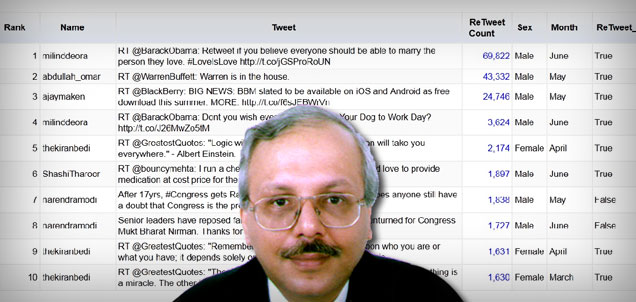
    Our politicians don’t understand social media. They need to take lessons from the likes of an Amitabh Bachchan, Shah Rukh Khan or even the Dalai Lama. Their tweets don’t get retweeted, and the ones that do like those of Milind Deora or Ajay Maken or Omar Abdullah aren’t political in nature.


    For instance, Ajay Maken’s tweet was as follows: RT @BlackBerry: BIG NEWS: BBM slated to be available on iOS and Android as free download this summer. MORE: http://t.co/f6sJEBWrVn . Note it didn’t concern anything remotely concerned with politics. And Omar? Here’s his tweet that got retweeted 43,332 times at the time of writing: RT @WarrenBuffett: Warren is in the house.


    The US internet population is around 170-180 million and that in India is 120-130 million.  There may not be too much of a gap here, but the problem is that in the US of A, 70-80% of the population is internet-enabled whereas in India it’s only 10-20%.


    Also, of the 15% of population that’s internet-enabled, at least 5% will be kids who don’t vote and another 5% from the affluent who have never voted, and possibly never will.


    What we have in balance is a 5% of the internet-enabled janata and I don’t think a swing here or there really matters. Bottomline: Mr Modi and his team may embrace Twitter and Facebook, write blogs, go to YouTube, but all of this will not help him win the 2014 general elections.


    But in 2019, we should have four to five hundred million people on the internet, and only then we could say there will be action on the social media front. Elections 2014 will be the semi-final and it’s important to get our act together for 2019.


    I have been a fair number of videos of the US elections over YouTube. One of them had a mindboggling 43 million views. With that kind of a number, the videos in question can impact a result, and create a stir with the masses. That’s why elections in the US can be fought over Facebook and Twitter.


    There are many issues that the new social order raises and which must be debated. The Election Commission sends people with video cameras to monitor the speeches at political rallies. How are they planning to monitor Facebook and Twitter? If I stand for elections from the Mumbai South constituency, and if you are in the US and you pay Facebook a million dollars for my promotion, how’s the EC  going to monitor that spending?


    Also, a contestant is not allowed to campaign within 48 hours before polling. So can Narendra Modi send a tweet out in that time period? And what if a well-wisher from England sends a hundred thousand tweets hours before voting?


    While one can’t be critical or character-assassinate an opponent, what’s stopping an unnamed supporter from doing that on Twitter, create blogs and go berserk? Suppose I create a million fake BJP Twitter followers and if they start retweeting nasty things about the Congress, wouldn’t it amount to be an election malpractice.


    It’s issues like these that we must discuss, debate and ponder over. The Election Commission must seize itself of these issues and figure what it should do. And if that doesn’t happen, expect mayhem in 2019.


    Battlewatch: BJP wins Facebook, Congress up on Twitter

    If the general elections were to be held today and the voting population comprised Facebook and Twitter users, the BJP would win the elections.


    What works on Twitter however does not necessarily work with Facebook and vice versa. Facebook is more BJP whereas Twitter is leans slightly towards the Congress.


    The million dollar question that no one has been able to answer is how do you rank politicians on Twitter or Facebook in terms of influence which then reflect in how people actually vote. Because there can never be just one answer, we look at how we can slice and dice the data to answer our conclusions.


    In our view the most important parameter on Twitter is not the number of followers you have but the number of Retweets. This is because you can follow someone only once but you can Retweet tweets multiple times. Retweeting is an ongoing process. When you Retweet, you are generally in agreement with that tweet and it is the only way of giving a thumbs up for that Tweet on Twitter. Please visit Vijaymukhis.com and see politicians fare on ReTweets. We update our data at least once a day and everything is interactive (www.vijaymukhis.com).


    Next fortnight: How many of Narendra Modi’s followers are real? And those of Shashi Tharoor?