Category: Digital

  • HomeShop18 appoints Vikrant Khanna as CMO

    By A Correspondent


    Vikrant Khanna

    HomeShop18, the ecommerce and homeshopping TV channel network of the Network18 group, has announced the appointment of Vikrant Khanna as Chief Marketing Officer for its TV, Web and Mobile business. In his new assignment with HomeShop18, Mr Khanna will lead a 360-degree role which includes marketing and communication, CRM, B2B Sales and Alliances.


    Mr Khanna has a 19 years’ experience in marketing and business roles across FMCG, Telecom, IT and Paints. He has worked with brands like Airtel, Dabur India, General Mills and ICI Paints. At Airtel he was the VP Consumer Engagement and Digital, where he was involved with award winning campaigns such as the “Har Friend Zaroori” across integrated platforms and also India’s first Grand Prix – 2011 Formula 1 sponsorship.


    On the appointment, Sundeep Malhotra, Founder and CEO, HomeShop18 said: “We are glad to have Vikrant head our marketing team. He brings years of rich experience in Business & Marketing roles across various industries. Vikrant will work towards building stronger consumer orientation across various touch points, shape a solid consumer franchise and take HomeShop18 brand to newer heights.”


  • Hathway ties up with D-Link to offer routers

    By A Correspondent


    Hathway Broadband Internet has tied up with D‐Link to offer wi‐fi routers bundled in the market under the “Wi‐Fi Broadband Homes” initiative.


    All existing and new customers of Hathway Broadband across the country can avail this offer and convert their wired homes into “Wi‐Fi Broadband Homes ” with speed of upto 15mbps.


    The company intends to leverage on its robust Hybrid Fibre Coaxial (HFC) network to deliver a superior connectivity to its users.


    “Consumer broadband usage has shifted to concurrent multiple wireless device consumption at homen” said Mr Jagdish Kumar, Managing Director & CEO, Hathway Cable & Datacom Ltd.


    Said Tushar Sighat CEO D‐Link (India) Limited: “With the mydlink cloud router on the offering we are confident to bring alive a never-before secured Wi‐Fi broadband experience ”


    Kunal Ramteke

    “A typical modern family by using the Wi‐Fi Broadband Home solution at home can save upto Rs. 500 per month,” said Kunal Ramteke, Business Head, Hathway Broadband.


    Hathway will not charge any one time fee or monthly rentals for the Wi‐Fi device. D‐Link Wi‐Fi router will be given to the customers at zero cost. However customers would be charged a nominal fully refundable security deposit, a communiqué notes.


  • 1 Minute View: Twitter kahin ka!

    Phew! That’s the one-word response we had on reading Vijay Mukhi’s ‘PoliTech’ column today. The information on how many followers that Narendra Modi and Shashi Tharoor have is known to everyone. However, the digging in that Mr Mukhi has done in his analysis is an eye-opener.


    The followers of followers, the number of tweets sent by followers, how many followers have joined in the recent past, how long have these followers been on Twitter, etc etc etc.


    It’s also interesting to see the number of common followers that both Messrs Modi and Tharoor have.


    Mind you, it’s not that Mr Mukhi had some special access to data provided by Twitter. It’s information that’s available in the public domain and you just need to know how to dig into it.


    The bottomline is that if you thought Politician X is going to win the forthcoming elections just because he or she has hajaar followers, perish the thought. If you thought Politician Y has a great connect with the youth, perish the thought. What he or she may have is connects with is a slew of human robots whose only job it is to be on Twitter. They could be sitting anywhere in the world and have no real linkage with the election process.


    Yet, there is the Congress which feels the need to deploy much energy and monies to be active in the social media.


    All of this is good news for those who specialize in the craft. And if nothing else, the enthusiasm that our political order has ensures good business for digital and social media players. Cheers to that!


  • Return of the good times for TV18 & Network18

    By A Correspondent


    It’s Q1 results announcement time. And although MxMIndia doesn’t do individual look-ins into the financial numbers presented quarter se quarter tak, this one deserves a special mention.


    For the q ending June 30, TV18 Broadcast Limited reported revenues for the television and motion pictures business (including IndiaCast) stood at Rs 396.2 crore. Ad revenues grew 6% year-on-year. Indicating the fruits of digitization and a well-orchestration distribution exercise, net distribution income grew 32% sequentially to Rs 34.9 crore this quarter, swinging from a loss of Rs 16 crore previously.


    And the real reason why the offices of TV18 were flooded with bubbly yesterday: the reported operating profit for the quarter stood at Rs 23.8 crore, up 57% over previous year. The company turned in a profit of Rs 5.9 crore after tax for the quarter as compared to a loss of Rs 23.5 crore in the previous year. Announcing the results, Raghav Bahl, Managing Director, Network18 said, “The macroeconomic environment continues to be challenging and growth prospects remain uncertain. Given this backdrop, our broadcasting operations turned in a steady performance aided by the roll out of digitization in 42 cities.”


    Commenting on the results for the quarter, B. Saikumar, Group CEO, said, “We continue to turn in steady operating profits from our television businesses. Motion pictures have seen losses this quarter and the management is confident of stemming them in the immediate term. While our news and infotainment businesses have seen distinct softness in advertising, our entertainment businesses led by Colors have performed well on this front. Net Distribution Revenues from IndiaCast are on a strong growth trajectory and we continue to be enthused by its growth potential. The industry is going through several important changes on both the advertising and distribution fronts. We believe that these changes are positive and will lead to a stronger industry structure. We remain confident of delivering a strong year ahead


    Meanwhile, Network18’s PAT for Q1FY14 stood at Rs 19 crores as compared to Q1FY13 loss of Rs 90 crore.  The digital content and eCommerce business grew to Rs 106.9 crores, registering a growth of 174%, over the corresponding quarter during the previous year (adjusted for the sale of Newswire18).


    Network18 inked an agreement with OCP Asia Ltd. to raise growth capital of USD 30 Million in HomeShop18. During the quarter, it sold its entire stake in a Capital18 portfolio company – Webchutney.


    Added Mr Bahl: “There were pockets of weaknesses in our portfolio and we are committed to improving segments that are not meeting expectations. We have a strong portfolio of media businesses and remain confident of unlocking their value for our stakeholdeRs ”


  • Guest Column by Saurabh Parmar: Branding in today’s digital age of Brand-Consumer Interaction

    By Saurabh Parmar


    In almost every conversation we have with a client or a potential one, the word ‘brand’ comes up. The interesting bit in most cases – I see the interpretation vary. And remember I am talking about marketeers here. I don’t think there is a right or wrong but the definition of what a brand is has evolved in this digital age.


    For me, a brand has never been a logo or a fancy tagline. It’s not even a vision or mission statement. At the end of the day it’s a dynamic entity which lives what it says, it evolves from where it is, it understands from it’s customers.


    It means a lot of those things which are probably taught in brand identity classes – Colours used, shape of the logo, brand identity guidelines, the thought behind the brand  etc. Yet  I earnestly believe – it has always been about something more – How the people perceive the brand.


    Think about brands like Apple, Vodafone or Dominos.. What do you see? What do you feel? And the exact answer will change, depends on who you ask. The logo, tagline, marketing campaign, product remain the same but people’s interpretation of it defines the brand for them and to an extent their social circle.


    This is more so in today’s world – where customers are directly interacting with brands via social media, where there are more brands making more noise via marketing and where technology is changing proximity and interactions between humans themselves. As a result, the dynamic nature of a brand is all the more obvious.


    I like brand X let’s say a restaurant but  if the food was bad last time or whether the waiter was rude or service slow all those things impact brand perception. But it doesn’t take a direct interaction always does it?


    Friends who have been raving about a product or place, a Zomato review or a review in HT or 5 of your friends having already like this new place on Facebook -all these live interactions influence our brand perception over time.


    So what should a brand do? There’s lots it can do, but for me 6 main things which stand out:

    1. (From the above) Remember brand building does not happen on day 1 only it keeps happening till the day you exist and if you are fortunate or maybe unfortunate enough people will have opinions even after you cease to exist. So be open to constant evolution.


    2. Having said that, like any human being you may evolve how you talk, how you interact, what you say but you remain mostly true to your core beliefs. Same goes for brands.


    3. Brands are often afraid of taking a stand, having an opinion. We believe that’s not the way to go, great brands stand for something and they also stand against something.


    4. An often heard statement ‘Great brands need to be larger than life’. I tend to differ and more so in today’s day and age of a cluttered market with enough brands shouting their greatness.


    Brands need to be true to life – They are based on a customer’s needs and aspirations and needn’t look down from a pedestal or exaggerate their own identity which makes it hard for a customer to trust them. (Eg: How many men believe that by spraying a deo, women will start swarming around you but for years brands have failed to go beyond the thought)


    5.Great brands focus on transparency -to their customer, their employees and other stakeholders. An interesting example by McDonald’s http://www.youtube.com/watch?feature=player_detailpageandv=oSd0keSj2W8


    6. They do not look at advertising as a means to display but as a means to communicate. And that brand-consumer interaction does not happen in silos but in an environmental and cultural context.


    Saurabh Parmar is Founder and CEO, Brandlogist Communications


  • Gozoop acquires Red Digital, doubles India revenue

    By A Correspondent


    Digital agency Gozoop, which recently expanded its global presence by setting up operations in Singapore, has today announced the acquisition of social media agency Red Digital. With this acquisition, clients and employees of Red Digital will be consolidated under the Gozoop brand.


    The acquisition is in line with Gozoop’s strategy of increasing the revenue contribution from its Indian operations. Over the past few years, Red Digital has worked for several brands like Mumbai Indians, Dell, PepsiCo, BMW, Parker Pens, Adidas, PVR, Godrej, Berger Paints, Reliance Foundation, Educomp, Citibank, ICC and Discovery Channel.


    Commenting on the acquisition, Ahmed Naqvi, Managing Director (India) and Co-Founder of Gozoop said, “Red Digital’s world-class brands and  top talent, together with Gozoop’s end-end digital service offerings and social products like Zozolo, will help move our collective clients and the industry forward. We expect further consolidation in our industry and look forward to acquiring digital agencies to fuel our growth in India as well as to enter international markets like USA, Australia & Qatar.”


    Said Rohan Bhansali, CEO and Co-Founder of Gozoop, “This move is in line with our vision to be amongst the Top 2 digital agencies across all our markets.”


    Meanwhile, Bhavit Sheth, Co-Founder of Red Digital will be actively involved during the transition period, to ensure a smooth process.


    Commenting on the business acquisition, Bhavit Sheth said, “Our clients will now reap the benefits of getting serviced by a much larger agency with more specializations and our employees will now have the chance to further grow their career trajectory and explore many more fields in the digital domain.”


    Harsh Jain, Co-Founder of Red Digital said, “Gozoop’s acquisition of Red Digital is a win-win for all parties involved. Red Digital’s clientele will now enjoy international standard best practices in operations, client servicing and processes, while continuing to work with the team they love.”


    Following the deal, Gozoop will increase its presence to Delhi, Bangalore, Chennai and Kolkata in addition to its current presence in Mumbai, Dubai and Singapore.


  • IAA seminar on how builders can exploit digital media

    By A Correspondent


    The India Chapter of International Advertising Association (IAA) has organized an industry-specific knowledge seminar for the realty sector on digital media. Digital has emerged as India’s third-largest medium and very few real estate developers have exploited its full potential. This seminar will enable an understanding and appreciation of this important medium which real estate developers can apply, and thereby benefit from, in this fast-changing communication era, notes a communiqué.


    Said Srinivasan Swamy, President IAA India Chapter & Vice-President, Development Asia/Pacific: “Through this seminar, the Indian Real Estate industry gets a new perspective on digital as a medium, grasp global trends, and hopefully apply these for better marketing solutions. When the economy is difficult and many real estate projects are not finding ready buyers, a cost effective medium like digital can help the realty sector. I hope many will participate and benefit from it”.


    Titled ‘Real Estate in a Digitized World’, the seminar will be held on August 2 from 2 to 7:30 pm, 2013 at The Trident, BKC and will have prominent speakers representing leading international companies in digital and social media including Group M, Google, Addikt, Wolff Olins and Panel speakers from Microsoft, Madhouse, Netcore and Magicbricks. Niranjan Hiranandani, Managing Director, Hiranandani Constructions and former Australian cricket captain Steve Waugh will be guests of honour.


    For information: Jaideep Gandhi, Treasurer, IAA-IC and Chairman of this Knowledge Seminar (Tel 9820284578 or gandhi.jaideep@gmail.com).


    For details: http://www.iaaindiachapter.org/vjk/


  • SMG Convonix is now a Google Analytics Certified Partner

    By A Correspondent


    SMG Convonix has been certified by Google to become a Google Analytics Certified Partner (GACP) becoming one of the few companies in India to receive this accreditation. Consequently, SMG Convonix will be granted certain exclusive privileges by Google which include access to a trusted and verifiable Certified badge, insight into the product roadmap and beta features and contact with the Analytics Product Management and Marketing team.


    SMG Convonix was founded in 2003 and has since evolved from being the first pure-play SEO Company in the country to offering the full range of digital marketing and advertising solutions for clients ranging from Fortune 100 companies to small and medium enterprises in India, the US and Europe. The strategic alignment with Starcom MediaVest Group as their Digital Marketing consulting arm took place earlier this year.


    “SMG Convonix has been working on complex projects using Google Analytics for quite some time,” said Sarfaraz Khimani, Co-Founder and Chief Operating Officer at SMG Convonix, “We are excited to be selected as part of the programme. We’ve been working on web analytics projects with varying degrees of complexity since the conception of our company, but with Google Analytics and its continuously evolving measurement and reporting capabilities, we have been able to take analytics consulting to a different level.”


  • Worldoo gets kids into giving with CRY

    By A Correspondent


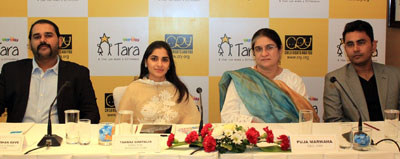
    From L to R Harsh wardhan Dave, Tanaaz Ghatalia, Puja Marwaha, Rahool Talukdar

    Kiddie online ecosystem worldoo.com has in association with leading NGO Child Rights and You (CRY) launched a unique initiative today called worldoo Tara. This will be the first online campaign where kids can donate to fellow kids in need.


    This is Worldoo.com’s first social initiative where citizens (users of the site) can ‘gift’ stars (Worldoo currency) from the earnings they make by browsing Worldoo.com, to less privileged children. Based on the number of stars accumulated on ‘Gift a Tara’, as it’s called on the platform, Worldoo will donate Rs 1 Lakh for the empowerment of these children. In the first phase of the initiative, Wordoo hopes to hit a mark of 5 lakhs stars for the initiatives ‘Gifting Asmina an education’ and ‘Gifting Karsan clean drinking water’.


    Commenting on the campaign, Taanaz Ghatalia, Director, Focus Kids said, “Most kids in today’s age are so used to getting that the idea of giving is rarely inculcated in them. We are really excited and believe in the nobility of the idea where a kid is helping another kid in need by his own means. We thank CRY for giving this its desired shape.”


    Said Harsh Wardhan Dave, Head, Experience and Brand: “This is just the beginning as we intend to take this to a whole new level by going to schools across India. We also want many more organisations who believe in the thought to partner us in the future.”


    Commenting on the initiative, Puja Marwaha, CEO, CRY – Child Rights and You said: “We believe that children are a reservoir of energy, and have the power to influence others. Together with Worldoo, we endeavour to sensitize children on the issues of child rights, by explaining the rights and their importance to them and how they can contribute to ensure a lasting change in the lives of other children.”


  • IAA Webinar with Julie Roehm, Chief Storyteller, SAP


    The International Advertising Association (India Chapter) hosted its fourth webinar under the ‘World Goes Digital’ series. Julie Roehm, Chief Storyteller, SAP was the guest who joined in from New York.


    The IAA Webinar series is spearheaded by Abhishek Karnani and director, Free Press Journal group and Manish Advani, head – marketing and public relations, Mahindra Special Services Group as co-chairs. *


    The panellists included:  Ashish Mehra (Mahindra Holidays), Abhishek Karnani (Free Press Journal group), Manish Advani, (Mahindra Special Services Group), Gaurav Mendiratta (Sociosquare), Pradyuman Maheshwari, Editor-in-chief and CEO, MxMIndia moderated the discussion:


    We know that storytelling is all about emotions and while you are an organization that’s essentially into technology, one doesn’t really need emotions because there’s technology that does it for you, right? How do you get the two to work for you?

    I think it’s interesting you said that because you know where my background is concerned I have been with SAP for 20 months and before coming here I had my own consulting business and had worked with companies like Wal-Mart, Chrysler, Ford…and as you may have gathered none of that resume included big technology software companies. I came here because Bill McDermott – who is going to be our CEO starting May of next year – had found me by reading something about me at some point of time and we had a dialogue for multiple years and he had asked me to come to work for SAP doing what I really like doing. I think to your point he also is a man who obviously has an interest in the success of SAP and has also been a technology executive himself. So he saw the need to bridge the fact that we are a technology company but sometimes big technology companies are seen as cold and very process oriented and therefore to try and be more human in approach. So when we came one of the big terms that we track and we try to fulfill is to humanize the brand because we believe that with this world the technology, maybe unlike 20 years ago, wasn’t something like a cool and slick kind of thing and nice to have in the background. Technology is pervasive in all our lives whether you work in a technology company or whether you are housewife you use technology everyday; you count on it and it is a part of the fabric of our lives. So to not to be able to connect that human element even in the big business scale that’s what technology enables companies to do. For example, we think about procurement and how it helps them to source products better. Okay, there is not a lot of humanization in that but if you go deeper then maybe there is because if you care about where you source your product from and who is it on the other end that is making that product then there might be a human story there and may make you think more about how technology improves the lives of employees every day. I mean think about the technology in the cloud that we are deploying all over the world where for example, you think of an HR person who is using it to help with the talent recruitment… So we know all, particularly the fact that you are all sitting in India with brilliant minds and the fact that we are very short of having bright strategic technologists to work in these high-tech companies. So the war on talent is big. Certainly money is the big thing but it’s not the only thing and technology can help us do that. So there is a lot of emotion that is available to us to connect and I’ve always believed that people who are trained in technologies and they always like to talk about that but everybody has a greater kinship and a feeling of connection; when you can connect something to a story or something that touches them personally. Those are the kinds of stories I think that will help us use this humanizing idea and get us to that next level by opening the doors maybe to the other industries and even to other types of businesses. People who have used our technology in the past understand that we actually do have solutions that’s going to help them in their positions too.


    What we have been trying to do essentially is look at storytelling by way of soaking in experiences as shared by the users. From the surveys that we conduct, we found out that customers were calling our call centres to share their experiences about the holidays and similar such sentiments. It was an incredible feeling because I’ve never heard customers actually talk to a tele-marketing executive or customer service representative that our holiday was fantastic; all they spoke about was individual moments during their holiday that made them elated. My question to you is whether you can share experiences on similar lines from your end and reference it against what we have experienced till date.

    Yes most certainly, I am not surprised at all. We see this all the time. It’s probably more expected in the travel & lodging and the entertainment world where one expects to hear great stories because if you go on a holiday you hope there is a good story that comes out of it and the fact that there isn’t always a place to communicate that unless people are tweeting or putting pictures on social platforms. We see the same thing in our business and maybe our challenge is even greater than what you are speaking of and that’s why we try to talk less about the actual technology itself and more about the experience and the impact. There are a couple of things that we have done and also that we are about to do – ideas that would be useful to you to think about. We’ve created an app for iPad that is called Customer Journey. It opens up on a series of stories. The reason we call it a customer journey is because it is the voice of our customer and in your case the traveler, but maybe it’s an opportunity for you to put across various entities or hotels or whatever to be able to capture some of the stories that people tell them and put them on here so that people like a little bit of trip advice or any of that third-party apps that are out there. One of the things we are in progress of doing is we are trying to create a movement, which I know is a very lofty goal, but it’s a movement around the idea that I mentioned about our first app which is to make the world better and improve people’s lives. Well, to run better means a lot to a lot of different people so what we are trying to do now is looking at creating our own social space through “Run better”. For instance in New York the fashion week is coming soon and we are thinking of capturing people talking about how fashion impacts their lives. Now you would be thinking what does it have to do with SAP? Well for Levi’s, especially for women who walk away with low self esteem because a certain pair didn’t fit in right, we have created a technology that helps them to image a women and tell which Levi’s jeans is gonna be best for them. We are talking about filming two girls chatting outside the dressing room where you can tell that they are trying to un-jean themselves by looking under their feet, under the curtain and then they come out and their faces are glowing because they’ve found this great pair of jeans and they feel so good about themselves. So when people feel so good about themselves they have energy or an aura that is very contagious to the people who they run into. So if we can capture that in other people’s movement by saying what does “run better” world look like to you it may have nothing to do with us in the long run but we can be associated with making the world better.


    I think today the social aspect is probably our most powerful tool and I would say it’s the same for you in the entertainment and the travel industry as well where it is about creating places where you empower not only your customer to be able to put their stories up but also your employees in all those hotels, restaurants etc. And I think the more angles you can have at a story out of personal experiences the more impactful it will be.


    How do you develop a talent pool of people with a right skill for storytelling? And in the era of ROI, how do you convince management and owners to invest in storytelling?

    From a talent perspective and something which I find interesting is that the team which started on customer storytelling was new – it’s not that people weren’t telling stories but to have an organization focus on that was new. What was interesting in that was what comes out from the woodwork of people who have a passion for telling stories whether it’s through writing or verbally or creating video or you know whatever method they use…it’s actually easier to find talent than you think. That said, once people get the notion that this is an option for them and that there is a commitment to this you will find a lot of people who actually have more of a talent face for it than you might have thought existed especially in a technology-oriented company. Secondarily, we set up storytelling training last year in as simple a way as possible. I did a five-step approach to storytelling which we did through a presentation. It is always easy to do five steps because to train people has to be a story in itself so it was like who was the customer, tell me a little bit about what they do, what is the problem or opportunity that they have…then the third step is how can technology help them either tackle their problem or realize their vision. Four, what kind of an impact does it have or they are hoping it has on their company and five, what is the impact it has on their customers? So if you can give a very prescribed list that is very simple, very logical to anybody out there to be able to capture that. What I did then is when we started to actually roll out these stories and when I was teaching my own team, I would have them follow that and then they would come back and read it to me. So I would say okay, if I am reading it or you are reading it to me and when I read it it reads like a Harvard Business case to me. Nothing wrong with the Harvard Business school mention, but it’s not necessarily highly consumable for everybody. It feels like I am in class and I got to read for school versus it’s a piece that I am reading in my favorite magazine or website that I am enjoying. So there a way to write and I really teach my team how to be more casual in language in writing these kinds of stories because otherwise it would become very professional. So that training has been super successful and was started last year; this year we mandated for all of our Marketing team. So there are 1600 people in Marketing at SAP so all those people are going to be trained in it. It’s a simple training just 30 minutes but when we know our marketing force understands what it means to tell a story or capture a story we know that we definitely are making a difference.


    How do you ensure all customer-facing departments within SAP walk their talk presented through storytelling to all their stake-holders?

    Well, it’s like 365,000 people so I am not magic but I think the best way to be able to do it is through word of mouth. First of all, none of this would event successful if our CEO at the time wasn’t committed to this. I mean he wanted to do this and in fact now he is pushing me very hard to give him stories from customer’s perspective. So instead of filming the CEO, COO you have Suzy who uses this out on the street and you need to have commitment from the top for anything like this to work. Secondarily, the training that we have implemented is like one group at a time and what we has also done is we ork closely with our head of Sales, Rob Enslin who also believes in capturing these stories. It’s like being introduced to a whole new way of doing things. So being able to talk to my customers about a handful of other customers who are in a like industry or a like situation and wow that’s really impactful and I really need to get more of that. So when we talk to our head of sales we share what we are trying to do and they were able to input tons of things that were helpful     to them when they are meeting with customers. More importantly, they also give us feedback that allows us to constantly grow and optimize what we are delivering. I think they are finding that now that they have tried it out it’s a much easier way to be able to talk about what we do.


    How does the art of storytelling change with demographics and culture?

    When we get pushed back in terms of whether our customers are willing to share their stories or be video-taped, it’s usually less because of cultural issue and more because of the fear that if they talk about what they do it somehow gives away their intellectual property. But from a cultural standpoint, you certainly have to take that into consideration but with the social world, even though people don’t want to have a picture of themselves there are other pictures that they can put to express themselves…to express who they are without actually having a image of them. So I think, more the choice that you give people to be creative on their own the more you can overcome some of the cultural barriers. Sometimes it’s cultural – country culture and sometimes its personal culture. Some people just don’t feel comfortable in any walk of life; it doesn’t matter where they live. They are just more introvert but if you give them an outlet to express themselves in a way that’s more comfortable to them I think what you will find is they do it so. So for me the moniker is choice…you have to give them choice…you know film yourself, take images, words whatever it is. We need to create interesting platforms where people can engage. There are lots of ways to generate engagement and I think the engagement component is lot more important even if not everybody is willing to jump on and create something for themselves.


    Very broadly, are there any other industries where storytelling works very well and where it doesn’t?

    Well you are talking to a purist so I don’t think there isn’t a place where it doesn’t work. I think the only time it doesn’t work is when it hasn’t been tried or done well so that would be my answer to that. When I give a talk on storytelling there are two examples that are relatively modern that I use. One is Google. You think about Google and you say well, it’s search. You may probably think I use Google all the time but it’s interesting to storytell. There is a beautiful video on youtube that is basically shot from a perspective of a father whom you cannot see but what you see is him putting something on search and then finding images and you hear him talking where he is writing an email to his daughter who is young. It basically chronicles her key moments in life like her first house using Google maps…then the day when she lost a tooth and such things…It’s all kinds of things using different Google tools but it never feels like a Google commercial because you are so involved with this man writing this touching email to his daughter that he is preserving for her. I find that it is great and I am really impressed with their storytelling because they have done a really nice job of telling their story from their perspective.


    Do you think that the government in India can use this technique to talk about what they are doing and communicate with the masses? For instance, do you think President Obama could have adopted the storytelling approach in the election year in the US?

    Yes I think he did that. I think how Obama uses it is to some extent to tell their personal story. I just find that at least in the US the political actions are so scripted that it lacks true feeling and I think that’s why people run towards Michelle Obama or the kid because they come across to us as being more authentic because when they speak as long as you are not behind the podium they are not typically as scripted as Barack Obama is. He has got lot of things that people have to say but Michelle to some extent comes across as much more national figure. When she goes on TV shows and when she talks about the clothes and the like it creates a very human personal connection and she does it better than he does it not because he can’t but I think “the handlers” believe it’s too great a risk because they put themselves out to be attacked on whatever personal things that they would share. So yes, I do think it would be a much better opportunity but I have low expectations that they will do it.




  • Times Internet announces senior hires

    By A Correspondent


    Times Internet has made some senior level appointments with Pratik Mazumder moving in from Yatra.com to join as Vice President, Marketing. Pawan Agarwal has joined as Business Head -Gaana.com , Swapnil Shrivastav joins as VP, Ad Tech and Miten Sampat as Business Head, Times City.


    Mr Mazumder has experience of 19 years, during which he has worked with Bharti Airtel and Yatra.com. Mr Agarwal, on the other hand, brings with him 12+ years entrepreneurial experience as co-founder & COO at Sunstone Business School. Mr Shrivastav, on the other hand, is an Adtech professional and entrepreneur. He was Founder and CEO of two ventures – Seeknet and Vriti. Mr Sampat was last with Neustar VP of Product Strategy.


    Satyan Gajwani

    Speaking on the appointments, Satyan Gajwani, CEO, Times Internet, said: “Each of our new joinees has come from an entrepreneurial environment with incredible expertise and exposure in their domains. Miten,Pawan, and Swapnil have strong technical backbones that will allow them to get into the cores of their business units, and Pratik’s creative energy and diverse background will help us approach marketing more uniquely. They have already made great contributions and we are excited for what’s to come.”


  • Vijay Mukhi: Why politicians are a failure on Twitter

    By Vijay Mukhi


    For all of us, the image of a politician in our minds is someone who with a simple wink and nod can bring a mighty city like Mumbai to a grinding halt. Someone who can also get a million people on the ground running at a moment’s notice. Politicians are men (or women) of the masses, their claim to power is because they have a connect with the people that no one else has, they represent the voice of the teeming millions. Journalists, and not columnists like yours truly, also think that they know the pulse of people.


    On Twitter, the Indian political class as whole  get an F- on Twitter because they have failed to connect with the cyber citizen using a tweet. So for now at least, no political party from India can ever think of organising a massive e-morcha on Twitter because they simply lack an understanding of what makes the Twitter tick. I expected them to have the same connect with the cyber world as they have in the physical world, but I am really disappointed as they have miles and miles to go.


    Before I get the wrong end of the stick of their followers (the editor thinks I am making a habit of this), let me as always use real numbers to substantiate what I have just said. There is no rule on Twitter that says that you have to follow someone to read his/her tweets, but Twitter makes it easier for you to see all the tweets of your followers on one page. Following someone on Twitter does not mean that you like or hate them. All that it means is that you would want to read that person’s tweet. I am sure a large number of Mr Modi’s followers are from the Congress camp and vice-versa. Finally, following someone needs a maximum of three mouse clicks and you can unfollow anyone you want with equal ease.


    Then, pray, can someone explain to me why would Mr Modi be Number 20 on my list of people I follow with only 2 million followers and Mr Tharoor a close Number 21 with 1.8 million? The Number 1 on my list is the Dalai Lama with 7.3 million followers followed by Amitabh Bachchan with 5.8 million and Shah Rukh Khan at 4.55 million very closely followed by his new long lost friend Salman Khan at 4.22 million. If you compare politicians from the US then President Barrack Obama has over 34 million followers and Justin Bieber 42 million. This means that if we compare like with like, then even Mr Bachchan is a pygmy on Twitter when it comes to Justin Bieber.


    If you look at the larger context of Internet penetration, India has about 120+ million internet-enabled netizens and the US has around 180 million. Some day I would like to write a column on how these numbers have no scientific basis, that column would indeed raise a lot of debate. Not everyone in India with an internet connection would use English as their first language and the social web is largely English even though regional languages are a viable option.


    The only valid conclusions that we can draw is that Twitter users are a very small minority of our Internet population, not even 10 percent of our netizens use Twitter. The day Messrs Modi or Tharoor cross 10 million followers, then we would crown them kings of Twitter but not of the social web which is a very different animal. The only reason why Twitter is seen to be a gamechanger for politicians is that each and every print or television journalist professional follows them on Twitter (more than any other social media property including the mighty Facebook). The day Twitter stops being followed  by the media, its influence on politicians would also drop. These Twitter cyber wars are more the creation of the media than a fact. Conclusion: Mr Bachchan, the three Khans and His Holiness should should be giving lectures to the politicians on how to increase their followers count on Twitter and not people like me who have not crossed 300 followers yet. You learn from people who have been there and done that.


    It’s important to understand that unless you have followers, Twitter makes it very difficult for people to read your tweet.


    The second metric we use is the number of times you are mentioned in Tweets. This is a metric that has more potholes than you could find on Mumbai roads. Take the case of Mr Modi. Do we count tweets that have his Twitter handle? But most times people would not use his Twitter handle, but use Modi or Narendra and the context says it all. The surname Modi is very common in India and do we search for tweets that also use his other nick NaMo. Finally, he is also know by some as the hashtag Feku. This is why getting an accurate count of the number of tweets that mention Mr Modi can always be argued till the cows come home. I have taken a decision, which you will disagree, I only count tweets that mention Mr Modi by his Twitter handle.


    With that explanation under our belt, in July Mr Modi comes 3rd with 78,000 mentions, Digvijay Singh  8th with 42,000 and Mr Tharoor 9th with 41,000. Not bad, three politicians in the Top 10 and three more in the Top 20. Would we not reconsider that may be we were wrong in failing the politicians? The only problem with mentions is that there is no way of figuring out whether the tweets were positive or negative.


    As Mr Bachchan once said English is a funny language and Twitter is even funnier. The reason being that we have 140 characters max to write out our tweet and of these we use stop words like ‘a’, and ‘etc’ that do not add any meaning to the tweet, we also take up valuable space by using Twitter handle names, urls etc in our Tweet making any sentiment analysis of a tweet extremely difficult from a machine’s point of view.


    Guess we need to have another column on why it is difficult to figure out whether a tweet is positive or negative is because the English we speak is not the same as that the US or UK speaks. However, if you believe in the maxim that all news is good news, and a nasty tweet is also a good thing, then your numbers would be different from mine.


    Let’s look at the third metric, which to my view is the most important of your popularity on Twitter on an ongoing basis. That is how many tweets of yours get retweeted. The best way to show that you like a tweet akin to a thumbs up is to retweet a tweet so that your followers also get access to a tweet. Thus the more your tweets get retweeted, the more you are getting your message across. In July, Mr Modi comes in at Number 7 with 78,000 retweets and he has Subramanian Swamy’s company at Number 15 and Kiran Bedi’s at Number 17. This you would agree is a bad showing compared to Mr SRK who is Number 1 at 170,000 retweets and Rahul Bose and Mahesh Bhupathi who just cross the 100,000 mark. This only means that the SRK fan base actually took the trouble of retweeting his tweets, whereas for whatever reason the politicians’ followers do not like to retweet their tweets. One reason could be that politicians’ followers do not know that they must retweet a tweet to show appreciation or that the tweets themselves do not convey something that enthuses these followers to retweet. Some day we would write another column on what tweets are popular in India and how should politicians tweet so that their tweets get retweeted. Conclusion: When it comes to creating tweets that can be retweeted, politicians have a lot to learn from our film stars.


    The last metric is simple output, how many times you tweet. This is not a very accurate counter as quality should always take preference over quantity. If politicians tweet a lot, all that it means is that they or the team that they have hired to tweet for them (this is a very big majority of politicians who would fall in this category) are active. Here Barkha Dutt takes pole position at about 40+ tweets per day and Mr Swamy comes in as the most active politician tweeter at a lowly 20 tweets a day at Number 12,  very closely followed by Ms Bedi at Number 13. We all know that politicians love speaking but it appears they or their teams do not enjoy tweeting very much.


    How do we explain this dismal showing of our politicians on Twitter? I conducted a small experiment. I send out 10 direct tweets to the political class, giving them the good news about their tryst with Twitter. The unwritten law is that you normally respond to a direct message on Twitter with a direct message, especially if it is good news. I do not know Barkha Dutt from Adams, but when I sent her a message on the same lines, she responded within 30 minutes. That’s one more person the politicians can learn from. Clearly, barring a few exceptions, politicians do not tweet themselves and do not spend time understanding the dynamics of Twitter. I have rarely seen a politician use a laptop forget about using a tablet or smartphone. Thus they are people who take what their ‘masters’ say in the physical world and simply tweet it. This model cannot work.


    My conclusion is that we will only see our political class take the top 5 positions out of 10, the day they start spending time on Twitter themselves and thus internalize the medium and platform.


    Next time we will rank the Indian Politician on Facebook because what works on Facebook does not work on Twitter which will not work on YouTube which will not work on e-mail and so on. The social web is not one homogenous mass where the same rules apply.


    A lots of people commented on what I wrote in my last column. Please understand that I am not a soothsayer. I am only interested in starting a discussion and debate how technology can help change the way our elections will be won and lost. All the data that I have used is available at www.vijaymukhis.com. I know no one who has the answer and I am looking into a mirror while I write this. I am happy to clarify doubts or any of the points I make. And, yes, I represent or have leanings towards no political party or movement.