Category: Digital

  • Narendra Modi is most mentioned political leader on social media: Blogworks study

    By A Correspondent


    As the countdown to the general elections 2014 begins, social media conversations around possible candidates for the top positions have gathered momentum.


    Marketing, communication and research services firm Blogworks has launched the first edition of its monthly India’s Most Mentioned Political Leaders index analyzing the Top 20 Most Mentioned Political Leaders online for the period January 2013 – April 2013.


    Some of the key highlights of the report:

    – The top five ‘Most Mentioned Political Leaders’ online are Narendra Modi, Rahul Gandhi, Manmohan Singh, Sonia Gandhi and Arvind Kejriwal (in that order)

    – Narendra Modi leads with more than thrice as many mentions as the nearest contender, Rahul Gandhi

    – Narendra Modi (63%) is marginally behind Rahul Gandhi (67%) in terms of percentage of mentions by the youth between the age-group of 18-34. It is noteworthy that ArvindKejriwal and Sushma Swaraj’s mentions are from a relatively older age-group of users between 45-54 years of age

    – Narendra Modi has the highest mentions by women (30%) followed by SushmaSwaraj (24%)

    – Though Narendra Modi has the highest total reach on Twitter, M Karunanidhi leads in terms of being connected with the most influential users onTwitter followed by Arun Jaitley, J Jayalalithaa, AnnaHazare and Omar Abdullah.


    A copy of the report can be downloaded from http://www.blogworks.in/post/most-mentioned-1/.


  • Firstpost launches promo for YouSpeak

    By A Correspondent


    Firstpost.com, India’s leading news and views portal has just launched the longest commercial for its interactive, video views platform, YouSpeak, which is also available on Android phones.


    Conceptualized and directed by Ravi Deshpande, Chairman and Chief Creative Officer, Contract, the ad runs for three minutes and 52 seconds and showcases a monologue of a quintessential modern woman spanning multiple subjects. She urges users to express themselves, as bottled-up feelings can be toxic.


    Mr Deshpande commented, “Often, your opinion, is linked to the way you are as a person. When you hear or read someone’s opinion, you can envision his face in your mind’s eye. That’s why, seeing the person speak is more powerful than just reading or hearing an opinion. The idea was to create a short film which is in fact a person’s opinion. Who she is as a person is clearly reflected in the content and delivery of her talk. Just as the personality of thousands of other video uploaders will be evident from what they have to say on YouSpeak.”


    YouSpeak, which was launched in March, allows users to express their views/ opinions via a 30-second comment on any topic on Firstpost.com and also allows them to start a conversation of their choice. It is also available for Android Mobile users, which will allow users to upload their points of view anytime, anywhere.


    The full ad can be watched at https://www.youtube.com/watch?v=EGa3R4yCYg and the app can be downloaded at https://play.google.com/store/apps/details?id=com.youspeak.


    Creative Agency: Contract India

    Art Director: Ravi Deshpande, Chairman and CCO, Contract Advertising

    Writer: Malobi Dasgupta

    Concept & Direction: Ravi Deshpande

    DOP: Faroukh Mistry

    Actor: Priyanka Bose

    Account Management: Anish Kotian, Gayathri Bhaskaran

    Production: FAR productions


  • Eros Now ties up with Tappp for prepaid cards

    By A Correspondent


    Online movie streaming service Eros Now (www.erosnow.com) has tied up with digital payment platform Tappp (www.tappp.com) to launch Eros Now Prepaid Cards that will enable cash purchase of Bollywood movies on Eros Now.


    With this new partnership, Tappp, the consumer brand of Swissclear Global Pte Ltd, is set to cater to the burgeoning demand for Indian entertainment by making it accessible to a large segment of the world’s population who either do not own credit cards, or are averse to making credit card transactions online. Tappp prepaid cards are available across an extensive global network of over one million retail points across India, UAE, Singapore and Malaysia, which include large chains, as well as small corner and convenience stores.


    To enjoy Bollywood blockbusters instantly, some well ahead of television and DVD premieres, consumers simply need to purchase prepaid cards or electronic vouchers at retail outlets, and redeem them online or on their mobile devices for immediate viewing. Prepaid cards start at just Rs 25 for access to movies such as recent zombie comedy Go Goa Gone, starring Saif Ali Khan.


    Sundip Argawal, Founder and CEO of Swissclear Global, said, “Digital delivery of content is shaping a new entertainment ecosystem, where consumers are now in control. The whole concept of choice is taken even further by the worldwide phenomenon of prepaid and gift cards, as it not only releases users from costly contractual obligations, but also gives them the choice to spend only on what they want to consume. We are therefore very excited to be working with Eros Now to offer consumers convenience and choice via on-demand entertainment.”


    Commenting on the partnership with Tappp, Rishika Lulla Singh, CEO of Eros Now, said, “Eros Now endeavours to provide a premium service that engages a new digital generation of Bollywood fans globally, and this exciting tie-up with Tappp will enable us to continue delivering on our promise to provide customers with the optimum viewing experience.”


  • Committed to quality journalism: Sambit Bal


    By A Correspondent


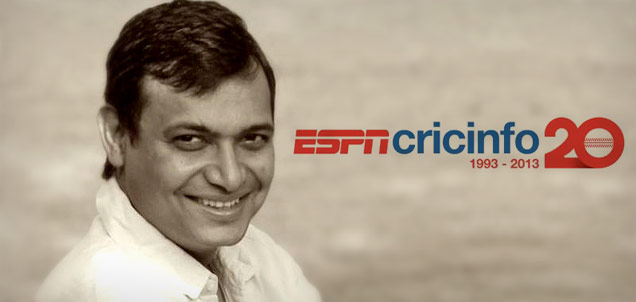
    Sambit Bal may have started in the profession as a sports journalist but he spent a fair bit of time in mainstream media is an Indian journalist. First as a correspondent with the now-defunct The Daily and The Independent and later with Deccan Herald. He was editor with Gentlemen magazine for five-odd years before joining Mark Mascarenhas’s total-cricket.com as editor. Later, he joined Wisden Asia as editor and he has been editor of ESPNcricinfo.com since August 2003.


    As the premier cricket website completes 20 years, Mr Bal takes our questions on cricket, journalism and specifically how Cricinfo (or ESPNcricinfo as it’s called now) is beyond scores and statistics, as it is perceived to be. In cricketing terms, we tried to bowl him some short-pitched deliveries, but he hit them back with much ease.


    Read on…


    Despite playing host to some good cricket journalism and cricketing greats writing for you, Cricinfo is still essentially known and referred to for its scores, stats and ball-by-ball commentary. As you celebrate 20 years of the site, is this an image that you are happy with or do you consciously try and work towards being a well-rounded cricketing site?

    That’s an incorrect perception. Apart from being the ultimate resource in cricket in terms of live match coverage and cricket statistics, ESPNcricinfo is also recognized, by fans, players and administrators, as the most authoritative and credible global voice in the game. We employ some of the finest cricket journalists and writers around the world and we follow the highest journalistic practices. Our credibility is based on editorial independence and the fact that we are the only media organisation in the world that can provide a global perspective on the game.


    Our next question follows this: if scores and stats and commentary are what people look for, then is there any point paying for expensive journalists and content? In fact over a period of time one has seen that you don’t have too many ”celeb” writers?

    If scores and commentary were all that people wanted, ESPNcrinfo wouldn’t have the position it occupies in the cricket world. We do provide the most reliable scoring service and the best quality of running commentary narrative, but our competitive edge comes from the editorial package we provide, the voice we have, the influence we wield in the game. And it’s a voice we have acquired by investing in and staying committed to high-quality journalism. A scoring and data service can be easily provided, the editorial reputation we have built is not so easily replicable. That’s the reason no other website has managed to come anywhere near us.


    As for the second part of the question, I don’t like the word “celeb”. We choose our writers and contributors on the basis of the quality they offer, not how well known their names are. We don’t believe in ghosted columns; we want contributors to add genuine value, and form our cricketer-contributors we want intelligent analysis and true insight. We have plenty of well-known former cricketers on our roster. In India we use Rahul Dravid, Sanjay Manjrekar and Aakash Chopra. Globally, we have Geoff Boycott, Ian Chappell, Ian Bishop, Martin Crowe, Ed Smith, Mark Nicholas and Mahela Jayawerdene to name a few. And of course, we have the finest stable of professional cricket writers in the world.


    Would it be right to say that you have moved from being community-driven to commerce-driven? Did the change of ownership impact the editorial direction of the site?

    Completely wrong. We have moved from a community-driven site to an editorially-driven site. Our journalists enjoy the kind of editorial freedom that will be unthinkable in the majority of the Indian media. The best thing about ESPN is that it is a content-driven business that believes in building value, not in shortcuts to drive pageviews. Our editorial mission is to serve cricket and the needs of the cricket fan. If anything, the change of ownership has given us the stability, resources and access to world-class technology to enhance our editorial coverage.


    How does the ownership by Disney and ESPN impact you?

    I have answered that somewhat already. ESPN is among the world largest sports- media businesses, which believes in serving the sports fan. It’s a company that invests in quality content. Being part of ESPN gives us the perfect environment for growth.


    In the recent IPL spot-fixing controversy and the controversies that have followed them, you had blocked off the comments feature. The web is all about freedom to contribute and discuss and argue. While we appreciate the legal implications, do you think there needs to be a different approach that affords interactivity?

    Freedom must come with responsibility. We are fully committed to integrating the voice of the fans, but we are also a responsible media organisation. When passions are inflamed, it leads to irresponsible and intemperate comments that are not only libelous but contribute little to an intelligent debate. We moderate user comments and occasionally take the extreme step of disabling comments.


    Sports coverage is a rights-based business. As the digital media becomes more important than conventional media, do you think you’ll have problems in the years to come doing the coverage?

    We have built a website based on editorial values – that’s our real strength. That’s something that can’t be bought. Not having rights has never been an issue for us; we don’t infringe on any rights and we are open to acquiring some. What we have is far more important: we have the trust of our readers to tell the story as it is.


    As a senior journalist and cricket writer, how would you rate Cricinfo vis-a-vis scores of publications with well-known sports journalists writing for them?

    I wouldn’t want to compare, but our numbers tell the story. We are the world’s favourite, most-read cricket website. We are known for credibility and integrity, so we must be doing some things right. But we have a unique advantage over most newspapers, which are constrained by the demands of the local markets. We follow the game from a wider angle, our writers are trained to see the game from a global, not parochial, point of view.


    Aside: do your commentators and scorers cover matches from the stadium or off TV? Is there any time lag?

    We do it off TV.


    What do you expect Cricinfo to grow into 20 years from now? And the next 5-10 years?

    The internet is an ever-changing medium and websites need to evolve continuously. The biggest opportunity lies in handheld devices, and for a content-rich site like ours, the major challenge is to provide an in-depth experience on mobiles and tablets.


    Video will become a bigger part of our package, and this need not be only match clips. Video can be used for storytelling and analysis. We have grown our video content steadily over the years, and that process will be accelerated in the coming years.


    But one thing is unlikely to change: ESPNcricinfo will stay committed to quality journalism and to covering cricket in the best way possible.


  • 1 Minute View: Batting right with Cricinfo

    It is heartening to read Cricinfo (or rather ESPNcricinfo) editor Sambit Bal talk of his commitment to offering quality journalism on his site.


    Cricinfo was among the first websites which got quite popular in India, even ahead of rediff.com or any of the various portals. One didn’t know who owned and ran it, but that didn’t really matter. It offered scores and statistics, in a clean format and was accurate. And that’s what really mattered.


    The acquisition by the Disney-owned ESPN ensured certain standards would be maintained, which it has done remarkably well.


    What makes Cricinfo standout is its commitment to quality. First, it’s no longer just a scores and stats site. Okay, there is also the commentary which is very popular. Over the years, Sambit Bal and his team have successfully built a site that goes beyond just the basics. It’s got content, agreed it won’t fuel controversies or carry gossip, but true blue followers of the game love that. And, yes, it’s got some big name cricketers (no, we won’t use the word ‘celeb’) who add to the weight.


    Clearly all of this has ensured that Cricinfo has virtually become the website of record for the world cricketing fraternity. There are the sites of the various country cricket boards (like that of the BCCI), there are sites of individual tournaments (like that of the IPL), but Cricinfo rules.


    Ensuring excellence in content always pays. And if it’s credible, it’s a surefire way of winning the hearts of the consumer.


  • ABP News launches #AakhriTaar campaign

    By A Correspondent


    ABP News has launched a campaign to keep alive memories of the telegram, and has asked people to share their stories about sending and receiving telegrams and using the telegraph service.


    #AakhriTaar is an initiative by ABPNews.in to enlighten people about the Electric Telegraph Service, and to revisit the telecommunications revolution that it brought about, the role it played in the Indian independence struggle and the importance that it enjoyed in the past.


    Social media is being used to drive the core objective of #AakhriTaar. As Twitter is the telegram of the new world, the campaign is primarily using the Twitter handle @Aakhritaar (https://twitter.com/Aakhritaar/). People can share their telegram stories at ABPNews.in. They may upload a picture/video of the telegram that they have received, the telegram form they filled, the friendly telegram officer they met, or the telegraph office that they visited.


    To boost the social presence of the message, the campaign is using the hashtag #AakhriTaar (https://twitter.com/search/realtime?q=%23AakhriTaar) and a Vine video (https://vine.co/v/hBPOHAjKvYv) on the history of Indian telegram has also been shared. The Facebook page, AakhriTaar (https://www.facebook.com/AakhriTaar), is also a seeing fan activity since its launch.


    More information is available at http://abpnews.in/aakhritaar.


  • Internet influences hair, skincare and beauty buys: Study

    By A Correspondent


    Google India has released its report on a study titled ‘Women & Web’ to understand internet usage pattern and its influence on purchase decisions of women internet users in India. The study was compiled by looking at search query data for top women-oriented search categories in India and independent online research done by TNS Australia, which reached out to over 1,000 women with access to the internet in India.


    Out of the total 150 million internet users in the country, around 60 million women in India are now online and use the internet to manage their day to day life. With easy access to internet at homes, cyber cafes, offices and growing adoption of smart phones, internet is being used by women for a variety of things. The study revealed that women who are online are relatively more affluent and younger. 3 in 4 women in SEC AB are now online and 75 percent are in the 15-34 age group, with over 24 million women accessing the internet daily.


    In terms of top searched categories by women on Google in India, apparel & accessories was the biggest search category followed by food & drink, baby care, hair care & skincare. The study revealed that – Skincare, hair care, food & drink were the fastest growing search categories, with queries coming from mobile phones growing rapidly and accounting for almost 25 percent of total query volumes in these categories.


    The study also revealed data on the growing influence of digital medium on women’s purchase decisions for these categories. Data from the online research conducted by TNS Australia, highlighted that among women who had access to internet, over 50 percent said that internet research influenced their decision before finalizing a product. In terms of most researched category and influence on final purchase decisions – internet influence was the highest for skin care (72%), baby care (69%) and hair care (65%) products.


    Rajan Anandan, VP & Managing Director, Google India said, “With this report, it is clear that the internet is empowering Indian women with easy access to information and helping them to make more informed decisions in their day-to-day life. The top generic searches and most searched brands reflect that women are heavily engaged on the internet and are using it to do online research before deciding on their final purchase for categories like skin, hair and baby care products.”


    In terms of online activity, email, search and social networking were the biggest drivers for women. Downloading music, looking for educational content, job search, watching videos and consuming news were the other top activities. The report also indicated adoption of ecommerce by women in India, with 1 in 4 shoppers buying baby products online. Women also emerged as strong brand advocates – with 80 percent saying that they recommend their purchases to other women and 25 percent stating that they share it online.


    Video on the web also emerged as one the key drivers of internet usage among women in India, with women accounting for 40 percent of the total monthly YouTube user base in India. Apart from music videos, TV shows and film content, beauty & fashion videos were popular among women on YouTube. Education, health and fitness, home care & cooking were also rated among the top 10 video content categories of choice on YouTube.


    The study was compiled by Google India, by combining Google search query data in India for apparel & accessories, food & drinks, baby care, hair care & skincare product categories along with TNS Australia research conducted online of over 1000 women in the age group of 18 to 65 and industry reports. The search query data was compiled for the period of one year starting from April 2012 to March 2013. Other data sources include TGI & IRS.


    Apparels & Accessories – International

    Apparels & Accessories – Indian

    Foods & Beverages

    Baby Care

    Hair Care

    SkinCare & Cosmetics

    Zara Fastrack Coca Cola Firstcry Loreal Oriflame
    Ray Ban Tanishq Amul Babyoye Livon Lakme
    Victoria’s Secret Fab India Cadbury Babycenter Tresemme Maybelline
    Louis Vuitton Van Heusen Pepsi Hushbabies Sunsilk Loreal
    Swarovski Chennai Silks Maggi Johnsons Baby Pantene Avon


  • Shopify enters Indian market with SingTel

    By A Correspondent


    E-commerce platform Shopify (http://www.shopify.in) has announced its entry into the e-commerce market space in India in partnership with communications group SingTel. Available from Rs 750 per month, the solution is an easy way for individuals and small business to set up attractive online shops within minutes, and accept secure credit card payments for goods and services. Shopify is successfully operating in over 100 countries and powers over 50,000 online stores with annual sales exceeding $1.5B USD.


    With Shopify’s web-based solution, storefronts can be set up and ready for business with just a few clicks of the mouse. Merchants can customise their storefronts, keep track of orders and manage customer data via a web browser. The platform provides features such as hosting, beautifully designed templates, a web dashboard to manage products and orders, a secure shopping cart, SEO tools, 24 hours customer service support, mobile optimized stores, and an iOS app which offers merchants the convenience of managing their business while on-the-go.


    In India, Shopify aims to reach out to new entrepreneurs who want to build their business online, established businesses that want to improve their stores with a stronger focus on branding, and brick-and-mortar retailers who want to take their products online.


    Customers in India can enjoy the following features: 

    – Shopify apps that help merchants extend the functionality of their store, and market their business online (e.g. referral apps, e-mail marketing apps, SEM services).

    – Customer support to help with store set up.

    – The ability to collect online payments through their Shopify store. Shopify supports PayPal, DirecPay and PayU in India. PayU conveniently accepts Visa/ Mastercard Credit Card and debit cards from more than 50 banks.

    – Free Advertising credits on Facebook and Google.

    – Sign up to Shopify and enjoy attractive shipping rates in the coming months


    “We’re really excited to announce this partnership with SingTel,” said Harley Finkelstein, Shopify’s Chief Platform Officer. “We built Shopify to allow anyone with a product or a service to easily create beautiful and highly scalable online stores, at an affordable price. SingTel is the ideal partner for us, as we’re both focused on helping small businesses succeed in today’s global economy. Together, we can help millions of small businesses and individuals build profitable online shops.”


    Loo Cheng Chuan, SingTel Group Digital Life’s Head of LocalL!fe, said, “SingTel is excited by the tremendous growth opportunities in the e-commerce market. By 2015, 35 percent of internet users in the Asia Pacific region will make purchases online, and 30 percent of these transactions will be performed on a mobile device. Shopify is an affordable and fuss-free solution to help entrepreneurs in emerging markets expand their reach in Asia and beyond. With more than 468 million mobile customers in 25 countries, SingTel is uniquely positioned to enable entrepreneurs to seize opportunities in the region.”


  • Are Marketers ready for the Digital E-way?


    By Ritu Midha


    The internet has long stopped being Wonderland. Indians are adapting to the ways of the web, and flocking to it for multiple reasons. The third largest internet consumer on the web, India is also one of the largest smartphone markets. Indian marketers are experimenting with the capabilities of the internet and while early adapters are already reaping benefits, others too are looking at getting into a far more serious relationship with it. Flirting alone is not enough!


    First a quick look at some recent internet studies. The numbers might vary from study to study, but the trend they plot is the same:


    – As per the Boston Study ‘From Buzz to Bucks: Capitalizing on India’s ‘Digitally Influenced’, Internet users in India will grow from 125 million in 2011 to 330 million by 2016, nearly a 300 percent jump. This will lead to more purchase decisions being impacted by digital influence.


    As per this report, 40 per cent of India’s 90 million urban internet users already say that what they buy is influenced by online activities such as product research and price comparison. The digital influence right now affects $30 billion of urban consumer spending, and is likely to accelerate further.

    It states that men are far more likely than women to be on the internet (32 percent versus 12 percent) and more than 300 percent likely to be digitally influenced (14 percent versus 4 percent).

    – Kleiner Perkins Caufield & Byers partner Mary Meeker’s report, meanwhile, states that India will have 67 million smartphone subscribers by the end of 2013, a 52 percent growth YoY.


    Interestingly, more than 50 percent of Indian respondents surveyed stated that they share nearly everything online, while the same number for the US is just 15 percent.


    – As per 2013 global ‘Internet World Stats’ report, India is ranked third (following the US and China) in number of active internet users. In sheer numbers it translates to 120 million users (up from 81 million users in 2010). In percentage terms, however, it is only 11 percent.


    As for the smart phones the study estimates that from 18 to 20 million smart phones in 2012, the number will grow to 30 million by 2016.


    – The Google study perhaps is the most interesting of all. It states that of the 150 million internet users in India about 40 per cent are women. It indicates that of these about 60 percent (24 million) are online every day. Among their key activities online are checking email, interaction on social networking sites and online shopping.


    Though the numbers might not sound huge when compared to television viewership or readership numbers, the medium’s continuous growth, India getting younger by the year, and purchasing power of this populace make it a force to reckon with. And then there are the medium’s inherent traits like high involvement, engagement, focused targeting, and measurability.


    Another key reason for the marketers to join the digital bandwagon is reducing cost efficiency of traditional media. States Vivek Nayer, CMO, Marketing Division, Mahindra & Mahindra, “In traditional media there is huge competition for commercial time and column centimetres. With the new guidelines, channels will be able to show ads only for 12 minutes per hour. It might lead to further increase in ad rates. In traditional media due to the high rates, ad sizes and durations are being reduced. Brand stories cannot be shared in 20-30 seconds. The digital platform allows you to tell the brand story. Secondly, there is high spillover. In digital, media interaction is far more targeted.”


    Marketers are not looking at digital just as a medium of brand communication but as a platform to engage with the consumer. Vivek Balasubramaniam Srivatsa, Head Marketing, Renault comments, “Online is not just a media choice, it creates brand experience and drives transactions. The key is to bridge the virtual world with the physical world seamlessly.”


    India getting younger and the young Indian being bolder and far more web savvy than his/her parents too is a key reason for the advertisers to look at internet far more seriously. States Ranju Kumar Mohan, Director & Business Head, JK Ansell – Kamasutra, “Audiences are evolving. Digital is the right medium for targeting bold experimental Indian youth. An effective way to use online is to link offline events with online activity. It immensely helps in growth in conversations.”

     

    Rajiv Dingra

    One of the key reasons digital engages with the consumer much better than the traditional medium is because here consumer is not listening to the story, but is a part of it. According to Rajiv Dhingra, Founder & CEO, WatConsult, “Digital marketing reduces marketers power to control the message – that power here resides with consumer. For the brands to be able to connect with the consumers online, it is important to make them a part of the story.”


    For a brand like Bisleri, which has long seen success via tradition route, too digital is emerging as an important medium to cut the clutter. States Anjana Ghosh, Director Business Development & HR, Bisleri, “For the last 50 years we have built brands like Gold Spot, Thums Up, Limca, Maaza and Citra via traditional media. However, now with more 3000 brands trying to battle for consumer attention on television and print, it is inevitable that one uses digital in the best possible way. It is important to engage with the consumer, and know what the consumer says.”


    Brands are increasingly using web to promote its on-ground activities. It helps in reaching a much larger number of users, and thus increases the RoI manifold. States Mr Nayer, “Amplification of offline events online enhances RoI. Mahindra has formed the Purple Club for Mahindra XUV 500 owners, and we do special events for them. One such event is XUV 500 torque day where we invite XUV 500 owners to drive on F1 track. We do considerable online activity around the event – we put up videos, send mailers and create buzz on FB. During the event, it is not only us putting live updates on Facebook, but also the participants themselves! It increases the buzz manifold. Another event we created was at Auto Expo Delhi – where we used augmented reality. Here a virtual cheetah sitting on the car and moving around became extremely popular not only with those at the venue but also online. The video had wow factor, and so went viral. Besides amplifying the ground event massively, it also won us a gold Abby and a silver Abby.”


    Marketers are emphatic that brands’ online persona needs to be same as the offline one. The interactions and activities conducted online too should be in sync with its offline activities. Any dissonance, they believe, would end up impacting the brand personality adversely. Mr Srivatsa comments, “The online experience needs to be in line with the brand promise. The key is to interact with online users right and to make them our brand ambassadors. There has to be seamless integration with reality.”


    A few brands have taken a leap forward. They are not only using online for brand communication and interacting with the consumer alone, but also to get insights into the consumer behaviour. Vinay Bhatia, VP, Marketing & Loyalty, Shoppers Stop reflects, “Marketers can get interesting and useful insights into their consumers by analysing data. We have a introduced a tab ‘Perfect for Me’ on our Facebook page. Here we display products to the users based on their preferences. Almost 50 percent of the people who use Perfect for me tab are First Citizen Club members. We now have both, their buying data and thinking data. Marrying the two provides useful and interesting insights.”


    Adds Mr Mohan, “One gets sharper data and insights from digital platform. Our product extension in 2010 was based on feedback we gathered from trendsetters. It was done on a closed door FB page.Based on that feedback KS deodorants were created. These deodorants are now doing very well in the market.”


    Marketers are also realizing that while they can talk to the consumer on various platforms, internet is the only place where they can listen to the consumer. Subramanya Sharma, CMO Cleartrip states, “Forums, Twitter, Facebook and feedback are the platforms to continuously listen to your consumers, understand their needs and pain points. What people like and converse about, are clear guidelines to improve one’s products and services.”


    Sanjay Tripathy

    For services the web is a completely different ball game – as the focus here is not on marketing alone but also on providing an excellent online service experience. Sanjay Tripathy, EVP, Head-Marketing, HDFC Life says, “BFSI (Banking, Financial Services & Insurance) is not a product business. Our online presence, to some extent, is about query and interest, which leads to new business acquisition. The web, however, works immensely well as a medium to service the customers.” He adds, “Having said that, for online to work, the right ecosystem is important. The company should have right mindset and right partner.”


    So the inclination is there to use internet as a medium not of advertising communication, but of brand – consumer interaction. Though, there are still only a few examples of path-breaking digital marketing, the learnings are immense. What a brand expects and attains out of online brand-consumer interaction depends on the brand’s PLC, its involvement level, and also on its internet age. As more and more brands put weight behind digital in this tug of war with traditional media, it will get more interesting. However, inclination alone is not enough, brands need to condition themselves to listen to the consumers and evolve. If they just want to convey an advertising message, digital is no match for television.

    Quotes in this article are excerpts from 9th Marketing Conclave organized by the Internet Mobile Association of India (IAMAI)

     

  • Vodafone Zoozoos have largest Facebook fan following

    By A Correspondent


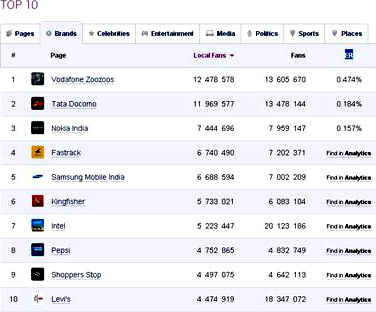
    Vodafone’s lovable characters the Zoozoos have yet again mesmerized the audiences to become the leading brand page with the highest number of fans on Facebook. (http://www.socialbakers.com/facebook-statistics/india)


    Recent statistics show that the Zoozoo army not only leads in the size of its fan following on Facebook, but the Vodafone Zoozoos page is the most engaging brand on Facebook with close to 617,529. (ER- 0.474%) people talking about it.


    Telecom Brands Chart (International)

    Vodafone Zoozoos page ranks 6th amongst the top 10 global telecom brands on Facebook. It is the only brand page of a telecom service provider brand apart from T-Mobile (10th) in the top 10 list. Nokia India is the only other telecommunications brand page from India that makes its mark in the top 10 telecom brand page list on Facebook.

    (http://www.starcount.com/chart/telecoms-brands/4f2ad5672418ae215b00002c/today)


    India Facebook Brands Chart

    The Zoozoos are one of the most loved characters in the advertising world. They not just appeal to the audience in the metros but are also popular amongst consumers in tier 2 and tier 3 cities.


    Their popularity is evident while skimming the list of top 20 Facebook brand pages in India. Currently Vodafone Zoozoos are 19th on the list of top 20 Facebook brand pages in India that is majorly dominated with the pages of the celebrities, production houses, and television channels. Nokia India (mobile handset manufacturer) is the only other telecommunications brand that makes its presence felt in the top 20 list.

    (http://www.starcount.com/chart/country/india/today)


  • Growth expected to be in video: Chaitanya Prabhu, Zapak

    By Johnson Napier


    Despite the challenges being presented, the year 2012-13 was a decent one for Zapak Digital as business grew by a significant amount. In fact the digital player is very bullish going forward as it readies itself for opportunities on the medium of mobile.


    Chaitanya Prabhu, Business Head – India, Zapak Digital Entertainment reveals to MxM India that its primary focus is to build up the mobile gaming business by offering high quality mobile games that can be enjoyed by casual gamers across platforms and across the world. Along with that, he reiterates, the agenda for this year is also to focus on Advergaming & SMM by reaching out to brands with refreshing ideas and pitches.


    How would you summarize 2012-13 for Zapak Digital in India? Were you able to achieve growth targets as per expectations?

    The year 2012-13 was challenging and exciting for us, as the business landscape was changing rapidly with the focus moving to mobile. We see great opportunities on mobile and that is why we altered our strategy to ensure that we maximize this big opportunity that will be the focus area going forward. We managed to grow our business in 2012-13 and we are going to be very bullish going forward as we prepare ourselves for the opportunities on mobile.


    How has the digital market evolved in India over the past few months given that new trends get thrown up almost every day?

    The online advertising market in FY12-13 has represented a growth of approximately 30 percent, and the share of advertising on mobile and social media is expected to grow dramatically this year too. Although search advertising still constitutes majority share (approximately 38 percent) of overall digital advertising spends, we expect this year, social media, video and mobile to increase share of marking spends which are still a smaller pie. As a trend for last year, definitely 2012-13 will be a year which will be remembered for companies in India officially taking the social media plunge, embracing Twitter, Facebook and advertising on social networking sites as an integral and crucial part of their marketing plans, and using demographic information to target their ads appropriately.


    How has the consumption pattern of the audiences changed with respect to accessing content on the digital platform?

    We have seen a massive burst of app downloads. The app economy in India is growing month on month. We are seeing 200 million app downloads every month in the country and we see this only grow considering that the Smartphone penetration in India is just 11 – 12 % and expected to grow to 15 % in 2013 and continue growing YOY. Rich media with video is gradually ramping up in mobile advertising industry and advertising in Gaming apps are also helping with greater reach and conversions.


    The next upcoming trend on mobile will be display to include rich use of rich media with banner ads which have capability to expand, offering advertiser larger space to communicate. We will also soon see relevant targeted Games that can also be placed within a banner to make user’s experience more interactive and engaging in smartphone devices.


    How have the various verticals under Zapak delivered on the growth front?

    We have the following verticals under Zapak including Advergaming, Zapak Portal on PC & Mobile, and SMM & Activations.


    Advergaming – This is a big focus as we are seeing that brands need engagement activities that continue to build the brand. We are working very closely with companies like HUL, Cadbury, Hyundai, Maruti etc so that they can keep interacting with the target user group through the concept of Advergaming.


    SMM and Activations We estimate total social spend in India to be approx 300 cr in FY 2012-13. Social media spends has nearly doubled in last 2 years. Growth area this year is expected to be on video. At Zapak, being aware of this we have made video as a key component of social media strategy and have worked on multiple client delivering them sharable videos which helps us develop an organic reach and better recall of digital campaigns. As brands keep asking for activations as part of their digital strategy, our activations team YOY keeps exciting brands with the way they are doing Phygital. With digital at its core, we have successfully executed couple of Phygital campaigns this year and were a runaway hit instantly with TG and were highly appreciated by clients we cater to in social media space.


    Zapak Portal on PC & mobile – While we see inventory sales in PC grow as we keep seeing an increase in the number of visitors on the portal, we are seeing a multi fold jump in users accessing the Zapak portal on mobile.


    What are the challenges you foresee for the growth of digital in India?

    The biggest challenge in digital media is understanding of key metrics which are relevant and should be set as an end goal; second major challenge is Diversity- East to West, North to South, planning for a nationwide campaign or at a regional level, the interest, culture and tastes vary and is very visible in any digital platform. This is a debatable issue, as people use internet in the universal language English and covers the educated middle and upper class. True, but local flavours rule the roost. Thirdly it’s about getting it Integrated: Any digital campaign with its well defined goals have many platforms- e-mailers, SMS, ad words, special promotions on Social media and SEO and ORM which area long-term affair and many more to come in future. Each of these platforms has its own perils and should be approached with its own expertise.


    Despite its prominence and ease of availability, digital has not found much favour with brands who fail to splash out sufficient budgets on the medium. What will it take for brands to take a proportionate liking to the medium?

    Marketers should aim to provide innovative concepts that are relevant to the brand and have the capabilities to sustain consumer interest for a longer period. In case of the digital medium, the return of investment for any brand is user’s engagement. Once that is achieved, brands will be more open to exploring the digital medium and leveraging the abundant opportunities available.


    What is the growth plan for Zapak Digital for 2013-14 in India?

    Our primary focus is to grow our mobile gaming business by offering high quality mobile games that can be enjoyed by casual gamers across platforms, across the world. Along with that, the agenda for this year is also to focus on advergaming and SMM by reaching out to brands with refreshing ideas and pitches.


  • What makes Google India’s best company to work for


    By Devina Sengupta


    Two years ago, the 21-year-old Zihan Ahmed made a mistake. The college graduate wore formals for an internship interview with Google India and the interviewer commented, “You can be serious without wearing a suit”. A year later, Ahmed went for his campus placement interview with Google, in shorts.


    Today, based out of the search engine’s Hyderabad office as an associate in the market sales team for small and medium business, Mr Ahmed realises his first job is virtually a dream job for others. His company wants him to pass the ‘airport test’ and not just be another keyboard punching machine desperate to stay ahead of the competition and peers.


    The airport test, which all employees must pass at Google, is to make sure that if they are stuck in an airport and someone strikes up a conversation, the Googler must have something interesting to talk about to a complete stranger. “Every Googler has a hobby,” says Mr Ahmed, “and that is what keeps us from being mediocre”. He is a polo player and a show jumper and heads out with his horse thrice a week at 6 pm, knowing that employees in most companies are wistfully staring at their watches.


    The internet search company that is heavily betting on mobile internet usage, online video growth and small and medium businesses, has strict abhorrence towards those who look upon hierarchy as a sign of success, work in silos and are complacent.”


    Life is awesome at Google, says Rajan Anandan
     

    At Google India, Rajan Anandan is on a roller-coaster high that does not have any dips. But in his firm, the don’ts are more clearly defined than the do’s. For the India head, silo worship, long drawn-out meetings and hierarchy are strictly off-limits at Google. And as for the dos, the Googlers have to just think 100-fold bigger and the rest will just fall in line.


    How has your journey at Google been?

    Overall, the two-and-a-half years at Google have been fantastic. The company values speed and entrepreneurship. There have been so many highs, like getting India business online and women on the web entrepreneurship. I got the opportunity to work with some incredibly smart people and have enjoyed this journey. Our business is more intense than others and I see myself with Google for a long time.


    What has been your greatest achievement at Google?

    It has been all team achievement and not mine alone. Accelerating adoption of internet, mobile users, especially with smartphones becoming affordable, adoption of online video. And the market impact has been tremendous. Today, internet user base in India is 100 million and there are 90 million mobile internet users with a 150% year-on-year growth potential.


    What is the Google way of doing things?

    Building teams and hiring the best. In Google, teams do not need to be told as micro-management is a disaster in this office. So we question every assumption of doing business as we have a saying that lets us take it up by 10x, and not just 10%.


    Is there any company (not Google) whose model of working you want to adopt?

    Not just one company, as every company has a distinctive way of working. I have brought with me some aspects of Dell and Mckinsey where I have worked before and others have done the same. There is no one company whose model we want to adopt.


    Is there anything in Google that you would want to improve?

    At Google, we are extremely self-critical and always looking at how to do things better. So, instead of 10x, I would want one to think in terms of 100x, make it bigger.


    What not to do at Google?

    Thinking small, incremental, being hierarchical and uncollaborative. Also, being in meetings all the time and not working. Meetings are a death of speed and as a leader if you do not get things done, the team will stop respecting you.


    Your roadmap for Google?

    The internet will continue to grow and cross 200 million at the end of this year. Mobile internet is growing and Android has enabled India to have internet on their phones for Rs 6,000-7,000. Online video is a big strategy and even small and medium business empowerment is important. We have a great team and a year from now my priorities should remain similar, or something has really gone wrong.


    If not Google, then what would you have been doing?

    I am here for a long time. As of now, life is awesome.


    Source:The Economic Times

    Copyright © 2013, Bennett, Coleman & Co. Ltd. All Rights Reserved

    Licensed to republish


    We are extremely self critical. At Google, we say things should improve 10x times and not by 10%, I would say why 10x and not 100x. It is a bad idea to think small in this company,” says Rajan Anandan, India head for the firm.


    And 31-year-old Parul Sharma says this trait of going beyond KRAs is integral for the company. She is the manager of online sales team and has worked with North American markets for projects on mobile shopping that was not related to her work at all. “It was not related to my performance and that does not matter .There is no career ladder here and it is more of a jungle gym,” says the Gurgaon-based manager. The company ensures that every decision percolates and teams have biweekly meetings where every decision taken by the CEO is aligned to their tasks. Employees have access to products that are yet to be launched so that they can test and give feedback, a sign of faith in its people- a system called ‘dogfooding’.


    But true to Google tradition, even meetings cannot stretch as it may hinder productivity. “Meetings are a death of speed. At Google, if you are in meetings and do not work, then they will not respect you,” says Mr Anandan. His meetings are for 15-20 minutes at the most except for the one-hour Monday morning one. The firm has developed ‘bureaucracy busters’, program where a Google employee can suggest ways of slashing red tape within the firm.


    But the workplace is not about beanbags and lava lamps. An employee will have to preempt what his peers are doing and stay a step ahead, says Meggha Bajaj Kapur. The 34-year-old manager for advertisement operations joined the company in 2007 and realised immediately that innovative ideas are dime-a-dozen here. “If there is a discussion on career development initiatives, then all team members will have innovative ideas and then some more,” says the Gurgaon-based employee. She realised her resume showed the right company when she was promoted on her ninth month of pregnancy.


    She was about to take a 5-month maternity leave and did not expect to climb the next rung as most workplaces would shy away from promoting a soon to be mother, but Google did not. Her ‘magic moment’ with the firm appeared when she received a personalized gift hamper from the company, and not just her team, upon childbirth.


    Faced with manageable attrition, according to Head of People Operations-Sales, Sharad Goyal, data and analytical minds rule over intuition in this workplace. And importance given to the India office is at an all-time high.


    Google India has developed ‘India Get Your Business Online’, a programme to offer free websites, domain and hosting services to small and medium businesses in India. So employees quit only to start their own business. As an employee commented, “Where else can you just drop a mail to the manager with only a subject line stating ‘WFH-EOM’ and manager replies ‘Cool, Tcre’?” The attitude may be informal but the care quotient evidently puts Google at the top of the heap.


    Source:The Economic Times

    Copyright © 2013, Bennett, Coleman & Co. Ltd. All Rights Reserved

    Licensed to republish