Category: Digital

  • India Today Conclave is back with its 20th edition

    By Our Staff


    India Today Conclave 2023 is back with its 20th edition. The conclave is being held in Delhi on March 17 and 18. It will be attended by top heads of state from the political, judicial, and entertainment worlds. PM Modi, Chief Justice DY Chandrachud, and film superstar Ramcharan will address the conclave. Others from various fields will also be a part of this event.


  • OTTPlay Premium collaborates with ManoramaMAX

    By Our Staff


    OTTPlay Premium, AI-powered OTT subscription, recommendation and content discovery platform, has announced its 16th OTT partner – ManoramaMAX, Malayalam OTT that delivers the latest movies, TV serials, programmes, web-series, and news from the home of of MM TV (Malayala Manorama Television).


    OTTplay Premium, in collaboration with ManoramaMAX will provide video-on-demand and over-the-top (OTT) streaming services of Malayalam movies, MAX Exclusives, and early access to Mazhavil Manorama programmes.


    Commenting on the collaboration, Avinash Mudaliar, Co-Founder and CEO – OTTPlay said: “We are concentrating our efforts on expanding our pan India presence, with the goal of capturing a share of the rapidly expanding OTT aggregator platforms across languages. With this collaboration, we are aiming to provide a substantial Malayalam content slate to our audience. In accordance with this approach, we aim to offer our OTT viewers with a wide and exclusive content slate in multiple languages. We are collaborating with the most creative OTT platforms to offer a plethora of exclusive content.”


    P R Satheesh, CEO – MM TV Ltd added: “MM TV is glad to partner with OTT Play in distributing ManoramaMAX to its end users. ManoramaMAX is the number one OTT in Malayalam with a significant base in Kerala who keep engaging with the platform enjoying over 400 blockbuster movies and 20,000 hours of entertaining content, live news and exciting exclusive web-series. We look forward to a great innings with OTT Play spreading the magic of ManoramaMAX.”


  • What a rocket, boys!


    By Avik Chattopadhyay


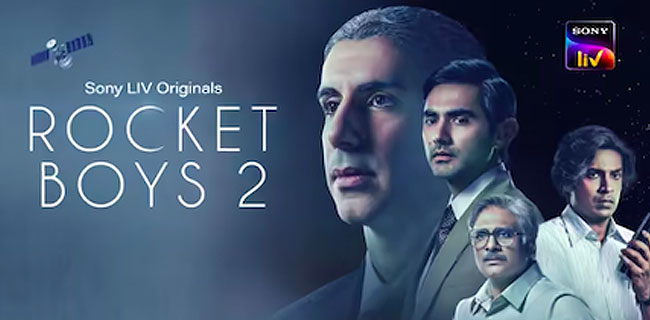
    Avik ChattopadhyayI just finished watching Rocket Boys Season 2 on Sony Liv.


    With my 79-year-old mother sitting beside me, wide-eyed, ears perked up not to miss a single dialogue. We had finished Season 1 in one sitting, so taking two sittings to polish off Season 2 was a bit of a let-down, by our own standards of binge-watching.


    It left a terrific after-taste… in the mind. Somehow it made me feel better about myself, the society I have grown up in and the ‘nation’ I belong to. Though not a great fan of the very concept of nationhood, this, for a moment made me break free from my self-imposed boundaries, and feel proud…very proud!


    What makes this web series work for me? It is definitely dramatic. It is not always factual. It does fall prey to some stereotyping, whether it be the grimacing CIA officials or the underdog Raza. It has taken definite liberties with situations and dialogues, given the very lack of any evidence to prove otherwise. Yet, it is a terrific story!


    It is not just the story of Bhabha, Sarabhai, Kalam and Ramanna. It is the story of a nation, just a decade young, trying to find its own feet and posture. It is the story of a nation that was carefully crafted, through a constitution, to be a lighthouse for the rest of the colonial world to admire and emulate. The India created in 1947 was more than a nation state. It was an idea whose time had come [to quote from Victor Hugo] of what a post-war, post-colonial, modern country should be like… diverse, inclusive, democratic, open, inquisitive, industrious, ambitious, assertive [not arrogant, mind you] and non-aligned. If a country of 300 million people of unending diversity could consciously choose be this in the 1940s, so could every new nation that followed.


    This exactly is the story of Rocket Boys [RB]. Each protagonist stands for a certain value or weakness of the new India. Each character is a certain shade of grey. Apart from the CIA that has been depicted in dark black, all others are shades of grey… from light as in Sarabhai to very dark as in Mathur. Nehru is vulnerable. Shastri is indecisive. Mrs Gandhi is fragile. Everyone has weaknesses. Nobody dons a masked suit with a cape and flies off to save a young India from the evil Pakistan and the hawkish US. They are just as commonplace we are. Just that circumstances made them be in places and hold positions that required of them to direct and define a legacy.


    This is what makes RB so endearing.

    And a terrific lesson for brands. Three clear inspirations can be taken by any brand manager from the Rocket Boys.


    Endless Engagement

    This is the first quality of any successful marketing campaign today. It has to build quick bonding and then carry the target segment through an immersive journey. RB is as racy as any thriller you have seen. It is a bit like Tom Clancy and K N Panikkar rolled into one. Right from the start it is a roller coaster ride of adventure, intrigue and crime without the Mumbai underworld. The only reference to ‘Bhai’ is how Bhabha addressed Nehru.


    Relatable Relevance

    The timing is perfect. So are the characterisations, or most of them. As we are entering into our ‘Amritkaal’ it is always good for the younger generation to know a bit about the early ‘Samudra Manthan’. The youth need to get a glimpse into how things of utmost import happened before issues like regionalism, religion and right[eous] ownership became the narrative.


    This is an era much before appeasement and invasions. This was an era of nurturing, questioning, scientific temper and a greater sense of bonhomie. This was an era that saw the subtle but sure transition from the Prime Minister being addressed as ‘Bhai’ to ‘Mrs Gandhi’. RB allows the young Indian to connect the dots and process the journey we have undertaken as a nation and where we stand today.


    And it has been deliberately made in English to cater to a wider audience across India and even overseas. Making it in Hindi would have restricted its viewership and national appeal.


    Inspiring Candour

    The tone of voice through the webseries is charmingly disarming. There are the obvious moments of high-sounding statements, but they are exceptions. The state of the nation has been shown in a truthful manner. There is no unnecessary bravado. There is no superhero. Every character has a fair share of strengths and weaknesses.


    Relationships have been sensitively depicted and nurtured, though a few characters like that of Kamla Chowdhry have been shown in a single dimension. But then doing otherwise might have digressed from the core narrative of how India became a nuclear power. There has been controversy around the fictional character of Raza Mehdi and how a stalwart like Meghnad Saha has been virtually ignored. But then, nobody’s perfect. Just like our nation is not. The characters grow and develop through the 16 episodes almost symbolic of the way the young nation slowly found its feet, reconciled with harsh realities, recalibrated after adversities yet relentless in its greater pursuit of creating a new world order… fearless, forthcoming and friendly with all!


    For the entire team that created Rocket Boys, there could not have been a better tribute to a still unsure, bit confused but totally committed 75-year-young nation!


  • Shopsy by Flipkart launches new campaign

    By Our Staff


    Shopsy by Flipkart, hyper-value e-commerce platform, launched its new campaign with Sara Ali Khan as its brand ambassador. The campaign brings to light the platform’s affordable pricing and the expansive product range curated especially for customers seeking value.


    Created and conceptualized by Leo Burnett Orchard, the campaign features an ad film that showcases the interactions related to online shopping that family members engage in, something that most Indians relate to.


    Commenting on the campaign, Adarsh Menon, Senior Vice President & Head – New Businesses, Flipkart, said: “At Shopsy, it is our constant endeavor to offer a shopping experience that blends affordable pricing, wide selection and pan-India availability with the latest trends and evolving needs of the consumer. Leveraging this deep understanding of our customers’ needs, ‘Aaj Shopsy Kiya Kya’ campaign is a recreation of a real-life scenario where the families of Shopsy’s customers are astounded to learn about the kind of vast selection in multiple product categories and low prices of the products available on the platform.”


  • Shemaroo partners with Web3 Consultancy Capital Block

    By Our Staff


    Shemaroo, media and entertainment entity, has joined forces with Capital Block, a top Web3 consultancy known for crafting fan engagement-based strategies for sports and entertainment brands. This strategic partnership aims to establish a global presence for Shemaroo’s Virtasy digital collectibles project within the NFT ecosystem. The collaboration leverages Capital Block’s expertise in Web3 and NFT strategy to establish Shemaroo’s Virtasy as a significant player in the global NFT ecosystem.


    Capital Block, a globally renowned Web3 marketing agency, brings a wealth of experience in the sports and media industries to the table, making them the ideal partner for Shemaroo’s NFT project, Virtasy.


    Speaking about the collaboration, Hiren Gada, CEO – Shemaroo said: “Shemaroo has been a pioneer in adopting new technologies and cutting-edge solutions. Our partnership with Capital Block is the latest step in our ongoing quest to stay ahead of the curve. We are thrilled to collaborate with Capital Block, a true leader in the NFT industry, to establish a strong presence in the global NFT ecosystem. We recognize that marketing NFT projects requires specialized knowledge and skills, as it involves reaching a niche audience of collectors and investors who are interested in this new and emerging market. With Capital Block’s wealth of experience and expertise in the sports and media industries, we’re confident that we’ll be able to successfully navigate this complex landscape. This partnership is the perfect match, and we’re excited to see what the future holds.”


    Commenting on the collaboration, Timothy Mangnall, CEO – Capital Block added: “We are delighted to be working with Shemaroo on this project. We believe that NFTs have the potential to transform the entertainment industry, and Shemaroo is well-positioned to lead this transformation. We look forward to collaborating with them to develop a strategy that will engage fans and enhance their global presence.”


  • Not at all Quiet on the OTT Front


    By Shailesh Kapoor


    Shailesh KapoorOver the last three years, it became abundantly clear that streaming (or OTT, as it’s called in India) is the medium of the future in this country, even as other media will continue to co-exist. Linear television always had the numbers. But thanks to a mix of factors, ranging from the pandemic, to ever-reducing data costs, to a nosey TRAI, linear television has barely managed to stay afloat. Pressure on revenues has been felt across the board, and that’s never a good sign.


    Streaming itself is trying to find its sweet spot. Is it a premium paid (SVOD) medium, as all the promotions of well-mounted web-series suggest? Or is it a medium for the ‘masses’, where free (AVOD) content is going to dictate the future? The jury has been out. And the last few weeks have seen their share of action on this front.


    Perhaps the biggest shift in the dynamic has been around the IPL. The 16th edition of the league, which starts March 31, will stream free on JioCinema. That’s a polar opposite to how it was thus far: IPL was a subscription (and hence, revenue) driver for Disney+ Hotstar, not just in India but at a global level too.


    Then, there’s the talk of the largest AVOD player in India outside of YouTube, i.e., MX Player, being up for sale. The content side is going through its continuous evolution. For example, price points for acquiring streaming licences to theatrical releases have not stabilised yet.


    All these are healthy signs, one would think. A growing category is bound to see new ideas, new strategies, and new alignments. And some of these may shape the future of the category. For example, there is little doubt in my mind that IPL’s streaming viewership will outnumber that on linear television this year.


    How did linear television find itself in this situation is a matter of another debate. But it should not have, because it’s still the staple, go-to medium for millions of Indian families every night. But the only way you can fight technology is by building a precise and relevant narrative. The linear TV industry has failed to do that for itself.


    Amidst all the positive action, the talk of censorship of streaming content has started again. This week, the I&B minister advocated censoring “vulgarity”. The genesis of this not-so-veiled threat lies in a Delhi High Court judgment will handling a complaint on TVF’s show College Romance. The state and the judiciary playing moral police can be a major irritant in a category that’s otherwise amid a period of high activity and growth.


    All eyes, hence, are on India’s streaming story, in its second phase, where the category seeks stabilization and re-alignments. And the upcoming IPL will set the ball rolling on that front.


  • Top 10 Takeaways on AI…


    By Our Staff


    Every year, the Stanford Institute for Human-Centered Artificial Intelligence (HAI) publishes a report studying trends in artficial intelligence.


    The 2023 AI Index has just been released and as it notes, the technology “has surpassed many benchmarks, leading researchers to reevaluate some of the very ways in which it should be tested and forcing the broader public to think more critically of its associated ethical challenges.”


    Here’s a little about the report: “The AI Index, led by an independent and interdisciplinary group of AI leaders from across academia and industry, is one of the most comprehensive reports on the impact and progress of AI. The AI Index tracks and evaluates AI progress through a wide range of perspectives, looking at trends in research and development, technical performance, ethics, economics, policy, public opinion, and education. The report helps to ground the AI conversation in data, enabling decision-makers to take meaningful action to advance AI in responsible and ethical ways.”


    The AI Index has published a list of 10 takeaways which we believe are must-reads and hence are publishing as is.


    Here goes:


    1. Industry races ahead of academia. Until 2014, most significant machine learning models were released by academia. Since then, industry has taken over. In 2022, there were 32 significant industry-produced machine learning models compared to just three produced by academia. Building state-of-the-art AI systems increasingly requires large amounts of data, computer power, and money—resources that industry actors inherently possess in greater amounts compared to nonprofits and academia.


    2. Performance saturation on traditional benchmarks. AI continued to post state-of-the-art results, but year-over-year improvement on many benchmarks continues to be marginal. Moreover, the speed at which benchmark saturation is being reached is increasing. However, new, more comprehensive benchmarking suites such as BIG-bench and HELM are being released.


    3. AI is both helping and harming the environment. New research suggests that AI systems can have serious environmental impacts. According to Luccioni et al., 2022, BLOOM’s training run emitted 25 times more carbon than a single air traveler on a one-way trip from New York to San Francisco. Still, new reinforcement learning models like BCOOLER show that AI systems can be used to optimize energy usage.


    4. The world’s best new scientist … AI? AI models are starting to rapidly accelerate scientific progress and in 2022 were used to aid hydrogen fusion, improve the efficiency of matrix manipulation, and generate new antibodies.


    5. The number of incidents concerning the misuse of AI is rapidly rising. According to the AIAAIC database, which tracks incidents related to the ethical misuse of AI, the number of AI incidents and controversies has increased 26 times since 2012. Some notable incidents in 2022 included a deepfake video of Ukrainian President Volodymyr Zelenskyy surrendering and U.S. prisons using call-monitoring technology on their inmates. This growth is evidence of both greater use of AI technologies and awareness of misuse possibilities.


    6. The demand for AI-related professional skills is increasing across virtually every American industrial sector. Across every sector in the United States for which there is data (with the exception of agriculture, forestry, fishing, and hunting), the number of AI-related job postings has increased on average from 1.7% in 2021 to 1.9% in 2022. Employers in the United States are increasingly looking for workers with AI-related skills.


    7. For the first time in the last decade, year-over-year private investment in AI decreased. Global AI private investment was $91.9 billion in 2022, which represented a 26.7% decrease since 2021. The total number of AI-related funding events as well as the number of newly funded AI companies likewise decreased. Still, during the last decade as a whole, AI investment has significantly increased. In 2022 the amount of private investment in AI was 18 times greater than it was in 2013.


    8. While the proportion of companies adopting AI has plateaued, the companies that have adopted AI continue to pull ahead. The proportion of companies adopting AI in 2022 has more than doubled since 2017, though it has plateaued in recent years between 50% and 60%, according to the results of McKinsey’s annual research survey. Organizations that have adopted AI report realizing meaningful cost decreases and revenue increases.


    9. Policymaker interest in AI is on the rise. An AI Index analysis of the legislative records of 127 countries shows that the number of bills containing “artificial intelligence” that were passed into law grew from just 1 in 2016 to 37 in 2022. An analysis of the parliamentary records on AI in 81 countries likewise shows that mentions of AI in global legislative proceedings have increased nearly 6.5 times since 2016.


    10. Chinese citizens are among those who feel the most positively about AI products and services. Americans … not so much. In a 2022 IPSOS survey, 78% of Chinese respondents (the highest proportion of surveyed countries) agreed with the statement that products and services using AI have more benefits than drawbacks. After Chinese respondents, those from Saudi Arabia (76%) and India (71%) felt the most positive about AI products. Only 35% of sampled Americans (among the lowest of surveyed countries) agreed that products and services using AI had more benefits than drawbacks.


  • Happy Birthday, ONDC! Aren’t you on a roll?!


    By Ashoke Agarrwal


    Ashoke AgarrwalIndia is proud of the digital stack it has created with Aadhar and UPI, which is bringing more of India’s informal economy into the formal financial channels. In addition, the digital stack allowed India to launch a very successful formally certified Covid vaccination programme at all levels of the socio-economic strategy—the digital stack in the public health and e-government sectors is in the works.


    Even based on the above achievement, India’s public digital infrastructure is genuinely world-class.


    Add the Open Network for Digital Commerce (ONDC) to it, and India’s digital public infrastructure will take another world-beating leap forward.


    ONDC is a Section 8 (non-profit) company launched a year ago as an initiative of the government but funded by non-government means and managed by an independent Board.


    ONDC’s launch was a low-key affair, and its progress went mostly unnoticed over most of the year. But as it celebrated its birthday this April, it is emerging as the paradigm-shifting concept it is.


    The impetus for ONDC came because of the profile of the e-commerce sector in India as it has emerged in India compared to its overall retail industry.


    1.2 crore (12 million) of Kiranas (hyperlocal neighborhood provision stores) account for 80% of India’s retail sector. However, 90% of the Kiranas are in the unorganised sector and digitally excluded. Moreover, 4.25 crore (42.5 million) of India’s medium and micro enterprises (MSMEs) are not part of the digital revolution. Only 20% of internet users are online shoppers at the shopper end.


    This is the chief reason for the low penetration of e-commerce in India. The GMV of e-commerce in India in 2020 was Rs 2.85 lakh crore (Rs 2.85 trillion, USD 38 billion in nominal terms) which adds up to just 4.3% of the total retail sales as compared to China at 25%, South Korea at 26% and the UK at 23%.


    An alternative before the decision-makers were to let private e-commerce integrated platforms like Amazon and Flipkart drive the growth of e-commerce. Such an option would leave the e-commerce market to those with the capital to make the significant investments an integrated platform requires. Moreover, dependence on integrated platforms would lead to exclusion and discretionary behaviour, which will likely leave much of India’s Kirana and MSME sector out in the cold. Another reason why integrated e-commerce platforms undercut both sellers and buyers is that the data and credibility that accumulates, which by all rights should be the property of the buyer or the seller, is appropriated by the platform. In that way, an integrated platform dams value and prevents it from flowing across the entire ecosystem.


    The solution was to build an open network for e-commerce that is akin to the open networks like Internet Message Access Protocol (IMAP) and Simple Mail Transfer Protocol (SMTP) that drive the e-mail ecosystem, the Hypertext Transfer Protocol (HTTP) that underpins the web and our own UPI that creates an open network payments ecosystem.


    ONDC’s design of an open network for e-commerce is an exercise in disaggregation. ONDC provides the plumbing and the basic rules to buyer-side Apps and seller-side Apps, along with service providers like logistics, technology, and other service providers like analytics to freely interact with each other.


    So, if a buyer through a buyer App searches for a particular product type, the ONDC network would list products from all the seller Apps. Once the buyer chooses a specific seller, he can choose from various delivery service providers. The ONDC platform has no single owner, and all the entities – buyers, sellers, and service providers – are equals and are owners of all the data they generate and can use it within the constraints of privacy rules. ONDC is an innovative breakthrough in making a community-owned e-commerce infrastructure that allows the flow of value across the community in stark contrast to the hogging of value by integrated platforms owned by a single entity.


    This design can bring India’s vast semi-organized and unorganized sectors into the low-friction e-commerce world. Hence, it has the potential to add many percentage points to India’s GDP growth.


    However, from design to delivery is a long process which needs catalysts. During the first few months, one wondered where the triggers would come from. Over the past few months, the contours of the ONDC community have emerged. HUL and ITC became part of the ecosystem. ONDC offers them a readymade platform for “e-commerce” their distribution to the millions of Kiranas they deal with. It also allows them to strengthen their trade relationship by helping Kiranas become e-commerce players in their neighborhood. After its divorce from Walmart, Phone Pe announced its initiative, “Pincode”. Pincode will be a hyperlocal commerce App that connects local stores to neighboring consumers. At the backend, they will enable its partner stores and Kiranas to become e-commerce ready. Another promising avenue that ONDC illustrates is a ride-hailing App called Namma Yatri that offers three-wheeler rides in Bangalore with zero commission charges to buyers and sellers. In a few months, 45000 auto drivers on the App and half a million users have used it. What is Namma Yatri’s business model? It all falls into place when you realise that the Auto Driver’s Union owns the App.


    Today, the ONDC has 26000 merchants and 27 lakhs products on its network. It recently extended its categories of products from food and groceries to beauty, fashion, and electronics. Its logistics provider network can serve 90% of pin codes in India. The transaction volume is still low – at 600 a day- but the signs of being on a hockey stick path are all there.


    Recently Amazon announced plans to join ONDC as a logistics provider and with SmartCommerce, an AWS-powered suite of SaaS products that will enable MSMEs to board the ONDC network. T Koshy, the Chairman of ONDC, welcomed the giant and, in a subtle dig, opined that he hopes they will soon bring their buyer and sales platforms to ONDC! Or was Mr Koshy taking the micky to Amazon? Way to go, Mr Koshy!


    As the ONDC network matures, it will open new vistas in hyperlocal and MSME marketing, branding and advertising services. The marketing and advertising services industry must figure out innovative structures and systems to serve this demand. If the ONDC universe takes 5% of the total retail cake a decade later, it will be Rs 5 trillion market. As a result, spending on marketing advisory, analytics, martech, adtech, branding and creative services can be as high as 6 % of the total sales, a Rs 30,000 crore market mainly in fees and production costs. A significant share of this market will go to agencies and consultancies that jump in today to grasp the dynamics of the ONDC system as it develops.


    In sum, ONDC will be the next giant digital leap India makes and could open a global market for one more Indian concept and service. So, let’s wish it luck and Godspeed.


  • WhatsApp launches campaign for online safety

    By Our Staff


    WhatsApp has launched an integrated safety campaign ‘Stay Safe with WhatsApp’ highlighting product features that empower users to take control of their online safety and ensure a safer messaging experience.


    The campaign focuses on educating users about WhatsApp’s in-built product features and safety tools that equip people with the necessary safeguards to help protect them from online scams, frauds and account compromising threats. The three month long campaign will highlight simple yet effective ways to enable WhatsApp safety features that come together to offer layers of protection to users as they spend more and more time online in their daily lives. The campaign also focuses on the importance of safeguarding your WhatsApp account to ensure you remain safe and protected at all times.


    Shivnath Thukral, Director, Public Policy India, Meta, said: “User safety is at the core of everything we do at WhatsApp which is why we’re launching our safety campaign “Stay Safe with WhatsApp,” in an effort to drive user-awareness around WhastApp’s safety tools and product features that can help keep users safe from online scams and frauds. Over the years we have added layers of security and protection with innovative features that empower users to take control of their online safety. This campaign is an important reminder for people on how they can safeguard themselves in today’s digital first world and aims to reinforce consumer habits that ensure key safety features on WhatsApp become second nature to users so that they can stay safe from messaging scams and to protect their friends and family.”


    Being an industry leader among end-to-end encrypted messaging services in preventing abuse and promoting online security, WhatsApp is focusing on communicating its core safety principles that can help keep users stay safe from online scams and frauds. Key safety features highlighted in the campaign include:


    Two-step verification to add an extra layer of security to your account: WhatsApp allows users to add an extra layer of security to their account by enabling the Two-Step Verification feature, which requires a six-digit PIN when resetting and verifying your WhatsApp account. This is helpful in case a SIM card gets stolen or if the phone is compromised.


    Block and report accounts that are suspicious: WhatsApp is a private and safe space for people to communicate with their loved ones and people who have your phone number. However, at times when users receive problematic messages from unknown numbers, some of which may include suspicious links, request access to personal information, among others WhatsApp provides a simple way for users to ‘block and report’ the account to WhatsApp. Blocked contacts or numbers will no longer be able to call you or send you messages.


    Privacy settings to control who sees your personal details: Users can control their personal details such as – Profile Photo, Last Seen, Online status, About, Status, and who sees it –  everyone, contacts only, select contacts, or no one. You can also control your online presence by selecting who can and can’t see when you’re online, for the times you want to keep your online presence private. Keeping your personal details visible to only your contacts can help safeguard your account against bad actors.


    Group privacy settings to ensure a safe messaging experience: WhatsApp’s privacy setting and group invite system allow users to decide who can add them to groups, increasing user privacy and preventing people from adding you to groups you don’t want to be a part of. If you find yourself in a group chat that’s not for you, you can choose to exit a group privately without having to notify everyone.


  • ShareChat appoints Vishal Sinha as Ads Strategy Head

    By Our Staff


    ShareChat, social media platform, owned by Bangalore-based Mohalla Tech Pvt Ltd, appoints Vishal Sinha as the Director of Ads Strategy. In the new role, Sinha will spearhead growth pillars for brand, content and lead performance marketing for both ShareChat and Moj, through direct and agency business.


    Welcoming Sinha, Udit Sharma, Chief Revenue Officer, ShareChat & Moj, said: “We are thrilled to have Vishal on board. Vishal with his extensive experience brings a strong set of skill sets across different verticals and will add immense value to our team. In the past few years, we have scaled advertising solutions with our unique offerings that have helped businesses drive growth and form strong connections with communities. We are sure his expertise will help scale business strategy for the holistic growth of our organization.”


  • Search is King!


    Search marketing is on the cusp of its most consequential transformation since Google first introduced its sponsored keyword search auction over 20 years ago, and the more recent introduction of the use of data and algorithms to provide greater personalisation in search results.

    Now a third era of search beckons – one defined as much by image or video as text, and by artificial intelligence and natural language processing, in which marketers shift from targeting keywords to targeting intent and context.

    WARC Media’s latest Global Advertising Trends report, Search 3.0, explores the impact of retail media on advertisers’ paid search investments, the growing role of social platforms on search journeys, and the rise of generative AI search.

    Author of the report, Alex Brownsell, Head of Content, WARC Media, says: “The search market is on the cusp of an era of innovation. Google’s long-standing market dominance is set to come under unprecedented pressure as consumers pivot away from text-based search towards discovery on social, generative AI reinvents the search experience, and the explosive growth of retail media, the majority of which is search-orientated, continues.”


    Steady growth for search, even in tough times

    Amidst an ongoing digital ad market slowdown, traditional search spend (excluding retail media) is proving to be resilient. While global advertising investment is forecast to grow just 2.9% to $907.2bn this year, paid search, the largest media channel by ad spend globally, is set to increase 6.2% according to WARC Media.

    40% of the global search market is in the US, where WARC Media forecasts a robust 12% growth rate this year, taking its value to nearly $100bn.

    In APAC, where social commerce is far more established, paid search’s share of advertising budgets falls to 17%. Japan, the APAC market outside of China with the biggest search spend, is forecast to see search investment expand to $7.4bn in 2023. In China search spend is expected to grow to ¥131bn ($19bn).


    The search market, including retail media, is forecast to reach $350.4bn in 2023

    Retail media has transformed the search advertising market over the last few years. According to WARC Media and GroupM forecasts, total search advertising spend, is set to be worth $350.4bn this year, of which just over a quarter (26.8%) will come from retail media, valued at $93.8bn.


    As brands commit more budget towards retail media, and the number of platforms increase, marketers may be forced to make trade offs where their ad spend goes. Advertisers will also need to rethink their approach to paid search and SEO, and particularly how their brands show up towards the bottom of the purchase funnel.


    Search experiences are fragmenting across platforms

    Younger audiences increasingly favour searching for information and inspiration on visual platforms such as TikTok, Instagram, Pinterest and YouTube or RED, Douyin and Zhihu in China. According to data from GWI, in 2020, 19.2% of internet users turned to TikTok to search, rising to 27.5% last year.

    As search evolves into a “system for exploration” and search strategies diverge depending on category and demographic, Google’s dominance of the global search advertising market is being challenged.

    According to WARC Media, whilst Google remains the dominant force in search and is forecast to earn $176.4bn in advertising revenue in 2023, its share of total search, which includes retail media, is set to drop from 51.0% in 2021 to 50.4% in 2023.

    Over half (53%) of global advertisers surveyed by WARC for The Marketer’s Toolkit 2023 report said they plan to increase ad investment with Google this year, down from 59% the previous year.


    Generative AI threatens to disrupt search behaviour

    A race has begun to develop the most compelling AI chatbot search product. Microsoft plans to incorporate OpenAI’s ChatGPT – estimated to have become the fastest-growing app in history, reaching 100 million monthly active users in only two months – into Bing.

    However, as it stands, Bing is only forecast to earn a 5.2% share of the global search market in 2023, per WARC Media. Yet the news was deemed a “code red” situation for Google, which has subsequently rushed to launch Bard, its conversation technology.

    The arrival of generative AI will cause major considerations for brands, such as how paid ads will fit into the conversational nature of the content, the partiality of chatbot responses, risk of content misinformation and misalignment with brand guidelines.


    Download a complimentary sample report of WARC Global Ad Trends: Search 3.0 here.


    Global Ad Trends, is a quarterly report which draws on WARC’s dataset of advertising and media intelligence to take a holistic view on current industry developments. It is part of WARC Media, which provides rigorous and accurate benchmarks aggregated and verified from over 100 reputable sources, empowering media decision makers to plan strategies with precision. WARC Media is available by subscription.

  • Creative.AI  launches with generative AI

    By Our Staff


    Creative.AI launches Generative AI  to bring this technology to video ads creation for mobile game publishers.


    Creative.ai is using generative AI to revolutionize the world of video ad production and ad analytics. Users simply need to input their desired ad parameters and then the Creative.ai AI algorithms take care of the rest;  generating data-driven, measurable, and high-quality ads in a matter of minutes. Ads are produced 6x faster, enabling creative teams to focus on new concepts, while Creative.ai generates high performing iterations. All of this removes the heavy lifting and time-consuming process of manual ad production.


    In today’s digital landscape, where Apple’s App Tracking Transparency (ATT) framework has reshaped online advertising, a robust and innovative creative strategy is crucial for marketers to unlock success. As privacy takes center stage and tracking signals become limited, creatives have emerged as the most critical factor in driving profitable ad spend and achieving marketing excellence. Generating data-driven, high-performing, and captivating ads to engage your target audience is now possible with the advancements in Generative Ai technology that is made accessible through Creative.ai.


    Creative.ai is the evolution and brainchild of Athar Zia and Jay Shah, the founders’ previous venture, BLKBOX.ai. That platform analysed millions of dollars of ad testing data to unlock the DNA of a winning ad which helped it generate the blueprint for successful ad creation, something that was previously considered a “Black Box”. With the advancements in Generative AI technology, the founders were able to take the creative blueprint they had developed and, now, produce winning ads within minutes.


    Said Creative.ai co-founder & CEO Athar Zia: “Creative.ai is a Generative AI Video Platform, leveraging millions of dollars of creative testing data within the Gaming vertical to unlock the DNA of a winning ad. This allows us to build data-driven, high-performing ads in a matter of minutes, empowering businesses to take their advertising efforts to the next level. Our platform is poised to revolutionize the way businesses approach their marketing strategies, and we’re excited to see the unprecedented success it will bring to our clients.”


    Creative.ai was founded in January 2023 by a team of seasoned experts in the advertising and technology industries including a former Meta ads auction expert [Athar Zia], and former Meta solutions engineer [Jay Shah]. Renowned creative production expert William Hughes joined as Chief Creative Officer having worked at EA, PopCap, BigFish, Social Point, and Tilting Point across more than 59 game titles.


    Added William Hughes, Chief Creative Officer at Creative.ai: “User-Acquisition managers and creative teams are under pressure to deliver high-performing campaigns with limited resources. However, every decision is based on human interpretation of performance data, competitor and market analysis and production limitations leading to low performance. Generative AI replaces human bias and outdated production methods allowing studios to reduce overhead, increase production volume, and improve performance, giving creatives more time to be creative.”