Author: mxmadmin

  • Brand Lift, Consumer Research & Digital Marketing


    By Ashoke Agarrwal


    Ashoke AgarrwalDoes John Wanamaker’s lament, “Half my advertising spend is wasted; the trouble is I don’t know which half.” hold in the digital marketing era?

    First, the question to ask is whether Wanamaker knew what waste meant.

    Did Wanamaker measure the efficacy of his advertising spending over a given period -weekly, quarterly or yearly- in terms of sales in the immediately subsequent period? Or did he also take the brand lift – changes in his brand’s top-of-mind, unaided and aided awareness and share of the consideration set -into account? Wanamaker probably did not. Sales figures are always at hand, and brand lift needs consumer research. And Wanamaker probably had another zinger ready about the cost and efficacy of consumer research.

    However, the fact that brand lift is a second-order metric does not detract from its importance. In FMCG categories, brand lift determines a brand’s position and potential shifts in the Markov Chain that determine stable shifts in market share. In categories with longer purchase cycles, low or negative brand lifts in one period could lead to a loss of market share in the next.

    In the early days of the Internet and social media, the promise was that marketing would evolve into an interactive one-on-one relationship between brands and their consumers. But then, with the arrival of the third-party cookie, this early promise crumbled.

    Digital Marketing evolved into a click-baiting exercise driven by algorithms that stalked people until they could lure them to click. The AIDA (Awareness-Interest-Desire-Action) model at the core of marketing fell by the wayside, along with concern for brand lift and consumer research. Digital marketing aided by third-party cookies continued to thrive and take an increasing share of overall spending as the ROI in immediate sales was directly visible in terms of cost per click and conversions per click and profitable. A digital-age Wanamaker would know which part of his digital campaign generated more clicks and clicks from which source led to better sales.

    Big consumer marketing companies that built brands in the mass media era embraced digital marketing while retaining the core principles of marketing.

    They encouraged their digital agencies to focus their messaging and targeting on creating positive brand awareness and consideration. In effect, these companies gave equal importance to the impact of a digital message and campaign on those who didn’t click.

    Some digital metrics measure brand lift. One such is the number of Google search words containing the brand name measuring against the searches with the category name and searches with competitive brands.

    The big established brands also had consumer research that regularly measured brand lift.

    The digital era has seen the emergence of digital-native or digital-first brands. For these brands, digital was their raison d’etre. It was digital that allowed them to be as small or niche a market; it was digital that allowed them to bootstrap; it was digital that allowed them to experiment and evolve.

    Many of these digital brands fell by the wayside. Others were like meteors, burning bright and then fading away. Quite a few lasted long enough to ask questions like where to go from here – when they start pondering growth beyond the next quarter, brand loyalty, brand equity, etc. Now, is when some of them turn to digital metrics that measure such things and even consumer research. Some of them, I can attest, take to the fundamentals of old-fashioned marketing with a vengeance.

    Though I am still waiting to see concrete data in this regard, the general sense is that digital marketing ROIs are beginning to fall. If true, the reasons are two-fold – the ongoing abolition of third-party cookies and increasing digital clutter.

    As a result, even new digital-first brands are beginning to evaluate their digital campaigns the old-fashioned way – giving importance to immediate sales and brand lift, leading to adtech and consumer research innovation.

    Tech start-ups offer SAAS solutions to marketers, and agencies are emerging, which enables them to fine-tune their campaigns to optimise between brand lift and sales. Some of these solutions sit atop the Demand Side Platforms (DSPs) within the programmatic buying ecosystem.

    In digital messaging, content marketing has become a core part of the digital communication strategy besides messaging that drives clicks and sales.

    Will the emergence of AI in marketing accelerate this brand-building trend in digital marketing? Or will it result in a virulent reversal to the click-bait era aided by the superior pattern-recognition ability of Machine Learning? On the other hand, AI may give rise to an entirely new marketing era, an era in which the AI avatar of a brand markets directly to the AI avatar of a consumer, fulfilling, in a way, the initial promise of the digital area – one-to-one AI-to-AI marketing! I wrote about such a situation in a blog post in February 2022 -“The Post-Digital Age and the Coming of Concierge Intelligence.” We live in interesting times.
     

  • Sunil Chhetri features in ACwO ad

    By Our Staff


    ACwO, a D2C audio brand backed by Sunil Chhetri, yas launched its Dual Sharing Wireless TWS Enabled with Wireless Charging, DwOTS Fire, on Myntra, ONDC Network, and www.acwo.com.


    Said Chhetri: “When I first saw the product, I was impressed to say the least. The DwOTS Fire is a game-changer, one that is a mix of a revolutionary idea and great audio quality. It is a testament to ACwO’s push for innovation and I’m certain the product will be well-received by everyone.”


  • Amazon miniTV collaborates with digital storytelling platform, Pratilipi

    By Our Staff


    Amazon miniTV- Amazon’s free video streaming service has collaborated with digital storytelling platform, Pratilipi, to launch its latest series, Dehati Ladke, into a comic adaptation. The streaming service recently premiered this coming-of-age drama series, originally published as a book on Pratilipi, and is currently streaming exclusively on Amazon miniTV, available on Amazon’s shopping app, on Fire TV and on Play Store.


    Talking about this endeavour, Ranjeet Kumar Singh, CEO/Co-founder, Pratilipi said: “Bringing this slice-of-life series into the comic world has been an amazing and memorable experience. From the adaptation of a book to a series, and then to a comic, we are grateful for the support from Amazon miniTV in this journey. Pratilipi always strives to bring something unique to the table for comic lovers, and this venture has added yet another feather to our cap. We are extremely excited to see the response of readers for Dehati Ladke’s comic adaptation.”


  • Interactive Avenues wins e-commerce mandate for TTK Healthcare

    By Our Staff


    Interactive Avenues, the digital arm of IPG Mediabrands India, has secured the e-commerce mandate for TTK Healthcare, a diversified conglomerate with a wide range of healthcare and FMCG products.


    Interactive Avenues will be responsible for elevating TTK Healthcare’s e-commerce presence and increasing sales across key marketplaces and quick commerce platforms. Their mandate includes e-commerce strategy, content creation, media activation, catalogue management, and more.


    Commenting on the association, Arjun Siva, DGM – Digital Marketing & eCommerce, TTK Healthcare, said: “We are delighted to appoint Interactive Avenues as our eCommerce agency. We’re confident their proven digital expertise will help us drive growth and efficiencies across eCommerce platforms, especially for our brands Skore & MsChief in the sexual pleasure category and Eva, our personal enhancement brand.”


    Aparna Tadikonda, EVP – South, Interactive Avenues, added: “TTK Healthcare has significantly contributed to the advancement of India’s FMCG & healthcare ecosystem for over 6 decades, and is also a pioneer of the condom industry in India. We are thrilled to be working with them. We will focus on delivering a seamless customer journey and driving digital growth powered by our proprietary data-driven frameworks and tools.”


  • RMT & Foundation for Democratic Reforms launch campaign

    By Our Staff


    Red Matter Technologies (RMT), a Digital Marketing solutions company, partners with Foundation for Democratic Reforms, under the guidance of Dr Jayaprakash Narayan, to launch a campaign titled “Refuse OPS.” The campaign aims to bring attention to the looming dangers posed by OPS (Old Pension Scheme), cutting through the noise of the media blitz and communication overload.


    The challenge had been to capture public attention and instill urgency amid the election-related information noise. RMT crafted three impactful feature ads metaphorically portraying individuals strapped with ticking time bombs, symbolizing the dire consequences of OPS. The campaign kicked off with teaser trailers resembling previews for a fictitious movie titled ‘The Inevitable.’ The films culminated with a powerful revelation – the only way to defuse this fiscal time bomb was by refusing OPS.


    Said Srikant Rajasekharuni – CEO and Co-founder, Red Matter Technologies: “We believe in the power of creativity to spark change. The ‘Refuse OPS’ campaign is not just about raising awareness but empowering the public to make informed choices for the future of our nation.”


  • L&K Saatchi & Saatchi strengthens Creatives

    By Our Staff


    L&K Saatchi & Saatchi, a part of Publicis Groupe India, has elevated Kartik Smetacek and Rohit Malkani, its Joint National Creative Directors, to the roles of Chief Creative Officers (CCOs). The duo will continue reporting to Paritosh Srivastava, CEO, L&K Saatchi & Saatchi and Publicis Worldwide India.


    As Chief Creative Officers, both Kartik and Rohit will guide L&K Saatchi & Saatchi’s creative vision, drawing from their understanding of the evolving media landscape.


    Commenting on Rohit and Kartik’s new role, Paritosh Srivastava, CEO, L&K Saatchi & Saatchi and Publicis Worldwide India said: “Kartik and Rohit have been true partners to me in every way over the last few years. They have been integral members of our leadership team, aligned with the vision for our agency and its product in the country. They have contributed significantly to the agency’s evolution. The last few years at the agency have been marked by creative renaissance and strong business growth. Now, as we embark into the next phase of our journey, with bigger goals and ambition, the nucleus of powerful leadership at L&K Saatchi & Saatchi, with Kartik & Rohit as CCOs and Snehasis as CSO, will play an even more significant role.”


  • Merry Christmas. See you Tue, Dec 26

    By Our Staff


    Our offices will be closed on Monday, December 25 as it’s Christmas. Our next scheduled update and newsletter will hence be on Tuesday, December 26.

    We wish you all a very Merry Christmas.

  • Acer teams Up with Sunil Chhetri for contest

    By Our Staff


    Acer India has introduced a gaming competition in collaboration with football legend Sunil Chhetri, titled ‘Score with Sunil’.  Gamers can download and install the game or play as Sunil Chhetri in any football game featuring Bangalore FC or Team India.


    Commenting on the collaboration, Sooraj Balakrishnan, Head of Marketing, Acer India, said “We are excited about the collaboration with India Football Captain Sunil Chhetri for the ‘Score with Sunil” contest. This initiative offers a fun gaming experience for football enthusiasts and reflects our dedication to connecting with our audience through innovative methods. We eagerly anticipate witnessing the gaming community’s enthusiasm and skills showcased in this thrilling contest.”


  • JioCinema & Jeevansathi join hands for ‘Saath By Chance’

    By Our Staff


    Entertainment platform JioCinema has partnered with matchmaker Jeevansathi.com  to launch ‘Saath By Chance’. Tthe three-episode series weaves the “magic of love with inspiration drawn from real-life success stories of Jeevansathi couples”.


    Speaking on the association, Himani Bahuguna, EVP & Head of Marketing at Jeevansathi.com, said, “Jeevansathi.com has always stood for creating meaningful connections, and ‘Saath By Chance’ is a testament to the incredible stories that have unfolded on our platform over the past 25 years. Each episode will bring to life the genuine, heartwarming narratives of couples who discovered love through Jeevansathi.com’s superior matching algorithms.”


    Speaking on the association, a JioCinema spokesperson said: “At JioCinema, our commitment is to curate content that is not just entertaining but also innovative and compelling. ‘Saath By Chance’ is a testament to this dedication, as it unfolds a narrative that celebrates the magic of love in a truly unique way. In partnering with Jeevansathi.com, we aim to create a seamless blend of entertainment and connection, resonating with our audiences on a deeper level. Our collaboration further represents our ongoing pursuit to bring stories that directly touch the hearts of our viewers. We look forward to fostering more such partnerships and continuing to provide our audience with captivating content that transcends boundaries and brings people together in the spirit of love and storytelling.”


  • Godrej Agrovet honours farmers with #KisanSeHumHai

    By Our Staff


    Godrej Agrovet Limited released a brand film to thank farmers. The film, titled #KisanSeHumHai, is a tribute to recognise the role farmers play in feeding the nation. Conceptualised and executed by the Corporate Brand and Communications team at Godrej Industries Limited and associated companies along with Creativeland Asia, the film showcases appreciation that Godrej Agrovet has towards the Indian farmers and its pledge to help uplift the farming families.


    On the launch of the brand film, Balram Singh Yadav, Managing Director, Godrej Agrovet Limited, said, “At Godrej Agrovet, we stand shoulder-to-shoulder with our farmers who ensure that our nation is well-fed. The film is a sincere acknowledgment of the hard work and selfless nature of farmers. Being the backbone of our nation, their well-being is not just our goal, it’s our foundation. Hence, on behalf of the entire team of our company, I extend our gratitude to them and salute their dedication.”


    Added Anu Joseph, Co-Founder and Creative Vice-Chairman, Creativeland Asia: “Godrej Agrovet wanted to express their gratitude to men and women who grow the food that’s put on our table. So, we wrote an ode to farmers on Kisan Diwas. And what can be better than the team at Agrovet themselves narrating it.”


  • Bioprime Agrisolutions launches outreach campaign

    By Our Staff


    BioPrime Agrisolutions, a biotechnology company specialising in developing cutting edge agri biologicals, is proud to announce the launch of its dynamic “Rolling Classroom: Solutions on Wheels” campaign. The outreach effort is designed to educate farmers across Maharashtra on the critical issues of climate change and sustainable farming practices.


    Speaking at the launch, Dr Renuka Diwan, Co-Founder & CEO, Bioprime Agrisolutions said, “Recognising the power of personal interaction, our team members are conducting farmer meetings in various villages, including evening sessions held in temples. These engagements are pivotal opportunities to share insights, address queries, and cultivate a community of farmers dedicated to adopting sustainable practices.”


  • The South South divide


    With apologies to none at all

    By Vikas Mehta


    Vikas MehtaLast few years I have spent a considerable amount of my time visiting business schools in South India. In cities like Hyderabad and Coimbatore, I had the opportunity to interact with thousands of Gen Z students. And, because I always stayed on the campus for any time between one to three weeks at a stretch, it also gave me an opportunity to mix and interact with students as humans. I have also been involved in interviewing MBA candidates and as such I have gleaned some interesting information and, dare I say, insights into Gen Z and their families from South India.


    We have always talked about the North-South divide in India. The difference is in almost everything. Appearance, food habits, culture, religiosity, politics, language. It’s almost as if India has two types of people, the northeners and the southerners. While it may be ok to lump the states of UP, Uttarakhand, Bihar, Rajasthan, HP and MP together as there are lot of similarities; linguistically, food-wise, religiously and even culturally, the same does not hold good by lumping all south states together as one. I am not saying that northern states are similar in all aspects but they have a commonality that runs through. The same is not the case in the southern states. And the dissimilarities start with language which are very different in not just oral but also in script. But let’s avoid the obvious dissimilarities and try to focus on some not so obvious.


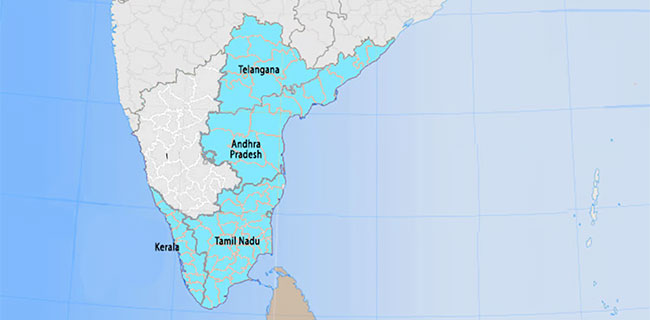
    My inferences cover the four states, Telangana, Andhra Pradesh (AP), Tamil Nadu (TN) and Kerala as Hyderabad is a magnet for Gen Z for not just jobs but also for education from all southern states and Coimbatore being close to Kerala, attracts Gen Z talent due to its educational institutes and textile industry.


    Before, I talk about the divide, one similarity which I saw across the states was that almost like in north, most state students are not too fluent in English. The common perception is that since they do not know Hindi, their English should be good. But they think in their own language and then try to translate the thought in their mind. So, these Gen Z know English but are not comfortable expressing themselves in english.


    The first thing that surprised me was the number of parents of Gen Z who were self-employed. And this was very true for AP. We think that Gujaratis and Marwaris from Rajasthan have a flair for business in India and most traditional business houses reflect that. Birlas, Tatas, Goenkas, Mahindra, Bajaj, Ambani et al are all from Gujarat or Rajasthan. And then who has not heard of the Patels and Shahs and Jains and Solankis into some business or trade. In the US, Patel motels is almost used as a generic term for inexpensive highway hotels.


    But the Reddys and the Rajus and the Raos and the Naidus are catching up. Look up who owns the GMR and GVK conglomerates. Which state has the largest number of fish farms? Gujarat exports the most seafood from the country and is also the largest marine exporter. But that is because most of its produce comes from the fish farms of AP besides its fresh catch. Andhra has a long coastline but the business acumen of its inhabitants has turned aqua farming into a huge export business.


    With the bifurcation of AP and Telangana, and the consequent need for land to set up government and administrative offices and also residences, land prices in both states have shot up. Consequently, both states have reaped many entrepreneurs dealing in property and construction. AP is also very rich in certain mineral reserves like bauxite, limestone, mica, asbestos and even iron ore. Granite is another mineral which is mined and exported from AP. All this has spawned a huge wave of entrepreneurs, from mine-owners to dealers to traders to exporters and to retailers.


    There is a big number of private moneylenders too. They lend money at exorbitant rates to a small circle which grows only by introduction. Usually, these money lenders thrive when there is some economic crisis and currently with RBI tightening the lending conditions, and  even NBFCs and fintech companies shying from small ticket personal loans these lenders are the lenders of last resort. A business which reflects the thin line between legal and illegal. A business which the Gen Z children do not either approve of or do not want to continue.


    The spirit of entrepreneurship has also caught up with much of the Gen Z. They want to not just take over the business but also diversify. And the presence of Hyderabad city as a cyber-hub has spurred many Gen Z into startups. Many MBA students or aspirants from a business background want to use the opportunity of grabbing a job in IT companies as a starting point to gain experience and maybe save some money. But three to five years down the line, the entrepreneurship bug catches on. Traditional family businesses are diversifying, automating or venturing into totally unrelated areas.


    This also has caused a conflict. The Gen Z entrepreneurs are more risk-taking. They don’t mind getting into capex with loans. Many into the food and service industry are finding the franchise model to be lucrative. All this does not go well with the elder generation. Though they are steeped in risk-taking, they still are not sure of growing too fast too wide. As a result, the spirit of rebellion or charting their own course is strongly manifested in the Gen Z thinking in AP and now also in Telangana.


    Another very interesting aspect in both AP and Telangana is that they send the highest number of PG and B Tech students to the US. While this may be attributed to the flourishing self-employed businessmen who can afford to pay hefty fees in the US, it also points to another interesting trend. The AP and Telangana students are worldly-wise and well-informed.


    It’s almost as if the internet revolution and the emergence of Hyderabad as a cyber-capital has spurred on a new internet culture. Gen Z is not only well-informed but also less traditional. They question rituals and traditions are not scared to question authority, The reverence towards elders, religious men, professors etc which spawned a no-questions-asked culture seems to be disappearing.


    And this is amplified when one compares to Gen Z from the state of Tamil Nadu. The generation is still steeped in tradition. Every year, I find students who follow the 41-day spartan living called manadalam before undertaking the Sabarimala climb. Being barefoot, eating non-spicy food, wearing black or blue veshti is followed even in classrooms. I am not criticising or calling it out. Just saying how it is prevalent as compared to Telangana where a visit to Tirupati temple is no more a must for Gen Z.


    What is more interesting however is the acceptance of the rituals without any questions asked. I always ask the students the significance of 41 days or why is fasting required? Their answers or the lack of them show an absolute respect to authority, with no questions asked. I get the same attitude in my classes. Questions are asked but not debated. The respect for authority, restrains the mind which can explore much more.


    Interestingly, I find the global effect in the food habits of Gen Z from AP and Telangana. Their cuisine tastes go beyond the local. So, a biryani or kebab or the chilli in food is loved in Hyderabad but a burger or a pizza or a salad is a part of the menu on the campus. In a Coimbatore campus, the traditional food still matters. There is non-vegetarian but hardly any fast food or salad types. And when I ask Gen Z students about burgers or [izzas, the answers are muted. Maybe even here, what the authority say is what matters.


    Tamil Nadu Gen Z is risk-averse. Most students are looking for jobs. Entrepreneurship is not something that they want. Maybe do some consultancy later on but not setting up industry or get into production. They seem to have moved somewhat away from the lure of a permanent government job to a result-oriented and more rewarding private sector. But the ultimate leap of entrepreneurship is still not burning strong as in AP student.


    The students from Kerala are very similar to Tamil Nadu. Except they are also well-exposed to the world. And I suspect that is so because of the high population of NRIs in Kerala. They may be white collar offsprings but the advancement in the Middle East is something they are aware of. Their exposure to global knowledge makes them maybe more inquisitive. Yet, not many are inclined to go abroad to work. About a decade ago, when I was in the Middle East, I would interact with many Keralites whose one dream would be to get their children get a job in the tax-free countries of the Middle East. But I am surprised that most of the Gen Z that I have come across from Kerala are not inclined to do so. They believe that the future in the country is bright and they aspire to do something on their own.


    So, while Gen Z who belong to the flourishing self-employed business families of AP aspire to go to US and do their Masters (and settle down there), the Gen Z of families from Kerala who are working in the Middle East do not want to go abroad to settle down. The divide could not be starker.