With apologies to none at all
By Vikas Mehta
 Last few years I have spent a considerable amount of my time visiting business schools in South India. In cities like Hyderabad and Coimbatore, I had the opportunity to interact with thousands of Gen Z students. And, because I always stayed on the campus for any time between one to three weeks at a stretch, it also gave me an opportunity to mix and interact with students as humans. I have also been involved in interviewing MBA candidates and as such I have gleaned some interesting information and, dare I say, insights into Gen Z and their families from South India.
We have always talked about the North-South divide in India. The difference is in almost everything. Appearance, food habits, culture, religiosity, politics, language. It’s almost as if India has two types of people, the northeners and the southerners. While it may be ok to lump the states of UP, Uttarakhand, Bihar, Rajasthan, HP and MP together as there are lot of similarities; linguistically, food-wise, religiously and even culturally, the same does not hold good by lumping all south states together as one. I am not saying that northern states are similar in all aspects but they have a commonality that runs through. The same is not the case in the southern states. And the dissimilarities start with language which are very different in not just oral but also in script. But let’s avoid the obvious dissimilarities and try to focus on some not so obvious.
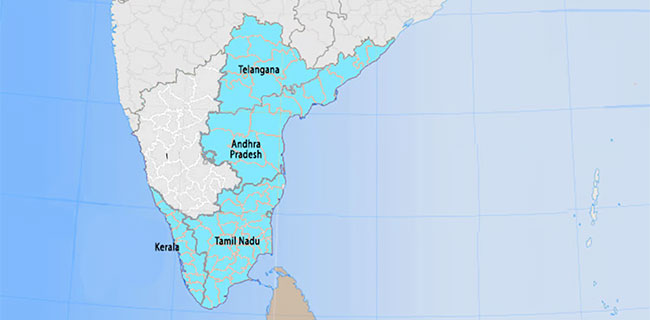
My inferences cover the four states, Telangana, Andhra Pradesh (AP), Tamil Nadu (TN) and Kerala as Hyderabad is a magnet for Gen Z for not just jobs but also for education from all southern states and Coimbatore being close to Kerala, attracts Gen Z talent due to its educational institutes and textile industry.
Before, I talk about the divide, one similarity which I saw across the states was that almost like in north, most state students are not too fluent in English. The common perception is that since they do not know Hindi, their English should be good. But they think in their own language and then try to translate the thought in their mind. So, these Gen Z know English but are not comfortable expressing themselves in english.
The first thing that surprised me was the number of parents of Gen Z who were self-employed. And this was very true for AP. We think that Gujaratis and Marwaris from Rajasthan have a flair for business in India and most traditional business houses reflect that. Birlas, Tatas, Goenkas, Mahindra, Bajaj, Ambani et al are all from Gujarat or Rajasthan. And then who has not heard of the Patels and Shahs and Jains and Solankis into some business or trade. In the US, Patel motels is almost used as a generic term for inexpensive highway hotels.
But the Reddys and the Rajus and the Raos and the Naidus are catching up. Look up who owns the GMR and GVK conglomerates. Which state has the largest number of fish farms? Gujarat exports the most seafood from the country and is also the largest marine exporter. But that is because most of its produce comes from the fish farms of AP besides its fresh catch. Andhra has a long coastline but the business acumen of its inhabitants has turned aqua farming into a huge export business.
With the bifurcation of AP and Telangana, and the consequent need for land to set up government and administrative offices and also residences, land prices in both states have shot up. Consequently, both states have reaped many entrepreneurs dealing in property and construction. AP is also very rich in certain mineral reserves like bauxite, limestone, mica, asbestos and even iron ore. Granite is another mineral which is mined and exported from AP. All this has spawned a huge wave of entrepreneurs, from mine-owners to dealers to traders to exporters and to retailers.
There is a big number of private moneylenders too. They lend money at exorbitant rates to a small circle which grows only by introduction. Usually, these money lenders thrive when there is some economic crisis and currently with RBI tightening the lending conditions, and even NBFCs and fintech companies shying from small ticket personal loans these lenders are the lenders of last resort. A business which reflects the thin line between legal and illegal. A business which the Gen Z children do not either approve of or do not want to continue.
The spirit of entrepreneurship has also caught up with much of the Gen Z. They want to not just take over the business but also diversify. And the presence of Hyderabad city as a cyber-hub has spurred many Gen Z into startups. Many MBA students or aspirants from a business background want to use the opportunity of grabbing a job in IT companies as a starting point to gain experience and maybe save some money. But three to five years down the line, the entrepreneurship bug catches on. Traditional family businesses are diversifying, automating or venturing into totally unrelated areas.
This also has caused a conflict. The Gen Z entrepreneurs are more risk-taking. They don’t mind getting into capex with loans. Many into the food and service industry are finding the franchise model to be lucrative. All this does not go well with the elder generation. Though they are steeped in risk-taking, they still are not sure of growing too fast too wide. As a result, the spirit of rebellion or charting their own course is strongly manifested in the Gen Z thinking in AP and now also in Telangana.
Another very interesting aspect in both AP and Telangana is that they send the highest number of PG and B Tech students to the US. While this may be attributed to the flourishing self-employed businessmen who can afford to pay hefty fees in the US, it also points to another interesting trend. The AP and Telangana students are worldly-wise and well-informed.
It’s almost as if the internet revolution and the emergence of Hyderabad as a cyber-capital has spurred on a new internet culture. Gen Z is not only well-informed but also less traditional. They question rituals and traditions are not scared to question authority, The reverence towards elders, religious men, professors etc which spawned a no-questions-asked culture seems to be disappearing.
And this is amplified when one compares to Gen Z from the state of Tamil Nadu. The generation is still steeped in tradition. Every year, I find students who follow the 41-day spartan living called manadalam before undertaking the Sabarimala climb. Being barefoot, eating non-spicy food, wearing black or blue veshti is followed even in classrooms. I am not criticising or calling it out. Just saying how it is prevalent as compared to Telangana where a visit to Tirupati temple is no more a must for Gen Z.
What is more interesting however is the acceptance of the rituals without any questions asked. I always ask the students the significance of 41 days or why is fasting required? Their answers or the lack of them show an absolute respect to authority, with no questions asked. I get the same attitude in my classes. Questions are asked but not debated. The respect for authority, restrains the mind which can explore much more.
Interestingly, I find the global effect in the food habits of Gen Z from AP and Telangana. Their cuisine tastes go beyond the local. So, a biryani or kebab or the chilli in food is loved in Hyderabad but a burger or a pizza or a salad is a part of the menu on the campus. In a Coimbatore campus, the traditional food still matters. There is non-vegetarian but hardly any fast food or salad types. And when I ask Gen Z students about burgers or [izzas, the answers are muted. Maybe even here, what the authority say is what matters.
Tamil Nadu Gen Z is risk-averse. Most students are looking for jobs. Entrepreneurship is not something that they want. Maybe do some consultancy later on but not setting up industry or get into production. They seem to have moved somewhat away from the lure of a permanent government job to a result-oriented and more rewarding private sector. But the ultimate leap of entrepreneurship is still not burning strong as in AP student.
The students from Kerala are very similar to Tamil Nadu. Except they are also well-exposed to the world. And I suspect that is so because of the high population of NRIs in Kerala. They may be white collar offsprings but the advancement in the Middle East is something they are aware of. Their exposure to global knowledge makes them maybe more inquisitive. Yet, not many are inclined to go abroad to work. About a decade ago, when I was in the Middle East, I would interact with many Keralites whose one dream would be to get their children get a job in the tax-free countries of the Middle East. But I am surprised that most of the Gen Z that I have come across from Kerala are not inclined to do so. They believe that the future in the country is bright and they aspire to do something on their own.
So, while Gen Z who belong to the flourishing self-employed business families of AP aspire to go to US and do their Masters (and settle down there), the Gen Z of families from Kerala who are working in the Middle East do not want to go abroad to settle down. The divide could not be starker.