Author: mxmadmin

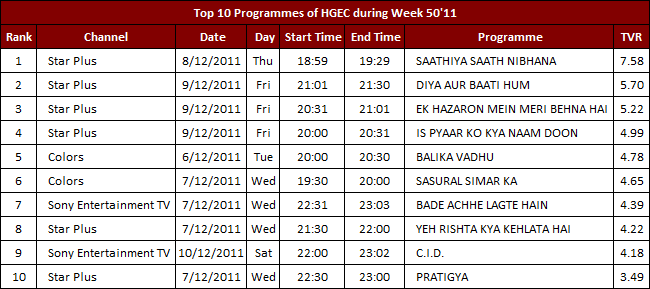
  • TAM data Top 10 programmes on HGEC – Wk 50 ’11


    Source: TAM Peoplemeter System
    TG: CS 4+ yrs
    Market: Hindi Speaking Market
    Period: Wk 50 (Dec 4 to Dec 10) 2011


    About TAM Media Research


    TAM is a joint venture between Nielsen Company & Kantar Media Research. Besides measuring TV Viewership, TAM also monitors Advertising Expenditure of Television, Print & Radio through its division AdEx India. Since 2004, it extended its presence in the PR Measurement & Analysis space for Corporate/Marketing Clients by setting up a separate division Eikona PR Measurement.


    In 2007, the joint venture introduced RAM (Radio Audio Measurement) service to track Radio Listenership for the Indian Radio Broadcast Industry. In year 2009, TAM launched a division, called TAM Sports that specializes in monitoring Sports Sponsorship ROI.


    TAM Media Research’s objective is to fuel media insights that will drive the growth of the Indian Media Industry.

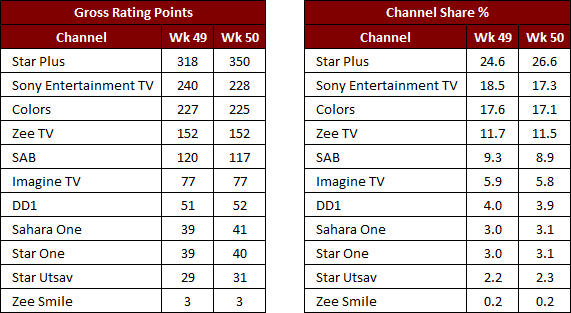
  • GRP Channel shares of HGECs- Wk 50 2011

    Source: TAM Peoplemeter System
    TG: CS 4+ yrs
    Market: HSM
    Period: Wk 49: Nov 27 to Dec 3, 2011
    Period: Wk 50: Dec 4 to Dec 10, 2011


    About TAM Media Research


    TAM is a joint venture between Nielsen Company & Kantar Media Research. Besides measuring TV Viewership, TAM also monitors Advertising Expenditure of Television, Print & Radio through its division AdEx India. Since 2004, it extended its presence in the PR Measurement & Analysis space for Corporate/Marketing Clients by setting up a separate division Eikona PR Measurement.


    In 2007, the joint venture introduced RAM (Radio Audio Measurement) service to track Radio Listenership for the Indian Radio Broadcast Industry. In year 2009, TAM launched a division, called TAM Sports that specializes in monitoring Sports Sponsorship ROI.


    TAM Media Research’s objective is to fuel media insights that will drive the growth of the Indian Media Industry.

  • It’s the economy, stupid

    By Ranjona Banerji


    Perhaps appropriately, the problems of the Indian economy have taken centre-stage. Some newspapers are concentrating on the falling rupee while others are concerned about the falling industrial growth rate. Both seem to be legitimate headlines. The general consensus seems to be lack of governance and the general drift of UPA II. Says The Times of India in its editorial on Wednesday, “If the political class needs a crisis to see that policy gridlock is strangling our economy, then that crisis is upon us… But the onus is also on the opposition to forego bloody-minded politics which makes the government’s job harder.”


    The Indian Express in its editorial concentrates on decline on the Index of Industrial Production and comments, “Unfortunately the slowdown has hit us at a time when real interest rates are negative.” However it cautions the Reserve Bank to wait and watch before “taking action”. It also brings up the valid point of many students coming out of management institutes being unable to find jobs if industrial and services growth on a downward spiral.


    The Deccan Chronicle in its editorial looks at how Indian companies are now looking abroad to invest their money, given the situation in India. “What India and the economy urgently needs to grow at this point is low inflation, low interest rates, immediate implementation of the new manufacturing and procurement policy, and a business-friendly transparent environment to unleash India’s unmatched entrepreneurial strengths.”


    The Economic Times carries a feature on the rupee crisis headlined “India Inc sends an SoS to RBI’. A Subba Rao of the GMR group is quoted as saying, “It’s like a natural calamity, like a tsunami… with the rupee falling so fast and so sharply, there is only so much you can do.”


    A discussion on Times Now on Tuesday had FICCI chairman Rajiv Kumar practically begging politicians to sort our their problems and prevent a further downslide in the economy. His predictions were dire unlike Union Finance Minister Pranab Mukherjee’s somewhat sanguine assurances that things were not so bad.


    **


    Given our current obsession with corruption, two stories in Wednesday’s newspapers deserve attention. The Telegraph, Calcutta, has a story on how the Jyoti Basu government handed the AMRI hospital land in the Dhakuria area of Kolkata between 1994 and 1998 at rates that will remain frozen till at least 2024. Unlike other such deals, there are apparently no provisions for revision of the rental rates. The state government has, according to the report, acquired the land in 1991 to provide affordable healthcare.


    The Indian Express’s flyer story looks at the various irregularities in the Noida farmhouse allotments, from which a key member of the Anna Hazare-Jan Lokpal movement also benefited – Shanti Bhushan and his son Jayant. The Express report provides details of various transgressions and concessions, many of which appear to be inexplicable.


    **


    Even as TV continues to be the chief champion of Anna Hazare and his campaign for his Jan Lokpal Bill, the print media conversely continues to question. The Economic Times in its second editorial on Wednesday says, ‘Anna Hazare has displaced the my-way-or-highway sort of undemocratic attitude reminiscent of authoritarianism and a vigilante-style notion of justice and that is part of the problem.” It cautions against actions which will lead to anarchy.


    eom

  • Middle India market for FMCGs will exceed US $ 20 bn by 2018 : Nielsen

    By Ratna Bhushan


    The FMCG market of about 400 smaller Indian towns with populations of 1 – 10 lakh, is expected to surpass US $ 20 billion by 2018 and 80 billion US $ by 2026, a new study by insights and analytics firm Nielsen said.


    Currently, the 400 smaller towns represent approximately US $ 6 billion.”Although big Indian metros remain the staple for FMCG marketers and rural India is proving to be critical for volumes in the long run, the next wave of the Indian urban demand revolution may be found in these 400 smaller towns with a population of 1 – 10 lakh,” said Ranjeet Laungani, Executive Director, Nielsen. “It’s time for marketers to take notice”, he added.


    Nielsen’s study shows that out of the total US $ 28 billion in FMCG sales last year, products worth about US $ 6 Billion were consumed in these smaller towns. This number makes up more than 20% of overall FMCG sales, and 30% of the urban FMCG sales. Since 2002, the FMCG sector grew 3.5 times in these smaller towns of 1-10 lakh population, compared to 3.2 times at the all-India level.


    “The demand revolution has percolated down to middle India and these towns will behave like the metros of tomorrow,” said Laungani. “Middle India leads the pack across urban and rural segments for FMCG value growth rates.


    Out of 81 FMCG categories tracked by Nielsen, 49 product categories across personal care, over-the-counter drugs, household care, and food outgrew the all-India rate. Over 30 categories saw growth rates faster than 1.15 times the all-India rate. FMCG companies which anticipated this kind of growth and invested in these areas a few years ago, are likely seeing a positive return on their efforts,” says Laungani.


    Source:The Economic Times

    Copyright © 2011, Bennett, Coleman & Co. Ltd. All Rights Reserved

  • It’s pitch time for Unilever media spends in India (and elsewhere in the world)

    By A Correspondent


    Life’s a pitch. Ah, well, for the new bossman at Mindshare India Ravi Rao, it’s going to be a hyperactive January as he takes charge after a week’s break later this month.


    For, Unilever has reportedly announced a global review of its media account. This is barely two years after it did one.


    MxMIndia does not have any official word from Hindustan Unilever, but media reports suggest that the review will include media buying and planning and will start next month.


    Unilever has apparently asked all incumbents to pitch. But there are a few more, and that’s the catch. According to Advertising Age figures, Unilever spent USD 6.62 billion on worldwide measured media in 2010.


    The pitch is said to include a review of the way spends will be conducted in India too. Please see the following reports which also carry Unilever statements:

    Ad Age report: http://adage.com/article/agency-news/unilever-puts-global-media-account-play/231536/

    Campaign Asia report: http://www.campaignasia.com/Article/284405,unilever-calls-us465-billion-global-media-review.aspx

  • [PR Channel] What journalists want: The 10 commandments for PR folks

    By Ashraf Engineer


    Whom do journalists love to hate? Public relations (PR) professionals probably wouldn’t top the list, but they’d come pretty close. The irony, of course, is that the journalist-PR executive relationship is deeply symbiotic – one can hardly do without the other.


    But before I say anything else, you should know that I empathize. I know journalists can’t wait to get you off their back – unless they need you. In which case, you need to respond, like, yesterday.


    How many times have you thought after an I-need-a-response-now ultimatum, ‘What do journalists really want?’


    Here are a few commandments. Live by these and, who knows, the rocky relationship might just get smoother.


    Thou shall be clear and concise

    Most journalists work to a deadline and don’t have the time for rambling, rah-rah press releases. Say what you have to without taking up too many words. You’re working to a deadline too, so this should work to your advantage. A well-written yet short press release has far more value than a tsunami of words that has at the core just one paragraph of usable information.


    Thou shall not promise what you can’t deliver

    Years ago, when I worked for one of Mumbai’s leading newspapers, Nobel-winning mathematician John Nash visited the city. The PR agency managing the visit promised us an exclusive interview, with other newspapers getting access to Nash only the next day. Turned out the agency promised every newspaper the same thing. Imagine our shock when we saw Nash’s interviews everywhere. My newspaper stopped dealing with the agency altogether. The CEO had to come over and apologize, but things were never the same again – we kept the agency at arm’s length and treated every communication from it with suspicion.


    Thou shall not peddle rubbish masquerading as news

    Journalists have had it with ‘news’ that isn’t really, well, news. And surveys that are little more than a few colleagues being asked their opinion. Good journalists are discerning; they won’t let something like that get through. The bad journalists, you should have no use for – they won’t last and will never be in a position to help you or your clients.


    Thou shall respect deadlines

    This might seem obvious, but you’d be surprised how often it is ignored. Nothing gets a journalist’s goat more than information/reactions not arriving on time. Your tardiness could slam the door shut on potential coverage. It could also destroy the goodwill that you and your firm might have with the newspaper concerned. Why risk it? Get it right.


    Thou shall make clients, facts available

    Journalists want people featured in the press release to be available, and also the facts and figures. There’s no point in pushing a story if its basic building blocks are out of reach. So, if your client has a new CEO, it’s not enough to just say it. The CEO must be on hand to articulate his vision and his plan. Unless you do that, a journalist would see no value attached to the story. Journalists aren’t carrier pigeons – they aren’t satisfied with only the information you give them. They may see a storyline you don’t, and would need support accordingly.


    Another sticking point is case studies. Wherever relevant, make sure you have good ones. Journalists love them because they make the story come alive. Make sure they support the larger story, make sure they’re well written.


    Thou shall know your target newspaper

    When I was working for a lifestyle newspaper, I was often flooded with press releases that weren’t relevant to me – from a new type of spark plug to a stent that made heart surgery cheaper.

    What were those PR executives thinking? We covered society events, fashion, cinema and television. Spark plugs? Really?

    Don’t carpet-bomb the media with releases. That’ll only result in a lot of dead trees and no stories to show for it. Read newspapers, know what they cover. Most good newspapers don’t simply run a press release; they use it to spark off an idea.


    Thou shall stay away from jargon

    Using jargon only creates an illusion that you know more than you actually do. And, like an illusion, it’ll shatter at the first challenge. Besides, it turns journalists off.

    So, the next time you’re tempted to say ‘ponzi scheme’, just say ‘a fraudulent investment operation that pays returns to investors not from any actual profit, but from money paid by subsequent investors’.


    Thou shall address releases to the right people

    Have an UPDATED list of journalists and the newspapers they’re working for. My last job involved handling news specials for a leading daily. Yet, I was bombarded with companies’ financial results. On the irritation scale, it ranked only below being addressed as ‘Mrs Ashraf Engineer’ (and that happened too!).

    A newspaper I worked for even received releases for a journalist who had passed away!

    Send your releases to the right people, make sure you address them properly and – for God’s sake – make sure they’re alive. Otherwise, guess where they end up. It’s no wonder they say ‘delete’ is the journalist’s favourite key.


    Thou shall be well informed

    I’ve lost count of the number of times the PR professional at the other end of the line didn’t have even basic information about his/her client – size, location, turnover, etc. Apart from seriously harming your own and your agency’s reputation, it creates a poor impression about your client.

    Wait, weren’t you hired to do the exact opposite?


    Thou shall know this – a newspaper is not just a print product any more

    Every newspaper now has a website. The traditional press release format was developed over 100 years ago for print journalists. But they’ve changed. Most people get their news from the web first. This has sent tremors through newsrooms and altered them forever. In the process, the PR professional’s job has been altered too.

    Help the journalists do their jobs by providing graphics – and, where required, multimedia – that are relevant and on time.

    It doesn’t end there. Journalists might require quotes from experts and client executives. Your story may never see the light of day unless you travel this extra mile. So, help journalists help you.


    Ashraf Engineer is Head – Content at Hanmer MSL. After a 16-year career in journalism, he now heads the high-value content operation of the agency. He can be contacted at ashraf.engineer@hanmermsl.com.

  • The Anchor: 5 skills you need to be a successful entrepreneur

    By Raj Gopal Iyer


    #1 Plan, stay organized and focused:

    It’s important to be absolutely planned with regard to the various aspects of the business. The more you plan, the better. Creating an effective organization with systems and processes are the key to success. The entrepreneur should be focused on the objective.


    #2 Be customer-centric:

    The customer is king. Happy customers will make an entrepreneur successful, for sure.


    #3 Have nerves of steel:

    This is an absolute necessity for being a successful entrepreneur. An entrepreneur is faced with many challenges, he/she needs to have strong will power to face them and succeed.


    #4 Hire the right people:

    People are extremely key to the success of an organization. A successful entrepreneur is someone who has the right people to manage the business.


    #5 Enjoy what you do:

    Finally, a successful entrepreneur is someone who enjoys what he/she’s doing. He/she should have the passion for it. Success will naturally follow!


    Raj Gopal Iyer is the CEO, Blue Ocean Media & Consulting.

  • Tata Docomo: Old idea, fresh play

    By Anil Thakraney


    Tata Docomo has done one rather smart thingie. Instead of using Bollywood stars to connect with the whole of India (their appeal down south is always suspect), they have created two commercials specifically tailored for the Andhra Pradesh and Tamil Nadu consumers. Using the local movie stars: Ram Charan Tej and Vijay. This should help immensely in building a bond with the locals.


    [youtube width=”400″ height=”250″]http://www.youtube.com/watch?v=RNiUp0b0c4U[/youtube]

    The commercials are however not based on a new concept. It’s the same old ‘always stay connected’ idea. In the TVC, the film star, who’s the protagonist, laughs when his neighbour, a young lad, hits a girl with a water balloon. The girl in turn calls and energizes her tens of pals to seek ‘revenge’. This follows hordes of people chasing our hero till he gets hit by many balloons. Not only is the idea not fresh, it seems to have been inspired by Airtel’s ‘Har ek friend zaroori hota hai’. In short, too much deja vu out here.


    Having said that, must confess the execution is peppy and alive, and full of masti. It is also the sort of script that, I imagine, will appeal to the southern audiences, so good show on that front. Neat job done by the ad filmmaker.


    Rating: (On a scale of 1 to 5): 2.5. The marks go for good treatment

  • TV news = Bigg Boss?

    By Ranjona Banerji


    As has happened with newspapers, there are small signs that television will also walk along the same line – the journalistic desire to question the intransigence of Anna Hazare and his insistence on his version of the Lokpal Bill. The political classes appear to be certain that they want more time and will not be harried into passing a bill which may be inadequate. The enormous scope given to members of Anna Hazare’s movement has been considerably reduced on television as other news enters the cycle.


    On Wednesday, for instance, the black money debate in the Lok Sabha got much play on television and led, as usual, to plenty of screaming and shouting on panel discussions later. The tendency of these leaders of society to yell and brawl on TV shows remains appalling and a tremendous indictment of Indian manners. However, it is also fair to say that most people do not behave like this in real life, thankfully and perhaps neither do these habitual TV guests when the cameras are turned off.


    **


    The terrible news of the deaths of more than 100 people in West Bengal from drinking contaminated illegal alcohol dominated Thursday’s TV bulletins, which includes the international channels as well. TV of course is concentrating on the human story so we will get the bigger picture from the newspapers. West Bengal chief minister Mamata Banerjee, already getting flak from a once-enamoured media, now has to do damage control on a number of fronts and this is bound to be further debated.


    **


    James Murdoch, son of media tycoon Rupert, has now admitted that he knew about the phone-hacking practices used by journalists in his newspapers. Earlier this year, James had told a British parliamentary committee investigating phone-hacking that he knew nothing about it. More media scrutiny will – and must – ensue.


    **


    The Indian Olympic Association has decided not to boycott the Olympic Games, as demanded by the sports ministers, some activists and a few sportspersons, in spite of Dow Chemicals’ involvement in the Games. More debate is expected and more TV-inspired pyrotechnics.
    TV news in India is like the Bigg Boss for those with intellectual pretensions.


    eom

  • M ties up with Park Avenue for supplement

    By Akash Raha


    M, the lifestyle magazine for men has tied up with Raymond’s Park Avenue to bring out an exclusive supplement on men’s styles. The supplement is a six-supplement tie-up to come out every second month, starting from December. The supplement comes in the same packaging as the magazine but not inside the magazine.


    The first supplement was unveiled at a swish event in Mumbai by Gautam Singhania, MD and CEO, Raymond and Amitabh Taneja, Editor in Chief, Images Group.


    Speaking about the supplement and the tie up with Park Avenue Ashish Pratap Singh, Editor-in-charge, M, said, “The supplement marks a new standard in richness and opulence. The target audience for Park Avenue and M is very similar. They are fashionable, young, smart and want to be informed about style.”


    The supplement covers the latest trends for men on the global platform, and Park Avenue’s latest offerings for both men and women. The supplement also talks about the latest and best cars to drive and the best of the best resorts from around the world to stay in. Each bi-monthly supplement will also feature a renowned CEO’s interview on comfort and style. For the first supplement, M magazine features Vikram Chandra, CEO, NDTV, talking about his first love, TV journalism, his style quotient and everything else.

  • Turning 50 and other problems!

    By Ranjona Banerji


    I was quite happy to discover that this is my 50th update for Freaking News and am unhappy to find that I was so wrong yesterday. By the evening, it seemed that TV had decided that the shenanigans of Team Anna required as much exposure as possible and that being sensible was just a whole lot of horse feathers, while being unreasonable was so much more fun. So there were members of the core committee of the anti-corruption movement doing their normal threatening and grandstanding all over TV and this morning had an unpleasant photograph of Anna Hazare and Kiran Bedi ominously wagging their fingers at us. Bedi on Times Now was as annoying as she can be, insisting that the Cabinet and Parliament must go no further than the Jan Lokpal Bill.


    But it was later that matters got really appalling on Times Now as Mumbai-based film-maker and activist Ashok Pandit (I did not recognise him because his grey hair has turned black) accused another guest of being a terrorist because she looks like one (a Muslim, she was, of course – Hamida Naeem, a lecturer at Kashmir University). What was even worse was that although Arnab Goswami said “no personal remarks”, he did not stop Pandit and neither did the other guests, Madhu Kishwar and retired general, Shankar Prasad. The issue was the death of a young shopkeeper in Kashmir who was beaten to death because he refused to shut shop. The people who killed him are called “stone-pelters”, a special breed of humans who exist only on TV land. TV wanted to know why the Armed Forces were blamed for all kinds of things but “stone-pelters” are not condemned with the same outrage by hardline separatist groups in Kashmir. The many specious conclusions in this argument need another whole article to deal with them.


    So I was wrong again because I really believed that the deaths of 145 people from drinking adulterated illegal alcohol in West Bengal needed more prominence.


    **


    The end of the American occupation of Iraq got plenty of play on international channels but only minimal on Indian TV, not unnaturally. The newspapers as usual filled in the gaps.


    **


    The Hindu has an interesting editorial on how the BJP loved Union home minister P Chidambaram when he was tough on Naxals and Maoists but are currently gunning for him because he targeting Hindutva-inspired terror groups. Who knows, this may well be true.


    **


    After the Parliamentary debate on black money, newspapers could have given us more figures on the parallel economy in India, its size and reach. The problem is not just about money stashed abroad: it is as much about the money within India which never enters the system and so bypasses not just tax but also quality control and standards laws.


    **


    Incidentally, just for the information of our ultra-jingoistic TV-wallahs, the battle against the Armed Forces Special Protection Act is not limited to Kashmir – the act is also why Irom Sharmila has been on a hunger strike for over 10 years in Manipur. Do we as journalists have the mandate to take sides without adequate information?

  • What’s more important? Creativity or Effectiveness? Or both?


    By Shubhangi Mehta


    [youtube width=”400″ height=”250″]http://www.youtube.com/watch?v=i6dEI6D_rcI[/youtube]

    Regardless of how ‘simple’ the end product may seem, creating advertisements for a brand has never been child’s play. It’s a task which only a creative mind can understand. And the complexities have grown over the years. When we spoke about campaigns 20 years ago, expectations were not as high as they are today.


    Today, it is the age of numerous and congregating media. While advertisers have many opportunities to reach to their desired audiences, the muddle can cause them to lose out. A beautifully executed campaign may not make its audience reach for their wallets, while an average one, creatively speaking, may end up garnering better results.


    What is the most important element, then, for the campaign of today? Is it creativity? Or effectiveness? Or a magic mix of both?


    MxMIndia posed the question to practitioners – people who create the campaign and people for whom the campaign is created.


    [youtube width=”400″ height=”250″]http://www.youtube.com/watch?v=odmcmnWjK10&feature=fvst[/youtube]

    Abhijit Avasthi, NCD, Ogilvy&Mather, said, “We only believe in creating effective communication. According to me people who separate the two cannot be called creative. If we look at the past 3-4 years’ trend, most of the campaigns that win at the Abbys are the ones winning at the Effies as well. A brand communication is complete only when it is an effective creative.”


    According to Ajay Kakar, Chief Marketing Officer, Aditya Birla Group – Financial Services, “What is the use of a knife that does not cut, or a gun that cannot fire? Similarly there is no use for a creative which isn’t effective. Such a creative work is only meant for Jehangir Art Gallery and not product promotion. According to me each and every creative needs to be effective and only then does it fulfil its very purpose”.


    The IPA/Gunn Report published in June 2011 examines the link between creativity and effectiveness. The original 2010 report had analyzed 257 campaigns over a period of ten years (1998-2008). The 2011 version of the report has been expanded to examine 435 campaigns over 16 years, from 1994 to 2010. The main aim of the report was to examine both effectiveness (a campaign’s ability to drive business like sales, profit and loyalty) and its efficiency for campaigns that have been awarded for their creativity and those that have not been.


    Some of the findings of the report include: creatively-awarded campaigns were seven times more efficient than non-awarded ones; between 2003 and 2010 creatively-awarded campaigns were 12 times more efficient; there is a pronounced time trend – creatively awarded campaigns are becoming more efficient over time, while non-awarded campaigns are becoming less so; the much greater ‘buzz’ effects of creatively-awarded campaigns appears to be why they are becoming more effective: in the multichannel world creativity is becoming more closely associated with buzz, leaving non-awarded campaigns struggling.


    Agnello Dias of Taproot said, “It is effectiveness that plays a key role. If the effectiveness is backed by a great creative it’s icing on the cake but if a particular campaign is effective for a brand then even mediocre creative can be accepted”.


    KV (Pops) Sridhar, NCD, Leo Burnett India, said, “One cannot really separate creativity and effectiveness in a brand communication. Both of them are two sides of the same coin. If one of these two elements is missing then it does not fulfil the purpose of an advertisement for a brand. There has to be an insight, entertainment, cut-through idea and it must break barriers. Hence it is impossible to choose between creativity and effectiveness. A creative is created for effectiveness of the brand.”


    Abraham Alapatt, Head – Brand & Corporate Communication at Future Generali India, said, “Neither the client nor the ad agency, have the luxury any longer, to choose one over the other. Given the growing media clutter, it is now more critical than ever to be creative and different to stand out and get noticed by customer prospects. I qualify ‘creative’ by using a phrase used by the Effie organizers – creative ‘work that works’ for real customers, in the marketplace. So put differently, both clients who are facing increasing competition, media clutter and tight budgets and agencies that are operating with these client constraints are now being called on to deliver marketing communication (which I don’t call advertising) that actively amplifies, complements and makes a tangible difference to the client’s pre-determined marketing efforts”.


    The debate may well rage on, but the market reality is that effective communication is the child of a creative mind. Both creativity and effectiveness are, thus, essential when creating communication for a brand.