A Friday question, a Monday answer. Presenting the one and only Dr Bhaskar Das in the July 21 edition of Das ka Dum. Read on…
If you wish to access the archives, please go to the Das Ka Dum tab on the website’s top navigation bar or click here: https://www.mxmindia.com/category/columns/das-ka-dum/
Q. Myntra is using an AI-generated image of actor Rekha as Barbie. After wax structures at Madam Tussad’s, Barbie dolls be the next big thing for actors.
Your view?
A. That films in India has a memetic impact on the escapism-seeking (even bordering on obsession) Indian audience is stating the obvious. The look of some of the leading heroines lend themselves to Barbie’s current preference for inclusiveness of multiple cultures (eg brown skin) and other society specific nuances to intensify its brand appeal.
But to predict the aforementioned trend as the next big thing appears at this stage is an exaggeration. A topical subject may not sustain as a trend — fad and style may not be synonymous.
Aditya Birla Sun Life Mutual Fund (ABSLMF) and Dentsu Creative India have launched their latest Investor Awareness campaign titled ‘3in1TohInvestmentDone’. The campaign aims to promote the ‘Multi Asset Allocation Fund’ – emphasising the benefits of investing in a single fund, offering exposure to three key asset classes: Equity, Debt, and Gold. Investors can enjoy the combined advantages of growth and stability through the diversification of investments across these asset classes.
Speaking about the campaign, Darshana Shah, Head of Marketing & CX, Aditya Birla Capital said: “At Aditya Birla Capital, our aim has always been to simplify people’s financial needs while presenting a compelling story. With this investor education campaign, we wanted to highlight the importance of portfolio diversification in managing market volatility and risks. We aimed to showcase how investing in a 3-in-1 ‘Multi Asset Allocation Fund’ can provide the advantages of three asset classes – Equity, Debt, and Gold – combined, offering potential growth and stability. This film aims to raise awareness about the benefits of investing in a versatile fund like this and starting your financial journey with us.”
Added Ajeet Shukla, Group Executive Creative Director, West, Dentsu Creative India: “We didn’t have to search far and wide to crack this piece, and as always, our focus was to create a device that would make the film a memorable story. We are pleased to have achieved delightful dimensions and sweet textures to the story by incorporating a musical jingle, children as characters, and their adorable performances.”
Rahul Dravid popularly known for being ‘The Wall’ of cricket is now creating a stronger, healthier wall for his fans. Farmley has unveiled its new campaign “Healthy Ko Rakhe Healthy” featuring former Indian Cricket Captain & brand ambassador Rahul Dravid batting for the immediate need of choosing unadulterated and high-quality dry fruits & nuts, for a healthier lifestyle.
The digital film features Rahul Dravid playfully tossing a cricket ball to a kid, but as the ball passes through different hands it symbolizes the different stages of dry-fruits adulteration. From being dipped in water to increasing weight, from artificial colour to polishing, the ball represents the deceptive practices borne by consumers. While Dravid catches the ball right before it reaches the kid (depicting the consumer), asserting that some things are best original. The video concludes with Rahul Dravid endorsing his trust in Farmley’s commitment to deliver the finest quality products to customers by eliminating middlemen.
Said Akash Sharma, Founder and CEO, Farmley: “At Farmley, we prioritize the well-being and satisfaction of our customers before anything. From sourcing the finest quality dry fruits to implementing stringent quality control measures, we are dedicated to delivering products that meet the highest standards of authenticity and purity. We are proud to have Rahul Dravid as the face of our ‘Healthy Ko Rakhe Healthy’ campaign empowering consumers to make informed choices. This campaign is a testament to our dedication towards delivering unadulterated dry fruits and safeguarding our customers’ health and well-being.”
The Public Relations Consultants Association of India (PRCAI) launches its first-ever podcast series – ‘Unmute with PRCAI’. The collection consists of 10 inaugural episodes that will be unveiled on World PR Day 2023 which is celebrated annually on July 16. The first episode to roll out on Thursday, July 20, and will be on over 75 platforms including Spotify, Anchor, Bingepods, JioSaavn, Google Podcasts, Apple Podcasts
The exclusive series brings together business leaders, and valued ‘Opinions that Matter’, from diverse speakers from the worlds of business, politics and culture, to amplify the voices of thought-leaders shaping the rising India. Thought-provoking, yet light-hearted conversations of individual success stories will empower listeners to critically think about the challenges and opportunities in an evolving landscape.
The podcast is hosted by Niret Alva, television journalist, producer, anchor, director and educator.
Said Alva Co-founder of Miditech Studios: “I have enjoyed interviewing these inspirational leaders and getting them to tell their unique stories. These stories will inspire, motivate and challenge listeners as they listen to how these industry leaders lead, deal with adversity, and find balance in their everyday lives. It’s a great initiative from the Public Relations fraternity.”
The show will feature Ravi Venkatesan, Chairperson of The Global Energy Alliance for People and Planet (GEAPP); Entrepreneur Priyanka Gill, Vikram Sakhuja, Group CEO of Madison Media, and OOH; Arundhati Bhattacharya, Chairperson and Chief Executive Officer of Salesforce India and Avinash Pant, Former, Director-Marketing for Meta.
Added Deeptie Sethi, CEO, PRCAI: “It is exciting to celebrate our profession and all the hard work of the community on this World PR Day with a new podcast series from PRCAI. We believe that there is an evolution in the value proposition being offered by the communications industry to businesses through credible narratives, powerful storytelling and shaping public opinion. Unmute With PRCAI aims to connect the creative communications world with India Inc, together crafting an honest narrative of a bold new India, saluting India’s compelling story in what could be the Indian century,”
ABP News appoints journalist Sandeep Chaudhary as Anchor and Consulting Editor. Chaudhary brings with him over twenty-four years of experience in the field of journalism. He will report to Sant Prasad Rai, Senior Vice President, News & Production, ABP News.
Chaudhary was also a part of Star News hosting 7 pm show ‘Desh Videsh’ from 2003 to 2005. He also hosted ‘Kaun Banega Mukhyamantri’ and ‘Kaun Banega Pradhanmantri’ on Star News.
Said Avinash Pandey, CEO, ABP Network: “We are thrilled to have Sandeep back with us. His wealth of experience and journalistic prowess perfectly align with our vision of delivering credible and insightful news to our viewers. We are confident that his presence will enhance our news programming and resonate with our audience. We extend a warm welcome to him and look forward to achieving greater milestones together.”
It took a video released on social media to wake parts of India up and force the government to make a few statements.
Manipur has been burning, on the verge of civil war and anarchy, if it’s not already happened, for almost three months now.
The mainstream media has largely ignored it. The “double engine” governments in Manipur and at the Centre have also done as little as possible. The internet was shut down to ensure only minimal information leaked out. If we know anything at all about what happened in Manipur, it is thanks to a few digital platforms like Scroll, The Print and Wire, journalists like Sushant Singh have examined the violence and the role of the Armed Forces. Mainstream journals began covering the violence – as little as possible – eventually.
TV? Well, if you watch TV then you know what it’s about: Hindu-Muslim, Modi, Modi, Hindu-Muslim. Plus “important” things were going on. Elections in Karnataka, toppling Maharashtra politics, the Prime Minister’s foreign visits. No time for Manipur, a state in the North East of India, far away from Delhi. Did I mention that the state is a BJP state? Please factor that in.
So, the video. Unless you are some sort of sexual deviant psychopath, the video is extremely gruesome and painful. A mob of men strip women, molest them publicly and then drag them into the fields. You cannot unsee it, so it’s better if you don’t if you haven’t yet.
The incident happened on May 4. The video made its way out to the world on July 19. An FIR was filed in May itself. But nothing was done by the state administration and no comment made by the Central government until the outrage on Twitter.
The Centre’s first response was to get the video taken down and threaten anyone who shared it with legal action. Hide what you can. What leaks out, shoot the messenger.
After a few hours the Union minister for Women and Child Development Smriti Irani took a few moments away from attacking Rahul Gandhi – her main job – to tweet her pain and add that she had spoken to the Manipur Chief Minister N Biren Singh. He incidentally is the person who has been able to do precisely nothing for the past three months.
Finally, the Prime Minister himself shook off the joy of all his foreign travel spreading India’s glory to express his “anger and anguish” at the glorious incidents in Manipur.
So how did our mainstream media react?
For a while, they were a bit shocked and silent. But it took a day for TV people, BJP supporters and propagandists in the media, to brush off any possible compassion they may have felt for the women in the video and get down to their real work. You know, Hindu-Muslim, Modi Modi.
TV person Pallavi Ghosh tweeted that she felt a little sad, as if Manipur was in another country plagued by troubles.
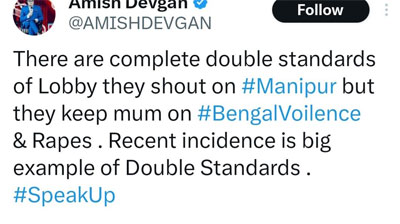
Amish Devgan who works in TV, said there were double standards and implied people were only talking about Manipur because it is a BJP state. This is said straight-faced, as if Manipur has not been burning for three months and as if his channel News 18 has had back-to-back coverage of Manipur for the last three months.
ANI, known as the news agency closest to the BJP, put out a tweet that a Muslim man had been arrested. This later turned out to be connected to another case – not the rapes in the video – and the tweet was quietly deleted without any explanation.
However the BJP IT Cell and the pliable, pliant troll army of media people, celebrities and others, immediately picked up on the Muslim name and amplified it.
Thus actual human behaviour: a few hours.
Brainless propaganda: Most of the time, barring a few hours.
Any form of journalism: zero hours.
Now, a few links which are not part of the massive TV stranglehold over “news” in India.
Eveready Industries, battery and lighting products manufacturers, has rolled out a TVC, ‘Hero Banne Ka Power’ to launch Boomlite DL 85 rechargeable torch. The TVC shines light on the unsung bravery of our people and celebrates courageous deeds, because not all heroes wear capes – some carry torches
Said Anirban Banerjee, Sr. Vice President & SBU Head (Batteries & Flashlights), Eveready Industries India Ltd.: “We are thrilled to announce the launch of Eveready Boomlite DL 85 rechargeable torch alongside a captivating TVC, ‘Hero Banne Ka Power’. This torch embodies Eveready’s dedication to offer innovative and versatile products to our valued customers. With its exceptional performance, we believe this torch will not only illuminate dark spaces but also ignite a spark within individuals, empowering them to embrace their inner strength and become the true heroes of their own narratives.”
Added Sukesh Nayak, Chief Creative Officer, Ogilvy: “Darkness is not to be feared. It is to be fought and defeated. That’s what most Indians know and do on a regular basis. They dispel the darkness in their own way, armed with resilience and resourcefulness. This new campaign is a celebration of the human spirit, of the never-say-never attitude. Anyone can be a hero. All one needs is power. That’s what Eveready offers. We hope this campaign will serve as a beacon of inspiration for those everyday heroes who make the world a better place.”
Fashion destination and house of brands Ajio has joined hands with Megalodon, AI marketing communications company, as their AI creative design partner.
Megalodon will bring its cutting-edge AI-driven design capabilities to Ajio’s brand strategy. This collaboration will enable Ajio to deliver personalised and impactful experiences to its customers, fostering a deeper connection and driving brand loyalty.
Says Rashi Agarwal, Founder, Megalodon:”We are thrilled to be chosen as AJIO’s AI design partner. Ajio has established itself as a trendsetter in the fashion industry, and we are excited to collaborate with them on their journey towards AI-driven design excellence. Our expertise in AI creativity and marketing, combined with AJIO’s vision and innovative spirit will enable us to create unique and captivating experiences that resonate with customers and elevate the brand to new heights.”
Added Sahid SK, AI Head & Co Founder, Megalodon: “In today’s fast-paced digital landscape, where customer expectations are evolving rapidly, brands must adopt innovative approaches to stay ahead. AJIO recognizes the immense potential of AI in reshaping the future of fashion and enhancing the customer experience.”
In a strategic move to bolster its investment strategies, Havas Media Network India has appointed Ramsai Panchapakesan as Managing Partner- Investments. Based out of Gurugram, he will oversee Integrated buying in the North and East markets, along with assuming additional responsibilities for Trading.
Commenting on Ramsai’s appointment, Mohit Joshi, CEO, Havas Media Network India, said: “The current momentum at the media network in India is remarkable, with new client wins, large acquisitions, and widespread expansion. As we strengthen our teams across verticals to deliver best business solutions, Ramsai’s appointment reinforces our vision and commitment to our clients. His extensive industry experience equips him with a valuable wealth of knowledge and expertise. With him on board, we further scale up and strengthen our media investments and optimize trading and partnership initiatives to create meaningful media solutions.”
R Venkatsubramanian, President – Investments, Havas Media India, and MD, Havas Play, added, “These are exciting times to be driving investment and partnership strategies in the media industry, and I am thrilled to have Ramsai join the team. His expertise and deep understanding of industry nuances will unveil remarkable opportunities for us to showcase the agency’s prowess and forge strategic partnerships that drive unparalleled success for Havas Media India. I am confident that, together with our talented team, we will achieve remarkable results and deliver exceptional value to our esteemed clients.”
A provocative question to start the last full week of July. And the answer from Dr Bhaskar Das in the July 24 edition of Das ka Dum is a must-read for every A&M mediaperson. Read on…
If you wish to access the archives, please go to the Das Ka Dum tab on the website’s top navigation bar or click here: https://www.mxmindia.com/category/columns/das-ka-dum/
Q. From your interaction with all the digital advertising folks in India, do you think they really understand Artificial Intelligence? Or is their awareness all artificial?
A. I don’t claim to have exhaustive interactions with so-called digital folks specially focused on the kind of query you have raised. But with my finite knowledge on AI, I may try to share a few top-line macro points on the subjects, irrespective of the level of understanding of the practitioners of the industry.
1. AI can meet the creative industry’s need for accentuated imagination (AI in another expansion of acronym)
2. As hyper-personalisation demand goes up, AI can rise to the challenge if one knows how to leverage it.
3. AI can create exciting and engaging new formats for storytelling and embodied experiences for consumers
4. Embracement of the various tools of AI (augmented intelligence – again another expansion of acronym) to increase performance, efficiency and improve output
5. AI can Improve creativity and create elements for any storyboard more impactfully.
6. AI, creativity, and learning are interlinked and will form part of mainstream learning.
Net-net, progress in AI and ML will enable brands to move at the speed of consumer/ country specific culture and get ahead of shifting sand of consumer tastes and preferences.
Practitioners need to see the writing on the wall rather than pooh-pooh the same as artificial. As they say, jhuk jao, ya toot jaoge. And that’s official.
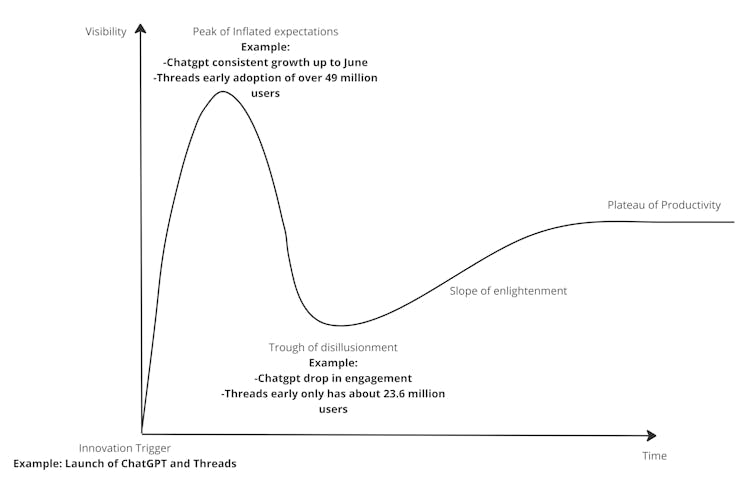
Representative graphic. It doesn’t give the exact drop in engagement of ChatGPT and Threads
By Omar H. Fares and Seung Hwan (Mark) Lee
ChatGPT recently experienced a decline in user engagement for the first time since its launch in November 2022. From May to June, engagement dropped 9.7 per cent, with the largest decline — 10.3 per cent — occurring in the United States.
Meanwhile, Meta’s Threads platform experienced a significant drop in user numbers, going from more than 49 million users on July 7 to 23.6 million active users by July 14. In the same time frame, the average time users in the U.S. spent on the app dropped from a peak of 21 minutes in early July to just above six minutes.
In the tech world, companies are always racing to be the first ones to introduce new innovations, aiming for the “first mover’s advantage.” This refers to a firm’s ability to get a head start over competitors by being the first to enter a new product category or market.
However, being a trailblazer doesn’t guarantee an easy ride. While there are perceived benefits, there are also a plethora of challenges that arise.
A news story about what the drop in Meta Threads engagement means for the social media app.
The recent declines of Threads and ChatGPT attest to this reality, demonstrating that rapid and widespread acceptance doesn’t necessarily lead to long-term success.
There are a few reasons why a fast adoption isn’t necessarily the key to success including unsustainable growth, inadequate scaling infrastructure and a lack of user retention strategies.
Unsustainable growth
The idea of unsustainable growth stems from a platform’s inability to uphold or maintain the quality of the user experience while scaling up at a rapid pace.
This is where the real challenge lies: being able to effectively scale up a product or service. It is precisely at this junction that the concept of unsustainable growth intersects with the Gartner Hype Cycle.
The Gartner Hype Cycle is a model that shows the stages of emerging technology adoption: from the initial hype and inflated expectations, through disillusionment and skepticism, to practical and mainstream productivity.
A graph illustrating how ChatGPT and Threads fit into the Gartner Hype Cycle. (Omar H. Fares and Seung Hwan Lee), Author provided
In the context of unsustainable growth, products like ChatGPT and Threads appear to have reached the stage known as “peak of inflated expectations,” where the publicity of a new product generates over-enthusiasm and unrealistic expectations. During this stage, users rapidly adopt the product due to its novelty and the hype surrounding it.
However, this stage often leads to the “trough of disillusionment.” During this stage, the product fails to meet users’ unrealistic expectations, causing a decline in their interest.
It indicates the product’s growth may have outpaced its ability to provide an excellent user experience. Without enhancing the product based on user feedback, declining user engagement will ensue.
This rise and fall underscores the challenge of achieving sustainable growth in the face of rapid adoption. The initial hype often attracts a massive influx of users, but without a clear, scalable strategy for maintaining quality and engagement, platforms can quickly lose their appeal.
Inadequate scaling infrastructure
When a platform’s user base expands at a rapid pace, the question of whether that platform’s infrastructure can scale to the demands of its users becomes critical.
The sudden influx of users that accompanies a successful product launch can be a double-edged sword; it brings a wealth of opportunities for data collection, user feedback and revenue, but also tests the scalability of the platform’s infrastructure.
If the underlying technology, support services or operational strategies are not built to scale, the product might suffer from slow loading times, frequent crashes or a lack of timely customer support — all of which are detrimental to the user experience and a product’s long-term success.
For instance, OpenAI, the company behind ChatGPT, had to limit ChatGPT-4 users to 25 messages every three hours due to infrastructure constraints — even for those with a paid membership. While this helps manage the infrastructure load, it presents a challenge from the user’s perspective.
Users who were accustomed to unlimited interactions with ChatGPT-3 now find themselves paying for a service with limitations. This may inadvertently dampen user engagement and drive some users away, underscoring the delicate balance between managing infrastructure and maintaining user satisfaction.
Lack of user retention strategies
One reason why tech businesses struggle to retain users is because they don’t prioritize user-centered design. By failing to incorporate user feedback in product development, businesses can end up offering a product that doesn’t meet user needs.
In addition, businesses must provide effective support for users. Insufficient or unclear onboarding may leave users feeling lost and overwhelmed, leading them to abandon the product. In the case of ChatGPT, OpenAI provides a basic explanation of platform usage, but users are primarily responsible for exploring it themselves.
Users experiment with prompts without a clear understanding of how to generate impactful responses, resulting in uncertainty and frustration. This lack of guidance may contribute to lower engagement rates, as observed in the recent decline.
Lastly, increasing concerns about security threats and privacy have raised questions about how new technologies are protecting their users. The conflict between the need for more personalized experiences and privacy can give rise to a phenomenon called the personalization-privacy paradox.
As individuals grow increasingly uneasy about how their personal information is stored, the lack of proper regulations can lead to a decline in the use of personalised services or technologies.
While rapid user adoption is a promising start, it doesn’t guarantee long-term success. Striking the right balance between growth and infrastructure scalability, adopting a user-centric approach, maintaining user trust and investing in continuous innovation are the cornerstones for enduring success in the competitive tech landscape.
Omar H. Fares is Lecturer in the Ted Rogers School of Retail Management, Toronto Metropolitan University and Seung Hwan (Mark) Lee is Professor and Associate Dean of Engagement & Inclusion, Ted Rogers School of Management, Toronto Metropolitan University. This article is republished from The Conversation under a Creative Commons licence. Read the original article.
If you thought the response by our Wizard with Words would be a ‘yes’, you must read the response here. Without further ado, here’s Dr Bhaskar Das in the July 25 edition of Das ka Dum. Read on…
If you wish to access the archives, please go to the Das Ka Dum tab on the website’s top navigation bar or click here: https://www.mxmindia.com/category/columns/das-ka-dum/
Q. We’ve seen a frenzy in the recent past with the marketing of some big banner Hollywood titles. Do you think movie marketing could be a worthwhile career choice for true blue CMOs in India
A. Frankly speaking, as a student of marketing myself, I would not fantatise about building a career through movie marketing and going up the ladder in corporate hierarchy in that space. This is not to say that the task would be boring but with Covid and the rising popularity of OTT platforms and the array of content options they offer, the sheen and attraction of a career in movie marketing is withering away fast.
 A Friday question, a Monday answer. Presenting the one and only Dr Bhaskar Das in the July 21 edition of Das ka Dum. Read on…
 It took a video released on social media to wake parts of India up and force the government to make a few statements.
 Amish Devgan who works in TV, said there were double standards and implied people were only talking about Manipur because it is a BJP state. This is said straight-faced, as if Manipur has not been burning for three months and as if his channel News 18 has had back-to-back coverage of Manipur for the last three months.