Tag: Star India

  • ISL gets its title sponsor in Hero MotoCorp

    By A Correspondent


    Hero MotoCorp Ltd has signed a three-year deal to be the title sponsor of the Indian Super League – the first-of-its-kind franchise-based football league in the country.


    With this sponsorship, the much-awaited new football league, promoted by IMG-Reliance and Star India, will be called the ‘Hero Indian Super League’.


    Synonymous with some of the marquee Indian as well as global sports partnerships, Hero MotoCorp has for long had a steadfast commitment towards promoting various disciplines of sports including cricket, hockey and golf.


    Pawan Munjal, Managing Director & Chief Executive Officer, Hero MotoCorp Ltd, said, “Football is not just the world’s most popular game; it has today become a phenomenon sweeping across continents. I witnessed this myself while moving from one Brazilian city to another to watch the games at the recent World Cup. Like every other part of the world, India is also in the grip of this magic called football as millions of youngsters across the country are taking to the game with enthusiasm. The Indian Super League, therefore, is a timely initiative, and we are delighted to be partners in this journey for the common goal of promoting football in the country. As the Title Sponsor of the league, we are happy to being catalysts in bringing in much-needed professionalism and promote the game at the grass roots level to help identify and promote local talent.”


    Uday Shankar

    Uday Shankar, CEO, Star India, said, “The Hero name brings with it credibility, commitment and passion to the cause of sports. I am deeply pleased because Hero and Pawan Munjal are true ambassadors of sports with a commitment that goes beyond sponsorship. It is great to see them take centre-forward position to support ISL and the future of Indian football. We feel honoured and privileged to present the “Hero Indian Super League” to the growing base of Indian football fans.”


    Backed by the All India Football Federation (AIFF), the Hero Indian Super League is set to usher a new era of football in India. Featuring eight new clubs, the Hero Indian Super League aims to promote the game of football across India, in the newer markets and foster young local talent to take up the sport professionally.


    Each team at the Hero Indian Super League will have a minimum squad strength of 22 players, including 1 marquee player, 7 internationals and 14 Indian talent. Additionally, a team can increase its squad by 5 more players of its choice, outside of the central player pool draft.


    The eight clubs participating in the Hero Indian Super League includes, Atletico de Kolkata, Delhi Dynamos FC, NorthEast United FC, Kerala Blasters FC, Team Goa, Team Pune, Team Mumbai and Team Bangalore.


  • Star India’s Uday Shankar to speak at Paley Center for Media

    By A Correspondent


    Uday Shankar

    Star India CEO Uday Shankar will achieve a new milestone when he becomes the first Indian CEO from the M&E industry to speak at the Paley Center for Media, the premier institution dedicated to advancing the understanding of media and its role across cultures and societies. Uday Shankar will be addressing a breakfast session, which will be moderated by Bobby Ghosh, Editor Time International at Paley Dialogue on Friday, May 30 in New York. He will be introduced to the distinguished guests by James Murdoch, Co-COO, 21st Century Fox.


    The Paley Media Council is an exclusive, invitation-only membership community for entertainment, media, and technology industry executives and provides an independent forum for top industry leaders. Featuring candid conversations with the best minds in the industry, this year’s Paley Media Council will see an exclusive gathering in presence of the most distinguished guests from major American business organizations, foreign press organizations and leading social organizations.


    At this global media platform, CEO Uday Shankar will discuss the journey of STAR India and how the company has become India’s leading media business by using its programming to spark national discussions on a range of social and political issues. Most notably, the series ‘SatyamevJayate’, STAR’s hit talk show about India’s pressing social concerns, has become the premier platform through which Indians can discuss social issues. This achievement, combined with STAR’s track record of cultivating forward-thinking programming, casts STAR as a model for what a 21st century media business should look like—one that harnesses the power and reach of television to touch lives and create meaningful change.


    Since 1995, the Paley International Council Summit has provided an independent forum that brings together chief executives of the world’s most important media, entertainment, and technology companies to advance the exchange of ideas and to foster community among them. Informal and organized discussions cover a wide range of critical issues that define the media industry and its role in society for generations to come.


  • Sachin, Saurav, Salman other biggies to star in football league

    By A Correspondent


    IMG Reliance and Star India promoted Indian Super League, under the aegis of All India Football Federation, reached a crucial junction on its path to rediscover Indian football, as it awarded eight League Partners across the country ahead of the proposed September-November 2014 inaugural season.


    Termed as an unrivalled footballing event, the Indian Super League being planned under the Football Sports Development Pvt Ltd., aims to ignite a revolution in the sport and ultimately enable Indian football to thrive and perform at the highest level on the international stage.


    Indian Super League’s proposal for ‘League Partners’ received an overwhelming response from the Business, Sports and Bollywood community, to own a team from the nine proposed cities in the contention. Four of the final eight cities – Delhi, Kochi, Guwahati and Bangalore – will find itself in the mainstream football map of the country, which is traditionally being dominated by Kolkata, Goa, Pune and Mumbai, through the high-profile professional Indian Super League.


    The winning bids comprise a good mix of corporates and celebrities including Sun Group for Bengaluru; Sameer Manchanda led Den Network for Delhi; Venugopal Dhoot (Videocon), Dattaraj Salgaocar and Shrinivas V. Dempo for Goa; John Abraham & Shillong Lajong for Guwahati; Sachin Tendulkar & PVP Ventures for Kochi; Sourav Ganguly, Harshavardhan Neotia, Atletico Madrid, Sanjeev Goenka, Utsav Parekh for Kolkata, Bollywood’s Ranbir Kapoor and Bimal Parekh for Mumbai and Salman Khan together with Kapil Wadhawan and Dheeraj Wadhawan of the Wadhawan Group for Pune.


  • Starsports.com shatters online cricket viewing record

    By a correspondent


    The video streaming initiative of ICC World T20 2014 on starsports.com has garnered unprecedented traction on the digital domain. The ICC World T20 final between India and Sri Lanka on starsports.com attracted a record 19.3 lakh unique individuals watching video on the destination, delivering an unprecedented 37.6 lakh visits. While public figures are not available, the previous record for a single game is believed to have been achieved on IPL last year, with around 14.8 lakh visitors watching video on April 23last year, when Chris Gayle scored 175 for Royal Challengers Bangalore. The final also beat the audience for the retirement Test match of Sachin Tendulkar, 10.3 lakh visitors, which marked the previous high point for starsports.com.


    Overall, starsports.com attracted more than 80.9 lakh users during the fortnight long tournament delivering more than 2.24 crore visits. The consumer engagement on starsports.com is continuing to grow dramatically. A total of 101 million live minutes of video were consumed by users during the last 4 matches played by India in the tournament, with an average of more than 30 mins per live view.


    Ajit Mohan, EVP and Head, New Media, Star India, said, “This is proof that the fans are ready to embrace a completely new destination conceptualized around video. We are emerging as the best way to follow cricket. The success of ICC World T20 really positions us well for Pepsi IPL 2014, which is debuting on starsports.com this year, and where we have the opportunity to really deliver a whole new experience for IPL fans. Our aspiration is to break the 20 lakh mark for a single game.”


    starsports.com offered live matches of ICC World Twenty20 as an ad-free subscription service on its advanced sports video player. In addition,starsports.com also offered a free, 5-minute delayed service.


  • Uday Shankar to be next I&B minister?

    By A Special Conespondent


    New Delhi, April 1, 2014: With a new government imminent at the Centre, there have been murmurs in Shastri Bhavan on who the new information and broadcasting ministry will be.

    There is of course a concern on who will be the new Prime Minister, especially if the BJP doesn’t cross the 200 seat mark and has to compromise on a PM other than Narendra Modi.


    Uday Shankar

    Be that as it may, there’s one name that’s turning out to be a consensus if the NDA or Third Front dispensations come to power. And that’s the name of Uday Shankar, CEO, Star India. In fact it is learnt that even the UPA returns to power, he will be the candidate.

    A former journalist and Editor, Mr Shankar was head of news at Aaj Tak and later CEO of Star News. Even now, he’s often invited to panel discussions and seminars discussing issues concerning journalism.

    Given that he’s fully aware of issues concerning I&B as CEO of Star India and very active on various industry bodies, Mr Shankar may well be the new I&B minister, sources say. For more details on the story, please click here.


  • #FF14 Day 2: Despite advent of multiple platforms, television still rules

    By A Correspondent


    With the explosion of a host of content delivery platforms in India, it is increasingly becoming demanding for traditional mediums to spruce up their offering and do it in a manner that is platform-agnostic. The observation is particularly true for the medium of television that is being confronted with newer challenges as a host of platforms are making a beeline to offer content in their own unique ways.


    The session on ‘Television is Dead – Long Live Television’ on day 2 of FICCI Frames discussed how content providers can reach out to consumers in a multi-platform world and who will be the ecosystem winners and losers in the future. The panelists comprised of Anuj Gandhi, Group CEO, Indiacast Media Distribution; Sanjay Gupta, COO, Star India and Todd Miller, CEO, Celestial Tiger Entertainment. The session was moderated by Vivek Couto, Executive Director, MPA.


    Mr Couto began by shedding light on how the traditional medium of television was still ruling the viewership pie and was not being as impacted by the emergence of other digital options including mobile. He presented the example of a developed market like US that was still seeing a healthy growth trend. Asserting that the future will be about consolidation, Couto said that the medium needed to get away from its garb of being a defensive medium and rather play the role of being an aggressor.


    Sanjay Gupta began by taking the audience back to a decade ago where it was prophesied that the medium of print would die with the invasion of television. “But that is obviously not the case with the medium of print growing by two times its total share today. We therefore are living in exciting times as new mediums are providing newer opportunities.” Mr Gupta advised that instead of looking at it as a TV business, the players should be platform-agnostic and receptive of changes that the newer platforms have to offer.”


    For Anuj Gandhi, the last two years were indeed exciting for the Indian broadcast industry largely for the digitization exercise that was undertaken on a national level. “While there were more than 40 companies that were launched, more than half of them shut down after facing challenges. The problem is that we lack scale,” said Gandhi. Mr Gandhi affirmed that it was still looking at opportunities on the digital platforms in terms of providing content for ‘binge viewing’ format.


    Todd Miller pitched in by saying that whatever the prevailing trend, the important medium to connect with the viewer still continues to be television. Despite the emergence of multiple platforms, television will still be the preferred vehicle as that is where the viewer’s tend to be the stickiest, he said.


    Offering an advice to the audience, Sanjay Gupta said that there was no attempt being made in terms of scale for viewing content of choice on linear platforms. “That is a challenge that the content creators need to resolve,” he said.


    According to Anuj Gandhi, the challenge still remains that the bandwidth speeds for accessing data on internet continues to be problematic. And this is despite the explosion of smartphones and tablets in the country. He cautioned the gathering that brands needed to be ready with high-value content when technologies like 4G etc take off. But come what may, television will continue to evolve as a medium and will become more ‘pull’ medium for attracting viewers than being a ‘push’ medium.


  • #FF14 Day 1: Text of Uday Shankar’s speech

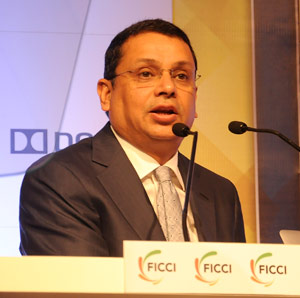
    Mr. Uday Shankar, Chairman of Ficci’s M&E Committee and Star India CEO giving the Opening Remarks at FICCI Frames 2014

    Opening Remarks by Uday Shankar, Chairman, FICCI Media and Entertainment Committee, and CEO, Star India, on Day 1 (March 12) of FICCI Frames 2014. Text courtesy: PR Department, Star India


    Good morning and welcome everybody.


    Honourable minister Manish Tewari, United States FCC Commissioner Ajit Pai, Dr. Khullar, Secretary Julka, my dear friends Punit and Karan, the wonderful team of FICCI that have organized this event, ladies and gentlemen.


    Amidst an environment of gloom and doom, the media and entertainment industry registered an impressive growth of 12% last year. The fact that we have been able to deliver this in light of an overall economic growth of 4% and a major resetting of exchange rates is a testament to the tenacity of the industry’s leaders and stakeholders. However, while delivering a growth rate three times that of the country at large is cause for satisfaction, the truth is that in dollar terms, we have barely made a dent this year. And, even more importantly, we remain at a great distance from the goal of growing the sector to 100 billion dollars.


    But, this is not a sector whose value is measured just by the size of its financial contribution. Media and entertainment remains central to defining the direction of India’s social and economic path; its work remains key to the imagination and inspiration of a billion Indians every day; and its health will be central to the ethos and values of the society we collectively shape.


    And, therefore, it is hugely important that we are gathered here in the days and weeks leading up to the national elections – one which comes at a particularly important time in our post-independence history. We have run the course on exploiting the momentum of the first set of economic reforms unleashed in 1991. We have created enormous opportunities and wealth for many. And, now, we are faced with a far more complex set of economic and social choices, including on the ideal role of the government, its relationship with industry and, in fact, the relationship of the private sector with the overall society at large.


    And no relationship is more important than the one between the government and the media. In many ways - and not uniquely to India - this is a relationship which by the very nature of its constituents is conditioned to be adversarial.Governments and political leaders are deeply aware of the power of shaping the message. The natural instinct of the state is to control the message. And, where it can, to control the messenger. The natural instinct of the media, whether the news media or the creative community, is to resist control, is to question authority. There is, therefore, tension inherent in the conflicting instincts of the two constituents.


    In India, that relationship has often moved from being just adversarial to flirting on the boundaries of dysfunctionality. Used to only a compliant state media, successive central governments have often used policy to limit free expression.And, increasingly, state governments have crossed the boundary to actually own and run private media enterprises.Why just run channels when you can integrate across the whole value chain, and run entire businesses from delivery to content?


    It is surprising indeed that irrespective of the political party or government, the expectation from the media is that they will always be flag bearers for the party line. So, there is no complaint when the media builds up the image of a clean, technocratic Prime Minister. Nor is there any problem when the media trumpets the idea of a youth leader or champions the development achievements of state leaders. But dare they cross the line into seeking accountability or evidence ofperformance, they are dubbed as incompetent, or worse,corrupt. What truly outraged me was the recent turn of events. It was the media that had created rock stars out of a bunch of street artists and protesters. It was the relentless 24 by 7 coverage of fasts and high decibel theatrics that created a political party from thin air and installed them in the government. You would have thought these leaders would have been grateful to the media for nurturing them. And, yet, even they resorted to accusations of corruption the minute the conversation turned to accountability for their choices and performance!


    Of course, the media has been more than just a silent victim in creating this environment. Too often, the news media has focused on what is sensational rather than what is important. Too often, the point of news seems to be to reduce the extraordinary diversity of the country to the most banal, a contest between extremes that can only be resolved through a shouting match on live television. With singular dominant narratives, the trend seems to be of creating heroes on a particular day only to be labelled as thugs and crooks the next.


    Legend has it that, in the early years of independence, Prime Minister Nehru used to write criticisms of his own government under pseudonyms published in leading newspapers. So concerned was he about a press that was not free and was not fiercely independent. It is ironic that today, it is perhaps easier to get articles published for a fee in newspapers than to place an honest criticism of the government. Nehru’s successors, both in politics and in the media, have strayed a long way away from that aspirational vision of the role of media in Indian society.


    Instead, it is now a broken relationship, and one that has dire consequences for both the industry as well as the government. The failure to establish credibility and importance has meant the industry perennially stays on a back foot, defending itself against every new wave of regulation aimed only at further curtailing its wings. In return, the government has not been able to leverage either the impact that mass media can have in India or harness the power of media as an economic engine that can create jobs and wealth.


    It is therefore appropriate that the weeks before the elections is the right time to call for a new contract between the government and the media. One that reaffirms both stakeholders to the theme of this year’s FICCI Frames: Transforming Lives.


    The central principle of this contract should be the recognition that this industry is a unique and powerfuleconomic enterprise. It is capable of creating employment and wealth much faster than most other sectors and with the ability to be a force multiplier, like it is in most countries. It is particularly relevant in India because it can be an employment generator without sizable public investments and without being hampered by the deficiencies of public infrastructure.


    Why would you not nourish an industry which has the potential to become a huge employer? Why would you not fuel an industry that can grow with more policy support than resource support?


    Second, the next government should recognize that it matters what the agenda of the Information and BroadcastingMinistry is. It matters what the Ministry sees as its dominant priority.  Do you see media as a tool for transforming lives thereby using it in the interest of serving the population or as something so powerful that it needs to be controlled? The regulatory agenda is one of the most crucial parameters that will shape how this industry will look like in the next 5, 10 and 15 years, and after some progress in the last few years, this agenda has now completely stalled. Whether in accelerating the digitization of television delivery, or creating progressive frameworks on consumer pricing, this agenda is waiting the arrival of a transformational government.


    And, this is particularly important when you review the media landscape today. It is littered with unviable and unhealthy media companies that cannot survive in the current framework. And unless all stakeholders are committed to retaining the vibrancy of the sector, the biggest victim will be free expression. No value is more important to this countrythan preserving the ability of a free media to showcase plurality in opinion and creative expression.


    I hope that the next few days will give us an opportunity to lay the foundations of a constructive relationship with a newgovernment for the next 5 years.


    Thank you.
     

  • #FF14 Day 1: Issues abound but collective stand will help boost industry morale

    By a correspondent


    Starting off from where the inaugural session left, the session on ‘De-bottlenecking the regulatory hurdles’ on Day 1 of FICCI Frames 2014 saw the panelists touch upon grave issues facing the industry and how the government could play an integral role in allaying the fears of all the stakeholders concerned.


    The panelists for the session comprised Bimal Julka, Secretary, Ministry of Information & Broadcasting, Government of India, Uday Shankar, CEO, Star India, Sudhanshu Vats, Group CEO, Viacom18 Media Pvt. Ltd, Punit Goenka, CEO, Zee Entertainment Enterprises Ltd, Rahul Johri, Sr VP & GM, South Asia, Discovery Networks and  Ajit Pai, Commissioner, FCC, USA. The session was moderated by Vikram Chandra, Group CEO, NDTV.


    Taking the opportunity to open up, Uday Shankar began by saying that the regulatory scenario in India was very diverse in its approach with some sectors being over-regulated while the others were under-regulated. “Lack of clarity on the intent of a regulation is something that is of concern. It has to be aligned with goals that have been set by the society”, said Mr. Shankar. He went on to highlight other issues that needed industry attention including the 10+2 ad cap provision and also the just introduced aggregator policy for stakeholders.


    Sudhanshu Vats presented a few indicators of his own as he said that there was a need to have a purpose to regulate. This, he said, could be achieved by having multiplicity of choice, have the need to operate like a free market and have adequate transparency and data. Adding further he said that the other essential needs were clarity, accountability and foresight.


    Rahul Johri pitched in by saying that there was indeed a need to have clarity on where the industry was headed on the issue of regulation and finding out what the core objective is. “We have regulated ourselves very well but there are too many regulations being imposed right now and we need to find a way to tackle them systematically. The aim should be to regulate well for the future of India.”


    Left to defend his turf, Shri Bimal Julka did a decent job of pacifying the panel as he said that it was a collaborative effort and that the responsibility rests with all stakeholders to get the job done. “Whatever the issues, we can agree in cohesion that it is the viewer towards whom our efforts have to be directed. Thus keeping such interests of the viewer in mind, the policies are framed with the intention of achieving inclusive growth,” he asserted.


    On the several impending problems facing stakeholders, Shri Julka said that the focus by the government was to throw open the field for a healthy discussion amongst all players so that they could arrive at an amicable solution. Mr. Julka asserted that despite the problems the digitization exercise was showing positive results as well including the carriage fees reporting a downward slide and more transparency being bought into the system.


    Mr Julka went on to add that the challenge would be to complete the phase 3 & 4 schedule of digitization and only after that could the issues of subscription versus carriage fee be resolved. But he cautioned that the stakeholders also had a role to play including deciding on how to make their content standout amongst a plethora of options facing the viewer.


    Sudhanshu Vats went to the extent of saying that there was no need to have a licensing system except for the spectrum allocation and that even if there is a licensing system there needs to be a fixed timeframe to address that. He added that things will be clear once the entire digitization exercise is complete but prior to that it was important that the industry take a hard look on addressability factor of digitization.


  • Jai Ho! Star Gold acquires rights of 18 top flicks

    By A Correspondent


    Star Gold appears to be setting the tone for blockbuster television premieres in 2014. The channel announced the acquisition of a fresh movie library as part of its extensive plans for 2014 in the Hindi movies genre. The new acquisition comprises 18 highly anticipated Bollywood films of the year including films of leading superstars such as Salman Khan, Ajay Devgn, Ranbir Kapoor and Hrithik Roshan.


    In early 2013, Star India had signed an exclusive television broadcast rights deal with superstars Salman Khan and Ajay Devgn for their films till 2017. In addition to this, the network has signed a deal for other exciting movies for its 2014 movies line up- Some of the high profile premieres slated for the year include Jai Ho, Kick, Bombay Velvet, Bang Bang, Roy, Action Jackson, Singham 2, Hamshakals, Bobby Jasoos and Creature, according to a communiqué.


    Announcing the movie acquisition plans for the year, Hemal Jhaveri, Executive Vice President, Star Gold and Movies OK said: “We have consistently received a phenomenal response for the big ticket premieres on our network.  Apart from entertaining the audiences, movie premieres also prove to be an extremely successful platform from the advertisers’ standpoint. Hence, it proves to be a win-win situation for all stakeholders. For 2014, we have targeted a diverse content line up acquiring films across different genres. Our strategy has always been to simply offer our viewers’ content they want to watch, rather than what we want them to watch”


    Touted to be the first hit of 2014, Yaariyan shall kick start the movie premieres for the year across the network. This shall be followed by Salman Khan’s Jai Ho, the first 100 crore grossing blockbuster of the year. The other acquired films of 2014 include Gang of Ghosts, Traffic, Sonali Cable, O Teri, Traffic, Bhaag Johnny and Hawaa Hawaai. The newly acquired movies are bought for a period of 10 years with exclusive telecast rights


    In 2012, the network had acquired over 500 films from the Viacom 18 group followed by adeal with superstars Salman Khan and Ajay Devgn in early 2013. Star India has successfully premiered blockbusters such as Singham, Bodyguard, Ra.One, Housefull 2, Bol Bachchan, Son of Sardaar, Dabangg 2 and Bhaag Milkha Bhaag.


  • CDOspeak | Do less, but effective


    By Rishi Vora


    From the many aggressive moves Star India has made in the past two to three years in the area of content, it is evident that the broadcast major is leaving no stone unturned in ensuring its continuous dominance in the industry.   Digital, which is seen as central to consumers’ lives, is at the core of Star India’s strategy to augment growth, says vice president and digital marketing head of Star India, CVS ‘Venke’ Sharma. A former marine engineering officer with the Indian Navy and an MBA gold medalist, Mr. Sharma, who comes with around 17 years of experience in shaping the digital strategy for brands, was last with Leo Burnett in Indonesia where he built the digital practice in the agency.  Prior to that, he built a marketing services agency Arc for Leo Burnett India and a digital agency Tribal DDB India for Mudra DDB..

    Excerpts: 

     You joined as the digital marketing headfor Star India network a little less than a year ago. What was the brief given to you and how far have you reached in achieving your goals?

    We are  making steady progress. The brief remains  to increase the demand for the network’s content using digital marketing.   As you know Star India is a leading broadcast network in India with 40 plus channels. And digital being central to consumers’ lives today, it certainly forms a critical part of the network’s overall strategy.    Over 600 million watch television in India, of that, about 90 million are on Facebook and other social networks.  In Sports, the English cluster and even general entertainment channels Star Plus and V, there are a lot of young audiences who engage with these brands on social media on a daily basis.

    Generally in India, the dominant social conversations are about sports, entertainment and politics.  As a network, we cover a wide gamut with definitive content in sports and entertainment. Thus our content inspires conversations on social media. Consumers are interacting while consuming content on TV or on any other device. Our endeavorto shape meaningful conversations that can help create content demand for our channels/shows. So that consumption increases and ultimately morepeople watch our channels.

     Has it changed from what it was earlier?

    The fact is that the network is leading across many genres – like Hindi GEC and English, Sports.  We have made progress in reaching out to people via digital media and engaging with them.   We have been far more focused in terms of not doing too much and doing stuff effectively. It’s more about listening, analyzing, and connecting the dots with actionable insights. I wouldn’t say we are already there but with the effort we are putting in, hopefully we should be.


       What are the kinds of mobile initiatives the network comes up with?


    All our digital marketing initiatives are mobile centric.  Social media usage itself is largely on mobile. So whatever digital marketing we do is to connect with the audience on the go.  In addition, we do build  appsif there is a genuine consumer context.  For example, we have an app for Mahabharata where consumers can get some exclusive content and keeps them engaged. The app was an important part of the show launch strategy.  We launched an app for Channel V called Vith U. It is an app devised for women’s safety. It has received a phenomenal response.

    The Star Sports app as you know  is very popular, so yes we do invest in mobile and we believe that mobile and social is the way to go.  

    From a brand’s perspective, do we have enough penetration of 3G to support mobile initiatives? Interestingly, social media platforms are aware of this problem and are coming up with ideas to tackle this. Twitter, is promoting an initiative where you can give a missed call on a certain number and you can converse with or follow a brand without an internet connection via SMS.   What’s happening is that the smartphone penetration is really increasing rapidly and also the operators are pushing usage. There is a reasonable amount of usage happening even from lower end handsets.   In fact, the discovery of internet for many people in India is happening via the mobile phone.  And for these new consumers, the digital initiation happens not through email but social media or search. And that’s a very interesting trend.

     With so many brands across categories trying to reach out to the consumers, is there a method to the madness? What is your view on this from the point of view of promoting Star India’s content via digital media?

    The point is that you need not do too much in the digital space. Do less but be effective and disruptive. That’s our mantra. It is not about how loud and how much we can talk but how interesting can we be. That can come from having the social voice being led by the brand  personality.  A brand is an experience and that has to have a voice. This voice will attract consumers to take part in conversations with brands and that’s how the bonding happens. When you’ve established the voice for your brand, you don’t need to do too much. You don’t need to tweet every half hour. Not required at all. On Facebook, if you do too many posts, the actual reach will go down drastically. It’s better you do limited; do the posts which are content rich and which can get meaningful engagement and a wider reach.   If you look at the Facebook page of Channel V, you’ll find we are far more focused. We are not trying to be excessively funny or  irreverent. We are just trying to be what Channel V is as a brand – “Politically Incorrect, Emotionally Correct”.

    Can you share initiatives undertaken to promote the sports channels of the network in the digital space?

    Take the case of  Wimbledon in India. You got about four to five million fans of tennis on social media, and as you know, tennis is a niche sport. So how do you promote it online so that many people would end up watching it?   We came up with an idea of giving out alerts to tennis fans. The insight was that people follow their favorites and they do not typically know when they are playing.   So we said we will send you an alert when your hero is playing. That was the proposition and we got a terrific response. We gave them a site, a number they can give a missed call on and choose the players for receiving alerts. Thousands of people subscribed and  consumed more tennis on TV. These are the kind of initiatives where digital marketing  increases the buzz and viewership on TV.


    From a network standpoint, is there a bigger thrust on digital marketing vis-a-vis traditional advertising?

    Of course the network strength is in favor of TV – that is a given. But is there a bigger digital push? Definitely there is a lot of thrust on digital marketing from a network standpoint. Star is a very progressive network and have taken to digital marketing earlier than most other brands. Every media has got its own role to play. The network’s digital thrust is very interesting as it goes into areas where no other media can venture.   Digital media engages with consumers when the TV is on (via mobile) and it of course engages with them deeply when the TV is off.

     For the network’s regional channels, do you think language is a barrier as the most preferred language for digital which includes mobile, social and web is English? Is there an attempt to engage with them in their local languages?

    Language is not a barrier. Our regional and GEC channels use the local language to connect with audiences on digital.

    Are audiences moving away from TV and consuming content only on Digital?

    There are over 90 million social media users (whom we can consider as heavy internet users) and the usage varies from user-to-user. There are people who consume everything on the smart phone and there are also people who are active internet users but when it comes to entertainment-they want to lean back and watch their favorite shows onHD television.   We believe one size doesn’t fit all. We need to be prepared to engage with all of them in the way they are most comfortable with. At Star India, our endeavor is to do all of this with a singular goal which is to create demand for our content and increase overall consumption. There is scope to use digital marketing to increase TV consumption as well as digital consumption.


    Wish to feature in MxMIndia’s CDOSpeak? Write to MxMIndia Digital Lead Rishi Vora at rishiv@mxmindia.in with a cc at editor@mxmindia.com.


  • Sports on the Go from Vodafone & Star India

    By A Correspondent


    Vodafone India has entered into a strategic partnership with Star India for multi-sports offering called ‘Vodafone Sports’ portal on Vodafone Live.


    The initiative will give consumers access to sports content on the go – on feature phones and smartphones.


    Powered by starsports.com, Vodafone Sports will offer sports such as Cricket, Football, Tennis and Hockey and going forward it will also cover  F1 and Tennis.


    Said Vivek Mathur, Chief Commercial Officer, Vodafone India, “The launch of Vodafone sports is an industry first initiative to bring across best of premium live and curated sports content blended with interactive platform and content delivery.”


    Sanjay Gupta

    Sanjay Gupta, Chief Operating Officer, Star India, noted, “Star India’s ambition is to shape the future of entertainment on a mobile screen and sports is a first big initiative for us. Starsports.com has already set a new standard for sports fans hungry to consume sports without being tied to their television. This partnership will bring the power of our service to a whole new audience.


    As part of the content offering, Vodafone Sports will offer unadulterated content such as  news, trivia, scores, instant access to live matches, interactive video scorecards, exclusive insights and analysis, columns, photos and wallpapers.


    A special feature for cricket fans  is an interactive video scorecard that allows users to watch the fall of a wicket, replay of individual innings, highlights for a particular player.


    Snack pricing plans

    • Watch a match at INR 10/INR 20
    • Watch a video clip at INR 3 /INR 5
    • Adorn your home-screen with Cricket wallpapers at INR 3


    All you can eat plan

    • Sign up for an individual series at INR 49/INR 99/INR 150
    • Watch archived video clips (e.g. Sachin’s best knocks) at INR 30/INR 50


    Subscription-based plans

    • Rs. 5 per day
    • Rs. 150 per month


    Customers can avail Vodafone Sports by visiting live.vodafone.in/sports or sending a simple text message SPORTS to 111. If not for the smartphone users, this one would be a great offering for feature phone users, who wants to enjoy sports on-the-go.


  • Press Club Mumbai discussion on ‘what ails journalism today’

    By a Correspondent


    The Press Club Mumbai has convened a panel discussion to discuss and understand what ails journalism today, and what perhaps is the way forward. The theme of the discussion which will be held at the Club premises today (Feb 6) at 6.45pm is: ‘The Elephant in the Room: The Crisis in Journalism Today’.


    The panel includes Siddharth Vardarajan, former editor of The Hindu, Hartosh Singh Bal, former political editor of ‘Open’ magazine, Kumar Ketkar, editor of Divya Bhaskar, Indrajit Gupta, founder and former editor of Forbes India, and Uday Shankar, CEO of Star India. The session will be coordinated by Gurbir Singh, President of the Press Club.


    The discussion will be webcast live at https://www.youtube.com/channel/UCg2QhyGqq6dOjWknK94ZSaw.