Tag: Star India

  • CVS ‘Venke’ Sharma joins Star to oversee digital marketing

    By A Correspondent


    Digital media specialist CVS Sharma has joined Star India as vice-president, network digital marketing. He joined Star last week, soon after returning from Indonesia where he worked with Leo Burnett.


    Since as a policy Star India does not issue communiqués on recruits and exits, MxMIndia had to rely on the changes that Mr Sharma (better known as ‘Venke’ in the fraternity) made in his LinkedIn profile. “My mandate is to build and optimise digital marketing opportunities for all the channels and digital initatives of the Star TV network in India,” he notes.


    April 12 was the last day at Leo Burnett for this former Indian navy marine engineering officer and an MBA gold medallist. With over 16 years of experience in shaping digital future of brands across categories, he also built Tribal DDB in India his stint with Mudra (2000-06).


    Mr Sharma joins Star India as Lalit Bhagia, who championed the digital media foray, quit to get into an entrepreneurial mode.


  • Delhi HC upholds Star India’s cricket rights on mobile phones

    By A Correspondent


    The Delhi High Court has prohibited Telecom Operators and Mobile Value Added Service (MVAS) providers from exploiting Star India’s exclusive cricket media rights by providing live updates of matches to their subscribers. Star India has the exclusive media rights to cricket matches organized by the Board of Cricket Control in India (BCCI) until 2018.


    The court, in its order on Wednesday, reaffirmed Star India’s exclusive digital rights to BCCI cricket matches on mobile as well and barred telecom operators from using match and score updates for commercial gains. It asked telecom operators and MVAS providers to either disseminate score updates with a lag of 15-minutes or pay a fair share of revenue generated through broadcast of live and contemporaneous scores to Star India by procuring a license. This is a vindication of Star India’s stand that match information and facts generated from a sporting event is a proprietary right which accrues to the event organizer in the digital space.


    “The honourable High Court has vindicated Star India’s stand by passing this historic judgment. The lack of clarity was severely compromising the ability of rights owners to invest to create great experiences for sports fans.  This decisive verdict finally creates clarity on who owns the rights and a mechanism for monetization and fair revenue share. For me, this is a huge boost to the entire digital and mobile space. Finally, we have a foundation on which to build great products as well as successful businesses and the biggest beneficiary will be the consumer,” said Uday Shankar, CEO of Star India.


    Hearing Star India’s petition, the High Court also observed that providing live score updates prevents Star India from effectively monetizing its exclusive rights.


    “It would be just and reasonable for the defendants to either obtain a license and gain equal rights to their subscribers, or make them wait for some time, in order to not prejudice the right of the plaintiff (Star India) to earn revenue from the match information,” the court said in its order. “Those who do not obtain a license from the plaintiff, may not disseminate the score update or match alert before 15 minutes from the moment such score update or match alert is telecasted or broadcasted by the plaintiff (Star India).”


    Star India intends to provide content to sports fans through multiple engagement platforms, including web, mobile phones and tablets.

  • Star India deal with Ajay Devgn for Rs 400 crore for movie rights till 2017

    By Nandini Raghavendra


    Bollywood actor Ajay Devgn has signed a deal worth about Rs 400 crore with Star India for exclusive satellite rights to all his upcoming releases until 2017, the second such contract that the network has sealed after it inked a pact with superstar Salman Khan last month.


    Mr Devgn, the only other Bollywood actor apart from Khan to have four films in the Rs 100 crore-club, said he could ensure a better value for his films than his producers.


    “Business is becoming increasingly open and clear, so it’s easier to deal directly,” said Mr Devgn, talking from Bhopal, where he was shooting for Prakash Jha’s Satyagraha.


    “I am securing the producer a higher value, so he benefits eventually,” said Mr Devgn, explaining the impact of the deal with Star India which is for a period of five years and is said to include at least ten films. Producers, depend on satellite rights to bankroll at least 35% of the cost of production.


    “But I am also ensuring a certain amount for myself. For the rest, like actors fees etc, all depends on the relationship between an actor and producer,” he added. Besides the yet-to-be-released films, the network has 18 of his earlier films, including Singham, Golmaal, Zameen and Gangajal.


    Among the films to be released, is Sajid Khan’s Himmatwala, which studio Disney UTV releases at the end of the month. The next is Prakash Jha’s Satyagraha, followed by an action film with Prabhudeva and a sequel to Singham with Reliance Entertainment. “This should keep me busy for the next year-and-a-half at least,” said Mr Devgn.


    The deal has strategic value for the network, said Sanjay Gupta, chief operating officer of Star India.


    The small screen is the new cinema hall where a premier of a big film can attract 20-30 crore viewers, ten times that in theatres, Mr Gupta said. Research shows that television viewers spend 20-30% of their time watching movies on the small screen, impacting the television rating points keenly followed by advertisers.


    “We have been growing this space aggressively as also buying more films. Our spend on buying films has increased 20% year-on-year,” said Mr Gupta, who the network”s fiction and non-fiction programmes, helmed by Bollywood talent. For Mr Gupta, adding movies also contribute at least 25-30% Gross Rating Points or GRPs for his network. Star India has two movie channels apart from the main general entertainment channel.


    A film is considered a success on TV if it can manage to garner an average 2.5 television rating points or TRPs through the year, apart from the high number it garners on premieres.


    The last three premieres on Star Gold starring Mr Devgn averaged 6.2 TRPs.


    Source:The Economic Times

    Copyright © 2013, Bennett, Coleman & Co. Ltd. All Rights Reserved


    Photograph: Fotocorp


  • Meet the IAA Awardwinners-3 | Differentiation is not enough: Gayatri Yadav

    The recipient of the Marketer of the Year for the media and entertainment category, Gayatri Yadav, Executive vice president, Marketing & Communications at Star India, chose to downplay her role in the award and instead credited the team. MxMIndia’s Johnson Napier caught up with Ms Yadav soon after she received the metal from I&B Minister Manish Tewari to gather her reactions on the win and more.


    What are your initial reactions to the inaugural Leadership Awards instituted by the IAA?

    This is a fantastic initiative where they’ve managed to get three different disciplines together; it’s something I have not seen anyone else do. The organizers need to be applauded.


    The line-up of shortlists under your category comprised the who’s who from Media, most of whom shone brightly with their performance last year. What worked in Star India’s favour?

    Where the award is concerned, I think it belongs to the whole team at Star and not to any one individual. What makes the media as a discipline challenging from a marketing perspective is two aspects: one is that it is a very dynamic category in the world. As a category this is the only one that undergoes a change almost every day. You may have categories like Telecom etc where the pricing and other such factors may change but the product doesn’t see any fundamental change. Media is the only category whose dynamics change every day when you’re catering to the consumer. The other aspect is that the consumer always has infinite choices at his/her disposal and unless you have something exciting to offer them they won’t stay loyal.


    What would be your advice to fellow marketers so that they’re ready to take on the challenges of tomorrow?

    There has to be a relentless focus today on knowing who your consumer is and what they aspire to be tomorrow. And, differentiation is not enough; it is necessary for one to disrupt. Whoever follows these precepts will emerge winners in the long run.


  • Star India launches starsports.com

    By A Correspondent


    Star India has taken a new step in sports viewing on digital, with the launch of starsports.com to give Indian cricket fans a personalized audio-visual experience. Flagging off with the Pakistan tour of India, the website will present a video experience for cricket fans that includes high-definition video streaming, an advanced player that can be individually controlled, and the ability to catch up on the game through both a video scorecard and a video timeline that marks the key moments of the game.


    Uday Shankar

    Commenting on the launch, Star India CEO Uday Shankar said, “At Star, we have always focused on dramatically enhancing the overall consumer experience. Smart technology, combined with powerful content, can be disruptive and we are excited about offering Indian fans an entirely new way of experiencing their favourite game.”


    Starsports.com includes a video timeline for cricket that marks key moments of a match, while it happens, allowing users to go back, relive the moment and jump back into the action in real time. The commentary section has also been reinvented. It not only focuses on explaining the action ball by ball but also pulls in real-time conversations on social media while the match is on. A video scorecard brings statistics to life with video clips of key moments supported by detailed analytics and graphics. Fans can also catch up on games through replays and highlights.


  • Satyamev Jayate Bags ‘Indian of The Year’ Special Achievement Award by CNN-IBN

    Left to right: Uday-Shankar-CEO-Star-India-Svati-Chakravarty-Bhatkal-and-Satyajit-Bhatkal-from-team-Satyamev-Jayate-Actor-Shabana-Azmi-at-the-CNN-IBN-Indian-of-the-Year-Award-Ceremony


    By A Correspondent


    Non-fiction television show Satyamev Jayate on Wednesday bagged the CNN-IBN Indian of The Year – Special Achievement Award 2012 for its path-breaking initiative.


    A release from Star India said that this accolade for Satyamev Jayate follows soon after recognition by the Government of India earlier this year. The show had been rewarded by the National Commission for Scheduled Castes in October for its efforts to create awareness against social discrimination.


    Satyamev Jayate won the CNN-IBN ‘Indian of The Year’ award under Special Achievement category along with Olympian Mary Kom and missile scientist Dr K C Thomas.


    Star India CEO Uday Shankar and the Satyamev Jayate team were honoured for their remarkable contribution in highlighting several social ills that continue to plague modern India and to help create awareness against such evils through the pioneering TV programme.


    “This award is extremely special to us at Star as responses from viewers were critical in deciding a winner. Satyamev Jayate was an initiative to offer a public platform to issues that concern all Indians and it’s quite humbling to see these efforts being recognized,” Mr Shankar said.


    Satyamev Jayate was also nominated in the most influential entertainer of the year category for its innovative use of television as a medium for social change.


    Satyamev Jayate was a landmark show in Indian television that set new benchmarks from the very first episode earlier this year. Star India was instrumental in helping conceive the show, which also demonstrated how TV can be an effective tool to influence social change and empower people.


    CNN-IBN Indian of the Year is one of the biggest and the most credible awards that are decided on the basis of votes from the general public as well as the eminent citizens of India. The award has been recognizing outstanding contributions by Indians to nation- building for the past seven years.


    The winners were selected through a four-tier process that began with selecting nominees in different categories by senior editors of Network18 which is ratified by a jury consisting of Padma awardees and concluded with polling by citizens from across the globe to choose their favourite Indians.


    Satyamev Jayate reached a third of India’s population, airing simultaneously in multiple languages. It was the most-talked about show during its 13-week run, questioning social mores, helping shape mindsets and leaving an imprint on the minds of people with compelling tales from everyday life.


  • Jaldi 5 with Kevin Vaz: Blockbusters to boom Bengal

    Having gained an unmatchable reach and popularity with its brand Star Jalsha in Bengal, Star India is also set for the launch of a new movie channel titled Jalsha Movies. The launch is in line with Star Jalsha’s philosophy of Chalo Paltai (let’s change) that aims at delighting viewers through contemporary stories from their surroundings.

     Kevin Vaz, President and General Manager – Star Jalsha and President – Ad Sales at Star India Pvt Ltd tells MxMIndia what viewers can expect from the new offering and why the channel is already a winner in the already buzzing Bengal television market.


    01. The third Bengali movie channel, and the second launch in close succession. From the sales point of view, is Bengal the new ‘hot’ market?

    I can’t comment on it being a hot market, but Bengal is definitely growing very fast. It has become a Priority One market for most brands today be it across telecom, consumer durables, FMCG etc. Most importantly, it is not the national clients but the retail business that is growing rapidly here. So whether it is jewellery stores or saree shops or biscuit manufacturers… a lot of local interest is gaining prominence here.


    As for the launch, Bengal is a huge consumer of Bengali cinema irrespective of the channel that it gets played on. Star Jalsha has always been offering quality movies to its audiences and has achieved a TVR as high as 12. Keeping these trends in mind we thought it was right time for us to launch a Bengali movie channel. According to us, there is nobody right now offering blockbuster movies regularly and that is what Jalsha Movies will stand for.


    02. Star Jalsha has been a huge success whereas at least one of the channels from a well-pedigreed media company has shut down. What’s the secret of the success with Jalsha?

    When we launched Star Jalsha, we were very clear that we had to be different. In fact within a few weeks of its launch it was a clear leader and has been so for the last four years with our GRPs totalling 500 compared to our closest competitor at 400 GRPs or so. More importantly we attained that position by redefining the market and the storyline that we do. With such a benchmark, we said that we clearly expect Star Jalsha to be leaders within the channel. I see that we have the necessary content that will help us deliver that promise.


    a. How fast do you hope to be on top of the pack?

    If we get into something we clearly look at become leaders at once. So the answer is: as early as possible.


    03. We see that you’ve stitched up quite a few alliances with film companies.  Will we also see any international/Indian movies dubbed in Bengali in future?

    We’ve got a great library of Bengali movies and the reason to launch a regional channel is for people to consume it in their own language. So we will be going ahead only with Bengali movies as of now.


    04. How has the response been from advertisers and media agencies?

    We’ve got a great response from them. Vivel has already come aboard as the channel partner. Going forward you will see a whole lot of clients who will be associated with us. In fact, most of these advertisers have seen Jalsha operate in the last four years and know the kind of mileage we offer to them. So most of them are excited enough to partner with us from day one of operations.


    A market like Kolkata is counted in as part of the extended HSM. Do you think with three Bengali movie channels, the Hindi movie channels will get impacted?

    I wouldn’t like to call Bengal as an extended Hindi Speaking Market and has rather reached a stage where it holds its own. At one point in time it was considered an add-on market but for most brands it has become a priority market. Also, if one were to see Star Jalsha delivers higher ratings than any other Hindi GEC or channel by a distance. So to reach out to the masses is our number one priority. If I may add here, Bengal is witnessing a huge surge in retail advertising and more and more brands are hopping on to be a part of the association with us.


    05. Tell us more about Vivel being the Channel Partner? The performance of this partnership could open the floodgates for many more?

    As I said, Vivel has come on board as the channel partner but it’s not we have closed our doors to the others. Probably as the numbers start to trickle in people will want to make bigger commitment to the channel. That will be an ongoing effort but a few brands have come based on faith and seeing potential in what we have to offer them. Jalsha has a very strong equity in the market with its advertisers and it is purely on that front that many have partnered with us.


  • Star India’s Green initiative bags back-to-back awards

    By A Correspondent


    Star India has bagged back-to-back awards – the prestigious Aegis Graham Bell Award and News Corporation’s GEI (Global Energy Initiative) Innovator Award – for its green initiative that encouraged a tapeless environment.


    STAR India won the award that recognizes Innovation in TV, Broadcast & DTH for sustainability at the Aegis Graham Bell Awards, beating more than 100 nominees across categories. The Aegis Graham Bell Award follows the honour for Content Live by way of News Corporation’s GEI Innovator Award last month.


    R. Balu, Head and EVP – Broadcast Technology, Krishnan Kutty Head and EVP – Distribution and Gajendra Tijare Senior Vice President – Broadcast Technology received the award on STAR India’s behalf.


    The network’s Content Live service, rolled out in January last year, encourages advertisers to go digital while uploading marketing content, thus reducing carbon footprint. Besides, it also enables reduction in spends on traditional tapes and transportation fuel.


    “It’s a double delight for us at STAR and encourages to further work toward reducing carbon footprint,” Sanjay Gupta, COO of Star India, said. “This initiative also forms an integral part of the movement to reduce the same by discouraging the use of tapes.”


    With Content Live’s new digital workflow, the team dissolved the need for the 2,245 tapes per week and additional 2,500 from advertisers that STAR was previously receiving. This eliminated 153.3 tonnes of CO2 from transportation per messenger per year. STAR also became the first broadcaster in India to go tapeless and digital.


    Going tapeless, in addition to reducing costs, also allowed STAR’s clients remove time inefficiencies. Cost savings were delivered to customers by enabling cut in expenditure on hardware such as tapes, logistics and dubbing.


    Besides, tape-based system was also vulnerable to external factors such as custom hold-ups, traffic that can delay the delivery of tapes and thereby delaying the entire process.


    Aegis Graham Bell Awards 2012, India’s largest and the only award that recognizes innovations in field of Telecom, Internet, Media and Edutainment (TIME), was held on November 1 in New Delhi. It is an initiative by the Aegis School of Business & Telecom, 21st Convergence India 2013 and supported by the Cellular Operators Association of India. The selection of winners is validated by PwC as knowledge partners.


  • Broadcasters set to mix ideas & business @ITF

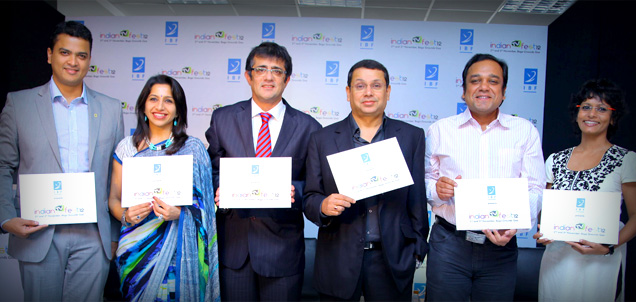
    Announcing the Indian Televsion Fest (from left to right): Keertan Adyanthaya, Monica Tata, Sunil Lulla, Uday Shankar, Punit Goenka and Lydia Buthello


    By Johnson Napier


    The god-like status that the medium of television commands in India today is indicative from the endless attention that gets showered on it from all and sundry. Whether for the advertisers who are willing to bend rules and swing  to their tunes or for the viewers who can take a liking to anything that’s thrown across at them (well, almost), the Indian broadcast industry is calling the shots in a manner that is pivotal to its growth.


    In fact, the popularity that it commands can be gauged from the growth that the medium has been throwing up in the past five years, which has been in the range of 12 per cent. This of course is backed by its ability to occupy a lion’s share of the ad pie and still remain a favourite medium for the advertisers.


    But while there are some obvious highs that ensue from the medium, the medium has been at the receiving end as well. Like the constant criticism it attracts for not being able to display a show of unity to voice common issues rather letting personal goals take precedence. Then there are also those who question the absence of a platform for the industry to come together and air and share views of common interest. But the last peeve may well be a thing of the past with the announcement of the Indian Television Fest 2012.


    The Indian Broadcasting Federation (IBF), led by president Uday Shankar of Star India and core festival committee members comprising Sunil Lulla of Times Television Network, Punit Goenka of ZEEL, Keertan Adyanthaya of NGC Networks, Monica Tata of Turner International India and Lydia Buthello of Star India announced the first-of-its-kind event for the industry. The two-day festival will be held at the Baga Grounds,Goa on November 2 and 3, 2012.


    The two-day fest would be a unique platform for the Indian and global broadcasting industry to network and exchange ideas through engaging panel discussions and master classes. Renowned names from India and across the globe are expected to participate in the mega event. And since it’s Goa, with the inviting beaches for company and some fun.


    Throwing open the idea to the gathering, Mr Shankar began by thanking his core team members, without whom the fest wouldn’t have been a reality. Explaining the thought process behind the exercise, Mr Shankar said: “The idea has been in the pipeline for almost a year now. We felt it was the right time to launch Indian Television Fest as the industry has grown big enough to manage an event of this scale. It basically stemmed from the need to create a platform where the entire broadcast industry could come together under a single roof – irrespective of the organisational and competitive background – so that there could be co-sharing and exchange of ideas and conversations on how the industry can take a big leap into the future.”


    According to him, what would make the event special would be its ability to get together honchos and industry persons from different verticals under television to come and be a part of the give-and-take. He affirmed: “Apart from some familiar and popular names the event will see the best in broadcasting brain trust from India and the world descend at the venue. The ultimate aim of ITF would be to service the larger Indian broadcasting community. It will also be driven with the dual need of being business-minded in its approach while at the same time having a social connect, as we believe the two are interlinked and cannot work in isolation from each other. All in all, we plan to make this event truly iconic in nature.”


    Giving a lowdown on the two-day event, Monica Tata of Turner India began by bringing to light some of the high points of the Indian broadcast industry. Providing a bird’s eye view of the current media scenario, she said: “India is the third largest market for media behind US and China. It has reported a growth of 12 per cent in the last five years which will continue to keep swelling. Further, the country boasts a reach figure of 500 million and is estimated to be worth Rs33,000 crore. This number is expected to triple to almost Rs100,000 crore by 2017. Needless to say there are tremendous opportunities that will enable the industry reach this figure in the coming few years.”


    Highlighting the tremendous opportunities that the Indian market presented for the future, Ms Tata said: “India has a penetration level of just 60 per cent leaving a lot to be achieved going forward. Further the C&S households are expected to grow to 88 per cent from the current 81 per cent. Also, the average time spent on television viewing is still low at 150 minutes compared to other countries that are almost double the number. And finally, with digitisation, DTH, HD taking off in a big way coupled with the unhindered growth of regional channels should see the industry enjoy prime status in the near future.”


    According to Ms Tata, some of the key themes scheduled at ITF include: best practices and masterclass that’ll be weaved around core areas of content, distribution, revenues, technology, etc; presence of visionary speakers like James Murdoch of International News Corporation, Andy Bird of Walt Disney, Hugh Johnson of Channel 4, Michael Lynton of Sony Corporation of America, Subhash Chandra of Zee & Essel Group, etc; debates and conversations; interaction with regulators and policy-makers; and finally encouraging cross-genre ideation.


    Presenting his viewpoint, Sunil Lulla of Times Television Network said: “There was no platform as yet in India where the issues and concerns of the Indian television industry were being raised and addressed. ITF will be a platform where one can learn, interact and demonstrate the road for the future. Three factors that’ll drive this event include the need for conversations, need for confidence to hold an event of this stature and need for commitment from the industry to take this industry from Rs33,000 crore to Rs100,000 crore by 2017.”


    On the key highlights to be expected at the event, Punit Goenka of ZEEL said: “We all know how New Media is going to be the platform of the future and we also know how regionalisation is going to take the industry further…and since regional has a lower base it is growing faster than the other genres. However, there are avenues that we need to discuss. Nobody has an answer as to how we will reach the Rs 100,000-crore mark but one has to start the process of thinking about it.” When asked if it would be a practically possible to reach the Rs100,000 crore mark in a short span of four years he said: “We have to talk about it and see how we get there. Nobody has an answer as to how we would get there. But unless you talk about it and bring it up in discussions how do we even make a beginning to reach there? I think the end goal is not important; it’s the journey which is going to be important.”


    When asked on the initial response that the event has managed to generate, Mr Lulla said: “Members from the broadcast industry have shown tremendous enthusiasm to the initiative, which can be seen from the initial buzz that is being created where registrations are concerned. As you know, we are a little late industry as we like to start things a little later. We hope the television industry supports us in a fashion by sending more members to attend the event. We have fantastic line-up of speakers from India and abroad; and of course, we would like the industry to stretch themselves a bit and sponsor many other themes and elements that we have lined up out there.”


    Mr Lulla added: “As you know, we are always a last-minute booking.com industry, so it’ll be a challenge to get a lot of people to attend the event. Also, there will be the challenge of generating advertising revenues so that we can stage the event successfully. But we are confident of putting up a successful event.”


    On the benefits that will accrue to IBF from the event, he said: “What IBF will particularly benefit from is take the ideas that come out and find out what will be the cornerstones for the industry going forward and what will become items of agenda. What people who come there to attend the event to take off is personal learning – so there will be ideas, new friends will be made…in all, it will be a mind-opening event, so to speak.”


  • End of Season 1 of Satyamev Jayate: The good, the bad and the ugly truths of life

    By Meghna Sharma


    In the past 13 weeks, one show has done what no other show has been able to in a long time – get people face-to-face with the ugly truths of our society. Aamir Khan’s television debut, Satyamev Jayate, was the most-talked about show even months before it was aired. It was touted to revolutionize the Sunday morning slot on the Indian television.


    From the very first episode till its last episode on July 29, the show was able to create a lot of buzz. People shared their views on the social ills the show highlighted on social networking sites. The news channels and newspapers carried expert views and opinions on the show. It didn’t back down from highlighting the fact that a country of one billion lives like ostriches when it comes to taking action against such evils.


    However, inspite of all the hue and cry, one question still remains on everyone’s mind: was it really effective?


    MxMIndia spoke to industry experts, journalists and even activists after the show was aired on May 6 and almost all of them gave it thumbs up. Now that the show has ended, we got in touch with the same people to know their opinions…


    TRP: the only yardstick?

    Chandradeep Mitra

    For any channel and show, the TRPs it gets are the yardstick at which its popularity is measured on. Star India’s Satyamev Jayate which premiered across nine channels – Star Plus, Star Pravah, DD National, ETV, Star Utsav, Vijay, Star Jalsha, Star World & Asianet – got a rating of an average 4 TVR for the CS4+ in the Hindi speaking markets and an average of 4.9 TVR for the All 4+, according to the TAM viewership data. But, as the weeks rolled on, the ratings dipped.


    Many, however, feel that such shows cannot be measured by TRPs as they are much bigger than that. “For a show like this, ratings alone cannot be the yardstick. One must not forget that the it was a non-entertainment show and was aired on Sunday mornings.  For a slot and content like that, the show did very good,” said Chandradeep Mitra, managing partner, Anvention.

     

    Anil Sathiraju

    He added: “We must look at the social impact it created and I’m sure it will remain in people’s memories for a long time. Apart from the buzz created on social networking sites and getting eyeballs, I’m sure now companies will also increase their CSR activities as it highlighted the work done by a few.”


    Similarly, Anil Sathiraju, Head – south, Mudra Max Media, too feels that content and impact are more important than the ratings: “What the show has done to the morning slot is evident enough, that it made people sit up and take notice. And I’m sure now most channels, including Star, will want to revive the slot and come up with shows which will not make the slot redundant.”
     

    Sundeep Nagpal

    The show wasn’t developed and promoted for TRPs, said Sundeep Nagpal, founder director, Stratagem Media. “It was applicable for the masses and not many shows of such genre have been created. Hence, it would be wrong to judge it on the ratings…it’s much more than that. It bought out the issues which are prevalent but under the surface. For example how many of us in Mumbai knew about Khap panchayats? The show is a turning point in the Indian television history.”


    The much-hyped show even went on to charge an exorbitant amount for the 10-second advertisement slot which was sold at thrice the usual rates. “For an advertiser, the show was the best medium to reach its audiences. For the first time, a show was created, which in turn created two new stakes – timeslot and a new category of a show. So, many didn’t hesitate in paying that extra for the quality they were getting in return,” explained Llyod Mathias, director GreenBean Ventures and former CMO of Tata Teleservices and Motorola.


    Aamir Khan vs Content

    Anita Nayyar

    According to the media planner, Anita Nayyar, who is moving back to her former agency Havas from Bennett, Coleman & Company (BCCL) by August, initially the show got the hype only because it was anchored by the actor and the fact that the concept of the show was well hidden. However, for a show like Satyamev Jayate, it’s the content which plays a bigger role.


    “Satyamev Jayate is a socially relevant show and in the beginning, I think, it did mobilize people. However, in between it lost its public appeal. And I’m not surprised as such shows only appeal to a certain section of the society. Hence, it wasn’t even able to garner the TRPs it deserved,” said Ms Nayyar.


    She explained that though the show was anchored by a popular actor like Aamir Khan there was a gap between enlightenment and mobilization. “The show was supposed to mobilize people, but it was only able to highlight the evils which we all know exist. Nonetheless, it was a good show.”


    Voicing the same opinion, Sarla Bijapurkar, sociologist, believes that if one has to score Aamir Khan vis-a-vis the content of the show, Aamir would win. “Public memory is very short and everything will be lost if there is no follow-up. For instance, take the episode where diktats of Khap panchayats were highlighted. Has anything changed? No, we still have such bodies making people’s lives miserable. Sometimes, when one hears or reads about such instances, it makes you wonder if we, as a society, take two steps backward for every one step taken forward.”


    “For me, the show will only mean something if it is able to do a follow-up on the issues highlighted. Also, instead of raising a new issue every time, I think, they should have focused on fewer and discussed about different dimensions related to a particular issue. Maybe, then it would have been able to brought about a change,” said Ms Bijapurkar.


    Waiting for a change…

    Ranjona Banerji

    However, there are many who think that the show was a success and was able to do more than just generate public interest and will eventually lead to some change as evolutions don’t happen overnight.


    Ranjona Banerji, a senior journalist and contributing editor, MxMIndia, feels that the show did justice to the concept though there were a few dodges like the show being too emotional, sometimes. The first two episodes – female foeticide and child sexual abuse – were able to create a lot of public interest. “Apart from these two episodes, the episodes which moved me were the ones on disability and senior citizens. The show did the work of a journalist and was even able to answer a few questions. Hopefully, they’ll tweak the show a little bit and come up with a second season – better and stronger.”
     

  • Vivek Bahl hops to Sony as Chief Creative Director

    By A Correspondent


    In 18 months, this is his fifth place of work… surely, the man’s on the move. Yes, Vivek Bahl is set to join Sony Entertainment Television (SET) as Chief Creative Director after short stints at Mahuaa, Turner and Network 18.


    One of the seniormost programming executives in the business, Mr Bahl, joined Zee TV a few months before it was launched way back in 1992. His last port of call has been the Viacom18 Network which he had joined in May this year as network advisor (content).


    In the new role, Mr Bahl will be responsible for the overall programming of the flagship channel. Speaking on his appointment, he said, via a communique: “I’m delighted to join SET and hope to provide valuable programming inputs in all genres of shows. This is an exciting and challenging role and I’m honoured that trust has been reposed in my abilities.”


    Mr Bahl will report to Sneha Rajani, Senior Executive Vice President & Business Head – Channel SET.  While announcing the appointment, NP Singh, COO, MSM, said: “Vivek’s entertainment experience and a cross-functional strategic perspective will enhance the growth of SET. On behalf of Sony Entertainment Network, we look forward to a long and fruitful working association with him.”


    Prior to joining Viacom18, Mr Bahl was with Turner International where he was the Chief Content Officer. And before that he was with the Mahuaa Network where he moved from Star India.


  • Nachiket Pantvaidya to replace Nitin Vaidya as head of Star Plus

    Nachiket Pantvaidya

    By A Correspondent


    Nachiket Pantvaidya, Executive VP and general manager at Star India and incharge of Star Pravah, the Marathi GEC of the Star bouquet of channels, has been appointed as incharge of flagship GEC Star Plus.


    Confirming the appointment, a spokesperson told MxMIndia that Mr Pantvaidya will take over from Nitin Vaidya who has put in his papers after a stint of 14 months.


    Mr Pantvaidya has been with the group since 2009 when he was appointed managing director of Fox Television Studios, the TV production unit of Newscorp’s Fox Entertainment Group. Earlier, he has been general manager,South Asia with the BBC and Executive Director, Programming and Production, for Disney where he managed the localisation of the Disney brands. An IIM-Ahmedabad alumnus, Mr Pantvaidya has held several key positions MSM (Sony) network.


    Nitin Vaidya

    Meanwhile, confirming the news to MxMIndia about his resignation, Mr Nitin Vaidya said: “Yes, I have quit and it has been a nice and exciting experience. Star is a great organization to work with and the team has been remarkable.” Mr Vaidya had joined Star India in May 2011 and was heading Hindi channels Star Plus, Star One (which is now discontinued), Star Gold and Star Utsav.


    On his next move, Mr Vaidya said: “I have plans of my own and as of now I’m not joining anywhere for the moment.” Without disclosing any dates, Mr Vaidya assured that only after a smooth transition will he move on from the organization.


    Nitin Vaidya, Photograph: Fotocorp