Tag: Star India

  • Maa TV repositions itself to Star Maa

    By A Correspondent


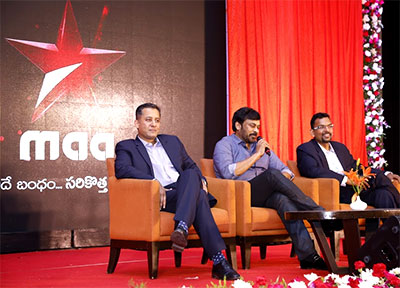
    Popular Telugu channel Maa TV which was acquired by Star India has announced a new positioning and refresh along with a new logo, tagline, pneumonic theme track and a new name. Star is now prefixed to the name.

    Actor Chiranjeevi, the chief guest, unveiled the new logo and the brand tagline. Maa TV now becomes Star Maa. The logo’s new identity is red with the intrinsically bold Maa written under it. According to a communique, Star Maa has aggressive and forward-looking plans of growth and expansion. It has plans to consolidate its position in the Telugu market and achieve dominant thought, content and image leadership.

    Said Kevin Vaz, CEO, South Region: “Star India’s acquisition of Maa was a testimony to Star wanting to build and grow in this market. With the brilliant synergy of the strengths of Maa and Star, we believe, we have come a fair distance in the last few months but we are now poised to take a leap,” he said, adding: “Keeping tune with changing aspirations and expectations of audiences is the key to long-term success. Programming innovation, content variety, and modernising the entire packaging and quality of the channel through Star Maa brand refresh is a sign of our commitment to the Telugu people, globally.”

    Speaking on the occasion, Alok Jain, Business Head of Maa, said: “Our aim is to make Star Maa more current and relevant to the viewers. We are crafting a philosophy that respects the spirit of the Telugu peopleacross the globe. Our story-telling develops linkages with the dreams to create an entertainment brand that is consumed by the entire family. We educate, uplift and usher in new thinking. Every Telugu woman and man, who is optimistic and growth-oriented, yet rooted in home and state, is our key audience. Our aim is to be innovative, revolutionary and original in every aspect of our business and hopes to deliver best in this journey.”

  • Ogilvy scripts nayi campaign for Star Plus

    By A Correspondent


    Star Plus may have pioneered saas-bahu soaps in the early 2000s, but over the years, the general entertainment channel has tried to reinforce itself as a channel with a new thinking. Rishta wohi, soch nayi.


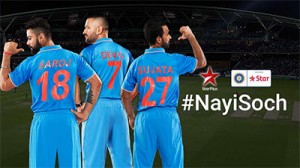
    That was circa 2010. Te spotlight is on half a billion women of India, notes a communiqué. Taking this legacy forward, Star India unveiled its new credo ‘Nayi Sochi’ with an out-of-the-box theme crafted by Ogilvy. The campaign kicked off with on Sunday with the first match of the India- New Zealand ODI series.


    In the campaign, India’s cricket icons – M S Dhoni, Virat Kohli and Ajinkya Rahane proudly wear their mothers’ names on their jersey instead of their own names or father’s surnames, acknowledging the fact that one derives one’s identity as much from one’s mother as one’s father. However, the stereotypical societal notions around lineage and identity fall short of acknowledging the role of women – a thought supported and celebrated by BCCI through this campaign as well.


    The campaign is built around real-life examples from the lives of these 3 cricketer icons, and the philosophy on how they are what they are, in large part because of their mothers.


    Said Sanjay Gupta, Managing Director, Star India: “We at Star India are very happy to partner with BCCI for an iconic brand initiative of ‘Nayi Soch’. Star Plus has been a lighthouse brand for women. We have always put women first, told their stories, and are now set to take it to the next level – by challenging orthodoxy and stereotypes that come in the way of progress for women.”


    Hmmm.


  • Star Sports premieres Select HD 1 & Select HD 2 in India

    By A Correspondent


    Star India announced the launch of two new high definition channels, Star Sports Select HD 1 & Select HD 2 – first and exclusive destination for international sports fans.


    The channel and programming strategy will offer an enhanced viewing experience that ensures more matches, increased behind the scenes access and in-depth analysis, all in high definition. Harnessing the sentiments of the ever-engaged, passionate international sports fans across the country, Star Sports Select HD 1 & HD 2 will broadcast all the action Live and will exclusively offer Premier League, Bundesliga, Grand Slam Tennis and Formula 1.


    Additionally, fans will also have a unique multi-platform experience, as they can watch every Premier League and Bundesliga game as well as every Formula 1 race live on Hotstar premium, Star’s digital platform. Hotstar Premium will beam all 380 matches live. To allow football fans to sample the service, all users will be allowed to experience a free 1-month trial of the service that will also get them access to the best of English shows and movies from around the world. Fans will also be able to watch the matches on the large screen on Hotstar via Chromecast and Apple TV.


    International sports (Football, Tennis & Formula 1) will be available on Star Sports’ SD channels up to October 31st, 2016 post which Star Sports HD channels will become the exclusive viewing destination. Television coverage for the Premier League will increase to over 270 matches.


    Nitin Kukreja, CEO, Star Sports said, “Recognizing the passion of the international sports fan, we are now launching two additional high-definition channels which will only broadcast international content, namely Premier League, Bundesliga, Grand Slam Tennis and Formula 1. With this offering we will be providing many more games with an enhanced experience that HD provides.”


  • Star India clamps down on pay channels piracy

    By A Correspondent


    Continuing its no-tolerance stand against illegal transmission/re-transmission of Pay TV Channels by cable operators indulging in piracy of STAR TV signals, officials of STAR TV filed complaints against cable operators in Karnataka, Madhya Pradesh and Andhra Pradesh, which led to police raids on their premises, arrests and seizures of equipment. The raids were conducted at the control rooms of RST Digital (Karnataka), Ganesh Communication (AP) and Tanishq Communications (MP), who were found indulging in illegal transmission/re-transmission of the Star Pay channels.


    Over the last 12 months, Star India’s anti-piracy campaign has resulted in 100+ FIRs against pirating networks across the country.


    The rampant issue of piracy in India has deprived the broadcast industry of reach as well as revenue worth thousands of crores. It is widely believed that the Piracy menace impacts the television medium the most with cable operators under-reporting their subscribers as well as indulging in illegal transmission/re-transmission of the pay channels, resulting in significant losses to the broadcasters as well as the government exchequer.


    While the implementation of Digitally Addressable Systems (DAS) in the country will be a big corrective and preventive step, the implementation of DAS all over the country is yet to be done. In the interim, Star India, since the last few years, has adopted a policy of “zero tolerance” against operators indulging in illegal transmission/re-transmission of the Star Pay Channels.


  • Star India launches Star Pravah in HD

    By A Correspondent


    Leading media conglomerate Star India launched Marathi general entertainment (MGE) channel Star Pravah in HD on May 1.


    The move to introduce Star Pravah HD is in line with the objective of enabling viewers of Marathi content to experience the world of high definition television. Among the new shows for Star Pravah viewers, includes a multi-starrer new fiction show ‘Lek Majhi Laadki’ to coming up in the same week as Mother’s Day. LekMajhiLaadki is an emotional story of mother and daughter, who are separated at birth, longing to unite. Maharashtra’s favorite real life couple Aishwarya and Avinash Narkar will be coming together on screen in this show.


    Speaking on the launch of Star Pravah HD, a Star India spokesperson said, “With the increasing demand for High Definition TV viewing, this was a great opportunity for the channel to enter the space. We have always strived to offer best to our viewers. With the launch of our HD channel, the Marathi general entertainment viewers will now be able to enjoy their favorite shows, events and blockbusters in richer colors, greater clarity and sharper images.”


  • Shining Star


    By Suman Layak


    It was Holi in Uttar Pradesh in 1991. Sanjay Gupta, at the time a young management trainee at Hindustan Lever (now Hindustan Unilever), had organised a short film show in Etah, a town in Aligarh. Gupta’s plan turned into a nightmare when revelry among the audience deteriorated into a drunken brawl. In desperation, Gupta went back to his room to get his katta (countrymade revolver). His host in Etah had asked him to keep it under his pillow when he slept, just for safety.


    Gupta fired the katta in the air (for the first and only time) and managed to break the fight. While that day, in end February of 1991, is etched in his memory for the wrong reasons, Gupta swears by his learnings in Etah. It made him live the life of his consumers and soak it in. Today, Gupta, who has just been elevated as managing director of media giant Star India, makes sure that his team members spend a lot of time in the homes of their audience. A Star India team is scheduled to fan out across Uttar Pradesh next month. Gupta recalls how, after joining Star in 2009, he did his own bit of such touring.


    In Surat, he met one Mrs Shah who helped her husband in his diamond business. She was well known in her locality. But he realised that she wanted to be more than Mrs Shah; she wanted to be known as Minal Shah, a jewellery designer. Gupta explains how aspirations for such transformations are part of his target audience’s lives, and have inspired Star to build their soaps around women who come from humble beginnings and want to make it big time. A transformation along similar lines was celebrated in the recently concluded Star soap Diya Aur Baati Hum , about a girl, married young, who becomes an IPS officer. Transformation is also the reigning buzzword in Star India.


    Chairman on His Feet

    It starts in the corner office. On the 37th floor of Urmi Estate in Mumbai’s Lower Parel commercial district, Gupta’s boss and Star India chief Uday Shankar works standing at his workstation, which is a raised table without a chair around. The room, with glass walls on two sides, looking over central Mumbai’s concrete jungle, has three separate seating areas and a large television screen. Shankar, who has just been elevated as chairman and CEO of the company, has his own storyline for transformation. He says: “The company was started and designed as a small operation. It was not created to handle the growth we are seeing now.” He started off last week by carving up the company into five business verticals and elevating the business heads as CEOs of those businesses.


    There is a lot to keep Shankar on his feet — mainly the financial goals set by his boss James Murdoch, CEO of Star India’s parent 21st century Fox. Shankar has to take the company from a negative operating profit position in 2014-15 to deliver half a billion dollars of profit by 2018 and then double it by 2020. Shankar has to make good on a Rs 20,000 crore bet that sports will be profitable, and make money out of a digital platform, Hotstar, that Star India has pioneered.


    The Good News

    Growth is a great place to begin with. In the last two years, Star India has doubled its turnover. From Rs 5,204 crore in 2013-14, it went up to Rs 7,164 crore in 2014-15 and now is at Rs 10,800 crore for 2015-16 (around 65% of Star’s revenues come from advertising). Star India has been valued at $14.3 billion (a little over Rs 91,000 crore) by Edelweiss in January 2016, putting it way ahead of its rival Zee Entertainment.


    With 51 channels in eight languages, Star’s overall network share among Indian broadcasters is 22-23%, making it the king of the hill. Star has a deep presence in general entertainment channels (GECs) and is among the top three in Hindi, Bengali, Malayalam, Tamil, Telugu, Kannada and Marathi. It leads in sports, with Star Sports owning the rights to BCCI and ICC events up to 2018 and 2023, respectively. It has the rights to Wimbledon and two European football leagues and also coowns Indian leagues in kabaddi, hockey and football.


    The Bad News

    While that is the good news, here is the bad. Year 2014-15 produced Star India’s biggest ever net loss — Rs 1,273.88 crore as a standalone entity and Rs 1,467.35 crore when consolidated with its subsidiaries. The sports model still revolves around cricket, which may be high on visibility but not on profits, not yet. Last August, Star India paid $420 million to get out of a contract with the BCCI to broadcast the Champions League T20. This will hurt the profit and loss account for 201516. In other words, the company will again be in the red. Hotstar, the digital platform, is still hungry for investments. Star is facing a tough challenge in Hindi GEC space, with Colors from Viacom’s stable often outdoing it in weekly ratings from BARC. In late 2015, its major gambit, Amitabh Bachchan-hosted Aaj Ki Raat Hai Zindagi gathered low ratings and was later taken off air.


    The Gameplan

    Shankar points out that Star India is in a unique position as it is unlisted and has a parent that is ready to pump in cash whenever needed — as it did for Star India’s acquisition of Telugu broadcaster Maa TV in February 2015. Also, the company barely has any loans. The acquisitions of Vijay Television and Asianet provided Star with a strong footing in southern India, and Fox was happy to invest through separate subsidiaries, keeping it out of Star India’s balance sheet. CFO Sanjay Jain points out that the two companies, Vijay Television and Asianet, are profitable (a combined net profit of around Rs 450 crore) but are not consolidated with Star India. For any plan to succeed, Star’s sports business must turn around by 2018. Shankar admits that the sports broadcasting model in India is broke and that broadcasting top cricket events is not profitable. He sees a turnaround of the sports business by pushing sports programming into regional channels and markets. To realise this vision, Star India has invested in a sports studio in Mumbai in the same building that houses its headquarters.


    The recent World T20 had multiple commentary teams in different languages, creating regional language feeds. In search of profitability, Star also wants a flotilla around cricket and to look beyond urban audiences. That explains investments in different sports leagues like football, hockey and kabaddi. To garner a larger viewership, kabaddi was also put on Star Gold. Star India has eight sports channels, with a clear focus on separating the audience that wants English content from the one that Shankar is seeking out. “The focus is to make sports available to a larger number of people, in local languages, Hindi as well as others,” says Shankar.


    Is Star India’s bid to create new sports media properties sustainable? There are a few sceptics. Ronnie Screwvala, owner of U Mumba kabaddi team, lauds Star for promoting kabaddi, but adds: “I have a mixed view, as media companies cannot use media expertise to build a sport, because then the DNA and the thinking will always be from the ratings, viewership /audience and advertising points of view. While there may be nothing wrong with any of that, just those can’t be the objectives because then we will not build a longterm sport but a long-term media property.”


    Take football. Star India created the Indian Super League (ISL) in a joint venture with Mukesh Ambani’s Reliance. The assessment within Star itself is that running two national football leagues, the ISL and the I-League, is not viable in the long run.


    The Digital Design

    Star also has to turn around Hotstar, its digital platform that has seen 58 million app downloads in 14 months — a record of sorts. Hotstar can be accessed through an app or directly on the web through mobile web and website. Star expects 100 million unique views for the 2016 IPL season, for which it has the digital rights. Ad revenues on digital for this IPL are expected to touch 12-14% (3% in 2014). Also, more people today watch the English Premier League on Hotstar in India than they do on television. Star India is planning a paid version of Hotstar.


    Streaming video is not cheap, and Star’s MD Gupta figures that anyone who is able to watch videos can also afford to pay more for premium content — for shows like Game of Thrones or even the English Premier League. Gupta says: “We expect an overall explosion of television-watching time in India and we want to grab the new advertising and subscription opportunities.” The search for audiences has taken wings, with the Star soap Iss Pyaar ko Kya Naam Doon? becoming a rage in Turkey.


    The digital platform allows Star India to seek subscribers outside India, wherever the diaspora is spread out. As a relief to the company, the film business has seen two successes in 2016, with both Neerja and Kapoor & Sons promising good returns. Shankar says Star India is changing gears in films. The profit and loss statement of Star India for 2014-15 shows that the company has upped its spending on programming and programme rights by more than Rs 2,500 crore to Rs 5,597 crore. So profitability will only come via greater revenues. Edelweiss analysts Abneesh Roy and Rajiv Berlia wrote in their report in January: “Star is best placed to charge premium ad rates due to a higher demand for prime-time slots. Zee TV’s ad rates are 0.75 x Star Plus rates, which shows the premium commanded by Star.”


    Closer to the Audience

    Shankar, doubtless, sees an opportunity for closing the gap between expenses and revenues. The regional thrust is a push for profitability as these channels often enjoy a 30-40% margin. The South is clearly a focus area. In the shakeup last week, managing director of Asianet, K Madhavan, has been elevated as managing director (South) for Star India. Madhavan says, “The South is a very profitable unit. About 30% of the television population resides in the four southern states and most of these markets are priority for advertisers.” Shankar wants to ride on the top line growth to a healthy bottom line and has decided to pump prime the content pipeline and create content ahead of its time. “I want our teams to work on at least 100 projects in Hindi and another 100 in other languages simultaneously,” he says. One of the initiatives he has taken has been to diversify recruitment.


    “We hire from the top management and engineering colleges but now we have started going to universities in places like Allahabad and Benaras,” he says, stressing on the need to avoid sameness in hiring and the key role that diversity plays in keeping alive a content-generating company like Star India. So to find Bengali writers, a Star team went to Santiniketan. To help bring in more creative people on board, Star has introduced flexible contracts that do not tie professionals to the company in the manner of a job. To retain women employees, the company introduced flexible maternity leave—six months of paid leave and then another six months of leave at half the pay, or full pay for half the working hours. In various ways, through programming and hiring and the changes initiated last week that drive the decision-making powers down the line, Star is trying to get closer to its audience, deep inside India, in tier-2 and tier-3 towns and villages. These are places like Etah where Gupta started his career. Television today ensures that in these towns, no one needs to wait for a film screening on special days like Holi. For Star, this audience can be key.


    Source:The Economic Times

    Copyright © 2016, Bennett, Coleman & Co. Ltd. All Rights Reserved

    Licensed to republish
     

  • Is there more to the rejig at Star India?


    By A Correspondent


    Ever since a town hall was announced to happen on April 13, there has been a buzz about what it could mean? Was there to be a big acquisition? A high profile exit or entry?


    We had got our friends in small places at Star India to keep us informed. Whatsapp Zindabad! We even suggested keeping the phone lines on for a listen-in, but that could be dangerous.


    So what did we finally hear. An organisation rejig with formations of easier-to-manage strategic business units (SBUs) and many elevations. Uday Shankar will be Chairman and CEO. COO Sanjay Gupta, COO was elevated to Managing Director,. Star India and K Madhavan will be Managing Director-South. Both Gupta and Madhavan will continue to report to Shankar. These changes position the organisation to meet its future growth ambitions on the back of a decade of rapid growth, noted a communiqué,  but keen Star India observers hint there could be more to it.


    “We are proud of its success and look forward to the next chapter of growth under Uday’s transformational leadership,” said James Murdoch, Chief Executive Officer of 21st Century Fox on the developments. Murdoch wasn’t present for the town hall.


    So here’s how the SBUs will be run, all reporting to Sanjay Gupta:

    :: Amit Chopra will be CEO of Entertainment, which spans drama and movie channels across national and regional channels in Hindi, English, Bengali and Marathi. So: Star Plus will have a new CEO
    :: Nitin Kukreja, CEO of Sports, which includes a portfolio of channels under the Star Sports banner
    :: Ajit Mohan, CEO of Digital, which oversees Hotstar, the digital platform
    :: Vijay Singh, CEO of Fox Star Studios, which produces and distributes Bollywood and regional films


    Meanwhile, Kevin Vaz has been appointed as CEO of South, reporting to K Madhavan. The South business unit incorporates all of Star’s business interests in the Southern states of Kerala, Tamil Nadu, Karnataka, Andhra Pradesh and Telangana. Also, a pan-India Content Studio will be set up to drive innovation in programming under Gaurav Banerjee who will report into Sanjay Gupta. The corporate roles will continue unchanged.


    “I congratulate Sanjay, Madhavan and the CEOs on their elevation. We have set ourselves a bold growth agenda and these changes will deepen the leadership bench, unlock entrepreneurial energy and position Star better to deliver on its ambitions,” said Uday Shankar, Chairman and CEO, Star India.


    We spoke to a cross-section of stargazers, and while the general sentiment was that it was just a set of elevations and restructuring of the way the business will be done, there were a few notables that deserved a mention.

    :: The Murdochs continue to repose their faith in Uday Shankar. So while he has made Chairman, it’s an executive role that he will be essaying as CEO. He’s the boss.
    :: Sanjay Gupta is the clear #2. There was no doubting of the fact, but this elevation clearly makes him the operational head of Star India. Of course K Madhavan is there, but he will be look after the Southern operations
    :: Great boost for Amit Chopra. He is incharge of the primary fuel of the company: the non-Southern languages entertainment network. This of course includes the all-important Star Plus. Chopra has been leading revenues until so far and has a rich past as a CEO at HT Media and earlier with HUL, so it’s not that he’s a newbie in running an SBU, but, then, Star Plus is a tricky cookie.
    :: Elevation for Kevin Vaz, but Star Plus going off rather early from under his charge is sad. He needed to be given more time
    :: Status quo for Ajit Mohan, Vijay Singh and Nitin Kukreja
    :: Innovation in programming is a good idea, and am sure as Uday Shankar’s trusted and old-time lieutenant Gaurav Banerjee will be entrusted with the responsibility of bringing in more


    The new structure has been announced, but Shankar has reportedly assigned a six-week window for the transition and handovers. The new financial year for Star India starts in July and with BARC ratings for the flagship channel looking better than before, there is a promise of achche din at Star. Naya Structure. Nayi Ummeed!


  • Text of Star India CEO & co-chair FICCI M&E committee Uday Shankar’s speech at Frames 2016

    By A Correspondent


    Text of the keynote speech made by Uday Shankar, Star India CEO and co-chair FICCI M&E committee at inauguration of FICCI-Frames 2016


    Honorable Minister of Communications and Information Technology, Ravi Shankar Prasad Ji, Chairman TRAI R.S. Sharma, Mukesh Ambani, Ramesh Ji, friends from the world of media and entertainment.


    As co-chair of FICCI’s M&E committee, I have had the opportunity to address you for a few years now. I take this as a rare privilege and hence spend some time thinking through what I should say. A few weeks ago, as I was discussing the theme with some of my colleagues, a young assistant of mine – cocky on youth and his recent admission to Harvard Business School stated rather dismissively that there wasn’t anything new to be said as there wasn’t anything new happening in the M&E sector. While it sounded like a cynical assessment at that time it did set me thinking if there was indeed a grain of truth in what he said. On the surface, it does seem that not much has changed in the last several years except for some incremental growth or decline depending on which vertical you are talking about. Cable TV continues to struggle – struggling to improve its business case, struggling to improve its talent & technology quotient and above all to stay relevant in a rapidly changing world.  DTH, that set out to revolutionize distribution, increasingly seems to be intent on locking its destiny inside an isolated box in a networked world. Even the story of digitalization that started 6 years ago remains incomplete. The advertising revolution of the 90’s when a large number of international and Indian brands were built on television screens, doesn’t seem to be breaking new ground in terms of what I call brand revolution 2.0. Content creators, a community that I belong to, generally seem to be caught in a time warp with the same themes playing in a loop again and again –cursed destinies, rebirth and revenge and deference to elders in public while bickering in private, pretty much sums up what rules national entertainment. The quality of news of course, seems to cause only national consternation, with now even our friendly neighbor taking a pot-shot at our news channels! Over all, it seems the more things change the more they remain the same.  So maybe my colleague was right after all.


    But then is the picture really as gloomy as this? Because beneath the surface ofentrenched stagnation, quietly – almost stealthily -there is a gigantic disruption playing out. A disruption that’s shifting the ground from beneath our feet.


    My friends, allow me to recap the year for you.  The creative group to make the most waves last year were 4 youngsters, irreverent enough to take on our entire film industry and then build on that success by putting the entire country under a scanner.  This is a group who has the audacity to have a name so offensive that our news media calls them by their acronym AIB.  Yes, I am talking about All India Bakchod, who are perceived as comedians although this is not a group of people who make imbecile jokes while dressed in a funny manner.  More than once they have set the news agenda for the nation.  They have the gall to take on the combined might of big telcos and Mark Zuckerberg’sFacebook when they felt that the freedom of the internet was being parceled away.  They have used humour to put a spotlight on the state of fire stations in India or for that matter the behavior of the police force. As a group, these four youngsters made more headlines last year than probably all of the creative community put together.


    Very recently one of the pioneers of television entertainment told me that she was so frustrated by the frozen state of traditional media that she was going to create a digital enterprise to tell the stories that traditional media has been too scared to tell.  Of course, I am talking about the totally adorable – Ekta Kapoor.  Think about that for a moment – the person who created the archetype of saas and bahu feels the need to break away from these stifling constraints of the medium that she herself created.  Why?  When that happens, we all need to think hard.


    Friends, the most talked about launch in Indian M&E last year was not a new channel, or a new newspaper or a new production house – actually it was a mobile app that had the gall to ask consumers to go solo.  A call fundamentally at odds with the concept of content consumption in this country, that believes that the entire family watches TV together in the living room. Well, I am talking about the launch of our very own hotstar.  In just about a year, hotstar has been downloaded over 50 million or 5 crore times.  What is the implication of this?  Consider this – more people have watched the English Premier league on hotstar last year than on television.  Yes, EPL was watched by more people on hotstar than on television.  Even for a mass sport like cricket, in the larger cities, hotstar’s watch time is now starting to reach 50% of television.  I urge you to reflect on the potential of that statistic.   This infant service is already becoming a product of habit in India and now this year, my friends, we have set our sight on creating the first global Media & Entertainment product born out of India, when we take hotstar to the rest of the world in a few months.  The numerous and affluent south Asian diaspora which for the longest time has been frustrated by the lack of access to its favourite content will be able to watch cricket, movies and drama through hotstar.  While I am indeed happy for hotstar to be the pioneer, we are very aware that this is a trend that will get replicated again and again, very quickly.


    This colossal shift by no means is limited to television.  At the risk of earning her disapproval, let me share the story of my daughter – she is a serious academic whose job is to analyze the social sector and legislation for a living.  She is always on top of news and opinion articles and yet I have never seen her hold a physical newspaper in her hand.  Her daily dose comes exclusively from the digital universe. Her intake ranges from headlines under 140 characters to ebooks over 14 million characters long. She is a voracious consumer of movies and drama; yet goes to theatres morefor fun than for creative consumption.  Fixed schedule programming sounds as bizarre to her as silent movies to us.  She is obsessed with music but doesn’t own a single CD.  Her near infinite library rests entirely on her iPhone – the same goes for her friends and colleagues who use android devices.


    The world has changed.  There is a tectonic shift happening in our industry right in front of us.And yet, what we see in the world of traditional television is just stagnation. And this stagnation has been made worse by the funny denial that all of us seem to be living in. Even though this change is happening faster than anything we have ever seen, our approach towards it seems to be one of incrementalism.


    I see an even more obsessive desire to protect the antiquated business models that we have painstakingly built over the years and that technology and the youth are decimating like a bull-dozer rolling over glass bottles.  It reminds me of the story of a Japanese soldier who was left stranded and forgotten on a small island in the Pacific. Many years after Japan had lost the war and the world had returned to normal that lone soldier kept guarding that isolated island thinking he was still protecting the Japanese empire.  Herein probably lies the explanation why print companies found it difficult to make the transition to TV and why almost all the digital successes generally come from companies that did not exist even a decade ago.  This is because these are companies and people who are not chained by their legacy businesses.  Just imagine where businesses like Netflix, Twitter and Facebook were a decade ago and what global empires they have created in this short span of time.


    It is pretty clear to me that we are in a battle.  In this battle there are only two options that we have – we can either continue living in denial, hide back in our artificial walled gardens, watching as the bricks crumble down one by one or we can arm ourselves with the sameweapons that our challengers possess, and venture forth into battle, sometimes even against the same businesses that we have created. Change or Perish.


    There is one thing however that will continue to be the same: the power of stories. For those of us who had imagined a world where the so called user generated stories would unseat high quality creativity, the answer comes from the Netflix strategy.  Netflix – the most successful content provider in the US, the challenger to the media behemoths of the west has done so on the back of extremely high quality content, so much so that Netflix’s catalogue today represents the absolute best of American television.


    However there is a twist in the tale here.  No longer is the story enough, within the commoditized consistency of experience.  Technology and creativity are coming together to enhance the experience literally, almost daily.  Indians long used to a life of having to start all over again if the power went for a minute are rapidly getting used to being asked if we want to resume where we left off?


    The new screens have once again highlighted the importance of the story but they have introduced the centrality of the experience at the same time.  Design and engineering can no longer be divorced from the story – this is a radical departure from everything that we were taught all these years.  We learnt this the hard way through hotstar – how small changes even in the browsing experience could lead to dramatic shifts in consumption.  Today I am happy to remark that we at Star probably have more engineers in our team than any other media and entertainment company.  Equally we have more designers and more story tellers than anyone else because those are the three pillars on which we see future M&E companies getting built.


    Clearly, we need to change the lens with which we look at talent.  In this new world neither technology nor talent will be limited by geographical boundaries.  The best engineers are as likely to be in Berlin as in Bangalore.  We already know that best designers and animators for Hollywood no longer need to be there – because they are already in Goregaon and let’s not forget our very own Priyanka Chopra who is the first home grown star of a truly global show.  We are looking at a truly global world.  But this global world has no patience for traditional forms of reverence.  At Star, we are grappling with this everyday – when we inducted culturally diverse talent we had to create space for that cultural diversity to exist. But that’s easier said than done.  Technology going global, talent going global also means adoption of a new tradition.


    Recently, I just saw amazon.in selling cow dung cakes online.  This humblest of the humble, the most traditional of fuels, being sold at 350 bucks for a small packet.  To me, that is the real power of the world that we are going into.  Power of the idea that someone actually thought that there is a market out there for cow dung cakes and the fact that that market is willing to a pay huge premium for it.  And the fact that the internet has created a market place where ideas and creativity are the only constraints.


    In this context let me draw your attention to the illustrious gathering on this podium today because if India has to make that leap into the new world where everybody can create value for himself or herself by sheer innovation then this group here must deliver.  Minister Ravi Shankar Prasad is not just a senior minister of the Union Cabinet – he holds the key to India’s transition into this digital world.  Chairman R.S.Sharma will have to decide how much can he accelerate that leap, and finally the whole country is looking at Mr. Ambani’s initiative called Reliance Jio to unshackle that truly global, truly democratic dream of 125 crore Indians.  Let’s all hope that they do the right thing, for it is in the best interest of this country they all must succeed.


  • Star India can now officially say ‘Meri Maa’

    By A Correspondent


    Star India has announced that it has successfully completed the integration of the broadcast business of Maa Television Network. With this integration, Star India enhances its outreach to South India markets, specifically Telugu-speaking viewers.


    With a bouquet of four channels, namely maa, maa Music, maa Movies and maa Gold, the Maa TV Network has a formidable presence in Andhra Pradesh and Telangana. However, it may be noted that as per BARC Week 47 ratings, ETV Telugu is a clear numero uno in the Telugu GEC genre. Maa is second with Zee Telugu a close #3.


    Said Star India CEO Uday Shankar in a statement: “We are pleased to announce the completion of the integration of the broadcast business of Maa Television Network, a journey that we had embarked upon in February, earlier this year. We are very impressed by the solid creative core and quality and depth of the management team at Maa Television Network and are delighted to welcome them to the Star family. The acquisition fills a critical gap in our portfolio and will allow our advertisers targeted access to the large Telugu speaking population. We plan to invest further in this important market to fundamentally change the content quality paradigm. I am confident that team Maa under the leadership of K. Madhavan will transform the content experience for Telugu viewers.”


  • Star partners HBO for exclusive programming content

    By A Correspondent


    Star India and HBO have announced an exclusive programming agreement that will take HBO Original content to a wider audience via both, the hotstar digital platform and the English channels on the Star India network.


    Star India is again set to redefine the viewing experience on one of the world’s fastest growing digital content platforms namely hotstar and for its viewers across India, with the very best of HBO’s Original programming including series like ‘Game of Thrones’ and ‘True Detective’.


    Uday Shankar

    Commenting on the deal, Uday Shankar, CEO, Star India, said, “Star is delighted to partner with HBO to bring world class HBO Originals programming for Indian viewers. Star will become the exclusive destination for screening HBO content in India – once again resetting the benchmark for quality and depth of content offering for its viewers. Fans will be able to watch their favourite HBO Original programs on hotstar on the same day as the telecast in the United States. Viewers will also be able to see the HBO Original programming on Star’s English channels.”


    Jonathan Spink, HBO Asia CEO, said “HBO is delighted to enter this new chapter in India with Star. Through the first release of our shows on Hotstar, Indian Audiences will now have unprecedented flexibility in how they consume HBO’s much loved premium programming.”


    Forthcoming series of popular HBO Originals that fans can look forward to include the popular Game of Thrones; True Detective; Silicon Valley; Veep; and Leftovers as well as new HBO  Original series in the forthcoming season which will include the Scorsese series Vinyl scheduled to air on 14 Feb and Westworld. In addition library favourites such as Entourage, Band of Brothers, The Sopranos and Curb Your Enthusiasm will also be available.


  • Star Network sells its 25.99% in Balaji

    By Ravi Teja Sharma


    Rupert Murdoch-owned Star Network has sold its entire shareholding of 25.99% in Ekta Kapoor promoted Balaji Telefilms in a block deal on the Metropolitan Stock Exchange of India (MSEI) at an average price of Rs 63.6 a share. This values the block deal at around Rs 108 crore.


    “This confirms Star’s exit of a minority stake of 25.99% in Balaji Telefilms,” said Uday Shankar, CEO Star India.


    “Axis capital acted as advisors to Star and also executed the on-market sale on August 5th 2015. This is in line with our strategy to focus on core businesses where Star has the ability to shape and scale the future growth path of its investments. Our programming and contractual relationships with Balaji are deep and we continue to work on strengthening them to our mutual benefit,” he added.


    Star had bought 21% stake in the company in 2004 for Rs 90 per share and had raised it to 25.99% later through an open offer.


    The production house had an exclusivity deal with Star. Balaji Telefilms is known for some of the top soaps such as Kahani Ghar Ghar Ki, Kyunki Saas Bhi Kabhi Bahu Thi and Kasuati Zindagi Ki.


    Balaji Telefilms’ shares were up 19.96% to 95.25 at the close of trading on Wednesday.


    Source:The Economic Times

    Copyright © 2015, Bennett, Coleman & Co. Ltd. All Rights Reserved

    Licensed to republish
     

  • English movies genre hots up with Star Movies Select HD

    By A Correspondent


    It’s all a-happenin in the English movie entertainment space. Close on the heels of the launch of Times Network’s MN+, Star India has announced the launch of Star Movies Select HD. The insight for this channel comes from an extensive consumer research that highlights how people yearn for variety and great stories, notes a communiqué. The channel has in its line-up a slew of movies lined up including Gone Girl, Fault in our Stars, The Grand Budapest Hotel, Boyhood, Theory of Everything and Birdman. Some 30 premieres are planned for the year and the channel will be available only in High Definition (HD) and the premieres and the 9 pm movies will not be screened on any other channel.


    Kevin Vaz

    Speaking on the occasion, Kevin Vaz, General Manager – English Cluster, Star India said, “We have curated content from the biggest Hollywood studios, created a programming line-up that will need no introduction to our select audience. Movies unreleased in India, award winning premieres and festivals are just some of the initiatives that will enthrall them with the sheer strength of spectacular stories.”