Tag: media

  • Paritosh Joshi: So you want a job in the Media?

    By Paritosh Joshi


    MBA from a leading business school in the American Midwest, two years with a boutique investment bank in Boston and then this young man lands up for a chat about what he needs to do to get a job in the media.


    It is still easy to think there is a clear demarcation that sets the media apart from the rest of the world. Aamir, Ashton, Arnab and Aishwarya are in the Media. (They don’t even need surnames to identify them). Media people ‘need no introduction’. Us grunts have nothing worth introducing and thus, don’t need to be introduced.


    Or is it so simple?


    There were the Media people but they were few and readily identified as such. M J Akbar dazzled us with his insight in columns for a newspaper he edited. Rajat Sharma put people into the dock, quite literally, as he hosted a talk show. Derek O’Brien got all of us furiously scratching our heads even as he quizzed school kids. Madhuri Dixit sent testosterone levels into orbit merely by counting from 1 to 13. And Lalu had to invoke Sridevi’s cheeks in search of a universally comprehensible metaphor for Bihar’s roads.


    Then Tim Berners-Lee came along and changed everything, although for years after he thought up hypertext in an obscure corner of CERN, we would scarcely have known it.


    By the late 90s, regular blokes discovered that it was possible to find a wider audience for their periodic rants on WWW than they previously could muster around a water cooler or in a cafe. The web log, then portmanteau-ed to weblog and finally truncated to blog was born either in 1995 or 1997 (you can find an interesting history here).


    Then blogger came along in 1999, bang in the heady days of the Dotcom Boom and setting up a blog became Luddite-proof. From the very beginning, the blogging community had a wide range of interests and capability. The largest majority would create an account in an idle moment never to visit it ever again. A few would invest time and effort in their posts and endeavour to reach out to an audience with regular, engaging updates. Remember that these were people operating far away from the conventional notion, but what they were doing was indisputably publishing.


    Everyman had just stormed Fortress Media.


    It began with the written word. Soon enough, authors had found ways of adding pictures to their words. And the web was becoming more clever all the time. It was able to transport not just text but sound and video too. Also, devices to record audio and video had started to shrink in price and size even as they got massively more powerful, thus putting near professional quality sound and image acquisition within reach. Events unfolded at a rapid pace thereafter. Amazon pioneered a lightweight handheld device for reading digital publications. The Kindle was a runaway success and for the first time, books could be self-published by anyone with a good idea and capable penmanship without ever being imprinted onto the dead-tree medium. Soundcloud allowed wannabe speakers, singers and instrumentalists to distribute their art and craft without surrendering themselves to the crafty gnomes of the music industry. Youtube opened doors for every standup comic, ballerina, burlesque queen and cute kitten to show off its talents on glorious Technicolor video.


    But wait, we were talking about an investment banker contemplating a career in the media. So what’s with this long riff about what we now refer to, rather condescendingly I might add, as User Generated Content?


    Well, it wasn’t just individuals that got inspired to start using the all new powers of WWW to talk to their “Audience”. Businesses of every stripe saw the opportunity too. To be rather more honest, what they saw was consumers – happy and irate, sounding off about their brand experiences in these wide open spaces and were left with little choice but to deal, for better or worse, with what they were getting. Surely we’ve all heard the now almost apocryphal story of Coca Cola’s attempt to take down a fan page on Facebook that spectacularly backfired? To the point where they had to pretty much say ‘Let bygones be bygones and let’s be friends’? (Moral: Don’t clobber, co-opt).


    You see what’s happening here. Companies and brands were becoming broadcasters and publishers.


    At no time before in the history of our human civilization has communication across every conventional fence and barrier been so easy, inexpensive and by implication pervasive or ubiquitous. And barring the rare exception, individuals and entities find it more productive to be participants in this endless feast of reason and flow of soul than mere mute spectators. There’s even a taxonomy to describe different levels of involvement with media: Paid media are, as the name suggests, those that you have to buy access to. Earned media are where the media voluntarily carry news or content about you. Finally, owned media are, again as evidenced by the name, those that you own and control. Who doesn’t want earned and owned media?


    And what was it that we were talking about when we began this ramble? Ah, yes. A job in the media.


    I told the young man, he could stop looking. After all, every job- FMCG, Banking, Automobiles, Telecommunication, <insert randomly chosen industry name here> eventually, was going to be a job in the Media.


    Paritosh Joshi was until recently CEO, Star CJ. He has been a marketer, a mediaperson and a key officebearer on industry bodies. He is Strategic Advisor, Ormax Media. He can reached via his Twitter handle @paritoshZero


  • The Anchor: Lloyd Mathias on the 6 things every marketer learns on the job

    By Lloyd Mathias


    1. No matter how good your campaign is, it won’t work till you have your team fully aligned with it. So, as much as you spend time on zeroing on the consumer insight, researching the proposition, fine tuning the communication – it is important to “sell” the campaign to your internal constituents.  Hence the need for internal communication – point-of-sale material for trade, detailers for the sales force.  It is also critical to align campaign breaks with availability of field materials and widespread distribution.  The best campaigns don’t succeed without product in the shelves.


    2. The past is no guarantee to the future. Most marketers believe if it’s worked well in the past, it will work again. The fact is consumer tastes change over time. Even more importantly, the market dynamics change. Also, most consumers need fresh stimulation.


    3. Treat your agency as an integral part of your marketing team.  It is amazing how many marketers have near adversarial relationships with their agencies (creative, media, digital PR).  Your agency is the co-custodian of your brand – the more they know about your business and the issues facing it – the richer will be their input. Treat them as co-owners. Give them the freedom to do the occasional over the tip creative.  Long term they won’t let you down.


    4. Marketers tire of their campaigns much faster than consumer do. Remember most consumers see a whole lot less of your brand than you do.  Refresh if you need to, don’t revamp.


    5. Meet real consumers as often as you can. An hour with consumers is worth many hours of pouring over research data. Consumers today – more than ever – have a strong point of view and want to be heard. Some of the finest ideas come from immersing with your consumers. And remember – don’t confuse your sales force or trade partners with REAL consumers. No, not even analyzing the brands’ Facebook page responses or looking up the Twitter handle can beat real consumer face time!


    6. Always keep the larger business objective in mind. Remember the primary role of marketing is to drive sales & bring in revenues. Everything else comes next. So try not to be overly protective about the marketing budget – especially if the business needs cuts.  In the long run if business wins – marketing wins.


    Lloyd Mathias is Director, GreenBean Ventures. He was President & CMO, Tata Teleservices until late last year and was Sales & Marketing Director of Motorola India prior to that.


  • The Anchor: Sandeep Bomble on four ways agencies can attract top talent

    By Sandeep Bomble, founder, Palasa


    1. Money! The obvious five letter word that is expected to shoot up once the above question is fired. Let us first dig and understand the working of an advertising industry. Innovation is the crux of any agency. One must know that every department, be it creative, media, client servicing should possess the ability to compete with latest innovative ideas and ways to explore. But at the same time, a lot of them prefer sticking to the age old methods or ways of going about, and not take the risk of capitalizing energy, money or time by going off the track. And sadly a talent hits a dead end, driving it off. It is here, where a fine bait to attract a great talent lies.


    2. Of course, there can be zillion ways to source talents but, personally I believe, there is only one way an agency can hook a ‘great talent’ in their team and that is ‘The agency has to go Gutsy!’ An agency that has the courage to go bold and brazen in their thoughts and actions, is like a charged magnetic field. It automatically attracts to it unexceptionally talented people. A great talent is hungry and is constantly on a lookout for an agency which is in the position to explore ideas. They believe the agency will do justice to their ideas and will churn out the best from the deepest crevices of their mind. The gutsy agencies act as catalyst to the effervescing minds of ever-fangled talented guns who are ready to venture into a territory that will facilitate their ideas and take them to a next level altogether.


    3. Money is certainly an important part when you look to feed yourself but it is very subjective in this case. It is surprising but true that a great talent will least care about money and not look at it as their first priority. And if one delves deeper into the psychology of these people, one understands the logic behind their motive of not being money minded. They are confident of what shall follow next, once they find their base to breed their creative energies. They are self-assured and positive that visibility through good work only, can win them fame, that’ll get them noticed in the industry. Money and perks are the next obvious that will follow. When a talent believes in agencies good work and ability to take forward the idea, he/ she won’t be bound by any limitations then. Their minds are free to explore realms unexplored. They soar high to think big and different. And an agency should know that investing in a great talent is any day much viable option than having hundred workers with lack of talent.


    4. Today, it’s a pitiful state that a lot of agencies are simply satisfied with their cash registers ringing and look at work through business perspective and are not inclined towards exploring newer ideas; they play ‘safe’. With every passing day one can only hope that an agency dares to hone its powerful magnetic field. We are an industry that has courage to defy the conventional and passion to take a leap of faith in ideas we believe in. And what more can a great talent want than to truly, madly, deeply be in love with an agency that harbours such a principle.


    “Great Talent Will Never Ask For Money”


    Sandeep Bomble is founder, Palasa


  • Anil Thakraney: The party-pooping media

    By Anil Thakraney


    Newspapers and TV channels have been flooded with pictures of those ‘caught’ at the recent Juhu (Mumbai) ‘rave’ party bust. (We still don’t know if it really was a rave bash, but that’s not the focus of my article.) All these guys and gals desperately trying to conceal their faces in shame. Or, as I believe, because of the fear of being seen by their families and pals in such a tight situation. And each time I watch these images, I get terrified. No, I don’t get invited to many la-di-dah parties (sadly, haha!), and yet that lingering fear… that it could have been me out there.


    Imagine going out with friends to a party and being suddenly accosted by cops just because a few buggers had decided to top up their noses. And being treated brusquely all night, and made to go through unhygienic tests at municipal hospitals. It’s a nightmarish feeling. Still, when you look at it rationally, you have to quietly accept that drugs were found at the venue, and so the cops had to do their duty. So far, so bad.


    But does it surprise you how the media lands up at such busts in full force? It shouldn’t. Obviously, the cops, who want to project themselves as some sort of heroes, invite chosen reporters and cameramen to tag along. And thus more than a crime battle, this turns into a media spectacle. Leading to more stress and agony for the party goers.


    This makes me wonder. Should we in the media broadcast and publish pictures of youngsters cowering with fear and hiding their faces? Is this ethical? Is it not possible that most of them are innocent party goers? Do they deserve to be put under such harsh spotlight? One more issue for all of us in the media to introspect upon. Of course, the reporters have to join in when the cops invite them. Of course, they need to cover the bust. But because, at the time, they don’t know who’s guilty and who’s not, is it correct to put out pictures of the people trapped out there?


    My own view is such pictures must never be made public. And only after the police investigation is done, only after the culprits get booked, must we go public with images. That would be fair. Having said that, I know this practice isn’t going to stop anytime soon. Who cares if some drunk revelers are seen squirming? Who gives a rat’s ass if they are seen being treated like trapped animals? The editor wants pictures, you see. Else, he/she will say there’s no story out here. He/She will kick me out of the newsroom.


    Let’s do some self regulation, people. Before it comes in from outside.


    * * *


    PS: Brilliant ad by Prada. It’s directed by Roman Polanski and features acclaimed actor Ben Kingsley. This is the way to expand market share, I say!


  • Anil Thakraney: Bad times looming for editors/content heads

    By Anil Thakraney


    What’s the best way for large advertisers to get some ‘good press’ in the media? Use PR agents? Throw lavish parties? Suck up to the editors? Naaah! All that is old fashioned stuff. Nowadays, at least in India, where the media acquisition laws are weak, the industrialists simply go ahead and buy a large stake in a media house. Thus controlling the content, whether the proprietors would like to accept that or not. Recently, Ambani picked up a substantial stake in the Network 18 group. And now the Birlas have bought into the India Today group. Am quite certain more large industrial houses are eyeing similar acquisitions in the media.


    This is obviously terrible news for content heads. Because their powers get badly curtailed. Of course, the worst case scenario, which means direct intervention in the content agenda, sucks big time… that’s a nightmarish situation. But even the best case scenario sounds pretty depressing. Because that would mean the media house cannot report/write a single word against the shareholding industrial group. And will often be compelled to project them (and all their partners and subsidiaries) in a favourable light. Consider this: If Mukeshbhai gets caught in a scandal, will Rajdeep Sardesai even think of going after the big man? You know the answer.


    I can understand why the corporate world wants to invest in the media. Because it’s a powerful weapon to have in the war chest, and industrialists can leverage business/political deals with its help. The question is: Can we not have tighter laws on media acquisition, like it happens in the western world? Surely the time has come for that.


    As a journalist, what worries me most is the yet another body blow to the freedom of expression. Already the industry has suffered because of paid news, sponsored news and other malpractices. Not to speak of the greater powers bestowed to the marketing department of the media company. And now this! Clearly it’s not a good time to be a journalist in this nation.


    As for moi, I am seriously thinking of shifting back to advertising. The advertisers are calling all the shots anyway. 🙂


    * * *


    PS: Haha. The advertising life depicted accurately and hilariously in pictures. If you belong to the ad world, you will identify with every single situation. I am sure you are living them right now!


    Link: http://thisadvertisinglife.tumblr.com/


    Anil Thakraney is a Mumbai-based commentator and editor. He is also Editor-at-large, MxMIndia. The views expressed here are his own


  • The Anchor: 6 things that ail the PR industry

    By Toral Sanghavi


    1. Lack of awareness or poor knowledge on what PR can do for a company or a brand, leads to ineffective use of this marketing tool. Clients who have a different perspective of the role leads to a huge void in meeting the PR objective.


    2. PR is also looked upon as a short-term activity and expectations are far higher vis-a-vis advertising. Here it is to be appreciated that PR is not a quick fix and helps achieve goodwill – which cannot be earned overnight and has to be nurtured and sustained through long-term PR activity for the company or brand.


    3. There is no true value placed for PR activity and hence it cannot be truly measured by any accounts, which at times, leaves the client wanting for more and dissatisfied inspite of good media reportage.


    4. Lack of the right talent in this industry. Average time spent in the industry by professionals is not more than 5 years and then the general growth chart of a PR professional is to move to the corporate side of the business. This can leave a void for seasoned PR professionals in the business.


    5. Public Relations is an unpaid form of communication and hence dependent on an outside agency’s opinion and bias on the topic.  It is totally dependent on an individual’s rapport with the target media and hence media reportage and coverage can get unpredictable.


    6. The media universe is getting larger, in-depth and niche to a variety of target audience and industry. In such case, PR activities can get challenged and restricted in nature.  Also timeliness can affect coverage.


    Toral Sanghavi is Director – Clea Public Relations, India


  • Possible for ethics & profit-making to co-exist: Paranjoy Guha Thakurta (Text & Video)


    By Shruti Pushkarna


    As he launched the second expanded edition of his book, ‘Media Ethics: Truth, Fairness and Objectivity’,  in the capital last week, MxMIndia caught up with veteran independent journalist and educator,  Paranjoy Guha Thakurta for an exclusive interaction. In this candid one-on-one, Mr Guha Thakurta spoke at length about ethics in media today, self-regulation vs. regulation; the debate on the freedom of expression on the internet and the need for media to be ethically and socially responsible.


    Mr Guha Thakurta’s experience spanning nearly 35 years, cuts across different media: print, radio, television and documentary cinema. He is a writer, speaker, anchor, interviewer, teacher and commentator in three languages, English, Bengali and Hindi. His main areas of interest are the working ofIndia’s political economy and the media, on which he has authored/co-authored books and produced documentary films. He lectures on these subjects to general audiences and also trains aspiring and working media professionals.


    Mr Guha Thakurta has served as a member of the Press Council of India nominated by the University Grants Commission between January 2008 and January 2011. In April 2010, as a member of a two-member sub-committee of the Council, he co-authored a 36,000-word report entitled ‘Paid News: How Corruption in the Indian Media Undermines Democracy’.


    Does an expanded edition mean a lot more to discuss in media ethics?

    The first edition of this book came out more than three years ago, since then a lot has happened. Moreover, after the book came out, there were a lot of people who came up with suggestions on how this book could be improved. So this book is about 40 per cent bigger and thicker than the earlier edition. There are new chapters – there is an entirely new chapter on corruption in the media based quite a bit on my experience as a member of the sub-committee of the PCI, which inquired into corruption in media and how it undermines democracy, the entire phenomenon of paid news. There’s also a new chapter on reality television and some of the existing chapters have been drastically rewritten and revamped, notably the chapter on the internet because a lot has been happening in the internet space; also the chapter on advertising, which was particularly weak in the first edition – I think it has been strengthened substantially in the new edition.


    Also a whole lot of major developments have taken place concerning the media in the recent past; these have all been incorporated in the new edition. Among these would be the News of the World and Rupert Murdoch controversy in UK, the entire Wikileaks and Julian Assange phenomenon and back home here in India, the entire Niira Radia conversations; all of these have raised significant questions pertaining to media ethics and these have been incorporated in the new edition of the book.


    How important is the ‘code of ethics’ in today’s commercialized scheme of things?

    Ethics is very important in every sphere, particularly so in the case of media, because you are dealing with information which is akin to a public good. The problem essentially arises because this information is being disseminated by privately owned corporate bodies with an important goal to maximize profit; therein lies the conflicts of interest. The problem arises because there are sections of the media that are interested in profit maximization to the exclusion of other goals.


    It’s become a bit of a cliche – once upon a time it used to be said, ‘journalism is a mission’, today journalists work only for a commission. We are seeing the corporatization and commercialization of the media having an impact on the kind of content that is being produced. The viewers of television channels, the readers of newspapers, and the listeners of radio stations are being perceived more as ‘consumers’ rather as citizens. They are ‘consumers’ of products and services which are being provided by companies which advertise.


    Can journalistic ethics and profit-making can co-exist?

    I do believe it can, it’s not easy but it is possible for ethics and profit-making to co-exist.


    What is your view on the issue of regulation v/s self-regulation? What works for you?

    In an ideal world, self-regulation is the best form of regulation. But what do you do with those who cross that proverbial ‘lakshman rekha’, what do you do with those who don’t follow the code of conduct which is supposed to be self-regulatory in nature. I’ll give you an example, in the US, when Janet Jackson had a wardrobe malfunction in the middle of a live broadcast, the channel was fined immediately by the Federal Communications Commission because the wardrobe malfunction happened during a live broadcast, it happened during primetime and the channel had to first pay the fine and then appeal against the decision in a court of law.


    What happens in India? Not very long ago, there was a series of incidents involving Bhanwari Devi Maderna episode in Rajasthan and content was put out during the day on television, which many considered to be pornographic in nature. When the Ministry of Information and Broadcasting issued show cause notices against these TV channels, all of them came to Shastri Bhawan saying, ‘we apologize and we won’t do it again’. That’s the nature of self regulation in this country.


    As far as print is concerned, we have a Press Council of India which has no powers to punish anybody, it cannot impose a fine, leave alone put a person behind bars, and its recommendations are not even binding on the government. We don’t have statutory organizations which are empowered in the manner in which say the Federal Communications Commission is, or the Office of Communications in the UK is. So it’s fine to talk about self regulation but what do you do when somebody doesn’t listen to you, do you have the wherewithal to punish them?


    Do you think we need an independent official regulatory authority for television news channels as against one set up by the channels?

    Yes, I do personally believe that it is possible and desirable to have an independent regulatory authority which is independent of the government as well as the media. Such a regulatory authority can be funded by the government, but it can nevertheless be autonomous and independent of the government, in the manner in which bodies like the Supreme Court of India, or CAG or Election Commission of India function.


    So, I do believe it is possible to have such a communications commission. The problem is that for the last decade we have been debating the need for such a commission and the joke is that every time the government proposes to form such a commission, the government collapses. There have been 10 or 12 avatars of a Bill to set up such a commission; time alone will tell when and if such a commission is established in India.


    Your view on Dirty Picture not being allowed to air during the day on Sony?

    The whole Dirty Picture episode has thrown up a number of issues pertaining to censorship, pertaining to what content is appropriate or not, and if adult content can be shown on television, if so when. I think these issues are contentious and debatable and they are going to be debated for quite some time to come.


    Would you agree with Justice Katju’s view when he says people in media are of poor intellect?

    I think Justice Katju is exaggerating. There are journalists who are dumb and there are journalists who are not dumb. I think Justice Katju is not being fair to the media fraternity but that’s his personal point of view, he also thinks 90 per cent of Indians are fools, I beg to disagree with him.


    There’s a belief that the Indian media doesn’t take too kindly to criticism. Agree?

    Who among us are willingly going to accept criticism? All of us have our egos, in that sense, I don’t think the media is unique. I think there is neither any individual nor any group who likes criticism but the point is if you do believe in democracy, if you believe in fairness, and if you are in the public eye, then you better get used to criticism otherwise you’ll end up like Ms Mamata Banerjee who could not take being lampooned online. This shows not only lack of tolerance on part of individuals, especially public figures, but I think it fails to appreciate the nature of freedom of expression.


    Isn’t it upsetting that all the journalists’ organizations like Press Club, Editors Guild are tightlipped about Paid News?

    I won’t entirely go along with you on that, I mean there was a conspiracy of silence about corruption in media and paid news, even the report of the subcommittee that was prepared by me and my colleague for the PCI, was sought to be suppressed by a powerful lobby of publishers within the PCI. Finally in October 2011, the PCI was literally forced to make that report official, place it on their website with a disclaimer saying that entire council had not approved of its content. But I won’t say all journalists’ organizations conspired to put under wraps this report. There have been sections of the media who have been reticent of highlighting corruption within the media fraternity, but I don’t think it’s true for the entire media.


    Do you think that Public Relations has adversely impacted the quality of journalism?

    No, why blame the PR person…she or he is doing his or her job. You can also say the government has bribed the media, you can say that corporate captains have bribed the media. So I don’t think we need to look for excuses, I think journalists have to look within if they have to introspect about why there is corruption in the media. You can always hold somebody or the other responsible for your sins but at the end of the day, you are yourself responsible I believe.


    Your views on the ongoing debate on the freedom of expression in the internet age

    I think this is a huge debate. The internet is not just the newest medium of mass communication, it’s also a form of personalized communication, and it’s difficult to control. Issues relating to freedom of expression on the internet have acquired many new dimensions and these are very contentious and not easy to resolve. And we’ve seen this debate been going on for a while…the ‘infamous’ Danish cartoons on the prophet Mohammed were all drawn ostensibly to generate a debate on freedom of expression. Yes, that cartoon was widely circulated on the internet, as was the gruesome video showing Daniel Pearl getting beheaded. But it’s also worth remembering and underlining the fact that the mainstream media were restrained in reprinting, publicizing either the Danish cartoon or Daniel Pearl’s beheading.


    The point is, sometimes in the name of freedom of expression, you want to generate a debate but you end up generating one huge controversy which goes out of control. It was the Danish PM who argued that the cartoon controversy was the biggest crisis that small Scandinavian country faced after the Second World War and he was particularly worried because it even had an impact on the economy of Denmark because countries of West Asia stopped buying dairy products made inDenmark.


    So very often we might want to start a debate without realising its wider ramifications. But the bigger question of what constitutes the right to offend, what is freedom of expression and the new dimensions these issues have acquired in the day and age of internet, these are very important, they are being debated and I think these debates are going to go on for quite some time.


    And given all of this, your view on the future of news media in India?

    The future of news media in India is very bright. Unlike many countries in the world, all media in India continue to expand, whether it’s print, radio, TV or internet. According to 2011 census, one out of four persons in India still cannot read or write her or his name, so as more and more people become literate I think all sections of media are going to expand. At the same time, media has to become more responsible, not just socially responsible but also more ethical if it indeed has to contribute to building democracy, to building a better country.


    If you were still a kid getting out of college, would you get into journalism given the ethical standards followed?

    That’s a difficult question…when I became a journalist 35 years ago, the Emergency had just got over. That was a unique 19 month period in the history of the country where for the first and so far the only time in politically independent India, the government of the day sought to abridge freedom of expression. For 19 months, during the Emergency, freedom of expression was sought to be curbed. I don’t think that will happen again, but the very fact that I was a student during that period did influence my decision to become a journalist. If I was born 35 years later, I don’t know if I would have preferred to become a rock star, or an airline pilot or a heart surgeon instead of a journalist.

     

  • The Anchor: Anita Nayyar on 6 things she has learnt from being in the media business

    It seems like a lifetime that one has been in the media business. One learns from every profession but it’s a different learning if one has had a dramatic shift in professions. From being a Microbiologist & Pathologist to the business of Media has been a long and interesting journey.
     

    Passion pays:

    Passion pays tremendously. Inspite of a dramatic shift in profession I realize that it was/is my passion to excel in whatever I do, has paid off in my career.


    Adapt as you progress:

    Key to success is to be always ready to adapt oneself especially in the fast moving and evolving industry like media. From full service to media brands, from implementation to strategy and planning, from traditional media solutions to integrated solutions, from media to communications, from media planning to communication planning.


    Eye for detail:

    As they say “God lies in the details”. In the fast paced, unorganized world of media and advertising unplanned and non implement-able big ideas fail to make impact of any kinds.


    Hardwork & Dedication:

    There is no shortcut to success. Hardwork and dedication are the key ingredients to a good professional recipe. Especially when you don’t have any mentors. Get known by your work.


    Multiple solutions:

    It is important to always have multiple solutions; it reduces the chances of failure.

    Alternates are keys to media solutions.


    Never repeat mistakes:

    In media you are allowed to make a mistake only once hence, never ever repeat a mistake, it costs.


    Anita Nayyar is the CEO, India & South Asia at Havas Media


  • Anil Thakraney: Don’t kill Kohli

    By Anil Thakraney


    Young Virat Kohli must be pleased as punch. Not only did he manage to do the unthinkable – eclipse Sachin’s 100th 100 – the hot, new sensation is sitting on a goldmine. Imagine the excitement inside corporate boardrooms, as brand managers salivate at the prospect of signing multi million dollar contracts with the lucky dude. And also inside the buzzing rooms of editors and programming heads, as they plan huge spreads for the new found hero. What works even more for Kohli is that he looks reasonably good, unlike most desi cricketers. This makes him a huge media and ad property.


    I must quickly add here that I personally have very little respect for brand managers who piggyback on celebrities. This is their way of acknowledging that they are idea-less and want someone else to save their skin. But that’s a debate for another day. I have a larger worry at this point of time.


    Not every cricketer is mentally as strong and sorted as Tendulkar. Too much adulation and quick riches could easily go to Kohli’s head; he’s still very young, a 23-year-old lad. We have finally found a real match-winner in the cricket team, a player who doesn’t get intimidated by huge targets, and it’s in the nation’s interest that we carefully nurture this rare talent. We need to give the guy some space and time to mature (he’s got a long way to go), and both, the media and the marketers, must go easy on the young man. Hold the mega praises and the fat endorsement contracts for a bit, people. Let’s not kill the golden goose. We must think India first.


    Having said all of the above, I am equally aware that I am wasting my time out here. Our celeb-obsessed media and our idea-starved brand managers will pay no attention to this. They will go for the kill. What to do, we are like this only. All I can say is, one hopes Virat Kohli stays grounded. And keeps his head screwed on. Else, he’s finished. Like one Vinod Kambli.


    ***


    PS: Must read. An interesting profile of Imran Khan. From his playboy days to his new avatar as a devout Muslim. From captaining a difficult cricket team to the burning ambition to lead a ravaged nation. And of course, his recent bonhomie with dodgy mullahs and terror groups.


    Link: http://www.guardian.co.uk/world/2012/mar/04/imran-khan-pakistan-cricketer-politician


  • Anil Thakraney: Sachin coverage sucks

    By Anil Thakraney


    As expected, the entire Indian media went orgasmic as soon as ‘God’ hit that very elusive 100th hundred. Quite understandable. This man is a national hero and he needs to be celebrated.


    However, there were two aspects of the mad coverage I found quite annoying. One, each time Sachin reaches a milestone, the media (both, print and electronic) regurgitates the same old childhood pictures and the same old tired cliches about the man. And the same old ex-cricketers sing the same old praises. even in a euphoric state of mind, it becomes difficult to handle all this recycled stuff. Surely there’s an innovative way to celebrate the hero’s achievements. Surely there are untold incidents from the man’s life that can be dug out if one cares to do the hard work. Something to ponder on for editors and programming heads. Because, unwilling to retire, Tendlya will reach even bigger landmarks, and we need some freshness going.


    Having said that, I must point out that cricket expert Ayaz Memon was the only one who told us something refreshing about the cricketer. This was in his column for the Hindustan Times. Memon mentioned how, as a young lad, he (Sachin) would jump over the wall of a cricket ground rather than use the main entry door. The master’s reason? Why wait for something you enjoy so much in life. Superb. It gave you a powerful insight into the passion the player feels for the game, the reason he’s reluctant to retire even after two decades. We need more such gems in the media.


    Secondly, I was rather upset by the behaviour of the young TV reporters who were ‘granted’ quick interviews by the great man, soon after the mega ton. They were grovelling at his feet, like crazed fans. Guys and girls, that’s NOT the way the media is expected to conduct itself. Sure, the man enjoys a godly status, but a couple of tricky questions badly needed to be put to him. Like, did his search for the Big 100 bring the scoring rate down, which ultimately cost the team the match with Bangladesh? Does he agree with that?  Like, he claims personal landmarks are never on his mind. So then how come he closes his shop while batting in the nineties? Not one reporter would ask him these things. They were busy fawning. Repeat: That’s not the job of the media.


    Net net: Sachin Tendulkar is our biggest contemporary hero. No doubt about that. Now let’s pay him tributes that befit his own stature.


    ***


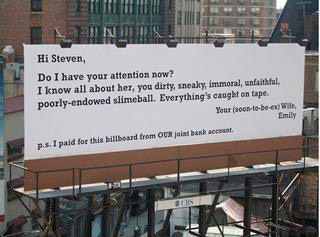
    PS: You should never, never piss her off. It’s worse than hell when she’s scorned. Here’s an American lady who passed on a sweet message to her philandering hubby through a hoarding. Wish Indian ladies did ditto. Tired of watching all those ugly thopdas of our politicians. 🙂


  • ASCI, Goafest come together on self-regulation

    By A Correspondent


    The Advertising Standard Council of India (ASCI), in a bid to encourage self regulation in Advertising, has announced its unique association with Goafest 2012. As a part of this partnership, ASCI will be a conducting a one-of-a-kind contest to promote responsible creativity, under the theme “Creativity with a Conscience” during Goafest 2012.


    The ASCI Mobile Movie Challenge contest, which is open for advertising, marketing and media professionals, revolves around creating short films using a mobile phone.  As per the contest, teams of 3 young professionals, under the age of 30 years, will be asked to create a short film (between 30 and 60 seconds), using their mobile handsets.  Each team will be assigned a mentor film-maker who can guide the team members on the nuances of film making. The teams will create the art forms on one of the four briefs provided by ASCI.


    The teams will create the art forms on the four tenets of ASCI’s code of self-regulation: Honesty & truthfulness in advertising; Decency in advertising as per generally accepted societal norms; Safety & avoiding exploitation of vulnerable sections of society, especially children; Fairness in competition.


    To register, one has to log onto http://www.ascionline.org/goafest2012/ and last date for registration is March 22.


    According to, Subhash Kamath, ASCI Board Member: “The theme ‘Creativity with a Conscience’ goes hand-in-hand with ASCI’s objective of responsible advertising. Our aim is to inspire professionals to abide by the guidelines set by ASCI and to take up self regulation on an individual level as the only other alternative is governmental censorship, which is, not desirable for a creative industry like ours.”


    He added: “By reaching out to young professionals, we’re ensuring that our efforts towards self regulation are understood by the people who will be implementing the work. Through this initiative, we want to instill the message in the mind of young professionals to always remember that with great creative power, comes greater responsibility.”


    These films will then be showcased at Goafest 2012 and will be uploaded on youtube.com and select online portals to inspire professionals to understand the importance of self-regulation in advertising. The entries will be judged by a jury of top creative directors and film makes of the industry.


    Four winning teams, one per brief, will be selected and each team member will be awarded during the Creative Abbys. Alongside, there will be a ‘Popular Choice’ award for the winner of a shortlisted best 16 film, which will be voted via SMS by over 3,000 participants at Goafest.


    Advertising Standards Council of India is a self regulatory voluntary organization of the advertising industry. The role and functioning of the ASCI and its Consumer Complaints Council (CCC) is in dealing with complaints received from Consumers and Industry, against advertisements which are considered as false, misleading, indecent, illegal, leading to unsafe practices, or unfair to competition, and consequently in contravention of the ASCI Code for Self-Regulation in Advertising.

    Click here to view all Goafest 2012 stories


  • Anil Thakraney: News for sale

    By Anil Thakraney


    Very recently, a publisher friend called to seek advice. And his question threw me off-balance. Because not only was the query alarming, I frankly had no ready answers. So I copped out, and left it all to his judgment. The question: “A few assembly election candidates have approached us, asking for favourable coverage. They are offering large sums of money in return. What should I do?”


    Since I knew that this particular friend was bleeding and needed some funding desperately, I simply replied with: “Man, it’s really up to you. If you are here to uphold the high standards of journalism, ask them to go fly a kite. But if you rationalize the situation in your mind, and conclude that if you refuse the offer and your rivals would lap it up, then you will be the only loser. In which case, go for it!”


    Quite honestly, I have no idea what the publisher eventually did. But speaking from a larger perspective, it’s becoming increasingly clear that paid news is here, and it’s here to stay. There was a time when elections would excite only the political class, as that would mean big moolah gains for the winners. These days, along with them, a section of the media feels ecstatic. For the same reasons.


    Corruption in the media isn’t really new. In the past, some journalists would accept alarm clocks and booze bottles from financial companies, and then write sweet words about their public issues. Now, of course, you can get your private party pics flashed in the Page 3 pages if you are ready to pick up the tab. We’ve learnt to live with these malpractices. But newspapers, magazines and TV channels accepting money to write good things about political candidates changes the goal posts. It’s clearly harmful to the nation’s future.


    So is there a way out of this mess? I am afraid not. During the 2009 general elections, a few cheating media brands got exposed. Maybe we’ll hear of more culprits after the recent assembly elections in some parts ofIndia. But soon everything will be forgotten. And it will be business as usual.


    [youtube width=”400″ height=”200″]http://www.youtube.com/watch?v=jjYxE2VD7VE[/youtube]

    Yes, it pays to be in the media biz in modern times. If you won’t get support from advertisers, you can always tap into alternative revenue sources.


    Jai Hind!


    * * *


    PS: The context of the Fiat 500 Abarth ad is different, but this commercial is the kind of stuff Tata Nano ought to have done. A car you can take inside your home. Super positioning for a little gaadi. So much better than pitching it as the broke bugger’s vehicle.