

Tag: media

  • Das ka Dum with Dr Bhaskar Das: With so many people losing jobs in the media, would you say it’s a safe place for people to take up as a career?

    There is only one word to describe the response to Das ka Dum by Dr Bhaskar Das: Huuuuge. There are of course many who say that the column was a no-brainer. Those who’ve had a chat with BD are familiar with his repartees and spiritual responses to down-to-earth issues and problems.


    To those who’ve come in late, the link to the last column is: https://www.mxmindia.com/2019/09/das-ka-dum-todays-question-to-dr-bhaskar-das-are-you-really-spiritual-or-is-it-a-facade/. And the link to the one before that is in the last column.


    The questions will be answered by Dr Bhaskar Das, the former big boss of the Times of India group and Zee Media and Dainik Bhaskar and now Republic TV. For those who’ve known him or have heard him, Dr Das belongs to the rare species of advertising sales professionals who has this unique combination of being a deeply spiritual being and a very persuasive salesperson. His unique turn of phrase can make you chuckle, but almost always sets you pondering. At MxMIndia, we enjoy our conversations with him. And for every googly we bowl at him, he hits back like no one has ever before.


    Das ka Dum will feature Monday through Friday, except on our ‘no edition days’. Enjoy Day 3.


    With so many people losing jobs in the media, would you say it’s a safe place for people to take up as a career?


    VUCA  is the new normal. Media is no exception. Stability is the new death trap. And since worry is not a mode of preparation, one needs to upskill oneself continuously to remain ever-ready  for pivoting, both horizontally and vertically. Those who love instability, media is the space for them. It’s not for the faint-hearted.


    Editor: As we mentioned on Friday, some of the words and phrases our dear and delightful BD uses could go over your head. So, purely in reader interest, we will link such words to the dictionary meaning. Like we’ve done in the case of ‘VUCA’ today. VUCA isn’t of course a tough word… it’s just an acronym for Volatility, Uncertainty, Complexity and Ambiguity.

  • Shashidhar Nanjundaiah: What ails our news media education


    By Shashidhar Nanjundaiah

    The government’s decision last month to scrap the University Grants Commission (UGC) will not change much on the ground for the quality of media education. Each field has its own imperatives, and education in journalism needs an approach that cannot be a part of an overarching structure and format. Neither the popular success of our news media nor the perceived failure of our media education system is a true indicator of quality. To the snooty intellectual, the industry is not good enough a measure of quality. But in my experience, that is simply not true. Even with the business imperatives, it is possible for meaningful journalism to flourish, so rejecting our most critical stakeholder will not help the cause of good education. I have had the privilege of framing, revamping and restructuring media curricula in my tenure, both at undergraduate and postgraduate levels, so I believe I owe myself the introspection I am about to make.

    In all the three categories of endeavours, I have operated with a troubling feeling that somehow we are accidental media educators—our products are largely a result of individual students’ backgrounds and doggedness. In each graduating class, a small percentage ‘makes it’, another group manages to find employment, yet another set of aspiring journalismstudents is pushed into the industry through clever marketing and by leveraging institutional credibility.

    Yet, that is not really what impresses the external stakeholder community. Rather, the industry is most worried about disappointing—declining, even—output standards. Many of our administrators are originally professors and not business executives. So it is beyond comprehension why more of us are not more troubled by lack of quality in our products. I hold this lack of concern on top of my list of why our media schools’ output is far less than desirable.

    Dealing with student diversity. Students’ differing educational and social backgrounds make up the biggest challenge in today’s higher education system, and is particularly challenging when it comes to fields like ours where expression abilities are critical. Regrettably, this challenge has become a sort of a cross to bear—an unavoidable trade-off to achieve business imperatives, to be tolerated and pushed through. This is why, having taken on the challenge of accepting students with varying social strata and educational backgrounds, our media educators largely fail to transform them into deliverable professionals or scholars—the very qualitative goals that an educational system should aspire for. Rather than blame the iniquities for poor output, such inclusiveness of student backgrounds should delight colleges themselves because of the opportunity it provides. Even government systems are doing it, if the Delhi school system’s recent success is anything to go by. So it should be possible for a college to take advantage of the diversity, even design specialised learning systems around it. Higher education in media can go farther by diversification of curricula and include more field projects that encompass diverse social, educational and geographic backgrounds of students.

    Overcoming a template approach. Secondly, the UGC curriculum in journalism leaves much to be desired, so affiliated undergraduate and even postgraduate colleges are left languishing. The mandated 148 credit hours to achieve each year at the undergraduate level (one credit hour gets halved when it is practical or workshop input—so much for motivation!) translate to approximately 3.5 hours of classroom input per working day (six days a week). With assignments, this is heavy load at the college level, where independent work should be emphasised. Colleges must then compromise the non-mandated time to squeeze in non-mandated input—which, surprisingly, includes internships and field work. This one-shape-fits-all approach simply cannot work for media education. Journalism and related media studies must be heavy on individual learning in simulated practice and on the field. Even within the existing structures, it is possible to instil depth of learning through the rigour of practice. That is, long hours of classes make far less sense than long hours of guided and independent practice.This requires flexibility at college levels and devoted guidance that unpacks diverse, quality and tangible output.

    Rote vs repetition. Of course, it is not all about processes. But repetition of processes alone provides experience, understanding and maturity. It is not enough, for example, to devote a semester to producing one issue of a magazine. Unless students continue to produce issue after issue for years, their learning will remain incomplete. Repetition also enables assessment to record learning over time, rather than the snapshot method that examinations and one-time performance will evaluate. Colleges that already practise this method have surely seen the growth in their students’ output. The converse of this method is the infamous rote method, where students habitually memorise for a one-time performance. Colleges and students—and regulators—routinely encourage this method, and to me it seems a cynical exercise. All of us in the education sector are aware of the immediacy problem with rote—that most information memorised for short-term returns is stored in short-term memory. Yet it is the most popular method. This must mean that we don’t really believe our education transforms a student into a professional: Good marketing does.

    The concepts-practice trick. By and large, our media education curricula do get the conceptual foundations right. However, clearly we have not moved with the times. Digital medium should be seen as a paradigm shift in media practice. Yet our education system dwells too heavily in the past to be able to come out of it. The other extreme would be to go so far into the current practice realm that journalism students walk and talk like toolsy apprentices of a machine works plant, with little conceptual grasp of the enduring and changing philosophies, roles, responsibilities of the media. Neither of these extremes is acceptable to the practice of the media—only a well-grounded but practical mix of the two will work. And this is why a flexible model including concepts-practical-field-repetition-diverse model will work, where any margins of error may truly be beyond the control of the college.

    For example, news writing is not a core part of curricula across our systems. Sure, it may form modules within courses, but ask any media practitioner in India, and you will hear the lamentation about the biggest problem among today’s graduating classes—the lack of expression skills. But it is not expression skills that students lack. They lack the systematic direction and guidance and putting them to use. From constructing thought to constructing sentences and building stories, writing and speaking effectively are the two skills that can indeed be developed far, far more effectively than it is currently. Add to that understanding of the various worlds around, from the neighbourhood to the geopolitical, from entrepreneurship to the stock markets, and so on. And you have a potent mix. But, as I said before, repeated practice is key.

    Caught in the conundrum of perceived correctness and real practicality, educators often end up bemoaning the systems that they are not a part of—leaving graduating students at the mercy of good branding, clever marketing, influential parents, and the student’s individual chutzpah.

    The business of education. College after college displays a gaping chasm between the confidence of the administration and an on-ground reality. Infrastructure, industry contacts, guest faculty—everything surrounding the core seems to excite us. When administrators at typical private institutes do seem troubled, it is almost invariably about enrolment numbers. How do we attract more students, they seek to understand. The enrolment numbers are the carrot before the funding horse—higher numbers means better equipment, infrastructure, a fresh coat of paint for the college. Since most of ouradministrative heads are teachers taking on business positions, this anxiety is understandable. It is reinforced by managements, many of whose decisions do not consider the entire product cycle. Administrators often speak the language of the promoters because growth in numbers and business is their hardest burden to bear. Indeed, spurt numbers through enrolment-marketing is seen as the hallmark of achievement. I argue that the best growth in numbers happens organically and by word of mouth.

    Fostering independent work. A factor of this business approach manifests itself in the way we quantify check boxes. Administrations offer satisfaction at the numerous guests from the industry (including Bollywood stars!) who have graced their campus, claiming that the industry-academia connect is accomplished. Only in infrequent cases does the industry participate in integral ways—setting up training news labs on campuses (perhaps under CSR initiatives), providing well-structured internships, providing guided training on an ongoing basis. Of course, these are also factors of location—if you are located in Noida or Mumbai or other big media hubs, there is a better chance the student is better exposed to the industry.With the predominantly classroom-and-lab style of learning they receive, students of journalism and allied subjects suffer from disconnect with the practice. True, teachers who are both aligned with the industry and solid in foundational concepts are hard to find. But teachers at this level are largely triggers and facilitators, and can go a long way in fashioning increasingly independent student work.

    The measurement of success of education is often disputed. There is a need to align student expectations with institutional goals for the student—which, usually, is gainful employment without compromising on the principles of practice. A revamped regulator needs to go much farther in the direction of structural changes, but most of all, it must permit media education to develop time and space for its unique concepts and practice, rather than depend on one set by some umbrella structure.

    Part 2 of this article – on media education outside of news media – will appear next week


    Shashidhar Nanjundaiah has led leading media institutes in India, as  Director of Symbiosis Institute of Media & Communication, founding Director of Indira School of Communication, and first Dean of India Today Media Institute. He pioneered research on the socio-economics of a newly liberalised Indian media marketplace. Currently, he observes how India’s media industry is shaping itself in this decade. He has also edited newspapers and magazines in India and the US. The views here are his own.




  • Jobs in Media: Slow & Unsteady


    By Johnson Napier


    With news of employees being given the pink slip occupying news space almost frequently, the going has been getting tough for many in the Media & Entertainment sector. While experts and analysts had predicted a recovery a few quarters ago, the situation seems to be almost static or on the downfall in some cases.


    When MxMIndia had spoken to experts almost a year ago, the opinion seemed divided on the prospects of a recovery. Whether the situation has changed and whether jobs will be hard to come by at this juncture is anybody’s guess. We speak to the job experts to assess the situation…


    Abha Kapoor, Executive Director, K&J Search Consultants

    The turbulent economic environment that is marred by tight liquidity, slow economic growth, the devaluing rupee and rising inflation has impacted advertising revenues. Subscription revenues are far below their potential as the benefits of digitization are yet to kick in. With margins under pressure many media companies are in consolidation mode whereby they are rationalizing marketing, distribution, programming and people costs. The hiring sentiment is therefore subdued. In fact, hiring is happening mainly at junior and mid levels with almost no movement at senior levels. This ensures that costs are low and fresh young talent comes in. Contractual/consultant hiring is also on the upswing. Specialist professionals are being pulled in for specific projects and not on payroll basis thereby controlling the fixed costs, in an extremely dynamic industry scenario.


    Also, the M&E sector has been overvalued and over leveraged in the past and hence in the current scenario, funding to this sector is further constrained. Therefore new initiatives/expansion plans with the exception of digital/new media have slowed down or are on hold which means – fewer start-ups and fewer replacement requirements as professionals hold on to their jobs!”


    Ashish Pherwani, Partner, Media & Entertainment, Ernst & Young LLP

    The first quarter of FY13-14 has seen some good results from companies, whether television, print or radio, and there has certainly been both ad volume and (a slight) rate growth. The new reality is that one can expect a tough working environment till the next elections. There are several positives for the media industry today such as increased revenues from DAS, rising cover prices of newspapers, the (always) imminent Phase III of radio licensing, and rising box-office collections of films on the one side, but this is being countered by a weakening rupee which is pushing up prices, falling stock markets and investor confidence, slowdown in some industrial sectors like auto, etc. It’s a precarious balance, and the winners will be those who can optimise costs, deliver audiences, and demonstrate that delivery.


    Pankaj Raj, Director, Search Value Consultants Pvt Ltd

    The M&E sector is poised to double in size by 2017. With a surge in digitization and a future forward election year approaching, the sector is poised to see sustainable growth.

    It’s easier today for global media organisations to dig deep in the market. They have understood localisation of content and strategy is the biggest leverage in the market.

    To produce this for the consuming millions, it is necessary to tap into relevant talent which now upgrades itself as fast as technology.

    The job market in the M&E has been slow in the last few quarters but there is still a lot opportunity for people having three specific competencies


    1) Ability to work and deliver in chaos and difficult situations

    2) People who have a genuine consumer and customer connect

    3) Can reinvent themselves with changing times and situations and regulations. What got me here is not going to take me further.


    Another trend we are picking up is the opening up of relatively unheard of sectors in the media space - digital, digitised distribution, VFX, online video, films finally seeing a level of corporatisation, the opportunities are still aplenty for the right people. One needs people with new skills to run these domains and hence this opens up parallel industries of training, creativity and new age leadership modes.


    Lastly, the sector seems to be open to the “non-media” talent like never before. There are many examples of people who joined the sector from consumer facings business backgrounds and have made a success of themselves.


    Sarabjeet Sachar, Founder & CEO, Aspiration

    The media sector is in a bad shape at the moment with the advertising revenues plummeting by significant levels. With reducing value of rupee, rising inflation etc traditional mediums like newspaper, television, radio, out of home etc are either in a static state or have gone down. If one were to see the hiring trends taking place right now, it is taking place in the digital and mobile domains. It will probably take a long time for a recovery to happen; I presume it will take even longer after the elections are over. If an economy like US takes about five years, we may take double of that to return to normalcy.


    From the business perceptive, the only domains where there is action being witnessed is experiential marketing and digital and mobile. Also, hiring is taking place at the junior level while at the middle and senior level there is hardly anything being witnessed.


  • Guest Column by NN Sachitanand: Rape, Punishment and the Media

    By NN Sachitanand


    Punishment, as meted out by our courts, has two dimensions : retributive and deterrent. The first directly affects the convicted person. The second is supposed to impact society. Retribution can normally be executed by the power of the state without much of a problem, unless the sentence involves sensitivities which can cause security-related problems.


    Achieving deterrence is not that simple. In primitive societies, retribution and deterrence were closely interlinked. Punishments were openly executed for the public to see, whether it be flogging or incarceration in stocks or burning at the stake or decapitation. To enable more people to get the message the bodies of hung criminals swung on gallows and decapitated heads were placed on pikes for days on end. If we adopted those tactics today I am sure the number of dowry-related bride burning cases would go down drastically if the convicted husbands/in-laws were publicly burnt at the stake and acid throwing crimes would become very rare if the perpetrator was doused by acid as retributive punishment in front of TV cameras.


    But we live in more humane times where, despite the uncivilized nature of the crime, retributive punishment by the state is supposed to be more restrained and low profile. So, convicts spend time in jail away from public gaze and are quietly released at the end of their sentences while executions have become the “rarest of the rare” and are carried out almost clandestinely. That takes most of the sting of deterrence out of punishment.


    There is, however, another way deterrence can be given a fillip even within the limits of today’s “civilized” punishment system. And this is where the media comes in. To achieve deterrence, justice must not just be done but also seen to be done. Our media, thanks to the unbridled freedom given it, does a good job of reporting crime and making a hue and cry about it. But it has singularly failed in highlighting convictions. While the commission of ghastly crimes like rape and murder form front page news, the conclusion of a case against the perpetrators and passing of judgement merit only a cursory mention tucked away in the inside pages.


    Consequently, most convictions and associated punishments do not catch the attention of the public, thereby dissipating their deterrent effect. It is a short step from this to the belief that the state is either not serious or incompetent to bring evildoers to book. For those inclined to commit a crime, this is a green flag to take to lawlessness, whether it be chain snatchers or rapists or bride burners or hit men.


    Admitted that the media is constrained from highlighting each and every conviction because of the limitations of space, time (in case of electronic media) and competing items of public interest. But exceptions can be made when it comes to serious social crimes like rape, paedophilia, bride burning and the like. Convictions and punishments in such cases should be given prominence, particularly by those local publications and TV channels which cover the region where the crimes were committed, so that at least the local folk feel the deterrent effect.


    The regional media should not only convey news about the convictions but also include details of the convicted persons such as their photographs, backgrounds, criminal history and other relevant information such as their professional positions, membership of associations and parties etc. This will impress upon the viewer and reader the fact that even well-connected persons cannot escape the long arm of the law.


    Speaking about the well-connected, it is only after the recent horrific rape-cum-homicide incident in a Delhi bus that such startling facts came to light that several legislators and parliamentarians are charged with rape. Even if they have not yet been convicted, the very fact that such lowly specimens were selected by their respective parties because of their “winnability” discredits the loud demands of the party leaders that the Delhi rape perpetrators should be handed the severest punishment.


    This is a golden opportunity missed by our media to expose the duplicity of these political leaders. The national press should have gone to town with this information, publicizing each and every one of these tainted legislators with their photos, background, the details of the rapes they are charged with and aggressive interviews with their party leaders demanding explanations about why such anti-socials were even selected as candidates in the first place. This was an occasion for an unrelenting campaign against the tendency of our political parties to cynically compromise with evil in exchange for electoral advantage.


    It is not that the Indian media is ignoring the incidents of rape. The problem lies in sporadic, episodic and uneven coverage. One of the ways the media can prod a lethargic administration and judiciary to shed their indifference is to maintain a structured data base of reported rape incidents and, off and on, keep publishing prominently such information as state/district/city -wise incidence, historical statistics like timeline of cases reported, being pursued in court, convictions obtained etc. It will take a bit of hard work to gather and organize such data but there are NGOs, women’s organizations, police and court records which can be tapped. The idea is to expose those administrations which are the most deficient in pursuing rape cases, shaming the respective political parties in government to perform better. This has to be a sustained campaign in which every newspaper, magazine and TV channel should participate.


    Finally, although it is true that newspaper space and TV time are prohibitively costly, if our media is sincere about their anxiety about the welfare of women in this country, they should devote a regular amount of space /TV time every day for women’s issues, problems, accomplishments, news etc. If whole pages can be devoted to cretinous stuff like the fulminations of politicians, vacuous remarks of celebrities and nauseating overdose of cricket, perhaps half a page a day devoted to the better half of the population would not be asking for too much!


  • Jaldi 5 with Asheesh Chatterjee: FM will grow five times

    Asheesh Chatterjee, CFO, 92.7 Big FM is positive about Phase III of FM radio licensing and the new spectrum being freed. MxM India caught up with him recently to talk about the FM industry, pre- and post-Phase III.


    01. With Phase III coming into play, do you think that the issues such as royalty, taxes etc that the FM industry has been struggling with, will be sorted?

    I am very optimistic. If you look at the efforts the government has taken towards digitization, the intent is to have a consensus and resolve the issues and make the industry grow. Most of these issues have been identified, and yes, there will be solutions. The phase III guideline itself solves many issues. We tend to look at the glass as half-empty, why not look at it as half-full? There were many things which have been addressed, and some which need to be addressed which I am confident will happen soon.


    02. Does the current RAM measure the listenership of FM radio appropriately?

    Ratings and measurement requires investment. So once you have strong players with a pan-India footprint, they will have the necessary revenues for the investments to make these measurements appropriate.


    Yes, today the measurement is restricted to the top markets, and this is set to expand. You do not need daily or weekly measurement to tell you that radio reaches where literacy has not reached yet or where, because of electricity problems, TV does not work. It is enjoyed as a passive medium, even while you are working. Radio does not really have a prime-time at all. So research will capture all this and much more. I am sure with phase III, and stronger players, there will be sweeps that will be done to bring out the statistics.


    03. Prashant Panday of Radio Mirchi recently said that FM radio will have strong competition from internet radio. Do you agree?

    Digital is one of the areas, which by no means implies that FM radio has little future. FM radio is itself going to grow five times from its current numbers. There is immense future in FM radio. And also, yes, digital radio with its uniqueness to be able to search, social networking, and customize, will offer another product. FM players who have the understanding of the audience, as well as content, will be able to monetize internet radio better than anybody else. However, if you are going to make it a paid service, there are not going to be many takers for it.


    04. Phase III: Challenge or opportunity for FM radio industry?

    I see only opportunity: to make good use of the spectrum that will be freed after the Phase III auction happens, and to execute on product innovation and product differentiation to make a profitable business model for all stakeholders, whether it is the advertisers who will look at this medium for its cost-effectiveness or listeners who will look at it as a passive medium for enrichment and entertainment, and us as radio operators who like to reward both investors and employees. It is going to be a work-work solution for everybody. The opportunity is right there at the section point and we need to execute it to the plan.


    05. Are advertisers taking this medium more seriously in their traditional media mix?

    Advertisers have always taken this medium seriously. Nobody buys you cheap, you sell cheap. The fractured spectrum that some us have had, because we are there in two towns in Gujarat, does not mean that no advertiser can do a Gujarat-plan with you. So those are the problems that will go away, and you will have the spectrum to reach the targeted region or TG. I think once that gets corrected, advertisers will start using FM as the primary medium.


    As told to Ananya Saha


  • Anger Management, a big deal for Comedy Central

    By Johnson Napier


    Comedy channel Comedy Central seems to have struck gold by bagging rights to the newest craze on the sitcom block, Anger Management. So impressed was the network with prospects of this new show starring Charlie Sheen, that it went overboard in acquiring rights to the show.

     

    Ferzad Palia, Senior VP and GM – English Entertainment, Viacom 18 Media Pvt Ltd reveals to MxMIndia what would be the implications of this expensive buy and how they expect the sitcom to break some advertising rules in the English entertainment market.


    Going by the buzz that’s being created, the acquisition of Anger Management seems to be the biggest thing that has happened for Comedy Central. How far did you stretch yourself into acquiring the rights for this sitcom? And, what was unique about the whole experience?

    When we saw the first 2 episodes of Anger Management at a private screening, we knew that this show is set to be the next big thing on television. We were vindicated when the show broke all ratings records over its first few episodes in the US. It did so well that before we knew it, an unprecedented further 90 episodes were ordered! Charlie Sheen is back… and how! Naturally it was a heavily sought after show. So I must admit that we did need to stretch ourselves to make it happen.


    How would you justify the huge spends on the acquisition of this sitcom in a market like India’s that’s still waking up to English entertainment?

    You will be surprised that India isn’t waking up to English language content. It already has woken up. And not just the metros, across the top 40 towns and is penetrating deeper at a rapid pace. English is one of the fastest growing languages in India for a variety of reasons. Comedy Central is here to grow the category with a distinctive offering. And as I’ve always mentioned to you, we’re here for the long term, so this fits in perfectly with our ambitions & plans.


    Would you be setting new benchmarks where ad rates for Anger Management are concerned?

    Yes. It’s a great opportunity for brands to co-own this franchise with us for a longer term. We’re looking at ‘partnerships’ for this show. Going beyond the traditional ‘spot buy’ format. There are tremendous opportunities that we have to allow brands to integrate themselves through the next few months. The positive response we’ve received over the last 24 hours since the announcement is extremely encouraging, to put it mildly.


    What is the English Comedy entertainment market like in India at the moment?

    We’re extremely happy with the response to Comedy Central India over the last 10 months. We’ve grown the English genre, cut through clutter, received recognition and awards for our brand, content, creative & marketing, have over 100 advertisers on our roster, already the most followed English entertainment channel on Twitter, 8 lakh fans on Facebook, etc, etc… And we’ve only just begun! The market is ripe. And hungry for more, as is clearly evident.


    What is the content acquisition plan for Comedy Central going forward into 2013?

    Lots of exciting things in store. None that I can reveal currently though.


  • CNBC Awaaz honours industry best at Real Estate Awards

    By A Correspondent


    CNBC Awaaz in association with RR Kabel hosted the ‘Real Estate Awards 2012’ to recognize commendable merit of visionaries and professionals from the industry. The event, themed as Modern Marvel, was attended by Housing and Poverty Alleviation Minister Ajay Maken, along with notable names from India’s real estate fraternity.


     

    Nominees for the CNBC Awaaz Real Estate Awards were judged based on criteria like standard, quality of project, customer satisfaction and efficiency. This year more than 8,000 projects across 12 cities were evaluated for the awards.


    On the occasion of the awards Sanjay Pugalia, Editor-in-chief, CNBC Awaaz said, “We have earned the respect of being one of the transparent and most credible recognitions in the real estate industry. It gives us great pleasure to know that our awards are considered as a benchmark in the industry.”


    Awards went out in the following categories:

    Affordable Segment – 100% Complete

    Shipra Estate NCR
    Mid Segment – 100% Complete Brigade Group Bangalore
    Luxury – 100% Complete Lunkad Realty Pune
    Ultra Luxury – 100% Complete Amar Builders Pune
    Affordable Segment – U/c – More than 70% Complete City Corporation Limited Pune
    Affordable Segment – U/c – More than 70% Complete

    Ashiana Housing & Finance ltd.

    NCR
    Mid Segment – U/c – More than 70% Complete Kalpataru Limited MMR
    Luxury – U/c – More than 70% Complete The Advantage Raheja Bangalore
    Ultra Luxury – U/c – More than 70% Complete Queens Court NCR
    Best Commercial Project DLF IT SEZ Chennai
    Best Retail project DLF Emporio NCR
    Most Consumer Friendly Developers Magarpatta Township Pune
    Best Project Execution Mahindra SEZ Chennai
    Best Greenest Project Magarpatta City Pune
    Commercial Greenest Project

    Pritech Park – RGA software System (P) Ltd. and Primal Projects Pvt Ltd

    Bangalore
    Best Integrated Project Magarpatta City Pune
    Best managed projects: Post sales City Corporation Limited Pune
    Most Reliable Builder Sobha Developers Bangalore
    Architect’s choice/Best Design Brigade Gateway
    Best Home loan provider State Bank of India
    Best Real Estate fund HDFC Real Estate PMS
    Best State Government Initiative Rajasthan Govt
    Building world class infrasturcture Jaypee Group
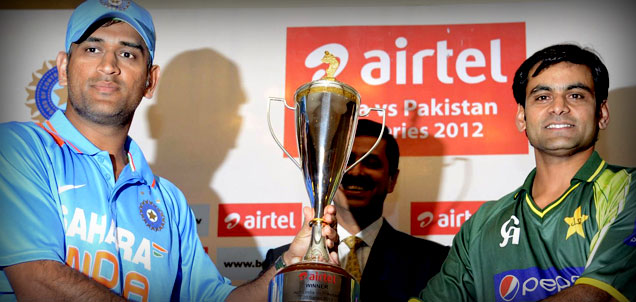
  • Indo-Pak series: Another historic thrash-a-thon?


    By A Correspondent


    Tensions of other sorts are usually forgotten when India and Pakistan meet on the cricket pitch. This time it is a battle of one-upmanship as the two countries are clashing after a gap of five years.


    While the Indo-Pak series of three ODIs and two T20s is a short tour, it is creating enough ripples among cricket-crazy fans. What makes it more enthralling is the fact that India had beaten Pakistan in both formats of the game the last time they landed here during the 2007-08 tour. Of the three Tests that the two played against each other, India won the series 1-0, having drawn the remaining two. As for the ODIs, it was a 3-2 victory in favour of India that did the country proud.


    While it was Saurav Ganguly who was at his superlative best in the Test series that enabled India to take the lead, it was the young Yuvraj Singh who shone with the bat in the ODI format, making him earn the prestigious man-of-the-series award.


    Going by speculation doing the rounds, for broadcaster ESPN-Star the tournament was a success even before it took off. According to some reports, the channel has managed to sell out maximum inventory at two to three times (totalling more than Rs 1.5 billion) the rate compared to the just concluded India-England series. This augurs well for the network given that it has to pay Rs 322.5 million per match for the five match series.


    Sanjay Kailash

    To a query from MxMIndia, Sanjay Kailash, EVP, ESPN Software India Pvt Ltd, said, “We are delighted with the response from advertisers to the India-Pakistan series. India-Pakistan is always extremely sought after and the series therefore was sold at a premium. We have monetised India-Pakistan ODIs at a rate which is double as compared to the historical industry average. Even rates for India-Pakistan T20 are double than the most sought after T20 tournament in the country.”


    Anilkumar Sathiraju

    Sharing his excitement about the series, Anilkumar Sathiraju, AVP & Head, DDB MudraMax, Media, said that on the ratings front he expects the series to be a big hit. “It will be quite good. I am expecting it to be a positive and a good series. Ratings will definitely see a spike as it is India-Pakistan at the end of the day. The fact that a few advertisers are quite gung-ho about it makes it more exciting.”


    Divya Gupta

    Divya Gupta, CEO, Dentsu Media, too had some words of praise for the series irrespective of the fact that India had put up a drab performance in the recent past. She said, “An India-Pakistan series is in a realm of its own; evokes emotions, fervour and fever like none else. It doesn’t matter whatever Team India has achieved /not achieved in the recent past. It is a marquee game, event, media property that viewers and marketers and broadcasters are betting on; and deliver it will.”


    Anita Nayyar

    Giving a more detailed outlook on the series, Anita Nayyar, CEO, Havas Media India & South Asia, said the fact that the series is taking place after many years is in itself a great pull. “From a viewing perspective three of the five matches are scheduled on holidays which will help the cause of viewing. Also the ODIs start at 8pm-primetime making viewers more available. In fact, most India-Pakistan matches have delivered ratings in the range of 5-6. This series should do similar numbers; however, with TAM data not being available the deliveries will be guess estimates.”


    Ms Nayyar’s summation of the series is probably what will matter at the end of this historical sporting tie-up. “Ratings or no ratings, the competition between India and Pakistan has always generated huge interest for both viewers and advertisers, and is considered a safe investment. It is a good way to bid adieu to a tough year and a fine beginning to a new one.”


    If the first T20 encounter between the India and Pakistan in Bengaluru last evening (Dec 25) was any indication, the contest on field is going to be tough. While every match going down to the wire may not be good news for weak hearts, it’s sure to see ratings soar. And advertisers and broadcasters happy.


    Photograph: Fotocorp


  • MxM Monday: Expectations from Phase III FM radio licensing


    By Ananya Saha


    FM Radio is set for exponential growth. Even as advertisers are yet to take this medium seriously, the industry players are waiting for Phase III with anticipation. The industry is positive that the third phase would result not only in differentiated content but will also interest the advertiser and listener alike.


    We speak to private FM players for their expectations from Phase III of licensing.


    By Ananya Saha


    Harrish M Bhatia, CEO, DB Corp Ltd - Radio Business (94.3 My FM)

    We all want Phase III to happen. It is an industry’s requirement to grow. But it is important for the government to remove hurdles like the issue that happenedinChandigarhor not allowing us to carry news. What is the objective of taking AIR news? If it the issue of keeping tab or administering the news we carry, they can ask us to keep our news recordings for 30 days and they can review it. How does the government control cable telecast? Why cannot they trust us?


    From the advertisers’ front, I am sure that the advertising in the medium’ will continue to grow. What is required is proper decisions by the government to ensure that the private FM players also gain.


    Asheesh Chatterjee, CFO, Reliance Broadcast Network Ltd (92.7 Big FM)

    The more number of Spectrum licenses in Top A, B cities will only benefit the industry. It will add to content loyalty. Phase III licensing will result in closure of music royalty issues when the tariff rates will resolve the ambiguity issues that exist at the moment. And yes, the FM players will be investing in Category C and D towns. Kozhikode, Chandigarh and the South will make the things uncomparable. Those areas need a bit of correction.


    These three are broadly the issues, apart from smaller issues such as news. Even while protecting the identity of your brand, we will be able to cover news in the same manner or better manner. Otherwise you are too restricted in communicating it in the same manner.


    Harshad Jain, Business Head, HT Media (Fever FM)


    The highest bidding of Phase II will becomes the lowest bidding price in Phase III and that is a cause of concern. I hope the government understands the fact that the cost of doing business is high. And I hope they do pay attention to this fact apart from solving the issues such as transmitter and infrastructure.


    It is no doubt that the Phase III is going to do better to the industry, but the back-end processes will have to be taken care of and sorted.


    Anurradha Prasad

    Anurradha Prasad, President, AROI and CMD, BAG Networks

    We want the processes of Phase III radio licensing to begin as soon as possible. We, as an industry, do not want something that becomes unviable. Hence, we are awaiting the process to begin soon so that industry gains. You cannot compare telecom and radio spectrum together. The consumer does not pay for radio. The medium requirements are different.


    It looks like the issue of music royalty will get sorted as Phase III licensing comes into play. However, I am concerned that in Phase III, the bidding prices might go haywire and people will not be able to pay, nor would they be able to make it profitable.


    Prashant Panday, CEO, Radio Mirchi

    The objective of any policy should be to ensure growth of the sector. In the case of FM radio, Phase-3 policy should attempt to expand FM in a big way.


    The Phase-3 policy as it stands today only partially addresses the objective. It does seek to expand geographically into some 250 new towns. However the auction methodology (electronic ascending auctions) and high reserve fees (highest bid received in Phase-2 in a similar category town in the same region) will frustrate this goal. The radio industry believes that FM auctions will be a flop with most new cities not being taken up. The industry prefers electronic tendering, just like done successfully in Phase-2. This would also take care of the problem of reserve fees, since they are set post-auctions (25% of the highest bid).


    The policy allows for networking across the network, which should help cut operating costs in small towns. It also allows broadcasters to operate more than one channel in the bigger cities, which should help in consolidation. The policy also allows news broadcast, but limits the content to AIR feeds. This is blatantly unfair, since news without restrictions is allowed to all other media.


    However, the biggest problem is conducting auctions under scarcity conditions. There is only 1 channel in Delhi, Bangalore, Chennai, Ahmedabad and Pune and 2 in Mumbai. This will lead to exorbitant “desperate” bidding. Further, this high bidding will become the base for the next round of auctions, which will put the radio industry into a cost spiral. Instead, the government should accept TRAI’s recommendation of halving “channel separation” to 400 KHz and doubling the number of channels. This way, the government will get more overall license fees, the public more programming variety and the broadcasters reasonable license fees.


    Suresh Sanyasi, National Sales Director, Radio Indigo


    Our expectation from Indigo are fairly simple: we are looking at larger market space in terms of international quality music available pan India. We current fall into very niche A+ segmentation. We are looking at Mumbai,Delhi as a market and may be a couples of Town A and B where we see potential like the way we got Goa where we can harness our brand and give listeners good music. Invariably connecting them with good brands and advertisers and giving them pan-India reach. Currently, if any advertiser wishes to advertise with us, they have to locally listen to our station in Mumbai and Goa. Once, we get license, the advertisers will be able to connect with our brand pan India. We already have offices in Delhi and Mumbai and once we get license, we will start expanding horizontally. We have, maybe about 20%, of business coming out of Mumbai and Delhi irrespective of the fact that they do not have touch-and-feel of Radio Indigo and they have only heard about our brand.


    Once Phase III begins, the market will grow. More radio stations coming in, licensing will become larger, the government is definitely going to get lot of revenues and a lot of employment will be created. There is huge amount of growth that we are looking at.


    However, radio in India has not reached maturity yet. By maturity, I imply, consumption of radio is not a very-well accepted norm right now. I say it comparing it to more mature medium like a television. People buy in terms of brand and advertising people do not know how to use radio. Radio is a very tactical medium. Advertisers do not understand the medium since it is not a visual medium, even as it remains the most cost-effective medium to advertise and there is a definite return that comes through. With larger number of stations coming in, people would like to try out and understand the value of radio in itself.


    We are looking at Phase III with much positivity and optimism.


  • Chitralekha upbeat on social media

    By Ananya Saha


    It took two years for Chitralekha to reach two lakh fans on its Facebook page. According to the official numbers provided by Chitralekha, 96% of these fans are from India with 87% under 34 years. Close to 35,000 active fans make it a highly interactive community. While the group has focussed on FB till now, and is present on Twitter, it will be looking seriously at the latter in 2013.


    Mitrajit Bhattacharya

    While many media brands are taking the social media route to be interact with the audience, it is known that beyond the ‘likes’, not many engage with them on a regular basis. However, Mitrajit Bhattacharya, President & Publisher, Chitralekha Group is upbeat about the statistics. “We are very active on FB as a community. We inform, entertain and empower our fans. For instance, the songs in a specially-compiled music CD with our anniversary issue were chosen by our fans, questions to celebs in our popular FB activity – “Chhoti Si Mulakat” are normally contributed by our fans etc. We also share jokes, pics and breaking news regularly. All these translate into an engaged fan base,” he said, while adding, “Regional brands have a huge power to connect with their audiences as friends. We have been a friend to the Gujarati community for over six decades. Social media helps us to be in touch with them closely, particularly the younger lot. Gujaratis are also very heavy users of digital devices, which help the process of connectivity.”


    The social media strategy of the group extends to Chitralekha’s brand philosophy “of being friend to our fans and being loved to a completely new younger audience.”


    Does an engaged fan base imply an engaged advertiser community as well? Mr Bhattacharya said, “Monetizing social media is a tricky issue, however there are many marquee clients who are actively looking at our online offerings currently.” He insisted that Facebook has played a large role in helping traction onto Chitralekha’s websites.


    With no choice but to be present on social media to stay in the game, Mr Bhattacharya concluded, “Digital is the future. All our major titles are available on tablets and smart phones. Our print copies get delivered to over 100 countries (sometimes, we learn about small countries from our subscriber’s database). Just imagine the power of digital, which avoids the problems of physical distribution due to geographical distances, both within and outside the country!”


  • FM Radio: Facing challenges, embracing growth

    By Ananya Saha


    The Confederation of Indian Industry (CII) organised the CEOs Roundtable on Radio in New Delhi last week, to discuss and chart the growth of the radio industry with the Phase III auction of the FM spectrum coming up, though dates are yet not out, and the ministry is said to be tweaking the loopholes. The conference saw private FM operators being critical of govt policies that did not allow them to carry news on their stations. The event also saw the release of CII- E&Y report – ‘Poised for growth: Fm radio in India’ (Read about it here: http://www.mxmindia.com/2012/12/fm-radio-will-generate-rs-14bn-in-coming-year-ey-report/)


    Prashant Panday

    Amit Khanna, Chaiman, CII Committee on Media & Entertainment and Chairman, Reliance Entertainment, requested the government to encourage diversity in programming by giving incentives. He said, “The existing policy has created clones of same station and has stalled the exponential growth of FM that could have happened.” He also spoke about how the cost of reach of radio was much higher than the cost of reach of radio, thus pushing the FM operators to stick to mainstream genre of Bollywood music to generate revenues.


    Prashant Panday, CEO, Radio Mirchi advocated multiple channels, 25 or more for cities such as Delhi and Mumbai for efficient usage of spectrum and diversification in genres. He pointed out, “FM gets only 40 lakh listeners per week. And daily only about 25 lakh people tune into FM. Why is that we reach 25 percent of population? The population needs variety, and we are often compared to TV when it comes to programming.” He also said that in 4-5 years FM radio will lose business to digital radio as consumer moves to internet radio. “The numbers are clearly growing. Saavn currently commands 10 million listeners. FM spectrum has finite life span. It is important to re-consider spectrum policy before broadcasting goes kaput,” he said.


    Anurradha Prasad

    Anurradha Prasad, President, AROI and CMD, BAG Networks, opined that the all stakeholders related to FM industry are missing the larger picture. “We sell airspace one-hundredth of TV ad revenue. It is clear that nobody is taking it seriously,” she said. She pointed out how advertisers look at radio as a ‘bonus’ medium and not as a serious medium.


    However on a positive note, Ashish Pherwani, Partner, Advisory Services, M&E, Ernst & Young, said, “Phase 3 is going to be imperative for growth of the industry. There are good things happening in the industry that will allow consolidation. Yes, it is important to extend licensing by 10-15 years. The lack of inventory is happening because of lack of licensing. But even then, one out of two campaigns currently use radio is a medium, even when ROI is not as well-defined in this medium.”


    Uday Varma, Secretary, Ministry of Information & Broadcasting, began on a very candid note. He quipped, “If the industry itself is calling a 10-12% growth bleak, what percentage of growth will make it look bright? The industry in itself is not clear what it wants – whether it wants fast growth or slow growth. Of course, the business aspirations of the industry and national interest will not go hand in hand and meet, and it should not for good.” He also pointed out why there is a delay in the auction of Phase III licenses, “There was an issue of migration fee. The process and auction will be done in very transparent manner. There are trade-offs but I am sure we will sort them out with the industry and other stakeholders like TRAI.”


    Mr Varma on a lighter note said, “If you as an industry player are sure that it will die, why expand at all? And if it is so, the government should re-look at the FM policy. We, as an industry, need to begin on a far more positive note. Of course, you cannot wish government away. There is a divergence of motive here – the industry is working for profits and we have to look at the working of the industry as a whole,” while responding to Mr Pandey’s statement that the FM industry will face the music the next 4-5 years. On the question of allowing private FM to air news, Mr Varma asked the industry to begin with AIR news feed and give it a time of 4-5 years.


    The Secretary and Rajesh Kumar Singh, Joint Secretary) Broadcasting (MIB) assured the delegates that Phase III was on the top of their agenda. Mr Singh said, “My agenda was to get the Phase III rolling by March 2013. But we hope to work on the areas that cause concern and do it thoroughly.”


    Harshad Jain

    Harshad Jain, Business Head, HT Media (Fever FM) said, “The market size is roughly Rs 12-1500 crore, for a medium (radio) that is absolutely free for the consumer. Compared to overall media industry, this is the fraction of revenue. The bidding cost for Phase III is unfair to the industry that is so small. While the numbers might look impressive when you see CAGR, the prices of this medium have actually declined keeping inflation in mind.”


    Anil Srivatsa

    Adding to the debate was Anil Srivatsa, CEO Radiowalla Network who said that the reserve price will deter new entrants into the industry. He recommended more frequencies with lesser space between two frequencies. To this, Wasi Ahmad, Advisor (B & CS), TRAI, responded that number of FM channels should be consummate to how many channels can a market absorb while Harrish Bhatia, CEO, My FM wished to make the industry more investor-friendly while pointing out “stations that are backed by news media houses should be allowed to carry news.” On an optimistic note Mr Jain of Fever FM wished that “radio industry becomes a $ 2 billion industry,” while Uday Chawla, Secretary General, AROI, wished for a level-playing field between radio, print and TV.


    Harrish M Bhatia

    The panel and delegates also pointed out how the industry is facing the dearth of good talent. On a positive note, Asheesh Chatterjee, CFO, 92.7 Big FM concluded, “We are going to grow at 30% in Phase III when 245 FM stations would result in four times in inventory with more comprehensive spectrum. Radio is set for huge jump. The ad revenues are falling because we are selling cheap. We, as an industry, have to focus on good content. The growth and the ability to grow lies within us. We need better and concurrent movement.”


    A Must Read for every Professional in Media Industry ….

    Extracted with permission from Authors of ‘The Advertising Mess’


    Universe Projections and a well-known Listenership Survey

    The existing Radio listenership survey from a ‘credible and trustworthy research organisation‘has shown utter carelessness and total lack of responsibility which has hindered the growth of this nascent medium.


    The listenership survey, which launched in 2007, used NRS 2005 universe estimates without applying growth rates for the intervening two years, which means its figures were two years out of sync with reality. This lethargic output was produced after charging humongous fees from the client for subscriptions.


    Logically, in any such media currency, the critical factor is the ‘estimation of the universe’, which needs to be done as accurately as possible. This can be done by using the latest available census figures and applying the intermediate growth rate to arrive at the current universe, OR by using IRS figures (since IRS provides updated universe estimation by demographics on a quarterly basis.)


    Moreover, this listenership survey continued to report these wrong universes for the next 3 years till the end of 2010. Not only was the universe underestimated but the radio penetration figures were also wrongly reported as compared to the baseline.


    When this ‘credible and trustworthy research organisation‘ finally updated the universe in January 2011, some markets showed growth in population by 143% over the previous year. (Obviously, since for five years, the research agency had not bothered to update universe, now there was a sudden leap).


    The basic demographics such as gender ratios changed almost inversely for male : female from 57 : 43 to 41 : 59, socio-economic classes observed stark differences. For example, upper socio-economic class demonstrated a drastic drop where as lower socio-economic classes showed significantly unrealistic rise over the previous year.


    Conventional wisdom says that the demographic proportion takes almost one full decade to show the kind of change in proportion that this listenership survey showed in a single year. Such drastic changes in gender ratio were last witnessed during World War II, when millions of members of the male population were killed in a single year of warfare at the front. They cannot radically change in just one year.


    Can we expect such blunders from an organisation which is looked upon as the ‘Messiah’ of media research in India? Unfortunately, YES.


    Such are the follies of these surveys which are unfortunately highly respected by the industry and form the basis on which most of the MarCom investments are made today.


    Different methodologies lead to different results with disastrous consequences (Diary v/s DAR)

    Different methodologies for the same objective appear to provide different results in research surveys. Each of these methods has their own disadvantages and advantages and that includes how the market perceives them. The different numbers emanating from the usage of different methodologies mean different opportunities to advertisers, broadcasters and agencies for revenue impact, visible return on investment and content formulation.


    Obviously all these methodologies cannot be giving the accurate results. Let’s take an example of MRUC which started India’s first radio listenership survey, ILT (Indian Listenership Track). MRUC had conducted a research to evaluate which methodologies out of DAR (day after recall) and Diary were the most robust and with minimum error. It was found that DAR reported a 55% inaccuracy, whereas Diary reported 85% inaccuracy.


    Post the results of these findings, TAM media research released the first round of Radio Audience Measurement with Diary methodology, pitching hard for real-time capturing of data.


    The radio station which according to ILT was the undisputed market leader for two consecutive years, suddenly dropped to number four position according to RAM, whom do we believe ILT or RAM? Further, this discrepancy occurred when there were only a total of 7 private FM stations available.

    The question is whether real time capturing of data (Diary), which was developed to overcome the inaccuracies of the previous methods (DAR), truly presents the actual picture.


    Another example which can be looked at is a famous radio station which recently converted from 100% Hindi content to 100% English content in Mumbai. When comparing three months of Hindi content (Pre-Launch) with 3 months of English content (Post-launch), the existing listenership survey conducted by a ‘renowned media research agency’ reported NO significant changes in either demographic consumption of the station across age groups, gender and socio economic class OR in tune-ins and time spent. On the contrary, lower socio-economic class showed growth for 100% English content for the same radio station.

    This either shows that all listeners are deaf or it shows how real time capturing of data could mislead due to some lesser known reasons or leakages in validation process or it shows that the data capturing and analysis are being done in a thoroughly unprofessional manner. Or could it be that there is a short-coming in the methodology itself and that fresh, new methods are urgently needed?


  • How safe are women in media – Part II


    By Ananya Saha


    Even as we brought you the views of women in news media on how safe they feel, yesterday (http://www.mxmindia.com/2012/12/how-safe-are-women-in-news-media/), we also got in touch with women in non-news fields to share their views.


    Rita Verma

    Media seems like a glamorous business. And probably it is, minus the harassments that go unnoticed or unreported. With stringent HR policies being put in place, it might just be a thing of past. We reported yesterday on how safe and unsafe women in news media feel in their respective cities. Today, we bring you the views of the females in non-news media.


    The industry coherently believes that the country is getting unsafe for women. Rita Verma, Senior VP, Organisation Development, DDB Mudra, voiced her angst, “With all the current issues going on across the country no women feels safe. And in odd hours it only gets worst. It does not matter if you are in an urbanIndiaas all these major cases are happening in the major metros.”


    ‘Learning self-defence is important’


    MxMIndia staffer Shruti Pushkarna weighed in: “As a working professional, I am pretty used to driving around the city on my own even in the late hours but yes, it would be wrong to say that I never worry about getting back home safely. There have been several incidents in the past when I have been stranded on the road with a punctured tyre or something else, and no one to help. This one time I remember, I was waiting for help to reach me and to be safe I locked myself in my car and then I saw a cop cross by, Hoping that he would help me, I rolled my window down to ask for his help, but he just told me, ‘Push your car to the corner of the street and stop blocking the road!” I was shocked and told him I had a flat tyre and needed help, but that didn’t seem to have any effect on him and he walked away saying it wasn’t his job!


    “Well this was when I still had a car to lock myself in, a helpline car service which came to my rescue twenty minutes later, but it was worse a couple of years earlier when I had to use public transport to commute across the city. And my only hope then, were a bunch of safety pins I kept handy. Small things women carry around in their bags turn out to be useful weapons at times, and I have used those safety pins many a times to guard myself on DTC buses.


    “In a previous job, we were provided with office cabs to go home from late night shifts. One night as I stepped into the car, a guard also joined us. I asked him if he was headed in the same direction as I was but turned out that the HR had decided to let a security guard (a man) travel with me and the driver (another man) for ‘my’ safety. I don’t know if it crossed anyone else’s mind but the only thought that crossed my mind was, “If the driver tries to rape me there’ll be another man to help/encourage him.” So I went and told the HR next morning that it’s obviously more difficult to guard myself against two men at the same time!


    “The news is full of how rapists are on a power trip, how the police are inefficient, how the politicians and the government don’t take any strict action and so on. I feel the logical thing to discuss and perhaps propagate via national media, is the need for women to be prepared for these things. It’s important for them to learn self-defence methods and have self defence devices handy.  I for instance, took a short Krav Maga self-defence course. It’s an Israeli martial art form which helps you defend yourself and also teaches you to be more cautious and guarded against odd/dangerous situations. I think it’ll take a lifetime to change the men in our society so let’s start with the easiest and the most logical solutions.


    Sagorika Kantharia

    Sagorika Kantharia, Chief People Officer, Radio City 91.1FM, opined, “We really need to do something to make women safe in this country. Nowadays when you open the newspaper only thing you get to read is crime, rape cases, murder stories. Really ugly stories like father raping daughter, man throwing acid on woman’s face etc. One of the news reports on “Crime against Women” shows rape cases have grown by 30 percent since 2007, molestation cases have gone up by 52 percent and sexual harassment by 50 percent. I think the offenders should be punished with capital punishment in such cases of crime. Today women are working and demands of work is just increasing day-by-day wherein women have to travel outstation, work late hours at times how does one manage if the country is going to unsafe for women.” To make the women employees feel safe and protected, “At Radio City, we do have facilities for women employees who work late hours. Special arrangement like a re-imbursement for a private cab booked post 11pm etc. are provided for employees,” she said.


    However, it is not difficult to guess how safe urban India is before 11pm.


    Ambika Sharma

    Ambika Sharma, MD and CEO, Pulp Strategy said, “Women in India are not safe, especially not post-dark. One has only to read the papers to realize this. Those of us in media who keep odd hours at work need to be extra cautious. Delhi in particular is not a place to be out at night, and its getting worse every year. If you are to be late at work ensure that the organization is responsible enough to drop you to your doorstep.” At Pulp Strategy, it is a rule that women colleagues be escorted to their homes if leaving office post dark. “I personally would not recommend public transport post sunset, its difficult but there is no other choice, safety comes first,” she said.


    But there are bosses who do not care. Megha Swarup (name changed on request) works for a PR company in Delhi, said, “We are not given cabs unless it is for official meetings or media rounds. Since our boss is stringent with proper filing of papers, minutes of meetings etc, we usually get late in office. Our office is in a commercial complex that empties out by 7 pm. There have been times when we have had to ignore lewd remarks within the complex, but bosses do not care. And the bizarre fact is that our boss is a female. They do not even ask if anybody wants a lift to a certain point.” One of the female colleagues of Ms Swarup, gets picked up by her husband every single day after office.


    Vivek Srivastava

    But then there are bosses who do care. Vivek Srivastava, Joint MD, Innocean Worldwide, said, “This heinous crime has shaken us all. It has definitely made us reassess the security of our women colleagues once again. Ours is a professional space that truly accords importance, equality and respect to the efforts of the women folk. Advertising is a service industry driven by client imposed deadlines which can be difficult and late nights at office happen often. At Innocean we ensure that women take utmost precautions when working late. They are provided safe taxi services verified for their antecedents whenever they work late. In some cases the other office colleagues accompany them as well wherever routes are common. Moreover we do occasionally issue advisories to our colleagues to maintain their safety not just from sexual crimes but road rage, avoiding driving when under the influence of alcohol and avoiding over crowded places during times of alerts as well.”


    Prerna Uppal who handles MTV Consumer Products at Viacom18 in Mumbai said, “I do not feel safe when I am travelling on a business trip especially to Delhi, Gurgaon and Noida. I usually wind up all my meetings before7pmespecially when I am travelling alone. I feel very unsafe and sadly, I end up ordering room service rather than experiencing the great gastronomy the city offers.”


    MxM View


    MxMIndia has a clear view on the issue of the safety towards women in the news media. The people who run the newsrooms – owners, CxOs, editors, team leaders, and commentators — must ensure that we provide for the safety of our women colleagues. We know that the world outside our offices – including our public transport — is unsafe. We also know that expecting people around to protect women is too much to ask as we discovered when a senior news journalist was mute witness to an excess on a Mumbai local train.

    So, while it’s good to see the news media playing up the Delhi gangrape story, it’s critical that stiff laws are created. Our newsrooms must work towards taking care of the staff as they work odd hours.


    If you think your newsroom or that of a friend is not taking good care of its women employees, write to us at editor@mxmindia.com. While we don’t guarantee a solution, we will take it up the bosses of the news media entity to ensure a better, safer world.


    - Pradyuman Maheshwari

    Editor-in-Chief and CEO, MxMIndia


    Mumbai-based Lekha Saluja (name changed on request) manages corporate communications for a media house. She said, “I feel safe in Mumbai, no matter what time of the night. The roads are buzzing, there are people and I think it is largely safe. Having said that, it has to do a lot with me having my own car and driving. I am not sure the trains or the rickshaws will be as safe. Regular patrolling of the cops and better security is required. My office ensures late night travel for women employees.”


    A corporate communications manager in Bengaluru for a media company (who did not wish to be named) said, “There is no security. But due to the cab pick-up-and-drop-facility that I have arranged for myself, picks me from my building’s gate and drops me to office gate, I feel safe. To each, its own, is the norm here.” Apparently, she worked in Delhi earlier and depended on male colleagues to go back home if leaving late from office. Echoing her thought is Bengaluru-based advertising professional, Astha G, who said, “The whole feeling of being safe in media is more of a mindset. HR does not provide any safety measures. Only your own methods can help you feel safe.”


    Another corporate communication woman who works in Delhifor a news website, said, “What safety are we talking about? I have to catch hold of one colleague at least to go back with me when I drive back home late at night. Even though my office provides a cab post 8 pm, I do not feel safe going in one.”


    Cab services are a precaution, which every organisation must have. While no one can make females feel safe on roads, it becomes imperative for organisations to take stricter measures for them. If they won’t, who will?