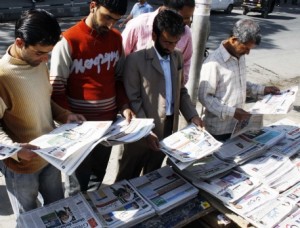
Tag: media

  • Ranjona Banerji: Giving with a twist

    Maybe Diwali is shining bright this year and maybe, well, there are a few dull spots here and there. Ads in newspapers over the past month certainly show that real estate and white goods are back in demand and jewellery it seems never goes out of fashion.

    But as journalists, you don’t have to count Diwali in terms of what you get (so how many media houses actually bother to give their employees anything for Diwali any more?) in material terms but what you get as, well, material.

    The top giver this year has to be Team Anna. Every day, all the members, former and current, work so hard to gift the media something substantial so that juicy stories and screaming debates can be organised. Tax evasions, slipper-chucking, chamber-bashing, endless fasts – which forced television to find every synonym for abstinence from food it could come up with across several Indian languages – dramatic exits, allegations, self-righteous sanctimony… sometimes you’re lucky as a journalist to get such a cornucopia of riches maybe once a year. Team Anna has been giving generously since April.

    The next most generous has to be the film industry (and I don’t mean press conference gifts or the air kisses some film star blows a young, impressionable film reporter who now thinks they’re BFF). Every other week a movie releases with such an enormous publicity blast that you need at least six months to recover. It is another matter that the film bombs before anyone sees it and is as same old same old as the last one. The publicity blitz is far more important than the film itself and generates so many stories. So what if most of them are fake? This season, it has been Shahrukh Khan who has been most kind. Now, anyone going to see the movie, errr, what’s it called?

    In most years, cricket would top the list but what started out as a great cricket year what with the World Cup and the IPL and then the England tour oops… um, what happened after that? My mind has gone a bit blank. There should have been stories galore but then I don’t know, whatever, cricket, yeah.

    The Sensex is usually good for some drama but this year, well, it’s behaved very badly, in a damp squib kind of way. Instead, rising higher and higher has been the inflation rate, so you know, you lose some and you lose some. Not quite a breezy Diwali story.

    Big thanks could go to our politicians who are usually ready with some fun stuff. Of course they never fail so there’s nothing new or unexpected here. We’re used to it. Sometimes, it’s like Diwali gifts every day.

    Now that Diwali is done and dusted, let’s see what kind of parties we get thrown for New Year.

    Have a good one.

  • Sukumar Ranganathan: Journos and media exec in a unique position

    Try as I may, I find myself unable to summon the enthusiasm inherent in the headline , so I am going to refine the topic a bit.

    It is an exciting time to be in media. A combination of circumstances — increased political and business activity, and a reduction in information asymmetry thanks to regulations such as the Right to Information Act and technology — has meant a significant increase in news flow. To resort to a cliche, there’s never a dull moment and that suits most journalists very well.
    Yet, it’s a challenging time as well.

    To stay relevant, newsrooms have to be proficient in multiple media and editors should understand print, video, the Internet, and social media. The business case for some of these is still being written, but that doesn’t mean they can be ignored. The good news for print journalists like me trying to cope with a whole new world is that print will continue to exist, even thrive in India.

    There’s also another challenge newsrooms face, one that many are just waking up to. The reduction in information asymmetry that gives them access to news they once wouldn’t have had access to, also gives readers and viewers access to information about how journalists work. Many newsrooms in India still work without a journalistic code and, over time, this will put off both readers (or viewers) and advertisers.

    Given all these, work is complex, interesting, hard, stressful, and sometimes fun.
    But great? I don’t really know.

    It is, at once, both exciting and frightening, to be in the middle of great change of the sort that the Indian media landscape is going through.

    I think I can safely say that journalists and media executives find themselves in a unique position.


    Sukumar Ranganathan is the Editor of Mint.

  • Don’t be scared of the Dolly Bindras in media: Shishir Joshi

    By Shishir Joshi


    This is not in defence of the media. As you read along, you may realize it. In fact, it is quite to the contrary.

    Foremost, let me lay down some of the allegations against the media and some of the prevailing perceptions;

    That the media is a king-maker. That it is corrupt. That it is far away from the realities impacting the society. And that it thrives on sensationalism.

    Partly, it is the media, itself, which is to blame. For the corruption. (Bhrasht-aachar; read, corrupt behaviour.) And for the perception.

    Let’s start with the most recent one. Media as the king-maker. Allegations which have shattered the holier than thou image. And as eminent journalist Arun Shourie put it in a TV show, “Time and again instances have come up where journalists themselves have been responsible for the betrayal.”

    Many, largely unrelated to media, strongly believe media is corrupt. Unfortunately, what they mean by ‘Media’, could really be a handful, but, those who get branded, are just any and everyone who is associated with ‘media’.

    So, to begin with, here’s a dekko to clarify some prevailing misconceptions.

    Very few people really know and understand how a news organization operates. In the fifty-odd people who work, in what is seen by the outside world as the ‘powerful’ editorial of any news organization, a little less than half, say twenty or so, are what everyone knows as Reporters (working Journalists in the real sense).

    They are the ones who have a contact with the ‘outside’ world. Or, that, the outside world really knows about. (The other non-reporter face known to the high and mighty could be the editor, but, increasingly, it is the CEO or the Marketing /sales head who is a far more ‘popular’ face.

    Within those twenty reporters, barely four or five such Journalists deal/interact with those in High places; by this, I mean, with Political heavyweights (by Reporters covering the political beat) film stars (mind you, not any film start, but only the big five of Hindi cinema) and Sports, again, here not just any sport or any sports heavyweight, but Cricket an d the mighty Sachin, no less.

    So now, of an approximate 50 odd, we have come down to the top five in any Editorial, who have the opportunity to rub shoulders with the Rajas (not to be mistaken with Spectrum Raja. And within that, on a rare occasion will one odd Journalist really mis-use his seat or position.

    All this also depends on the reach and impact that the Media house commands, in circulation or readership. (NDTV among policy makers and Hindustan Times in Delhi do count for being heavy weights…umm… what a coincidence). Needless to say, a fancy designation helps.

    So if a Managing Editor of one among many many many media organizations is found to step into grey area or is caught on tape, mediating or promising solutions, this could be just ONE he or she caught in the act isn’t it? Is it then fair to brand all of media as corrupt?

    It may be unfair. But the guilty, is the media itself. And some of these journos in power. And the perception that they have created.

    How often have we seen PRESS stickers adorning two wheelers and cars of media persons. Any self respecting journalist who holds a valid identity card from his organization will tell you that these stickers are not required. Not required unless you are using them to ensure the traffic cop does not stop you.

    Maybe those using these stickers do not know this, but the ‘public’ and the traffic police surely believe this is the reason.

    To say press stickers are by themselves to blame, would be highly unfair.

    We also have a mushrooming number of ‘king-maker’ journalists. Who throw names, host parties and ensure that the bigwigs attend their private dos.

    Rarely does the ‘King’ , either a big-ticket politician or a film star, not oblige. Graciously, he ensures that the journalist is addressed by his first name, and a few back slaps later, the powerful man is back in his den.

    Only a handful would cringe at the thought of a powerful and popular name walk into your living room and back-slap you, chat up your family and share a chai with you. What the action leaves behind is you, the journo beaming from ear to ear, like a fat cat having stolen a bowlful of cream, with the rest of your family, friends and neighbours in a daze.

    Mind you, there is nothing wrong in the high and mighty visiting you.

    But, where the hacks go wrong, is when they start believing that powerful are in love with you the person and not you the Journalist. I promise you, it can’t be further away from the truth, in most cases.

    And as you bathe in the halo of the big one calling you by your first name and your family and some friends gazing at you with renewed affection and respect, you fail to see the rest of the neighborhood, who see you as an ass-licker. That is perception, as it gets created.

    You, in fact are an ass with a big bloated ego, refusing to see the writing on the wall. “You are so dear to me,” says the politician and you glean with pride. What you don’t read between that line is he muttering under his breath that “I accept you only with your designation and organization.”

    The power of a journalist, in today’s age (unless his good deeds speak volumes) is like the hair on the head, the tooth in your gums and the nail on your fingers. It is valued only when it is in its place. Worthless when chopped.

    There was a time when Journalists wielded the power of the pen. The power, by what they wrote. Based on facts and fair play. That was power. Real power laced with absolute respect.

    Today, the power has corrupted. Absolute power (based on a belief that he is the king maker) has corrupted absolutely.

    The far and few, but absolutely corrupt journalist is powerful not by what he is capable of writing, but his ability to WITHHOLD information. The power to conceal a story, often at the cost of a favour, or as seems in the case of the Radia tapes, through an alleged TRADE-OFF makes the corrupt journalist in the lot nothing less than a white-collared extortionist.

    But you hate them, you call them names and yet, you do not speak out against them. What is it that scares people when it comes to speaking up? Or speaking out? Unless it is in hushed tones? Politicians have been hurling abuses at each other, taking names, in the spectrum scam. But no one has dared name the journalist(s) or media houses at all. Only after social media (and later a few magazines) began talking about it, have names begun cropping up. The role of the journalists is beginning to get scrutinized.

    While social media has been active in this case, mainstream media has been largely mute. Be kind to thy comrades for they may one day come and lord over us. Is that the reason why?

    But what stops the rest of the world from talking about these names in public? Two reasonings come to my mind.

    One, Industry captains do not wish to rub India’s much watched English channel(s) and powerful newspapers the wrong way. “I am seen on it, quoted by them and would continue wanting to be seen there” is what they believe. Any rubbishing of the network, or its key stake holders would mean, being blacked out.

    The second, and more real fear is of an unwarranted backlash. I call it the Dolly Bindra effect. Nobody wants to rub Media big-wigs the wrong way. However wrong they may be. They may be paper tigers, but tigers no doubt. Their byte is more poisonous than the (non existent) bite. They have a habit of bouncing back and, like the boxing cushion, slamming right into your nose.

    So, however much you dislike them, hate their guts, have evidence of their alleged wrongs or have taped conversations of political coziness, you would rather shut up and lead your life.

    After all, we all know what happened to Shweta Tiwari and Samir Soni on BiGG Boss season four when they took on Dolly Bindra, right? Shweta was stung in the face, Samir was ousted. And the one who got maximum press, was Dolly, who returned to the BiGG BOSS house with a bang.

    PS: Remaining quiet has never been a solution. Mute spectators to a crime too, are as much guilty as those perpetrating the crime.

    It is time you speak up against those, whom you believe are corrupt under the garb of being honest. It is important too. For others, Citizen Journalism, or social media, is a solution.

    For, isn’t it a commoner like you and me who exposed the Adarsh scam or the CWG or the initial lid of the various scams in recent times?


    Shishir Joshi is the co-founder of Journalism Mentor, and till recently was the Group Editorial Director of the Mid-Day group of publications.

  • WMC 2011: We have to be innovators as much as publishers: Aroon Purie

    By Shruti Pushkarna


    Addressing delegates at the 38th FIPP World Magazine Congress in New Delhi, Aroon Purie, FIPP

    Chairman and Chairman and Editor-in-Chief, India Today, said much had changed since he first joined FIPP at the Paris World Magazine Congress 2000. He believes, “India has arrived at the world stage and the fact that the World Magazine Congress is being held in Delhi is a reflection of that.” Mr Purie leaves the chairmanship of FIPP at the end of the Congress.


    Compared to 2000, when the Indian media space had not opened up to the world, in 2011, the media space in India is bustling with activity. With 10, 500 newspapers and 58,100 magazines registered in this country, Mr Purie emphasized, “Although newspapers are shutting down in most parts of the world, and most cities have only one newspaper; in a place like Delhi, you can get 16 English newspapers delivered to your doorstep and there are 10 Hindi language newspapers. I don’t think that’s possible anywhere in the world.”


    The demographics in the Indian market, assured Mr Purie, will make any publisher “salivate”. We have 22 official languages which means you have that many more languages to publish in. In that sense, we are like Europe, except Europe has a population of only 739 million and ours is 1.2 billion.”


    India, Purie further added, is a country “straddles many centuries simultaneously”. “That is our

    uniqueness in a way. Not far from here you’re likely to see a bullock cart on the road next to a Bentley, both stuck in the same traffic jam. So it is in the media space. We happily straddle digital as well as traditional media and both are growing rapidly.”


    Citing the latest numbers, Mr Purie added, “Consider that magazine advertising is slated to grow by

    a compound annual growth rate of 13 percent for the next five years. Internet connectivity, although

    now low in terms of penetration, still has 100 million people accessing the net. This is expected to grow to 237 million by 2015. Smartphones now constitute only 5 to 6 percent of the total phones but this is expected to grow to a 25 percent by 2015. India has 31 million Facebook users which makes India the third largest market for Facebook. India is a country rich with promise.”


    But the uniqueness of Indian market does not take away the need to innovate. Mr Purie recalled, “When I took over FIPP two years ago as the Chairman, the mood among publishers was truly dismal. It was like watching terminal cancer patients just biting their time. There is now an aggressive optimism and a growing realization that the new technology is not a cancer but one of those injections that offer rejuvenation.”


    Mr Purie believes that tablets will be both “the saviour and the biggest challenge for magazine publishers”. “For us to succeed we have to know now to design content for eyes, fingers and ears too, and provide an immersive experience to our consumers,” he said.


    Drawing a parallel with this year’s theme, ‘The 360 Opportunity’, Mr Purie reiterated the need to

    integrate the traditional models of content with new technology and new platforms.

  • Rio to host first digital journalism fair

    By A Correspondent

    The first exhibition dedicated to showcase digital journalism related products and solutions will take place in Rio de Janeiro, Brazil in December. Digital News Show (DNS) will be attended by an audience of students, news executives, online media professionals and people interested in new media.

    Stands of media groups – as well solution development companies for the digital journalism industry – will take part in the event to display the latest innovations in this environment. Augmented reality, mobile applications, interactive infographics, QR codes, digital editions and publishing systems are some of the attractions that will be exhibited at the fair.

    In the two-day event, visitors will have the opportunity to interact with the technologies shown by exhibitors, and to purchase gadgets like tablet computers, smartphones, e-readers and digital cameras at attractive prices. Digital News Show will also realize discussion panels with online journalism related topics, such as ‘Interactive Infographics and Data Journalism’, ‘Investigative Journalism in the Digital Age’, ‘Newsgames’ and ‘News Content for Smartphones and Tablets’.

    Digital News Show is a production by Jornalistas da Web, an 11-year-old Brazilian website that covers the relationship between journalism and new media. The event will take place on December 10 and 11, at the SulAmérica Convention Center, in downtown Rio de Janeiro. The stands can be booked by exhibitors now. Tickets go on sale soon at www.digitalnewsshow.com.

  • Anil Thakraney’s Hard Knocks: The Bitch Boss

    This completely ridiculous reality show is now in its fifth season. Five, five, five, five… as the hosts Sallu and Sanju very irritatingly croon. Therefore how much ever many of us loathe Bigg Boss and its floozy contestants, we have to grudgingly admit the format works. It’s also worked in the western nations, where the show is called Big Brother.
     

    The serial is totally dumb in its content, and that’s by design. Because it is targeted at the low-brow viewers, and there are plenty such in every nation. People who look for cheap laughs after a hard day’s work, and particularly enjoy it when the contestants slam and abuse each other. Which is why the channel and its producer only pick people with shady backgrounds and aggressive demeanour…. even retards will do… as they are most likely to clash with each other. In fact, even to be offered a part in Bigg Boss is tantamount to a grave insult.


    It’s very tempting for me to trash Bigg Boss five, five, five, five, five. It’s a sitting duck for ridicule. Examine the fantastic star cast: Twelve dumb chicks, one transvestite and one confirmed sex pest. And two hosts, both of whom face criminal charges in assorted cases. And that’s just the start.


    But I have decided to hold my fire, grab some beers and catch the demented action whenever I can. Because the hard truth is this: There’s a big market out there for this sort of crap. And you can’t argue with business and TRPs beyond a point.


    Ganda hai par dhandha hai, as it’s often said.


    ***


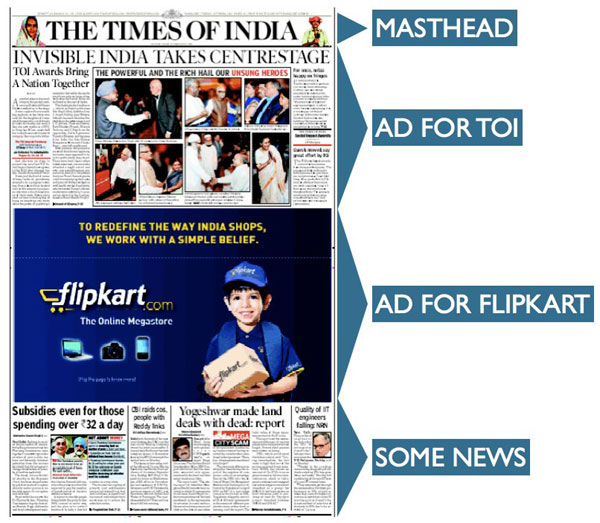
    PS: Found this image floating on the net. A good example of how valuable readers are to the publishers of the TOI. And the irony is that just a few days back the newspaper was gloating over its rising readership!


  • The Anchor: Abraham Alapatt on 7 reasons a marketer prefers television to other media

    #1 Reach

    IRS media figures show a 17.9 percent compound annual growth rate (CAGR) in the spread of cable and satellite TV across India. The figures, for the first quarter of 2011, show that the total reach of cable and satellite TV is now 416.51 million, up from 403.51 million registered in the fourth quarter of 2010, and just under 383.61 million homes a year ago. Television – including terrestrial transmission – is now available in 522.44 million Indian homes, up 5 percent on the 516.41 million figure at the end of 2010, and the 509.86 million recorded in the first quarter of 2010.

    In fact, the only sections of the survey which registered a dip in the IRS figures were radio and cinema penetration. Cinema’s reach fell by minus 5.4 percent CAGR, from 81.66 million at the end of 2010 to 79.71 million in Q1 2011. The total reach of radio fell from 163.91 million to 161.48 million in the same period: a drop of 8.3 percent negative CAGR.

    #2 Family consumption

    In markets like the US or the UK – small families, working parents and typically “more than one TV homes” is the norm. In India on the other hand, TV viewing is a social “family” gathering where Indian families (often larger/joint families) gather around the single television in the living room of the home. This means that, with approximately four people viewing per TV set in India (during prime time) the reach is not just significantly larger than the numbers suggest, but also more involved and animated as a family unit. This aids marketers across segments and target groups. This group consumption of TV as opposed to radio, print or internet (which are usually consumed alone) makes it very powerful and unique.


    #3 Nature of media

    The versatility of the media – combining audio and visual elements and allowing stories, humour, glamour and imagery to be combined, makes it a potent tool for marketers to project their message/brand in the most attractive manner possible.


    #4 Segmentation based on viewer profile

    Based on time of day, nature of programme etc, marketers are able to target the right segment better than other traditional media such as print and radio.


    #5 Planned consumption

    TV viewing, in extension to being a social/family event, is consumed to a specific time pattern/lifestyle and is therefore fairly dependable from a marketers’ point to view to reach prospects.


    #6 Consumption by habit

    An extension of the social and planned aspects is “force of habit” – viewers of a particular program/channel tend to consume it almost by habit, unless the content fails to deliver or something more attractive comes up on another channel during the same time band. Women viewers of soap operas, teens watching MTV or lifestyle channels, men watching cricket/sports/news are cases in point.


    #7 Ads themselves as content

    With ads getting more creative, slick and entertaining, TV ads have themselves become subjects of discussion and aid brand consumption – Vodafone’s ZooZoos, Airtel’s new jingle “Har ek friend…” etc are just some very popular recent examples. This is, for obvious reasons, a marketer’s dream come true.


    Abraham Alapatt is Head – Brand & Corporate Communication, Future Generali India Life Insurance Company Limited.

  • MediaVest grabs PIX media mandate

    By A Correspondent

    In what can be described as another note in its symphony of wins, Media Vest’s Mumbai office has bagged the media mandate of PIX, the leading English movie channel. Both the agencies will handle all the media planning activities for the channel. Media Vest will handle television and radio and Zoom Advertising will handle only print.

    MediaVest Worldwide is part of Starcom Media Vest Group. Starcom MediaVest being ranked one of the largest brand communications groups in the world. MediaVest will handle the operations for PIX in Mumbai.

    Commenting on the development, Mr Dinesh Rathore, VP MediaVest, Mumbai said, “Pix is one of the leading channels in India that provides excellent English content to the viewers. It has been broadcasting great content to the viewers consistently over the past few years. We intend to drive the channel to a leadership position in the English genre with our human experience strategy framework and hardnosed analytics, providing simple, real-time and meaningful solutions. We are excited to be working with the brand and believe that this partnership will translate into a success story for it.”

    Zoom Advertising became operational in 2004 and within a span of three years it managed to get INS accreditation. Delighted at their recent success,  Mr Chirag Barasia, Proprietor – Zoom Advertising commented, “Being an evolving agency we have established ourselves as a formidable agency in print action, so we take great pride in the way which PIX has put immense trust in us. We are also excited in bagging their print AOR & media buying duties which is a challenge and an opportunity for us to connect them to wider print options. We are extremely positive on our media buying capabilities and thus we will strive hard to ensure PIX achieves significant progress and success in their print portfolios. Similarly, PIX has given us a big boost to venture out in exploring and implementing other media opportunities for them and our other clients.”

  • Freaking News by Ranjona Banerji: Where’s the fizz gone?

    Life is dull, I have to admit, when television is not having hysterics about some issue or the other. And this week has been particularly short on made-for-television news events. I know I’ve grumbled about the neglect of subjects like the civil war in Libya or the collapse of the world economy but even I know that we cannot whip ourselves into a jingoistic frenzy with such sparse material to work on. No anchors foaming at the mouth, no calls for answers and no heartfelt pleas for justice, mercy or anything at all, nothing in fact that makes television news compete with the top general entertainment channels.

    So yes, the collapse of the world’s economy did make it to Indian television at last but that’s only after the Sensex fell at the end of last week and investors lost a notional amount that ran into lakhs of crores. By now we are so used to inflation and rising interest rates that no one can drum up even one fleck of hysterical foam at the mouth.

    In fact, we seem to be so wrung out and tired by recent events that even some T20 cricket tournament has not filled us with our normal passionate exuberance. We did try to drum up some enthusiasm for that mysterious note that one finance minister wrote to another former finance minister, something to do with the 2G scam, but no one knows enough about it and the people who know aren’t telling.

    Then Headlines Today, which is trying to steal the top patriotic channel slot from Times Now, did get quite excited about the current fight between the US and Pakistan but even that didn’t go far. Shoaib Akhtar, the Pakistani cricketer, said something about Sachin Tendulkar in his new book (yes, apparently he can write). But for all the patriotic fervour which we could have shown, the only people who managed to make something of it were some political parties in Maharashtra.

    CNN IBN remained steadfast in its coverage of the earthquake in Sikkim and its aftermath while by Monday morning, the floods in Orissa and Bihar were all over television.

    Talking about Pakistan, the BBC has a fascinating Hard Talk with Imran Khan, asking some very tough questions as usual and allowing the guest to answer them.

    **

    The newspapers, obviously, were in the same boat. They also realised that the world economy was in trouble. They managed to explain something of it, throwing the collapse of Greece into the mix as well. The unfortunate plane crash in Nepal got the front pages. Patriotism is everywhere so the Hindustan Times headlined the number of Indians who had died. Lesser mortals of other nations not so fortunate to be Indian also died.

    The weekend saw some newspapers telling us that Paris Hilton, general celeb and heiress of the eponymous hotel chain, was in town. The opinion pages were still obsessed with Narendra Modi and his prime ministerial ambitions and whatever else. Am not sure that anyone else still cares, especially since we are currently in this non-news cycle.

    This morning The Times of India came to me bright yellow as if it had been dipped in haldi and this made reading it very difficult.


    **

    I can only hope that things pick up as the week moves on.

  • MTV’s Roadies is a game to wait and watch for

    By Dhara Salla


    Nine years down the line, the Roadies fever can still grip the way it always does. This is probably India’s only reality show format to be adopted internationally.  MXM tracks down the complete journey masala of Roadies.

    MTV Roadies has caught on among the youth to the extent that it has been termed a cult. Not only was audience interest intact throughout, it geared up in its fourth and fifth season. Mr Raghu Ram, the producer of the show, had commented in a media report back in 2005 itself that the popularity of the show has increased to 2500 per cent than what it was in the first season.

    According to the TAM data, Target Audience, CS-15+ in the HSM, for the opening episodes in 2003, the first season of Roadies opened with just 0.14 TVR. Later in the second season in 2004 it ascended to 0.27 TVR and in 2005 to 0.3. It really picked up in the fourth season and one of the reasons of this credit goes to Gurbani, known as VJ Bani, with whom the TVR touched 0.31 in 2006. This was followed by 0.34, 0.34, 0.42 and 0.29 TVR in 2007, 2008, 2009 and 2011.There has been a consistent upward trend except for 2011.

    In 2009, Roadie Palak aka Gurmeet Kaur claimed to Times of India that Roadies is scripted and all those youth who consider to be a part of this show should re-think. But according to the TVR it did not touch the popularity quotient.


    Success Mantra

    Then what could be the success mantra? According to Ormax study in the month of August, it said VJ and Actor Rannvijay is the most popular personality among the youth followed by Mr Raghu Ram. Does the popularity of the faces make this show so successful or is it the concept? Mr Aditya Swamy, Channel Head MTV, answers this, “Every year we try to set a different standard for the show. It is a cult, Rannvijay came in because of Roadies and now Roadies is associated with his face, and Raghu is the brain behind this concept. Everything together gives a complete package of success. We always need two hands to clap.”

    According to Mr Swamy, its not only about the TV show but also the off-TV engagement that they have created, like on Orkut Roadies where the community has more than 3 lakh members. The Roadies Page on Facebook is the fifth most engaged page in the world, and the Roadies Battleground contest that happens online encourages youth to participate by giving them tasks online and uploading their videos.


    This year’s Roadies

    MTV Hero Roadies 9 this year travels to USA with the new theme, “Everything or Nothing.” Mr Swamy explains, “The Roadies contestants will be given two choices at every turn and they will have to choose one which will lead to either everything or nothing.” He further adds, “As this year we are going to USA the tasks will be according to that, for example in Las Vegas the tasks will be about gambling.”

    The auditions have already started but Mumbai is not in the list of cities for auditions. On this Swamy reveals that, “Roadies has its diehard fans in the cities like Pune and Hyderabad so we chose to go there and get the right people.”

    The title sponsor is Hero (earlier known as Hero Honda) and the associate sponsors are Mountain Dew, Lava mobiles, Spraymint, Ceat, Steelbird, Denver. Cafe partner is CCD, Radio Partners are Radio Mirchi in Pune, Kolkata, Delhi and Hyderabad and Big FM in Chandigarh, and Multiplex Partners are Inox in Pune and Kolkata and PVR Cinemas in Delhi, Chandigarh and Hyderabad.


    What’s In Store

    Mr Swamy said, “We have MTV Unplugged with 10 episodes, second season of Crunch which is a multi platform reality show, F1 Rocks, Vodafone Race to Fame and Roadies will be on air by the end of the year.”

    MTV is a channel that originally started as music television, then moved on to be a youth reality channel and now it is a mixed bag of youth channel and music. Whether Roadies, MTV’s hottest property, will live up to expectations and continue to rule the charts, remains to be seen.

  • Paid news: Who will bell the cat?

    By Akash Raha

    While it is generally agreed that paid news is a menace, newspaper editors across India are averse to the idea of a government regulatory body to check it. It could turn out to be a Big Brother and usurp the freedom that the media enjoys today. Yet, it is also acknowledged that something does need to be done to stop the iniquity of paid news, which affects the whole industry.

    Some critics suggest that a government-funded body be found which can be a regulator, yet remain independent of government intervention. Such a body will also be independent of media and corporate interests. The regulator thus formed will not only keep the print media, but also the electronic media under check from paid news. Some editors have suggested that the Press Council of India could be the regulator and given more teeth to take punitive action. As the debate seethes, MxM India reflects some voices and concerns from the industry.

    Paranjoy Guha Thakurta

    I think that organizations which indulge in such malpractices are undoing their own cause. Putting up ads in the name of news is not going to help them in the long run. Hence, it is in the self-interest of the media to act in a more responsible manner and discontinue such unethical practices. Moreover, now it is up to the Election Commissioner or India, Securities and Exchange Board of India (SEBI) and a group of ministers, a process that has already been initiated, to decide whether the government will make the law bring the corrupt practice of paid news under the conduct of election rules. What the group of ministers will eventually decide I cannot guess, but I think such a step should be taken.

    Some government intervention and interference is perhaps required if media can’t keep its own actions under check. Self-regulation is good, but only when everyone behaves like nice guys and we won’t have a problem. It is because self-regulation is failing, that’s why you need an independent regulator. I think the regulator should be independent of media and other corporate interests. Likewise, it could be funded by the government, yet not directly under the government.

    Moreover, whatever regulatory authority is set up, it should be empowered. Right now, we have the Press Council of India (PCI) which is a quasi-judicial authority, but unfortunately, it has no punitive powers. It can’t punish a journalist or newspaper management indulging in corrupt practice. Even if the PCI says that a particular newspaper should be denied government advertisements, which are released by Directorate of Audio Visual Publicity (DAVP)… Even that the PCI does not have the power to ensure that it is implemented. Government bodies are not obliged to implement the recommendations of the PCI. So basically we currently have a PCI which is toothless body without punitive power. On top of that the electronic media does not come under the purview of the PCI.

    Jayant Mammen Mathew, Deputy Editor, Malayala Manorama

    “I am not sure how paid news came in to being… However, I think the reader will see through those carrying paid news and this will ultimately end in erosion of trust the reader has with the newspaper. The Malayala Manorama group’s editorial policy is very clear about paid news. We have a zero tolerance policy and we are completely against paid news.”

    Shashi Shekhar, Editor, Hindustan

    I am strongly opposed to the idea of government interference in any form. It is true that paid news has to be checked, yet government interference is going to mess with the workings of the media industry. Debates are on in the industry if self-regulation is the best and the media industry as a whole should decide what is best for it. I can’t speak for other media houses, but as far as we are concerned, we have given a signed affidavit to the Editors Guild to stay away from paid news.

    Kulbir Chikara, Group Editor, Hari Bhoomi

    The problem of paid news cannot be solved by government intervention and there can be no law to differentiate between paid and un-paid news. Moreover, paid news can be camouflaged to suit purpose. For example, liquor owners were banned from advertising their product, but they have camouflaged their way out of it. Those who want to indulge in such malpractices will always find a way around it… There is a massive difference in promotional feature stories and paid news in political context. I think the second is more harmful as the future of India depends on it. It is indeed a problem when the readers are unsure whether it is the neutral media speaking or a political party. Such practices are bad and unethical. I think the efforts of PCI and government will be of no use till news broadcasters and publishers themselves understand that such practice hits credibility and thereafter the whole business. Regulation or law of any kind, according to me, will be ineffective.

    Ranvijay Singh, Group Editor, Rashtriya Sahara

    I strongly believe in the ethics of journalism and hence, evils such as paid news should be done away with. Having said that I am totally opposed to any sort of government role in this matter. I think that there is still a substantial part of media who are driven by ethics and they will decide the course of what should be done to curb paid news. I think PCI should come up as a strong body. PCI should be able to impeach a journalist or media house if there is evidence against them.

    Shyam Parekh, Resident Editor, DNA Ahmedabad

    I feel the newspaper industry survives on credibility. If newspapers lose credibility, there is no business. I am talking not only talking in terms of being a journalist but also in terms of the business. Newspaper is the first thing a consumer spends his money on to begin a day, and he would certainly not like to read bogus news. Eventually, the audience will see through the network of paid news and will stop spending time on something which is not in his interest, but in someone else’s interest.

    Sachin Kalbag, Editor, Mid-Day

    My opinion on paid news is very simple: It’s an abhorrent practice. It demeans journalism. I don’t really know when this crept in, but it has plagued the media for decades. Unscrupulous journalists have been on the take for several years, and this is not a new phenomenon. The widely cited example of institutional selling of content space is Bombay Times which introduced a rate card for coverage in the supplement. Recently, the supplement began putting a disclaimer under its masthead. The phenomenon of institutional selling of content space crept into the media for various reasons – but the root cause was always to increase revenue.

    Our editorial policy is very clear: any “Advertorial” is placed in a two-page section called Centre Stage, which is part of the Classifieds section of the newspaper. Centre Stage in Mid-Day is differentiated in various ways from the editorial part of the newspaper. Here’s how: 1) The Centre Stage carries a prominent disclaimer in a large point size under the masthead “People, Parties, Promotions”. This has been happening since the day Mid-Day started Centre Stage, which was more than two years ago. In Centre Stage, we carry items on movie releases and profiles of actors, fashion designers, parties, etc, that happened in Mumbai that week, apart from product launches.

    Close to 85 percent of the Centre Stage advertorial section is non-paid, that is to say the Centre Stage team of writers (this team is not part of the Mid-Day editorial team) interviews people or writes about their parties or products. Around 15 per cent of the items are placed where the content space is sold by the sales team. Once again, these items are only about Bollywood, fashion, parties or product launches. There is a separate, specialized sales team that sells this space, and at no point in time do they dictate terms to

    Editorial, mainly because Centre Stage is not editorial space, but marketing real estate. In fact, there have been several instances when the Editorial staff in Mid-Day has trashed Centre Stage advertisers in the review section of the newspaper, and the sales team has gotten into trouble due to that negative coverage. Yet, we are very clear at Mid-Day that the Sales and Editorial wires do not cross, and that the Chinese wall between them stays even though we may be good friends outside the office.

    We are also very clear that Centre Stage will not carry any “news”, but only information on these three or four categories listed above. There is neither any opinion nor any recommendation made in the section that is endorsed by the editor. In the strictest sense of the term, it is an advertorial. Mid-Day, therefore, has stayed away from “paid news” and will continue to do so.

    Photograph: Fotocorp

  • SAB meets the laughter challenge

     By Dhara Salla


    Cluttered as the General Entertainment Channel (GEC) space is with new shows and many new channels, one that stands out is Multi Screen Media’s SAB, which makes the most of the relatively unexplored comedy genre and has posted tremendous growth.

    Competition

    It is always a point of benefit when there is less competition or no competition at all and there are hardly any channels in this genre. Mr Anooj Kapoor, EVP and Business Head SAB reasons, “We are the pioneers and it becomes easy to stay on the top when there is less competition. But there is a tremendous dearth of comedy talent in the industry. It is difficult for the new entrants to tap into the existing pool of talent and still churn out so many comedies. On the other hand, more players entering this genre could attract new talent to the industry and expand the talent base.”


    The secret of success

    SAB has been able to achieve a growth of 500 percent in the past three years, with its success attributable to mainly two reasons. Firstly it provides clean comedy and family entertainment which helps to generate stickiness among the audience. The target audience for SAB is the age group of 4+, hence it gets a huge viewership benefit. Besides, the channel’s tagline is “Asli maza sab ke saath hai” which is underlined well by the shows on SAB. According to Anooj Kapoor, EVP and Business Head of SAB, “We have brought the concept of the joint family in with a positive face, unlike other soaps which convey a negative sense, which is one of the reasons we have been able to achieve our targets.”


    SAB is also trying to be a pan-India channel so as to increase their viewer base, with soaps like Tarak Mehta ka Oolta Chashma which has a Gujarati backdrop, Chintu Chinki Aur ek Badi si Love Story set in Bhopal, Ammaji ki Gali with a Punjabi flavour, and mostly all their shows currently sporting a regional connection.


    One problem that most GECs are facing is audience fragmentation, due to the wide variety of choices available. SAB has turned this to its advantage as its audiences are not fragmented. Other reality-based comedy shows don’t offer much competition as they are projected mostly towards male audiences, and SAB still garners the major chunk in the comedy market.


    Mr Anwesh Bose, Head North/East, Mudramax, states “SAB has taken a quantum leap. In the past SAB was selling at a rate of 800 and then moved to 2500 per 10 secs spot in the prime time but now it has touched 8000 CPRP. For advertisers today it promises a stable ROI.” He further adds, “All the brands that target the HSM would like to advertise on SAB. At the GEC 1 level it becomes expensive to enter with the rate of 13,000-14,000 CPRP so SAB becomes an entry ticket for brands to advertise, which is very cost effective.”


    Future plans and growth

    SAB is all geared up to face the new challenges, “We are coming up with a reality show which would happen in the next couple of months, but unlike other stand-up comedy shows, it would be a comedy reality show of the families, by the families and for the families and are also coming up with two-three new soaps by the end of the year” confirmed Kapoor. On a final note, Kapoor reveals the expectations of touching 200 GRP’s by the end of fiscal 2011.


    Mr Sathiraju shares, “Sab has a good potential. But currently the skew is too much towards Gujarat. Therefore if, for my brand, Gujarat is not a market then I wouldn’t even consider, alternatively if Gujarat is my key market, I would certainly consider. Probably the channel therefore has to relook at this and ensure that the skews are also balanced.”


    Mr Bose forecasts, “While SAB can never reach the number one slot in GEC’s, though they are number one in comedy genre, but today to be on the fifth position among the GEC is a great achievement. It is a steady progression. They can reach to 10,000 CPRP. The Indian advertisers don’t give in so easily but the road looks brighter”