
Tag: Indrani Sen

  • Gung-ho TV Advertising Trends


    By Indrani Sen


    Indrani Sen

    The recent TAM Axis report on TV advertising trends in India in 2018 published in ET Brand Equity (https://brandequity.economictimes.indiatimes.com/slide-shows/tv-advertising-at-a-glance-tam-report/68096082) on February 22, 2019 shows that contrary to the popular belief TV advertising revenue did not suffer in 2017 after introduction of GST. Demonetisation in 2016 was a big blow which crippled the growth rate, but the advertising revenue was back on its growth track in 2017 which accelerated in 2018.

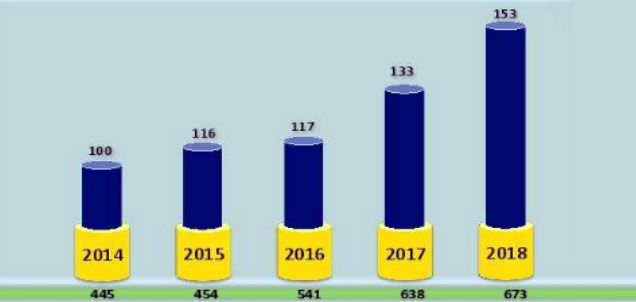
    Indexed growth rate of TV ad revenue 2014-2018: Source TAM Axis (AdEx India)
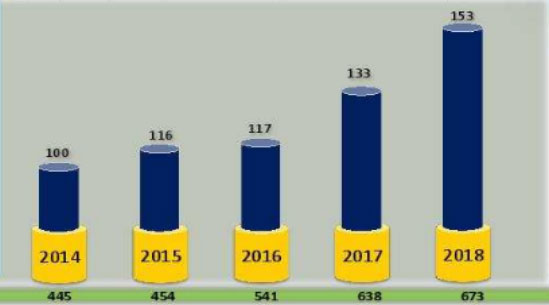
    N.B. The number of channels covered by AdEx is shown under each year in the green line.

    The above table shows that from 2014 to 2015 the index rose by 16 points and after adding only 1 point in 2016, it jumped by another 16 points in 2017 followed by 20 points in 2018. Over the last five years, from 2014 to 2018 there has been an overall growth of 53% in TV advertising revenue.

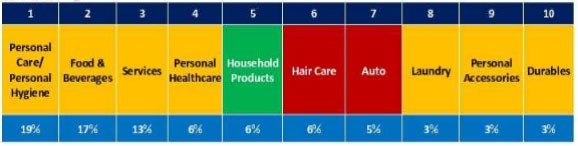
    Top 10 sectors in TV advertising in 2018: Source TAM Axis (AdEx India)

    The Top 10 sectors and the Top 5 sectors respectively account for 81% and 61% of total TV advertising revenue in 2018. While the Top 2 sectors retained their positions, household products rose from rank 7 to rank 5 with 43% growth in TV advertising in 2018 over 2017. Hair Care and Auto ranked lower in 2018 as compared to 2017 while Laundry, Personal Accessories and Durables held on to their ranks.

    It is interesting to note that of the Top 10 categories, 3 (Toilet Soap, Tooth Paste & Perfume /Deodorant) belong to Personal Care/ Personal Hygiene sector; 2 (Washing Powder/ Liquids & Toilet/ Floor Cleaner) belong to Household Product sector; 2 (Milk Beverages & Chocolates) belong to Food & Beverage sector; 2 (Two Wheeler and Cars/ Jeeps) belong to Auto sector and 1 (Shampoo) belongs to Hair Care sector. Though Services and Personal Healthcare hold the 3rd and 4th ranks among the top 10 sectors, no category from the two sectors feature in the list of top 10 categories which collectively account for more than 25% of the total TV advertising revenue.

    Top Ten advertisers accounted for 30% while top 50 advertisers accounted for 56% of the total TV advertising revenue in 2918. Hindustan Unilever topped the list with 10% share, followed by Reckitt Benckiser (India) and ITC who rose from 8th rank in 2017 to 3rd rank in 2018. Wipro and Amazon Online were new entrants among top 10 advertisers in 2018.

    The 2017-18 Annual Report of the Telecom Regulatory Authority of India (TRAI), published last week, indicates that the subscription revenues accounted for 59.5% of the overall TV industry revenue as it rose from Rs 38,7007 crore in 2016-17 to Rs 39,3007 crore in 2017-18. The report quoted the FICCI-EY Report 2018 which indicated that TV advertising revenues rose from Rs 20,1007 crore in 2016-17 to Rs 26,7007 crore in 2017-18, at a much higher rate of 32.8 per cent than reflected in the analysis of TAM Adex data for 2018, albeit referring to a different time period.

    Regardless of different reports based on different time periods, it is a reality that with close to 200 million TV households and 836 million TV viewers In India (Source: BARC Establishment Survey 2018), the Indian advertisers will continue to invest in TV medium for reaching out to the masses. The detailed analysis of TV AdEx data of 2018 by TAM Axis seems to indicate that Indian TV advertising revenue is all set for a roller coaster ride in 2019.

  • Indian Ad Industry: Are Happy Times Really Here Again?


    By Indrani Sen


    Indrani Sen

    Last week, the advertising and media industry probably had an overdose of data and information to chew, both GroupM and Madison released their annual reports on industry AdEx “This Year Next Year” (TYNY) 2019 and “Pitch Madison Advertising Report” (PMAR) 2019; Dentsu Aegis Network’s arm Posterscopre released a forecast for only OOH industry followed by the TAM AdEx Report and the results of the DD Free Dish e-auction held from February 11 to 14, 2019. It will not make any sense to discuss the implications of all the reports together. Let me today take a look at TYNY 2019 and PMAR 2019 released by GroupM and Madison.

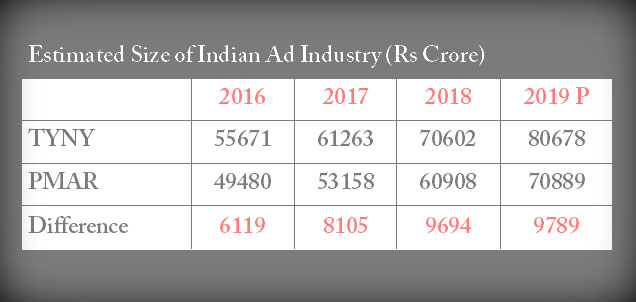
    By now, industry professionals are reconciled to the reality that there is a big gap in the estimation of the size of the Indian Ad Industry by the two agencies. However, as an academic I find it difficult to explain the reasons of the same to my students. I was alarmed to find earlier that since 2016, the gap in real terms increased year on year till 2018 as shown in the chart below. It is reliving to find from the recent reports that the same is not increasing further in the estimates made for 2019 by GroupM and Madison. We can probably hope that in another few years the difference between the two estimates will be reduced to 4% to 8%, the acceptable statistical margin of error at the 95% confidence level.

    Estimated Size of Indian Ad Industry (Rs Crore)
    2016 2017 2018 2019 P
    TYNY 55671 61263 70602 80678
    PMAR 49480 53158 60908 70889
    Difference 6119 8105 9694 9789


    A comparative analysis of the 2018 adspends by media made in the two reports show that the main bone of contention between the two is in the estimated size and share of TV media. Apart from TV, the differences in the estimated size in rupee value of Print, Digital and Radio fall within the acceptable margin of error ranging from 4% to 8%.The estimated size in rupee value are very close for OOH and same for Cinema. The detailed analysis is given below:

    Indian Ad Industry 2018: Estimated Size (Rs Crore) & Share (%)

     Rs. Crore 2018 f   2018  
    Media TYNY %share PMAR %share
    TV 33577 48 23432 38
    Print 17970 25 19467 32
    Digital 12337 17 11706 19
    OOH 3202 5 3365 6
    Radio 2709 4 2144 4
    Cinema 806 1 805 1
    Total 70602 100 60908 100
    Growth over last year 11%   12%  


    In terms of forecasts for 2019, the growth rates predicted by TYNY for different media are lower than the growth rates predicted by PMAR, apart from Radio where TYNY has predicted a higher growth rate than PMAR. Both the reports agree that the highest growth rate will be in Digital media fuelled by mobile, online video and social media, followed by Cinema though on a very small base. In terms of overall growth, TYNY has pegged it at 14%, 2.4% lower than the prediction of PMAR at 16.4%.

    Indian Ad Industry Forecast
    2019p 2019p
    Rs Crore TYNY %  Share Growth % PMAR % Share Growth %
    TV 38612 48 15 27649 39 18
    Print 18368 23 2 20442 29 5
    Digital 16038 20 30 15612 22 33
    OOH 3536 4 10 3750 5 11
    Radio 3116 4 15 2401 3 12
    Cinema 1008 1 25 1047 1 30
    Total 80678 100 14 70889 100 16.4


    Both the agencies have cited upcoming Parliamentary elections and ICC Cricket World Cup 2019 as major contributor to the growth in ad spends in 2019. While Madison have cited increase in government spending to showcase its achievements, the growth of OTT, increased spending in rural sector and India moving to a consumption society as the other reasons for predicting a high growth for the ad industry, GroupM has highlighted major trends like emerging technology, availability of data, content creation and distribution, etc. as factors contributing to the growth in advertising expenditure. There is no doubt that after two bad years in 2016 and 2017, Indian advertising industry has turned around in 2018 and is poised for further growth in 2019.

    Let me turn around and play the role of Devil’s advocate musing over what can disrupt the rosy dreams of advertising industry during next year. Over the last four days all of us are reeling under the effect of the terrorist attack in Pulwama killing 40 CRPF jawans. The entire nation wants revenge and our expectations have increased since the last surgical attack. Such attacks and counter attacks may lead to unforeseen developments affecting our economy and business.

    After the results of the last round of state elections, many political analysts think that BJP may have to depend on coalition with other political parties to run the Government in Centre after the next General Election which may affect smooth functioning of the Government. The gross overspending (Rs. 99610 crores over approved expenditure) by the Union Government as reported recently by CAG may have a diverse effect on various government approved projects in future as well as rural development.

    If RBI falls in line with the directives of the Finance Ministry, then India’s financial ratings may suffer globally and rupee may face further devaluation in its foreign exchange rate. There could be changes in the domestic as well as foreign policies of US which will have far reaching effect on the entire world and India will not be an exception. To sum up, we are living in very uncertain times when any significant change in internal or external political situations or foreign/ economic policies can adversely affect the growth of our advertising industry. Let us keep our fingers crossed and hope that the predictions for the growth in advertising in 2019 made by TYNY and PMAR will be realised without any major disruption.


    List of my articles related to this topic over last three years:


    Feb 20, 2018 Mind the TV AdEx Gap

    Feb 20, 2017 What is the real size of the Indian Ad Industry

    Nov 21, 2016 Post Demonetisation, it’s boom to doom for ad spends

    Feb 15, 2016 Boomtime for Media: A Review of Pitch Madison Advertising Report 2016


  • Indrani Sen: Indian Social media in 2019: “Big Brother” to watch over users

    By Indrani Sen

    2019 will go down in the history of Indian social media as the year when the “Big Brother” started watching over Indian social media and the users lost to a large extent their rights to privacy and freedom of expressing their thoughts. As we get ready for the general elections in May 2019, the Indian government is planning to change its IT rules to control fake news and curb spread of misinformation under the pretext of maintaining the “sovereignty and integrity of India”.

    The changes in the IT rules proposed by the Information and Technology Ministry towards the end of December, 2018 and open to public comment till January 31, 2019 have sparked some protests from civil rights activists and ensued debates among select experts in cyber media law regarding its scope and interpretations. We have seen fresh news reports over the last couple of days about global social media and technology companies getting ready for legal actions against the proposed regulations.

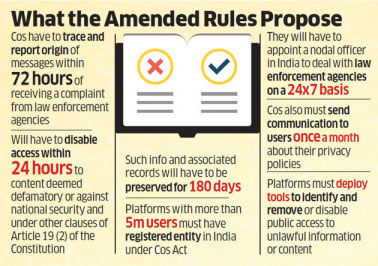
    The new rules, when implemented, would compel all social media platforms to remove unlawful content, such as anything that affected the “sovereignty and integrity of India” within 24 hours. It calls for 24X7 surveillance of 100% of the posts, comments, chats, etc. by all users of social media in India which is estimated to be close to half a billion.  If implemented, this will increase the cost of operations of the social media platforms which eventually will affect the consumers apart from depriving them of their rights to privacy and freedom of expressions as mentioned earlier. The safe harbour protection currently available to intermediaries, which is an integral part of the way the social media business is run, is under threat of removal under the proposed rules.


    Please see the link https://economictimes.indiatimes.com/tech/ites/govt-plans-amending-it-rules-to-curb-social-media-misuse/articleshow/67232660.cms  for details of the proposed rules, a glimpse of which is shown below.


    Infographic: https://economictimes.indiatimes.com


    Indian social media was all set for a roller coaster ride in 2019. Read an article on January 3 in www.socialsamosa.com by Vijay Shenoy, AVP Operations South, WatConsult, highlighting four trends that we can expect to see in social media during 2019: moment marketing, video marketing, applications of augmented reality and influencer marketing in a mobile first Indian market with estimated 258.27 million social network users. The global trends showed that Facebook will have a strong growth of users from Asia-Pacific region headed by India with US accounting for only 10% of Facebook’s global base. Instagram and Snapchat are both expected to grow globally in 2019 and again India will be contributing substantially to their growths.

    In a report on the forecasts and predictions for social media in US in 2019, www.emarketer.com  commented “We expect an explosion of stories and vertical video across the digital landscape. That will lead to the inevitable swing of the pendulum toward backlash and questioning about stories’ effectiveness. Facebook will work hard to promote the format to users and advertisers, but the feed will remain the dominant way users use the app”. In India we are already seeing Facebook and Snapchat investing in the original video content and introducing new tools and features for their users.

    In 2018, social media giants had started actively implementing certain steps against fake news and misinformation generated by users. Managing the election-related interference in 2019 is an uphill task and Facebook announced in October 2018 that they are establishing a task force in India to ensure that users do not abuse their platform. Now the proposed “censoring” of all social media content by the Indian Government with a very steep implementation dead line of removing the “undesirable content” has baffled all social media owners and as per various reports in media they are busy taking legal opinions on the proposed amendments in Indian IT rules.


    The users of social media in India have not yet woken up to the full implications of the rules on their rights of privacy and freedom of expressing their thoughts. We have also not seen much of expert opinions expressed on the topic across different media. In 2016 when Facebook proposed their plan for introducing “Free Basics” in India, we had witnessed much more uproar in our public domain. This proposed amendment in our IT rules has far more serious long-term implications, but strangely till now there have been very little public views with 18 days left for commenting on the same.


  • Indrani Sen: Looking back at 2018

    By Indrani Sen


    2018 has been an interesting and inspiring year for the Indian media industry. After struggling with the aftermath of demonetisation in 2016 and the GST in 2017, the industry saw a year without any external interruption and was able to regain the momentum of growth. We have to wait for another couple of months before we get the estimates for 2018 and the projections for the future from various industry sources, but market indicators show that traditional media industry in India has good reasons to welcome tonight 2019.

    Indian traditional media has continued to remain resilient inspite of the growth of the digital media. Globally, 2018 would perhaps go down in history as the watershed year in advertising industry when the old guard bowed down to the new generation, best illustrated by the announcement made by  WPP in November 2018 to merge the traditional agency J Walter Thompson and digital agency Wunderman to form a new agency ‘Wunderman Thompson’. Abi Dan wrote an article in Frobes on the merger where he commented “While these are positioned as mergers of equals, they are essentially a takeover by the digital agencies of their older siblings.”

    Against this global backdrop, traditional media continued to thrive in India in 2018 and the momentum is likely to last till we usher in the third decade of the new millennium in two year’s time. For Print, the oldest medium in the traditional media team, 2018 began on a high note with IRS 2017, released in January 2018, showing a growth of 9% in total newspaper readership from 2014 to 2017 and reiterating the reach and strength of the print media in the digital age. The continuous growth of the regional newspapers which sustained during 2018 indicates that Print in India is going to write its own history. The “fake news” controversy and the “#MeToo” movement made some scratches on the reputation of some publications, but did not have any lasting effect. On the other hand, digital media bore the brunt of the “fake news” more heavily and made readers turn to the printed words for assurance.

    The various new ventures and deals in the Television sector announced in 2018 showed clearly that the medium is thriving for growth. The process of merger of Dish TV India of Essel Group with Videocon D2h was completed in 2018. Essel Group announced in November 2018 its plan to divest up to 50 per cent of its stake in ZEEL to ensure disruptive technological advancement and transformation of the company into a digitally equipped media tech firm. The decision is expected to be processed and implemented in 2019.

    Reliance Jio announced in July 2018 Giga TV set-top boxes which will have the ability to use Internet to offer live TV and live interaction through Jio TV Call. This announcement was followed in August 2018 by the announcement of Jio Giga Fibre, an ultra-high speed fixed line broadband service for homes and enterprises. Jio also made substantially large primary and secondary investment in Den Networks and picked up majority stakes 51.3 per cent in Hathway Cable and Datacom Limited.

    After winning the media rights of Indian Premium League in September 2017, Star TV managed to increase the overall viewership of IPL 2018 through successful implementation of their marketing strategy in national and regional markets.

    E-Auction of DD Free Dish slots was postponed from 2018 to 2019, probably in view of the uncertainty around the implementation of the new tariff policy announced by TRAI. . The next E-Auction of DD Free Dish will play a significant role as all TV viewers will have to pay a fixed base rate for getting access to the free to air channels and then choose the pay channels as per the rate cards.

    Early in 2018 we saw Star India & Star Viay challenging TRAI’s new guidelines related to the tariff order (issued in 2016) in Chennai court. After Chennai High Court ruled in favour of TRAI, Star India made an appeal in the Supreme Court, who also upheld the order of TRAI in October, 2018.  The year has ended amid a lot of confusion related to the implementation of the new tariff order forcing TRAI to extend the deadline by a month from end December 2018 to end January 2019.  Most of the large TV operators have announced their own package deals for subscribers, but the distributors are not offering the same as TRAI has not given any guideline related to such package deals and how the revenue of the same will be shared between the TV channels and the distributors. It remains to be seen if the consumer actually benefits from the new tariff orders or emerges as the looser, particularly in small towns and rural belts.

    Radio, the older yet weaker sibling of the Broadcast media, managed to retain its share of business against the financial disruption caused by demonetisation and GST in 2016 and 2017. The same trend continued in 2018 when we saw the base of FM Radio expanding with many of the new radio stations sanctioned in the Phase III Auction going on air. FM radio stations have been actively integrating for some time their on-ground activations with digital content through innovations which has helped in their overall growth of revenue. 2018 was no exception to the same. While the growth of Radio Adex has remained moderate in 2018, the overall growth in revenues of the radio stations has probably seen a healthier growth riding on the rapidly growing digital and social media.

    During 2018, OOH has recovered from the effects of demonetisation and GST but we did not see much growth in Digital OOH which was expected. Due to lack of a proper Adex system in outdoor medium, its revenue as well as growth has been getting under estimated over the years and 2018 has not seen any change in that condition.

    According to the industry sources, the cinema advertising has seen a healthy growth in 2018 riding largely on in film advertising, particularly in regional cinema. Again, this growth may not get reflected in the overall calculations of advertising expenditure in 2018 which we will get to see in another couple of months.

    As predicted, Indian digital media has grown in an exponential rate during 2018, in spite of the disturbance created by “fake news” etc. The growth has been helped by the increase in internet access through mobile internet and various forms of internet advertising.  Video Games and on line streaming of music and movies have continued to accelerate the growth. The international and homegrown OTT players have also helped in the overall process of digitization of media exposure in India.

    To sum up, 2018 has been a fruitful year for media industry in India with lot of activities across different media. It is expected that the growth will not only continue but will accelerate during the first half of 2019 riding on the upcoming General Elections.


  • Indrani Sen: Should the A& M Industry allow a TV Ratings blackout?

    By Indrani Sen


    Indian nroadcasters are apprehensive of the effect of the consumer friendly new tariffs order which TRAI plans to introduce from January 1, 2019 allowing the viewers to chose and pay for only the channels which they want to watch. According to a report carried by ET today, the Indian Broadcasters Federation (IBF) is worried about the implications of the new tariff order on the channels with relatively less viewership which are currently riding on the more established and popular channels from the stable of the same broadcaster. Therefore, IBF, which has majority shareholding in BARC, is planning to put up a proposal to the Board of the monitoring agency to suspend the TV ratings monitoring reports for 45 to 60 days (https://brandequity.economictimes.indiatimes.com/news/media/broadcasters-want-a-tv-ratings-blackout-of-upto-two-months/67018521).

    While I feel that the new tariff order of TRAI is restrictive in nature and puts a lot of constraint on broadcasters by dictating them how they should set up their pricing policies for the marketing their bouquet of channels to the consumers in the market place, I think it is also not right on the part of the IBF to request for a TV Ratings blackout for almost two months. If we look at the current marketing strategies and pricing policies followed by publications, we find that there are ample examples of newspapers and magazines offering combo-pricing of titles to the readers. Long time back, a few years after Independence, the government tried to introduce an act for controlling the number of pages and pricing of newspapers ie. Newspaper Price & Page ACT 1956, which had to be withdrawn later as the Supreme Court ruled it as unconstitutional. Currently, there are some pending legal cases filed by broadcasters against the TRAI tariff order pending in various courts.

    With three weeks to go before the new tariff order is to be implemented, the Cable & TV industry is in doldrums with no clarity on how the new tariffs order should be implemented.  The broadcasters are justified to be concerned about the future of the long-tailed channels which are riding piggyback on their more established channels. However, their concern does not justify their plan for a blackout of the TV ratings for two months. I presume by proposing a blackout, IBF does not want to put a stop to the continuous monitoring process which will be disaster. I hope IBF just wants to stop the publication of the ratings reports by BARC.

    While setting up the rules about who can operate as a Broadcast Monitoring Agency in India, our I&B Ministry was concerned about the ownership and shareholding pattern of the incumbent monitoring agency TAM, but they did not foresee the hidden implications of a Broadcast Monitoring Agency formed as an industry body with majority of shareholding by the association of broadcasters. If the A&M industry allows this proposal to get implemented, it may just be the beginning of many other high-handed moves by IBF exercising their majority shareholding of BARC.


    Indrani Sen is a media agency veteran and now an academic and strategy consultant. She writes fortnightly – and often weekly – for MxMIndia. Her views here are personal


  • Indrani Sen: Digital has hardly affected popularity of TV and Print in India

    By Indrani Sen


    Last week, I read the Executive Summary of the eighth Global Media Intelligence Report by eMarketer (file:///C:/Users/Lenovo/Pictures/GMI-2018-ExecutiveSummary.pdf). As I am not a PRO subscriber of eMarketer, I was not able to access the full report which covers 40 countries across the globe and has been conducted by eMarketer in collaboration with Starcom on the state of global digital media.  But the Executive Summary revealed some interesting trends which are worth sharing with the readers of www.mxmindia.com.

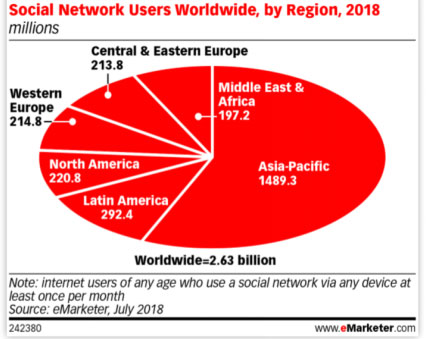
    Among the four key trends shown in the report, it reconfirms that the “World has gone mobile” and “World internet users have also embraced social networking”. On top of that, the statistics further shows out of the total social network users worldwide, the Asia-Pacific region accounts for 57% of the users as shown here.

    According to the data released by TRAI, India’s total mobile phone users have touched the 1 billion mark, of which smart phone users are over 300 million. In other words, we have a bigger number of smartphone users than each of the four regions, i.e. Western Europe, Central & Eastern Europe, North America and Latin America!

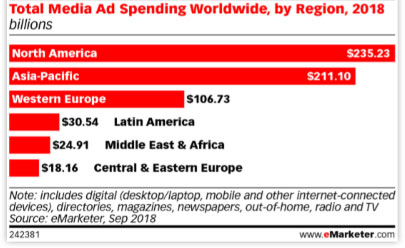
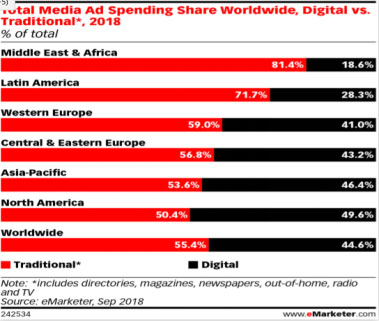
    The above chart shows the estimates of the total media ad spending by regions, where Asia-Pacific ranks second after North America.  The chart below shows the split between traditional media and digital media by different regions, where traditional media is enjoying 53.6% share in the ad spends of the Asia Pacific region.

    The report’s third insight says “Individual markets are just that: Individual” quoting different trends of different markets. It comments that “Print media were particularly strong in India; newspapers rivalled TV for penetration among internet users there in H1 2018”. The fourth trend quoted by the Executive Summary says that “Digital has hardly dented TV’s popularity”. The findings of the report have shown that television remains by far the most popular content-based medium despite the explosion of content over digital platforms. “In every country surveyed by GlobalWebIndex, a majority of internet users took advantage of the myriad options now available to view TV content at all hours, and on a range of screens—including TV channels’ catch-up services and video-on-demand providers such as Netflix and MUBI, as well as video recorders”.

    Indian advertisers, who use TV as their main medium for advertising and rely on print for creating topical/ immediate impact, will find the findings of this survey reassuring and useful.


  • A 4-tier formula for curbing #MeToo complaints


    By Indrani Sen


    A lot has happened during the last couple of weeks after the #MeToo movement started in India. I was holidaying among the tranquil hills in Himachal, blessed often by connectivity problems and it took me a while to catch up with the tide of events on my return to the plains. This website www.mxmindia.com has been most vociferous in supporting the #MeToo movement since its floodgates opened in India. Ranjona Banerji has posted three articles on the issue within a week, “Stop the silence about Sexual Abuse” on October 5, “Speak up and support” on October 9 and “All sexual assault is assault. And it needs to be condemned and action taken” on October 12.  Sanjeev Kotnala wrote on October 9 “Are you too guilty of silence?” and proposed #MeTooGuilityofSilence and #NotMe after evaluating your own behaviour. Shailesh Kapoor wrote “Time for men to shut up and listen” on October 12.

    I wholeheartedly support the views expressed by the three fellow-columnists. Banerji has done a great job and I am sure she will continue to fight for the cause till the industry leaders come up with a tangible solution. I doubt if Indian men will respond to the excellent suggestions made by Kotnala. There has always been a strong sense of belonging to the “Boys’ Club” among male executives across industries, so those who are not guilty of sexual harassment would hesitate to openly condemn the guilty boy and throw him out of their club. Kapoor’s call to men asking them to shut up and listen is most appropriate and we can only hope that out of the silence some sense and sensibility will emerge.

    I personally do not have any #MeToo stories to relate, but during my time in the industry I did witness some incidents where I always counselled the victim and tried to either speak to the predator or his boss which ever seemed to be suitable under specific circumstances.  In the process, I often picked up fights which definitely were not my own, but never baulked or regretted my actions. Recently a friend shared with me a column by writer Geetanjali Arora  on the issue. While I do not agree with all her views, I would like to quote a line which reflects my own belief “The Shakti does not wait for a later date to speak up; she silences the evil on the spot…”

    Women of the industry are lending all their support to the cause. Network of Women in Media in India (www.nwmindia.org ) is giving wide coverage to the issue and extending a helping hand to all women journalists.  A number of senior women executives of Indian Advertising issued an open letter to all ladies working in advertising on 10th October through Economic Times’ Brand equity https://brandequity.economictimes.indiatimes.com/news/advertising/dear-ladies-this-open-letter-from-senior-ad-women-is-all-about-hope/66150679 which was subsequently carried by all social media networks. Brand Equity followed up with an article assessing and reporting on the effects of the #MeToo movement and the reactions of different advertising and media agencies on 12th October https://brandequity.economictimes.indiatimes.com/news/advertising/metoo-times-up-for-indias-mad-men/66134945.

    So, where do we go from here? Will the exposures through #MeToo campaign stop the menace of sexual harassment in workplace from now on? Can we be assured that work places would be safe for all young girls aspiring for a career in Media and Communication Industry in India? Can we promise them that they would not be haunted any more by any male predator in their workplaces? No, it is not going to be so simple. There will be a lull following this social media storm, but the roots of the problem would stay buried under the debris of the scandals and unwanted mushrooms of sexual harassments will spring up in future. What we need is a continuous solution, an internal forum to address such complains and to take actions against the guilty men in order to assure the safety of our women at work places in media and communication industry.

    Union Minister Maneka Gandhi has been talking about a committee of judges to address sexual harassment issues but most victims in our industry would hesitate to get involved in such a complicated long drawn affair. I suggest a “four-tier formula” for addressing the issues of sexual harassment in workplaces in Media & Communication Industry. Firstly, our Industry bodies need to ensure that all their members adopt the “Vishakha Guidelines 1997”and the subsequent “Sexual Harassment of Women at Workplace (Prevention, Prohibition and Redressal) Act 2013”. Secondly,  all organisations must make it mandatory to mention in their appointment letter their policy for prevention of sexual harassment in the workplace and the consequences of such behaviour. Thirdly, there should be a dictate issued by industry bodies to all member organisations for conducting  workshops for all employees on the above Act from time to time and discuss the issues openly, a move that Hindustan Times has taken already as reported in exchange4media last week https://www.exchange4media.com/media-print-news/metoo-hindustan-times-to-organise-mandatory-workshops-for-employees-92499.html.  We can hope that these workshops will encourage women to report immediately about any sexual harassment which they may be subjected to in the workplaces. Fourthly, each member organisation should have a high level internal committee for looking into such complaints of sexual harassments by their employees. All such committees should have representation of women and in case the organisation does not have a suitable senior woman to take up the responsibility, they should invite senior industry ladies as honorary members of the internal committees. The committee would review the complaints and take suitable actions against their male employees if found guilty of any misconduct.

    We can hope that if such a four-tiered formula can be implemented in our media and communication industry, then we will be able to provide a safe working environment to all our women employees in future.


  • Indrani Sen: Wanted a stronger industry body for Telecom

    By Indrani Sen

    About two months back, on July 11, 2018 the Telecom Commission (TC), the highest decision-making body in the telecom ministry, approved TRAI’s recommendation on net neutrality rules that prohibit internet service providers (ISPs) from discriminating between their web traffic. This decision ensured that internet for Indians will continue to remain free without any discrimination or restriction.

    BBC said earlier that India has “the world’s most progressive policy on equal internet access for all” and we continue to hold that status. India’s reaffirmation of net neutrality has come at a time when the Federal Communications Commission (FCC) in the US repealed its free internet rules in December 2017 and allowed internet providers to charge more for certain content or giving preferential treatment to certain websites through commercial agreements.Recently, on August 31, 2018,California state lawmakers passed a bill preventing internet service providers (ISPs) from blocking traffic or providing so-called fast lanes. For the bill to become law, it has to be approved by the Governor of California by the end of September.

    The telecom operators in India are not very happy with this decision of the Telecom Commission as they feel that they need to have some control to manage the traffic going through their infrastructure for which they have made investment of crores of rupees. They also think the ruling would curtail the scope of innovation on the medium as ISPs cannot offer any fast lanes for content providers who are ready to pay for the privilege.Young talents within the Advertising & Marketing industry engaged in designing and implementing delivery of content, particularly on various OTT platforms will also be disappointed with the limitation on the scope of innovation.

    This decision also means the ruling that service providers cannot make any agreements with services like Facebook’s ‘Free Basics’ or Airtel Zero (services banned later by TRAI) offering only a set of services or websites for free, stays on. However, some critical services and emerging technologies like remote surgery and autonomous cars requiring high-speed internet lanes have been kept out of the ambit of net neutrality rules.


    The telecom secretary Aruna Sundararajaninformed the media that a committee formed by the Department of Telecom will shortly draw up a list of the technologies that will be allowed the exception and theTelcos will be allowed to use traffic management practices to maintain the quality of service for them as and when required. CDNs (content delivery networks) will also be treated as an exception and will be out of the ambit of the restrictions of net neutrality. It is not clear how the government proposes to regulate the operations of CDNs in India.


    Some of the media reports mentioned about Government’s plan for spreading WiFi hotspots to rural India. Hindu Business Line reported that “An official, who was part of the meeting, said that the TC has also approved installation of around 12.5 lakh WiFi hotspot in all gram panchayats with viability gap funding of around Rs 6,000 crore by December 2018”.(https://www.thehindubusinessline.com/info-tech/net-neutrality-telecom-panel-approves-trai-recommendations/article24389534.ece). The Commission also cleared the new“National Digital Communications Policy 2018” for approval by the Union Cabinet at the same meeting.


    Subsequently on August 19, www.livemint.com  reported about TRAI starting consultation for traffic rules for net neutrality – “The telecom regulator will soon start consultations over a framework for traffic management practices as well as the structure of a multi-stakeholder body outlined in the net neutrality principles, according to a senior TRAI official”. (https://www.livemint.com/Industry/cvf8xlYB4PpBy5NT25AmsI/Trai-consultation-soon-on-traffic-rules-for-net-neutrality.html).

    Currently, there is a need of a strong industry body for the telecom sector. In 1995, Cellular Operators Association of India (COAI)https://www.coai.com/about-usbut unfortunately the association does not function as the spokes person of the industry, nor does it take a leading role in negotiating with TRAI and the Telecom Ministry. There is strong competition among the telecom companies and currently the sector is facing a financial crisis largely triggered by price wars since Mukesh Ambani-led Reliance Jio’s entry. However, considering the emerging importance of the sector in shaping the digital future of India, the telecom companies should get together and form a stronger association to lead the interactions with TRAI and the Telecom Ministry for forming the rules and regulations.


  • Here’s how the various M&E reports compare…


    By Indrani Sen


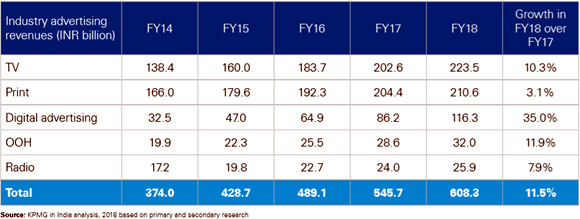
    The Media & Entertainment Industry has got another report which was released last week by KPMG, the longstanding partner of FICCI whose tie-upended in 2017 when FICCI awarded its M&E report mandate to EY. So, the Advertising and Media industry has now several reports to refer to for estimating the size and the growth of Indian Advertising Industry. KPMG has reported the following estimates and predictions for Indian Advertising Industry:


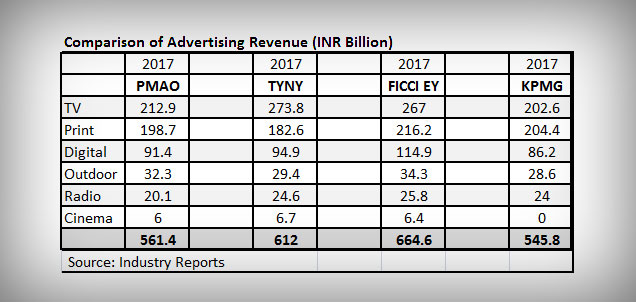
    How do these reports compare when it comes to estimating the total advertising expenditure in India? The following table will give the top line information:

    Comparison of Advertising Revenue (INR Billion)  
      2017 2017 2017 2017
      PMAO TYNY FICCI EY KPMG
    TV 212.9 273.8 267 202.6
    Print 198.7 182.6 216.2 204.4
    Digital 91.4 94.9 114.9 86.2
    Outdoor 32.3 29.4 34.3 28.6
    Radio  20.1 24.6 25.8 24
    Cinema 6 6.7 6.4 0
      561.4 612 664.6 545.8
     Source: Industry Reports    

    The above analysis shows us that TYNY and FICCI reports estimates are in one bracket with PMAO and KPMG reports in another bracket with a large gap in estimates between the two brackets. For two consecutive years, the TYNY and PMAO reports were released during the same week in January. TYNY closed the estimate for total ADEX 2017 at Rs 61,263 crore with a growth rate of 10% over 2016and PMAO showed a growth rate of 7.4% in 2017 over 2016 and estimated the total ADEX as Rs 53,138 crore in 2017.

    Digital is going to have the highest growth in ADEX as perthe two studies, 30% according to TYNY and 25% according to PMAO. KPMG has pegged the Digital growth rate even higher at 35%. Both reports predict 13% growth in TV AdEx and 4% (TYNY) and 5% (PMAO)in Print AdEx. KPMG has reported lower growth rates for both TV (10%) and Print (3%).

    PMAO and TINY both agree that the highest growth after Digital will be achieved by Cinema (20% TYNY & 14% PMAO) which has the smallest share of the advertising pie. The FICCI EY 2018 report shows statistics for cinema industry revenue from domestic theatrical, overseas theatrical, cable and satellite rights, digital/OTT rights, in cinema advertising and home video.  KPMG has not been reporting in cinema advertising in FICCI reports over the last few years as they have been clubbing it with digital/OTT rights and home video as ancillary revenue stream and they have continued with that trend in their own report. As the FICCI EY report 2018 has shown the detail break ups and I have taken the liberty of using the in cinema advertising revenue as a part of FICCI-EY total advertising projection. However, the growth rate cannot be estimated without access to KPMG’s research data.

    Both have shown similar percentile growth rates for OOH and Radio (15% TYNY & 10% PMAO). The KPMG report also predicts good growth rate for OOH (12%) and Radio (8%). The FICCI report and the Group M report are closer in terms of overall projections, but they differ in details but more or less agree about trend of growth in digital media.

    Before KPMG, we also had the DAN Report with estimates closer to PMAO and now KPMG. The Pitch Madison report and the DAN report are closer in terms of overall projections, though they differ in details, particularly in case of digital media


    Source: DAN Report 2018

    The gem of an insight which KPMG has been able to mine and share with the Advertising & Media Industry is reflected in the following quote: “This year, we saw telecom-media-technology (TMT)convergence take centrestage and the emergence of media ecosystems…. media companies need to take a relook at their strategies and business models to successfully operate and thrive in the new paradigm.”

    This insight adds a tremendous value to the KPMG 2018 report and warns the industry about the significant changes which we are going to experience about how media is created, distributed and consumed by Indian consumers.  We will not be able to borrow a business model from another country, as the Indian model will be unique. Our law makers, particularly TRAI needs to tighten their belts and churn out rules and regulations capable of dealing with the changes in media consumption along with the ongoing changes at a pace which will keep pace with the TMT convergence.


    The KPMG report and executive summary can be accessed at :https://home.kpmg.com/in/en/home/insights/2018/09/india-media-entertainment-convergence-report.html


  • Indrani Sen: IBF Pitching Against Pitch Discount

    By Indrani Sen


    Recently we saw an unprecedented move from the IBF chief Punit Goenka who sent an email to all agency heads asking them to take prior approval from the broadcasters before quoting any discount on their channels to the advertisers particularly during pitch presentations. So far, most of the agency heads have refrained from commenting on the same; advertisers, who actually instigate such practices and demand the same from the agencies, have been totally silent. We read an anonymous comment in exchange4media on August 13. “In a free market, only demand and supply determine prices,” said the head of a leading agency when asked to respond to the concerns raised by the Indian Broadcasting Foundation (IBF) on ‘pitch discount rates’.

    The process of an AOR pitch is supposed to be confidential and the idea of getting a prior approval on the rates quoted/ used for arriving at the savings would betray the confidentiality. Even if we imagine that agencies would agree to observe the IBF dictate, on what basis would a broadcaster differentiate the discounts offered to multiple agencies pitching for the same business? How can the agencies at the stage of pitching agree to the terms and conditions of the broadcasters offering the same or differential rate discounts to them based on certain guaranteed business without the consent of the advertiser concerned? Globally, there is no such precedence of getting approval from media owners on rate discounts before making any media pitch.

    Including an offer of rate discount in a media AOR pitch is not a new practice, it has been existing from Day One of the system. In fact, it is the crux of the approach on which advertising agencies were divided into creative and media agencies was the efficiency of media buying (read as discounted rate) based on large volume of media buying  Similarly, “Pitch Discount” has been an integral part of pitching for any media AOR business. This change in the mass approach of buying and selling media has been in practice for two decades, beginning in end of 1990s. It was accepted by the all the players in the market (media owners, advertisers, agencies) and has been running without any major hitch. So, what has prompted IBF to raise this issue with the agencies now?  Why are the broadcasters gunning for only the agencies without having a tri-party discussion involving the clients?

    It is the advertisers who actually gained most from the system of dividing the creative and media portfolios of their advertising agencies. When the break-up took place, the traditional 15% commission was split into 12.5% for creative function and 2.5% for media function. Working in the media segment, I never understood the logic of marginalising the value of the media functions to one-fifth of the value of the creative functions. Media agencies have been struggling to make profit within the frugal 2.5% service fees since then. In some cases, their service fees have been raised to 3% or 3.5% or some incentives have been added on ROI delivered by the media plans. On the other hand the service fees of the creative agencies have been delinked with the value of the annual advertising expenditure. The creative agencies now get annual fees for their services based on the terms of their contracts varying from 5% to 8% of traditional media expenditure. The practice of calculating the creative agency fees based on traditional media expenditure has been becoming obsolete over the years. So, it is the advertisers who have laughing all the way to their banks.

    It appears that the IBF members are concerned about the drop in their business margins. If there is a pressure on the margins, it is not just due to the rates negotiated by the media agencies, the growth in number of TV channels, rural ratings reported by BARC, rise of the digital media the change in the process of delivery of video content have all added to the pressure on the business margins of the broadcasters. Last week, we saw an article in Brand Equity on the phenomenon of Indians shifting from cable or Dish TV connections to OTT platform for video streaming and viewing(https://brandequity.economictimes.indiatimes.com/news/media/cutting-the-cord-many-indians-are-skipping-cable-to-binge-on-video-streaming-services/65383783). The shadow of Programmatic Buying getting extended to TV spots is also looming large on the TV industry. So, broadcasters have to take a pragmatic view of the overall situation instead of zeroing on the “Pitch Discount” offered by the media agencies.

    The IBF members are at a liberty to refuse a discount promised by any agency to an advertiser which will leave the agency to stew in its own juice. In order to implement such a step, IBF needs to have a control over their own members so that when one broadcaster refuses to accept any discount, another broadcaster would not agree to accept the same. Instead of controlling their own members, IBF is contemplating taking stringent actions against agencies even to the degree of revoking their accreditation (https://www.exchange4media.com/spotlight/margin-pressures-push-industry-to-find-solutions-to-pitch-discount-issue_91580.html) which is totally unfair. It is strange that when IBF includes representatives from agencies and advertisers, such a move has originated without a tri-party discussion at industry level involving AAAI and ISA.


  • Cable Operators Up in Arms


    By Indrani Sen


    Recently, cable operators have raised an objection to the new tariff order issued by the Telecom Regulatory Authority of India (TRAI) as they feel that the new directives would have more negative impact on their business. The All Cable Operators Association of India (ALCOAI) has brought their problems to the notice of TRAI in writing twice during the last one month. The Association claims that the cable operators have suffered losses running into crores in the last financial year due to the promotion of the OTT platforms by the broadcasting companies and the consumers taking advantage of the alternative viewing options.

    In its tariff order, TRAI has directed broadcasters to declare the maximum retail price (MRP) and nature of all their channels within 60 days from the date of notification issued on 03.07.2018.  However, there is no directiveon the tariff rates for telecasting the same programme content on internet via over the top (OTT) platforms. As per the current rules, the broadcasting companies can stream the channels on internet without having to worry about the tariff order or any permission from the government for downlnking the content.

    The ALCOAI has pointed out that due to technological changes, they have lost first a significant share of their customer base to Dish TV operators and more recently to OTT platforms, particularly after the launch of JIO leading to fall in internet data rates.

    The Association claims that according to information available with them, most of the OOT and IPTV operators have neither got permission from Indian Government to provide services in India nor are they registered as Distribution Platform Operators (DPO) by the I&B Ministry.  In this connection ALCOAI has citied an old notice of the Ministry of I&B dated 23.12.2015 restricting the broadcasters from giving access to their signals to any non-registered distribution platform operators. The cable operators have also claimed that pornographic content and non-permitted channels are being distributed without any regulatory control through the OTT as well as IPTV services.

    These allegations by the cable operators are serious if they are found to be correct. Our media lawmakers need to investigate into the complaints ASAP and take corrective measures.  However, it is difficult to believe that any prominent OTT/ IPTV player would start their services without completing the required legal formalities for operating in India. The consequence of such actions would be leading to legal actions against them with financial implications.

    Earlier this year, we learnt from media reports that TRAI was planning to regulate online video streaming platforms by inviting consultants’ views on the same. The sooner TRAI introduces such regulations would be better for all concerned. The technological changes which are sweeping over the global markets cannot be stopped or stalled by introducing media regulations. So, TRAI needs to ensure a fair playing ground for all the different types of operators involved in the distribution of the content of the broadcasting organisations as well as independent video content competing with the content of TV channels. TV will be enjoying the highest share of the advertising expenditure pie for quite a few years to come. It will be unfair for the cable operators, who pioneered the distribution of satellite TV channels in India,  if they get marginalised in the process of TV distribution through legal rigmaroles.


    Indrani Sen is a veteran mediaperson and educator. The views here are personal

  • Indrani Sen: Indian TV writing its own script for growth

    By Indrani Sen


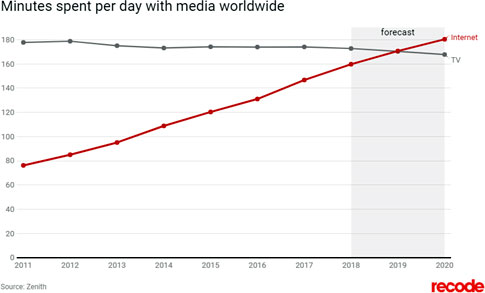
    The latest Broadcast India 2018 survey by BARC indicates that like Press, TV in India is going to set another trend which will be contrary to the global trend. By 2020, people around the world will spend more time online activities than watching TV, as predicted by Zenith. In a recent article on June 8, 2018, Rani Molla shared the global forecast made by Zenith. (https://www.recode.net/2018/6/8/17441288/internet-time-spent-tv-zenith-data-media)


    BARC’s latest Broadcast India 2018 survey states that in urban areas, average time spent (ATS) per viewer is about 246 minutes, while in rural India, it is about 207 minutes with an all India average of 224 minutes. It is unlikely that in the next five years Indians will spend less time watching TV than the time spent on online activities.

    As per www.statista.com, in 2016, Americans watched 274 minutes of TV per day, while people from India only watched 140 minutes per day. What was interesting to note that Americans spent 240 minutes watching live TV and a further 34 minutes watching time-shifted TV (https://www.statista.com/statistics/276748/average-daily-tv-viewing-time-per-person-in-selected-countries/). The Indian viewers have come a long way from 2016 with 60% increase in their time spent on TV over two years. As TV viewership in India is driven by family viewing and only 17% of the households are nuclear family with elders, time shifted viewing may not be a significant feature of our TV viewing habit.

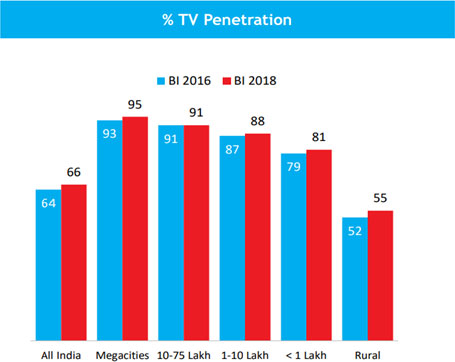
    According to the FICCI EY 2018 Report on Indian M&E Industry, 2017 TV ratings saw the impact of BARC’s enhanced weightage on rural panel. The same has also been reflected in the BI2018 survey with TV homes outpacing the growth of total number of homes in India. India currently has 298 million homes, of which 197 million have a TV set with 88 million located in urban and 109 million located in rural areas. While there is a scope of adding almost 100 million more TV homes to the existing 197 million TV homes, the opportunities for growth is higher in below 1 lakh towns and in rural areas.

    Source: BARC Universe Update- July 2018

    The BI 2016 and BI 2018 both covered 3 lakh households selected on the basis of stratified random sampling with 68% from urban and 32% from rural areas. Considering that 55% of TV homes are located in rural areas and the percentage is likely to grow further, a further correction by BARC may be required in the spread of their audience panel in order to do justice to the distribution of TV homes across population strata.

    As per the press release issued by BARC , both HSM and South markets have seen a spike in viewership with HSM saw an increase of 12%, while South grew by 10% in week 29. In BI2018 survey, the overall penetration of TV stands at 66% with all the states in South India having more than 91% TV penetration. Maharashtra, Gujrat, Punjab, Haryana, Himachal Pradesh and J&K follow with TV penetration of 80% to 90%. A vast land mass across the country from Rajasthan to Madhya Pradesh, Chhattisgarh, Odisha, West Bengal and North East have more scope of growth with current TV penetration of 45% to 59%. In the Hindi hinterland, UP (30% to 45%), Bihar and Jharkhand (both below 30%) are at the bottom of the table re-emphasising the dilemma of the advertisers targeting these markets through traditional media. West Bengal with as large bouquet of regional channels as the Southern states remains an enigma with its comparatively low level of TV penetration.


    On 27th July www.mxmindia.com quoted Partho Dasgupta, CEO, BARC India: “With BI 2018 we have been able to showcase the changing face of India. However, what hasn’t changed is the fact that TV remains the most effective platform for both content creators and advertisers to reach their audiences.”

    The Media & Advertising Industry will agree wholeheartedly with Dasgupta and we will see dominance of TV’s share in our advertising media pie continuing in the next decade challenging some media forecasts which have predicted a shift towards digital advertising.