
Tag: Indrani Sen

  • Wanted: A Greater Push for Programmatic!

    Credits: Janajech/Wikimedia Commons


    By Indrani Sen


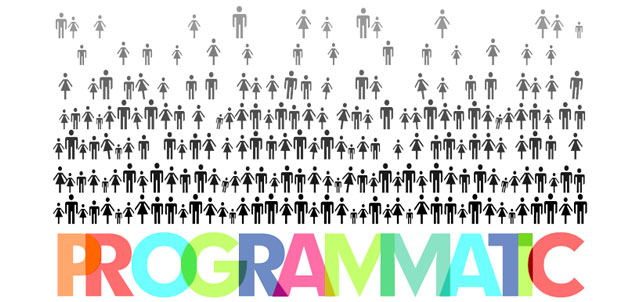
    Programmatic advertising, the automated process of digital media buying, has been taking baby steps towards growth in India. According to the FICCI-EY Report on Indian M&E Industry 2018, around 10 to 15% of our digital advertising was routed through the process of programmatic buying in 2017 and that share is expected to increase to 50% by 2020. It is going to bea huge jump from 10 to 15% of the digital advertising spends 119 INR billion in 2017 to 50% of the projected digital advertising spend 224 INR billion in 2020 in three years!

    Last year in September, when Guy Gibbs, director, Google’s ad serving arm Double Click Asia-Pacific (APAC) visited India, he said in an interview given to www.livemint.com that demand for programmatic advertising is not consistent in India and stressed on the need for raising awareness among publishers and advertisers. He also indicated that Google aims to drive programmatic buying numbers to 60% by 2020 in India.

    In March 2018, we read an interview of Matt Brocklehurst, Programmatic & Platforms Marketing Lead, Asia-Pacific at Google with a contrary view that penetration of programmatic is 41% in India (https://www.exchange4media.com/digital/programmatic-in-india-is-more-widespread-than-many-global-markets-matt-brocklehurst-google_88794.html).

    Considering the growth trajectory projected by the FICCI-EY Report and the interest shown by Google in Indian market, Indian Marketing &Advertising Industry needs to campaign on war footing for raising awareness of programmatic advertising and spread knowledge through  training,  but we are not yet seeing any sign of stepped up activities in that direction.

    Let us take a look at how programmatic advertising is performing in digitally advanced countries currently. In an article published on June 27, in www.emarketer.com , we found that marketers have split views about programmatic advertising with half of them believing in its effectiveness (https://www.emarketer.com/content/half-of-marketers-believe-programmatic-is-effective?ecid=NL1013). The article is based on a survey conducted by Nielsen among 3000 marketing executives in US. The respondents were most satisfied with social and search marketing and majority of them rated the two marketing activities as extremely or very effective. However, the same survey also showed that due to the complexity of the process, many marketers delegate their programmatic work to some digital agency. The same article quoted another survey done March 2018 of 120 CMOs worldwide by marketing consulting firm NewBase, where 43% of respondents admitted to outsourcing their programmatic efforts, the highest outsource rate among all marketing functions.


    Another article published inwww.emarketer.comaround the same time, referred to asurvey by World Federation of Advertisers (WFA) and Dataxu carried out in December 2017, where more than 60% of marketers worldwide said acquiring a better understanding of programmatic auction pricing was a priority for them for 2018. Against such a perspective, it is imperative that we take immediate steps for conducting training workshops on programmatic advertising in India if we want to progress towards a digital India.


  • Indrani Sen: Mediacom: Media Network of 2018 at Cannes

    By Indrani Sen


    Last Thursday, June 21, at the Cannes Lions Festival 2018, MediaCom was declared as the Media Network of the year. The win rode on the agency’s UK team’s work for Tesco’s “Food Love Stories”, which got it the Grand Prix for Excellence in Media Planning, while its team in Israel added two Silver Lions and a Bronze Lion for campaigns for P&G’s Gillette. The agency also received eight shortlist nominations (including Bachelor of Shaving Gillette India) and topped the chart as one of the most decorated media agencies in the competition. OMD Worldwide and Mindshare were second and third in the Media Network award, respectively. After falling to Omnicom for the past three years, WPP and GroupM made a big comeback this year at the Cannes Lions.

    Stephen Allan, Global CEO of MediaCom has been quoted while commenting on the win “Tesco’s Food Love Stories combines great insight with fantastic business results and demonstrates how our Systems Thinking approach can help brands be both creative and effective in the way they invest their marketing budgets. I’m also thrilled by the geographical spread of our shortlisted work. From Vietnam to India, Australia to Belgium and Israel to Russia, we have ensured our clients get the same high quality of service in every market.” (https://www.exchange4media.com/marketing/mediacom-named-media-network-of-the-year-at-cannes-lions-2018_90675.html)

    The GroupM website introduces MediaCom with another quote of the Global CEO: “MediaCom believes everything is connected and that means media agencies must think and operate in a new way. MediaCom is The Content + Connections Agency, shorthand for our unique approach to planning and buying across paid, owned and earned media which optimizes our clients’ entire system of content and connections – not just individual channel silos” (https://www.groupm.com/our-agencies). The Media Grand Prix winner, Tesco’s “Food Love Stories,” won by MediaCom, London (and creative agency Bartle Bogle Hegarty, London) demonstrated this positioning of MediaCom by showcasing application of their media planning skills acrossmultiple platforms.


    The campaign objective was to highlight the quality of Tesco’s food offerings by sharing customers’ own favourite recipes focussing on building an emotional relationship with the brand and a sense of a shared community. As per the information available on the net, media-mix used for the campaign relied on paid media includinga series of TV ads, paid digital, outdoor (traditional and digital) and radio, plus personalised stories to consumers via data targeting. Outdoor led to in-store sales activation and played a key role in fighting for the market share.  MediaCom used data from YouGov and Kantar World Consumer panel to reach people with low perception about the brand bygeo-targeting them through mobile, online and outdoor. Various owned media, including point-of-sale, recipe cards, email and digital were also deployed.


    According to MediaCom, the campaign delivered a 53% improvement in quality scores, making “Food Love Stories” Tesco’s most effective campaign ever. As a follow up to the campaign which was launched in 2017, earlier this month MediaCom unveiled fresh stories in an exclusive ad break during ITV’s evening prime time programme “Coronation Street

    (https://www.itvmedia.co.uk/news/mediacom-bbh-london-and-tesco-turn-to-itvs-coronation-street-for-the-latest-food-love-stories-communications).  The use of this innovative break has been a first for the channel as well as the advertiser where other advertisers were pulled in for making an effective media buy.


    Tesco’s “Food Love Stories” case seems to be a rich fusion of traditional and new media using relevant application of technology. All of us, students, teachers and practitioners of media planning would benefit from studying this as and when MediaCom showcases and shares it with industry at large.


  • In the race to the top of M&E industry…


    By Indrani Sen


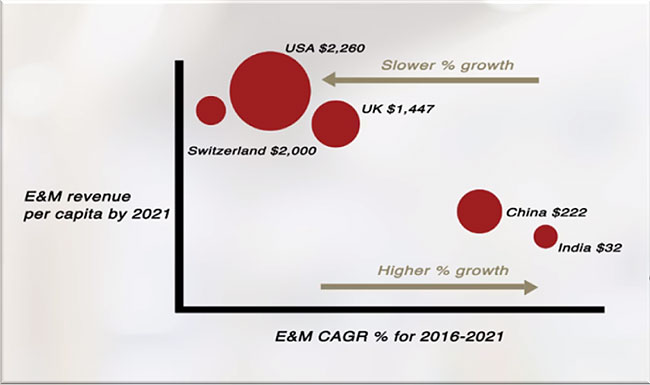
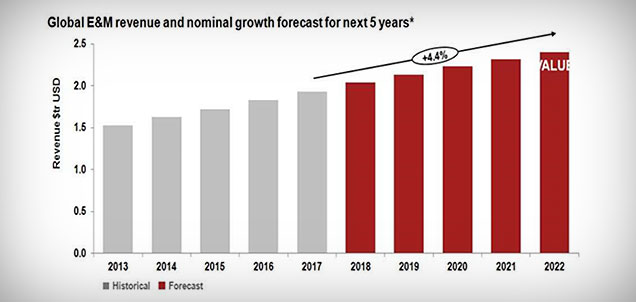
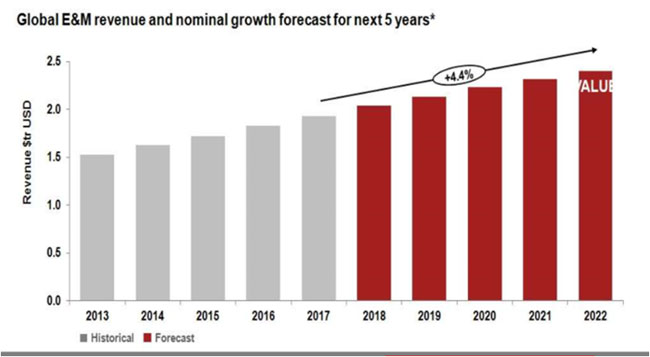
    In early June, PWC released their Global Entertainment and Media Outlook 2018-2022 predicting that in India the Media and Entertainment(M&E) industry will grow at a compound annual growth rate (CAGR) of 11.6% growth of between 2018 to 2022 (https://brandequity.economictimes.indiatimes.com/news/media/indias-me-industry-to-clock-over-rs-353609-crore-by-2022-pwc-report/64477039). This growth rate will be 2.5 times the growth rate of 4.4% predicted for the global M&E industry. However, in terms of M&E revenue per capita in US$, the developed countries will be far ahead and in 2021 US M&E per capita revenue ($2260) will be 10 times of China ($222) and 70 times of India ($32).


    Source: PWC Outlook 2018-2022

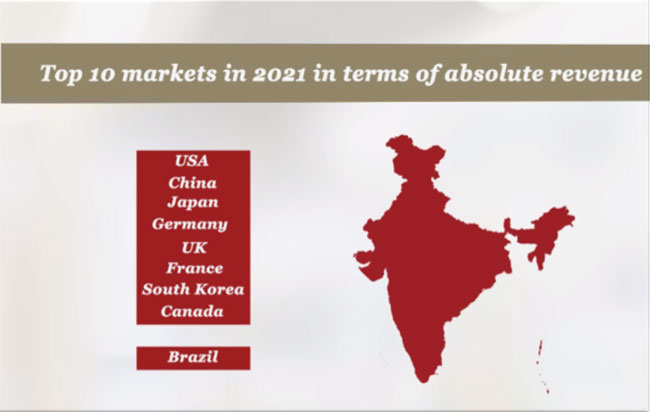
    The PWC analysis also predicted that India will earn a place among the Top 10 countries in terms of absolute revenue for M&E industry by 2021, a fact which is extremely reassuring given the exchange rate of INR and US$. Among the BRICS countries, China, India and Brazil will be among the top ten countries in terms of absolute revenue of M&E industry. China will overtake all other countries and will be in the number 2 position after US, followed by Japan, Germany, UK, South Korea, Canada, India and Brazil.


    Source: PWC Outlook 2018-2022

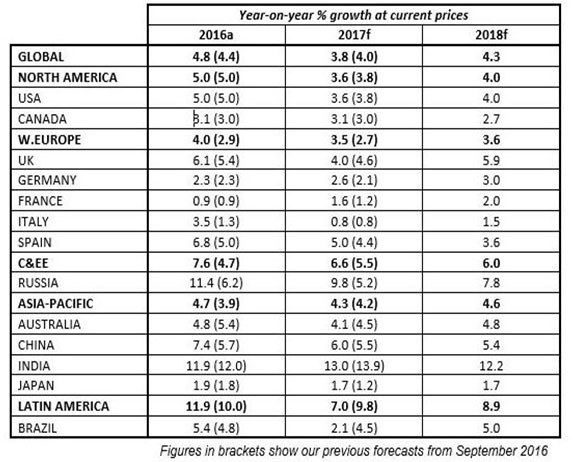
    Last week, the Dentsu Agies Network predicted that adspend in India will grow by 12.5% in 2018, a substantial increase from 9.6% in 2017 and against a global growth of 3.6% in 2018, up from 3.1% in 2017 (http://www.mxmindia.com/2018/06/dentsu-adspend-forecast-for-2018-down-from-12-5-to-10-5/) The advertising market in India is forecast to grow by a further 12.5% in 2019. Ad spend is a component of the total M&E industry, but any small fluctuation in the affects the industry’s overall revenue and growth. It is reassuring to find that the DAN Global Advertising Forecasts (January 2018)based on data received from 59 markets, supports the trend predicted by PWC in their overall forecast for the M&E industry and particularly for India. Both the studies agree that the future growth will be driven by various forms of digital media. DAN forecasts that during the current year, digital media spend in India will increase by 30% with 43.6% growth in mobile spend, accounting for 47% of total digital spend in 2018.

    In a comparison of the growth rate in adspends across countries the Dan report shows that only India will continue to enjoy a double digit growth rate over the period 2016-2018. Russia and Lain America, who had similar two digit growth rates in 2016, are going to experience declines in their growth rates over 2017 and 2018.


    Global Ad Spends 2016-2018

    Source: DAN Global Ad Spends Forecast (January 2018)


    Going back to the forecast of PWC, after attaining a place among the first ten countries in terms of absolute revenue in 2021, India’s next goal should be to attain a position among the top five countries. Apart from the growth which will come from within the M&E industry fuelled by technological changes and ad spends growth, we will need to improve our exchange rates with other foreign currencies, particularly the US$ which is used as the currency for global comparisons. How much demand there is in relation to supply of a foreign currency determines that currency’s value in relation to the local currency.Other geopolitical and economic indicators that affect the exchange rates between two countries are changes in interest rates, unemployment rates, inflation reports, gross domestic product numbers, data on manufactured commodities, etc. So, in the race to the top of M&E industry we must have a robust economy and the solid financial infrastructure leading to a favourable exchange rate with US$.


  • The Digital Duopoly targets a Billion-plus


    By Indrani Sen


    Last week,a roundtable discussion on ‘Disrupting Mobile Advertising Duopoly in the Indian Media Landscape’ was held in Delhi NCR, where experts from A&M industry shared their views on the future of the existing market duopoly of Google-Facebook in India. Most of them were of the opinion that the duopoly will continue to exist in India in spite of the growing competition in the market (http://businessworld.in/article/Challenging-The-Digital-Duopoly-Has-The-Change-Begun-/06-06-2018-151336/). A probability of a triopoly including Amazon and its marketing services was tabled by an expert with another expert adding that OTT platforms have began to challenge the duopoly. The need forbrand safe environment with created content rather than curated content and regulations like GDPR was tabled.

    Bharat Sanchar Nigam Limited, which has a limited tie-up with Baba Ramdev’s foray to mobile internet, has also partnered with Call2Action Communication India Private limited recently for launching a new mobile advertising platform. This platform is expected to create disruption in the Mobile Advertising Ecosystem by offering lucrative price points and challenge the duopoly of Google and Facebook in India as reported by the above article in www.businessworld.in.

    Both Google and Facebook have high business stakes in the Indian market and have been investing a lot of time, talent and funds in local development.  Some of these efforts are not well known to the advertisers and agencies that use the two platforms for digital marketing. The common users of the platforms are blissfully ignorant of the same.

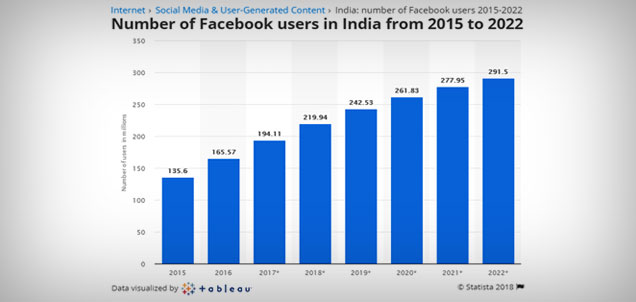
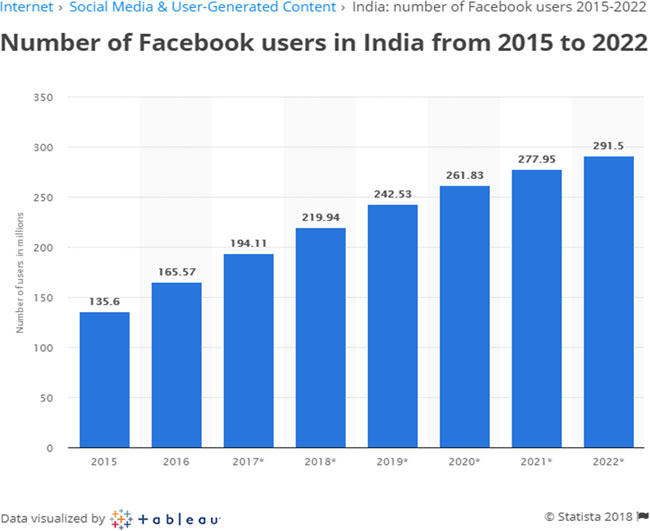
    India has been the country with the largest Facebook users since 2016. There were about 195 million Facebook users in India as of May 2016, against about 191 million in the U.S. and 90 million in Brazil (https://www.statista.com/statistics/304827/number-of-facebook-users-in-india/ ). The number of Facebook users in India is forecast to continue to grow in the coming years, and add up to nearly 320 million by 2021.The penetration of Facebook in India isexpected to jump from almost 15 percent in 2016 to around 23 percent in 2021.Facebook also owns three of the most popular social networks WhatsApp, Facebook Messenger and Instagram which help to increase its strong hold in the Indian market.

    Mark Zuberberg has claimed that globally, Facebook’s advertising-driven business has not been significantly damaged after the Cambridge Analytica bombshell dropped. Its share prices which dropped after March 2018 when the Cambridge Analytica reports broke, has climbed back to slightly above its price Facebook enjoyed before the news break.  Its ability to protect its users’ personal information shared and stored on its social network is yet to be proved to the complete satisfaction of the law makers across different countries

    Our Ministry of Electronics & IT has recently asked Facebook to explain if it allowed phone and other device manufacturers access its users’ data without taking their consent by June 20 following a recent report in media that Facebook has admitted to sharing information with a “small number” of companies including RBC Capital Markets and Nissan Motor Co., advertisers and other business partners (https://brandequity.economictimes.indiatimes.com/news/digital/facebook-kept-sharing-users-data-with-companies-even-after-saying-it-had-stopped-third-party-access-to-information/64516829).

    Google, the leading player in the Digital Duopoly, is comfortably settled in India. Google Search has 90% market share in India, Google’s Andriod OS is used by over 90% smartphone users in India, YouTube is watched by 80% of the internet users in India with a 225 million monthly user base, Gmail enjoys the largest user base in India and Google Map is consumer focussed and free to use. Google has been working steadily on India first tweaks and apps  such as offline videos for YouTube, two-wheeler navigation on Google Maps, Android Oreo (Go edition) to improve experience on low-RAM phones, Google Assistant for Reliance Jiophones, new apps like Google Go and Files Go, built from scratch, Google WiFi stations in partnership with Indian Railways and the mobile payment platform Google Tez, which within a month of its launch in September 2017, captured 60% share of m-payments in India.Facebook should take a lesson from Google and introduce some India specific social apps.

    India is a focus market for Google’s Next Billion Users Plan through which it aims to bring everyone online in India (https://brandequity.economictimes.indiatimes.com/news/digital/google-wants-to-bring-everyone-online-in-india-through-its-next-billion-plan/64457803). As a part of this initiative and based on intensive field research by its technical team, Google launched a multilingual app in Mumbai 10 days back (on May 31),  called ‘Neighbourly’ catering to only Mumbai.Thislocal discovery and community app works in English, Hindi, Marathi and six other Indian languages. The hyperlocal platform helps to find anything from a doctor, ATM or petrol pump to a mechanic or badminton coach, within 2 km radius.In coming weeks and months, Google plans to roll out the app across more cities in India.

    It is a difficult proposition to challenge Google’s total supremacy today In India as it is far ahead of its other competitors. Facebook, which has now become vulnerable, may have to deal with more competition in the sphere of social media. Itmay be compelled to spend comparatively more time to ensure protection of consumer data and implementation of its privacy policy, which may lead to erosion of its market share through competition in the global market. However, in India, there is minimal chance of a similar threat. So, the immediate future of the digital duopoly seems to be secure in India in spite of Baba Ramdev’s plan to relaunch Kimbho after a flamboyant launch followed by a silent withdrawal.


  • Indrani Sen: Mobile phones may be injurious to our health!

    By Indrani Sen


    As per the IAMAI Report released in last March, by end of June 2018 there will be 478 million internet users in India riding on mobile penetration. The recent launch of the new Patanjali sim cards and the apps Kimbho by Baba Ramdev will surely add an impetus to this growth. At the same time it will promote BSNL connections along with cheaper smart phones. This possible growth of cheaper handsets brings up a serious question of possible health hazards.

    Mobile phone users are aware that they are not supposed to use their mobile phones in petrol stations, but very few know about the reason. Mobile phones emit radiofrequency energy, a form of non-ionising electromagnetic radiation, which is capable of igniting the petrol fumes present in the pumps. This radiofrequency energy can be absorbed by human tissues close to the phone. The amount of radiofrequency energy a mobile phone user is exposed depend on many factors as the technology of the phone, the distance between the phone and the user, the extent and type of mobile phone use and the user’s distance from cell phone towers. The cheaper handsets have higher risk of health hazards.

    The WHO’s International Agency for Research on Cancer (IARC) after some research classified mobile phone radiation possibly carcinogenic in 2011. In simple words, it means that there “could be some risk” of carcinogenicity related tobrain cancer. According to some additional research, mobile phones are greatly contaminated with different types of microorganisms especially bacteria which cause a lot of diseases.

    IARC advised additional research into the long-term, heavy use of mobile phones to arrive at conclusive results. But, by the time the WHO has conclusive proofs, we may be raising generations of children who have already been partially affected. Medical research has shown that children absorb more than 60 percent of the radiation into the brain than adults. Their brain’s thinner skin, tissues, and bones allow them to absorb the radiation twice than the grown-ups. The developing nervous system makes thechildren more vulnerable to this ‘carcinogen’.

    The radiofrequency energy emitted by mobile phones also affects our environment including birds, mammals and pet animals. It has been observed that the animals which are more exposed to radiations emerging from these mobile phones or towers have many abnormalities as compared to those who are not exposed to these types of radiations.

    There are various other negative effects of mobile phones. Mobile users are aware about the risk of accidents on the roads if using the device while walking or driving, but still many are seen breaking the traffic rules and regulations in the big cities and more so in smaller towns and villages. Teenager’ boys and girls communicate each other through their mobile phones and engage with social media which often has negative impact them. Students do not give proper time to their studies and waste their time in playing games, listening music, watching videos and reading messages on their mobile phones.People are wasting lot of their time and money in sending unnecessary sms/ text messages to one another through their mobile phones. The biggest social problem is the isolation of members in nuclear families, each immersed in own mobile. Mobile phones are also being misused for criminal activities and terrorism. However, the technology is also helping the police to detect the criminals.

    Technology has led the development of mass media right from the dayJohanesGutengergintroduced the first movable type printing system in Europe around 1450. At the advent of each new medium there were debates on its usefulness and its effect on society, but no serious issue was ever raised related to health hazards associated with use of any new medium. In this digital age when we all are celebrating the mobile revolution, a silent storm has started gathering about the health hazards of using this hand held device. The I&B Ministry as well as the telecom regulatory body TRAI should review this issue and take some steps to create awareness among mobile users.


    Indrani Sen is a veteran mediaperson and now an academic and a marketing strategy consultant. The views here are personal

  • Indrani Sen: Wooing Newspaper Readers Online

    By Indrani Sen


    The annual World Press Trends Survey 2015 published by the World Association of Newspapers and News Publishers (WAN-IFRA) claimed that the global newspaper circulation revenue had crossed the global newspaper advertising revenue in 2014. I wrote an article for this website on February1, 2016, highlighting the shift of global newspaper industry from B2B to B2C model and comparing with the Indian scenariohttp://www.mxmindia.com/2016/02/the-seismic-shift/.

    Three years have passed since the circulation revenue overtook advertising revenue globally, but we have not yet seen the sign of a similar trend setting in India. IRS 2017. which showed an overall growth in readership from 2014, at the same time reflected the lack of growth in “yesterday” readership, the age-old basis adopted by researchers for defining “average issue readership”. Some speculations have been done by industry experts to understand this phenomenon of irregular readership of Indian newspapers, but no definite conclusion has been reached. In my article reviewing IRS 2017 on this website, I suggested that the large number of readers in younger age group could be a possible reason for the irregular readership of our newspapers http://www.mxmindia.com/2018/01/print-shines-in-irs2017/.

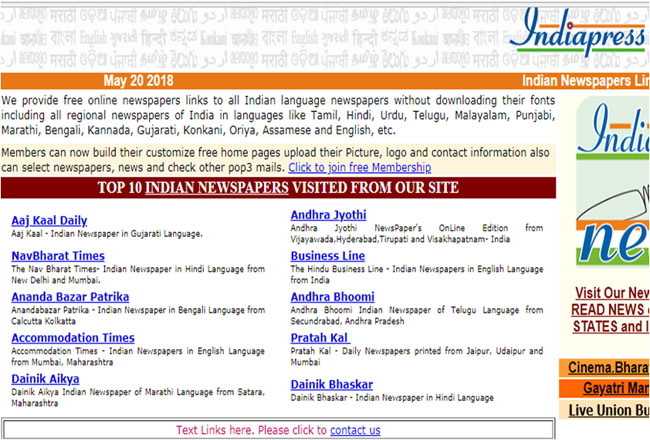
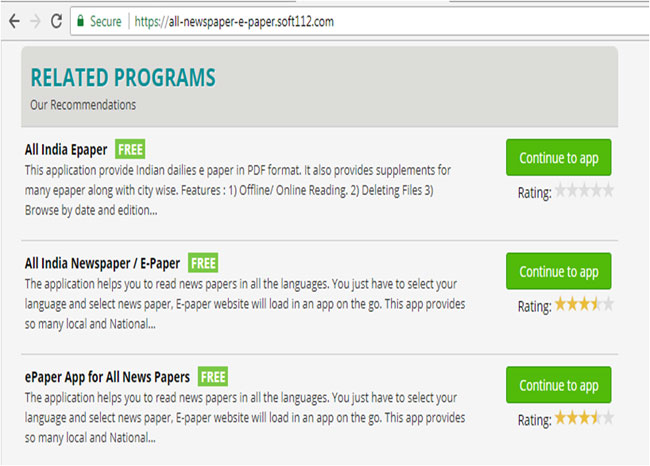
    Does the answer to the skewed distribution of frequency of readershiplies in the ample availability of free online portals and apps for reading Indian newspapers today? The online and offline mastheads of the newspapers are same which can result in the online readers recognizing the mastheads during the survey and staking their claim as readers. There are many such portals which offer their readers free online news like (1) https://www.readwhere.com/newspapers/ , (2) http://www.indiapress.org/ , a global website from Web Wombat-(3) http://www.onlinenewspapers.com/ etc. and various easily available apps like (4) https://www.apkmonk.com/app/com.kp.epaperpdf1/ for free news and magazines, (5) https://play.google.com/store/apps/details?id=com.kp.epaperpdf1&hl=en, and (6) https://all-newspaper-e-paper.soft112.com/download.html, etc offering free services.

    The screenshots of www.indiapress.org and www.soft112.com are shared here with the readers. It is difficult to estimate which of the websites have legal contracts/ moral acceptance of the newspapers for making these free offers and which are having clandestine-affairs.

    There are also site like http://epaper-downloader.software.informer.com/ which offer free Java software for e-paper downloader from four Indian newspapers (Hindustan Times, DNA, Mint and Times of India) as PDF files. Another website https://www.paperboy.com offer some free and some paid subscriptions to various Indian publications. Paperboy has its head office in Bengaluru with branches in Mumbai and Chennai and claim to be an app for “online news discovery and distribution application that aggregates newspaper and magazines available on any platform” in their website.

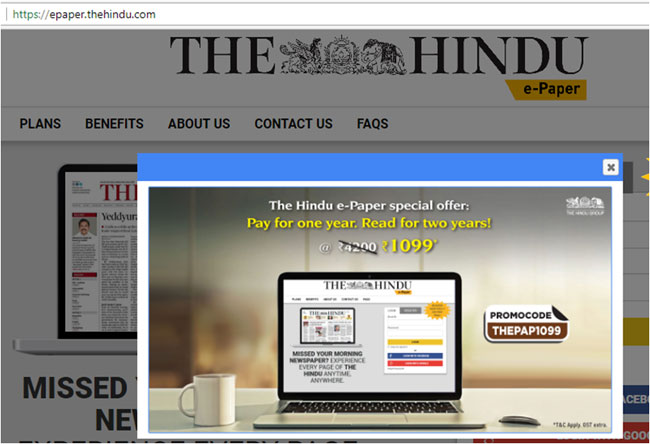
    Most of the Indian newspapers in English as well as vernacular allow free access of e-papers to their readers. A few leading newspapers are pushing for online subscription at huge discount, bravely trying to woo readers from free to paid mode. The Hindu, who has been a pioneer for trying for online subscription of the e-paper, is currently offering two years’ online subscription at one year’s rate.

    An interesting development is an Indian website which is promoting off line circulation of newspapers on line with not just discounted subscription rates, but also other special offers. This site http://www.newspaperkart.com/is offering along with the subscription a free monthly scrap picking service from doorstep, free scrap bag and coupons with exciting local offers and up to 70% of the subscription value as hard cash back on return of the scrap. This site has collaborated with newspapers and the hard copies of the newspapers are delivered through the usual distribution chain keeping the last mile delivery intact. Needless to mention that the various discount offers which are available to the readers on ground are also extended on line as shown in the screen shot of www.newspapermart.com offering 40% discount for monthly subscription of TOI, Delhi edition. This is probably a unique model in newspaper distribution where off line sale is driven by a common offline portal, but will surely have its limitations in developing an on ground network in small towns and villages.

    At this rate, it will take the Indian newspaper Industry a long time to reach the global trend where subscription revenue was estimated to be 56% of the total revenue of newspapersin 2016 as per the annual World Press Trends Survey 2017 published by the WAN-IFRA. It will be difficult proposition to convert the Indian internet users used to getting free news to the paid mode unless more Indian newspapers/ publishers of news start now to promote actively the subscription of their e-papers. Our media law makers should review this free-for-all field of free offers for reading Indian newspapers online and introduce some guidelines and restrictions if they want to promote e-editions of Indian newspapers.


  • Indrani Sen: Who should own Indian media?


    By Indrani Sen


    Last week, after the Flipkart deal was signed and sealed, we saw an interesting article in ET Brand Equity on 11th May, 2018 pointing out the apparent scepticism with which large Indian Business Houses viewed the scope of investing in the internet ecosystem and home grown digital business -https://brandequity.economictimes.indiatimes.com/news/business-of-brands/hello-ambanis-and-tatas-how-did-you-not-see-the-elephant-in-the-room/64123862 .

    The above article pointed out the opportunities which have been lost by Indian corporate giants in investing in the country’s e-commerce boom. Perhaps the crash of the first dot.com bubble in India (1997-2001) coloured the judgement of our corporate giants, perhaps they did not see adequate value in the digital media business formats which their foreign counter parts did, and perhaps they could not foresee the speed at which digital media will be growing in India, a developing country. Whatever were the reasons for their apathy, the outcome has not been good for India as our digital ecosystem is largely owned by American companies rather than being a standalone system like China, who does not seem to have any qualm about investing in India digital companies.

    It might not have been possible for Indian corporate sector to finance a totally stand alone system like China, but their participation in the financing of internet ecosystem in India would have seen a more balanced digital infrastructure. It is surely a lost opportunity for India Inc. and poses a threat to Indian economy and society through cultural imperialism in the digital age. Times Group MD, Vineet Jain raised this issue in his recent speech delivered at the recently held 15th Asia Media Summit in New Delhi during last week (May 10-12) – https://www.exchange4media.com/marketing/india-is-the-most-exciting-media-market-in-the-world-says-vineet-jain-_89900.html.

    This naturally brings up the question – who owns Indian media? The rules and regulation related to this ownership issue are quite vague with many regional newspapers owing their origin to the politics of the Indian freedom struggle.The proprietors of many such newspapers got actively or passively involved with different political parties after independence. Subsequently, we have seen examples of seemingly apolitical editors getting nominated to Rajya Sabha as MPs by the ruling political parties in different states followed by tactical changes in news reporting policies of their newspaper.

    Nalin Mehta, an educator, journalist and writerfound through his extensive researchthat three types of people/ organisations have invested large funds in news television in India – politicians, real estate proprietors and big chit fund and money marketing companies. Both the real estate and chit fund businesses are heavily dependent on the local government and the political parties in power for a profitable running of their business which is expected to colour the news reporting in the channels owned by them. Mehta wrote in an article in Outlook in 2015 (https://www.outlookindia.com/website/story/who-owns-the-news-and-why/294350)“My research shows that between them such companies make up over 80% of news TV business in Andhra, Karnataka and Odisha and around 60%- 70% in Punjab, Maharashtra, West Bengal, Tamil Nadu and the north-east.”

    On the other hand, relaxation of rules related to FDI in different media after globalisation has opened up a Pandora’s Box regarding ownership of Indian media which our government is not able to control. It is high time that our government review the rules and regulations related to media ownership across traditional and new media formats in India and draw up a standard format regarding who should own Indian media.


  • Indrani Sen: The Digital News Storm

    By Indrani Sen


    While a violent dust storm was sweeping across parts of North India last week, causing destruction, death and havoc in many ways, we saw a digital news storm in terms of the number of reports and announcements breaking on the internet related to the M&E Industry in India focussing on digital. Fortunately for us, the nature of this digital storm has been more constructive and futuristic reflecting the changes expected in India in the short-term and the long-term.

    It began on a quite note on May 1, when we read a well-researched article “Is smartphone the new TV” by Gaurav Laghate of Economic Times. It is a must-read for all who are interested in future of digital India). Facebook was holding its annual Facebook Developers Conference, F8 in San Jose, CA on May 1 and 2 and naturally I expected that we will get to see an analysis of the proceedings and new announcements also on Indian websites.

    On May 2, www.socialsamosa.com carried the highlights of the first day of the F8 conference, but chose to highlight in a special story the video chat feature getting added to Instagram. Brand Equity also carried a report by Reuters highlighting how Facebook will use AR to draw ads on Messenger App.

    The next day – on May 3 – we were literally floored by news related directly or indirectly to the digital industry. The biggest news of the day was Sameer Singh joining GroupM as CEO, South Asia. An IIM Calcutta alumnus, Singh has fascinating experience of 28 years in marketing and media withleading advertisers and agencies across different markets. His move from Google toGroupM reflects GroupM’s plan for moving towards the digital future. The second important news was that digital advertising in India will touch Rs 12,046 crore by December 2018 growing at CAGR of 30% based on the “Digital Advertising in India 2017” report jointly published by the Internet and Mobile Association of India and Kantar IMRB.

    In addition to the above two news, on May 3 we read in Brand Equity  about Tim Cook wanting India a larger size of the Apple and stepping up marketing and retail initiatives and declaration of bankruptcy and closure by Cambridge Analytica, the firmlinked with the recent privacy scandal of Facebook. Viacom 18 Motion Pictures announced the new launch of its digital content brand “Tipping Point”which will offer a host of web series, short films and non-traditional formats in collaboration with some leading film directors. Another interesting report was published in www.emarketer.com.  Based on a global study by e-marketer,the report predicted that by end of 2018, more than a quarter of Indian individuals of any age will be smartphone users.

    The next day, on May 4,GroupM released its publication “The State of Digital” predicting inflation in inventory cost on mobile formats in India where 42 per cent of online ad spend will be on video ads and 12 of all digital advertising will be programmatic. Their Global predictions include continuation of stronghold of the duopoly by Google and Facebook and online time spent overtaking linear TV viewing timein 2018. On the same day we also read the announcementby WPP that the Analytics teams from Kantar and Group M will be combined to form one combined practicein India. These two stories/ media releases were carried in many industry websites.

    On May 5 we read in Brand Equity that Facebook is actively conducting market research on its ad-free subscription based version. This version, if launched in India in future, may act as a catalyst for converting the Indian social and digital media users from free users to paid subscribers.

    From May 1 to May 5, we saw daily news bulletins on internet about Walmart nearing Flipkart deal, described as the largest cross-border M&A deal involving an Indian business. Flipkart issued a statement on May 5 claiming that it has got 70% share of online smartphone sales. To sum up, this deluge of news on digital media which we saw during last week is probably going to be the norm for future as we move towards a Digital India.

    In addition to all the above news, we have also seen the promotion of the second edition of Techमंच, by the exchange4media group as the platform for bringing together advertising, marketing and media fraternity for discussing the digital future of India. This event will also see the presentation of the Digital Marketing Awards.

    In most developed countries industry and academia are working together to monitor and understand the changes in marketing communication in the digital age, but in India we are yet to see similar interactions and iterations. I am happy to inform the readers of www.mxmindia.com that Symbiosis Institute of Media & Communication is planning an International Conference on New Media in September, 2018 (http://simcicmac.com/).The SIMC faculty would be delighted if people from the M&E industry join the conference and share their experience and contribute to our academic pursuit of understanding effectively the changes in new media formats locally and globally.

    Indrani Sen is a veteran advertising professional and is now Adjunct Professor in Media Management with the Symbiosis International University, Pune. The views expressed here are her own.

  • To be or not to be… on DD Free Dish


    By Indrani Sen


    Over the last two weeks, we have seen various news reports about Prasar Bharati’s new, yet-to-be-proposed policy for Free Dish slot auction among private broadcasters.  A report in www.economictimes.indiatimes.com highlighted a reminder letter sent by the Ministry of Information & Broadcasting (MIB) to Prasar Bharati on the subject of reviewing  and recasting of their policy for auctioning of free slots on DD Free Dish TV  platform to private broadcasters in (https://economictimes.indiatimes.com/news/politics-and-nation/dont-subsidise-private-channels-review-free-dish-policy-ib-ministry-to-prasar-bharati/articleshow/63707567.cms ). The same report was carried by other websites and newspapers.

    According to the above report, the ministry officials said that from August 2017, PrasarBharati has not responded to any of the six reminders sent by the Ministry on the subject. The article quoted from the ministry’s letter “Recognising the limitation of the present arrangement it was suggested that these co-branded channels could be operated on a revenue share basis, this will ensure DD brand is not diluted and DD has a continuing stake in revenue growth…..This limitation should have been identified when the Free-Dish was thrown open to private channels.” In this connection, we can recall some interesting numbers.  PrasarBharati earned Rs 85.10 crore from the auctioning of 11 slots on DD Free Dish in July 2017. Prasar Bharati’s earnings from a single auction saw a phenomenal rise from Rs. 25 lakhs in its first auction to GEC channels in 2005 to Rs 85.10 crore in its last auction in 2017. Obviously, when the system of auctioning was introduced, neither the Ministry nor PrasarBharati had visualised the potential of The DD Free Dish platform.

    According tohttps://www.livemint.com/Politics/L1SzhVVx4ik3EO63ytq4WL/IB-ministry-suspends-auction-of-slots-on-DD-Free-Dish-to-r.html, Doordarshan earned more than 30% of its revenue from Free Dish at Rs 264.17 crore for the year 2016-17. It was the highest-ever revenue earned from the DD Free Dish platform. Overall, the broadcaster earned Rs 827.51 crore in the year 2016-17, surpassing its annual target of Rs 800 crore.

    Prasar Bharati cancelled the auction of slots on DD Free Dish scheduled in August 2017 citing administrative reasons. Subsequently we learned that I&B Ministry had asked the broadcaster to suspend e-auctioning of slots on DD Free Dish until further notice. TDSAT (Telecom Disputes Settlement and Arbitration Tribunal) had advised Prasar Bharati vide their order dated October 27, 2017 to carry out a comprehensive review of the policy of DD Free Dish. Meantime, private broadcasters whose contract expired were allowed to broadcast on DD Free Dish on a pro rata basis as per TDSAT order.

    We learnt recently that Prasar Bharati has told TDSAT that it will come out with a new policy for its free direct to home (DTH) DD Free Dish in a few weeks.“Following Prasar Bharati’s submission, the tribunal has posted the matter under the same head on 28 May” (http://www.televisionpost.com/prasar-bharati-to-come-out-with-new-policy-on-dd-free-dish-in-a-few-weeks/). The Prasar Bharati Board has appointed a Task Force for coming up with the new policy. Now the question is on what basis this new policy will be framed.

    An article on TOI, Pune on Saturday, April 21, 2018 quoted sources who said: “the government is keen to push a revenue sharing model, where private channels are asked to bid for DD Free Dish slots and also share a portion of their revenue with the public broadcaster.” We got a hint of this from Shashi ShekharVempati, CEO, Prasar Bharati who commented in the FICCI EY Report 2018 under Looking Beyond for Prasar Bharati:“Public broadcasters to move away from only government funded to self-sustained models, which mean: Platforms must be based on revenue sharing models …”


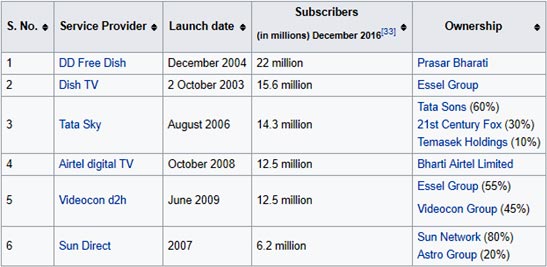
    Currently, Prasar Bharati does not have any clue regarding the number of subscribers accessing DD Free Dish across the country, let alone their distribution by states/ urban and rural, etc. The number of subscribers quoted by the Ministry as well as TRAI is based on market estimates by private organisations. As per TRAI, there were 66.99 million active pay DTH subscribers in 2017 apart from the subscribers to DD Free Dish which was estimated to be 22 million. The private TV channels are available through the paid Dish TVs and cable operators and the TRPs earned by them come from a combination of all the distribution platforms. Naturally the advertising revenue earned by the TV channels is also based on the availability of the channels through all the distribution platforms.


    Source: http://www.trai.gov.in/sites/default/files/PIR_July_Sept_28122017.pdf

    In the current system of distribution, the TV channels pay a carriage fees/ placement cost to the DTH distributors/ cable operators based on how many subscribers they have. The DTH distributors/ cable operators also share a percentage of their subscription fees with the TV channels. The range of the carriage fees as well as the subscription fees varies widely based on the number of subscribers, the popularity of the TV channels as well as individual negotiations between the two parties.

    The TV channels agreed to pay for slots on DD Free Dish in lieu of carriage fees/ placement cost. Prasar Bharati had kept a reserve price of Rs 8 crore for non-news channels and Rs 6 crore for news channels. Several channels left the platform over last couple of years as they found the reserve price to be too high. A new model based on revenue sharing over and above the auction fees may turn away the private broadcasters from DD Free Dish when there is no scope of earning from subscription fees.

    Such a move may not be beneficial to Prasar Bharati as the FTA TV channels may choose to opt out from the platform of DD Free Dish. The rural TV viewers will be deprived of quality content and penetration of TV in rural areas may slow down. There is an untapped rural market across the country and our Government increased the FDI in the DTH sector from 49% to 74% in 2013 and to 100% in 2015. Therefore, it will not be surprising if we see the entry of private Free DTH players in the strong regional markets in near future. There is a high chance that if a new policy for allocating slots on DD Fee Dish based on revenue sharing is launched, it may boomerang and hamper the growth of the distribution platform.


  • Are we shortchanging OOH media projections?


    By Indrani Sen


    The FICCI EY 2018 Report on Indian M&E Industry paints a bright prospect for the OOH sector by commenting that “There is a clear shift toward digital OOH which is expected to be the growth driver for the industry.” It mentions about applications of AR and VR technologies and other DOOH applications, integration of OOH with activations, creation of immersive experiences through sponsorships of lounges, etc which will help in the future growth of outdoor. The government initiative for expansion of infrastructure by adding airports and MRTS (Mass Rapid Transport System) across the country is also supposed to boost the growth of OOH in general and Digital OOH in particular. The fact that the “Railways getting into the act” with their offer of increased opportunities for commercialisation of railway properties and services will also tilt the scale in favour of OOH industry.


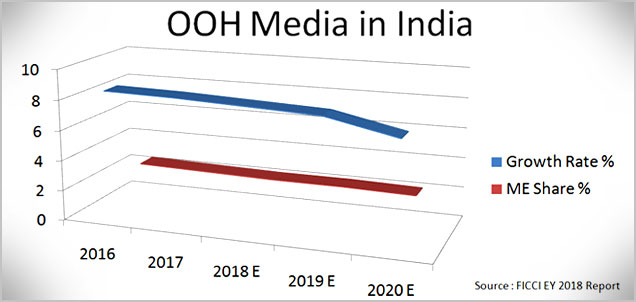
    However, the OOH Industry size shown in the report does not reflect the above prophecies for the OOH sector. On the contrary, the report shows a static/diminishing year-on-year growth rate of OOH media and similarly a static/ diminishing share in the M&E Industry.


    OOH Industry Size & Projected Growth
    CY 2016 CY 2017 CY2018E CY2019* CY2020E CAGR2016-2020
    INR Billion
    OOH Media 31.6 34.3 37.1 40 43
    Growth Rate 8.40% 8.50% 8.16% 8% 7% 7.70%
    ME Industry 1308 1473 1660 NA 2032 11.60%
    Share of OOH Media in ME Industry 2.40% 2.30% 2.20% NA 2.10%

    Source: FICCI-EY 2018 Report, page 11*Estimated by writer


    As per the Pitch Madison Advertising Report 2018, OOH market grew by 6% to reach Rs3085 crores in 2017 with a contribution of 5.8% to the total Advertising Adex.In 2018 it is expected to grow by 10% to reach Rs 3395 crore with a contribution of 5.7% to the advertising pie. The increase in the growth rate in 2018 is based on the upcoming eight State Assembly Elections in 2018 as well as Central Government publicity as a build up to the general Election in 2019. PMAO does not mention about the other opportunities related to growth of infrastructure, etc. There is one common thread between the two reports: the contribution of OOH to the total advertising pie has been hovering around 6% over the years (2013 to 2018E) according to the estimates of PMAO. Admittedly, the percentage shares are different as the two reports deal with different definition of the universe.


    What is the future of the OOH sector in India? Is it really poised for an advertising leap based on the coming of age of our millennial population, increased penetration of mobile and social media and availability of digital technologies? I read an interesting article about a year back on “Top 5 Emerging Technologies of Outdoor Advertising in India -207” (https://www.posterstalk.com/Blog/Post/technologies-of-outdoor-advertising-in-india) which described Digital Billboards, Digital Signage, Geo-fencing Technology,  Beacons and Near Field Communication (NFC) as the five emerging trends in Outdoor advertising which we can expect to become realities as we progress to the next decade.


    It may take a few more years before we see applications of Geo-fencing Technology, Beacons and Near Field Communications in India. But, Digital Billboards and Digital Signage are both poised for immediate growth with huge opportunities of development across our airports, railway stations, MRTS systems and malls, multiplexes, theme parks, sports stadiums and other entertainment complexes. Hospitals and health centres can also benefit from digital signage. Our Ministry of Tourism along with The Archaeological Survey of India can also use this medium for promoting tourism and enabling the travellers with knowledge of world heritage sites and historical monuments.


    I strongly believe that we will witness OOH becoming an integral part of social and mobile strategies within next few years. Closer interaction and collaboration is required between the Social Marketing and Digital Marketing Agencies and the Outdoor Agencies for achieving this transformation which will benefit both the parties. Eventually, digital technology will transform OOH from a passive medium to a direct response medium and our media classifications will have to be re-written. While technological churning of the OOH industry takes place, media analysts have to ensure that their industry estimates do not short change the growth of the sector.


  • Indrani Sen: The Reigning Regional Queens dethrones the English King

    By Indrani Sen


    English, the undisputed King of all languages for business and commercial transactions in India, seems to be fighting a losing battle when it comes to the language of communication and entertainment in India. It is estimated that only around 10% of our total population speaks in English, though we are supposed to be the world’s second-largest English-speaking country. Recently, research after research has been showing the hunger for content in Indic among the Indian audience.


    IRS 2017 published earlier this year showed us that from 2014 to 2017 most of the regional languages dailies have grown more than the growth of English dailies. Except Times of India, all the newspapers featuring in the list of Top 20 newspapers in India were regional newspapers in vernaculars.


    Film and television in India have been thriving on Indic content for many decades. Regional TV channels in different languages have been delivering much better than National Hindi channels in their respective markets.  FM radio stations rely heavily on content in Indic and interact with their listeners in their mother tongues which are getting them rich dividends, both in terms of audience and advertising revenue.


    New media is also trending in the same way. ‘Internet in India 2017’, published jointly by the Internet and Mobile Association of India (IAMAI) and Kantar IMRB in March 2018, estimated that there are 205 million internet non-users who are likely to embrace internet if the service is provided in a language of their choice. According to the report usage of Indic in Urban India is strictly restricted to various forms of infotainment like news, music/ video streaming and other forms of entertainment, the average of all such activities work out as70% of total usage of internet in Indic.On the other hand, critical services like online banking, job search or ticket booking still reflects very low local content usage (less than 20%). The survey reveals that internet in Indic, not just content but the entire digital ecosystemwill be a key factor for achieving the dream of a “Digital India”.


    Media groups are using different strategies to encash the growth opportunities in the regional markets; the latest strategic move by Star TV is to broadcast cricket commentary Vivo IPL for in four regional languages, Tamil, Telegu, Kannada and Bengali apart from English and Hindi.  Star India announced in December 2017 its telecast plan for IPL 2018 covering six languages, 10 channels and live streaming on Hotstar service. In 2017, the cumulative reach of IPL 10 on Hotstar for the months of April and May across the 60 matches played was 130 million while the reach on TV was 410 million. In 2018, Star India is aiming to reach over 700 million people and they are relying on cricket commentary in Indic to achieve that target.


    The latest announcement of the agreement between Prasar Bharati and Star India, allowing a 60minute delayed broadcast over DD channels and equal sharing of advertising revenue generated by Doordarshan, will ensure maximise viewership of cricket commentary in Hindi, particularly if the feed is also available for DD’S free Dish TV users. It is not clear if Star India will share the cricket commentary in the other four regional languages with DD.


    Jaideep Vaidya, Desk Editor, Sports, Scroll In,published an interesting analysis in last February (https://scroll.in/field/869789/how-hindi-and-tamil-are-taking-over-cricket-commentary-in-india) where he analysed BARC data to show that viewership of Star Sports 1 in Hindi was much higher than the viewership of Star Sports in English for the India vs. Australia ODIs and T20s during the period September16  to October 13 last year.  Vaidya also showed a comparison of viewership between Sony 10 3 (Hindi) and Sony 10 1 (Tamil) for the India vs. South Africa Tests during the period January 6 to 26 this year to highlight the neck to neck race between the impressions in millions between the two languages.


    So, the last bastion of English broadcast content i.e. cricket commentary in English, is also crumbling before the onslaught of the regional language commentaries. It appears we are developing an indigenous style of cricket commentary in vernaculars mixed with “desi” humours and filmy dialogues which is different from the straight jacketed professional cricket commentary in English. Whatever is the style; the audience is lapping it up and showing distinct preference for channels providing cricket commentary in Indic over cricket commentary in English.


  • Mobile Magic on a High


    By Indrani Sen


    Last week, two interesting reports on usages of mobile and mobile advertising were released prompting strategic planners in media agencies to do quick reviews of the mobile advertising strategies recommended for their clients for the current year.The first one, the  ‘Mobile Internet Report 2017’, jointly published by Internet And Mobile Association of India (IAMAI) and Kantar IMRB predicted that the number of mobile internet users will reach 478 million by June 2018. The second study by InMobi surprised us with the insight that programmatic advertising expenditure on mobile has grown by more than 500% from Q1 2017 to Q4 2017.


    The writings on the walls, in this case the small screens, were there for the last few years, but the positive indications started coming from last year. Kleiner Perkins Caufield & Byers partner Mary Meeker descried India as the “most fascinating markets for the internet on the planet” and “an incredibly fierce battleground right now for hardware and software companies” while predicting on the trends of 2017 at the Code Conference on May 31, 2017. https://www.recode.net/2017/5/31/15720378/mary-meeker-india-annual-internet-trends-report-code-2017. Meeker highlighted in her presentation the dramatic and accelerated changes in Indian mobile market from 2016. She said that “Excluding China, Indian users spend the most time on Android devices. People in India spent nearly 150 billion hours on Android devices in 2016. They’ve also become the biggest downloaders of Google Play apps.”


    She further commented that Indian wireless data prices are still relatively high but they have been falling steadily over the years and was down about 50 percent from Q1 2016 to Q1 2017, after the Reliance Jio Launch.  Cheaper wireless data has accelerated the growth of smartphone ownership and has caused data consumption to jump year over year.


    The FICCI-EY report on M&E Industry 2018 showed that internet penetration in India is being driven by Mobile Internet. It estimated that 75% of the overall wireless internet base and 90% of the broadband subscriber base are mobile users, which supports the prediction of IAMAI.


    According to the media release by IAMAI, the number of mobile internet users increased by 17.22% from December 2016 to reach 456 million users by December 2017. Urban India had 18.64% Y-o-Y rise, while Rural India 15.03% during the same period. The report predicts with 59% mobile internet penetration, Urban India will witness a slowdown, while Rural India with only 18% penetration will be next area of growth. The report further confirms that Mobile Internet is predominantly used by youngsters, both in urban and rural areas.


    Programmatic advertising was still in its nascent stages in India in 2016. However, with the growth of digital advertising, it is inevitable that programmatic advertising would also grow in India. The FICCI-EY Report on M&E Industry 2018 estimated that 10% to 15% of all advertising expenditure was through programmatic advertising in 2017. It predicted that by 2020 its share may grow to 50%. The In Mobi report seems to differ from the FICCI-EY Report as it indicates an accelerated growth of mobile programmatic advertising spend by 534% (by ten times) from Q1 to Q4 of 2017.  https://www.exchange4media.com/digital/mobile-programmatic-ad-spend-grew-5-fold-in-2017 study_89173.html. The InMobi report indicates high growth of video content through mobile programmatic advertising has led to an acceleration of the process.


    The “Mobile Magic” is rewriting the script of media planning strategies in India and we may be witnessing major disruptions sooner than predicted by EY in the FICCI ME Industry 2018 Report. EY indicated (Digital Media – Page 42) that overall changes can be expected once programmatic advertising crosses 25% share of the advertising spend as Programmatic advertising then would put pressure on advertising rates which in turn might put pressure on advertising led models.