Tag: Indrani Sen

  • The Cookies are Dead. Long Live the Cookies!


    By Indrani Sen


    Indrani SenEver since Google announced its decision of withdrawal of third-party cookies, which were a driving force behind programmatic advertising and digital marketing, there has been lot of speculations in the digital industry about the future course of actions for digital media planning and marketing. For years, marketers have relied on third-party cookies for behavioural targeting, re-targeting and data-driven advertising and the decision of Google suddenly shook up the core of existing digital marketing strategies. Before Google, Apple’s Intelligent Tracking Prevention (ITP), and Mozilla’s Firefox enabled them to stop the practice of collecting data through third-party cookies which did not raise such hue and cry. As Google holds 60% plus share of the worldwide browser market, it is not surprising that its decision had a widespread reaction. While no one could argue with the need for user privacy, many marketers as well as publishers panicked and scrambled for finding alternative digital marketing strategies for their brands. However, this is not the end of working with cookies as first-party cookies can be a very useful tool for marketers.


    While the third-party cookies will no longer be available, first party cookies will continue to exist. First-party cookies are set by the websites viewed by the users and are stored by the websites.  First-party cookies help the website owners to collect anonymous data about their users and improve user experiences. Consumers do not complain about these first party cookies as these help in improving their digital experiences leading to higher satisfaction. However, consumers object to invasion of their privacy by third-party cookies which are created and set by third parties other than the publisher or owner of the website which they are visiting and stored at the browser ends.


    These third-party cookies became ubiquitous on the internet for behavioural targeting, retargeting, audience extension, tracking and ad serving and at the same time they were the main bone of contention in the crusade for consumer privacy in the digital world. Google has argued that the removal of third-party cookies will not only create more privacy for consumers, but also will provide the marketers opportunities for better digital advertising. First-party cookies will help the advertisers to have a better and more direct relationship with their consumers which in the long run will reduce their dependency on distribution platforms like Google, Facebook, and Amazon. Consumer Relationship Management (CRM) which has been gaining importance over the last two decades, will play a key role in building direct contact with the consumers.  Data tie-ups between advertisers and digital publishers based on first-party cookies can be leveraged for marketing.


    Google had been working on developing alternative analytics platforms based on first-party cookies, etc. even before they made the announcement about removal of third-party cookies. Universal Analytics was built for a generation of online measurement that was anchored in the desktop web, independent sessions, and more easily observable data from third-party cookies. With elimination of third-party data this measurement methodology will become obsolete. In mid-October 2020 new version of Google Analytics GA4 was launched as the new default analytics property for Google for the replacement for Universal Analytics. Google has been urging all their users to move over to GA4 as soon as possible in order to build the necessary historical data before Universal Analytics stops processing new hits. As it stands now, all standard Universal Analytics properties will stop processing new hits on July 1, 2023, and 360 Universal Analytics properties will stop processing new hits on July 1, 2024.


    GA4 collects both website and app data to better understand the customer journey; it uses event-based data instead of session-based data. It has been designed with privacy settings at its core, can track consumers across touchpoints and measure their engagements and conversations and has predictive capabilities.  GA4 offers behavioural and conversion modelling to improve ROI with data driven attribution, it can activate consumer insights. Apart from GA4, Google Chrome has also offered marketers the Privacy Sandbox technology for interest-based advertising which will target groups of people with common interests instead of individual consumers. This tool hides individuals “in the crowd” and uses on-device processing to keep a person’s web history private on the browser.


    However, elimination of third-party cookies will have certain effects on the publishers as the flow of targeted ads will stop. So, publishers will have to look for alternative ways for monetising traffic to their sites. In order to make up for the loss of ad revenue, publishers may try to introduce Paywalls which in turn may reduce the traffic to their sites as some of their regular customers may not opt for paid subscription.


    There will be growth of walled gardens of data collected through first-party cookies. Google and Meta already have their own first-party cookies and logged-in user data, Amazon is also likely to develop such database. Various video and audio streaming services such as Netflix and Spotify also have such first party data and can join the group of walled gardens opening new digital marketing opportunities.


    Departure of third-party cookies is likely to be a big challenge for Indian programmatic industry which has been thriving on start up ventures and consultancy outfits. The programmatic marketing and advertising will become more an expensive and difficult proposition. We can review how our programmatic industry is planning to cope up with the new challenges in another article. In conclusion we can only say ” The cookies are dead. Long live the cookies!”
     

  • A Tale of Two Reports


    By Indrani Sen


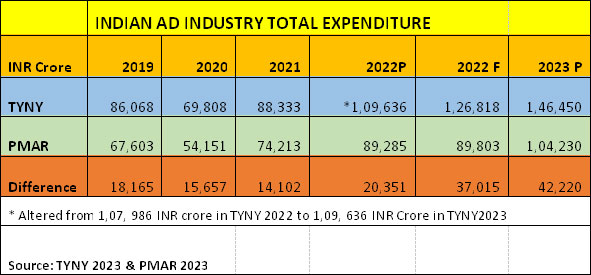
    Indrani SenIt is time to celebrate as the TYNY (This Year Next Year) 2023 report released by GroupM last week declared that the total value of Indian AdEx in 2022 has crossed the 100K crore mark touching INR 1,09,636 crore and in 2023 is estimated to grow at a healthy rate of 15.5% over 2022 towards another milestone of 150K crore (predicted as INR 146450 crore in 2023). Digital AdEx with an estimated 30% growth rate is expected to power the overall growth. India continues to be the fastest growing advertising market and as per the TYNY report has moved up from 9th position to the 8th position among the Top 10 countries with a share of 2% of the global adspend.


    As per the tradition set up over the last few years, the PMAR (Pitch Madison Advertising Report) 2023 was also released last week with a prediction that Indian AdEx will cross 100k crore mark in 2023 (predicted as INR 104230 crore) with a growth rate of 16% over 2022. Digital AdEX with an estimated 25% growth rate provide momentum to the growth.


    Both the TYNY and PMAR have been predicting in the same line over last few years with the gap between their estimates of the size of Indian AD Industry becoming wider year on year. By 2023 the size of the gap in the two estimates will be 40% of the total Indian ADEX size estimated by PMAR and by 2025 the size of the gap may become 50% of the Indian ADEX estimated by PMAR!! Globally is quite common to have difference in the estimates of the AD Industry size / AdEX estimated by different organisations, but if the difference becomes huge then it causes serious concern.


    Six years back, I wrote here an article comparing the estimates of TYNY 2017 and PMA 2017 https://www.mxmindia.com/2017/02/what-is-the-real-size-of-indian-ad-industry/. In that year, the estimates for Digital AdEx by the two agencies were almost the same, INR 7000+ crore in 2016 and INR 9000+ crore in 2017. However, the TV AdEx estimated by TYNY was considerably higher than the TV AdEx estimated by PMAO and hence the total Ad Industry expenditure estimated by TYNY was around INR 6000 crores higher than the that of PMAO.


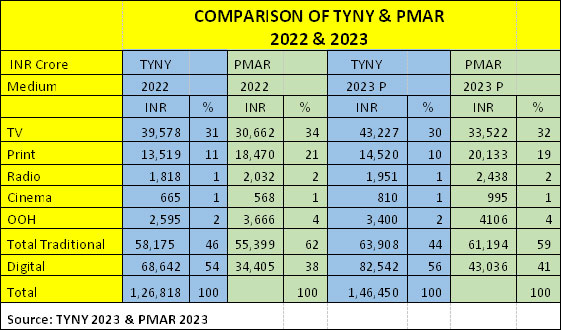
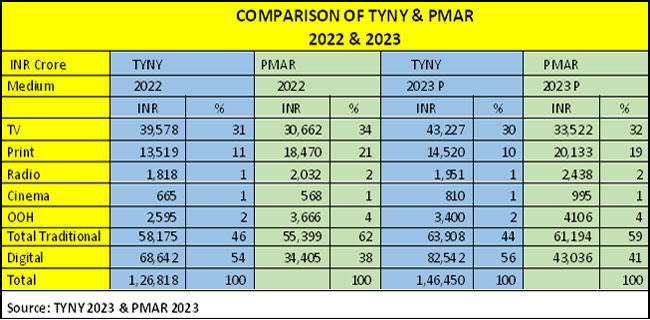
    It is interesting to note that over the last six years, Digital AdEx has increased at a much higher rate in the TYNY reports than in the PMAR reports. In 2022, the Digital AdEx INR 68,642 crore reported by TYNY was double the estimate INR 34,405 crore shown by PMAR.  AS per the TYNY report, Digital ADEX now has more than 50% share of the total AdEx, while in the PMAR report total traditional media is still enjoying around 60% share of the total AdEx as shown in the table below.


    The various industry websites including www.mxmindia.com and financial/ business publications have already reported on the findings of the two reports. Digital did not suffer during the three waves of Covid-19,  among the traditional media TV was the first to recover its pre pandemic revenue, outdoor recovered in 2022, print, radio and cinema are expected to recover in 2023. On the whole. 2022 was a good year for Indian Advertising and the immediate future looks bright.


    In spite of the widening rift between the TYNY and PMAR estimates, their leaders agree on the future directions. Prasanth Kumar, South Asia CEO, GroupM has said “As technology redefines interactions between consumers, brands and businesses the ad industry must navigate thru this changing environment.” Sam Balsara, Chairman and Managing Director, Madison World has advised the advertisers “to take advantage of the evolved digital infrastructure for distribution and advertising to prepare for the future growth and to invest in building their own D2C channels.” Only if the two agencies could stop the widening rift between the two reports, we would be in a happier situation.


    Indrani Sen is a veteran industryperson and educator. This is a new season of her Monday column on MxMIndia. Her views here are personal.


  • The Changing World of Inspirations


    By Indrani Sen


    Indrani Sen Wunderman Thompson’s recently published ‘Inspire Score: Top 100 2022’ (now in its third year) reflects how people’s ideals and aspirations have been changing with the digital and technical innovations as well as the conditions of the uncertain times that we have been living over the last two years. The Inspire Scores are no longer influenced by the brands’ inherent core values, their relationship with the consumers and their ability to adopt to the changing environment but are influenced by the changing focus in the consumers’ lives, consumers’ wish list for achievements.


    According to the report, Inspire is a “proprietary global platform that explores what makes brands inspiring and what inspires consumers, making Wunderman Thompson the world’s leading researcher into inspiration.” Wunderman Thompson has designed the ‘Inspire Score’ based on robust methodologies in order to find out how elevating, magnetic and motivating the different brands are to determine their inspire scores which in turn guide the brands about how they can connect better with the consumers to become more inspirational in their eyes and achieve tangible growth in terms of market share. Within a category, the brands with high inspire scores can charge a higher premium for their products and services enabling them to increase their profitability. Cross category comparisons of inspire scores help in understanding the changing mindset of the consumers.


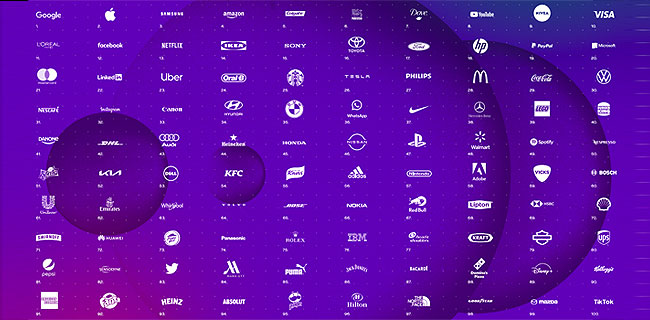
    For the second year running, Google is the most inspiring brand in the world followed by Apple, Samsung and Amazon, who have also managed to hold their positions within the top four. Apart from Nike (37), brands like Adidas (51), Unilever (56), IBM (76), etc. do not even feature in the Top 50 inspiring brands. In the automobile industry, Toyota (16) and Ford (17) lead the pack, followed by Tesla (26), Volkswagen (30), Hyundai (34), BMW (35), Mercedes Benz (38), Audi (43), Honda (45), Nissan (46), Volvo (64) and Mazda (99). The presence of a dozen automobile brands in the Top 100 shows the category continues to be highly relevant to the consumers, though the brands have become comparatively less inspiring than brands in digital, social media and ecommerce categories.


    Social media brands have seen strong gains in 2022 over 2021 reflecting their growing importance in people’s lives through social interactions.  Facebook has moved up from 16 in 2021 to 12 in 2022 and the inspiring power of both Instagram and WhatsApp has grown despite various problems. Twitter (83) has gone down the Inspire Score ladder in 2022 due to the controversies surrounding the brand and what the industry has started describing as the “Elon effect”. The Chinese brand TikTok (100) has managed to enter the Top 100 for the first time in 2022.


    Streaming brands remain inspiring with YouTube moving up two notches within the Top 10 brands and Netflix’s score has risen from 28 in 2021 to 13 in 2022. Spotify has also moved up couple of notches from 52 in 2021 to 49 in 2022 and Disney+ has entered the Top 100.


    It was surprising to find Microsoft has slipped in the inspire score though it has managed to stay within the Top 20 brands. Intel which ranked 87 in 2021, has dropped out from Top 100. The Chinese brand Huawei, a leading global provider of information and communications technology, has gone down the inspire score ladder drastically from 26 in 2021 to 72 in 2022. Does this show a trend where the consumers are taking digital technology for granted and are finding the applications of the technology more inspiring?


    In the personal care and beauty categories, Colgate and Dove have gained hugely and have entered the Top 10 in 2022, while Nivea has manged to retain its position within the Top 10 and L’OREAL has slipped one notch from 10 in 2021 to 11 in 2022.


    Impulse brands have done well in the post lockdown year, with inspire scores of soft drinks, beer and spirits rising. However, coffee shops and fast-food chains have lost the inspiration momentum which they had during the Covid years.  Except Nestle which continues to feature in the Top 10, other CPG food brands have also become less inspirational.


    To sum up,  Wunderman Thompson’s efforts to generate ‘Inspire Score’ year on year would surely help in accelerating globally the growth of marketing investment in the various forms of digital media for reaching target consumers.


  • The Future of Digital India lies in Voice, Video & Vernacular


    By Indrani Sen


    Indrani SenThe IAMAI-Kantar ICUBE report published in 2020 predicted that internet users in India would increase by 45% between 2021 to 2025 and will touch 900 million. The report also made a forecast that the growth will be driven by higher adoption of internet by users in small towns and rural areas. In 2020, two out of every five active internet users in the country came from small towns and there was a 13% growth in the number of rural internet users between 2019 and 2020. The report also estimated that by 2025, the number of rural internet users will surpass the number of urban internet users. In a country with 29 states based on linguistic divisions and 22 major regional languages (including Hindi), the emerging digital ecosystem is calling for urgent applications of voice and video in vernacular to reach out to the new internet users.


    An article in Economic Times by Rahul Sachitanand published on October 7, 2018 did an excellent analysis of India’s  changing internet landscape covering its past, present and future (https://economictimes.indiatimes.com/tech/internet/voice-video-and-vernacular-indias-internet-landscape-is-changing-to-tap-next-wave-of-users/articleshow/66102478.cms). The article talked about the three waves of internet adoption in India, the first wave (1995-2005) saw the arrival and early adoption of internet and digital content in India followed by the second wave (2005-2015) when internet took the centre stage and a variety of new businesses were built in travel, e-commerce and fintech riding on internet which not only attracted international players and investors but also laid the foundation of Digital India. The third wave, which began from 2015 (2015-2025), saw the validation of Indian Internet market with Flipkart’s sale to Walmart for $16 bn. Data prices crashed as reliance Jio entered the telecom market and mobile became the main device for accessing internet across the country breaking geographic and demographic boundaries.


    I wrote two articles here, the first one “The Deep Divide” published on February 5, 2018 dealt with the difference between the language of communication used by our advertising industry and the language understood and appreciated by their target audience across India in the digital age (https://www.mxmindia.com/2018/02/the-deep-divide/); and the second one published on November 4, 2019 dealt with the inevitable upcoming process of localisation of Indian digital market (https://www.mxmindia.com/2019/11/localisation-in-indian-digital-media-market/). However, in 2019 I was not able to foresee how fast the timeframe of reaching out digitally to the rural internet users would shrink during the three waves of the pandemic, national/ regional lockdowns and forced online education at primary and secondary school levels. A lot of water has passed under the bridge during the last two years and today a number of new entrepreneurs are ready to offer AI solutions for enabling Voice and Video in vernaculars for reaching out to the new Indian internet users from small towns and rural areas.


    The Indian internet which was initially designed in English for the top end of the market is now going through an explosion of vernaculars enabling usage of voice and video for enabling the new users to graduate from utility services to online transactions. Today, it is estimated that more than 60% of smartphone users in India consume various content in their mother tongue and about 30% consume content in multiple Indian languages along with English. Only 10% of the smartphone users consume content only in English and this percentage is expected to decrease with the increase in the number of smartphone users. According to Google, there has been a four-fold increase in rural internet users. India’s data consumption now can be easily compared with developed countries at an average of 8GB per month per user. The transacting audience kas gone beyond the large cities to touch 170 million. The next generation of Indian internet users would prefer to have content, communication and ecommerce in non-English vernaculars and would be more comfortable with voice rather than typing messages in their mother tongues.


    Google has introduced India First and India-only apps to bring in new users to its fold. It has launched support on its Gboard handset keyboard in all Indian languages; its voice assistant can understand and interact in eight Indian languages and its web browser Chrome can translate web pages into eleven Indian languages. More Indian languages would be added to the Google apps in near future.


    For over 10 years, Reverie Language Technologies, a vernacular language venture, has been building capabilities for search and discovery in multiple languages. They have gone beyond translation and have built interfaces to engage via voice the need of the new users of internet by focussing on customer relationship management (CRM) of this emerging digital consumer segments. Over the last couple of years, a whole new B2B sector with digital organisations like vernacular.ai offering AI enabled use of voice and video in vernacular has opened up.  VIVA or Vernacular Intelligent Virtual Assistant is one of the services which are offered by vernacular.ai today. All large ecommerce companies operating in India have started voice enabled transactions in vernaculars.


    YouTube, Hotstar, Voot, etc. along with first TikTok and then desi versions of TikTok have shown us the operations with videos, particularly videos in vernacular can reach a massive scale. Research has shown that close to 90% of marketing companies use videos as the main tool for digital marketing. More than 75% of all B2C content is delivered through videos which have higher engagement rate leading to greater penetration of the messages. In future with technological developments, search operations will be done through voice search or video search in multiple Indian languages.  While voice and video will be adopted in future by the entire digital world, Digital India will be clearly different market by the use of at least a dozen of vernacular platforms.


  • Looking Back at the last 11 Years


    By Indrani Sen


    Indrani SenThe second decade of the twenty-first century was perhaps the most eventful phase in the history of the Indian M&E industry, where Indian media played a significant part in transforming Indian economy. When www.mxmIndia was launched in 2011, Indian the M&E industry had just come out of the effects of the economic slowdown of 2008-09 and a new beginning, the start of a digital metamorphosis was looming large on its horizon. Marketers and advertisers were looking forward to the implementation of the Digital Addressable System (DAS) which would transform the regional footprints of the TV channels to national; the only glitch was the delay in execution of Phase 3 of FM Radio.


    The three totally different events of 2011 which sums up the whole year beautifully are: the Indian Cricket Team winning the Cricket World Cup which was celebrated across all households in India; the anti-corruption campaign started by Anna Hazare which flooded the country as a movement and last but not the least: the release of the song Kolaveri Di which broke all records by going viral on the first day of its release. All these incidents had one common thread: the power of mass media, both traditional and digital.


    In 2012, the digital metamorphosis continued and dream of reaching and engaging with the significantly diverse, one billion strong Indian customers became a reality. The theme for the FICCI Frames 2013 conclave was ‘A Tryst with Destiny: Engaging a Billion Consumers’. However, a global slowdown of economic growth affected the Indian market and advertising expenditure again took a dip. A grewsome incident of rape resulted in the ‘Nirbhaya’ protest movement followed by women’s safety campaigns across traditional and social media and gained widespread awareness and support. The social issues were the main focus of the year 2012, supported by the TV programme Satyamev Jayate; movies like OMG and Vicky Donor; campaigns like Lead India and Teach India, all highlighted various social issues and proved again the power of mass media, both traditional and digital.


    In 2013, it was clear that “the Stage is set” for the gradual process of triumph of digital media (which has been around since 1995) though all the traditional media ranging from television to newspapers to films to radio to outdoor continued to connect with various touchpoints in the lives of the Indian consumers. The roll out of DAS in Phase I and II cities were largely completed by December 2013 and the process of digitisation across the sub-sectors of the M & E industry continued but monetising the digital content remained a challenge.  Sony Liv and Ditto TV (ZEE) were launched in 2013 marking the beginning of the OTT explosion in India.


    The next year – 2014 – saw a new government at the centre after a successful general election followed by a marked positive shift in investor’s interest for investing in India. However, in the domestic market there were various unresolved issues like implementation of DAS as the deadline for completing the implementation in Phase III and Phase IV cities got extended to December 2015 and December 2016 respectively. Still, the FICCI KPMG Report was optimist about the future growth of M&E industry and estimated the industry to grow from INR 1026 billion in 2014 to INR 1964 billion in 2019 a CAGR of 13.9% over next five years.


    A new era of TV ratings began in India with BARC releasing its first report in April 2015 and by the end of the year they announced their intention of reporting rural TV ratings which would later change the hierarchy of TV channels. Print, which had the largest share of advertising revenue till 2014, finally lost its crown to TV in 2015 (Source FICCI KPMG reports). The entire focus of growth in digital media shifted to the mobile sector as it became absolutely clear that mobile would be the backbone of digital India. Of the 331 internet subscribers, around 200 were mobile internet users. India’s mobile market with over 500 million active subscribers, but had less than 200 million smartphones and low-end phones known as feature phones dominated the market. It also became clear by 2015 that the Central Government had its own rules about allowing criticism of its various policies in mass media. As a result, news media, particularly News TV got clearly aligned to the ruling political party and began taking sides, which was not the characteristics of Indian media.


    The year 2016 was marked by the banknote demonetisation at the end of the year which had ripple effects on the entire economy. Jio mobile phone service was launched publicly in September, 2016 which quickly changed the Indian mobile network scenario in the next couple of years. The implementation of GST in 2017 which saw certain adverse effect on the revenue of traditional media. In 2017, the growth in M&E sector was led by digital, film, gaming and events while in TV subscription growth outpaced growth in advertising. Traditional print media began to lose young genres of readers to digital news rapidly.


    In 2018 and 2019, the overall growth in M&E sector continued to be led by online gaming and digital. These were two good years for Indian advertising industry. The BJP government at the centre was re-elected in 2019 having a positive impact on trade and commerce.  The last Indian Readership Survey was released in 2019 showing TV reached 77% of Indians above 12 years of age against 37% reached by newspapers. However, towards the end of 2019, the whole world saw a new pandemic, Covid-19, which shook up economies and affected business growth across all countries. In India, the National Lockdown declared at a short notice by the Prime Minister towards the end of March 2020, severely affected all business sectors and M&E industry also suffered severely. Indian Print media, which was heavily dependent on the last mile delivery by hawkers, was impacted hugely.


    In 2020, we saw the beginning of the work from home culture, which changed the consumption pattern across media almost overnight. The viewing of content on OTT platforms went up significantly turning the linear TV viewing scenario upside down. Print continued to struggle with both subscription and advertising revenues. Event industry had a most severe setback followed by outdoor, cinema and radio.  The severe degrowth of all traditional media however did not get extended to digital media and online gaming. At the end of the year, it was found that M&E sector performed much worse than Indian economy and it was estimated that it will take 2 to 5 years for traditional media to get back their pre-pandemic advertising revenue of 2019.


    In 2021, the M&E industry regained some of its lost business, but the second and the third waves of Covid-19 did not allow proper growth of the sector. The current year, 2022 promises to be a better year with PMAR and TYNY respectively predicting 20% and 22% growth in total advertising revenue. Advertising and Media agencies also are bullish about their business growth. The agency sector had a tough time during the last decade with stress on margins and commissions. Another trend which became prevalent over the last 11 years was large agencies acquiring or tying up with smaller specialised agencies, even promising start ups. Talent and training have become two issues with agencies in spite of the mushrooming of MBA institutes teaching advertising and media.


    It is doubtful if we will see another such eventful and colourful decade of ups and downs in M&E industry in the near future. www.mxmindia.com has been closely associated with this interesting phase and has flourished as a platform for exchange of independent views and opinions over the last 11 years. I am proud to be associated with website since 2016.


  • Adani Stake Buy of NDTV | Indrani Sen: 8/23!

    Indrani SenBy Indrani Sen


    The last week was unusually busy for the Indian TV industry. The week began on Monday, August 22, 2022 with TV Industry honchos speculating about the growth in TV AdEx in H2, while the big four got ready for the final fight for the ICC TV and Digital rights. On Tuesday, August 23, our TV industry saw its first hostile bid for takeover of NDTV by Adani group and the ripple effect of the news went vibrating through the nation and across all news media for rest of the week.


    Like 9/11 has become an unforgettable date in the world history, 8/23 will become an unforgettable date in the history of Indian journalism. The news of SPN acquiring TV and Digital rights of US Open, which was announced on Thursday, August 25, went almost unnoticed as we were all busy in figuring out about the legitimacy of the Adani takeover bid. Finally, the news of Disney Star retaining the ICC TV and Digital rights for India till 2027 came on Sunday, August 28, 2022 ending all discussions on that front.


    The speculations on the takeover bid of NDTV by Adani are alive. There is no doubt that the move by Adani was pre-planned and well-researched with calculated objectives in mind.  As a well-wisher and regular follower of NDTV channels, I would be extremely happy if this attempt to strangulate NDTV news channels who dared to criticise the present government does not succeed, but from whatever information I have gathered over the last week, talking to various people in the industry and reading various reports, the chances of RRPR coming out unscathed from this entanglement does not seem to be good.


    If we try to plot the happenings related to the NDTV takeover bid by Adani during the last week, we find that Advani group’s subsidiary AMG Media Networks Limited (AMNL) acquired Vishvapradhan Commercial Private Limited (VCPL), which was indirectly owned by Mukesh Ambani’s Reliance Enterprises. Almost immediately Adani Group announced their intention to take over indirectly 99.5% stake in RRPR Holdings Pvt Ltd, the promoting company of NDTV, which will give them 29.18% equity shares in NDTV on August 23. RRPR was asked to transfer the shares within two working days. In the same announcement an open offer was made to buy up to 26% of NDTV’s shares from the market.


    NDTV management issued an internal circular the same evening claiming that the acquisition was not valid as it was done without their consent or any prior notice.  Subsequently letters have been exchanged between RRPR and VPCL raising the issues of giving prior notice/ getting consent of the promoters as well as prior approval from SEBI for transfer of the shares, both of which have been rejected by VPCL. Adani Enterprises issued a statement on August 26 claiming that SEBI’s approval was not required as RRPR was not a party to SEBI’s order issued on November 27. NDTV on the other hand, cited an order by SEBI which bans both the promoter-directors, Radhika Roy and Prannoy Roy from accessing and dealing in securities for two years and has expressed their inability to transfer the shares immediately to VPCL.  However, the period of that ban will end on November 26.


    The route cause of this trouble seems to be a huge unsecured loan of Rs 400 + crore which was taken by RRPR in 2009 from VCPL. Why the promoter-directors needed such a huge loan is another story and will require another article. The loan agreement apparently gave an option to VCPL to convert the loan to equity shares. The details of the small prints of the agreement, like if VCPL was required to give a prior notice to RRPR or get their consent before exercising their rights of conversion are not known. Legal experts in the media industry are of the opinion that NDTV is currently buying time but their chance of thwarting the takeover bid depends on any loophole which Advani group might have overlooked in their hurry to acquire VCPL. However, that is a remote possibility.


    The money trail interestingly goes back to Mukesh Ambani-owned Reliance Enterprises as VCPL in turn borrowed money for financing the loan to RRPR from Shinano Enterprises in the form of another unsecured loan in the same financial year. Shinano Enterprises was co-owned by Teesta Retail Private Limited, which was wholly owned by Reliance Industrial Investments and Holdings Limited. In 2012 the ownership of VCPL changed and two companies Nextwave Televenture Private Limited and Skyblue Buildwell Private Limited linked to the Reliance group became its owners. As per current market information VCPL was wholly owned by Nextwave Televenture Private Limited till AMG Media Networks Limited (AMNL) acquired it last week. However, no move was made by the Reliance group to take over NDTV by exercising the warrant as per the loan agreement during the last ten years since 2012 though they increased their stakes in media industry during this period. A complex deal of acquiring Network18 Group by Reliance Group was concluded in 2014.


    NDTV shares which were not doing well in the market have got a boost after the takeover bid by Adani Group. The private shareholders currently may not accept the offer made by VCPL for selling their shares as the price is below the current market price. An upward revision of the price may tempt them to accept VCPL’s offer which will give Adani group the majority share holdings of NDTV. In that case NDTV will not be the same media brand and Adani Group will have to deal with practically a new launch which is not in line with a successful bid for taking over any ongoing business.


    References:

    https://economictimes.indiatimes.com/markets/stocks/news/what-d-street-analysts-said-on-adanis-hostile-takeover-bid-for-ndtv/articleshow/93751027.cms

    https://www.usnews.com/news/top-news/articles/2022-08-25/takeover-of-ndtv-by-indias-richest-man-worries-journalists

    https://www.thequint.com/explainers/gautam-adanis-2918-percent-ndtv-takeover-

    https://www.capitalmind.in/2022/08/adani-ndtv-not-quite-takeover/

    https://edition.cnn.com/2022/08/24/media/adani-ndtv-channel-takeover-bid-hnk-intl/index.html


  • TV Industry Needs a Better Household Establishment Survey


    By Indrani Sen


    Indrani SenAs per the latest Performance Indicator Report (PIR) released by the Telecom Regulatory Authority of India (TRAI), subscription to the private DTH service continues to decline. A comparison between Q4 2021 and Q1 2022 shows a collective loss of 1.6 million paid active subscribers to DTH. It seems the various marketing initiatives introduced by the private DTH operators in 2021 have failed to arrest the slow and steady decline of the subscribers.


    The same TRAI report shows that the cumulative active pay subscriber base of the top 13 cable and HITS platforms rose Marginally from 4.58 crore to 4.59 crore in Q12022, while the subscriptions to some other smaller MSOs declined. On the whole, it can be said that there is a stagnation in the subscriptions to cable TVs.


    The dark horse in the arena of DTH operators is the DD Free Dish. According to various reports available, increase in number of channels available through DD Free Dish between 2017 and 2021 as well as addition of better-quality channels has doubled its subscribers from 22 million in 2017 to 43 million in 2022. Different Government sources have been claiming that DD Free Dish is the largest Dish operator in India covering more than 25% of the TV viewing households. The growth of users of DD Free Dish presents a totally different picture from the slow decline seen in the private DTH subscriptions. However, we have no clue regarding who are the users of DD Free Dish or what is their demographic profile. We often assume that the use of DD Free Dish is prevalent in the lower income groups in small towns or rural areas, but the actual penetration of DD Free Dish may be quite different from our assumptions.


    We need to take into account three additional factors for a complete understanding of the source of TV viewing in India. First is the rapid growth of the OTT market in India; the second is the growth of smart TV sets and the third is the partnership of the telecom operators with the OTT players which are providing the TV viewers with alternative platforms for viewing TV content.


    According to the Ormax OTT Audience Report 2021, the Indian OTT space has 353 million users and 96 million active paid subscribers. Most of the TV content is available today through various OTT platforms promoted by the TV Channels. The growth of internet and introduction of smart TV sets have eliminated the need for separate subscriptions to the TV content through Dish operators or Cable TV operators. So, the decline in direct subscription to TV through DTH or cable TV needs to be reviewed along with the growth in OTT subscription and smart TV sets by households.


    Today, all telecom operators offer free access to more than one OTT platforms along with their pre-paid and post-paid services. A typical telco-OTT partnership is an ideal example of a symbiotic relationship which allows both parties to benefit. The strategy enables the telecom operator to ensures customer retention and adoption and the OTT players to enlarge the viewership of their content.


    However, when we try to get an overview of TV viewership in India, we find that we do not have a complete understanding of the source of TV viewing. It is high time that research organisations provide the Media & Entertainment Industry with a Household Establishment Survey which indicates the type of TV subscription along with the ownership of TV, so that the users of the data get a clarity on the total picture. We have come a long way from the time when such household establishment surveys used to provide information on B&W and colour TV sets. We now need to know about the platform used for viewing TV contents, the type of TV set owned by the households as well as the type of subscriptions made by the household. Both BARC and MRUC should plan for household establishment surveys accordingly.


  • Can Decarbonisation of Media Help to Meet India’s Decarbonisation Goals By 2030?

    Source : https://www.carbonbrief.org/the-carbon-brief-profile-india/


    By Indrani Sen


    Indrani SenIt is estimated that “the global digital industry consumes so much water, materials and energy that its footprint is three times that of France or the United Kingdom.”(https://www.archyde.com/the-carbon- footprint-of-the-media-media-column/ )  The growing digital media has been steadily contributing to the change in the global climate witnessed across the world. Decarbonisation of media with help of a carbon emission calculator has been adopted as a priority for media agencies in western countries, though the issue is yet to arouse interest among the media agencies in India.


    Last week, on July 20, 2022, GroupM announced the establishment of a globally scalable approach to carbon measurement. This is a major step the media arm of the WPP group is taking to deliver on its commitment to decarbonise its media supply chain by 2030, as announced earlier by WPP in April 2021. GroupM’s tool will help to calculate the carbon emission of the different elements of the media plan and make adjustments accordingly for reducing the carbon emission. Work for developing tools for calculating carbon emission by media has been going on for some time. In 2021 many agencies in UK including Mindshare and MediaCom of GroupM signed IPA’s Media Climate Charter enabling them to use a common calculator designed to measure and reduce carbon impacts of media plans, particularly the digital media plans. The question which comes up next is to what extent decarbonisation of media will help in the process of reducing the per capita carbon emission of any country?


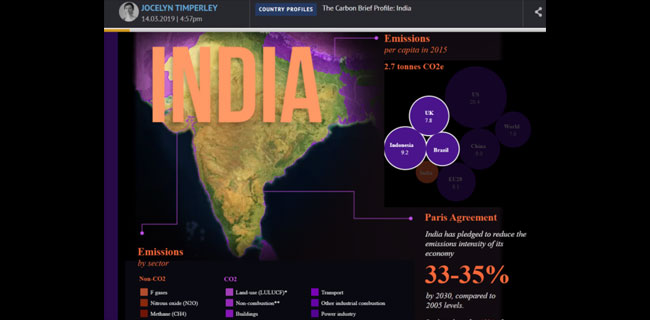
    United Nations Paris Climate Agreement (2016) sets out a path for limiting global warming to well below 2 degrees centigrade. India signed the same agreement pledging to reduce the carbon emission intensity of Indian economy by 33-35% from 2005 level by 2030. India is the world’s third largest emitter of greenhouse gases (GHGs), after China and the US. In 2015 our per-capita emissions statistics (2.07 CO2e) was well below the global average, but collectively our population made our share high in the global statistics.


    The Carbon Brief Profile India

    Source : https://www.carbonbrief.org/the-carbon-brief-profile-india/


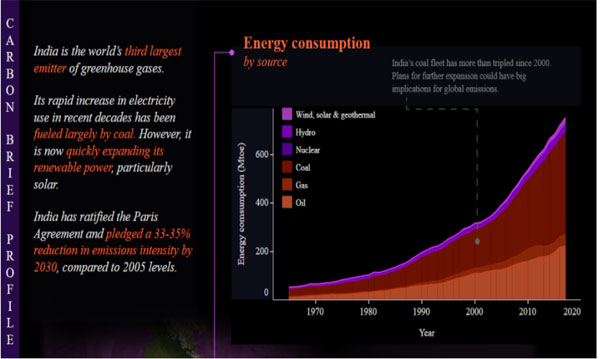
    Our dependence on coal power plants, large scale cultivation of rice and raising of cattle across India continue to be three major sources of greenhouse gas emissions, all of which have been rising steeply even after India signed the Paris agreement on global climate change. The melting of Himalayan glaciers and change in monsoon pattern have added to our woes, making us more venerable to climate change.


    Lately, the growth of internet and digital media riding on the penetration of smartphones in India has become another area of concern for climatologists.  Compared to printing a newspaper, broadcasting over TV or Radio channels, audio and video streaming over smartphones have much higher carbon emission. Satellites also clutter up space and along with the non-recyclable parabolas create significant pollutions, yet compared to smartphones their contribution to carbon emission is insignificant.  According to a recent Eutelsat study “Between fibre, satellite or TNT broadcasting and watching TV images via the 4G network, the ratio is 1 to 100 in terms of carbon impact. The higher the quality of the video, the stronger the mobile antenna array and the greater the CO2 weight.”


    India has been going through a drive for digitisation based on smartphones which accelerated during the pandemic, introduction of 5G network is underway and all predictions about future of Media and Entertainment Industry are showing high growth for digital advertising. It is doubtful if decarbonisation of media can make any effective contribution towards the overall decarbonization goals of our country. A media hype over decarbonisation of media may divert our Central Government’s attention from taking corrective measures in other important areas for achieving our decarbonisation goals by 2030.


  • Do we really need rules to control cross-media ownership?


    By Indrani Sen


    Indrani SenAlmost four months back on March 12, 2022, TRAI released consultation papers on media ownership, particularly related to cross-media ownership in India. This is not the first time that TRAI has raised the issue. However, after a comment made by the I&B Ministry, all the industry media bodies and associations have responded indicating unequivocally that there is enough plurality in the ownership of media in the Indian market and there is no need to be concerned about making regulations related to cross-media ownership.


    The western world has been grappling with the advantages and disadvantages of cross-media ownership over the last few decades. The seeds of cross-media ownership were probably sown during the post second world years during the 1950s when the American policy-makers had realised that control of world media can help to make America a superpower and encouraged transnational expansion of US media.  Since the 1980s, the business practices as well as the economic environment in the world began to change dramatically across industries with companies either merging or taking over other companies operating in the similar field and media industries also followed suit. However, American domestic media saw a dramatic change in cross-media ownership as the media ownership pattern changed dramatically due to mergers and take overs.


    “In the United States as of 1985, 90 per cent of all media companies were owned by 50 different companies. Through acquisitions of smaller companies by larger ones, 90 percent of media companies are now concentrated under the ownership of just five corporations: Comcast, Time Warner, The Walt Disney Company, News Corp and National Amusements.” (Source: https://www.lawyersnjurists.com/article/effect-of-cross-media-ownership/)


    In India, though the owners of Times of India, India Today, Hindustan Times, as well as some regional print media owners have cross-media ownerships, the magnitude of their holdings are far away from reaching any alarming stage or creating an environment of controlled messages influencing public opinions. In recent years cross-media holdings in India have created a free and competitive environment. The advocates for freedom of speech need not worry about control of public opinion due to cross-ownership ownership in India, particularly when under the present Government we seem to have indirect controls over the content of news media. The media associations’ claim that the plurality in media ownership is absolutely correct.


    If we examine the advantages and the disadvantages of cross-media ownership, then we find that the advantages probably out weigh the disadvantages in a country like India where media penetrations across traditional as well as new media have still huge scope of growth. The biggest advantage of cross media ownership is reduced cost which allows the media owner either to pass on the benefit to the consumers or to invest in further expansion of their media business and in the process if they also increase their profitability that should be excused as a normal part of doing any business. The creation of synergy is another important advantage of cross media ownership resulting in better products at reduced costs. The expansion of distribution network is another huge advantage along with increase in business security. As far disadvantages are concerned, the misuse of media power, the concern that one particular voice may become too powerful if distributed through different media vehicles across different media segments appears to be the main issue against cross media ownership.


    The four industry bodies, the IBDF, NBDA, INS, and AROI, representing TV broadcasting, print media, and FM radio companies, have strongly made the following points:

    1. There is no need for controlling cross-media ownership as there is enough plurality of ownership in Indian M&E market.

    2. There is no requirement for a common mechanism to monitor ownership of print, television, radio, or other Internet-based news media as already different mechanisms exist in different media sectors for monitoring editorial content, etc.


    While teaching the subject Economics of Media Business, I give examples of various vertical, horizontal and diagonal integrations done by different media houses in India. The proposed restraint on cross-media holdings will result in imposing control on the normal business activities in the media industry and discriminate against them in comparison with other industries are allowed do all three types of integrations. Such constraints would also violate the constitutional rights of the media houses from transmitting information and would hamper the constitutional rights of citizens to receive information under Article 19(1)(a).


    Finally, as the telecom companies have now become the biggest distributor of news and consumers are creating their own news/ circulating fake news on social media portals using the facilities offered by the telecom companies, it is fair to have a parity between the current rules and regulations governing media industry and the telecom industry and the TRAI should review the same before imposing new controls on traditional and digital media industries.


  • Indian M&E CAGR 8.8%, nearly twice that of global

    Note: 2021 is the latest available data. 2022–2026 values are forecasts.
    Source: PwC’s Global Entertainment & Media Outlook 2022–2026, Omdia


    By Indrani Sen


    Indrani SenPWC’s 23rd annual Global Entertainment and Media Outlook released on June 23, 2022 shows that globally after a setback in 2020 due to the pandemic, the entertainment and media industry is set on a steady path of recovery with a CAGR of 4.6% during 2021-26 to reach a market size of US$ 2.9 trillion in 2026 as shown in the chart below.


    Under the title “Fault lines and fractures: Innovation and growth in a new competitive landscape” the report says: “But amid all the unpredictability, there is greater clarity about the overall trends of the market and the forces driving growth, and a better understanding of the fault lines and fractures that are altering the entertainment and media landscape.” It is worth quoting another interesting observation “But the stable overall growth pattern masks an underlying volatility. It is clear that the pandemic accelerated changes in consumer behaviour and digital adoption in ways that will affect future growth trajectories. Some of the sectors that saw immense gains amid the pandemic will not be able to sustain that growth, while others will continue to build from their higher bases.”


    Turning its focus to India, the PWC report has made some interesting predictions. The Indian media and entertainment industry is expected to reach INR 4,30,410 by 2026 growing at a CAGR of 8.8%, nearly double the global CAGR of 4.6%. Deeper penetration of internet and mobile devices along with the roll out of 5G over next five years, are expected to fuel the growth of digital media and advertising while the traditional media, particularly TV will continue to hold a steady growth rate.


    Let us take a closer look at the new media sector.


    In terms of growth, India’s total video games and esports segment leads the media pack increasing at a CAGR of 18.3% from a revenue of INR 16,200Cr in 2021 to INR 37,535Cr in 2026. Given the size and population of India, it is comparatively a small market for video games and e-sports. Dominated by social and casual gaming, India currently is the third fastest-growing video games market in the world, after Turkey and Pakistan.


    The OTT segment will have the second highest growth with a CAGR of 14.1% and will touch a total revenue of INR 21,032 crore in 2026. This growth will mostly be driven by various subscription services accounting for 90.5% of revenue in 2021 with a forecast to account for 95% of revenue in 2026.


    OTT will be followed closely by the internet advertising with a 12.1% CAGR to reach INR 28,234 crore in 2026. Within the segment the mobile sector accounted for 6 0.1% of the total revenue in 2021 which is expected to increase to 69.3% in 2026.


    India’s TV advertising market saw a -10.8% decline in 2020 over the 2019 levels due to the pandemic, but recovered in 2021 with a 16.9% growth to INR 32,374 crore. The market is predicted to grow at a 6.3% CAGR to reach INR 43,410Cr by 2026. According to PWC, this will make India the fifth-largest TV advertising market globally, after the US, Japan, China and the UK.


    The total newspaper revenue is predicted to grow at a 2.7% CAGR from INR 26,378Cr in 2021 to INR 29,945Cr in 2026. India will become the fifth-biggest newspaper market by 2026 overtaking France and UK. Interestingly, in spite of a low CAGR, India will be the only country globally to grow total newspaper print revenue consistently across the 2020-26 period. During this period, India will also be the only country to grow daily print newspaper copy sales (by volume) at a 1.3% CAGR.  By 2026 India is expected to have 139mn daily average print newspaper sales, one-third of the global daily total earning the distinction of the biggest world market for print putting China in the number two position.


    Among the other smaller media and entertainment segments, India’s music, radio & podcast segment grew at 18% in 2021 and is expected to grow at 9.8% CAGR to reach INR 11,536Cr by 2026. The subsegment recorded music industry will continue to make steady progress at a CAGR of 13.6%, thanks to audio streaming platforms and touch INR 4,849Cr by 2026. In comparison, live music industry continues to remain small.


    India’s out-of-home (OOH) advertising market is predicted to grow at 12.57% CAGR to reach INR 5,562Cr in 2026. In 2020 this segment faced the biggest fall in revenue globally, however, it also recovered spectacularly in 2021 by 63.4% over the 2020 levels to INR 3,076 crore.


    As far as cinema industry is concerned, India was the third-biggest market globally in terms of ticket sales after China and the US in 2021 and is expected to grow at the highest growth rate of 38.3% CAGR during 2020-26 to reach INR 16,198 Crore in 2026. It should be noted that in 2021, the number of total tickets sold was still much below the pre-pandemic level. In terms of advertising revenue, the share of cinema advertising is miniscule due to the inherent problem of building reach and OTS through the medium, though the big screen impact offered by cinema is undeniable.


    To sum up, the Indian media and entertainment industry seems to be running on a healthy track with various prospects of creating new world records. Compared to various other such industry reports, the global comparisons across different segments makes the PWC report an interesting read.


  • Thoughts on IPL Media Rights, a week after


    By Indrani Sen


    Indrani SenLast week, on June 14, 2022, the final results of the e-auction conducted by the Board of Control for Cricket in India (BCCI) were declared with the Board earning a whopping Rs 48,390 crore for all the packages offered by them for auction. The amount is almost three times of Rs 16,376.5 crore, the money which Star India paid for TV and Digital media rights for the 2017-2022 cycle. This has made IPL the second most valued sports league in the world, next to America’s National Football League pushing English Premier League to the third position.


    By now everyone knows that this time Disney Star India has won only Package A containing telecast rights (India sub-continent) for next five years 2023-27 by bidding Rs. 23,575 crore. Viacom18 has bagged Package B containing digital rights (India subcontinent), Package C containing digital rights of 18 matches per season and part of Package D containing media rights (both TV and digital) for three global regions, Australia + New Zealand, the UK and South Africa, the main cricket playing countries whose players have been regularly participating in the IPL tournament. There is some confusion in the market related to the total payment of Rs.23,758 crores made by Viacom 18 to BCCI as lot of people have concluded that the amount has only been paid for the domestic digital rights whereas Viacom18 actually paid Rs 20,500 crore for the domestic digital rights. The media rights for the balance global regions have been won by Times Internet.


    Lalit Modi has been getting lot of coverage related to IPL media rights auction this time as cricket historian and author Boria Majumdar timed the release of his book on Lalit Modi “Maverick Commissioner” last week right after the announcement of the winners of IPL’s e-auction for media rights for 2023- 2027. Majumdar also announced that his book will soon be made into a film. Suddenly. media channels are busy interviewing Lalit Modi who is having a field day. At the time of writing, I read his interview on www.mykhel.com where he has said that BCCI should make it mandatory for all IPL franchises to own a women’s team in order to start a Women’s IPL in India. Last week, in an interview to NDTV Sports, he said that value of media rights will double again in next cycle as IPL viewership is probably the highest in the world in terms of people watching the matches (https://sports.ndtv.com/ipl-2022/ipl-viewership-probably-highest-in-the-world-lalit-modi-to-ndtv-3079226 ).


    While the Indian M&E industry is still struggling with its overall growth after the pandemic, one wonders from where the growth in the value of IPL media rights will happen? According to the EY FICCI report 2022, digital advertising grew by 29% in 2021 and TV advertising grew by 25% in 2021 which was still slightly short of the pre-Covid 2019 level. TV subscriptions continued to fall in 2021 for the second consecutive year. In the last few weeks of IPL, there was a sharp fall in the TV viewership which had raised doubts about the base rates fixed by BCCI for the e-auction. If any particular media property grows at a much higher rate than the market average for a certain period, it does so at the cost of other media properties in the same media bucket which cannot be sustained in the long run. Only time will tell if the value of IPL media rights based on the current e-auction will be actually attained.


    Back in 2016, when Star India won the TV and Digital rights for IPL (2017-2023), a lot of doubts were raised about the possibility of their success in achieving the targets. This time, industry people are speculating more about the winning bid of Rs 20,500 made by Viacom 18 for the digital rights and the implications of TV and digital rights going to two different organisations.  The Reliance-backed Viacom18 seems to have played its cards well based most likely on a deep-routed strategy for increasing their market share in online video viewing backed by the huge share of Jio in the telecom market. The introduction of 5G is expected to change consumers’ choice for live viewership of sports events from TV to mobile during this 2023-2027 cycle.


    According to an article by Javed Farooqui on Exchange4media on May 7, 2022, London-based Omdia’s recently published report on online video viewing trends shows that in India Disney+Hotstar leads the chart with 41% share. The article also shared the following graphic from the research.


    Source: https://www.exchange4media.com/digital-news/disney-hotstar-has-41-share-of-indian-online-video-subscription-market-omdia-112817.html


    Disney+ Hotstar’s subscription base tripled during pandemic years from 8 million to around 25 million by the end-2020, thanks mostly to IPL’s coverage and the competitive pricing of its annual plan. Omdia believes Disney+ Hotstar will continue to lead the standalone subscription online video market. The same report estimated that online video-on-demand (VOD) subscription market in India reached a value of $639 million in 2020, up by 142% from 2019. Disney+ Hotstar and Netflix together accounted for 78% of the total online video subscription market.


    ViacomI8 may be planning to revive Voot with this bid for digital media rights of IPL and may be also ready to write off losses, if any, as part of marketing cost for promoting Voot. With 41% marketshare, Disney+Hotstar was not required to invest proportionately high amount in winning the digital rights of the IPL. On the other hand, Disney Star India has a greater need to protect its turfs in the various TV genres where competition is much stronger.


  • Smalltown India is the future for SVOD


    By Indrani Sen


    Indrani SenOrmax Media, a specialised Insights consultancy firm, was established in 2008. In its own words: “Over the last 13 years we have pioneered the usage of various testing, tracking and forecasting-based tools, designed to achieve higher profitability in films, television, streaming, print, radio and other categories in the Indian media industry… We are constantly innovating to introduce new tools and build knowledge that can help the Indian media & entertainment industry use consumer insights and data analytics to create businesses, brands, shows, films and campaigns that are both consumer-centric and profitable.”


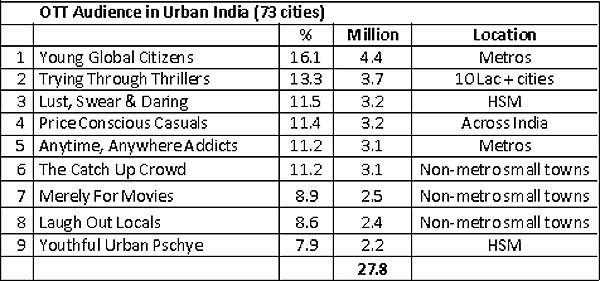
    Ormax Media launched the first edition of its Ormax OTT Audience Report 2019 with a promise to conduct similar reports year on year. In its first report, Ormax analysed the viewing behavior by preference of content watched and divided the urban OTT audience into interesting segments of nine different types.


    Source: OTT_AudienceSegments_OrmaxMedia__1_.pdf


    The onslaught of Covid-19 and the national lockdown forced them to miss the opportunity of conducting field research in 2020. But Ormax was back in 2021 with the 2021 report based on a 12,000 sample size across urban and rural India. As per that report, OTT audience universe in India in 2021 stood at 353.2 million (35.32 Crore) people. In other words, the penetration of OTT viewing was of 25.3% of the population, “which means that one in four Indians watched online videos at least once in the last one month”. The report was aligned to other syndicated media research and presented analysis of the universe by gender, age, NCCS, pop strata, states and cities.  This second report elevated OTT from a niche medium to a mass medium with huge prospect for further growth. It was possible to calculate reach of the OTT medium in different target audiences for the first time. The report also revealed that in 2021 there were 353 million OTT users in India of which 40.7 million were paying (SVOD) audiences accounting for 96 million active OTT subscriptions. In other words, each unduplicated paying audience member was subscribing to 2.4 OTT subscriptions on an average. This SOVD audience were dominated by male members who constituted 66% of 40.7 million.


    Last month, Ormax Media released The Ormax OTT Audience Report 2022, which has some interesting insights related to viewing habits of OTT audiences including content watched in different languages. The latest report is based on a sample size of 6,000 SVOD and AVOD audiences in urban India, and is probably India’s largest profiling study of the streaming /OTT audience.


    The report has revealed that Indian SVOD viewers use the dubbing and subtitling options on their OTT platforms and watch content in four to five languages on an average, while AVOD viewers watch in at least two languages, primarily due to less content options available to them. AVOD viewers watch a lot of content on YouTube where no dubbed content available.


    Content in the four South Indian languages have a large audience outside their home states, 88 per cent Malayalam SOVD content viewers and 82 per cent Tamil SOVD content viewers are respectively from outside Kerala and Tamil Nadu.


    This research also has highlighted the difference in preferences for content between SOVD and AOVD audiences.  The latter do not prefer to use web series instead they want more of shorter formats, like comedy scenes, songs, knowledge videos, including recipes, education and health, and films.


    The research has predicted that the next level of growth of SOVD viewers would come from small towns as 60-70 per cent of the top six metros’ population has already converted to SVOD audience, making the metros a near-saturated market. The male domination of the SOVD audience segment continues which may be due to other socio-cultural reasons and not just financial independence of women.


    On the whole, The Ormax OTT Audience Report 2022 has opened up a new vista of opportunities for content strategy and content creation for the Indian OTT platforms. It is interesting to note that Ormax media so far has not repeated any research on OTT audience in India, but has looked at a new concept for research every year to provide the users in the industry with either better estimates or in-depth insights.