Tag: Indrani Sen

  • Forced confinement leading to increase in TV consumption, but…


    By Indrani Sen


    On March 27, 2020 Nielsen and BARC India shared the first edition of their report “Covid-19 Impact- What’s happening in the TV and smartphone landscape” with the industry at large analysing how the lockdown has increased TV viewership in India. In the first week of the partial lockdown from March 14 to March 20 (BARC Week 11), the all-India TV viewership in minutes/week went up by 8% and TV reach went up y 6%. Overall time spent on TV went up by 2%.


    BARC conducts television audience measurement in India while Nielsen passively captures smartphone behaviour through a 12,000 strong smartphone panel. The time spent on smartphones per user also went up by 6.2%. The time spent/user/week on VOD apps saw an increase of 3%. News apps saw 8% more users per week with an increase of 17% in time spent/user/week stimulated by use of non-English News apps (+87%). Gaming apps saw an increase of 2% in users/week supported by 11% increase in time spent/user/week.


    We will look more closely at changes in TV audience behaviour. In Week 11, average daily viewers grew by 32Mn supported by kids, younger age groups and NCCS A. Viewing time for Television increased by over 70 billion minutes in India with each of 592Mn viewers watching TV daily for 3hr 51 minutes. Strangely, there was hardly any growth in the primetime viewership as the growth in viewership was driven by non-prime time. GECs also grew by 32% in non-primetime slots, but saw a 15% dip in the primetime slots which was higher (23%) in the Hindi Speaking Market (HSM) than the south Indian market (5%). An analysis by genres given below show that news, kids and movies gained the most in terms of daily ATS followed by infotainment, lifestyle and youth.


    Last week, Nielsen and BARC released the second edition of the ‘Crisis Consumption: An Insight Series into TV, Smartphone and Audiences’ report of Week 12 (starting March 21) where four days  coincided with the first week of country wide lockdown, showing an unprecedented growth of  298%  in TV news viewership. The increase in the viewership of news channels was accompanied by a 15% growth of average daily free commercial time (FCT) to 6 lakh seconds in between March 21-27 (Week 12) compared to January 11-31, 2020 or the pre-Covid-19 period reflecting last-minute changes in the allocation of TV budgets.


    All the parameters reported by BARC showed increases during Week 12 with the weekly viewing minutes (total number of minutes spent watching TV) touching 1.2 trillion. The number of people watching TV all seven days a week jumped from 32% to 44%, the average time spent per viewer increased 23% from 3 hours 46 minutes to 4 hours 39 minutes. As a result, the total number of channels consumed per viewer in the week also increased from 16 to 22. This surge is TV viewership is expected to continue during the next few days of the nation wise lock down and the spread of Covid- 19 in India will decide its future course.


    It is heartening to see that the news genre has been able to get additional advertising during this lock down period. Kids’ genre, with 20%+ share of total TV viewership and only 3% share of the overall advertising space, has not been so lucky. However, on the whole the prognosis is not good when we look at ad revenue of TV channels in immediate future. Going by the current trends, TV channels will hardly be able to convert this increase in viewership to increased ad revenue. Financial Express reported on March 21, 2020 (https://www.financialexpress.com/brandwagon/coronavirus-impact-ad-expenditure-to-decline-by-50-55-on-tv-between-april-june-2020/1914445/) “As the novel Coronavirus continues to wreak havoc around the world, television is one such industry which is currently under its grip, besides other sectors. According to industry estimates, advertising expenditure on television is expected to decline 50%- 55% to anywhere between Rs 3,750 crore – Rs 4,125 crore between April-June, that is Q1 FY2021 – if the lockdown continues.”


    The economictimes.indiatimes.com reported on April 2, 2020 in similar lines, though their estimate of the loss was pegged at 30-40% than 50-55% reported by Financial Times – “Top broadcasters, media buyers and advertisers ET spoke with, feel that if the situation doesn’t improve by end of April, the TV industry will end up with a 30-40% drop in ad revenues in April and May.” (https://economictimes.indiatimes.com/industry/media/entertainment/media/broadcasters-stare-at-drop-in-ad-revenues/articleshow/74937708.cms?from=mdr)


    While we wait for FICCI-EY to release an update of their report on M&E industry, FICCI’s recent report on the impact of Covid-19 on the Indian economy has predicted that the pandemic will potentially derail India’s growth story by affecting both the demand and the supply side. We are going through unprecedented times when it is extremely difficult to predict even the immediate future.
     

  • When Subscription Outpaced Advertising Growth…

    Source: FICCI EY M&E Report 2019


    By Indrani Sen


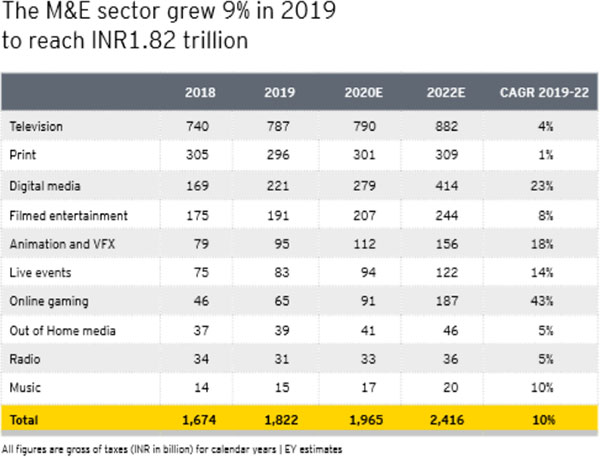
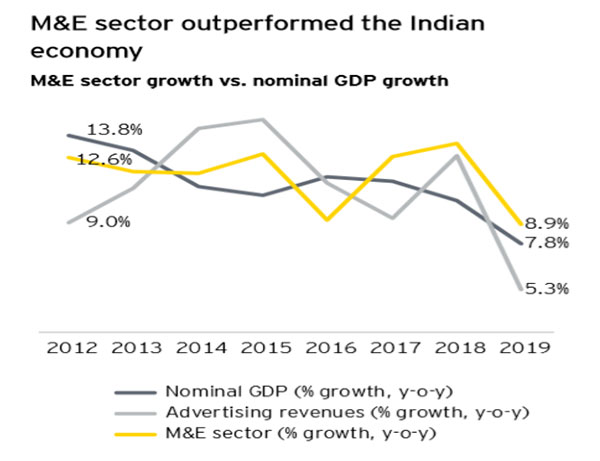
    The FICCI EY M&E Report ‘The era of consumer A.R.T. – Acquisition Retention and Transaction,’ released on March 27, 2020 shows that the Indian Media and Entertainment (M&E) sector outperformed the Indian economy (nominal GDP growth) for the third successive year with a growth of 8.9% over 2018 and reached INR1.82 trillion (US$25.7 billion) in 2019.


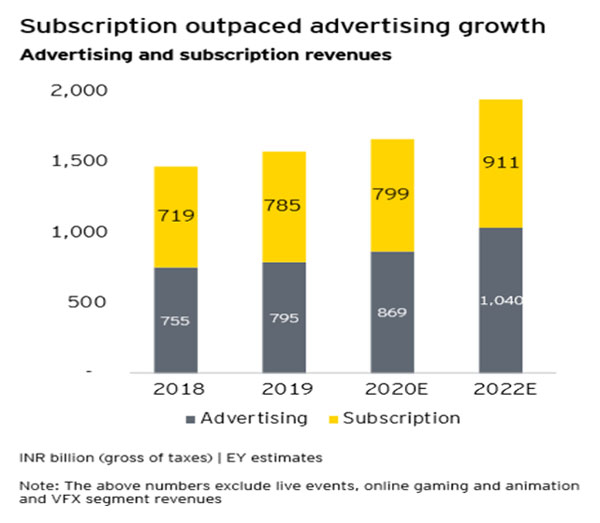
    Advertising revenue grew 5.3% while subscription revenue grew 9.3% in 2019. Subscription growth was driven by OTT video consumption (111%), film (10%) and television (7.5%) which resulted in EY labelling 2019 as “The Era of Consumer A.R.T. – Acquisition, Retention and Transition”.

    Source: FICCI EY M&E Report 2019


    Ashish Pherwani, Partner & M&E Sector Leader, EY India has added a word of caution in his forwarding note. “The current situation around the Coronavirus will, unfortunately, impact the 2020 estimates we have provided in this report, and we will update the same as soon as we can reasonably estimate its impact,” he has written. Coronavirus is going to affect both the Indian Economy as well as the M&E sector. While it is certain that the growth rates of both will see dips, how much they will dip remain a matter of speculation at this stage.


    As things stand now, it is unlikely that the Indian economy will see a negative growth, but it is highly possible that M&E sector may experience the same as it did in 2009 after the international financial crisis of 2008 triggered by the sub-prime mortgage crisis in the US. Effectively, we can use the FICCI EY M&E Report 2019 for reviewing the trends and growth different media in 2019 over 2018, but cannot rely on the future forecasts shown in the report, till EY releases an update.


    In 2019, two traditional segments, print and radio ended the year with de-growth in ad revenues, despite their growth curves remaining relatively flat for the first seven to eight months of 2019. However, print remained the second-largest segment after television, followed by Digital media as the third.


    Digital media rode on growth of both subscription and ad revenue and overtook filmed entertainment in 2019 to become the third largest segment of the M&E sector. Digital subscription revenues more than doubled from 2018 levels and digital advertising revenue grew to attain a share of 24% of total advertising spend.


    Online gaming retained its position as the fastest growing segment on the back of transaction-based games and a 31% growth in the number of online gamers to reach around 365 million.


    The following table shows the details of the growth by different media in 2019:

    Source: FICCI EY M&E Report 2019


    A detailed analysis reflects that ad spends increased by INR40 billion in 2019 over 2018 due to INR37 billion growth in digital and an INR15 billion growth in television, reduced by a fall of INR12 billion across local traditional media (print, radio, OOH).  Advertising growth was muted due to overall economic slowdown in 2019 which also impacted festive ad spending.


    Source: FICCI EY M&E Report 2019


    The growth in subscription revenue was driven largely by the proliferation of mobile access, enabling on-demand, anytime-anywhere consumption of content across India, in both urban and rural areas. In a country with 1.3 billion population, we have 688 million internet subscribers and nearly 400 million smartphone users and a tele-density nearing 89% of households. Riding on such statistics, India’s telecom industry is poised to become the primary platform for content distribution and consumption. Today, India ranks as one of the fastest-growing app markets across the world with entertainment apps as well as gaming apps driving significant consumer engagement which is likely to accelerate as people are forced to stay at home and work from home during the current 21 days lockdown and in the event of the lockdown extending beyond mid-April, 2020.


    We can safely assume that in 2020, the effects of Covid-19 will be more on ad revenue than on subscription revenue in the M&E sector.  It is too early to make any estimate regarding the effects on ad revenue of individual segments of the M&E sector. With the rush of migrant labourers wanting to go back to their home states, we seem to be sitting on the tip of an iceberg as we step into the crucial first week of April/the second week of nationwide lockdown to fight the deadly Coronavirus, to hope and to ensure that India does not get into the stage of community transmission.


  • The Ripple Effect of Coronavirus


    By Indrani Sen


    A lot has happened in the last one week, when we speculated about how Covid-19 might affect the AdEx in 2020. As India fights against all odds to stop the accelerated outbreak of the virus through community transmission with the entire country is facing partial to total lockdown, there is no doubt that our economy will be badly affected like many other developed and developing countries. So, along with the rest of the world, India will be getting into a severe recession for the rest of the year. The point we need to speculate, will there just be a dip in the growth rate of AdEx or will we see a negative growth as we saw in 2009?


    The international financial crisis of 2008 which originated in the sub-prime mortgage crisis in the US and led to a severe recession in many countries over 2008 and 2009 also affected the Indian economy and we saw first a dip in the AdEx in 2008 and then a negative growth in 2009. However, AdEx recovered quickly from that recession and we saw a healthy growth in 2010.


    Source: Pitch Madison Media Advertising Outlook 2015


    The ripple effect of Coronavirus is going to create an employment crisis across the globe and India will not be an exception. We were already at a high unemployment situation before this crisis hit us. With industries experiencing forced shutdowns, many are asking their employees on go on leave without pay or with truncated pay.  Employees who work on the basis of contracts, as per terms and conditions of the contracts are often not paid unless they report to work and in the present situation are likely to lose financially. Financial loss will be experienced by the lower end of self-employed workers (Ola/ Uber drivers, auto drivers, rickshaw pullers, plumbers, electricians, etc.) as well as the daily wage earners. MSME sector which is known as the engine of growth and employment in India will also take a big hit. A combined effect of these muted wage or loss of wage will lead to decrease in consumer demand. In addition, there will be a disruption in the supply chain also due to temporary closure of production, lack of transport for distributing the goods, etc.  These changes in demand and supply will have adverse effect on the marketing and advertising budget forcing the advertisers to curtail their expenditure.


    Circulation of our print media so far has not been affected like global print media many of who have stopped the printing of hard copies, thanks to the last mile delivery by newspapers delivery persons and hawkers as against the sale through news-stands in developed countries. Indian newspapers managed to develop a schedule of work from home for their reporters and a system of rotation for other essential staff in order to reduce the number of employees present on their premises.


    The ‘Janata Curfew’ on March 22 followed by lockdown of some cities/ districts from March 23, may force newspapers also to take a call regarding their production as the distributors/ hawkers and the delivery boys will also get hit by the lack of local transport. Probably, newspapers from second-tier cities under lockdown will be less affected than the newspapers from metros facing a similar situation. So, some Indian newspapers may experience temporary closure and fluctuations in their circulation and readership and subsequently lose ad revenue as supplies of goods dwindle due to logistical issues related to production, transportation, etc. and consumer demand drops.

    There is going to be an increase in TV viewership, particularly the viewership of news and entertainment channels as people try to stay abreast with Covid-19 related news and entertain themselves with serials and movies during their stay at home. With all production of Film and TV industry closed till March 31, there is a chance that the serials will run out of their banked episodes which have been already shot and canned. Lack of new episodes will affect the viewership of serials adversely. Even if the viewership of GEC and Movie channels increase, ad revenue may go down due to demand and supply related issues as mentioned above in relation to print.


    Sports Channels are going to lose both viewership and advertising revenue with cancellation of sporting events and their telecast. As TV still accounts for the major share of our ADEX, the extent of loss of TV revenue will determine the fate of AdEx in 2020.

    Contributions of radio, cinema and outdoor to the overall AxEx are much less than Print and TV. However, ad revenue of FM radio stations will be affected as listening to car radio goes down with people being forced to stay at home. In the US, Nielsen is working on special analysis as well as a quick survey to give the advertisers some idea about how Covid-19 has affected radio listenership. Our Radio Audience Measurement is already affected by lack of financial support from the sector and it may not be possible for them to react in a similar way (http://www.insideradio.com/free/nielsen-to-release-study-on-covid–impact-on-radio/article_6c1e0246-6a81-11ea-8ab4-17d484c1eb56.html).


    Many of radio advertising deals are linked with on ground activities and consumer activations and radio ad revenue will see a decline due to curb on all such activities. With closure of malls and cinema halls, cinema will lose the ticket sales money as well as advertising revenue. Traffic on the roads, stations, airports will dwindle due to lock down of cities, social distancing and work from home which will have a negative impact on OOH advertising.


    Usage of digital as well as social media will increase during this troubled days as people are trying to get constant update on the pandemic, keep in touch with their friends and relatives while staying at home and opt for some entertainment of their choice on OTT platforms. There is a good chance that advertisers will try to utilise this opportunity by stepping up their budget on digital and social media till the ripple effect of Covid-19 force them to stop advertising.


    So far, we have seen only an estimate for loss by events and experiential industry which has been estimated as Rs 3000 crores with ten million jobs at risk which was published on March 17, 2020. (http://everythingexperiential.businessworld.in/article/Loss-to-events-experiential-industry-in-India-estimated-at-Rs-3000-Cr-due-to-COVID-19-ten-million-jobs-at-risk/16-03-2020-186335/). Other media sectors have not yet made any forecast of their probable losses.


    The ripple effect of Coronavirus will be directly proportional to the number of days that India takes to control the spread of the virus. In some European countries currently experiencing community transmission, economic analysts are already forecasting that at least 12 to 16 weeks period will be required to curb the virus. If India gets into a similar situation, it may take us longer to curb the virus given the expanse of our country and irresponsible behaviour of our citizens. In that case AdEx will end up with a negative growth like we experienced in 2009.


  • Just how much Covid-19 impact AdEx in 2020?


    By Indrani Sen


    Today, it is difficult to make any guess on when our country and the world at large will be free from the deadly attack of Covid-19. The UN Conference on Trade and Development estimated it may wipe off $1 trillion from the global economy in 2020. It is too early to estimate the effect of the pandemic on Indian economy and business and the consequences of the same on media and advertising industry.


    Our economy has been slowing down from last year and now various manufacturing industries are facing a forced halt in production due to lack of supply of parts and ingredients which are usually imported from China. Recently, we have been witnessing a fluctuating Sensex in a jittery stock market which is unlikely to recover soon.


    On March 12, the Indian government suspended issuing tourist visas till April 15 and on the next day BCCI postponed IPL 2020 till April 15. What miracle are we expecting to happen in next 30 days? Experts in healthcare have declared that this 30 days window is the most crucial period for India to control the spread of Covid-19 and stop it from getting into the third stage of community transmission, though some of them feel that community transmission of Covid-19 is inevitable (https://economictimes.indiatimes.com/industry/healthcare/biotech/healthcare/community-transmission-of-covid-19-is-inevitable-icmr/articleshow/74621197.cms).


    In other words, by end-March/ early-April, we will know if we have been able to contain the progress of Covid-19 and escape from getting into the dreaded stage three of community transmission. If we fail to contain the disease in stage two of local transmission, then the current restrictions may be extended beyond April 15 till we are able to curb the growth of Covid-19. Considering that from January 30 when the first case of Coronavirus was reported in Kerala, it took 40 days for 50 cases to be detected in India and then in the next six days the number climbed from 50 to 108 cases spreading across the country, the virus is an active growth phase in our country.


    What will be the fall out of Covid-19 on media spending by Indian advertisers? The industry sectors/ organisations whose production will be affected may start reducing their ad spend to mitigate economic losses. The sectors/ organisations who are dependent on Chinese supply chain, may also find their sales taking a dip as consumers are not likely to spend less and save more in the current situation of uncertainty. Some industries like travel, tourism and hospitality are already in severe loss and are unlikely to spend on advertising during the first half of 2020. Events have also taken a hit and are not likely to recover before the festive season. A lot of money rides on IPL and if BCCI is forced to cancel the tournament due to Covid-19, it will be a great loss of revenue for traditional as well as digital media.


    As severe to moderate restrictions are imposed by different state governments on their citizens, they have started avoiding shopping in crowded malls and markets and are utilizing online shopping for purchasing daily necessities and other goods. Advertisers who would like to reach out to their consumers during the next six to eight weeks can ride on this wave of online shopping. E-commerce is likely to get a boost as people also try to avoid cash transactions in brick and mortar outlets.


    With closure of schools and colleges in various states, there is bound to be an increase in content consumption across traditional media and digital media at home. It will be interesting to analyse the readership and viewership data for this period to assess if traditional media were able to get a share of the consumers forced to stay at home. Many organisations who have adopted digital technology are asking their employees to work from home which in turn can boost the other uses of internet for entertainment e.g. engagements with OTT platforms and other digital media.  However, given the current scenario of consumer spends across various categories of goods and services, it is unlikely that such consumer engagements will attract higher investment in digital advertising.


    The two other media which are going to be affected are cinema and outdoor. As state governments close down malls and cinema halls to prevent spread of Covid-19, cinema will not only loose the ticket sales money, but also advertising revenue. Due to travel restrictions, social distancing and forced staying at home, the traffic on the roads, stations, airports etc. will be less having a negative impact on OOH advertising.


    As a combined effect of all the above factors, it will not be surprising if the growth rate of AdEx drops from two digits (10.4% as per Pitch Madison Media Outlook 2020) to single digit in 2020. On the whole, 2020 does not promise to be an exciting year for media and advertising in India.


  • India: Still a Small Player in Sports


    By Indrani Sen


    Around fifty years back, sports used to be played just for the sake of excellence in sports and not for any financial gain. The advent of television followed by satellite telecast created a global audience for sports and changed the business of sports totally. The second and perhaps more crucial change happened with the introduction of the World Wide Web and internet with sports reaching the remote corners of the world riding on the new media technology. Today, million dollar deals back big sporting events with promises of big money to all the stakeholders.


    Recently, Media Partners Asia (MPA) released a report Asia Pacific Sports Media 2020.. The report predicts sports revenues in TV and online video will grow at a 6.7% CAGR to reach US$7.2 billion by 2024. According to the report, OTT accounted for 21% of sports media revenue generation in 2019 in the 11 Asia Pacific markets. This is likely to almost double over the next five years to reach 40% by 2024. Excluding China, OTT will account for 23% of sports media monetisation in 2024 across the measured markets, up from 12% in 2019.


    The MPA report further notes: (1) Sports rights costs and revenues are seasonal and lumpy; major global events typically occur every 2-4 years and can either inflate or adversely impact sports economics on a year on year basis and (2) Global sporting events in 2020 (i.e. the Tokyo 2020 Olympics scheduled in July 2020 in Japan, etc.) will be key drivers of value in Asia Pacific markets. Currently these events are subject to risk given the global spread of the Coronavirus. Japan has already cancelled a few pre Olympic schedules and is taking extra precautions for the torch relay.  The torch is scheduled to be lit in Greece on March 12 and handed over to Japan on March 19 at Athens.


    Sports rights investments in China, India, Australia and Japan are driven by a strong domestic sports ecosystem. Rights costs in China are driven by growing appetite for domestic and international football as well as basketball with domestic baseball and football driving growth in Japan’s sports rights market. Cricket continues to drive more 85% of India’s costs and the trend is likely to continue irrespective of growing popularity of some other sports.


    In 2018, Sanjay Gupta (then MD of Star India) predicted that Indian sports industry can become a $10 billion industry in next five to seven years while speaking at the CII Scorecard Forum. Gupta said, “Over the last few years, the kind of activity around the business of sports has been tremendous. There are now over 15 domestic leagues in the country – across kabaddi, football, wrestling, boxing, badminton – from just 2 five years back…… And in my mind, this journey has only begun. Sports is still at 0.1% share of our GDP, while globally the industry is sized at around 0.5% of GDP share” (https://www.exchange4media.com/media-tv-news/indian-sports-industry-can-become-a-$10-billion-industry-in-next-5-7-yearssanjay-guptamd-star-in).


    We will still have a long way to go even after becoming a $10 billion dollar sports industry to make any mark in the APAC sports market as well as the global sports market. As per research by ResearchAndMarkets.com the global sports market reached a value of nearly $488.5 billion in 2018, having grown at a compound annual growth rate (CAGR) of 4.3% since 2014, and is expected to grow at a CAGR of 5.9% to nearly $614.1 billion by 2022 (https://www.businesswire.com/news/home/20190514005472/en/Sports—614-Billion-Global-Market-Opportunities). In spite of the media hype which gets created every year around IPL and over ICC World Cup every year, India will remain a small fish in a big pond as far as sports business is concerned unless we can improve our standards in other sports and get higher fan following across different sports to build up audiences for TV and OTT platforms.


    In March 2019, PWC along with ASSOCHAM published a report “Sports infrastructure: Transforming the Indian sports ecosystem” which highlights not only the lack of sports infrastructure in India, but also the lacuna in government’s policies and funding for promoting sports. As per PWC, collaboration of private and public sectors is required in order to uplift the standard of sports in India. If the government allows investment in sports as a part of Corporate Social Responsibility (CSR) projects and permits few companies to participate jointly in large projects, then we can probably hope to see substantial improvement in near future.


  • Well-Pitched Delivery!


    By Indrani Sen


    As per the Pitch Madison Advertising Report, in 2020 adspends in India are predicted to grow by 10.4%, while GroupM’s This Year Next Year predicts that in 2020 the same will grow by 10.9%. This rate of growth is the only aspect on which both the reports have shown some similarity.

    Even while commenting on the growth rate, GroupM sounded buoyant by comparing it with the 5.1% growth rate of global ad spends in 2020 and ignoring the Indian ground realities while Madison described the growth rate as “muted” expecting the economy to bounce back only in the second half of 2020.

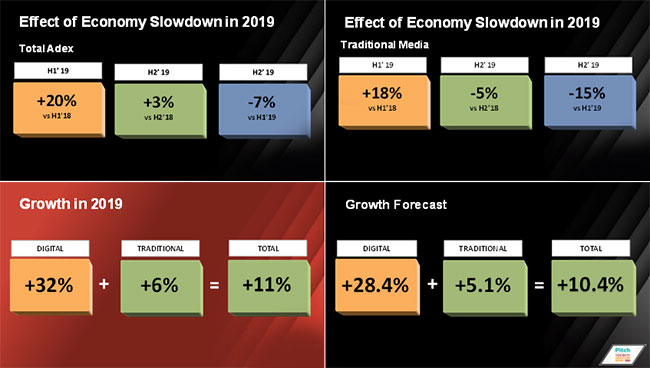
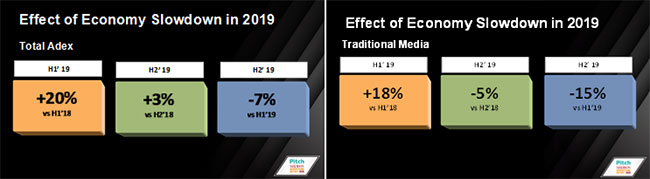
    PMAR 2020 is more firmly rooted in the Indian media and market scenario and has presented an excellent analysis of the ups and downs faced by the traditional media industry in 2019 and its consequences. In his presentation, Sam Balsara made an interesting observation by dividing 2019 in two halves and showing how AdEx grew very well during the first half riding on IPL, World Cup and Lok Sabha Elections, but collapsed during the second half due to economic slowdown. Balsara also showed how the traditional media suffered heavily during the second half of 2019, when compared to second half of 2018, there was a de-growth in second half of 2019.

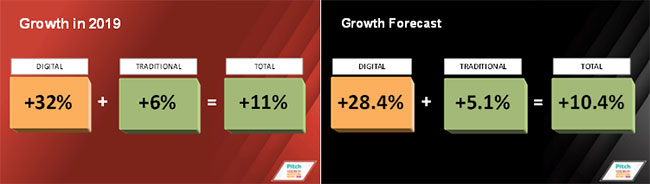
    Balsara presented  charts showing that the Digital media grew by 32% in 2019 and projected a growth rate of 28.4% in 2020 as against traditional media which grew by 6% in 2019 and is expected to grow by 5.1% in 2020.

    He commented in his presentation that: “We also expect a wide variation of growth rates across mediums ranging from a low of 2% for Press, 5% for Radio, 6% for Outdoor, 7% for TV, to 20% for Cinema and 28% for Digital.” In 2020 TV will continue to enjoy the largest share of the advertising pie at 36% and Print may be demoted to number 3 with Digital securing a march over it. As of now, PMAR predicts 26.6% share for Digital and 27.4% share for Print in 2020. PMAR and TYNY also projects different estimates for the size of the traditional media, with TYNY estimating a value of TV AdEx almost 10000 crore higher than the value estimated by PMAR.

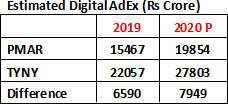
    The growth rates for Digital media estimated by TYNY is 28% in 2019 and 26% in 2020. Both the reports predict Digital as the main growth driver of Indian Adex in 2020, but there is again a significant differences between the estimated sizes of Digital AdEx.

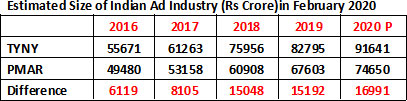
    GroupM has revised their estimate for total AdEx upwards for both 2018 and 2019 while Madison revised their estimate for total AdEx downwards for 2019 due to economic slowdown and various headwinds faced by the traditional media industry. As a result of these revisions made by the two agencies, estimated sizes of Indian Ad Industry by TYNY are now 15000+ crore higher than the sizes estimated by PMAR, a difference which is not only difficult to reconcile, but also creates confusion in the market place.

    By now, we have learned to live with different sizes of the Indian Ad Industry estimated by different agencies. PMAR estimates are most acceptable by the industry at large due to its ability to link the market realities with their statistics supported by analysis of trends in Ad Spends as well as in depth analysis of individual media. Balsara also adds an icing on his presentation every year through advice to advertisers which are considered to be extremely useful and this year he has excelled himself on that score.


    Indrani Sen is a veteran advertising and media agency practitioner. She is now also an academician. Her views here are personal


  • A Roller Coaster Ride of Adspends


    By Indrani Sen


    It appears from GroupM’s This Year Next Year (TYNY) 2020 report that the Indian ad Industry is on a roller coaster ride in spite of the slowdown in certain sectors of the manufacturing industry and hits and misses in agriculture during 2019. Prasanth Kumar, CEO – Group M South Asia expects sustained and stable investment across the media in India in 2020.


    GroupM predicted in TYNY 2019 that the World AdEx will grow by 3.67% from 2018 to 2019 and the Indian AdEx will grow by 14%, higher than the CAGR growth of the previous four years. In TYNY released last week, GroupM has estimated that world AdEx grew by 3.7% from 2018 to 2019, but Indian AdEx grew by only 9% against the earlier estimated growth of 14%. However, there was no comment on the drop of growth rate in the press release issued by Group M.


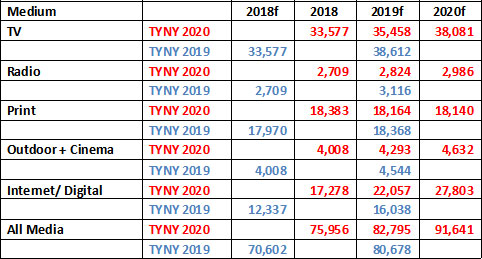
    I initially thought that probably the drop in the growth rate of adspend was due to the slowdown in the industry, but a closer look at TYNY2019 and TYNY2020 statistics showed that upward revision of the estimate of the total adspend in India in 2018 led to lowering of the growth rate from 14% to 9%. A comparison of the two reports is shown in the following table.


    Indian Adspend (INR crore)


    It is interesting to note that the forecast for 2018 for Digital as shown in TYNY2019 was increased by 40% in actual adspends of 2018 shown in TYNY 2020. Estimate for Print was also increased marginally while all other estimates remained the same. These changes in Digital and Print adspends resulted in an overall increase of total ad spend from 70,602 crore to 75,956 crore in 2018. GroupM should have added an explanatory note in their press release to warn the users of TYNY about these changes in their estimates as reflected in TYNY 2019 and TYNY 2020.


    As per TYNY 2019, India was 10th largest market in adspends in the world, the 3rd highest contributor to incremental global ad spends and the fastest growing major ad market in the world. In TYNY 2020, India continues to be the 3rd highest contributor to incremental global adspends and the fastest growing major ad market in the world and has come up to 8th position in the list of largest markets by ad spends by beating Canada and Australia. In 2020, adspends in India is predicted to grow by 10.9% against a global growth of 5.1% in adspends.


    According to Kumar, Digital would garner 65% of incremental ad spend in India in 2020. Tushar Vyas, President Growth and Transformation – GroupM South Asia further commented: “There are multiple advancements happening in technology which is transforming digital advertising and other mediums. India being a diverse country, digital will keep growing, especially with the rise of content platforms and its availability in multiple languages powered by the growth of 3Vs (video, voice and vernacular)”.


    In conclusion, I agree that Digital media has gained its own momentum of growth in India and most advertisers do not want to miss out on the opportunities offered by the new media. Slowdown in certain sectors of manufacturing industry is unlikely to affect the investment in digital advertising in particular which would be the engine of growth in ad spends in India in 2020 as predicted by TYNY 2020.


  • Indrani Sen: The Window of Mobile Payment

    By Indrani Sen


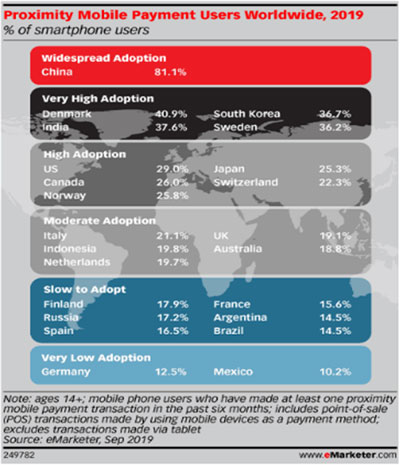
    An article in www.emarketer on January 21, 2020 shared a chart of the proximity mobile payments users of different countries showing that in 2019 India featured in the “very high category” bucket in terms of adoption of mobile payments along with Denmark, Sweden and South Korea.

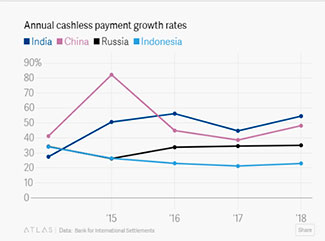
    While, India still has to go a long way before catching up China’s rate of penetration among smartphone users—81.1%, there are other evidences which show that the rate of growth of cashless payments in India has been faster than that of China during the period 2015- 2018 as shown in the chart below on the left (https://qz.com/india/1746910/cashless-payments-growing-faster-in-india-than-almost-anywhere-else/).


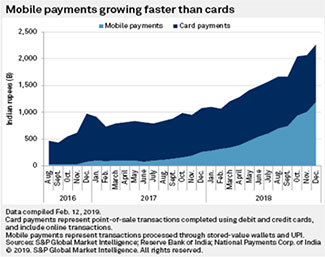
    In an article on May 9, 2019, SP Global Market Intelligence showed that during 2016 to 2018 mobile payments in India has been growing at a faster rate than card payments as shown in the above chart on the right (https://www.spglobal.com/marketintelligence/en/news-insights/blog/mobile-payment-apps-driving-fintech-frenzy-in-india). Wall Street Journal affirmed the growth of mobile payments in India in their article tiled Cash May Be King in India, but Google Is Prince of Mobile Payments on September 19, 2019 showing how millions of Indian mobile users were using Google Pay to pay for their transactions.

    In another article Will India’s payments ever be fully mobile? published on September 23, 2019 Edd Gent wrote “But while that expansion sounds impressive, industry consensus is that digital payments still only account for 10 to 15 per cent of all retail merchant transactions, says Vijay Mani, partner at Deloitte India, with mobile predicted to play second fiddle to cards, at least in terms of value.” He further argued that “only a quarter of Indians own a smartphone with the capabilities to use banking apps and popular payment services such as PayTM, Google Pay and PhonePe, though with 40 per cent of Indians under the age of 18, the percentage of adults using them is likely to be considerably higher” (https://www.raconteur.net/finance/mobile-payments-systems-india).

    Global Advisory KPMG published an highly informative report in August last year Fintech India- Powering mobile transactions covering Indian Mobile payment ecosystem in the backdrop of global mobile payments ecosystem, key learning and  major challenges. The report claims that digital payments in India are growing at a CAGR of 12.7 per cent in the number of non-cash transactions through mobile phones (https://assets.kpmg/content/dam/kpmg/in/pdf/2019/08/Fintech-in-India%E2%80%93Powering-mobile-payments.pdf).

    The window of mobile payment is a reality which advertising and marketing industry cannot afford to ignore. The FMCG industry particularly needs to explore the opportunities of communicating with their customers through this window as an extension of their mobile advertising. KPMG report listed the emerging business services provided by Mobile Payment Service Providers (MPSPs) as Financial Services, Mobile Marketplaces, Utility & Bill Payments, Payment Containers and Government Enablers and there can be innovative opportunities of associating with some of these services as well as mobile wallets.

    In the report, KPMG had given recommendations for transforming India into a leading payment ecosystem to all the stake holders, the Government, financial institutions, regulators and merchants. In the Union Budget announced on February 1, 2020 the only consideration given to digital payment is the Government’s Aadhaar-enabled payments system which is subject to various other financial arrangements and security considerations. The wish list of the digital industry, particularly related to incentives for digital payments has not been considered. It seems that the Government has put its vision of Digital India on a back burner and has definitely not considered the recommendations made by KPMG and other such advisory bodies.


  • The Four Giant Leaps


    By Indrani Sen


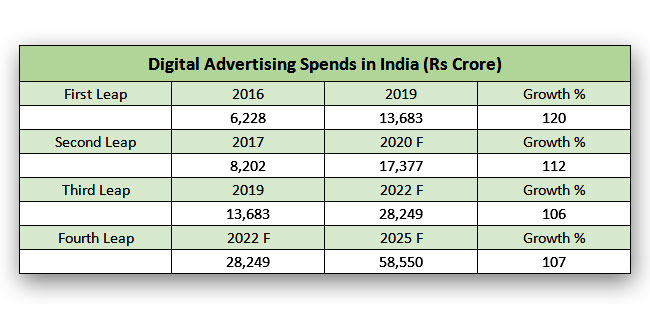
    According to the DAN Digital Advertising Reports, spends on digital advertising in India is increasing by 100%+ every three years and is poised to cross the 50,000 crore milestone before 2025. It was only in the second half of the last decade, the Indian advertising industry crossed the milestone of 50,000 crores, so it seems strange that the newest and youngest competitor for the share of the advertising pie will be crossing that same milestone by middle of this decade! We have already witnessed the first giant leap from 2016 to 2019 and it seems quite possible that in three more giant leaps digital advertising will achieve this fantastic growth.


    Digital Advertising Spends in India (Rs Crore)
     First Leap 2016 2019 Growth %
    6,228 13,683 120
    Second Leap 2017 2020 F Growth %
    8,202 17,377 112
    Third Leap 2019 2022 F Growth %
    13,683 28,249 106
    Fourth Leap 2022 F 2025 F Growth %
    28,249 58,550 107

    Source: DAN Digital Advertising Reports


    The question which comes up next is which industry verticals are contributing to this spectacular growth of digital advertising? An analysis of the DAN Digital Advertising Reports show that almost across all industry verticals, advertisers have been increasing their spends across various platforms of digital advertising. The following table shows the comparative weightage on digital advertising by industry verticals in their total advertising budget in 2017 and 2019. Except Media & Entertainment where the weightage has remained 23% and miscellaneous small categories grouped under “others” where the weightage has gone down, across all other industry verticals, advertisers stepped up their expenditure on digital media. Digital media is no longer a myth; it is a reality now competing for share of the advertising pie and propelling the growth of advertising in India.


    Weightage on Digital Advertising
    2017 2019
    FMCG 7% 19%
    Auto 12% 16%
    E Commerce 30% 37%
    Retail 16% 20%
    Telecom 28% 35%
    BFSI 24% 42%
    M&E 23% 23%
    Consumer Dur 19% 38%
    Others 9% 4%

    Source: DAN Digital Advertising Reports


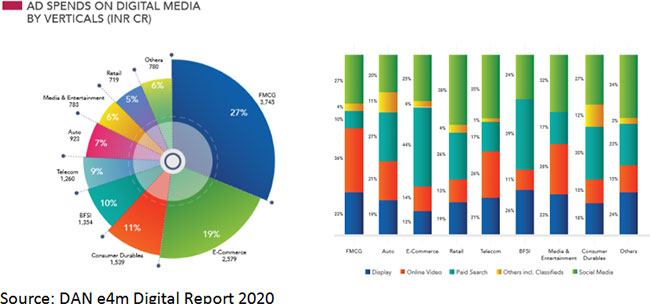
    Though FMCG as a category spends 19% of their advertising budget on digital media, it contributes 27% of the total digital advertising pie, followed by E Commerce 19%, Consumer Durable 11%, BFSI 10% and Telecom 9%, followed by others as shown in the chart below on the left. So, across all industry verticals, advertisers have got into the Indian digital bandwagon.


    The next chart on the right shows that based on the target audience and their use of different digital media, the various industry verticals use the different digital formats for advertising; while E Commerce and BFSI rely more on paid search, Retail and Telecom rely on Social Media. However, a comparison of 2017 and 2019 shows that the share of formats in digital advertising have hardly changed except video increasing at the cost of classified and paid search.


    2017 2019
    % %
    Social 28 28
    Paid Search 26 25
    Display 21 21
    Video 19 22
    Classified 6 4

    Source: DAN Digital Advertising Reports


    In 2017, 43% of the digital advertising was through mobile, which increased to 47% in 2019 and is expected to grow to 53% in 2020. Clearly, the mobile revolution in India has contributed in a large way to the growth of digital advertising. By the time digital advertising crosses the 50,000 crore mark mobile will have 60% + share in that revenue. Programmatic buying has also been growing year on year and by 2020 direct buying will be 44% with programmatic buying going up to 56%.


    The digital media industry still faces many challenges, but apart from a detail discussion on ROI for digital advertising, the current report does not touch on the other issues like ad fraud, ad blocking software, lack of metric for measurement etc. On the whole, the DAN e4m Digital Report 2020 is an informative and excellent resource and the advertising and marketing industry should be thankful to the leadership of Dentsu Agies Network for sharing it free with all concerned.


  • Indrani Sen: Millennial Mothers & Media

    By Indrani Sen


    I was intrigued when Femina announced its report on “Millennial Working Women 2020” last week. But my excitement died quickly when I found that its “extensive quantitative research” was conducted among 1500+ English-speaking millennial working mothers belonging to SEC A in the Top 10 metro cities.

    The sample represents a miniscule segment of millennial working mothers of India which is further affirmed by the finding that “85% of these millennial mothers hardly cooked or never did so at home.” Even with the luxury of being able to afford domestic help, most housewives in SEC A still have to cook when the maid is either on leave or simply absconds. As health and nutrition conscious mothers of young children, they are not expected to depend on ordering food from outside. So, this is a surprising finding.

    A large number of these upper class millennial working mothers have acknowledged that their spouses help them not only in taking care of the children, but also with the domestic work though the nature of the work has not been detailed in the report available for downloading. It is understandable that their children are first priority for these mothers and for maintaining perfect work life balance they enjoy harmonious relationship with their parents and in-laws. It is however surprising to note that “at a professional level they receive a lot of support, strength and motivation from their respective managers and peers at the workplace” when we know about the cut throat competitiveness across professions.

    Most of these women feel that “good looks do matter” and ensure that they get good nutrition for themselves. They are all addicted to online shopping as “the easiest way for them to indulge in some me time is to shop online.” Last year in a report “Trend-setting millennials: Redefining the consumer story” released by Deloitte India and lobby group Retailers Association of India, we saw that millennials still preferred offline retail modes and were gradually shifting towards the online mode based on the aspects of  convenience and options (https://rls.net.in/wp-content/uploads/2018/02/Trendsetting-Millenials_RAI-Deloitte.pdf). Perhaps the shift has already happened among this particular target group.


    When it comes to media habits of these millennial working women, they are consuming contents mostly on TV (97%), Facebook (91%) and newspapers (85%). Newspapers score much above magazines (38%) as a source of content. However, in nuclear families almost half the millennial working mothers source their content from magazines.


    Whats App messages play a significant role in their life by providing them with information about current local news as well as the latest happenings in the world with 66% of all the mothers sourcing content from the messaging app. They consume movies and video content through YouTube, OTT platforms (37%) and Facebook videos. 20% of them also listen to radio for entertainment.

    “According to a Morgan Stanley report of April 2017, India will have 410 million millennials, who will spend $330 billion annually, by 2020. That’s more than the total population of the US, and more than the total number of millennials (400 million) that China has today. Naturally, every brand owner wants a slice of this pie” quoted www.livemint.com in June, 2018. Femina conducted their research with the objective of getting a better understanding of a section of the millennial consumers, the life of millennial working mothers, but the report available for downloading lacks in providing in-depth understanding of their lifestyle and does not offer meaningful insights to their media habits.


    Indrani Sen is a veteran adperson and now a full-time educator. She writes for MxMIndia on most Mondays. Her views here are personal.


  • Indrani Sen: Will Ekam get a new lease of life in this New Year?

    By Indrani Sen


    In 2016, television viewership measurement body Broadcast Audience Research Council (BARC) India announced plans to measure digital viewership and going beyond audience measurement of broadcast media. In April 2017, BARC launched its plan of providing the industry with a single platform for all measurement products, across TV and digital through “Ekam” in a phased roll-out over 18-24 months. Partho Dasgupta, then CEO of BARC India, detailed out the five products which were designed based on specific needs of the industry: Ekam Pulse, Ekam Beam, Ekam Stream, Ekam Ad-Scan and Ekam Integra.

    To recap the memories of readers, Ekam Pulse, the first product to be rolled out, is for measuring video ad campaigns while Ekam Beam will be measuring linear broadcast that is viewed on a digital device and Ekam Stream will be measuring both non-linear and pure play digital video content. Ekam Ad-Scan, as its name suggests, will give an overview of digital ads in India from different perspectives and Ekam Integra will provide the industry with independent audience numbers enabling calculations of reach and frequency. BARC also announced that its TV data will be integrated with Digital Video data with the help of Single-Source and Digital Booster panels.

    A month later in May, 2017 BARC announced that Nielsen India will be its primary digital measurement partner. Nielsen will develop India-specific adaptations for digital measurement based on its global experience. We did not see any publicity of Ekam from the side of BARC for some time, but had assumed in good faith that BARC would deliver as promised based on their tack records of TV audience measurement. In June, 2018 when Economic Times reported that BARC’s digital measurement system would get delayed by one year, ), we did not comprehend all the complications which BARC was encountering in the process of developing Ekam. ( https://economictimes.indiatimes.com/industry/services/advertising/barcs-digital-measurement-system-to-get-delayed-by-another-year/articleshow/64759655.cms?from=mdr )

    The above report quoted Nakul Chopra, then Chairman of BARC: “The new General Data Protection Regulation (GDPR) that came into effect in the European Union from May 2018 has sparked similar discussions around privacy issues in other countries as well… Our government has appointed the Srikrishna Committee. These developments have implications for the content ratings that will be part of Ekam. We need to be sure that the entire Ekam piece is compliant with the prevailing and likely data protection norms. So, while we are still pushing for an earliest possible launch, we are currently recalibrating our plans in light of these new developments.”

    The Srikrishna Committee submitted its report along with the draft of Data Protection Bill in September, 2018. Based on the Committee’s recommendations “The Personal Data Protection Bill 2019” was tabled by the Minister of Electronic and Information Technology in Parliament on  11December , 2019 and was immediately sent for further analysis by a Joint Parliamentary Committee. Under the present political climate in our country which is causing frequent black out of internet in select areas, it would not be surprising if the PDP Bill 2019 gets lapsed before it gets a chance to be registered as an Act.

    But the real reason of the delay in the process of launching Ekam is not compliance or lack of compliance with regulations of Personal Data Protection. In late 2018 there were rumours in the market that Nielsen had not been able to provide a suitable solution acceptable to all stakeholders. There was a very low key announcement in May, 2019 that BARC is evolving its own mechanism for digital audience measurement as its association with Nielsen has come to an end. Obviously, this was a major setback to the entire process as BARC might have to start developing the system from the scratch unless it has developed a parallel system on its own.

    Apart from the technology of digital measurement, BARC has also has to resolve another serious issues of participation by Google and Facebook in their measurement survey. Though BARC has not made any official announcement, yet by now it is widely known in the industry that Google has refused to participate in the digital measurement survey proposed by BARC by citing their global policies related to third party measurement of their content and data privacy agreement with their users. The Indian digital video content producers/ OTT platform owners are willing to participate provided BARC gets Google and Facebook included in the survey. It has become a real Catch 22 situation with no immediate solution in sight.

    In January 2019, BARC exhorted Telecom Regulatory Authority of India (TRAI) to “empower” it to be the uniform measurer of audience and other data related to TV, and OTT and digital platforms.    (https://www.indiantelevision.com/television/tv-channels/viewership/barc-india-exhorts-trai-to-empower-it-as-digital-measurer-190114) It was a smart move to counter competitors like Comscore, etc. who enjoy patronage of Google. However, till date TRAI has not responded to BARC’s petition.

    During January and February 2019, www.bestmediainfo.com carried a few provocative articles by Niraj Sharma exploring the reasons behind the delay in Ekam. The articles speculated on the lack of support Ekam was getting from ISA and why Google was not cooperating with BARC and allowing them to measure both ad and content viewership on their platforms. While I do not agree with all the points made by Sharma, I concede that if ISA as a body could take an uniform stand, then Google might have to reconsider their decision regarding participation in Ekam. Both Google and Facebook consider India to be an important market for their future growth and value the business which they get from Indian advertising industry.

    The question which BARC needs to address now is how to revive and kickstart Ekam in 2020. Apart from the technological needs, there seems to be the need of a master negotiator for solving the participation issues with Google and Facebook. BARC can simplify their offerings for doing a survey of only ads across all digital media platforms followed by a survey of digital contents minus Google and Facebook content. Will Sunil Lulla, the new CEO of BARC, find a solution acceptable to all the stakeholders? If Ekam cannot be revived during this year, then probably it will be shelved forever which will be not only a wastage of financial resources and time, but also a setback for media research in India.


  • Milestone Year for Mobile


    By Indrani Sen


    The current year will go down as a milestone year in the history of Mobile when 5G networks, the next generation of mobile internet connectivity was launched and in US TV was dethroned for the first time by Mobile as the media channel where Adults in US spend the most time.


    In April, 2019 Verizon surprised most of the world by launching first its 5G network in Chicago and few other locations. UK was not far behind as EE launch its 5G network, switching it on in six cities in UK in May 30 2019,  followed by Vodafone launching 5G  in seven cities in July 3, 2019. Australia soon followed suit. China and Korea have also been planning 5G network for a long time and launched the services around mid- 2019. China has officially announced that they will have 150 million 5G mobile subscribers by 2020. By end of 2019, 5 million Koreans are expected to have 5G phones.


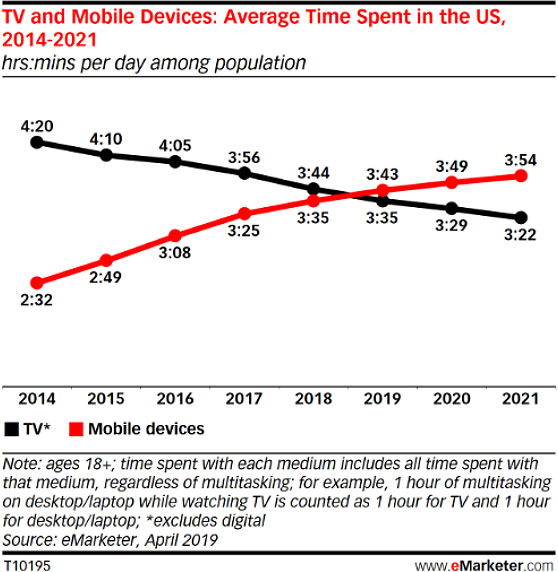
    On December 19, 2019 www.emarketer.com  announced in a report that the average US adult spent 3 hours, 43 minutes (3:43) on their mobile devices in 2019, compared with the average 3:35 spent watching TV (https://www.emarketer.com/content/mobile-year-in-review-the-launch-of-5g-is-the-biggest-story-in-a-busy-year-for-mobile?ecid=NL1001). Only three years back, in 2016 the same US adults watched nearly an hour more of TV than they spent on their smartphones and tablets (4:05 vs. 3:08). The forecast made by www.emarketer.com shows that the trend is going to continue with the share of time spent on mobile climbing higher year on year.


    In India, we are seeing the trend of increasing time spent on digital media driven mainly by mobile, but we have still years to go before an average adult Indian starts spending more time on mobile than on TV. But the trend has set in among select target audience groups including millennials at the upper and lower end of the economic ladder. A survey is conducted among college going students who including their travel and class hours spend a lot of time outside their home about time spend on TV and on mobile, may find that they are already spending more time on mobile than on TV, helped by the choices available on OTT platforms. The student community is a mix of young people coming from lower middle class to upper class homes, but almost everyone today owns a mobile which has become a necessity rather than a luxury.


    Reliance Telecom Services celebrated three years of Jio in 2019. Jio has revolutionised the use of mobile among certain working class people like auto rickshaw drivers, household maids who often indulge in seeking entertainment through their mobiles during short breaks in their work schedule. Such people usually have long working hours and as a result may have started spending more time on their mobiles than on watching TV at home. Again a survey conducted among such target audience groups may reflect the truth, but as these people have poor purchasing power, a survey among them will serve only academic interest.


    Current research conducted by different agencies are showing that time spent on digital media including mobile is growing at a faster rate than all other media in India. A recent report by McKinsey showed that with data becoming more accessible, monthly mobile data consumption per user is growing at 152 per cent annually in India — more than twice the rates in the United States and China and internet users will rise by about 40 per cent and number of smartphones will be double by 2023.
    (https://economictimes.indiatimes.com/tech/internet/internet-users-in-india-to-rise-by-40-smartphones-to-double-by-2023-mckinsey/articleshow/69040395.cms?from=mdr ) Time spent on mobile internet has gone up from 9.4 minutes daily in 2013 to 54 minutes in 2019 and is expected to reach 79 minutes by 2021.


    Global Web Index’s Social Media Trends 2019 Report showed that Indian users spent 2.4 hours on social media, in line with the global average (https://www.globalwebindex.com/reports/social) This finding is confusing as if the average time spent on mobile internet is 54 minutes then how can Indian users spent 2.4 hours on social media which is mostly consumed through mobile internet? The sample size of the social media survey covered 15000 Indians among 2.78 lakh respondents across 45 countries, but the details of the sampling frame work is not available, so it is difficult to figure out if the survey was limited to mobile users only which will explain the discrepancy.


    The writings on the walls are very clear, like the rest of the world the average adult Indian will also be gradually moving to spending more time on mobile than on TV. The global milestone year 2019 should be an inspiration for our telecom industry to accelerate their growth plans and move in that direction.