
Tag: Indrani Sen

  • Is Legacy Media Recovering in the Unlocking?


    By Indrani Sen


    During the last two or three weeks, we saw many reports on how the AdEx has improved in June 2020 ensuring us that not only digital, but TV and print are also on the path of recovery after Covid-19. TAM AdEx for June has shown that TV advertising volumes increased by 74 per cent per day in June compared to April, when adspends declined sharply due to decline in demand during the nationwide lockdown. TV ad volumes saw 46% growth in June compared to May.


    Print, which suffered a bigger hit in terms of revenue due to distribution problems during lockdown, has recorded a higher increase of 325% in average ad volume per day in June 2020 when compared to April 2020. Most of the business newspapers and industry websites reported on the recovery of digital and TV media. None of the articles highlighted the comparison between the first quarter and the second quarter of 2020 which could have given a better idea about the recovery of ad volumes in digital and TV media.


    I saw only one article in details on Print AdEx on the recovery of Print AdEx which also did not have any such comparison (https://www.financialexpress.com/brandwagon/print-advertising-on-the-road-to-recovery-as-average-ad-volumes-per-day-rose-325-in-june-2020-tam-adex/2032701/). This trend of lack of reporting on print clearly indicates that the medium has lost its position to digital not just in terms of share of the advertising pie, but also in the share of mind map of the audience, the advertisers and agencies.


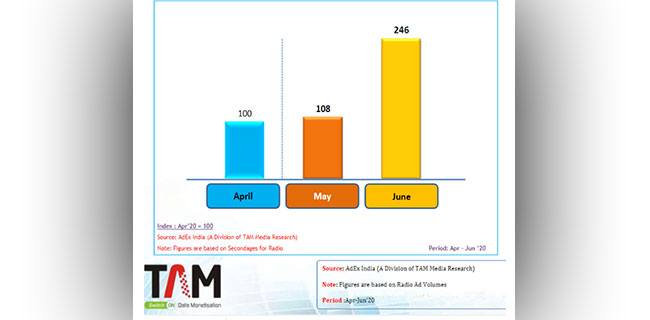
    The Advertising Report on Radio – April-June 2020 published by TAM shows that average ad volume per day increased by more than two-fold in June compared to April and May. However, a comparison with the first quarter of the year (Jan-March) shows that the ad volumes in radio are still much below the pre-Covid-19 phase. It is interesting to note that FM Radio ad volumes in Non-metro cities have recovered better than metro cities.
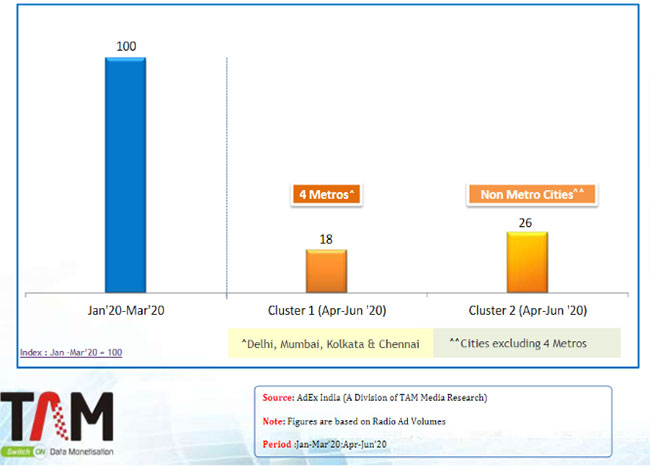


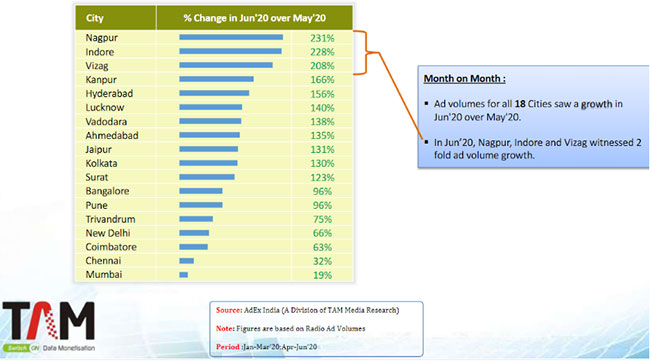
    The ad volumes of radio advertising in all 18 cities grew in June 2020 over May 2020. The chat below shows that the eight non-metro cities, Nagpur, Indore, Vizag, Kanpur, Hyderabad, Lucknow, Vadodara and Ahmedabad have shown much better growth in June 2020 compared the four metro cities. Kanpur, Indore and Vizag led the chart with each accounting for two-fold growth in ad volumes. Among the four metro cities, Kolkata has shown the highest percentage change in June 2020 over May 2020 with Mumbai showing the least percentage change. The listenership of FM radio increased during the period of lockdown and has retained the level, but advertisers across different cities are investing in the medium in different way.


    The report has detail analysis of radio advertising by categories, advertisers and brands as well as city wise analysis of the performance of radio AdEx. It also presents comparative analysis of TV and radio and digital and radio advertising during Jan-June 2020. The Top 10 common categories, advertisers and brands between TV and radio shows that during the first six months of 2020, Top 10 common categories, advertisers and brands added 33%, 14% and 4% on TV while they added 10%, 7% and 4% on radio.  Similarly, the Top 10 common categories, advertisers and brands between digital and radio shows that during the first six months of 2020, Top 10 common categories, advertisers and brands added 47%, 18% and 12% on digital while they added 19%, 2% and 1% on radio. The role of radio in the media mix needs to be reassessed by advertisers and agencies for the growth and survival of the FM radio industry during this period of unlocking and subsequent return to normalcy.


  • Indrani Sen: The Refreshing Breeze from “Dakshin”

    By Indrani Sen


    The shadow of gloom cast by Covid-19 on our newspaper industry has not yet shifted and most of our newspapers are still struggling to revive their circulation, readership and revenue. During June and first half of July, I have come across very few articles on Indian print/ newspapers and all of them either had a negative connotation or provided  an advisory for revival of the sector. An article published in www.scroll.in  on June 25, 2020, related to the unique last mile delivery system of Indian newspapers, illustrates the negativity syndrome (https://scroll.in/article/964158/hard-times-after-the-lockdown-a-newspaper-vendor-in-mumbai-is-losing-clients-to-online-media) and an article published in www.policybazar.org on June 23 is an example of an advisory issued to the print industry at large (https://www.policycircle.org/economy/industry/change-or-perish-indian-newspapers-stare-at-a-crisis-of-their-own-making/).


    The press release on TAM AdEx report published last week treated print and eadio like Corona-positive patients and avoided touching the trends in the AdEx.  Against such a backdrop, during this regime of Coronavirus, it was really refreshing to listen to the speakers of the webinar ‘Go Dakshin: Print Emerging Stronger Post COVID 19 organised by Exchange4media on July 7, 2020. The webinar panel had representation of publishers covering all southern states and was ably moderated by Kishan Kumar Shyamalan, VP, Wavemakers. He began the webinar by commenting that print in South India is different in many ways for their counter parts in North, West and East India and requested the panellists to share their experiences during the lockdown and post lockdown.

    KRP Reddy, Director Advertising & Sales, Sakshi Group opened the panel discussion admitting that they lost 25% circulation in urban areas during April after the lockdown, but in rural areas their circulation was not affected. After unlocking, they have recovered in smaller towns and now are working harder to regain their lost circulation in large cities. Suresh Balakrishna, Chief Revenue Officer, The Hindu Group, agreed by saying that Hindu is still under pressure in large towns. He reiterated that April was really bad. It was like “holding on to a hand break of a car coming to a screeching halt”. In May, Hindu had revived 89% of its circulation in Tamil Nadu and Kerala and 75% in Andhra, Telengana and Karnataka. Balakrishna added that being relevant and being agile helped The Hindu Group to navigate this critical period successfully. The magazines Sportsstar and Frontline were converted to digital magazines during the lockdown and did not stop publishing.

    Verghese Chandy, VP Marketing & Advertising Sales, Malayala Manoroma Group said they were better prepared to deal with the crisis after experiencing other health crisis and multiple floods in the past. In the early days of the pandemic, they managed to convince their people that hard copies of newspapers do not carry the virus and lost a very small percentage of their circulation during the lockdown. Circulation revenue helped Malayala Manoroma Group to survive when advertising dried up during the period of lockdown. Abhinav Khare, CEO, Asianet said that Kannada Prabha took a hit initially in April and had 18% de-growth, but started recovering from May and the trend is continuing in June. Eshwar N, CMO, Casagrand said he is one of the biggest spenders on Print in Tamil Nadu and Kerala and were one of the first to start advertising their real estate projects after lockdown. Their advertisements got a good response comparable with pre-Covid time.

    In response to the question of the moderator Shyamalan “How can Print re-emerge now?” Balakrishna said 10 years ago, when the realisation began that digital is here to stay and Hindu began its digital journey, the pandemic has fast-tracked the process. The Hindu Group had collapsed its traditional and digital sales team into one seamless team and the editorial team had also evolved digitally. Their pricing policies had changed over the time and all their digital offerings were behind the pay wall by the time pandemic hit. The economics of the business had started changing for them and COVID 19 just fast tracked the transition. Reddy, however felt that traditional Print is still considered to be most credible and would continue to grow in next decade.

    Chandy felt both the traditional and digital formats of newspapers will co-exist and grow for some time and readers can choose the format they like to read. He argued that the pandemic exposed the shallowness of the digital media and the legacy media re-emerged as the more trusted one. He gave a couple of post lockdown examples of readers’ response to ads from the automobile and film industry in print to support his arguments.  Khare said traditional print would need to make their formats more interesting to attract younger readers who have started reading news digitally. Balakrishna gave the example of “Singapore Straight” and said that cover prices would increase and become hard and balance between advertising and circulation revenue would be restored. He argued that readers would gradually get used to paying for digital content. The webinar ended with the participants requesting advertising agencies to support Print during this period of Covid-19.


  • Indrani Sen: Global Media Gloom

    By Indrani Sen


    We are all feeing the fallout of the Covid-19 crisis in our lives and livelihoods. According to a report by World Economic Forum, global poverty is expected to increase for the first time since the 1998 Asian Financial Crisis and unemployment rates are going to increase across developed as well as developing countries of the world.  No business sector is immune to the effects of the pandemic, but Media & Entertainment (M&E) Industry is among the few sectors which are likely to be affected more.

    We have not yet seen any report on how the Indian M&E Industry has fared during the first two quarters of the current year by the agencies who regularly publish such reports annually.  There was a report “Media and entertainment post Covid-19: The best and worst of times” released by KPMG in April, 2020 which touched on the broad trends. Brand Equity reported in an article published on May 12, 2020 about the predictions by Crisil, the global analytics company, predicting a 16% decline in the revenue of Indian M&E Industry in FY 2021 (https://brandequity.economictimes.indiatimes.com/news/media/media-entertainment-sector-revenue-could-take-16-pc-hit-in-fy21-crisil/75687403).


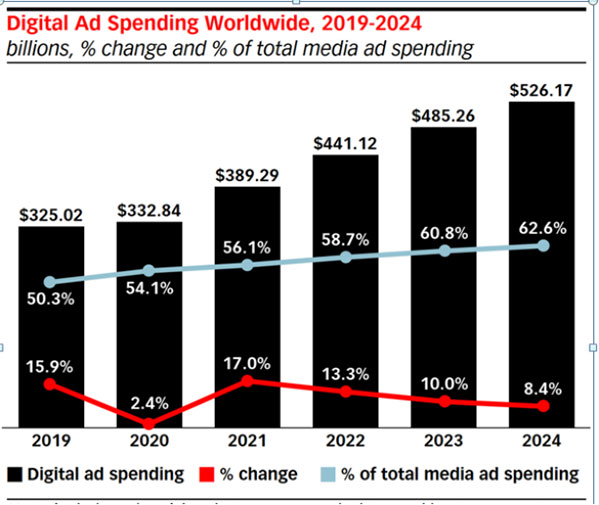
    While we wait patiently for mid-year reviews from FICCI-EY, KPMG, Group M, Pitch-Madison, etc, let us take a quick look at what has been happening around the globe. I read three reports in www.emarketer.com during last week and would like to share a few findings with our readers. On July 6, 2020, an update on Global Digital Ad Spending Q2 2020 was published which highlighted that “…every market we cover will experience a decline in ad spending except China. Google will see its first ever contraction in digital ad revenues, as search advertising will struggle compared with display….Overall ad spending will decline by 4.9% worldwide this year, a significant drop from last year’s 6.3% growth and from our pre-pandemic 2020 forecast of 7.0% growth” (https://www.emarketer.com/content/global-digital-ad-spending-update-q2-2020).


    Source: eMarketer, June 2020

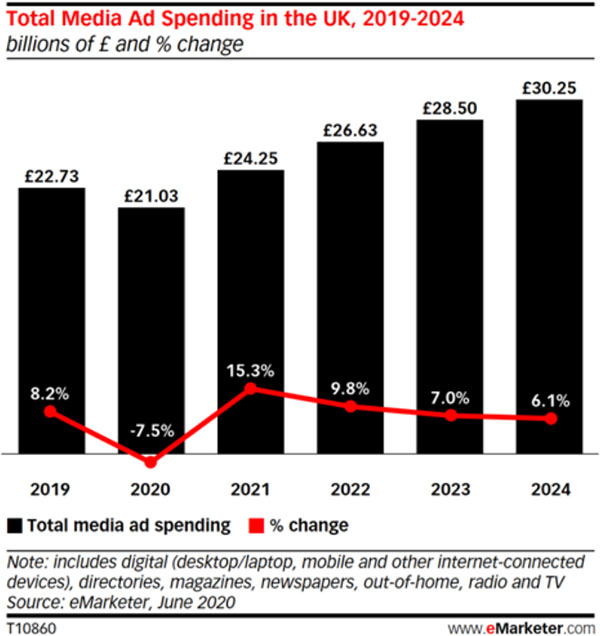
    On July 8, 2020, there  was an article on UK predicting sharp declines across traditional media will drag total ad spend down by 7.5% in 20202 (https://www.emarketer.com/content/uk-sharp-declines-across-traditional-media-will-drag-total-ad-spend-down-by-7-5-2020?ecid=NL1009). The report also predicted recovery of the media industry in 2021 with a healthy growth rate of 15.3%.

    On the same day, there was another article on US, predicting a substantial fall in TV Upfront ad spending in the 2020-2021. “US upfront TV ad spending will decline 1.4% in the 2019-2020 season to $20.28 billion, and drop a substantial 27.1% in the 2020-2021 season to $14.78 billion….”( https://www.emarketer.com/content/tv-upfront-ad-spending-will-fall-5-5-billion-2020-2021-season?ecid=NL1009). The UK economy is officially in a recession and there is a Huge uncertainty about investment in advertising by most advertisers.

    It would have been wonderful if similar reports could have been generated for Indian media industry showing the advertising revenue of the first two quarters, January to March, 2020 and April to June 2020. In absence of such information, we can use the above global trends in making some estimates about the Indian Media industry.  It can be safely said that we are also going to see a decline not just in the growth rate, but also in the size of our media industry across traditional and digital platforms.


  • Has the Lockdown diverted audio streaming to video?


    By Indrani Sen


    During this decade, the listening habits of consumers have been steadily moving to online platforms. The demand for vernacular content consumption helped popular music streaming giants to establish their apps in India and benefitted the homegrown apps. At present, the main players in the Indian market are Times Internet-owned Gaana, JioSaavn, Apple Music, YouTube Music, Amazon Prime Music, Spotify, Google Play Music and Airtel Wynk.


    The consumption of digital audio has been growing steadily from music streaming to podcasts. One would have thought that the coronavirus pandemic would further increase digital audio streaming, but it reality it has turned out to be different.


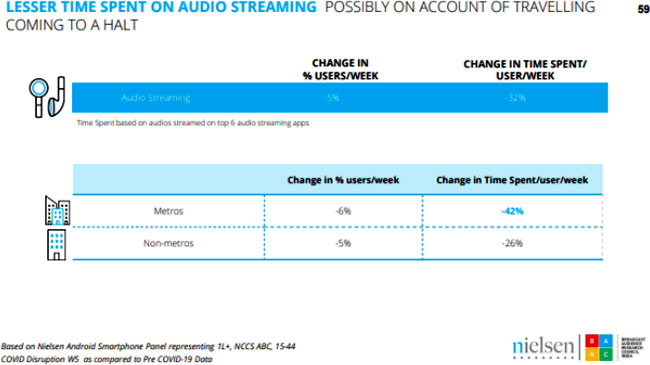
    In one of the earlier reports released jointly by BARC and Nielsen, it was reported that both users per week and time spent by users per week for audio streaming have been going down across metros and non-metros. While the research agency attributed the decline to travelling coming to a halt, informal research showed that people staying at home preferred to see music videos than listen to audio tracks of music.


    Source: Deep Dive into content and advertising consumption during COVID 19, 23rd April, 2020


    This trend has been seen across the world with www.emarketers.com  reporting on audio streaming getting diverted to video streaming in UK and US during Coronavirus lockdown resulting in decline of average time spent with digital audio in 2020.


    In UK, where steady gains were made till recently in digital audio consumption, www.emarketer.com has predicted a zero growth among the adult population in 2020. The picture in the US is broadly similar, though with time spent among adults declining only by a single percentage point. (https://www.emarketer.com/content/in-the-us-and-uk-audio-streaming-has-diverted-to-video-during-coronavirus-lockdown). April 2020 data from Nielsen Music as reported in the article, found that compared to an eight-week pre-Coronavirus baseline, audio music streaming volumes in the US were down by 6.2% in the week ending March 19 and by 9.2% in the week ending March 26. Music video streaming on the other hand increased by 9.3% and by 13.4%, respectively during the same two weeks. It is likely that a similar analysis in India will show similar trends during Covid-19.


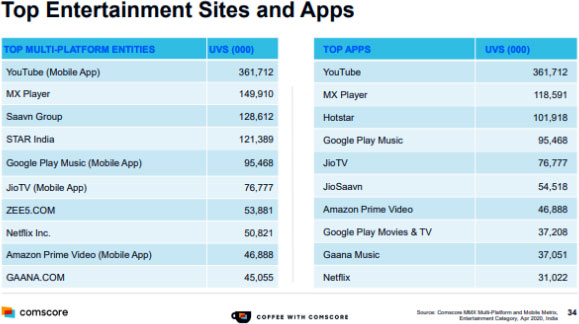
    Source: Coffee-With-Comscore-India-JUN2020


    The Comscore Report of June 2020 estimated  the number of Unique Visitors (UVS) for top entertainment sites and apps in India. Among the music steaming apps, Jio Saavan had highest number of Unique Visitors followed  by Gaana Music. Hotstar has almost double the number of UVS of  Jio Saavan. An informal check with the audio streaming companies further revealed that both their Daily Active Users (DAU) and Monthly Active Users (MAU) have been going down staedily. They are now shifting their focus to increasing their subscription revenue, which currently has a miniscule share of their revenue.


    The question which is currently haunting the audio streaming industry is if this shift to video streaming from audio steaming is a temporary phenomenon which will disappear with the pandemic or is it going to be a lasting effect which will adversely affect their future business plans? As education, trade and commerce grapple with the manifestation of the ‘new normal’ status, it can be safely guessed that the current trend is not a short-term affair. Unlocking of the economy will probably slow down the rate of diversion from audio streaming to video streaming, but it would not bounce back to the pre-Covid-19 scenario.


  • Indrani Sen: FM Radio in an Existential Crisis

    By Indrani Sen


    Covid-19 has enforced an existential crisis on FM Radio Industry in India. The industry is totally dependent on advertising and ground events-related activities tied up with social media deals as their sources of revenue. All ground events came to a sudden halt after the attack of coronavirus and advertising expenditures dried up as sales took a nose drive. The economic slowdown of last financial year had already impacted the FM Radio industry in FY20 and there was a fall in the revenues of all major companies operating in the segment. According to FICCI EY Report on Indian M&E Industry 2020, revenues of FM Radio Industry grew 5% in the first half of 2019, but fell by18 % in the second half.


    Due to the decrease in advertising support thanks to lack of business activities during COVID19 followed by the national lockdown, FM Radio industry revenue fell by 80% in April, 2020 and 90% in May 2020 compared to last year. It is estimated that during the first two months of FY21 (April and May) the industry has suffered loss of INR 200 crores and by September, 2020 the loss will mount up to INR 600 crores. The unpaid past dues of DAVP and MSMEs has added to the financial crisis of the various companies owning different brands of FM Radio.


    Association of Radio Operators of India (AROI) approached the Ministry of Information and Broadcasting in March, 2020 with a concrete proposal asking for immediate short term financial support and long term changes in policies. AROI asked the Government for moratorium in license fees and other charges, waiver on interest for delayed payment for a period of one year, clearance of dues from DAVP pending for more than a year and restoration of Government advertising on FM radio channels.  MIB has so far allowed only three months’ extension of licence fees payment without interest which hardly offers any financial relief and is in fact a very small concession offered by the Government who has in the past ripped good financial benefits through auctioning of private FM stations and continue to earn annual revenues from the industry.


    How has the FM radio industry been dealing with the pandemic in their content? Most of the stations stepped up their programming for educating their listeners about the virus and safety measures and various ways of dealing with home quarantine. Government policies stopped them from making their own local news, but they carried health bulletins from various hospitals and other local government organisations free of cost. A large portion of their content shifted from entertainment to information. Red FM and Magic FM launched a programme “Care Karona” on their channels encouraging their listeners to become facilitators of correct information by educating their maids, drivers and everyone who is in direct contact with people to contain the ripple effect of virus. My FM from the Bhaskar Group introduced a programme “Real Ya Na Real”for busting fake news. Radio City, Mumbai raised donation off INR 8 lakh through their programme “Dabbewale Ka Dabba Bharo” for helping Mumbai’s dabbawalas affected by the lockdown. A recent article in The Print (https://theprint.in/features/how-fm-radio-spread-positivity-and-created-a-sense-of-community-during-the-lockdown/437111/) has praised the way FM Radio spread positivity and created community feeling during the lockdown.


    What about the listenership of FM radio during Covid-19?  As per the Indian Readership Survey, listenership of radio remained stable across the last three studies at 20%. Urban radio listeners are almost twice (28%) the size of rural listeners (15%) base (listened during last 1 month). However, the findings most likely relate to total radio listeners (AIR channels as well as Private FM Radio channels) and no separate estimate is available regarding the contribution of the Public and Private radio channels in the radio listenership. There has been a lot of speculation during the pandemic about the listenership of FM Radio going down during the lockdown as people could not listen to their car radios and at home had to compete with TV and Digital Media for attention.


    A recent article in www.moneycontrol.com  referred to a research done by AZ Research during the lockdown showing daily listenership of Radio has gone up during the Pandemic. “Radio is one of the very few mediums that are currently offering you new and fresh content. That has helped increase the listenership for radio by three million to 51 million listens a day post-lockdown, according to a study by AZ research.” (https://www.moneycontrol.com/news/trends/entertainment/coronavirus-impact-more-people-listen-to-it-now-but-radio-is-still-struggling-5232061.html)


    The online version of Deccan Heard referred to the same study done by AZ Research in details in an article published on April 9, 2020 ( https://www.deccanherald.com/national/coronavirus-lockdown-radio-listenership-increases-by-23-per-cent-study-823395.html) “The study, commissioned by the Association of Radio Operators for India (AROI), also said radio industry has witnessed a  listenership of 51 million people, which is nearly as much as television’s reach of 56 million and social media’s reach of 57 million.” AZ Research conducted the study across a sample size of 3,300 people across India in selected cities having FM Radio channels and found that 82% people have been tuning in to radio during the lockdown period.  As per the study, FM radio has a credibility score of 6.27, second only to the internet which is at 6.44, while TV has a score of 5.74.


    As per the Pitch Madison Advertising Report (PMAR) 2020, the Top 5 categories of Radio ADEX in 2019 were Real Estate, FMCG, BFSI, Auto and Telecom accounting for only 39% of the total while in case of TV   the top five categories contributed to 78% of the total ADEX.  FMCG accounted for only 9% of Radio ADEX as against 49% of TV Adex. As we gradually unlock the lockdown and our economy limps back to “new normal”, advertising of various goods and services have started reappearing in TV and Print. The advertisers should try to consciously support FM Radio Industry by allotting a small part of their investment to the medium; my assessment is they would not be disappointed with the return on their investment.


  • The Silent Coup by Prasar Bharati


    By Indrani Sen


    In February 2019, post TRAI’s NTO, big broadcasters had pulled out their Hindi mass entertainment channels from DD Free Dish which subsequently led to loss of viewership, weekly GRPs and ad revenue for those channels. The four big broadcasters, who submitted fresh bid invitation for vacant MPEG-2 slots by Prasar Bharati and won the e-auction held on June 2, 2020, must be sighing in relief now after getting five channels back on DD Free Dish. With effect from June 10, 2020, DD Dish TV subscribers would be able to view Star Utsav, Sony Pal, Zee Anmol, Colors Rishtey and Zee Anmol Cinema. It is definitely a win-win proposition for viewers as well as the channel owners in the post Covid-19 scenario.


    Considering that these channels were earlier earning on an average 100 times more that the average carriage fee of Rs 6 to 8 crore paid per annum to DD Free Dish and most of them lost 50% + of their ad revenue after pulling out from DD Free Dish, it is no wonder that they have all boarded back the DD Free Dish Band wagon at the first available opportunity. The five channels are in dire need of restoring their ad revenues in the post-Lockdown stage and cannot do without the viewership numbers which DD’s free-to-air platform promises to add. It is a silent coup by Prasar Bharati for making DD Free Dish an essential part for the survival and growth of these private channels.


    In most of the statistical analyses of subscribers of DTH providers, DD Free Dish is not included which makes the advertising and media Industry forget about its existence. While Doordarshan does not have the built in mechanism to measure the growth of DD Free Dish connections, estimates available from government sources as well as private consultancy firms unanimously agree that DD Free Dish is the leading DTH service provider in India.


    On June 23, 2019 at a programme to launch distribution of DD Free Dish TV set top boxes in Kashmir, Union Minister for Information and Broadcasting Prakash Javadekar claimed that (https://www.indiantelevision.com/dth/dth-operator/dd-free-dish-has-35-crore-subscribers-prakash-javadekar-190623) Doordarshan was the biggest DTH service provider in India with 3.5 crore (35 million) subscribers of DD Free Dish.  He further claimed that there are total 5.5 crore (55 million) DTH connections in India. The 2019 FICCI-EY report estimated 30 million subscribers for DD Free Dish and predicted that it would cross the 50 million mark in near future.


    It is evident from the activity related to DD Free Dish on various private e-commerce sites that their business is doing well. From the sale of DD Free Dish set-top boxes on Amazon (https://www.amazon.in/STC-DD-free-Dish-Set-Top/dp/B07FNKDGGC ) to installation of DD Free antenna on Indiamart (https://www.indiamart.com/proddetail/d-d-free-dish-antenna-installation-5874029873.html) to sale of remote  on Flipkart (https://www.flipkart.com/mase-remote-dd-free-dish-controller/p/itmfdcbspgtjqmgg) , e-commerce sites are doing brisk business due to the popularity of the DD Free Dish.


    DD Free Dish is available in Ku-Band on GSAT-15 (at 93.5°E). It has been upgraded from time to time. The number of channels available increased from 80 to 104 in 2019, of which 26 channels are reserved for Doordarshan. Currently 104 SDTV channels along with 40 radio channels of AIR are available to the subscribers. DD Free Dish has been the greatest contribution which Prasar Bharati has made to broadcasting in India since the satellite TV’s invasion from the sky and privatisation of TV channels. If the set top box for DD Free Dish can be made technically enabled to receive WiFi signals then a new vista of media consumption will open to the vast audiences belonging to  “Bharat”.


  • Will OTT consumption trends last beyond the Lockdown?


    By Indrani Sen


    Starting March 25, Covid-19 imposed four phases of a lockdown over 68 days in India. We have seen many changes in our Media & Entertainment industry during this period. The rise of consumption of video streaming or OTT platforms is a major one among the various changes. As we enter the Phase 5 of lockdown with gradual unlocking of restrictions, the questions which are foremost among the various sectors of the M&E industry ‘will the gain made during the Lockdown last/ can the loss made during the Lockdown be reversed?’


    How long does it actually take to form a new habit? Maxwell Maltz, a plastic surgeon published his thoughts on behaviour changes in an audio book called Psycho-Cybernetics which was not only a blockbuster hit, but also influenced thinkers like Zig Ziglar, Brian Tracy, Tony Robbins etc. Maltz’s submission “it takes minimum 21 days to form a new habit” was shortened to “it takes 21 days to form a new habit” and the ‘21 days’ myth was born.


    There have been other scientific studies on the subject and a study by Phillippa Lally published in European Journal of Social Psychology found that on average, it takes minimum 66 days before a new behaviour becomes a habitual one. Though we have had 68 days’ of lockdown, the consumption of OTT platforms did not increase at one stroke at the beginning of Lockdown, but has increased gradually over this period. Still, it would be fair to assume that a large percentage of the viewers contributing to increased OTT consumption is on the verge of forming a new habit which is likely to last as we slowly emerge from the lockdown.


    From only nine in 2012, today the number of OTT platforms in India now stands at 35. The technique of personalisation of content for individual viewers has been helping them to increase their subscriber base which in turn has started attracting distribution of recent movies and other interesting contents. According to TAM AdEx data, the OTT platforms have been advertising aggressively during the Lockdown period on national and regional TV channels across different genres. Most of the platforms have been rewarded with growth of paid viewers and rise in viewing time.


    Apart from the above increases, what other trends we can expect to emerge in OTT viewing in India? As the consumption of OTT platforms increase both vertically and horizontally, the bandwidth required for delivery would continue to remain as an issue. The Cellular Operators’ Association of India has already asked OTT platforms to limit the quality and quantity of video to reduce the strain on the cellular network infrastructure.


    The shift of OTT viewing from small screen to large screen would be a trend to watch out for. As we would be living under the cloud of COVID 19 till an effective vaccine is discovered and is available globally at an affordable price, we will be accepting ‘new normal’ in various wakes of life including spending more time at home with family. The urge to view content together as well as the limitations of the broadband internet may lead to a shift of OTT viewing from the small screen of the mobile to the large screen of TV, a fact which was highlighted in the recent KPMG study.


    Another trend to watch out for would be a shift in prime time viewing of OTT platforms due to WFH and early return from work to home due to night curfew.  A recent article in Financial Times stated: “According to a recent survey by mobile marketing platform InMobi, 46% viewers are watching more content online. Another consumer survey conducted by Hammerkopf has found that OTT consumption primetime has moved to 7 pm onwards, as opposed to 10 pm-12 am before.” (https://www.financialexpress.com/brandwagon/how-is-coronavirus-impacting-the-streaming-platforms-with-an-increasing-appetite-of-viewers/1919916/).


    Various websites have recently carried articles on the ad spend on OTT platforms based on the TAM AdEx report of January to April 2020 showing that ad insertions doubled from 16000 in March to 33000  in April on this medium. An article on www.warc.com made an excellent analysis of the same ( https://www.warc.com/newsandopinion/news/adspend-on-ott-platforms-double-as-advertiser-mix-shifts-in-india/43633) pointing out that while some  categories/advertisers/ brands withdrew their advertising from OTT platforms, many new categories/ advertisers/ brands started advertising in their place. The churning of traditional to new advertisers would be the third trend that we can expect to see in near future on OTT platforms.


    Could there be a negative impact on the Lockdown on OTT business? If there is a further spike in Coronavirus cases after unlocking and the Government is forced to impose Lockdown again, then the economy may take a grievous down turn due to prolonged Lockdown resulting in a severe cash crunch and loss of employment. In such a situation, there may be de-growth in subscription of the video streaming platforms along with de-growth across M&E industry.


    The OTT platforms have restructured the content creation and distribution in the entertainment industry and it appears that the Lockdown would be acting as catalyst to accelerate the growth of this sector and the current consumption trends would last beyond the Lockdown period.


  • The Internet Gets Mainstream, Finally


    By Indrani Sen


    On May 8, 2020, the Media Research Users Council India (MRUC) released its findings of the last and final quarter of Indian Readership Survey 2019. Fieldwork of IRS 2019Q4 covered the period from December 2019 through March 2020 and the report has data based on a rolling average of four quarters of IRS 2019 data i.e. Q1+Q2+Q3 and Q4 2019.


    The highlights of the readership trends among English and vernacular titles have already been reported and analysed by different industry websites. The highlights of the survey- presented jointly by Nielsen and MRUC – has noted that: “Newspaper readership, is on a slow decline and is a trend seen across Hindi, English and Regional languages”. Vikram Sakhuja, IRS Technical Committee Chairman and Group CEO Madison Media & OOH, Madison World has noted in the press release: “(The) ability to read and understand English has increased and while overall print readership is holding, daily readership has started showing signs of decline.”


    According to the highlights of the report, a “rapidly evolving media landscape with multi-media adoption is seen across consumer strata resulting in large media markets, both traditional and digital with substantial increase in Internet penetration lifting it to mainstream along with TV and Print.” Moreover, the report has acknowledged “There was more number of internet users (Last 1 month) in rural now then urban.”


    Source: IRS2019Q4


    If we consider that the fieldwork for March 2020 ended before the National Lockdown due to Covid-19 was imposed on March 25, 2020, we can easily guess a further surge of internet users has happened across urban and rural India in the last seven weeks. Unfortunately, as the IRS fieldwork also is on hold now, we will have to wait for sometime before we get a clear indication of the media usage during the total and subsequently partial Lockdown enforced by Covid-19.


    IRS2019Q4 highlights have also given us a glimpse of how Indian consumers today are more equipped and more connected than before as shown in the following chart. There would not be significant change in the connectivity except during the lockdown both ‘shop from modern trade’ and ‘online shopping’ may go down and ‘access social media’ may go up substantially.


    Source: IRS2019Q4


    This calls for a total change in the approach of media planning where TV and Digital would have to be planned simultaneously now supplemented by Print, Radio and OOH plans. It would also be beneficial to plan for TV and Digital under the same roof by the same media agency than to distribute the business by traditional media and digital media to two different media agencies.


    Unfortunately, we still do not have single source data for TV and Digital media users which is essential for preparing cutting edge media plans. BARC’s plan for providing such data have been shelved indefinitely reportedly due to non-cooperation by Google and Facebook and instead of finding a solution to that problem, TRAI has now created other problems for the ongoing research on TV viewership with their new directives about TV viewership research. So, as internet continue to surge ahead as a mainstream media, media agencies will keep struggling with data and insights for doing justice to their media plans.


  • Indrani Sen: TikTok Ticks Fast in India during Lockdown

    By Indrani Sen


    Sensor Tower, a US-based app analytics firm has estimated that between March 25 and April 10, 2020, Zoom, TikTok and Aarogya Setu topped the list of apps downloaded by the Indians during the first two weeks of lockdown. The statistics was published in ThePrint in their article on India’s favourite apps in Lockdown (https://theprint.in/tech/indias-favourite-apps-in-lockdown-zoom-tiktok-and-aarogya-setu/406709/) on April 22, 2020.

    As corporate India was suddenly forced to work from home, it is not surprising that Zoom, the video conferencing app became India’s most downloaded app during March 25 to April 10, 2020. It is also understandable that Aarogya Setu, the mobile app developed and promoted heavily by the Government of India, connecting people with the healthcare facilities as well as Government advisories in the fight against COVID 19, was the third most downloaded app. TikTok, which was a close second to Zoom, reaffirmed the addiction which Indians have developed for the app ever since its launch in 2017.

    TikTok by definition is just an app where users post their short videos, but in practice it has turned the small screen to a stage for mini reality shows where people compete and crave for attention, for instant celebrity status, for a different life than their mundane existence or simply for emotional release from day to day monotony in social media. It has taken the imagination of Indians fed by song and dance sequences and fantasy of Bollywood movies by storm. For Indian youth TikTok is not just a time pass, it offers them an outlet for their hidden creativity combined with a career option and scope of financial success.

    TikTok was launched in 2017 by its parent company, the Chinese media business ByteDance for iOS and Android operating systems in markets outside China. ByteDance acquired Musical.ly, a social-media platform for sharing music videos, for $1 billion and merged it with TikTok on August 2, 2018 and TikTok downloads started surging ahead from that time.

    Some parents and politicians in India think the content of TikTok is inappropriate for children. On April3, 2019, the Madras High Court after hearing an IPL asked the Government of India to ban the app. Accordingly, Ministry of Electronics and Information Technology ordered Google and Apple app stores to remove the TikTok app. However, the ban was reversed by court order in a subsequent court case on April 24, 2019 and the TikTok app returned on app stores.

    A year back in May 2019, India was already topping the list of top ten countries using TikTok apps in the world (http://routenote.com/blog/top-10-countries-with-the-largest-number-of-tiktok-users/) showing three times more number of users than USA.

    Top 10 TikTok Users as on May, 2019

    Rank Country TikTok Users (mn)
    1 India 119.3
    2  USA 39.6
    3 Turkey 28.4
    4 Russia 24.3
    5 Mexico 19.7
    6 Brazil 18.4
    7 Pakistan 11.8
    8 Saudi Arabia 9.7
    9 France 9.1
    10  Germany 8.8

    Source: http://routenote.com


    By the end of 2019, TikTok shocked even the Netizens when it achieved the number one position in terms of worldwide downloads hitting 1.5 billion downloads and beating Facebook. India had almost 44 per cent share of the 1.5 billion downloads and again topped the list. It is estimated that at the end of 2019 there were more than 200 million TikTok users in India making India TikTok’s biggest global market.

    On January 28, 2020, www.thehindubusinessline.com carried a story “TikTok targeting INR100 crore revenue in India by September 2020” (https://www.thehindubusinessline.com/info-tech/tiktok-targeting-100-crore-revenue-in-india-by-september-2020/article30673050.ece). The TikTok management was hoping to ride on their new ad formats for brands, including in-feed videos, branded effects such as AR filers and branded lens, hashtag challenges, etc. for realising their business target.

    It would be interesting to see if TikTok still manages to achieve its business target in 2020 when all traditional and non-traditional media are anticipating loss of ad revenue due to the prolonged lockdown to fight Covid-19 19 in India. There is no doubt that even if TikTok suffers a setback, it will recover faster than traditional media.

  • Indians more optimistic about recovery after Covid-19


    By Indrani Sen


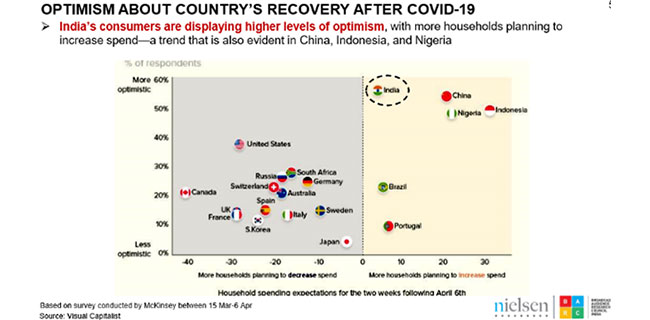
    BARC India and Nielsen Media jointly released the fifth edition of the report on ‘Crisis Consumption on TV and Smartphones’ last week. Their presentation before discussing the details of the TV and smartphone consumptions, gave a brief glimpse of a global scenario showing that Indian consumers are more optimistic about their country’s recovery after Covid-19. Similar trait has also been found among consumers in China, Indonesia and Nigeria who have shown higher levels of optimism than Indian consumers.

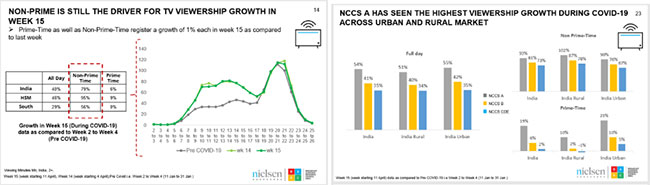
    Another chart showing a comparison of growth in TV viewing across the globe compared to the pre Covid-19 period and last week (Week 15) highlights the growth in India (40%), Australia (34%), Czech Republic (25%), France (20%) and United Kingdom (17%). The viewership growth in India was driven by both reach and ATS.

    After a huge dip in FCT in week 14, there was a rise in FCT during week 15 with many Indian advertisers using the COVID19 theme. Advertisement of essentials category saw a growth across TV genres, but Digital Video Advertising spends dropped across most categories. Reruns driven Hindi GEC in HSM were at an all-time high with 8.5 BN impressions with Mythological shows leading the way. HSM Urban maintained a all time high for 3rd week in row.

    TV viewership growth was led by News and Movies and the Movies growth came more from the PAY platforms. Consumption of both News and Movies genre surged after the lock down and now continue to maintain their higher shares. Viewership growth is highest in Mumbai, Bengaluru and Delhi compared to other megacities.

    Nonprime time is still driving the overall growth in TV consumption which raises doubts about the long term stability of this growth as after the lockdown is lifted, consumers would not have time for engaging with nonprime time shows. NCH A has seen the highest viewership growth across urban and rural markets with India rural showing high growth of consumption in non-primetime.

    Strong double-digit growth was seen across various segments of OTTs (movies, originals, etc.) while audio streaming apps show a decline possibly on account of commuting going down. During the lockdown period consumers might be opting for audio visual entertainment against just audio entertainment.

    The new normal of 3 hrs, 40 minutes+ a day on Smartphone continues – 10% increase over pre-Covid-19 times. News franchise on Smartphone continued to be nearly 50% of all smartphone audience, Views grew by 40%. Almost 4 in 10 searches in week 5 were around Coronavirus which is 4 times the searches made during week 1.

    One in five smartphone consumers in India were using the Aarogya Setu app in Week 5 – an 80% + increase v/s the launch week of the app. Consumer time spent on social networking has grown by 35%+ and 1 in 5 spends more than 1 hour per day. With large number of Indians working from home, a staggering 200% increase was seen in time spent on video conferencing and time spent on virtual drives almost doubled.

    There is already lot of speculation on the scope of extending WFH and flexible working hour concepts to our work culture as the lockdown is likely to be lifted gradually and definitely not uniformly across the country. It will take quite a few months for our school and college education system to return to normalcy. The growth spurts which we have witnessed in TV and smartphone consumption will not be reduced abruptly. The higher level of smartphone consumption is more likely to continue even after the cloud of Covid-19 starts moving away from India, whereas the higher level of TV consumption is bound to come down and settle at a level above the pre-Covid days.


  • Dark Days Ahead for Adspends


    By Indrani Sen


    Last week, KPMG released a report titled “Covid-19: The Many Shades of a Crisis” trying to provide stakeholders in media and entertainment a perspective of the effects of Covid-19 on M&E sector (https://home.kpmg/content/dam/kpmg/in/pdf/2020/04/the-many-shades-of-a-crisis-covid-19.pdf).


    The report reviews three alternative scenarios related to the overall performance of Indian economy. The first scenario assumes that the spread of covid-19 would be largely contained by April-May and Indian economy could grow in the range of 5.3-5.7% in FY21. The second scenario assumes that under the shadow of a global recession with a containment of spread of the virus in India, the country could witness 4-4.5% growth for FY21. The third scenario assumes a proliferation of the virus in India accompanied by a global recession, GDP growth could fall below 3%. However, the report does not throw any light on how the three alternative scenarios may affect the M&E sector in different ways.


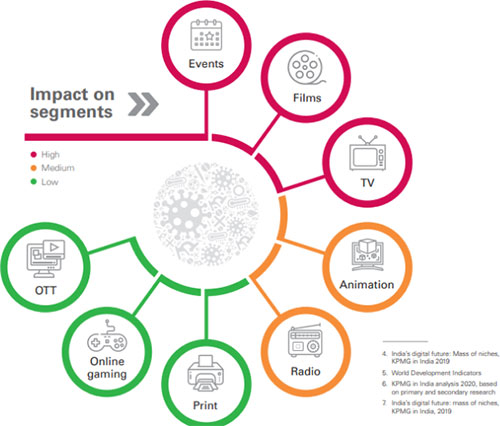
    The title “The many shades of a crisis” relates to how Covid-19 has affected the different segments in the M&E sector. The graphical presentation of their assessment (shown below) raises some doubts regarding the parameters used for making the assessment, particularly in relation to traditional media where print has been shown as having low impact against television having medium impact.


    Source: KPMG Report “COVID 19: The many shades of a crisis”


    While BARC data is showing a week-on-week increase in TV consumption, at the same time there is de-growth of advertising revenue leading to slowing down of monetisation with additional crisis of production of new content /episodes of the serials. KPMG has predicted for TV “slow ad spend recovery in medium term with long term risk due to digital competition”.

    On the other hand, KPMG has predicted “a new lease of life” for print riding on the credibility of the printed words against proliferation of fake news in social media and has advised print media to “leverage positive consumer segment and build strong digital products to capture the opportunity”. This advisory ignores the current scenario related to printing and distribution of hard copies of newspapers and the various hurdles which they may face in recovering their circulation and readership post COVID 19. It is difficult to agree with KPMG’s views that the impact of COVID 19 will be less on print than on television.


    Animation sector also has been hit severely as work from home poses a challenge to implementation of the tools and techniques which are difficult to access from home of the individual illustrators. High fixed costs and high investment costs of the animation sector clubbed with cancellation/ postponement of contracts have created a serious cash flow crisis.


    The impact on radio also has been quite high as there is a loss of listenership due to lack of travel and work from home. Many advertising campaigns on FM radio are linked with activation and events at various social gatherings which have been as badly affected as the events sector. KPMG agrees that ad spends on radio will take time to recover and assures that demand for timely localised content should remain high even after the recovery from the virus. Given the restriction on production of news content by FM radio, they can do very little to satisfy the demand for timely localised content during lockdown and after removal of lockdown.


    KPMG shows that Events and film sectors have been badly affected due to social distancing and the OTT and gaming sectors have gained riding on the additional time spent by people at home. KPMG predicts footfalls in cinemas may take a while to return to normalcy and live events may also take longer time to recover as consumers emerge gradually from the social distancing mode. Both OTT and gaming can benefit if the growth in current consumption can be converted to habitual activity.


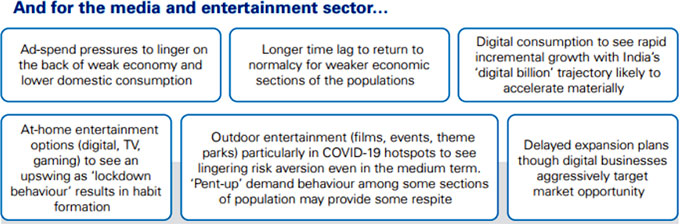
    Summing up, the KPMG report provides the following insights for the M&E sector:


    Source: KPMG Report “COVID 19: The many shades of a crisis”


    The above themes will play across the M&E value chain impacting supply chain, consumption and monetisation. KPMG apprehends that the gap between India and Bharat in consumption of various goods and services may widen due to the reverse migration from urban areas to rural areas as a result of lockdown and halt in all economic activities. Remote collaboration for creative ideation and scripting may last beyond COVID 19 altering the supply chain management of content creation permanently. Finally as far as monetisation is concerned, KPMG predicts longer timelines for ad spend recovery as the economy would continue to be under stress even after the virus is contained. The slowing down of the economy would have adverse impact on key advertisers in FMCG, auto, e-commerce etc. and they might take longer time to restore their ad spends to the level before the pandemic struck India.


  • Will loyal newspaper readers lose the newspaper habit given the 5+ week lockdown?


    By Indrani Sen


    I have been reading various articles on how the Indian newspaper industry has been performing since Covid-19 struck India. We are all aware about how the newspapers in major cities were forced to stop printing for couple of days due to protest by hawkers’ associations.


    Subsequently, all newspapers resumed regular printing though no one indicated if they were able to print and distribute their regular print orders. Last week, there was a joint statement issued by publishers assuring their readers about the safety measures undertaken by them to ensure that the newspapers reaching their hands in safe condition. Publishers have also claimed that newspaper distribution have largely stabilised across India. In the meantim, hard copies of most newspapers have reduced their number of pages and the lack of advertisements is noticeable even to an untutored eye.


    A sensational article (https://www.ozy.com/around-the-world/the-virus-other-victim-the-worlds-final-hope-of-a-major-newspaper-industry/293705/) published on April 10, 2020 led me to do a quick dipstick survey this weekend over the phone among 31 elderly (50+) upmarket citizens across Kolkata, Mumbai and Delhi to find out if they are receiving/reading their usual newspapers. I found that 26 of them have shifted to reading e-papers and have stopped reading hard copies of the newspapers they used to read regularly till the pandemic struck India.


    Only three of them reported that their building societies are not allowing newspaper hawkers’ access inside the complex. The other 23 have stopped reading the newspapers on their own in order to avoid the chance of getting infected by Coronavirus with some of them discontinuing their subscription even before the lockdown was imposed.


    I tried to probe the root cause of their fear. I found that they are not worried about how the newspapers are printed and despatched from the press, but about the distribution process where many people handle the same under unhygienic conditions at the roadside dumps and distribution points. Some of them have seen the messages from leading newspapers assuring that surface of newspapers do not carry the virus. All of them have received contradictory information through social media and messaging apps and have decided to boycott the hard copies of their favourite newspapers. A couple of them who are early risers are actually happy that they can read the e-copies early in the morning, much before they used to get the newspapers delivered at their doorsteps.


    All of my respondents were not ready to pay for accessing e-papers which they are now reading free of cost. Under the lockdown, those who were not browsing the internet earlier have also learnt to browse for news and have become aware that TV channels deliver the same news faster than the newspapers and keep updating the news throughout the day. Only one of these people had previously downloaded the apps of the newspaper he used to read.


    As many as 52% of the 23 (50 to 60 years in age) were unsure if they would again subscribe to the hard copies of the newspapers which they used to read earlier. The others (60+ age) would like to go back to reading the hard copies more due to the inconvenience of reading small print of the e-papers on their mobiles. All of them would prefer their newspapers to be delivered at their doorsteps rather than stepping out of their home to purchase a copy from a nearby convenience store or newsstands/ shops across the roads. I read the article by my friend Jwalant Swaroop, a veteran from the newspaper industry, a few days back arguing for a change in the distribution system of newspapers in India (https://www.exchange4media.com/media-print-news/its-time-for-newspapers-to-reinvent-their-distribution-model-jwalant-swaroop-happy-ho-103795.html). I am afraid I cannot agree with Swaroop’s view as I think the unique last mile delivery system is keeping the newspaper industry alive in India, in spite of agreeing with his observation on the prevalent unethical practices by the some newspapers to control the newspaper hawkers union and the lack of transparency in the entire system.


    The five respondents (50 to 60 year age) of the dipstick survey, who are continuing to read the hard copies of the newspapers, are more scientifically enlightened and net savvy. They have done through research on the internet about the possibility of hard copies of the newspapers carrying the Coronavirus and have compared it with the possibility of surface of other goods (milk packets, etc.) entering their household on a daily basis. On the basis of their findings, they have decided to continue with their subscription of newspapers.


    Summing up the findings from my dipstick, I can conclude that the newspaper industry in India is facing a grave crisis as many loyal newspaper readers, particularly the elderly elite, are likely to have stopped reading hard copies of the newspapers under the threat of Coronavirus. Five continuous weeks of lockdown followed by a few more weeks of staggered withdrawal would be capable of creating a time window for changing the current newspaper reading habits of Indians, even the elderly elites. Along with the policy for surviving the present crisis of fall in circulation and ad revenue, the newspaper industry needs to simultaneously draft a strategy for winning back their loyal subscribers after the dark cloud of Covid-19 disappears from our Indian sky.