
Tag: Indrani Sen

  • Three Key Media Trends Sweeping the Pandemic-hit World


    By Indrani Sen


    Over the last couple of months, we have seen many surveys which have looked at the current level of global and local media revenue and its recovery path over the next two to three years. Most of these surveys have highlighted the bright picture looming at the end of the tunnel. Last week, I came across a survey released by www.emarketer.com which has focussed on three key media trends sweeping the pandemic hit world, providing the advertising and media industry with deep insights.


    On October 23, 2020 eMarketer released Global Media Intelligence Report for 2020, produced in collaboration with Starcom and GlobalWebIndex covering 42 major markets in the world with a focus on internet users’ engagement with digital and traditional media.


    The first trend observed in the study indicates that ownership of PCs and tablets are declining in many countries including India. “Between H1 2019 and H1 2020, ownership of desktops, laptops, and/or tablets declined most sharply in developing markets, including Brazil, China, Egypt, and India—all countries where the focus has long been on mobile devices and services. But the same trend appeared to a lesser degree in several other countries too, including France, Russia, Sweden, and the US.” This trend indicates that smartphones are consolidating their position as the primary screen across the pandemic hit world both in the developed as well as in the developing countries among the internet users. (https://www.emarketer.com/content/3-key-trends-shaping-media-landscape-this-year?ecid=NL1009)


    We already know that in India mobile phones are playing a crucial role in spreading digital media communication with more and more mobile-first internet users coming to the market. This study shows that while there has been hardly any change in the ownership of smartphones from HI2019 to H12020 as it is already near saturation level, the time spend on the device has gone up marginally. “96.0% of internet users ages 16 to 64 owned a smartphone in H1 2020—a figure unchanged since H1 2019. In addition, one in 10 respondents had a feature phone. Time spent with mobile devices averaged 3 hours, 37 minutes (3:37) per day, 1 minute more than in 2019.” Compared to 2019 the ownership percentage of PCs and tablets have come down from 72% to 54.2%, showing a significant decline. Comparatively, ownership of tablets was less affected with only a drop from 24.5% to 22.3%. Time spent by Indians with their PCs and tablets declined sharply from by 45 minutes per day (https://www.emarketer.com/content/global-media-intelligence-2020-india).


    The second trend emphasises on digital video which continues to close its gap with broadcast TV.  In the western countries the share of internet users watching free or paid for digital video have already surpassed the share watching live TV or are almost equal to it. In India, it will take a longer time for a similar trend to set in, but the warning signs should not be ignored by the TV channels who have not yet invested in OTT business.


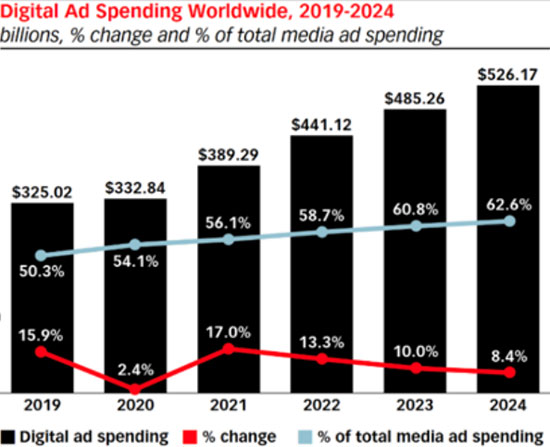
    Based on the various trend of digital media consumption among the internet users, the study predicts that by 2024, digital ad spending worldwide will become $526.17 billion and will account for 62.6% of the total media ad spending. The growth rate of digital ad spend will fall sharply during 2020, but will rise equally sharply in 2021. Over 2022 to 2024. The growth rate of digital ad spending is expected to fall gradually, but its share in the total media ad revenue will continue to grow year on year as shown in the chart below.


    Source: eMarketer


    In India, it will take many years before the digital ad spending crosses 50% of the total media ad spending. However, as shown  in the recently published M&E industry Report 20202 by KPMG, the trend of ad spending on digital and OTT crossing the ad spending on TV media, is expected to set in by FY 2022 (https://www.mxmindia.com/2020/10/the-great-churning-of-the-media-cauldron/).


    The third trend observed in the study indicates that the pandemic is probably hastening the decline of print media: “Print audiences aren’t shrinking everywhere, but print newspapers and magazines did register many of the most dramatic decreases in media engagement this year.” In India, traditional print industry seems to be in a buoyant and positive mood during the current festive season. Some large newspaper houses have also posted good growth during the third quarter of 2020. But, the Pitch Madison Advertising Midyear Review 2020 released in August, 2020 estimated a loss of 31% to 36% in print ad expenditure from 2019 to 2020 (https://www.mxmindia.com/2020/08/dramatic-changes-in-indian-ad-industry/).  Only time will tell if COVID 19  will hasten the process of decline of the print media in India.


  • Indrani Sen: Exploring remedies for two burning topics stalking our industry

    By Indrani Sen


    The last 12 days have been very eventful for our industry on one hand about Mumbai Police reporting a TRP scam involving TV channels and on the other hand about social media vandalism related to the Tanishq commercial based on the story of an interfaith marriage. The first issue is still under investigation, but based on initial available evidence, BARC decided to suspend reporting the TRPs for news channels for three months.


    The second issue has seen more decisive and quick actions and let us look at that first: The uproar by a section of netizens over their different social media handles protesting against the interfaith marriage story shown in the Tanishq commercial, things took an ugly turn with some of the Tanishq executives getting threatened on their Linkedin accounts, call for boycott of all Tata products, etc. The share of Titan, the holding company of Tanishq fell by 2.18%, the Tanishq shops all across the country with crores of jewellery stocks became venerable to attacks by social miscreants and Tanishq withdrew the commercial and issued a statement on a sad note “… This film has stimulated divergent and severe reactions, contrary to its very objectives. We are deeply saddened with the inadvertent stirring of emotions and withdraw this film keeping in mind the hurt sentiments and wellbeing of our employees, partners and store staff.” Contrary to what some people believe, the company did not tender an apology for producing the commercial.


    Our social media users were divided in two camps on Facebook and other social media handles right from the beginning and after the commercial was withdrawn, a counter campaign has started protesting against the withdrawal. However, what has been most gratifying is the spontaneous sharing of personal stories by many couples with interfaith marriages. It has also been extremely reassuring that the industry at large has come together and IAA, AAAI, ISA, TCA etc. have issued statements condemning the social vandalism and supporting Tanishq. But the incident has raised a few very serious questions about rules and regulations required for user generated content in Facebook and other social media platforms.


    Do we really need to control user driven content on social media?  Today with the help of artificial intelligence it should be possible to hit a warning button before individual users’ posts multiply into a hate movement and leads to online vandalism. However, such a move may also boomerang if it stops all social movements for good causes generated through user generated posts. As we have seen in case of the Tanishq commercial, there is always two sides of a coin with each side believing it is on the right side! However, we need to know if posts are getting generated by genuine users or by fake users. We understand social media marketers have adopted the concept of buzz marketing and instead of appointing real time online buzz marketers, they take the easy way out by creating fake social media accounts. Our Advertising and Marketing Industry should take initiative to interact with the owners of social media platforms for stopping this practice and ensure that anyone posting on social media is a genuine user. Users should be stopped from owning multiple accounts on social media platforms even at the cost of the platforms losing number of users.


    The second incident about the TRP scam has kept our TV news channels, media agencies, advertisers and BARC (Broadcast Audience Research Council) and the investigative agencies busy ever since the news was published on October 8, 2020. The process began with Mumbai Police Commissioner announcing in a press conference on October 8 about a FIR against few TV channels and has been going on since then with claims and counter claims and legal suits being filed in Delhi and Mumbai.  The story has got a lot of coverage in mainstream newspapers where it hit front pages news and was covered through multiple stories on each day. Couple of newspapers also took the trouble of educating their readers on definition of  TRP, the methodology of the audience research, how BARC collects and processes TV viewing data, etc. Industry websites have been carrying multiple stories and interviews with industry stalwarts for last few days. We have also carried number of stories including two write-ups by MxMIndia’s Pradyuman Maheshwari.


    I shall not repeat the narratives of the second incident which have already been posted in www.mxmindia.com. This is not the first time that we are facing complaints on TRP related issues and this will not be the last time unless the industry introduces severe measures for the offenders.    The various industry bodies need to review the problem and take very stern measure for stopping such malpractices in future.  My suggestion is if a representative of any TV channel is found guilty of tampering with generation or collection of TRP data, then that channel should be barred from the BARC roaster of TV channels for a period of three to five years, long enough to be able to make a negative impact on their advertising business.


    If the owner or any other top executive of the TV channel is proved to be a party in any such devious practice, then he or she or the channel would have to pay heavy fines to TRAI/ BARC for the misconduct. Failure to pay the fines may result in the TV Channel losing its rights for uploading and downloading for a specific period. The TV channels would have to create legally bound strong employment contracts ensuring that they are able to partially recover the loss of business from the errant employees who may be instigated by a competitive channel tor indulging in illegal activity. To sum up, unless the industry bodies as well as TRAI review and redesign the rules for punishing malpractices related to TV ratings, we would never be able to have a robust audience measurement system in spite of all the technological advancements.


     Indrani Sen is a veteran mediaperson and now an academic. She writes on MxMIndia on most Mondays. Her views here are personal


  • D K Bose: Father of Social Communication in India


    We  have had a major power outage in Mumbai and were ill-prepared for it. No power backups, plus a very weak internet connection. Our edition today is hence a little truncated. Our apologies. – Editor


    By Indrani Sen


    Dwipal Kumar Bose, known to most of us in the advertising and communication industry as ‘DK, expired suddenly due to a heart attack on the morning of October 9 at McLeodgunj in Himachal Pradesh. DK was 76 years’ old and had over 50 years of extensive experience in the industry across Media Planning, Social & Rural Marketing and Advocacy Research.


    DK and family were refugees from Bangladesh and after coming to India had to move their base a number of times due to his father’s frequent job changes. During his childhood and teenage years spent in many places across India, DK had to change schools frequently, but acquired grassroot level knowledge of India which was deeply rooted in his psyche.


    Financial constraints of a middleclass family with 12 siblings forced him to take up in 1964 his first job at 20 years as a voucher clerk in the billing department of S H Benson, the parent company of Ogilvy. But he was destined for bigger and larger roles in his life, so with his drive for learning and his unstoppable energy he managed to secure a degree from Elphinstone College, Mumbai and over the years rose through the ranks in Ogilvy, Benson & Mather to become a Media Manager in 1974.  He worked in Mumbai and Kolkata offices of Ogilvy (O&M) during the 70s and early 80s.


    I met DK for the first time in Mumbai in the early 1980s when he was working in Ogilvy and I was working in Contract Advertising. In spite of a slight age difference, we struck a bond as two Bengalis and as two professionals trying to improve our skills in understanding of media research and its applications to media planning. He taught me the value of grassroot level learning one can acquire through only travels in India, which made me drag my family to many small towns and villages across the country during our annual holidays for many years. My friendship with DK lasted for forty years though we never worked together or even lived in the same city after the few initial years in Mumbai.


    in 1984, DK joined HTA (JWT) Delhi as Media Director and I shifted back from Mumbai to my home town Kolkata, but we continued to stay in touch. For a few years, both of us worked in HTA’s media departments in Delhi and Kolkata and we used to meet at various seminars, conferences, media heads’ meets and during our official travels to Delhi and Kolkata. My travels to Delhi were more frequent than his travels to Kolkata and he never failed to invite me to his home for a meal whenever I went to Delhi. His wife Sahana (Khuku Boudi) was a gracious hostess and a great cook.


    DK shifted from media to social and rural marketing and started India’s first Social Communication Agency as the head of Thompson Social. He is rightfully the Father of Social Communication in India. He subsequently worked with RK Swamy BBDO and Ogilvy Outreach and expanded his knowledge and skillsets in social and rural marketing and media. I learnt a lot about social and rural communications by just interacting with him over the years. DK was a Founder Trustee for Centre of Advocacy Research, a member of Awareness & Communication Strategy Advisory Council (ACSAC) set up by UIDAI under Nandan Nilekani and served as a consultant to USAID, UNICEF Bangladesh and Myanmar. He helped set up rural and low-income communication units in Sri Lanka and Indonesia.  A book can be written on his experiences and achievements in the area of social and rural marketing. After his retirement from his last job as President of Ogilvy Outreach, DK started working as an advisor and strategist in Behavioural Change Communication mainly in the area of health and primary education. His described himself in his LinkedIn profile as “Margdarshak and advisor on Rural and social Marketing”. DK was awarded with the Lifetime Achievement Award from Rural Marketing Association of India in 2017.


    DK taught at IIMC, Delhi as visiting faculty for many years and was later associated with IIM Lucknow, IIM Khozikode and Jamia Milia University as visiting faculty. In his time, he trained many media planners and social and rural marketing executives, who later attained important roles in the industry. Some of them have been pouring their tributes to him over the last few days on social media. I quote here a few lines from the FB post of Kunal Sinha (a consumer strategist & foresights expert, 12 times winner of WPP Atticus award for original thinking in marketing services, including the Grand Prix) posted on October 9- “TO SIR WITH LOVE: You were my teacher, mentor and guide to life. And to countless others. I remember every moment we spend together because they were all valuable…… You inspired me. You challenged. You applauded. You were the source of new beginnings, at every age. Here is to your latest! Stay joyful- there’s no one who shared his love so selflessly.”


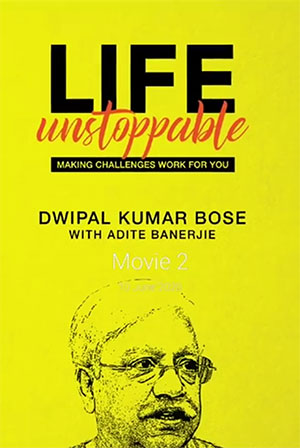
    Earlier this year, DK published his autobiography “Life Unstoppable: Making Challenges Work for you” with Adite Banerjee as an e-book on Amazon. The link is available on his website www.dkbose.com. The introduction on the back cover says: “Bose’s story is an inspiring tale of grit and determination, rejection and success. In narrating his life’s journey, the social communication strategist and behaviour change mentor goes beyond the tried and tested route of offering ‘success strategies’ but shares his own learnings and reveals how challenges can be made to work for you.” Young aspirants in advertising and social marketing must read this book for invaluable learnings.
     

    DK and Khuku Boudi were a made for each other couple and she accompanied him on his various travels across India and many other countries. She shared his love for travelling and visiting places in Interior India, particularly the small towns and villages of Himalayas. DK nursed her caringly and lovingly during the last few years of her life when unfortunately, she became wheelchair bound. DK also travelled with Khuk -Boudi during that period. He missed her a lot during the last two years after her death in September, 2018. I met DK last in January 2019 when I made a visit to his house in Mumbai and he offered me some homemade snacks prepared by his cook proudly telling me that she was trained by Khuku Boudi.


    He wrote in his FB account last month: “Two years back, Sahana, my wife left us for her journey into another world, leaving me to carry on my journey in this world alone. It is not easy to adjust to a life without her after 45 years off travelling together. While my children and their spouses are doing their best, I know I will have to travel alone. In the first 15 months after her demise I travelled to 15 places trying to create a world of my own. Unfortunately, the pandemic destroyed it all…. I know time will help. I am trying my best. RIP my co-traveller.” Little did we know that DK would be joining Khuku Boudi in another world within a few days of writing that post!

    A couple of days after the above post, DK posted on FB: “Planning to travel to McLeodgunj in October. Anyone willing to join?” We spoke last after that post, when I told him that I won’t be able to join him, but would enjoy the beauty of the hills through his lens. DK reached McLeodgunj in late evening of October 6 and breathed his last during sleep in early morning of October 9. He was cremated in the afternoon of October 10 at Dharmshala by his son Dipankar. DK now lies in eternal peace cuddled by the Himalayan hills he loved so much. He is survived by his daughter Sonali, his son-in-law and granddaughter, his son Dipankar and his daughter-in-law.  He will be remembered among his many friends and associates for his caring nature, his great spirit, his passion for learning and teaching, his sharp analytical mind and his awesome energy. I end here with my heart-felt condolences to his immediate and extended families.


    Rest in peace, my friend!


  • The Great Churning of the Media Cauldron


    By Indrani Sen


    Last week, KPMG published its M&E Industry Report 2020, six months after the FICCI EY Report on M&E Industry 2019 was published on March 27, 2020. KPMG had ample time to study the effect of Covid-19 on the M&E sector during the lockdown and the unlocking period before coming up with its final report by FY20 and its predictions for the next two years FY21 and FY 22.


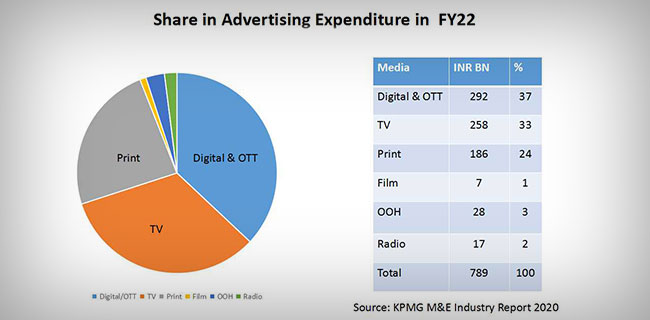
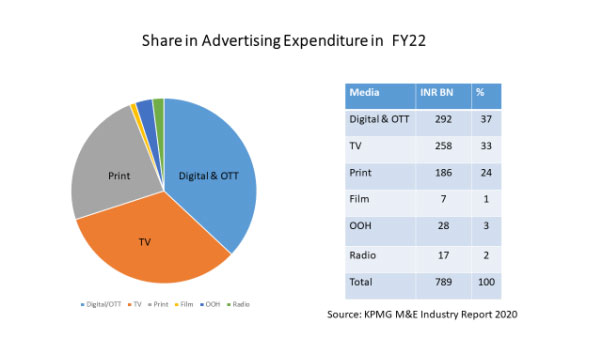
    As we all have realised by now, 2020 is a milestone year in Indian M&E Industry, with digital and OOT emerging as the number 2 in the share of the overall industry size as well as in the share of advertising revenue. The KPMG report confirms the same and springs a surprise by predicting that in FY21 and FY22 Digital and OTT will become #1 in terms of share in advertising revenue, overtaking TV. As per the trends seen in western countries, this seismic shift was written on the cards, but we were definitely not expecting this shift to happen so soon. The pandemic COVID19 seems to have acted as a catalyst accelerating the process of change.  As a result, the KPMG Report 2020 predicts a great churning of the media cauldron over the next two financial years.


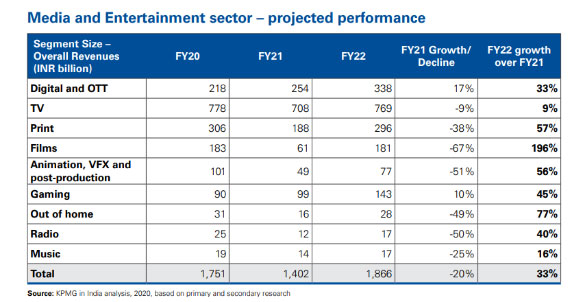
    As far as the overall industry size is concerned, TV is by far ahead of Digital & OTT as shown in the next chart, though the growth rate of TV is much lower than Digital & OTT. The absolute size (769 INR BN) of the TV industry in FY22 will be slightly below their size (778 INR BN) in FY20, while Digital & OTT will be growing year on year in their overall size. Print will take a big hit in FY21 with 39% de-growth and will recover hugely in FY22. However, like TV their overall size (296 INR BN) in FY 22 will be slightly below their size (306 INR BN) in FY20. Similar trends are reflected in case of Films, OOH, Radio and Music while Gaming shows a huge gain in size (143 INR BN) in FY22 from (90 INR BN) in FY20. Animation, VFX and post-production is the only sector which in FY22 (77 INR BN) will be much below the size in FY20 (101 INR BN), in spite of the recovery of the Film industry.


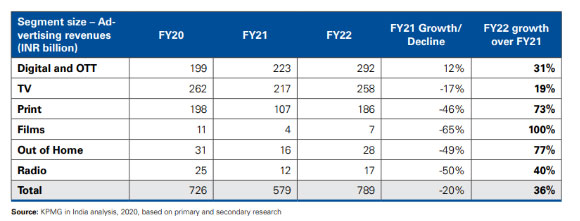
    The chart showing the share in advertising revenue represents a different picture with Digital & OTT predicted to overtake TV in FY21 and continuing in the #1 position in FY22. Print which had neck-and-neck share with Digital & OTT in FY20, is predicted to go down to the #3 position in FY21 and FY22. In FY21, the size of Print advertising (107 INR BN) will be less than half of the size of Digital & OTT advertising (223 INR BN). In spite of a growth of 73% in FY22 over FY21, Print advertising will be 106 INR BN less than Digital & OTT advertising in FY22. As per KPMG’s predictions, Films, OOH and Radio will also not be able to regain in FY22 the size of advertising revenue which they had in FY20, with Radio being the worst affected among the three media.


    All is not well for Digital & OTT as a comparison of the total industry size and the share of advertising revenue in the same both in FY21 and FY22 reflects a lack of growth in subscription revenue and an unhealthy dependence on advertising. In FY21 and FY22 the share of advertising revenue will be respectively 87% and 86% in Digital& OTT, which does not reflect the trend of growth in subscription. This is also contradictory to the findings of FICCI EY M&E Industry Report 2019 which showed that growth rate of subscription outpaced the growth rate of advertising led by digital media. The pandemic should have boosted the subscription growth which however is not getting reflected in the KPMG report.


    It is very difficult to compare the two reports on M&E Industry as FICCCI EY reports are based on calendar years and KPMG reports are based on financial years. However, at the time of the release of their report in Mach 2020, FICCI EY promised to review and revise their estimates for future. As and when the revised report of FICCI EY is released, we would be able to assess if similar shifts in the share of the advertising pie is also reflected there reconfirming the predictions made by KPMG and the churning of the media cauldron.


  • Can ASCI Play A Role In Review of Surrogate Advertising?


    By Indrani Sen


    In the week before the last, the Consumer Affairs Ministry had issued a draft of the Central Consumer Protection Authority (Prevention of Misleading Advertisements and Necessary Due Diligence for Endorsement of Advertisements) Guidelines, 2020 requesting people to submit their comments and suggestions on the guidelines by September 18, 2020. As per industry estimates based on TAM Adex data, the size of total surrogate advertising in India is around Rs 700-800 crore per annum with 70% share of TV in the pie. The new draft guidelines, if enforced with immediate effect, may affect the post lockdown financial recovery of TV channels.

    Along with guidelines for endorsements, definitions for valid advertising, new rules for advertisements targeting children etc., the new guidelines clearly prohibit surrogate advertising — the practice of promoting banned products like liquor and tobacco by promoting another product under the umbrella of ‘Brand Extension’ unless the promotion of the said product advertised under the same brand name can be substantiated with certain proofs of its legitimacy. The legitimacy would be judged based on (a) if the new product is produced, distributed and sold in ‘reasonable quantities’ having regard to the scale of the advertising campaign in question, the media used, and the markets targeted and (b) do not have any direct or indirect indication of a banned product. While the guide lines do not give definition of ‘reasonable quantities’, the same allow for some concessions like advertisements wouldn’t be disqualified just for using similar branding of a banned product.

    The revised guideline issued by the Ministry of Information & Broadcasting  last week, under rule number 7(2)(vih)(A) of Advertising Code in the Cable Television Network Rule 1994,  notifies that all such TV commercials  falling under the ‘Brand Extension’ of  banned products like cigarettes,  other tobacco products, wine, alcohol, liquor etc. will have to be first previewed by Central Board of Film Certification and certified as fit for consumption before any TV channel can broadcast the same. It is not very clear from the advisory if the legitimacy of the product will also be reviewed by the CBFC or if that would be done separately by the MIB before the advertiser invests in the production of the TV commercial. Traditionally, the Chairman and members of the CBFC are from the film and entertainment industry. The CEOs are usually selected from bureaucrats like Ravinder Bhakar, a 1999 batch officer of Indian Railway Stores Service (IRSS), who has taken over as the Chief Executive Officer (CEO) of Central Board of Films Certification (CBFC) from March 2020.

    Can ASCI play an active role in this entire new process of decision making on surrogate advertising?  They would be in a far better position to judge the legitimacy of the product than the MIB or CBFC.       ASCI’s role has been acclaimed by various Government bodies including The Department of Consumer Affairs (DoCA), Food Safety and Standards Authority of India (FSSAI), Ministry of AYUSH as well as the Ministry of Information and Broadcasting (MIB). In January 2017, the Supreme Court of India in its judgement affirmed and recognized the self-regulatory mechanism as an effective pre-emptive step to statutory provisions in the sphere of advertising content regulation for TV and Radio in India.

    I read a research paper ‘Surrogate Advertising or Brand Extension Advertising: A Need for Strict Norms’ authored by Prof. Neha Bansal in International Journal of Marketing & Financial Management, Vol. 2, Issue 1, Jan-Feb-2014 ISSN: 2348 –3954. Prof. Bansal presented in her paper a six point formula for developing and implementing strict norms:

    1. Developing an explicit plan of action.

    2. Code to differentiate between acceptable advertising from unacceptable advertising.

    3. Translucent laws for banning such kind surrogate promotion.

    4. More powers in hands of ASCI.

    5. Increase consumer awareness.

    6. Strict actions against those involved to set lesson for future wrong doers.


    The Consumer Affairs Ministry and the Ministry of Information & Broadcasting have taken steps in the right direction except involving ASCI in the process. ASCI can also explain to the ministry the need for having a two step approval process, first getting the legitimacy of the brand extension approved and then applying for the approval of the TV commercial to avoid the financial loss of investing in a TVC and then getting stuck at the approval stage on the legitimacy issues. ASCI can also  advise the government regarding the paper work needed for establishing the legitimacy of the products  as ‘non-surrogate’ and as genuine brand extension. We can only hope that good sense will prevail in the implementation of the new rules drafted by the government and adequate notice would be given to the industry for changing their advertising campaigns as per the new guidelines.


  • How India’s Gen Z is addicted to Streaming


    By Indrani Sen


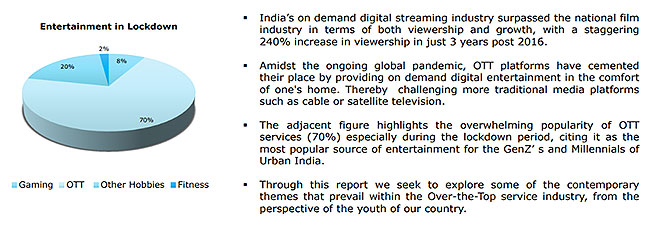
    Covid-19 has transformed the media consumption trends in India. Globally, streaming platforms gained in a big way since the pandemic struck and India is no exception. The report published by Dentsu Agies Network – “Now Streaming: The Indian Youth OTT Story” – is a study conducted among urban India’s Gen Z & Millennial reconfirms this trend. These trends could be reflecting behavioural changes of the two younger generations which are likely to last even after the cloud of pandemic shifts from the Indian sky. The highlights of the findings from the report are shown below:

    Source: https://dentsumarketing.cloud/dmcinsights.php


    As many as 74% of the respondents came from the Top 8 metros with 26% coming from rest of urban India. 47% of the respondents were male and 52.2% were female. 78.5% came from Gen Z (5 to 25 years) and 21.5% came from Millennials (25 to 39 years).  The report therefore cannot be taken as uniform trends across urban youths across India but trends which are visible among youths residing in the top 8 metros and mostly below 25 years of age. They are, however, the future targets of marketing and advertising in India.


    Average daily time spent in hours

    Gen Z Millennials
    On line Gaming 1.97 1.11
    Binge Watching 4.45 3.66


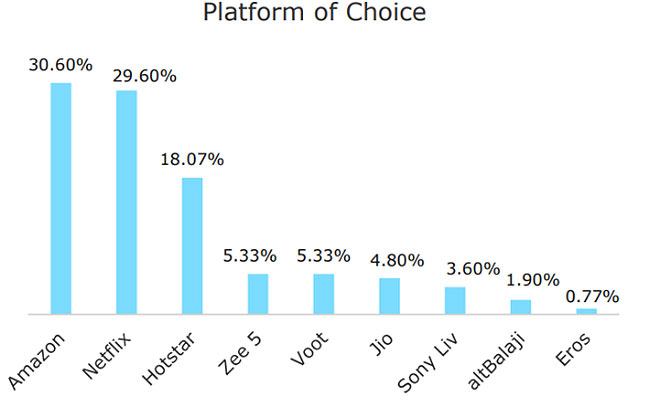
    Among the various OTT platforms, Amazon Prime and Netflix lead the pack, followed by Hotstar. The other OTT platforms are yet to build up significant presence among the Indian youths. Gen Z spends more time than Millennials both on gaming and binge watching on OTT platforms.


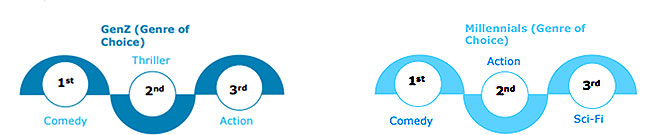
    The choice of genres by the two sections of youth explains the popularity of the top three platforms which offer more content as per their preference. Zee 5, Voot, Jio, Sony Liv, etc have less content to offer in the Comedy, Action, Thriller and Science Fiction genres. Amazon Prime, Netflix and Hotstar have also invested more in production of original content. However, the report has also shown that both in North and South India across different demographics the primary usage of OTT platforms were for viewing TV shows and movies.


    During the lockdown north Indian youths invested on an average in three OTT subscriptions than their counterparts in south India who invested on an average in two OTT subscriptions. The Gen Z invested on an average in 3 OTT subscriptions while Millennials invested in 2 OTT subscriptions during the same period. The report does not give details of the demographic profile of the sample, but we can safely assume that the sample was skewed towards higher SECs as indicated by higher spends on OTT subscription by Gen Z, most of whom would not have been financially independent and had to ask their parents for the subscription money. Obviously their parents were not financially affected due to the economic slowdown during the lockdown and could afford to indulge their children. The report therefore captures mainly the trends of OTT consumption of urban youths from 5 to 25 years age belonging mostly to NCCS A and the top 8 metros.


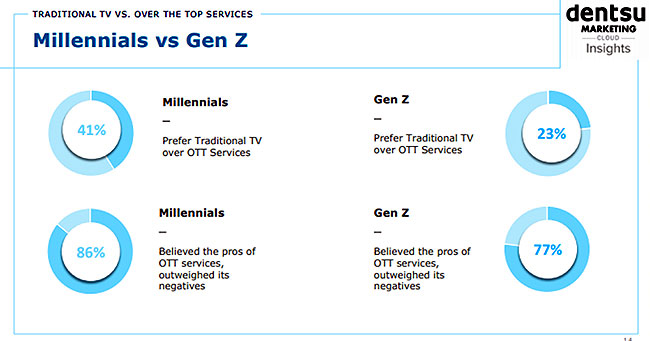
    The report has also captured that 73% have no concern about the content of the OTT platforms. The other 27% have stated obscene content, anti-national content, strong and bold language of the content as well as content hurting sentiments of religion/ caste as causes of concern related to OTT platforms. On the other hand all respondents had concerns about internet connections, pop-up ads and buffering related to steaming of the contents. Both Millennials and Gen Z have shown a clear preference for OTT services and believes that the positives factors outweigh the negatives.


    The report concludes that content distribution, attractive marketing, transitioning the gaming industry and personalisation are the key factors which is helping consumption of OTT platforms to dominate over consumption of traditional TV viewing. The analysis does not mention about the tie ups between OTT platforms and Telecom giants like Airtel, VI and Jio, a practice which began in 2017/ 2018 and has been continuing since then.


    As per the range of packages offered by the three telecom companies, it appears the leading OTT platforms do not believe in exclusive tie ups with any single telecom company and have created a level playing field for all the service providers by having tie ups with all of them. It seems this survey did not probe into this aspect of free subscription with mobile connection among the Gen Z and Millennials, most of whom would have been enjoying some such free benefits through a single sign in. The findings of the reports outweigh the apparent skewing of the sample and a few gaps and have provided all of us a crystal globe for gazing into the future of media consumption.


  • IPL 13: Who will Gain & Who will Lose?


    By Indrani Sen


    Ever since BCCI announced that IPl 13 will be held this year in the UAE from September 19 to November 10, there has been a lot of speculation in the media about how much revenue BCCI, the eight franchisees and Star India would be able to earn through this high value cricket tournament held away from home turf.


    It is still a matter of speculation, but one aspect is clear that BCCI’s scheduling of IPL 13 matches scheduled during evening primetime will deprive many GEC channels from the revenue which they have been expecting to get from the festive seeson advertising. As per various industry estimates, 40 to 45% of total annual advertising revenue is generated during the festive season spreading from September to December with bulk of it spent by Diwali every year.


    Revival of mega programmes like KBC, Big Boss, Indian Idol and Dance India Dance is expected to give IPL some competition and to help the big players Sony, Colors and Zee to get a good share of the TV advertising budget of festive season, but many other channels will not be that lucky. BCCI has also planned for maximising its revenues during the festive season as after October 25, 2020 there will be no afternoon match and all matches will be scheduled at 7.30 pm IST. With the final scheduled on November 10, only a small window of  four days before Diwali is left for other channels to encash on their share of festive spends. Had BCCI scheduled the IPL 13 a month later from October 2020, then probably the picture could have been different.


    Let us now look at the three main interested parties who have serious revenue tagets to be realised from IPL 13. The first is BCCI who earns the lion’s share of its annual budget every year from IPL. Apart from Rs 3270 crore which Star pays to BCCI every year for the TV and digital media rights, they were supposed to get Rs 440 crore from Vivo for title sponsorship, Rs 250 to Rs 300 crore for other associate sponsorships and another Rs 17 to Rs 20 crore from other sponsorships. After Vivo pulled out from the title sponsorship, BCCI got Dream 11 as a title sponsor for Rs 220 crores, at 50% discounted price of the earlier deal. BCCI shares 50% of the title sponsorship money with the eight franchisees by distributing the same among them and the revenue of the fanchisees has also been reduced as a result of this discounted deal. As per the experts’ views, BCCI’s revenue target from associate sponsorsips etc. are also expected to see a downward revision. BCCI will have to give a hefty fees to Emirates Cricket Board for holding the matches at UAE and their other logistical cost will also go up. A combination of all these factors will lead to a lower realisation of BCCI’s earlier revenue target from IPL 13.


    As far as the eight franchisees are concerned, each of them will lose out revenues from three sources. The first will be the loss from their share of title sponsorship which BCCI has sold at 50% lower value than expected earlier. The second will be the loss from gate revenue which used to be between Rs 22 to Rs. 28 crore per team from cricket grounds. The third will be from expected lower revenue of title sponsorship of each team under the current situation. Each team now anticipates to earn at least 15% to 20% less on the estimated the team title sponrship value of Rs. 50 to Rs. 75 crore (except Mumbai Indians which was looking at Rs 100 crore-plus) from title sponsorship before the pandemic struck.


    In addition, all of the franchisees will have to spend extra for the travel and accomodation cost of the players as well as creating arrangements for the bio-bubble and net practice at UAE. The combined effect of all the above is expected to result in a loss of Rs 80 to Rs 90 crore per franchisee. BCCI has already rejected the appeal for concessions in IPL 13 due to the pandemic made by the franchisees. (https://www.insidesport.co/ipl-2020-bccis-stern-no-to-ipl-franchises-demand-for-compensation/)


    The last but not the least of the three interested paries is Star India, the broadcaster holding the media rights of IPL for TV and Digital media. In Star India’s original plan for revenues to be earned over the contract period with BCCI, 2020 was supposed to be a crucial year when they had expected to replace earlier losses with profit. However, the pandemic changed their plans. An article published on July 4, 2020 by www.sportstar.thehndu.co referred to a statement made by Uday Shankar, the Star & Disney India Chairman to ET Now: “If there is one tournament where advertisers will put money, that is IPL but only if they have to put monies. The market has gone through massive shock. Whether it would recover enough to put thousand of crores worth of advertising in next 6-8 weeks is the real issue and we doubt that… I am not sure the market is ready to support the IPL with the same fervour…” (https://sportstar.thehindu.com/cricket/ipl-2020-postponed-future-star-india-uday-shankar-advertisers/article31986991.ece). He has obviously changed his mind since then as in a recent article in  https://www.timesnownews.com/sports/cricket/, he has been quoted as saying: “Our viewership of IPL on TV, as well as OTT platform, has grown year-on-year, and that will continue even this year…Also, for any company, which is looking at advertising, IPL provides the best and most-effective platform.”


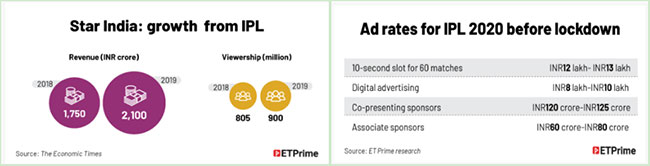
    As per industry sources, Star is targeting at a revenue of Rs 3000 crore plus from IPL 13. There is difference in estimates on how much they earned from IPL 12. According to ET Prime, the revenue was Rs 2,100 crore in 2019, but some other sources peg the earnings around Rs 2500 crore.


    Source: https://economictimes.indiatimes.com/prime/media-and-communications/ipl-2020-star-india-will-have-to-rework-its-strategy-to-hit-the-inr3000-crore-revenue-target/primearticleshow/77321586.cms?from=mdr?fromsrc=etprime


    Star India has already declared that there will be no reduction on the advertising tarif declared earlier which had a built in 20% hike over IPL 12. As per industry sources going rate for 10 second advertising is 12.5lakhs. Based on estimate of ET Prime, with a revenue target of Rs 3000 crores in IPL 13 Star is aiming for a growth of 43% over IPL 12, which semms to be highly ambitious. Based on the estimate that revenue from IPL 13 was around Rs 2500 crores, a 20% to 22% growth over last year will enable Star to achieve the revenue target of Rs. 3000 crores, which seems to be more realistic. There is already a prediction that viewership of IPL 13 will increase by 25% from IPL 12 which will help Star in marketing IPL.


    To sum up, the broadcaster seem to be on a good wicket as riding on the promise of 25% higher reach, they have a good chance of realising the target revenue for IPL 13. On the other hand, BCCI and the 8 franchisees will have to be contented with reducing their losses from IPL 13 held in UAE than a total loss of cancelling IPL 13 in 2020. The smaller TV channels across genres may be complete losers as many marketers suffering from the loss in sales and revenue over the first two quarters of 2020 and the slow rate of recovery in the third quarter, may not be able to extend their advertising budgets  for festive seasons beyond investing in IPL 13.


  • The Grave Crisis in OOH Continues


    By Indrani Sen


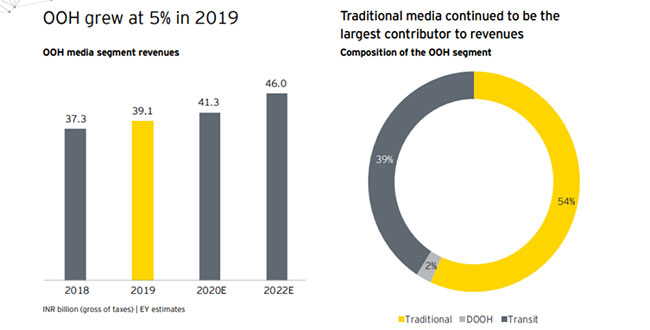
    The EY-FICCI 2019 Media & Entertainment Industry Report estimated that the Indian OOH industry grew by 5% in 2019, taking the industry size to Rs 37.1 billion. The traditional OOH formats, driven by increased advertising opportunities in tier-II and tier-III cities, contributed 54% to the overall revenue. However, according to the report the main driving factor behind the growth is recent development of infrastructure network, including upcoming airports, smart city projects, malls, metros, bus shelters, public utility, coffee shops, etc.


    Source: EY-FICCI 2019 M&E Industry Report


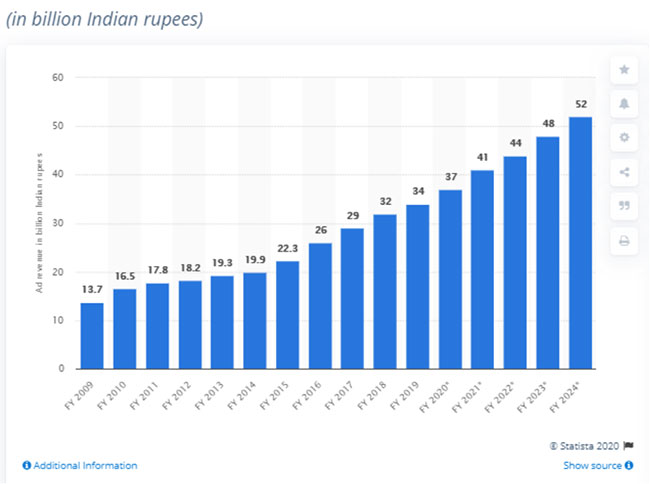
    A couple of years back, www.statistia.com published an estimate of out of home advertsing in India from 2009 to 2024 as shown below. It is interesting to note that overall size of OOH industry estimated In the FICCI EY report is higher than shown in the chart for 2019 (Rs. 34 billion).


    Source: https://www.statista.com/statistics/233491/out-of-home-advertising-revenue-in-india/


    The growth of the OOH industry has been stalled completely as an effect of Covid-19. In the ‘FICCI Frames 2020’ virtual conference, WPP’s CEO Mark Reed remarked that OOH was the most impacted medium due to Covid-19. While we are seeing some signs of revival in digital, TV and print media, the trend has not yet been seen in OOH media under the gradual process of unlocking. While we are still waiting for FICCI EY to release a revised estimate for M&E industry in 2020, the mid-year review of the Pitch Madison Advertising Report 2020 has estimated 35% to 50% de-growth in OOH advertising revenue in 2020.


    At the early stage of lockdown, IOAA also estimated that their annual revenue may see a 50% drop in 2020 and appealed for financial relief to the various state governments who have not yet responded positively. The association also requested the central government to declare the pandemic as natural calamity which is covered under ‘force majeure’ clause of all OOH contracts which also has not received any definite response. In US and couple of other countries, OOH industry registered as small business has received some financial relief, but we have not seen any such relief measures for the OOH industry in India.


    An article published on August 10, 2020 has predicted four key trends for OOH medium in 2020 and beyond (https://www.advendio.com/4-key-ooh-advertising-trends-2020-beyond): 1/ build brand awareness with smart creatives; 2/ adapt value for money messaging approach; 3/ the evolution of touch screen OOH advertisements and 4/ curbside pickup and digital OOH are here to stay. Apart from the first trend, there is hardly any scope seeing of the other trends happening in India. It is high time that our outdoor advertising agencies take stock of their inventories and consider disinvesting in traditional formats and channelize their attention to building up standardised digital OOH formats as per the global trends.


  • 12 minute ad cap may turn to 12 death nails for FTA channels


    By Indrani Sen


    The right thing at a wrong time is a wrong thing.

    Taking liberty with the words of Charles Dickens, one can say this is not the best of times; this is probably the worst of times in the twenty-first century when we are fighting with the deadly Coronavirus, the total number of COVID 19 positive cases and death caused by the pandemic are going up every day in India, the Indian economy is in recession and Media & Advertising Industry has just seen a huge drop of 65% in advertising revenue in Q2 of 2020 (Source: Pitch Madison Advertising Report 2020 Midyear Review). What a time for TRAI to press for the 12% ad cap on Television by pushing for a hearing of the case at the Delhi High Court!


    Dust has not yet settled on NTO 2.0. Indian TV Industry and the Regulating body have been discussing the possible implications of implementation of NTO2.0 over the last few months. It has come as a rude shock to the TV industry that TRAI has pushed the Delhi High Court for an early hearing of the case on 12 min cap per hour on television advertising. The final hearing has now been fixed on 28th September, 2020. If Indian television industry is forced to accept the 12% ad cap during this difficult time, then many TV channels, particularly the free to air channels and news channels may be forced to close their business.


    Let us take a quick look at the effect of the pandemic on TV advertising. The Pitch Madison Advertising Report 2020 Midyear Review released last week has shown that against a 65% loss of total advertising in Q2 2020, loss of TV advertising was 61%. The chart below shows the TV advertising market in April, May, June TV advertising revenue over last 3 years. Across all categories, advertisers have spent less on TV during the first half of the year with 25% of the regular advertisers not spending on TV advertising. Even after the boosting of as spend in the second half of the year due to the festive season, IPL, big ticket properties on TV like Big Boss, KFC, the TV industry is expected to end the year 2020 with 12% to 17% de-growth.


    Source: Pitch Madison Advertising Report 2020 Midyear Review


    Based on consumer complaints in 2012, the TRAI first announced the regulation on 12% Ad cap in 2013. I wrote an article on 12th October, 2015 here comparing the systems of regulations on TV advertising across various countries (https://www.mxmindia.com/2015/10/mediasense-by-indrani-sen-to-cap-it-all/) and requesting TRAI to look beyond the regulatory system of UK to other countries across the world. Since 2015, some of the countries cited as example in my article, have changed their own regulatory frame works and have made it more user friendly for the TV channels. For example in Europe instead of 20% of advertising in every hour, it has been relaxed to overall 20% advertising between 7.00 to 23.00 hours with broadcasters’ own promotions, sponsors’ announcements and product placements not counting under the 20% stipulated time.


    As per the last FICCI EY report we had 918 TV channels in 2019 of which 65% were free to air channels.  Out of the registered TV channels in India 386 (42%) are news channels of which many are in the FTA category. These channels depend solely on advertising revenue and will be really badly hit if the 12% ad cap per hour is imposed at this unprecedented time. The eco system of Doordarshan’s Free Dish will also be affected in the process and the viewers will end up getting a raw deal in terms of the channels available on the Free Dish.


    It is obvious that it is not possible to attract advertising for the repeat shows after 12 midnight till 6am in the morning when the country goes to sleep. Many TV channels have already petitioned for changing the ad cap per hour to an overall ad cap per day. By relaxing the 12 min per hour cap to 12 minute overall cap during 24 hours, TRAI can allow the TV channels the flexibility to distribute the total commercial time of 288 minute per day in a more profitable manner. Alternatively, TRAI’s purpose of providing better content to the consumers would be self defeating as consumers will get less variety of content with many FTA channels going off the air or will have to pay additional cost for viewing better content with more established GEC channels introducing more ‘pay & view’ content.


    Finally, there is a time for taking all actions. If a right action is taken at a wrong time, then it can become a wrong action. After procrastination of 7 years, TRAI can surely wait for normalcy to return to our economy at large and the media and advertising industry in particular before enforcing the proposed ad cap on TV advertising.


  • Dramatic changes in Indian Ad Industry


    Editor’s Note: The Pitch Madison Advertising Report 2020 is a significant industry milestone held every year. Although MxMIndia belongs to the same space as the Exchange4media group-owned Pitch magazine, we believe the report is an industry property and are glad that the two entities – Pitch and Madison – are doing this for many years. Our report very clearly acknowledges the association of both Pitch and Madison, and have hence not called it the Madison Advertising Report, but the Pitch Madison Advertising Report 2020, as it should be.


    By Indrani Sen


    The Pitch Madison Advertising Report 2020 presented its mid-year review yesterday and revealed the extent of damage done by the pandemic to Indian ad industry.


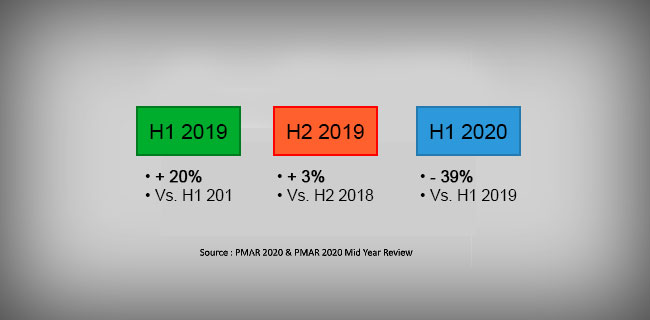
    A comparison with 2019 shows that the overall AdEx lost INR 14,000 crore and declined by 39% in H1, the first half of 2020 due to the effects of Covid-19. A break up of the first half by two quarters showed that Q1 had an 8% decline in the overall AdEx in the pre-Lockdown period due to the slowing down of Indian economy. In Q2, during the complete lockdown in April and May, the overall AdEx dropped into almost a bottomless pit. The fall was partially arrested with the unlocking starting in phases from June 1, but overall AdEx still declined by 65% in Q2.


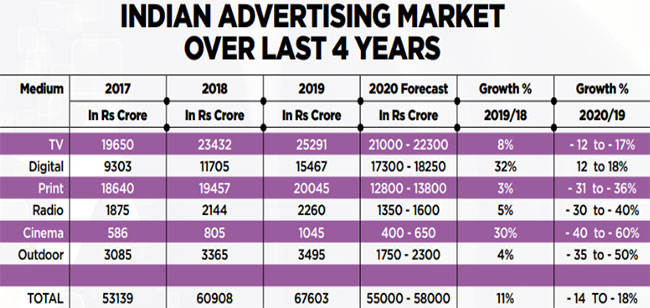
    Citing the trends of recovery of TV and Digital advertising in June and July, PMAR has predicted 60% -72% recovery of overall AdEx in H2, the second half of 2020 boosted by the festive season, revival of IPL, big ticket TV shows like KBC and Big Boss. The estimated recovery of AdEx in H2, is expected to arrest de-growth of overall AdEx in 2020 and contain it within a range of -14% to -18% as shown in the chart below.


    Source: Pitch Madison Advertising Report 2020 Midterm Review


    While TV and Digital are set on getting back to normalcy, Print is lagging far behind and Radio, Cinema and OOH are yet to show signs of regaining normalcy. The report has refrained from calculating a specific growth number in the forecast for 2020, instead has indicated a range for the AdEx value of each sector as well as the overall Ad Industry as reflected in the above chart. PMAR needs to be congratulated on their commendable efforts of mapping the effects of COVID 19 on Indian Ad Industry in the current situation.


    As per the usual format of reporting, PMAR has presented a detailed picture of TV, Digital, Print, Radio, OOH and Cinema and an analysis of advertisers active during the first two quarters of 2020 across different media. Among traditional media TV suffered the least damage with TV AdEx dropping by -43% in H1 ‘20 and retained 38% share of the advertising pie. Print AdEx dropped by 51% in H1’20 and it had to concede the number two position to Digital in terms of share in the advertising pie which dropped to 25%.  Adex dropped respectively by 52% in Radio, 55% in OOH and 52% in cinema in H1 ’20.  Digital had only a minor contraction of just 7% in H1 ’20 and its share in the advertising pie went up to 30%.


    As far advertisers are concerned, more than half disappeared from Print and Radio during the first half of 2020. TV also lost a quarter of its regular advertisers. 13 new advertisers entered the list of Top 50 advertisers which accounted for 31% of the overall AdEx. HLL topped the list with INR 1300 to 1500 crores advertising in H1 ’20. A wide gap was noticed among HLL and Procter & Gamble who ranked second with an ad spend of INR 250 to 350 crores.


    The Indian ad industry has never experienced such a decline. If we look at the last two decades, we find the industry growing in leaps and bounds during the first 8 years of this century with year on year double digit growth. In earlier PMAR reports we saw the growth rate of overall AdEx dropping to -8.9% in 2009 from 18.9% in 2008 as the international financial crisis triggered off by the sub-prime mortgage problem in the US led to recession in many countries and cast a shadow also on our economy. However, the overall industry recovered quickly with a whopping 27.9% growth in 2010. During the current decade there has been ups and downs in the performance of the overall AdEx but we never saw actual de-growth of our Ad Industry. According to PMAR 2020 Midyear Review, COVID 19 may set the industry back by 2 to 3 years. It is unlikely that the industry will recover as quickly as it did in 2010. A lot depends on how the government can control further spread of the pandemic and how soon vaccine for coronavirus can be available for Indian masses.


  • Indrani Sen: Reincarnation of Media Sales

    By Indrani Sen


    The pandemic has affected media revenues adversely, but at the same time approach to media sales have undergone a sea change. Most of the media houses who used to have separate sales team for selling traditional media and digital media have integrated them to a seamless force. Digital media marketing has become much more data driven and focussed on interpretation of data. In fact, approach to media selling has started encroaching into the territory of media planning.

    Last week, on August 13, 2020, I received two interesting mailers “Your Cheat Sheet for Streaming Trends” from Jio Saavan and “Introducing HT AdWorks – Personalised Media Consultation and Discounted Ad Prices across Mediums” from HT Media Ltd. The Jio Saavan mailer showed a very creative way of pushing their brand for digital media campaigns based on their research findings and HT Media cleverly introduced packages for their media brands across different verticals under the guise of media consultancy.

    The first mailer from Jio Saavan was based on the findings of their Digital Audio Playbook for a New Reality”. Interesting charts showed highlights from the research along with cues for digital audio panning, eg. 520% growth in throwback hits with a suggested cue for spreading good vibes through narratives that provide an escape from life. The mailer also included an invite for a free downloading for the Playbook. For some time various digital media platforms have started offering content solutions to the advertisers along with media buying deals, the Jio Saavan offer goes beyond creative solutions to the domain of providing interpretation of research and strategic solutions. Using research as a strategic tool for planning was the forte of media agencies, now that is being challenged by digital media marketing.

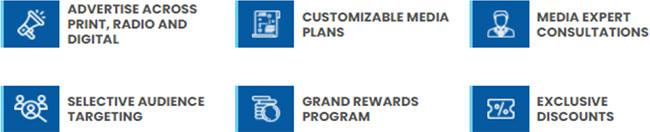
    HT Media’s mailer on ‘HT Adworks’ with a tagline of ‘Grow your business’ invited registration for a free digital event for better understanding of their membership based program for cost effective and personalised media plans. The link provided in the mailer opens up https://www.htadworks.com/ with registration facility for two digital events in Delhi and Bangaluru, a write up about the programme and a facility to download an e-brochure on HT Adworks. As shown below, the benefits of the programme, advertised on the website, cover all the aspects of media planning and buying across Print, Radio and Digital verticals where HT Media brands are present.


    The digital events by HT AdWorks focus on Delhi and Bengaluru which indicates that the programme has been designed for small and medium scale advertisers. However, some of the large advertisers may also be interested in participating in HT Adworks. The question which comes up automatically is if the budget allotted to HT media brands through this channel will remain a part of the overall media budget routed through media agencies or will be routed through HT Adworks directly for getting the ‘exclusive discounts’?

    Long back, in the days of fixed 15% agency commission, media sales used to dictate their terms to the agencies. In the digital age, we are seeing a reincarnation of media sales with media houses bypassing the role of media agencies by offering the advertisers all the functions of the media agencies along with exclusive discounts. We have been witnessing vertical as well as diagonal expansion by all traditional media houses over the last three decades along with consolidations and mergers in the media business. Most of the large media houses now have multiple brands in their stable under traditional as well as digital verticals. A spread of media sales practice like HT AdWorks can play havoc with the business of media agencies.


  • Podcast: The Crawling Baby is Walking Now!


    By Indrani Sen


    Our students at Symbiosis Institute of Media & Communication have been surprising us with their online co-curricular activities ever since we opened our campus virtually. Recently, we noticed a keen interest among them to use and explore podcasts.


    The Public Relations students of PR Club have started an initiative of regular podcast using Spotify Live on “PR in Post Covid World” from July 2020 and are inviting various senior people from PR industry for featuring in the podcasts. Media Management students of MM Club organised a panel discussion on “Growing podcast culture in the audio streaming industry” and invited three bright young professionals, Ishani Dasgupta of Jio Saavan, Kavita Rajwade of IVM Podcast and Daniel Fenandes, a stand-up comedian and SIMC alumnus to share their perspectives with the students.


    Encouraged by the students’ interest, I was trying to update myself on podcast in India during last week when www.emarketers.com came up with an interesting article on podcast adspending in the US on August 4, 2020. “Podcast listenership in the US has been soaring in recent years and advertising dollars are following…… By the end of 2020, podcast ad spending in the US will reach $782.0 million, up 10.4% from last year, giving it a 21.0% share of the US digital radio ad market. And in 2021, spending will jump nearly 45% to $1.13 billion.” (https://www.emarketer.com/content/us-podcast-ad-spending-surpass-1-billion-next-year?ecid=NL1009).


    The term “podcast” was first used in February 2004 by combining “iPod” and “broadcast” by Ben Hammersley, a Guardian columnist and BBC journalist. The term was coined before Apple introduced its formal support for podcasting to the iPod, or launched its iTunes software. Apple rolled out iOS 8, a standalone ‘Podcast’ app in 2014, which accelerated the process of growth in podcasting.


    Today, many podcasts can be downloaded free; some are underwritten or sponsored by organisations with the inclusion of advertisements. Advertising, subscription, licensing content and content generation as a service are the revenue generation models in podcasting.  Lately, many people have made business ventures in the area of podcasting supported by combination of a paid subscription model and advertising.


    Podcasting in India began around 2005 with Indicast launched by Abhishek Kumar and Aditya Mhatre and caught up very fast with younger people as a verbal storytelling platform. Within a year, the number of podcasters rose to nearly 3000 in India and since then has been growing at a steady pace. Though China and the USA are globally most advanced podcast markets, it is estimated that India is on its way to become one of the top five podcast markets. Google indicates similar trends by observing that India is one of the top five countries using its podcast app.


    In India, there is a definite demand for local, Indianised content and podcasters are looking at audio-streaming as the new battleground. Industry experts agree that Indian podcasting may see exponential growth in both audiences and content during the next few years, making it an independent, economically viable standalone media.


    “As of December 2019, 40 million Indian internet users have listened to podcasts in India….this market is just one small fraction of the bigger OTT video and music streaming industry.” claimed an article mapping the Indian podcast market released on April 14, 2020 (https://inc42.com/features/mapping-the-market-indias-podcast-landscape/). Another article published in The Hindu Businessline on May 22, 2020 wrote about five home grown apps for podcasting in India.  (https://www.thehindubusinessline.com/info-tech/five-homegrown-podcast-apps-for-indian-listeners/article31650585.ece).


    The article in The Hindu Businessline observed: “…compared to western markets, India has all the right growth variables. The emergence of digital marketing to grab more users and revenue, entry of celebrities in podcast creation (Neha Dhupia, Kunal Kapoor, Kalki Koechlin and others); entry of foreign players (Spotify, Audible, Apple Podcasts, Audioboom and others); adoption of podcasts as a content stream by media companies (Hindustan Times, BBC, NPR etc.) as well as local music streaming platforms such as JioSaavn, Gaana have all played a crucial role in the growth of podcasts in the Indian market.”


    As of today, it is estimated that we have 40+ players, including local and international apps as well as aggregators in our podcast market. In the post Covid era of online teaching, podcast is being considered as an alternative platform for teaching. We can safely assume that Indian advertisers will follow the trends in US and other markets and podcast will emerge as an additional advertising option in the next decade.