Tag: Indrani Sen

  • Effects of Covid-19 on M&E in 2021


    By Indrani Sen


    Indrani SenThe second wave of the pandemic is spreading all across the country and we are seeing state after state imposing various restrictions like night or weekend curfews, conditional lockdowns etc. The central government has decided not to impose a nationwide lockdown like last year which paralysed the entire Indian economy. The decision to impose restrictions for curbing the spread of the second wave has been left to the state governments. As the pandemic situation stands now in the second month of the April-June quarter, our economy is likely to see a contraction in this quarter which will have a cascading effect on M&E industry as advertisers will spend less on promoting their products and brands.


    Till now, most economists have predicted that the effect of the second wave of COVID 19 will be less on India Inc. than the effects of the first wave when we had a national lockdown for 70 days. However, it is too early to be assured about that prediction. The outbreak of Covid-19 is no longer concentrated in urban areas, it has been spreading virulently across villages, particularly in the Hindi hinterland of Uttarakhand, UP, MP, Bihar and Chhattisgarh. The rural areas of other states, particularly the states which recently held Assembly elections, are also experiencing a surge of the pandemic.


    Urban India contributes to 60%-65% of the sales of FMCG companies while rural India accounts for the balance 35% to 40. In certain FMCG categories the share of urban and rural is 50%: 50% or even tilted a bit more to the rural sector. Last year, when the lockdown had affected the sales of FMCG industry in urban areas due to restricted consumer spends, Bharat or Rural India spurred the growth of FMCG companies. An article published on February 28, 2021 in www.livemint.com  said: “To be sure, companies are betting on large swathes of consumers in rural India switching from unbranded, loose products to branded ones over the next few years. This gives them room to push their soaps, shampoos, biscuits, beverages and packaged staples in India’s villages, albeit at lower price points. Demand in rural markets has outstripped sales growth witnessed by companies in urban markets over the last several quarters. Companies expect India’s smaller cities and villages to continue driving growth.”  (https://www.livemint.com/companies/news/why-are-fmcg-majors-chasing-growth-in-rural-india-11614504243913.html). At the beginning of 2021, most economic analysts expected the momentum of sales in rural areas to continue. However, the ground realities have already turned out to be different which will affect not just the sales of FMCG products in rural areas, but also the production of Argo industries.


    The controversies over vaccination between the Centre and the states coupled with shortage of oxygen supply and inadequate health infrastructure have given a different dimension to the Covid-19 crisis induced by the second wave. Middle class urban families are spending their live savings, begging and borrowing to try and save their near and dear ones, in the process reducing their subsequent purchasing power. Upper class affluent urban families have realised suddenly that the big fat medical insurance in which they invested are not of any use to them if they cannot get their relatives admitted to any hospital or nursing home. Many insurance companies are refusing to give coverage for Covid treatment. These rich people are feeling the need of having large amount of cash in hand for emergency treatment of Covid, which will reduce their disposable income and affect the sales of consumer durables.


    The pandemic has already managed to disrupt our cricket calendar by postponing the IPL 2021 indefinitely to another venue in another country and it is unlikely that T20 World Cup will be held in India in 2021 which has affected the tourism and hospitality industry, the on-ground display, etc. The advertisers having peak season during summer months are putting a brake on their TV expenditures due to state level lockdowns, restricted movement of transport for delivering of goods and reduction in consumer spends due to very small windows of time available for daily shopping.


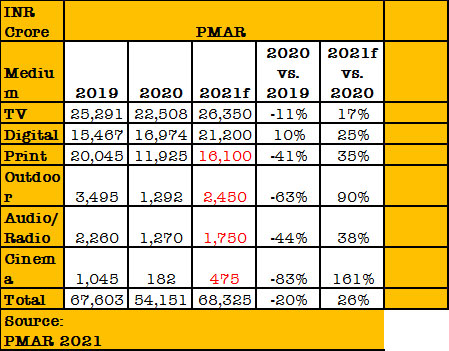
    Medical experts are predicting a third wave of the pandemic around September, 2021 which may result in further contraction of the economy in the October-December quarters, in spite of the festive season. Lack of economic recovery in the next two quarters will result in further loss of business for the M&E industry. As per the Pitch Madison Advertising Report 2021, overall AdEx de-grew by 20% and traditional media AdEx degrew by 29% in 2020 with only digital media growing by 10% during the same period. The PMAR 2021 predicted that in 2021 overall AdEx will grow by 26% touching the 2019 level. In the second month of the second quarter of 2021, it is too early to predict the overall effect of Covid-19 on the M&E industry over the entire year. The current signs indicate that it will be difficult for the AdEx to jump back to the 2019 level in 2021.
     

  • Indrani Sen: Effects of Suspension of IPL 2021

    Indrani SenBy Indrani Sen


    The last one week advertising and marketing industry has been buzzing with speculations on the consequences of suspension of IPL 2021. Star Disney has been very prompt in offering possible solutions to sponsors and advertisers. As per the contracts, all IPL ad deals are non-cancellable, but as a special case if the sponsors and advertisers do not want to continue with the existing deals, the broadcaster has offered to cancel the deals from their end and allow their clients to negotiate fresh deals for the remaining IPL tournament as and when it gets rescheduled. Alternatively, the clients can keep the existing deals in abeyance and utilise the balance as and when BCCI finds a new window for scheduling the rest of the matches and a new venue for holding the same. The sponsors and advertisers will pay on pro rata basis for 29 matches which have taken place of the scheduled 60 matches.


    It is too early to get a feedback on the decisions of the sponsors and the advertisers. My guess is that most sponsors will stay with the existing deals as investment in IPL 2021 is a part of their long-term marketing and advertising strategy. Some of the advertisers who have peak seasons during summer months or have some immediate growth targets, may consider the other option. However, one thing is certain that cancelling the existing deals and renegotiating later will cost the advertisers more for purchase of similar time over the TV and OTT platforms. Strategically by offering an option of cancellation, Star Disney has probably ensured that most of the existing IPL deals continue with them.


    It is being estimated that BCCI and the franchise teams will collectively suffer a loss of INR 2500 to 3000 crore if IPL is cancelled totally. If it is rescheduled later, the loss will be considerably less, but the additional cost of the logistics of arranging the matches outside India will reduce the profit margin and will shrink BCCI’s central revenue pull available for sharing with the eight teams.


    The biggest losers would be the ancillary industries who were directly or indirectly associated with the IPL tournament, e.g., ground management, hotels providing bio-bubbles, travel, production, agencies providing on ground display, etc. Even if the tournament is rescheduled abroad, there would not be any scope of recovering their financial loss, which admittedly is on a much lesser scale than the tournament revenue, but is a very high percentage of their annual income.


    The situation is also complicated with the advertising and media agencies. Most of them will suffer a loss of projected revenue during the first half of 2021 due to suspension of the tournament. Their clients will insist on renegotiating the deals with them and will try to reduce the commission or fees. It will be difficult to find suitable programme/ content for rescheduling the advertising campaigns and to achieve the target reach required for achieving the sales objectives during the first half of 2021. However, all the leaders of the industry have agreed unanimously that postponing the tournament was the right decision under the current COVID situation in the country.


    What about the consumers, the viewers who make IPL the big blockbuster event? The day after BCCI announced their decision of postponing the 14th edition of IPL and rescheduling it at a later time outside India, The Indian Institute of Human Brands (IIHB) and the Rediffusion Consumer Lab (or Red Lab) announced findings of a survey indicating that the cancellation of the tournament may be a blessing in disguise for the advertisers during the rapidly spreading second wave of the pandemic in India.


    IIHB and Red Lab conducted a small survey among 482 consumers (271 males & 211 females) over three weeks (April 17 & 18, April 24 & 25 and May 1 & 2) to judge change in their attitude, if any, towards IPL as the second wave of the pandemic continued to increase across the country. The questions mainly concentrated on three broad areas (1) the appropriateness of holding IPL in India this year (Should the IPL have been played at all this year? Given the pandemic, should the IPL have been played overseas again?); (2) the respondents intensity of watching IPL (Are you watching more/less/same of the IPL as last year? Do you think watching IPL every evening provides an escape from all the pain, grief and death all around? IPL were to be cancelled; would you miss the game?) and (3) the respondents recall of ads and celebrities and effects on brands (Do you remember ads and celebrities from the IPL telecast? Given the current mood, do the ads on IPL attract you? Would you buy the brands being sold?).


    Over the three weeks, the number of respondents not available or not contactable decreased steadily. The positive sentiment towards conducting IPL in 2021 also decreased from 81% to 58% over three weeks and the number of people agreeing that IPL should have been played outside India went up. There was a 33% drop over the three weeks in the positive answer to the question “Do you think watching IPL every evening provides an escape from all the pain, grief and death all around?” Percentage of people watching less of IPL 14 compared to IPL 13 also went up over the three weeks. The recall of advertisements as well as celebrities were very good across the three weeks, but the intention of buying the brands dropped from 84% to 52% over the three weeks.


    IIHB and Red Lab concluded that the sensibilities of the consumer were getting hurt with the cricket extravaganza continuing during the pandemic and there was a growing discontent with IPL 2021.  It appears that continuing with the tournament in India might have got the sponsors and advertisers the desired exposures but would not have translated the same to desired consumer spends on the brands. The partial or total lockdown imposed by many state authorities will also contribute to the dip in sales.


    It is very difficult to take any guess at this stage about the condition of the pandemic in our country in September when a window is available for rescheduling the IPL. We do not know when the current second wave will end and what will be the final death tolls, if there will be a third wave of the pandemic in September as predicted by many medical practitioners and health experts. Only one thing is certain, we will overcome this coronavirus one day.


  • Indrani Sen: TV penetration in urban India: Is there any room to grow?

    Indrani SenBy Indrani Sen

    On April 15, 2021, Broadcast Audience Research Council released the “TV Universe Estimate 2020” indicating that “TV UE 2020 has been developed by computing the Linear growth of TV Households and TV Individuals from Broadcast India (BI) Studies conducted in 2016 and 2018 at geographic and demographic levels. The distribution of the TV population by NCCS was taken from the most recent Indian Readership Survey (IRS).” The field work could not be conducted in 2020 due to the pandemic and BARC had a plan to conduct a large-scale establishment survey as a part of Broadcast India (BI) 2021. However, the current second wave of the pandemic raging all over the country will cause a delay in the implementation of that plan.

    As per TV UE 2020, out of an estimated 300 million households in India, 210 million are TV owning households, of which 91 million (43%) are in urban areas and 119 million (57%) are in rural area. From 2018 to 2020, the number of total households owning TV has grown from 197 million to 210 million (by 6.6%); urban households owning TV has grown from 87.8 million to 91 million (by 4%) where as the number of rural households owning TV has grown from 108.9 million to 119.2 million (by 9%). Over the last 10 days TV industry has been celebrating the increase in TV penetration during the COVID infected period which accelerated the growth of digital media in India.

    Against the national average of 6.6% growth, the growth in the number of TV owning households in the HSM area has been 8%. As far the distribution platforms are concerned, share of DD Free Dish has grown from 13% (2018) to 19% (2020) which has largely driven the higher growth of TV households in the HSM area. South India, with higher TV penetration than rest of the country, has shown 5% growth which is less than the national average.

    While it is quite acceptable that the total number of households has increased from 248 million in 2011 to 300 million in 2020, the question arises how much scope is there for TV penetration to grow in urban area? As per the 2011 Census, there was 248 million households in India with an urban: rural share of 31%: 69%. 91 million, the number of TV owning households in urban area in 2020 accounts for 30.3 % of 300 million, the total estimated households in India and 98% of urban households (31% of 300 million= 93 million) leaving very little scope for further growth of TV penetration.

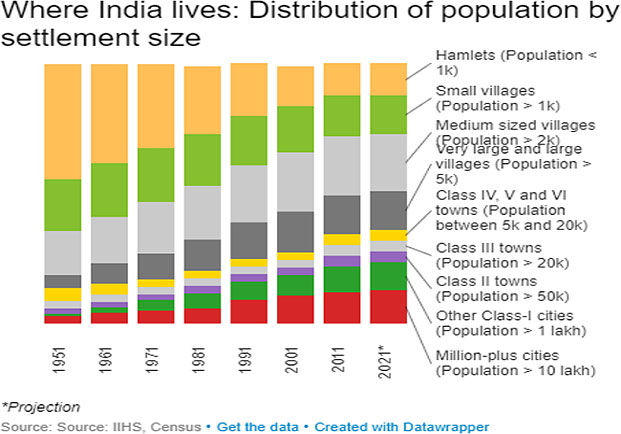
    Here, we need to ask, going by the three-tier definition of urban as used by Census, what will be the urban-rural split of households in 2021 Census? Should we reconsider the definition of urban introduced in 1951? In reality, what percentage of our population lives now in villages and what percentage lives in towns?

    An article by Ajay Sreevatsan in the www.livemint.com which was updated on September 16, 2017, analysed the possible reasons why actual share of urban areas should be higher than the official Census statistics. The chart given below has been taken from that article, which after arguing strongly in favour of higher rate of urbanisation, concluded with “…how much of India is urban, and how much of it is rural is as much a question of politics as it is of economics.” (https://www.livemint.com/Politics/4UjtdRPRikhpo8vAE0V4hK/How-much-of-India-is-actually-urban.html).


    Source: www.livemint.com

    Recent government policy documents have argued that the share of urban households could be 37%-38% depending on the infrastructure developments and other parameters. Even if we make a moderate estimate that the urban: rural split will be 35%: 65% in the 2021 Census, we will still have 105 million urban households out of estimated 300 million total households, leaving a 14 million headroom for growth in TV penetration. However, TV industry needs to recognise that TV penetration in urban India is close to saturation point in the higher NCCS categories and need to make their future plans accordingly.


  • Scanning the Indian Pay TV Market


    By Indrani Sen

    Indrani SenIndian Pay TV market is highly fragmented due to the multi-lingual distribution of TV content through many regional distributors along with national distributors covering the HSM and all major regional markets. As per different available research, 50% + share of the subscribers of Pay TV are currently being held by several small regional players. None of the available estimates except the FICCI EY reports takes into account the subscribers of DD Free Dish while estimating the total TV households in India. DD Free Dish subscribers do not have to pay for the TV content so do not contribute to the pay TV market revenue.

    Media Partners Asia (MPA) has recently published a report titled “Indian Pay TV Distribution 2021” which predicts that by 2025, the Indian Pay TV industry will reach revenue of USD 12.3 billion and total Pay TV subscribers will increase to 134 million in 2025 from 127 million in 2020. According to the same research, DTH homes in India will grow from 58 million in 2020 to 68 million in 2025 at the cost of the cable TV homes during the same period. Compared to estimates published by various other research organisations, the total pay TV subscribers’ base in India seem to have been underestimated while the revenue may have been overestimated by MPA.

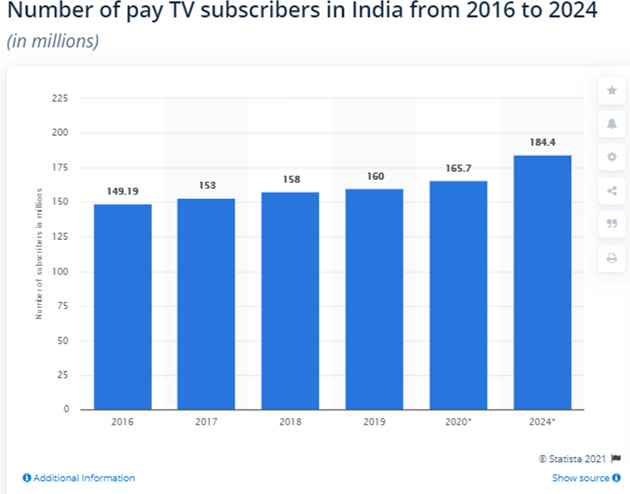
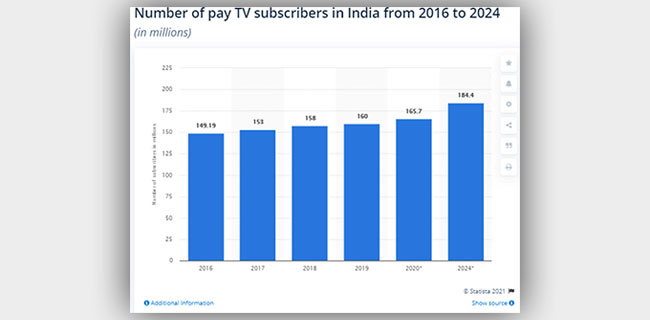
    According to an estimate published by Statista Research Department on March 19, 2021, “India had over 160 million subscribers of pay TV in the year 2019. This figure was around 149 million subscribers in 2016 and was estimated to go up to over 184 million Pay TV subscribers by 2024.” These estimates are higher than the estimates made by the FICCI EY in their report on the Indian M&E industry 2020.

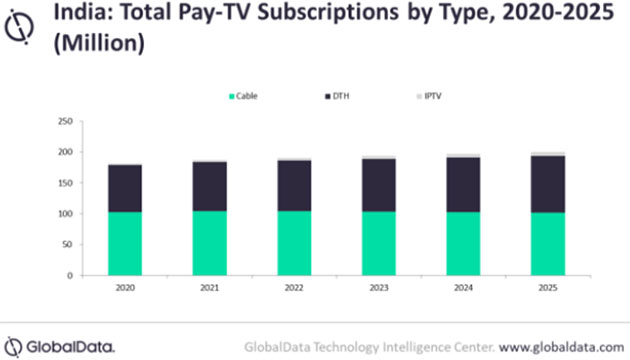
    Another report India Telecom Operators Country Intelligence report published by www.globaldata.com in 2020 supports the estimates of Statista. As per this report, Cable will be the leading Pay TV technology in India throughout the forecast period, followed by DTH with a small presence IPTV which is expected to grow in India at a very fast rate during the next 4 years. As per www.globaldata.com the total Pay TV revenue in India is expected to grow at an annual growth rate (CAGR) of 0.7 percent from USD 3.19 billion in 2020 to USD 3.30 billion in 2025, which is much lower than the FICCI EY estimates.

    The above picture reflects the trends in TV distribution by technology in the global market, though the pandemic has reduced the share of the cable TV subscribers in India. IPTV is expected to grow at a CAGR of 19.4% in India during the next 4 years riding on the fixed broadband penetration in India as well as smart TV sets.

    According to the report published in www.grandviewresearch.com: “The global Pay TV market size was valued at USD 225.9 billion in 2019, registering a CAGR of more than 1.5% from 2020 to 2027.” This report spoke about the growth in penetration of Pay TV in rural households in China, India and Indonesia creating overall growth in the Pay TV industry.


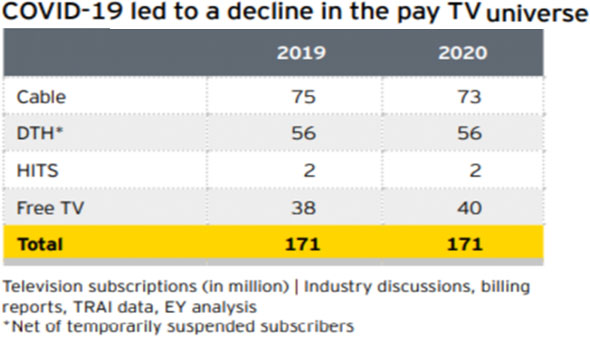
    Source: FICCI EY Indian M&E Industry Report 2020

    As per the FICCI EY report on the Indian M&E industry 2020, there are 171 million TV households in India of which 40 million are Free TV households. The report estimates distribution revenue of the Indian TV Industry to reach INR 502 billion (USD 6.72 billion) in 2023 from the current level of INR 434 billion (USD 5.80 billion). The FICCI EY estimates seem to be the best one available currently for the size as well as the revenue of the Pay TV market in India.

  • IPL 2021: The Show Will Go On, but…


    By Indrani Sen

    Indrani SenThe second wave of the pandemic has hit India, record number of cases have been reported across the country just a week before the IPL 14 scheduled to take off at the Wankhede Stadium in Mumbai on April 9, 2021, Maharashtra has been declared as one of the worst affected states by the second wave, night curfew has been declared in Mumbai, Pune and other cities of Maharashtra, yesterday a lockdown over weekends has been announced in Maharashtra, at the same time the BCCI has announced that IPL matches will be held as per schedule.

    On April 3, a total of 18 people connected with IPL tested Covid positive, 2 players, 10 groundsmen of Wankhede Stadium and 6 members from IPL Event Management Team. BCCI has already arranged to replace the groundsmen, which was not easy as five IPL teams are currently in Mumbai training on different grounds. Alternative venues in other cities have been lined up in case matches cannot be held at the Wankhede stadium. Huge logistical issues will arise in case last minute changes are made in venues. In order to hold night matches and matches over the weekends in Mumbai during night curfew and weekend lockdown, BCCI must have sought special permissions from the state authorities.

    The show must go on as too much is at stake financially not just for BCCI, but also for all the IPL franchisees, the players playing in the teams, the official broadcaster of the tournament on TV and OTT platforms – Disney Star India, many advertisers and ad agencies who have already invested in the property and have planned marketing activities accordingly and last but not the least the viewers who are eagerly looking forward to watching again the annual festival of live cricket and provide the currency for justifying the rates charged by the broadcaster to the advertisers.

    It is estimated that in 2020, Star Sports and Hotstar together earned around INR 3000 crore in ad revenue from IPL 13 held in Dubai in 2020. This year, they are apparently eyeing a target of INR 3600 to INR 3800 crore. A more conservative estimate also envisages a 17% to 18% growth over last year’s ad revenue. As per the recent TVC released by Disney Star India, the broadcaster has bagged 17 sponsors for IPL 14. Disney+ Hotstar has already acquired 14 sponsors and are negotiating with couple of others. Altogether more than 100 brands across different categories are expected to advertise on TV and OTT platforms riding on the band wagon of IPL 14.

    As per industry estimates, co-presenting sponsorship on Star Sports is priced at Rs 110-Rs 125 crore and associate sponsorship at Rs 65-70 crore. While the cost of 10 seconds is pegged in the range of 13.2 lakh to 13.6 lakh for sponsors and cosponsors, the same for spot buyers is charged at the rate of Rs 14 .3 lakh. Traditionally 50% of the total time available for advertising is allotted to the sponsors and the other 50% is sold to the spot buying deals. The broadcaster has already announced that from April 1, 2021 the remaining ad inventory will be sold at 20% higher rate as apparently 90% of the total time available has already been sold. Usually, before the semi-finals and finals, IPL spot buying rates on TV are hiked again for last minute spot buying deals, so a further hike may be expected.

    Ever since the IPL 14 was announced, we have seen many articles based on various advertisers’ experience of advertising with earlier IPLs, particularly IPL 13 and the returns which they got on their investments in terms of growth in awareness and consideration scores. IPL has established beyond doubts that there is no other TV property which can deliver the leap in awareness and consideration scores within the span of 8 weeks. It is the ability of IPL to connect with target audiences across age, sex, education, occupation, income groups and states which attracts advertisers to invest in the property.

    Many women-centric brands have been considering the option of advertising with IPL 14 as the popularity and viewership of IPL among women has seen an increase over the last few years. As per the BARC Report, women viewership of IPL 13 grew by 23% over 2019 while the male viewership grew by 22%. In 2020, IPL 13 registered 171 billion viewing minutes of female audience, while in 2019 IPL 12 registered 139 billion viewing minutes of female audience. From 2018 to 2020, the share of male viewing has dropped from 58% to 57% while the share of women viewing has increased from 42% to 43% in the total IPL viewing minutes.

    Most industry sectors are now on a path of recovery after the disastrous year of 2020, as discussed earlier many advertisers have already invested in IPL 14, ad agencies have been hoping to earn relatively better fees from their clients advertising in IPL 14, when the increasing fury of the second wave of pandemic is threatening to upset all the plans. Postponement of a cricket tournament of the scale of IPL and finding another slot of 8 weeks in the international cricket calendar is not an easy task. Cancellation of the tournament at this stage is not desirable as it will amount to huge loss for all concerned. BCCI needs to get ready for firefighting on a day-to-day basis to hold the tournaments of IPL 14 on home grounds in 2021.

  • Advertising goes down 29%


    By Indrani Sen


    Indrani SenThe FICCI EY report on Indian M&E industry 2021 titled “Playing by New Rules” was released last Friday, March 26, 2021 at a virtual event. By now, we know that M&E sector posted INR 1.38 trillion in 2020 (a decline of 24% from 2019). Except Digital Media and Online Gaming, all other media suffered degrowth as an effect of Covid-19. Print media lost its #2 position to Digital Media, while Television managed retain the #1 position.

    Let us turn our focus to the advertising industry, which according to the FICCI EY report, saw the highest single year drop in the history of Indian advertising. The industry saw a degrowth of 29% in 2020, higher than the 24% degrowth of the overall M&E sector. The report describes 2020 as “a watershed year for advertising spends”. A review of how advertising revenue was distributed among different media in 2020 and how did the distribution compare with 2019 is shown in the table below:


    Ad Revenue by Media: Source FICCI EY Report 2021

    Advertising in traditional media experienced a degrowth of 37% from 2019 to 2020, but advertising in digital media remained steady and did not suffer any loss. Advertising in Print sufferred due to reverse migration, changed consumer habits and cost-cutting while advertising in Radio and OOH was affected by reduced mobility of consumers. The experienial industry comprising of Events and Cinema degrew due to lockdown guideline, social distancing norms and consumer fear of crowded places.

    The advertising industry is not expected to recover the losses of last year in next two years (2021 and 2022). While the total advertising spend is expected to regain the pre-Covid-19 levels in 2023, the individual traditional media are estimated to regain the same levels over a period of 5 years: 2021 (none), 2022 (Television), 2023 (Events & Cinema), 2024 (OOH), Radio (2024+) and Print (2025+).  Digital media is expected to grow by 22.5% over the 2019 level in 2021.
    In a Marketer Survey conducted by EY in 2020, 88% of marketers were confident that consumer spends in their sector would grow in 2021. 66% of the marketers felt that their advertising expenditure would grow in next two years. However, 33% of the marketers surveyed felt that their advertising expenditure either would not grow or would decline in the next two years.

    The same survey showed the marketers incresed investments in D2C initiatives during the pandemic in 2020 as shown in the above chart and 74% of them expeted to spend over 20% of their total spends on digital media against 45% who had shown interest in investing in digital media in 2019. A significant increase in digital spend were expressed by most.

    The survey probed further on how the marketers were assessing the state of their future readiness in terms of their digital maturity and found that the advertising agencies are playing a crucial role.

    :: “92% of respondents were actively monitoring their digital readiness, at a time when complex ecosystems are emerging across the business and marketing landscape.

    :: 53% of respondents surveyed depended on their agency partners to update them on leading practices in their digital transformation journeys”

    The FICCI EY report finally sums up the section on advertising by listing how advertisers are turning uncertainty to opportunity through Martech adoption, investments in brand purpose and architecture, hyperlocalisation, building and retaining immersive consumer experience, diversification of media, colaboration and last but not the least ensuring digital effectiveness. The experts’ comments at the end of the section on Advertising makes it clear that in the digital age advertising agencies need to invest in data, technology and analytics to stay relevant for their clients.


  • Indrani Sen: Online Gaming: The New Claimant for Share of Advertising Rupee

    Indrani SenBy Indrani Sen


    Last week, the advertising and marketing industry got an overwhelming exposure to online gaming through the “e4m Game On: Gaming Summit” over two days and the report “Everyone’s Gaming Among Us – Mobile Gaming through the Pandemic and Beyond” released by InMobi simultaneously. The highlights of the report show (i) 45% of Indian mobile users got introduced to gaming during the pandemic, (ii) women constitute 43% of the gamers in India, (iii) 60% of gamers is in below 25 years age group, while 12 % is in the age group of 25-44 and 28% is in the age group of over 45 years and (iv) Indian gamers interact 2.6x times more with the video ads shown in gaming apps than in other apps.

    The FICCI EY Report on Media & Entertainment (M&E) Sector “The era of consumer A.R.T.:  Acquisition | Retention | Transaction” was released in March 2020 before the pandemic hit our economy in a big way. We saw in that report that online gaming continued as the fastest growing segment with 39.8% growth in 2019 over 2018, riding on the back of transaction-based games, mainly fantasy sports, and a 31% growth in online gamers. The InMobi report findings indicate that the online gaming growth during pandemic has sky rocketed during the pandemic and it would not only continue to be the fastest growing segment, but also reflect a huge growth in the number of online gamers in the next FICCI EY report on the M&E sector.

    In the e4m ‘Game On: Gaming Summit’, various speakers dwelled on the benefits of advertising through online gaming apps over the two days. On the first day, in the first panel discussion on “Gaming: The New Media for Marketers”, panellists spoke about how the use of gamification can enhance consumer engagement for a brand apart from traditional advertising.  In the second panel discussion on ‘Decoding the Online Gaming Market in India’, one of the panellists, Naman Jhawar, Senior Vice President, Strategy and Operations, MPL said “This industry is going to create a lot more opportunities on the brand monetization side as well. That is something that is already happening whether it is live sports or on the online gaming platforms and this branding is going to scale up.” Another panellist Dinesh Sharma, Business Head, Commercial PC, and Smartphone, System Business Group, ASUS India, said “One of the key trends that we are seeing is that when the pandemic occurred people wanted to connect emotionally and gaming became a perfect platform to get together virtually. E-sports is trending in a manner and will become as big as cricket.”

    On the second day of the Ssummit, GroupM Business Head, Entertainment, Sports & Live Events Vinit Karnik shared some revealing statistics that in last ten years the number of Indian gamers has grown by 14 times and currently they spend on an average 22 hours per week watching e-sports content and playing online games. He emphasized “Brands need to ride the e-sports bandwagon very early to reap the benefits. Today is the time for brands to evaluate various opportunities and how can one relate to this target audience and look at building brand affinity with them over time.”

    Rajesh Pantina, Director of Marketing, Asia Pacific, InMobi, also spoke at the e4m Game On: Gaming Summit and shared the findings of the InMobi report highlighting the facts that online gaming is not just a young man’s game, gamers are well distributed across India (South 29%, North 27%, West 22%, East 22%) and ad recall is high amongst Indian online gamers. He explained that programmatic sampling was used for running the survey and generating responses from 1000 plus Indian consumers using smartphones across 30 cities from tier I, II, and III. The sample was targeted and weighed to represent of India’s smartphone population and the survey was conducted between February 9 and 16, 2021. The most interesting insight shared by Pantina was on the consumption of various forms of digital entertainment “People are treating gaming as a part of their entertainment bucket, which comprises also of OTT video and music but then gaming started to own that entire entertainment and relaxation genre, and it’s probably the newest face of entertainment.”

    We are definitely going to see more participation by various brands in online gaming which can be either through gamification of their communication or through sponsorships and placement of advertisements in online gaming platforms and apps. In the new entertainment bucket of consumers, online gaming has an edge as it is an interactive platform while OTT and music are both passive platforms. Online gaming, therefore has the potential for claiming a higher share of consumer engagement, particularly from India’s growing youth segment. In conclusion, I feel we are going to see online gaming not only competing with OTT video and music, but also with social media in future. A day may come when family and friends will make appointments to meet digitally for watching or playing games instead of having a chat on social media.


  • A Trillion-Dollar Digital Economy Beckons


    By Indrani Sen


    Last week, in a virtual event, Assocham released along with The Dialogue, a research report titled ‘Enabling A Trillion Dollar Digital Economy – Interdependent, Interconnected and Digital’. The media coverage of the event highlighted the gist of the speeches given by the various dignitaries which did not do justice to the actual content of the report.


    The report by The Dialogue presents an in-depth analysis of the telecom industry of India and the way it has enabled the digital economy. It also reviews the challenges of privacy, security, intermediary liability, competition and financial loss which the industry is facing currently along with the opportunities and the action points for achieving the target of a trillion-dollar digital economy by 2025.


    As action points, the report offers solutions like reducing regulatory levies, addressing the AGR issue, reducing GST burden, progressive regulatory policies, an online portal for transparency of approvals along with introduction of new technologies. In an indirect way, the report challenges some of the current rules and regulations related to the telecom industry.


    If our government takes the suggestions given in the report seriously and activate the action points suggested by them, then we shall definitely achieve the target of a trillion-dollar digital economy in four years.


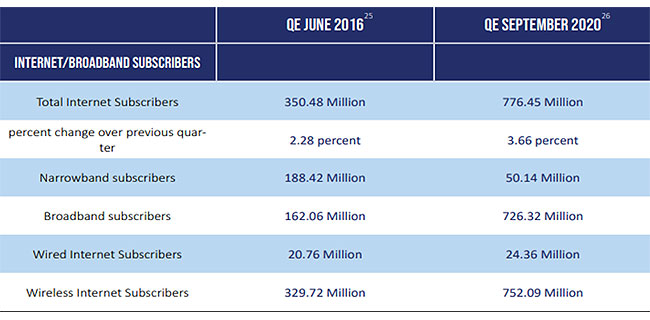
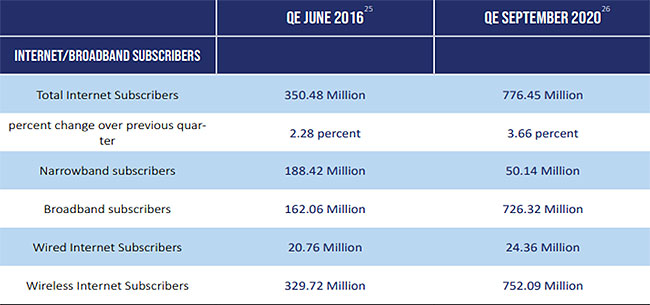
    The report gives an estimate of the size of the internet users in India, which shows 97% of internet subscribers (752.09 million) are wireless internet subscribers. A comparison of the internet subscribers between June 2016 and September 2020 shows that the wired internet subscribers increased by only 3.6 million while the wireless internet subscribers increased by 422.37 million in four years. Broadband subscribers grew by 564.26 million during the same period from 162.06 million to 726.32 million.


    Source: https://thedialogue.co/wp-content/uploads/2021/02/Enabling-a-Trillion-Dollar-Economy-The-Dialogue.pdf


    In November 2016, Assocham had published along with Deloitte a research report titled “Digital India: Unlocking the Trillion Dollar Opportunity”. There is no reference to that report in the recently published report except the use of the June 2016 data for comparing the internet/ broadband subscribers.


    Said Kazim Rizvi, founding director, The Dialogue in the introduction of the report: “I hope that for years to come, this serves us as a guiding document on the regulatory issues to be debated and discussed, in order to enhance the potential of India’s digital economy.” I not only agree with him, but congratulate The Dialogue team for producing a comprehensive guide for solving the problems of our telecom industry which is the backbone of our growing digital economy.


  • DD Free Dish Latest Auction: Who wins, Who loses?


    By Indrani Sen


    DD Free Dish has come a long way since its launch in 2005. Last year during the pandemic while Prasar Bharati had an auction of 53 MPG2 slots in March, 2020, followed by various auctions for limited number of channels for limited periods, allowing the Broadcasters to experiment with the pros and cons of having more than one channel from their stable on DD Free Dish.

    This year finallym the 52nd DD Free Dish Auction was announced inviting applications from eligible channels across six buckets of TV channels for the period of one year beginning from April 1, 2021. Prasar Bharati announced the reserve price for MPEG-2 slots according to the below bucket/categories:

    Bucket A+(All Hindi GEC TV channels) – 15 Crore

    Bucket A(All Hindi Movie TV channels) – 12 Crore

    Bucket B(All Hindi Music channels, Hindi Sports channels, Bhojpuri GEC channels, Bhojpuri Movie channels and Hindi Teleshopping channels – 10 Crore

    Bucket CNews & Current affairs (Hindi / English / Punjabi) channels – 7 Crore

    Bucket D– All other remaining Genres/ Regional channels and Regional Teleshopping channels – 6 Crore

    Bucket R1– Devotional / Spiritual / Aayush channels – 3 Crore

    Any channel participating in the auction had to bid above the reserve price in that particular category.


    During the last week, there has been a lot of excitement in the TV industry over the 52nd DD Free Dish Auction. According to industry sources, there was keen competition among Broadcasters for getting the slots across all buckets. Particularly in the News & Current Affairs category, the news channels have ended up investing huge amounts to secure slots on the distribution platform of Prasar Bharati. The final round of auction took place on last Saturday and the final list has been released on March 1, 2021. The results declared shows that 10 players have won the slots in A+ category while 15 players have won the slots in A category as shown below. The results also shows clearly that DD Free Dish has become an essential component of the marketing strategy of all the major Broadcasters.

      Category A + Hindi GEC   Category A Hindi Movies  
    1 ABZY Cool 1 Wah Movies* 9 Maha Movies
    2 Azaad 2 ABZY Movies 10 Manoranjan TV
    3 Big Magic 3 B4U Kadak 11 Movie Plus
    4 Color Rishtey 4 B4U Movies 12 Rishtey Cineplex
    5 Dangaal 5 BDM 13 Sony Wah
    6 Shemaroo 6 Bflix Movies 14 Star Utsav Movies
    7 Sony Pal 7 Dhinchaak 15 Zee Anmol Cinema
    8 Star Utsav 8 Enterr10 Movies    
    9 The Q India * Expected to be relaunched as Dhinchaak 2
    10 Zee Anmol        

    Bucket B earlier used to be reserved for only Hindi Music, Sports, Teleshopping, etc. The inclusion of Bhojpuri channels in that bucket reflects growing viewership of Bhojpuri language beyond its linguistic territory. Of the 13 TV channels winning slots in this category, 7 are Bhojpuri channels. In bucket C, 12 News Channels have fought the auction and both buckets D and R1, have 5 applicants each. As per the information available the news channels winning slots in the auction are Aaj Tak, Aaj Tak Tej, ABP News, India TV, NDTV India, News18 India, News Nation, Republic TV Bharat, TV9 Bharatvarsh, Zee Hindustan and Zee News. The industry grapevine is saying that the news channels have ended up investing proportionately major chunk of their expected annual revenue in the DD Free Dish auction and couple of them may back out subsequently.


    As of now, Prasar Bharati has got INR 730 + crores from the sale of 57 MPG 2 slots on the DD Free Dish from the 52nd DD Free Dish Auction which shows a 23% increase over the last auction of INR 594.25 crore collected from the sales of 53 MPG2 slots in March, 2020. The Bucket A of Hindi Movies Collectively has got the highest collection at Rs 194.85 crore, but a Hindi news channel has come out as the single highest bidder at Rs 22.05 crore.

    .

    The total number of channels participating in the auction has crossed the number of 53 slots which were available for the auction. The senior officials of Prasar Bharati have been huddled together in meetings over last Friday and Saturday trying to decide which Doordarshan channels they should delete from the DD Free Dish offerings to allow all the private channels to come on board.


    It is not really fair for a Public Broadcaster to take such a step as the axe is bound to fall on some smaller Doordarshan Channels catering to small states. Prasar Bharati is yet to declare which Doordarshan channels have been taken out from DD Free Dish to accommodate the private channels. Last year, I wrote in this column about the silent coup by Prasar Bharati. I am an ardent supporter of the DD Free Dish strategy, however, Prasar Bharati should not promote this strategy at the cost of depriving smaller states from the viewing Doordarshan programmes in their own language on the DD Free Dish.


  • So how do the GroupM & Madison forecasts compare?


    By Indrani Sen


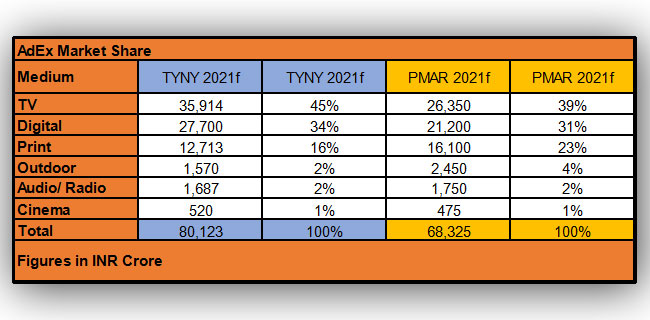
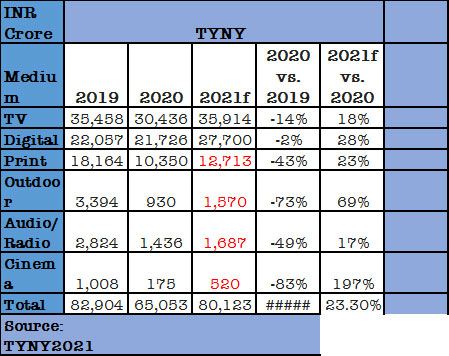
    Like every year, last week we saw the release of both This Year Next Year 2021 (TYNY2021) by GroupM and Pitch Madison Advertising Report 2021 (PMAR2021) by Madison Media. Both agreed that the pandemic year 2020 was a disastrous one for the Indian Media and Advertising Industry, when the overall AdEx dropped by 20% (PMAR2021) to 21.5% (TYNY2021) from the 2019 level. Both have predicted better days in 2021 with the overall AdEx growing by 23.3% (TYNY2021) to 26% (PMAR2021).  According to PMAR2021, the predicted AdEx INR 68,325 crore in 2021 will touch the AdEx INR 67,603 crore in 2019. According to TYNY2021, the forecast for 2021 is INR 80,123 crore, which falls short by 3.35% from the AdEx in 2019 which was INR 82,904 crore.


    In spite of the huge gap in the overall AdEx estimates by the two agencies, it is relieving to find that the trends predicted by both of them are similar. The gap in the estimated size of the Indian AdEx between the two reports has been existing over many years and the Media and Advertising Industry has learned to live with the differences. TYNY2021 has estimated both TV and Digital AdEx at much higher levels than PMAR2021. On the other hand, PMAR2021 has estimated Print AdEx at a much higher level than TYNY2021. The following two tables show the details of the two reports by medium for making easy comparisons.


    According to PMAR2021, the pandemic year 2020 will go down in the history of Indian Media and Advertising as the year when Digital overtook Print and became #2 in terms of market share of overall AdEx. However, TYNY2019 showed Digital as the #2 and Print in the #3 positions in terms of market share. In 2020, GroupM estimated a 2% degrowth in Digital from 2019 level, while Madison Media estimated a 10% growth in Digital over 2019 level. Both the reports show Print AdEx in 2021 would be below the 2019 levels, while Digital AdEx would be crossing the 2019 levels in 2021. So, we can now conclude that Digital has the second highest market share in overall AdEx and it is unlikely that Print would be able to regain that position in 2021 or later.


    TV which holds the #1 position in Indian AdEx in both the reports, had degrowth of 11% (PMAR2021) to 14% (TYNY2021) last year, but is expected to grow at higher rate 17% (PMAR2021) to 18% (TYNY2021) in 2021 and touch or cross the 2019 AdEx levels.


    Both the reports show the huge loss which was suffered by the other traditional media, Outdoor, Radio and Cinema during 2020.  In spite of the overall growth of AdEx predicted for 2021, these three media would be far below their 2019 benchmarks. The combined market share of these three media continues to be less than 10% in both the reports. A difference in reporting between TYNY and PMAR has been noticed this year regarding Radio. While PMAR2021 has reported only on Radio, TYNY2021 has changed the nomenclature to Audio. It is however not very clear what other audio component apart from Radio has been included under that definition.


    It is encouraging to find from the two reports that the worst effect of pandemic is over; Media and Advertising industry is on the path of recovery; the process of digitisation has been accelerated; we are expecting a robust GDP growth and globally India will continue to be the second-fastest growing AdEx market among the top ten countries in 2021. At the same time, it is also frightening that the economic effects of Covid-19 have manged to wipe off two years of overall AdEx growth (2020 & 2021) and many media-owners and some media agencies still have to fight battles for survival.


  • Indrani Sen: Booming Digital Advertising

    By Indrani Sen


    Zenith, the RoI Agency of Publicis Media, released its Business Intelligence – Video Entertainment report across ten key global markets in last week. The report has predicted that India will see higher growth in adspends on OTT than on TV during the next two years of this decade. In FY21, adspends on TV will grow by 4% while on adspends, OTT will grow by 24% and in FY22 ad spends will see 9% increase on TV against 34% increase on OTT.


    While the Zenith report talks about future, the Advertising Report on Digital – Part 1 – July-Sept ’20 also published last week by TAM India analyses the immediate past. Based on AdEx data, the TAM India report confirms the accelerated growth of digital advertising during the lockdown and the post-lockdown period. There was a small negative growth in May, but during the unlocking period, the growth regained its momentum from June and went on increasing steadily.


    Source: TAM India


    The highlights of the report covering Jul-Sept’20 show that ad insertions per day increased by 32% during Jul-Sept’20. Among the top 10 categories, e-com and gaming had the highest growth. Five of the Top 10 categories with positive growth came from services sector. Amazon India was the leading advertiser and its brand www.amazon.in topped the brands list. Top 10 advertisers and brands had respectively 21% and 19% share in the total digital ad insertions.

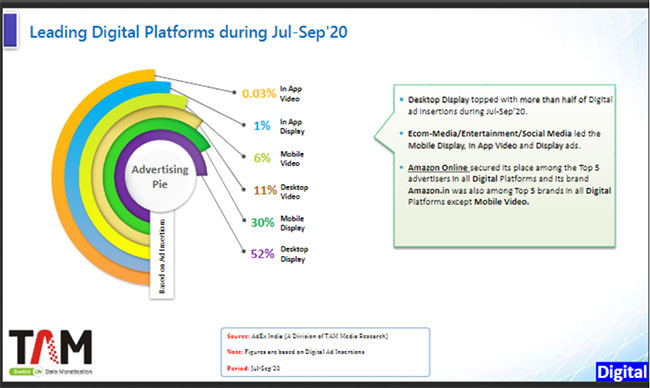
    In spite of the rise in smartphone users, among digital platforms, Desktop Display topped with more than 50% share of the total digital ad insertions. YouTube topped the list of publishers with 15% share of digital advertising, while all other publishers has 85% share. advertising on digital platforms.


    The next chart shows the share of the digital advertising pie by different platforms. Mobile Display and Mobile Video had respectively 30% and 6% share while Desktop Display and Desktop Video had respectively 52% and 11% share. Here Desktop includes Laptops also.


    Source: TAM India


    The findings on most utilised methods of transactions show that Ad Network was the most preferred mode of transactions (45%), followed by Direct (20%), Programmatic (17%) and others (19%). Though only 17% of the transactions were done through Programmatic, among other methods, the share of Programmatic/Ad Network (13%) and Programmatic-Direct (5%) indicate that programmatic buying has been making a steady progress in the transactions of digital advertising.


    Source: TAM India


    An analysis of creative types used for digital advertising during Jul-Sept’20 shows that Banners had a share of 45%, followed by HTML5 (40%) and Video (17%). Among the top 5 categories comprising of E-Com/ Entertainment/ Social Media, E-Com Online Shopping, E-Com Gaming, Corporate IT and Life Insurance. E-Com Gaming had the highest rate of growth during Jul-Sept’20. A total of 316 advertisers across 40 categories advertising 510 brands accounted for 80% of the total as insertions. The balance 20% was spread across many advertisers and brands who all wanted to board the band wagon of digital advertising. The total count showed 20,500+ advertisers across 480+ categories with 24,100+ brands participating in digital advertising during the period Jul-Sept’20!


    This report has given us a comprehensive understanding of the rapidly growing digital advertising. We will be eagerly looking forward to the next editions of Digital Advertising Report by TAM India in order to follow the progress of the digital media during the pandemic hit 2020 and beyond.


  • IPL 13 Rules. And how!


    By Indrani Sen


    Ever since IPL 13 began on September 19, 2020 with a massive 20 crore viewers on Star India Network and Disney + Hotstar, the tournament has been delivering high ratings on TV and OTT platforms.


    On the digital media front, IPL 13 is generating huge tractions over and above its coverage through Star India’s OTT platform Disney  + Hotstar. On October 30, 2020 Wavemaker published a press release on their mid-season report of “IPL Mesh 2020” covering matches from September 19 to October 24. Mesh is Wavemaker’s Realtime Data Intelligence tool which has integrated data from “multiple consumer touchpoints across Digital ecosystem ranging from Social Listening, Google Searches, Website visits, BARC, Video analytics in partnership with VIDOOLY, Interaction data points collected from Facebook, Twitter, Instagram and YouTube” to arrive at the observations and predictions shared in the report.


    The press release by Wavemaker contains a few charts and whets the appetite for the total report. The report predicts that the IPL buzz volume of the digital track will grow from 37 Mn in 2019 to 60 Mn + in 2020. During the first 36 days of the tournament, CSK was the driving force behind the interactions on social media. Now that CSK has failed to secure a place in the playoff matches, it will be interesting to watch if the buzz volume of the track gets affected. Similarly, it would be interesting to see who takes the place of M S Dhoni as wicketkeeper in the Leading Player Index Leader Board.


    In the Leaderboard ranking of most loved ads, Dream 11, Oppo and Tata Motors took the first three positions in desending order. IPL 13 has also seen a never before engagement in gamification of Cricket Fantasy League with the top five Fantasy League in September 2020 generating 30 million google searches and 90 Million web traffic. Based on historical data, the report claims that there will be huge surge both in TVP and social buzz during the next two weeks which will counter the drop in the social media buzz over during the last few weeks as shown in the chart above.


    While the Wavemaker’s report reconfirms the accelerated growth of the digital media intractions in India, in traditional TV media also IPL 13 continues to deliver high ratings to the satisfaction of the advertisers who have invested their advertising rupee in cricket. A fortnight back on October 15, TAM released “IPL 13 Advertising Report 1” based on their ADEX data covering the period from September 19 to October 10 (25 natches).  The report has shown an 8% growth registered in average ad volumes from IPL 12 to IPL 13 during the same time span/ number of matches. 5 out of the top 10 categories have been from E-commerce with 35% share of IPL 13 advertising volume and Oppo India’s commercial made it to the top position quite fast during IPL 13 compared to 2nd position in IPL 12.


    The most interesting fact which has emerged from this Advertising Report is the participation of new categories and brands in IPL 13. According to the TAM Adex report 30+ new categories and 150+ new brands advertised during IPL 13 compared to IPL 12. It remains to be seen how the advertising frenzy builds up further during the last two weeks of IPL 13, strategically scheduled during the pre-Diwali season in this pandemic hit year.