Tag: Indrani Sen

  • Indrani Sen: A Review of Vivo IPL 2021 Phase II

    Indrani SenBy Indrani Sen


    Star and Disney India has really played their hands very well and have managed to retain most of the sponsors and advertisers who onboarded the event initially for Phase II of the tournament currently being played in the UAE.  When the tournament got indefinitely suspended in May 2021 due to onslaught of the pandemic among the players and supporting members, the broadcaster reacted very quickly in a customer-friendly manner.


    Star and Disney India, who had sold almost the entire inventory in advance, assured all advertisers that the first right to continue with the sponsorship or advertising  deals at the negotiated rate would be given to all committed customers as and when the second phase of the tournament takes place. The broadcaster also indicated that no penalty would be charged to the advertisers who might want to withdraw from their earlier commitments due to their marketing requirements not matching with the revised schedule of the tournament.


    When BCCI declared that the second phase of IPL 2021 would be played in the UAE from mid- September, a majority of the original advertisers chose to honour their earlier commitments. Star and Disney India announced in the first week of September that 95% of the advertising inventory of Phase II were already sold with most of the original sponsors, i.e. Dream 11, Phone Pe, Coca Cola, Byju’s, AMFI, Amazon, Asian Paints, Cred, ITC Foods, Kamala Pasand, Mondelez and Upstox staying with the tournament.


    A few sponsors like Vodafone-Idea, Frooti, Garnier etc. have withdrawn from their sponsorship contracts. Against that scenario, new sponsorship deals have been struck with Jio, L’Oréal and Ajio, etc. for the remaining matches. It appears that the broadcaster will close the season with a record revenue collection exceeding their earlier expectation of Rs. 3,200 crore. With the qualifier and the final matches enjoying higher spot advertising rates, the second phase of IPL is expected to earn higher revenue than that of the first phase.


    As per the available BARC data, the Star India Network is cruising comfortably to breach the 400 million viewers’ mark on TV for successive fourth year. Till Match #35, the cumulative reach of the tournament has generated 380 million viewers. The trend is better than the past three years and the aggregated number of cumulative viewers at this stage are higher than what it was in the last three IPL series. The fan following of the tournament has been growing year on year which is reflected in the viewership data for the first 26 matches of 2021 showing that higher cumulative reach of the tournament than that of last year. As per BARC data, the reach of the first 26 matches in IPL 2021 was 352 million, against 349 million for IPL 2020.

    The strategy of regionalisation, whereby the tournament gets telecast in eight different languages for reaching out to viewers across different states has really helped the broadcaster to grow the viewership of the tournament. Introduction of additional customised match-feeds have started catering to specific consumer segments. The customer segmentation strategy has been further enforced with a light-hearted take of the matches presented by stand-up comedians and guest commentators on Disney + Hotstar.  Side by side introduction of other programmes like Byju’s Cricket Live, Cricket Countdown and Game Plan have ensured a total coverage of the tournament.


    To sum up, it can be said that Star and Disney India have broken new grounds in television programming while promoting the property of IPL across our multi-lingual country which will be taught as an unique media marketing case history in academic textbooks for next few years.
     

  • Indrani Sen: Does the growth of messaging apps & social media apps open up new opportunities for Indian marketers?

    Indrani SenBy Indrani Sen


    In 2020. during the early months of the setting in of the pandemic, the entire world saw an accelerated adoption of mobile messaging apps as people wanted to stay connected with family and friends and the number of users across the world grew by 14 per cent. Indian consumers also joined in the race. In 2021, according to an article published in www.emarketers.com last week, there will be a deceleration in growth with the rate of growth falling down to 6.1% from 14%. However, introduction of interactive features, new applications of video callings for payments, etc. will continue to attract people to the messaging platforms.


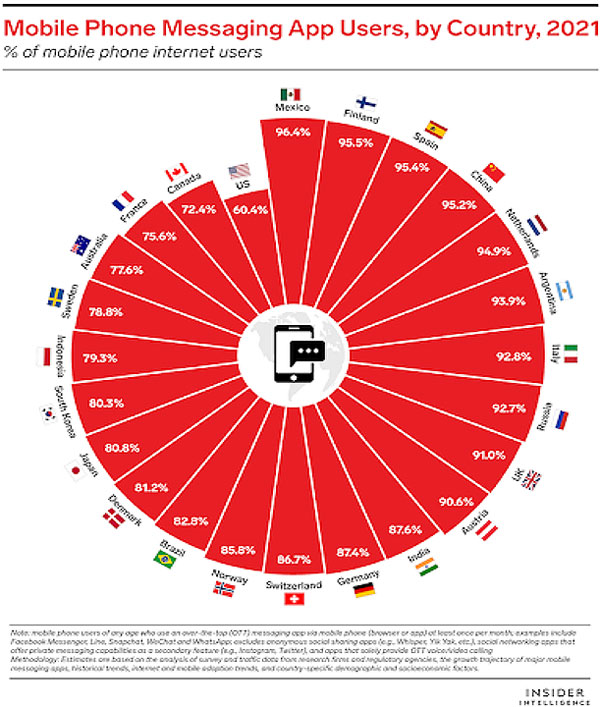
    The same report (https://www.emarketer.com/content/sizing-mobile-messaging-app-opportunity-marketers?ecid=NL1009 ) had an interesting chart showing the comparison of various countries across the world in terms of usage of mobile phone messaging apps, which I am sharing here.


    As shown in the above chart, India has 87.4% mobile phone messaging apps users presenting a good opportunity to the marketers in our country. It is not among the top ten countries which have 90% + mobile phone messaging apps users, but leads the next group of countries having 75% + mobile phone apps users. The report warns that due to the controversial privacy policy of WhatsApp, the growth of the same has been declining in most of the countries including India. Similarly, Facebook’s Messenger is also expected to decline in 2021 in many countries including India, which posted the strongest growth for Messenger in 2020. Still the overall estimates for users of messaging apps across countries are now at a far higher level than what was estimated before Covid-19 struck the world.


    We saw another report last week from App Annie which reported that India is the top market globally in terms of downloading of social apps across iOS and Google Play in the first half (H1) of 2021. As per their report, Asia is the largest region for downloads of social apps in Hi2021 having a 60% share of the global market. However, in terms of consumer spends through social apps, India is in the 17th position in a list of top 20 countries.


    So, the marketing companies in India may still not be able to utilise fruitfully the growing numbers of users of messaging apps as well as social media apps. It seems that while brand awareness can be promoted through the apps, but Indian consumers are still not ready to spend money through the apps in spite of the assurance given through the interactive apps. Still, it is undeniable that the pandemic has given a big push to the usage of both messaging and social media apps in India and has opened windows of new opportunities for digital marketing.


  • Indrani Sen: Writings on the TV Wall

    By Indrani Sen


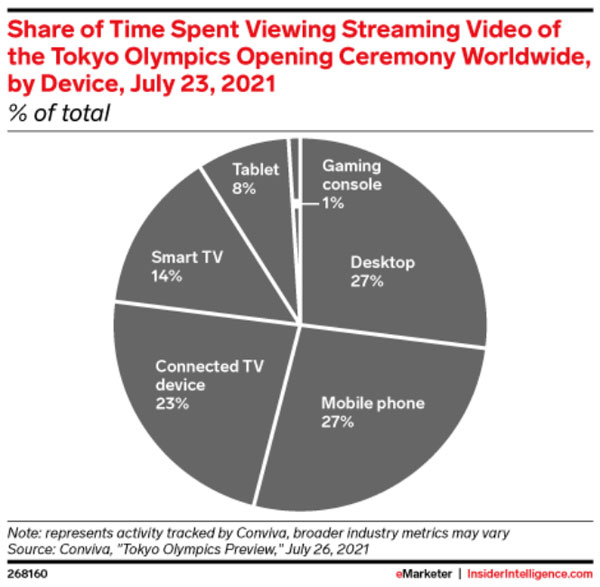
    Indrani SenSara Lebow wrote in an article published on August 16, 2021 in www.emarketer.com that around the world over 60% of the Tokyo Olympic opening ceremony streaming time occurred on non-TV devices (https://www.emarketer.com/content/olympic-opening-ceremony-streaming-time-non-tv-devices?ecid=NL1001) In fact, desktop computers and mobile phones between them captured a combined share of 54% of viewing time.


    In developed countries today, TV is largely viewed as a declining medium. It is estimated that time spent on TV will continue to decline while time spent on digital video will increase over this decade.


    www.emarketers.com has recently reported that in US, the measurement agency Nielsen has been having issues with the Media Rating Council (MRC) and may soon lose its accreditation. An MRC review found that Nielsen underestimated viewers in the crucial 18-49 age group by 2 to 6% in February 2021. During the pandemic, Nielsen took a decision to not send their technicians to Nielsen family homes which apparently has caused further damage to its reporting standard.


    There is a lot of speculations in US market that if Nielsen loses the prestigious contract of TV ratings measurement, then it may be a blessing in disguise for the TV industry. The move of ousting Nielsen may usher in alternative TV measurement methods with potential for upending the existing business models and advertising structures of network television in the US. Such a move may be able to arrest the downward trend in TV viewing and bring back lost advertisers to the medium.


    In India, our TV industry is still in a comfortable situation where it will take long time before we start viewing it as a declining medium. However, it would be good to keep a close watch over the developments in the US market and learn about the changing business structure and introduce the same marketing practices in India without waiting for the declining trends.


  • Happy days may be here again, for adspends


    Indrani Sen
    By Indrani Sen


    Two months back on June 22, 2021 I reviewed here the TYNY Midyear report for 2021 and commented: “It seems though the pandemic may not disappear from our lives in 2021, the dark shadow of the pandemic will be lifted from our advertising Industry.” Today, when two months of the second half of 2021 are almost over, it looks like Indian advertising industry is well set on the path of recovery in 2021 H2 with prediction of increased advertising spends during the festive seasons and during the forthcoming back-to-back sporting events.


    Onam ushers in the festive period in India. In Kerala, Onam sales account for more than 50 per cent of the annual sales of the businesses. Advertising during Onam festival accounts for 30-60 per cent of the total turnover of the various media houses in Kerala. This year, Onam (August 12 to August 23, 2021) has been celebrated in Kerala with cautious optimism, the run up to the festival was below the expectations as the number of Covid cases in Kerala again went up. However, going by the latest reports coming out from Kerala, it seems that both sales and advertising spends picked up with the approach of the festival and have performed better than last year.


    The next big festivals are Ganesh Charurthi in Maharashtra (September) and Durga Puja in West Bengal (October) and in both the states, the marketing and advertising industries are feeling upbeat as Indians are learning to live with Covid-19 and its variants. In spite of the predictions that the third wave of the pandemic will hit India during September and October 2021, marketers are expecting good return on advertising investments during the national festival Diwali scheduled on November 4, 2021. The GEC channels are also gearing up for the festive season with properties like Kaun Banega Crorepati (KBC) and Bigg Boss in different regional languages. Print, which saw a bonanza of full page ads with the Independence Day offers, is expecting a repeat of similar advertising with festive offers.


    The Dentsu Global Ad Spends Forecast June 2021 estimated India will be one of the top five markets in terms of advertising growth rate in 2021 which also supports the growth of advertising spends in 2021 H2.


    As per the above report in India, the ad market is “forecast to grow by a further 12.4% in 2022, recovering to pre-pandemic levels, particularly led by Digital and TV versus a longer recovery for Print, Cinema, OOH and Radio.”


    The back-to-back sporting events in 2021 H2 has raised the level of expectations for advertising spends, particularly among the sports broadcasters. It is estimated that Star Sports may earn INR 2500 crore plus between second half of IPL and T20 WC. The Olympics saw a fair number of advertisers and the advertising inventory for the India-Sri Lanka cricket series in last month was fully sold out. Industry experts estimate that the total advertising spends on various sporting properties like Olympics, India-Sri Lanka series, India-England series and UEFA Euro 2020 will contribute another INR 2000 crores taking the total advertising spends on sporting properties to INR 4500 crores on TV alone. It is expected that there will be a good advertising investment in digital media also for a total coverage of the sports fans.


    To sum up, unless another disaster like the second wave of the pandemic hits us during the next two months, the advertising industry is well set on the path of recovery in 2021 H2. The chances of an intensive attack of the pandemic during the third wave is estimated to be less as around 50% to 60% of our total population has already got COVID 19 during the first and the second waves and have developed some immunity. However, a lot depends on the success rate of the vaccination drives currently being untaken by the central as well as the state governments and we are running sadly behind many other countries with only 13% of the eligible population fully vaccinated till now (https://www.bbc.com/news/world-asia-india-56345591).


  • The Push & Pull of Print


    By Indrani Sen


    Indrani SenPrint media in India was the worst affected by the coronavirus pandemic last year. As per the FICCI EY Report on M&E industry 2021, the revenue of print shrunk by 41% from INR 206 billion in 2019 to INR 122 billion in 2020.  The report estimated that while TV will recover its 2019 level of revenue by 2022 and the combined revenue of traditional media will recover the 2019 level by 2023, it will take print at least till 2025, if not more to recover the 2019 level of revenue.


    I commented on print media in an earlier article in www.mxmindia.com “However, the industry seemed to be recovering well during the first quarter of 2021 as TAM AdEx data for Jan-Mar 21 showed that 1350 new brands advertised on print during that period.  When compared with Jan-Mar 20, the quarter also showed 9% increase in ad space mostly from Hindi and other language newspapers. Similarly, April-May 2021 recorded better results compared to April-May 2020.”


    Now, it appears from the latest TAM AdEx report that the print media has begun the first month of the July-September quarter with an upward swing. At the end of July 2021, ad space per publication on an average has grown by 35% when compared to July, 2020. Multiple educational courses, cars, hospitals/ clinics, two wheelers and real estate have topped the list of categories who advertised in print media during last month. Media planners are hopeful that the next months of August and September will see further increase in print advertising with many regional festivals, Onam, Independence Day, Raksha Bandhan and Ganesh Chaturthi dotting the calendar.  The dhamaka of 15% discount has already begun in newspapers, the tempo will surely build up further before August 15, 2021, the 75th Independence Day. This year, Onam in Kerala begins on August 12 and ends on August 23, overlapping Independence Day and Raksha Bandhan on August 22. Ganesh Chaturthi will be celebrated next month on September 10. Together these festivals will be the precursors of the main festive season of Dussehra (Durga Puja) and Diwali.


    Why print media still works in India, particularly during festivals? It is convenient to execute sales and other promotional campaigns in newspapers at short notice. The entry cost or the cost of creating static creative content for print media is less expensive than creating video creative content for TV, OTT and other digital formats. The local advertisers with comparatively small budgets rely on print media for advertising throughout the year. By definition all traditional media are push media delivering content to the users with little interactions between the media and the users. Pull media by definition is the opposite of push media where the users seek out information from media. During festive season, print media plays a dual role of both pull and push media as brands step up their advertising activity and consumers seek out information on various offers and discounts available in different stores and retail outlets. This interplay of push and pull of the print media will definitely continue for the next two or three years enabling the print media to recover its lost revenues.


    In the last month, we saw many full-page and jacket advertisements in newspapers, a trend which is likely to continue well into the main festival season. Ads placed below the mastheads as well as some other formats which were considered as innovations when first introduced by newspapers, have now become part of the regular options like half page, quarter page, etc. offered by regularly by newspapers. As per market reports the deal sizes in the print media has started going up, demand for inventory for advertising space in newspapers is also on the rise. It can be safely assumed that if the pandemic does not cause any other disturbance, print media will recover a substantial portion of their lost revenue during 2021 and will reach the 2019 level much before 2025.


  • India Shining in Ecommerce Growth


    By Indrani Sen


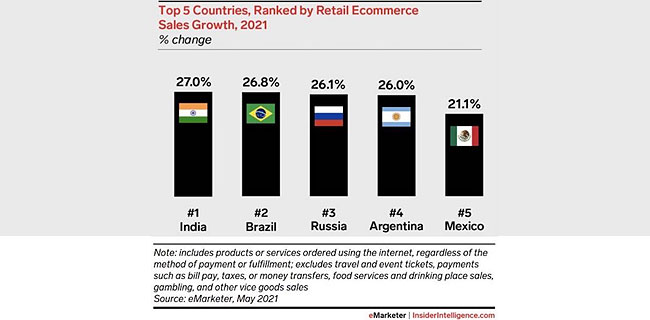
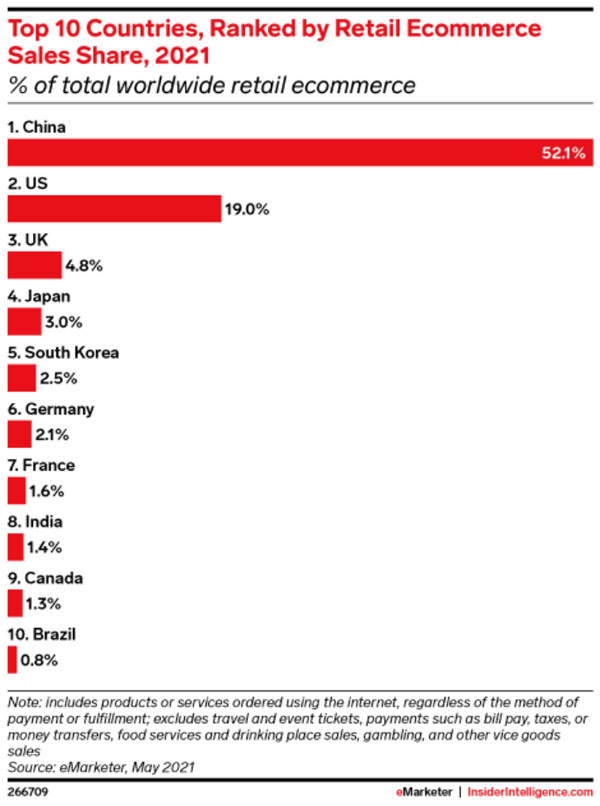
    Indrani SenA study “Global Ecommerce  Forecast 2021” conducted earlier this year, followed by articles published in www.emarketer.com recently show that India ranked eighth in the share of retail Ecommerce  sales in the world in 2020, while leading in the growth rate along with a pack of Latin American countries and Russia. The trend is estimated to continue during 2021 with China leading the pack of countries with US featuring as the poor second. India, thanks to the huge population base and the accelerating drive for a “Digital India”.


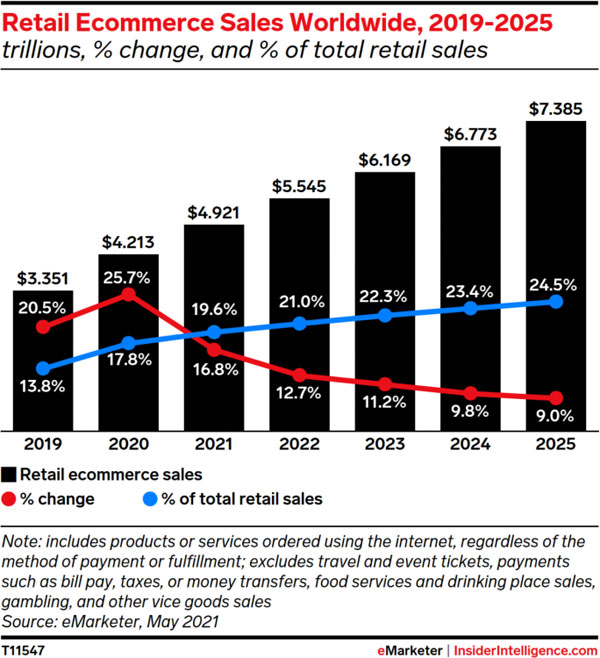
    The retail Ecommerce grew dramatically across the world at the cost of the physical stores sales in 2020 as COCID 19 raged across both developed and developing countries. In an article published on July 7, 2021 Karin Von Abrams wrote “Before the pandemic, we had forecast that total retail sales worldwide would rise by 4.4% in 2020, to $26.460 trillion. We now estimate that retail sales amounted to just $23.624 trillion last year-a decline of 2.8%. But in 2021, this figure will rebound to pre-pandemic (2019) levels, reaching $25.052 trillion.” (https://www.emarketer.com/content/global-Ecommerce -forecast-2021) 


    Another chart published in the same article reflects the worldwide growth of Ecommerce  from 2019 to 2020 and the subsequent drop in the same.


    India, however is expected to have an increase in the growth rate of Ecommerce  in the coming years and reach a size of US$ 99 billion by 2024 as also indicated in another article published on May 9, 2021 (https://www.ibef.org/industry/Ecommerce .aspx)   which lists a series of initiatives taken by the Ecommerce  industry along with Government initiatives and increasing investments as the key factors behind this surge of growth apart from growing demand and attractive opportunities. The road ahead also seems to be full of promises. The growth in this sector has been beneficial for the MSME sector in India and is expected to fuel their growth in the long run.  Along with the growth, the share of India in the world wide retail Ecommerce  is also supposed to increase propelling its rank from eighth to third after US in the coming years.


  • Identity Crisis within Social Media

    Image courtesy: https://anchordigital.com.au/


    By Indrani Sen


    Indrani SenThe discussions about the identity crisis faced by the users of social media, particularly the younger generation, started almost from the inception of social media. Lately researchers, academics and industry watchers have been talking about other identity crisises within the social media. The first crisis relates to managing one’s identity on the internet across various work related and social media related accounts/ apps and it is often said that if a person has more than a dozen of such accounts with different IDs and passwords then the person needs a ‘password manager’. A movement has ben going on for some time advocating for an unique identity per every consumer on internet which will enable them to acces all internet accounts with the same ID and password. However, this may lead to a breach of trust between consumers and their individual internet accounts as all personal information shared by them on any account can be accessed through their unique identities.


    The second crisis is the intense identity aggregation of consumers by Google and Facebook which has started pushing some internet users from the two giants to other anonymous platforms. For the purpose of marketing through their networks Google and Facebook create such aggregated buckets of identities which many consumers find unacceptable.


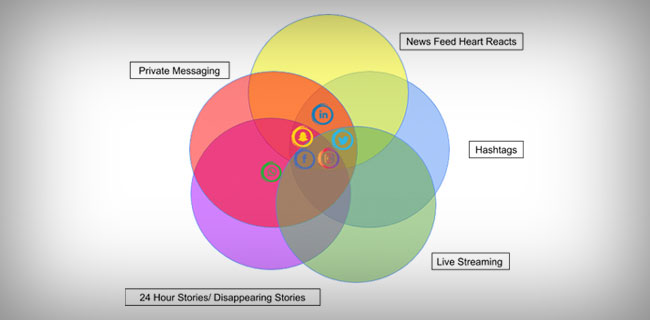
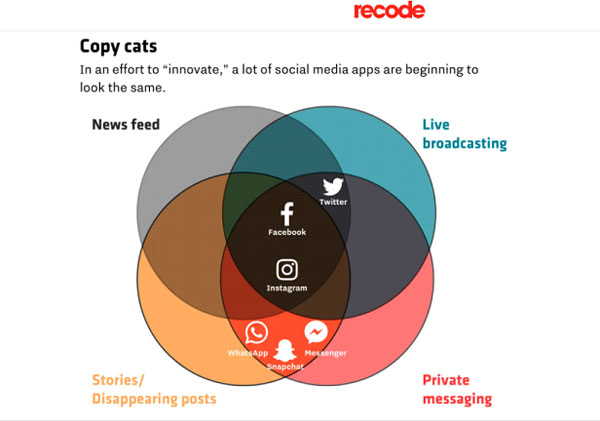
    The third and perhaps the biggest crisis is the loss of identity of different social networks / apps which has emerged during the last 5 due to the blatant copying or adopting of features of another social network. Last week I listened to an interesting podcast on www.emarketers.com talking about “…. what Facebook has become and is trying to be, what to make of social media platforms looking more and more alike, and which of these “copycat” moves might strike gold. We then talk about the significance of Nextdoor going public, how India’s social media content liability laws could impact Twitter (and others), and some changes as to what advertisers can, and can’t, do on social media.” The podcast can be accessed through the following link https://www.emarketer.com/content/podcast-facebook-and-social-media-identity-crisis-twitter-liability-retouching-ads?ecid=NL1009.


    Source: https://www.vox.com

    There is an extensive list of services/ features which have been copied since their introduction in one social media platform by others. In 2010 Instagram launched with the feature “double tap to heart react”. Instagram copied Snapchat’s stories feature first which was followed by Facebook adopting the same application from Instagram. In 2012, Facebook acquired Instagram and adopted the “heart react” feature from Instagram. In 2015, Twitter replaced it “star react” feature with “heart react”. In 2019 Linkedin introduced a set of “react” features including the “heart react”. There are many more such examples.


    In the digital age, we have seen a shift of power from organisations to consumers which has been labelled as ’transformed consumer contexts’ by Neil Perkin and Peter Abraham in their book titled Building the Agile Business Through Digital Transformation. Consumers once experiencing once a satisfactory service or a tool on a social network, expect the same capability from all other social media networks. As a result, this trend of extensively copying from each other has started in the social media sector for winning over the consumers. This trend has attracted lot of criticism as it is becoming increasingly difficult to differentiate among the social media platforms, but no immediate solution for countering this trend is in sight for reversing the identity crisis within social media.


  • Will the New I&B Minister fulfil M&E Industry’s Expectations?

    The Minister taking charge (PIB photograph)


    By Indrani Sen


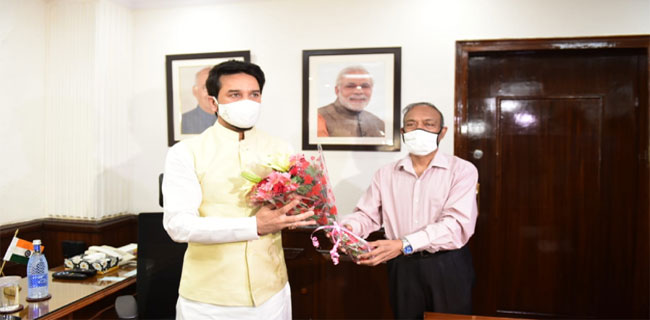
    Indrani SenLast week, in the reshuffling of the cabinet of ministers of the Central Government, Anurag Singh Thakur took over a double-barrelled charge of Sports & Youth Affairs Ministry from Kiren Rijiju and Information & Broadcast Ministry from Prakash Javadekar. He was elevated to full cabinet minister rank from minister of state rank in which capacity he has been working in the Finance and Corporate Affairs Ministry since 2019.


    Two years back, I first read about Anurag Thakur when he was appointed as a Minister of State “…’You elect Anurag with a record margin, I will make him a big leader,’ Shah had urged the voters at an election rally in Bilaspur, Hamirpur, on May 12. They did. And Shah kept his word, with Thakur being sworn in as a Union minister last Thursday.


    (https://economictimes.indiatimes.com/news/elections/lok-sabha/india/from-bcci-to-union-cabinet-anurag-thakur-enters-big league/articleshow/69585917.cms?from=mdr). Thakur first got elected to Lok Sabha from Hamirpur through a bypoll in 2008 and then won the same seat three times in 2009, 2014 and 2019.


    Amit Shah has continued to honour his promise as in two years Thakur has not only got elevated to the rank of a full cabinet minister, but has also been entrusted with the charges of two key ministries considering the importance of young voters in India and the dynamically changing media scenario in the digital age. It is expected that Thakur will be able to resolve the issues faced by both the M&E Industry and the sports industry given his record as a parliamentarian from 2008, former Chairman of the IT Committee and President, BCCI.


    Last week, various leaders from M&E industry welcomed Thakur as the newly appointed I&B minister and expressed their hopes that he would be looking into various concerns and demands of the various sectors and would provide a level-playing field for TV broadcasters, publishers on print & digital platforms, radio operators, cinema producers, etc. The various issues which are on the cards currently can be divided into two categories, one related to the content of the media and the other related to all non-content issues. Let us first look at the issues in the first category related to the content of media.


    Starting June 18, the Centre has sought public comments on the draft bill of the proposed Cinematograph Amendment Bill (2021) which includes fine and a jail term for film piracy, introduces certification on the basis of age and empower the Central government to order recertification of an already certified film following receipt of complaints. Centre had sought public comments on the draft bill starting June 18, 2021. Six film trade associations have already sent a joint representation to I&B Ministry objecting to the revisionary power sought to be provided to the Centre. Well-known filmmaker Shyam Benegal has also opposed this bill, saying that the government has no role in film certification and recertification. As this proposed amendment enhancing the role of the Central Government in deciding on the content of the films seems to be part of a bigger gameplan of the Central Government to choke the voice of Indian media, it is doubtful if Thakur in his new role will be prepared to listen to the voice of the industry.


    The timely adoption of the new IT rules by OTT and digital news channels also belongs to the content category and the bigger game plan mentioned above. Under this rule digital media publishers, publishers of digital news linked to traditional media, and over-the-top (OTT) media service platforms to furnish basic information about themselves and their self-regulatory mechanisms creating a role for a government appointed regulator for overruling the decisions of self-regulatory bodies. As I wrote earlier on this topic (https://www.mxmindia.com/2021/06/will-indian-netizens-lose-their-digital-rights/), so will not elaborate on it again. Subsequently, many publications moved court against the IT rules 2021. The Supreme Court has turned down a transfer petition filed by the Centre seeking transfer of all cases related to IT Rules to the apex court. Thakur will be expected to handle the legal cases and resolve the issue to the satisfaction of the Central Government.


    About two weeks back, the Central government introduced a three-tier grievance redressal mechanism as an amendment to the Cable Television Network (Regulation) Act with the intention of making the content related grievance redressal system for TV Broadcasters at per with the OTT and digital news platforms. The TV industry requires more clarity on this issue and its implementation.


    Among the pending issues pending for some time in the non-content category, the following require immediate attention from the new I&B minister:

    :: Certain long-standing demands of broadcasting sector related to their demand for an infrastructure status, liberalised licensing regime and a stable regulatory climate. The proposal of IBF seeking stimulus package based on economic relief and flexibility in the regulatory system.


    :: Addressing broadcasters’ concern about 5G system disrupting their transmission. Almost all C-Band satellites use spectrums between 3.7 GHz and 4.2 GHz for their downlinks and band of frequencies between 3.7 GHz and 4.9 GHz are used by most television channels for their operations which are adjacent to the band of frequencies identified for 5G usages in the country in the range of 3.00 GHz to 3.6 GHz.


    :: To come up with a solution for audience measurement of TV channels by either introducing reforms in the current system of BARC or by setting up an alternative TV measurement system. In November, 2020 I&B Ministry formed a committee headed by Prasar Bharati CEO Shashi Shekhar Vampati to examine the matter and to give a recommendation. The Vampati Committee submitted its report to the I&B Ministry in January, 2021, but the content of the report was not shared with public at large. The recommendations may also provide some guidelines for resuming the ratings of the news channels which have been suspended by BARC.


    The M&E industry at large and the TV broadcasters in particular are hoping that Thakur will address their immediate concerns impartially and will take positive steps towards making constructive changes in the media ecosystem. Industry watchers like me are keeping our fingers crossed as only time will prove the efficiency and effectivity of our new I&B Minister.


  • Indrani Sen: End of the Dark Days: 2021 Midyear Adspends Forecast by GroupM

    Indrani SenBy Indrani Sen


    A week back, GroupM released their Midyear Report on This Year Next Year (TYNY) for 2021, predicting that in 2021 Indian Advertising Industry will not only overcome the degrowth of last year, but also will record almost 2% additional growth.  The Midyear TYNY predicts that India Inc’s investment on advertising will grow by 23.2% during 2021 calendar year and will touch 89,123 crores at the end of the year. The growth in advertising expenditure will come from FMCG, e-Commerce, Auto, Retail, Telecom and Durables categories.


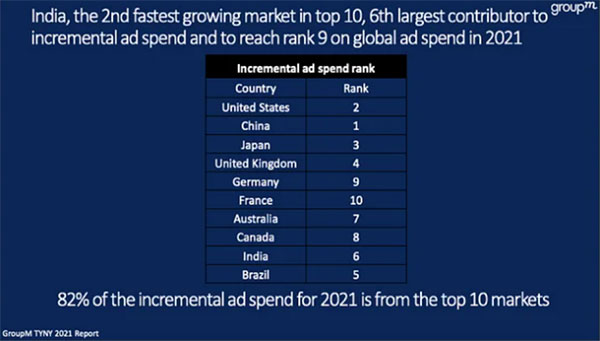
    India’s rank in the Top 10 fastest growing advertising markets globally had gone down one notch in 2020 to number 10 from number 9 in 2019. It is expected that as the 2nd fastest growing market among the top 10 countries, India will regain the 9th rank in 2021. GroupM predicts 82% of the global advertising spends will come from top 10 markets in 2021 and India will be the 6th largest contributor to incremental ad spends among the top ten markets as shown in the chart below:


    Source: GroupM TYNY 2021 Midyear Report


    In 2021, Indian advertising expenditure is estimated to grow at a rate (23.2%) which is more than double of the expected growth rate (10%) of global advertising expenditure. India will be in the same bracket with UK, China and Brazil where advertising expenditures are also expected to grow by 20% plus. The Midyear forecast for global advertising expenditure is 19% higher than their forecast made by GroupM for 2021 in December, 2020. As per the Midyear Report globally, digital advertising expenditure is expected to grow by 26% as against 15% and TV is expected to grow by 9.3% as against 7.8% predicted in TYNY last December. GroupM has cited the following factors as the catalysts of the higher growth rates: (1) faster than expected expansions of app ecosystems; (2) rapid small business formation activities and (3) the growing role of cross-border media marketplaces.


    Focussing back to India, of the estimated total advertising expenditure of 15,000 crores of incremental spends in 2021, 40% will be contributed by digital and the share of digital in the total advertising expenditure will be 35%. TV will account for around 45% share and the non- TV and Digital media will have a share of 20%.


    The website www.businessworld.in has shared an article on June 21, 2021 which says “With states easing lockdown curbs due to declining number of COVID-19 cases, there are immediate indications of improvement in economic activity as companies are hopeful of better performance in the next 6 to 12 months, according to a survey.” The TYNY Midyear report for 2021 is highly encouraging with an assurance of better days for the Indian Advertising Industry. It seems though the pandemic may not disappear from our lives in 2021, the dark shadow of the pandemic will be lifted from our advertising Industry.


  • Newspaper Industry in India after the Second Wave of the Pandemic


    By Indrani Sen


    Indrani SenThe Indian newspaper industry faced an unprecedented crisis last year after the National Lockdown was declared at a very short notice. Circulation fell drastically when many subscribers, particularly housing societies, shut their doors for the newspaper delivery persons for the fear of the contagious virus being carried by the newspapers or the delivery folk, leading to change is consumption pattern of newspapers. Lack of local transport also prevented the distributors and hawkers from reporting for work. This was followed by withdrawal of commercial advertising as advertisers were worried about a fall in circulation and readership and were themselves affected by choking of distribution pipelines and economic slowdown leading to loss in their sales. The FICCI EY Report on Indian M&E industry 2021 showed that ad revenue of Print came down from INR 206 billion in 2019 to INR 122 billion in 2020.


    After the National Lockdown was lifted in 2020, the newspaper industry tried its best to recover their lost grounds. As per the same FICCI EY report, it will take Print four to five years to regain the pre-Covid ad revenues level. However, the industry seemed to be recovering well during the first quarter of 2021 as TAM AdEx data for Jan-Mar 21 showed that 1350 new brands advertised on print during that period.  When compared with Jan-Mar 20, the quarter also showed 9% increase in ad space mostly from Hindi and other language newspapers. Similarly, April-May 2021 recorded better results compared to April-May 2020.


    As per TAM AdEx analysis in May 2021, when the second wave of the Covid-19 was at his peak, there was an average 58% growth in ad space per publication as compared to May 2020. However, all was not well as compared to February 2021 and March 2021, the ad space in Print saw a drop of 42% and 29% in April 2021 and May 2021 respectively. As the phased process of unlocking has begun, the newspaper publishers expect that both the ad volume and value would pick up by August 2021 and grow further during the festive season of 2021.


    It appears that newspapers were better prepared to handle the second wave of the pandemic in 2021 and the lockdowns imposed by various state governments across the country. Along with the process of gradual unlocking, the newspapers now are looking forward to recovering their lost grounds. The credibility of the printed word, the vaccination drive, revival of the corporate sector and good rain forecasts are the other factors which are expected to contribute to the overall growth of the newspaper industry in 2021. The Print industry has appealed to the government for a stimulus package and an increase in FDI in 2021. The government has not responded so far, but the industry is still hopeful of getting, some positive response though no relief was announced in terms of waiving the import duties on newsprint by the finance minister in her 2021 Union Budget.


    The newsprint prices, which saw a decline in the international market (below $300/metric tonne) in 2020, have started going up from the beginning of the calendar year 2021. The price was $670/tonne-$700/ tonne in April-May. The industry expects it to go up further. It appears that quite a few paper mills which used to export newsprint to India and other countries, either shut down their business or migrated to the businesses of producing brown papers and craft papers during last year when their business was hit due to the global pandemic.


    As India is far from being self-reliant in newsprint production, our newspaper industry, struggling to recover from the effects of the pandemic, has been hit further by this demand supply imbalance of newsprints in the international market. Many newspapers are increasing the use of indigenous newsprints to balance out their cost of productions.  However, most newspaper owners feel that this crisis of newsprint prices is not going to last for a long term and expect the international market to stabilise before our festive season in the third quarter of 2021.


    To sum up, the newspaper industry in India seems to be set on the path of recovery after a severe decline of both circulation revenue and advertising revenue in 2020. In recent times, during the second wave of the pandemic, the industry was not much affected and would have been in a better financial position if they were not hit by the crisis of newsprint prices. It is expected that by end of the calendar year 2021, their overall performance may be better than predicted earlier by media analysts.

  • Will Indian netizens lose their digital rights?


    By Indrani Sen


    Indrani SenOn February 25, 2021, the Electronics and Information Technology ministry notified the Information Technology (Intermediary Guidelines and Digital Media Ethics Code) Rules, 2021 for news publishers and OTT platforms giving a three-month deadline to websites to comply with the same.


    The Government introduced the new rules aiming to “establish a soft touch progressive institutional mechanism” for adherence to Digital Media Ethics Code by the news publishers and OTT platforms “featuring a Code of Ethics and a three-tier grievance redressal framework”. The new rules are applicable to all digital news publishers, social media platforms like Facebook, WhatsApp, Twitter and all OTT platforms like Disney Hotstar, Netflix, Amazon Prime, Zee Live, etc.


    The time limit of three months expired on May 25, 2021. Subsequently, on May 26 the Digital Division of the I&B Ministry has extended the deadline for OTT platforms by 15 days till June 10, 2021 through a public notice. The public notice has three different formats for furnishing information designed for three types of publishers:

    1. Digital news publishers who also publish/ telecast news through traditional media
    (newspaper/ TV)
    2. Other digital news publishers
    3. Publishers of online curated contents (OTT platforms)


    There is not much difference between the three types of forms except that for the first category under “Entity Information” the digital news publishers are only required to furnish the RNI registration number or details of TV channels licensed by the I&B Ministry under Uplinking and Downlinking rules. Where as the publishers of the other two categories have to provide various other details about their entity. In all the three formats, the publishers have to provide details of their membership of Self-Regulatory bodies in the industry.


    The first two categories of publishers are required to give details of their News Editor while the OTT platforms have to give details of their Content Manager. All three have to furnish the details of their Grievance Redressal Officer (GRO) in India.


    In the meantime, both News Broadcasters Association (NBA) and News Broadcasters Federation (NBF) have requested the I&B Ministry that traditional news broadcasters also publishing digital news should be excluded from coming under the purview of the new IT Rules. With only three days left before the new deadline on June 10, 2021 the Ministry has not yet replied / given a clarification to MBA and NBF. A reminder has issued a reminder on June1, 2021 asking all publishers on the digital media to furnish the required information to the Ministry.


    Over the last three months we have seen lot of debates in various media websites on if live news will continue on the OTT platforms and what will be the implications if OTT platforms stop live news. There has been hardly any discussion on mainline media on the implications of the proposed Information Technology (Intermediary Guidelines and Digital Media Ethics Code) Rules. If we deep dive into the three-tier structure for grievance redressal or for observance and adherence to the Digital Code of Ethics, then we find that the Level I comprise Self- regulation by the specific entity and Level II comprise of Self-regulation by the self-regulating bodies of which the specific entity is a member of. It is Level III which becomes an area of concern where Oversight mechanism by Central Government will be acting over and above the Self-regulatory bodies with power to censor and even block the contents.


    The Wire published an excellent analysis of the proposed IT rules on February 27, 2021, day after the new IT Rules were announced and commented on the three-ties system “All of this is being planned to be done without any legislative backing or a clear law made by parliament.” (https://thewire.in/tech/explainer-how-the-new-it-rules-take-away-our-digital-rights). On the same day https://scroll.in also published a detail analysis of the new It rules explaining why the same is anti-democratic and unconstitutional
    (https://scroll.in/article/988105/explainer-how-indias-new-digital-media-rules-are-anti-
    democratic-and-unconstitutional).


    Under the disguise of introducing a soft touch progressive institutional mechanism, the Central Government is about to introduce an autocratic digital censorship and rob all Indian netizens of their digital freedom as well as of expressing their own views on social media platforms. And this move is being executed when the country is still struggling with the second wave of Covid-19, when digital media is acting like a lifeline for many Covid patients, Covid volunteers and frontline medical practitioners all across the country.


    Indrani Sen is a veteran advertising professional and academic. She writes on MxMIndia on Mondays. Her views here are personal

  • Adspending globally degrows only 1.2% in 2020!


    By Indrani Sen


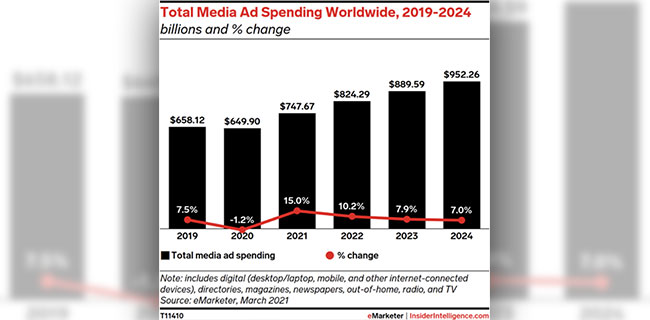
    Indrani SenLast week, I read an article “How the pandemic changed worldwide ad spending” by Etham Cramer-Flood on emarketer.com. The article compared the forecasts made by them with the revised estimates and spoke about their predictions for 2021. The reason I would like to share the highlights of that article here is due to the optimistic attitude reflected in their calculations. They pointed out that according to their analysis, the final figures for 2020 “outperformed dire mid-pandemic projections.” According to this article, the global adspending has a degrowth of only 1.2% in 2020 which is the lowest among all the various estimates seen till now. (https://www.emarketer.com/content/how-pandemic-changed-worldwide-ad-spending?ecid=NL1001)


    As shown in the above chart, after a contraction of 1.2% in 2020, the global ad pending is predicted to grow by 15.0% in 2021. Even traditional adspending will grow this year, by 7.6%.  The growth rate will come down to 10.2% in 2022 and subsequently over next two years will fall down to 7% in 2024 compared to 7.5% growth rate of 2019. By the end of 2024, ad spending worldwide is expected to be close to $1 trillion.


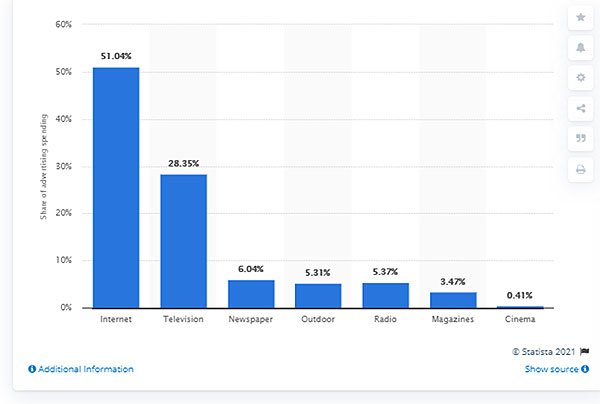
    All the various estimates on global advertising spending released so far agree that while the ad spending on traditional media suffered a huge degrowth, the overall situation was saved by growth of adspending on digital media with the share of digital advertising varying from one research to another. Traditional media were already in slow declining mode across various countries in the pre-pandemic years. The pandemic aggravated their degrowth. As the article does not have a chart showing the share of different medium in worldwide advertising spend. I have sourced one chart from www.statista.com with the medium-wise distribution of global advertising spend in 2020 which is shown below:


    Distribution of advertising spending worldwide in 2020 by medium

    Source: https://www.statista.com/statistics/376260/global-ad-spend-distribution-by-medium/


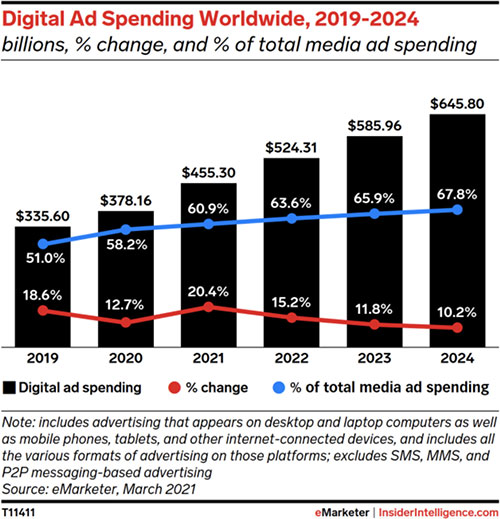
    The www.statista.com has estimated that in 2020, the shsre of digital advertising in the worldwide advertising has touched 51.%. The balance 49% is distributed among the traditional media with TV leading the pack with 28% share followed by newspapers 6%, outdoor 5%, radio 5%, magazines 4% and cineam 0.4%. The analysis of www.emarketer.com agrees that globally the share of digital advertising spend may touch 60% by end of 2021 and 70% by 2025.


    The pandemic has surely accelerated the growth of digital media across the world in the middle of major economic disruptions.  We have also been surprised by the kind of resilient growth of digital advertising in India showed in 2020. However, it will take at least this decade before the share of digital advertising in India can have the highest share in the Indian advertising pie.