 By Indrani Sen
On April 15, 2021, Broadcast Audience Research Council released the “TV Universe Estimate 2020” indicating that “TV UE 2020 has been developed by computing the Linear growth of TV Households and TV Individuals from Broadcast India (BI) Studies conducted in 2016 and 2018 at geographic and demographic levels. The distribution of the TV population by NCCS was taken from the most recent Indian Readership Survey (IRS).” The field work could not be conducted in 2020 due to the pandemic and BARC had a plan to conduct a large-scale establishment survey as a part of Broadcast India (BI) 2021. However, the current second wave of the pandemic raging all over the country will cause a delay in the implementation of that plan.
As per TV UE 2020, out of an estimated 300 million households in India, 210 million are TV owning households, of which 91 million (43%) are in urban areas and 119 million (57%) are in rural area. From 2018 to 2020, the number of total households owning TV has grown from 197 million to 210 million (by 6.6%); urban households owning TV has grown from 87.8 million to 91 million (by 4%) where as the number of rural households owning TV has grown from 108.9 million to 119.2 million (by 9%). Over the last 10 days TV industry has been celebrating the increase in TV penetration during the COVID infected period which accelerated the growth of digital media in India.
Against the national average of 6.6% growth, the growth in the number of TV owning households in the HSM area has been 8%. As far the distribution platforms are concerned, share of DD Free Dish has grown from 13% (2018) to 19% (2020) which has largely driven the higher growth of TV households in the HSM area. South India, with higher TV penetration than rest of the country, has shown 5% growth which is less than the national average.
While it is quite acceptable that the total number of households has increased from 248 million in 2011 to 300 million in 2020, the question arises how much scope is there for TV penetration to grow in urban area? As per the 2011 Census, there was 248 million households in India with an urban: rural share of 31%: 69%. 91 million, the number of TV owning households in urban area in 2020 accounts for 30.3 % of 300 million, the total estimated households in India and 98% of urban households (31% of 300 million= 93 million) leaving very little scope for further growth of TV penetration.
Here, we need to ask, going by the three-tier definition of urban as used by Census, what will be the urban-rural split of households in 2021 Census? Should we reconsider the definition of urban introduced in 1951? In reality, what percentage of our population lives now in villages and what percentage lives in towns?
An article by Ajay Sreevatsan in the www.livemint.com which was updated on September 16, 2017, analysed the possible reasons why actual share of urban areas should be higher than the official Census statistics. The chart given below has been taken from that article, which after arguing strongly in favour of higher rate of urbanisation, concluded with “…how much of India is urban, and how much of it is rural is as much a question of politics as it is of economics.” (https://www.livemint.com/Politics/4UjtdRPRikhpo8vAE0V4hK/How-much-of-India-is-actually-urban.html).
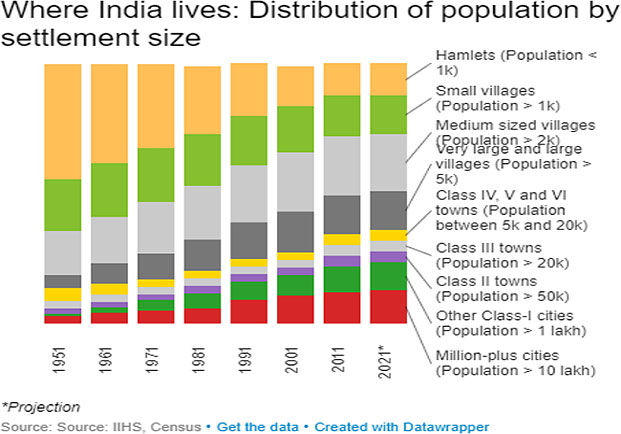
Source: www.livemint.com
Recent government policy documents have argued that the share of urban households could be 37%-38% depending on the infrastructure developments and other parameters. Even if we make a moderate estimate that the urban: rural split will be 35%: 65% in the 2021 Census, we will still have 105 million urban households out of estimated 300 million total households, leaving a 14 million headroom for growth in TV penetration. However, TV industry needs to recognise that TV penetration in urban India is close to saturation point in the higher NCCS categories and need to make their future plans accordingly.