By Indrani Sen
 Over the last two weeks, we have seen various news reports about Prasar Bharati’s new, yet-to-be-proposed policy for Free Dish slot auction among private broadcasters.  A report in www.economictimes.indiatimes.com highlighted a reminder letter sent by the Ministry of Information & Broadcasting (MIB) to Prasar Bharati on the subject of reviewing and recasting of their policy for auctioning of free slots on DD Free Dish TV platform to private broadcasters in (https://economictimes.indiatimes.com/news/politics-and-nation/dont-subsidise-private-channels-review-free-dish-policy-ib-ministry-to-prasar-bharati/articleshow/63707567.cms ). The same report was carried by other websites and newspapers.
According to the above report, the ministry officials said that from August 2017, PrasarBharati has not responded to any of the six reminders sent by the Ministry on the subject. The article quoted from the ministry’s letter “Recognising the limitation of the present arrangement it was suggested that these co-branded channels could be operated on a revenue share basis, this will ensure DD brand is not diluted and DD has a continuing stake in revenue growth…..This limitation should have been identified when the Free-Dish was thrown open to private channels.” In this connection, we can recall some interesting numbers. PrasarBharati earned Rs 85.10 crore from the auctioning of 11 slots on DD Free Dish in July 2017. Prasar Bharati’s earnings from a single auction saw a phenomenal rise from Rs. 25 lakhs in its first auction to GEC channels in 2005 to Rs 85.10 crore in its last auction in 2017. Obviously, when the system of auctioning was introduced, neither the Ministry nor PrasarBharati had visualised the potential of The DD Free Dish platform.
According tohttps://www.livemint.com/Politics/L1SzhVVx4ik3EO63ytq4WL/IB-ministry-suspends-auction-of-slots-on-DD-Free-Dish-to-r.html, Doordarshan earned more than 30% of its revenue from Free Dish at Rs 264.17 crore for the year 2016-17. It was the highest-ever revenue earned from the DD Free Dish platform. Overall, the broadcaster earned Rs 827.51 crore in the year 2016-17, surpassing its annual target of Rs 800 crore.
Prasar Bharati cancelled the auction of slots on DD Free Dish scheduled in August 2017 citing administrative reasons. Subsequently we learned that I&B Ministry had asked the broadcaster to suspend e-auctioning of slots on DD Free Dish until further notice. TDSAT (Telecom Disputes Settlement and Arbitration Tribunal) had advised Prasar Bharati vide their order dated October 27, 2017 to carry out a comprehensive review of the policy of DD Free Dish. Meantime, private broadcasters whose contract expired were allowed to broadcast on DD Free Dish on a pro rata basis as per TDSAT order.
We learnt recently that Prasar Bharati has told TDSAT that it will come out with a new policy for its free direct to home (DTH) DD Free Dish in a few weeks.“Following Prasar Bharati’s submission, the tribunal has posted the matter under the same head on 28 May†(http://www.televisionpost.com/prasar-bharati-to-come-out-with-new-policy-on-dd-free-dish-in-a-few-weeks/). The Prasar Bharati Board has appointed a Task Force for coming up with the new policy. Now the question is on what basis this new policy will be framed.
An article on TOI, Pune on Saturday, April 21, 2018 quoted sources who said: “the government is keen to push a revenue sharing model, where private channels are asked to bid for DD Free Dish slots and also share a portion of their revenue with the public broadcaster.†We got a hint of this from Shashi ShekharVempati, CEO, Prasar Bharati who commented in the FICCI EY Report 2018 under Looking Beyond for Prasar Bharati:“Public broadcasters to move away from only government funded to self-sustained models, which mean: Platforms must be based on revenue sharing models …â€
Currently, Prasar Bharati does not have any clue regarding the number of subscribers accessing DD Free Dish across the country, let alone their distribution by states/ urban and rural, etc. The number of subscribers quoted by the Ministry as well as TRAI is based on market estimates by private organisations. As per TRAI, there were 66.99 million active pay DTH subscribers in 2017 apart from the subscribers to DD Free Dish which was estimated to be 22 million. The private TV channels are available through the paid Dish TVs and cable operators and the TRPs earned by them come from a combination of all the distribution platforms. Naturally the advertising revenue earned by the TV channels is also based on the availability of the channels through all the distribution platforms.
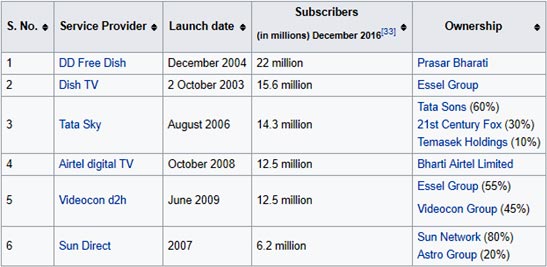
Source: http://www.trai.gov.in/sites/default/files/PIR_July_Sept_28122017.pdf
In the current system of distribution, the TV channels pay a carriage fees/ placement cost to the DTH distributors/ cable operators based on how many subscribers they have. The DTH distributors/ cable operators also share a percentage of their subscription fees with the TV channels. The range of the carriage fees as well as the subscription fees varies widely based on the number of subscribers, the popularity of the TV channels as well as individual negotiations between the two parties.
The TV channels agreed to pay for slots on DD Free Dish in lieu of carriage fees/ placement cost. Prasar Bharati had kept a reserve price of Rs 8 crore for non-news channels and Rs 6 crore for news channels. Several channels left the platform over last couple of years as they found the reserve price to be too high. A new model based on revenue sharing over and above the auction fees may turn away the private broadcasters from DD Free Dish when there is no scope of earning from subscription fees.
Such a move may not be beneficial to Prasar Bharati as the FTA TV channels may choose to opt out from the platform of DD Free Dish. The rural TV viewers will be deprived of quality content and penetration of TV in rural areas may slow down. There is an untapped rural market across the country and our Government increased the FDI in the DTH sector from 49% to 74% in 2013 and to 100% in 2015. Therefore, it will not be surprising if we see the entry of private Free DTH players in the strong regional markets in near future. There is a high chance that if a new policy for allocating slots on DD Fee Dish based on revenue sharing is launched, it may boomerang and hamper the growth of the distribution platform.