Tag: Google+

  • Day3 Goafest 2019: Mary Kom, CSR and social sector rule conversation

    By Rahul Chandawarkar


    Corporate Social Responsibility (CSR) and the social sector was the common thread that bound most presentations together on the final day of the third day of Goafest which concluded at the Grand Hyatt hotel in Bambolim, Goa on Saturday, April 13.


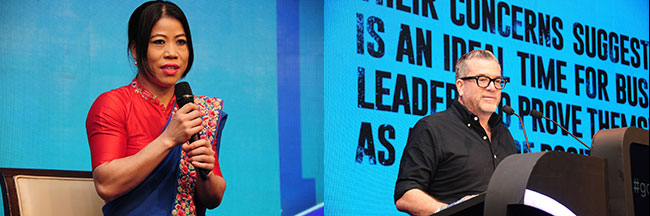
    Matt Eastwood, global chief creative officer, McCann Health who spoke in the National Geographic knowledge seminar in the afternoon said that while the world was going through tough times, it was also a time for advertising professionals across the world to be agents of positive change.


    Day3@Goafest2019: Key Takeaways

    :: Increased involvement by corporates in CSR projects had given rise to the concept of ‘return on doing good’ (RODG).

    :: Hi-end technology platforms like Artificial Intelligence (AI) were helping creativity reach new heights.

    :: The United Nations were keen that 50 per cent of its sustainability development goals (SDG) should emerge out of India.

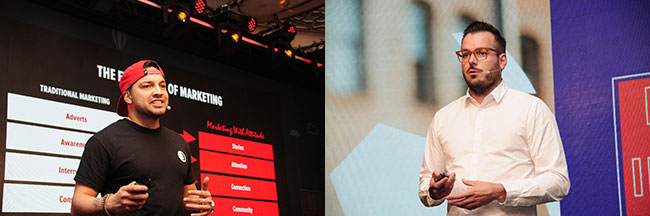
    :: One of the speakers redefined the four Ps of marketing as purpose, people, passion and physical.


    Rahul Chandawarkar, a former newspaper editor, is a communications strategist and active triathlete based in Goa. He has been covering the Goafest for mxmindia.com since 2017. 

    Eastwood said that in a competitive world, business enterprises had realised that if they made a positive impact on society though the corporate social responsibility route, their brands stood to gain. Eastwood went on explain how increased involvement by corporates in CSR projects had given rise to the concept of ‘return on doing good’ (RODG).


    Citing an India example, Eastwood explained how the Kwality Dairy milk company had chosen to address the problem of Vitamin D deficiency among Indian school children through a very innovative CSR project.


    Kwality Dairy had managed to convince 50 schools in the Delhi region to shift their open-air assembly timings to 1130am, so that children could be exposed to peak sunlight for at least 20 minutes of the day. Several hundred more schools had shown interest in implementing this idea. According to Eastwood, this innovative initiative on the part of Kwality Dairy would directly benefit the brand, as the brand would have top-of-the-mind recall when parents made a decision to buy milk for their children.


    Among the several, international CSR examples that Eastwood shared with the audience, was the one initiated by Microsoft where, they created an information technology supported game which enabled physically disabled children to play video games. According to Eastwood, this ‘let everybody play’ philosophy of Microsoft would positively impact the brand.


    Earlier in the day, Ross Jauncey, Head of Create at Google spoke along similar lines in the Google keynote address and said: “The best time for creativity was now.”


    Jauncey was of the opinion that hi-end technology platforms like Artificial Intelligence (AI) were helping creativity reach new heights. Demonstrating this through a video clip, Jauncey showed how the recently launched Kupu app was helping people shoot photos on their android phone and learn the aboriginal, Maori language in New Zealand.


    Similarly, Jauncey pointed out to a Nike advertisement campaign on multiple digital platforms which supported the anti-racism movement by featuring several sporting champions across the various continents of the world.


    Society and the social sector once again resonated in the joint presentation made by Navi Radjou and Jaideep Prabhu, co-authors of the popular books, Jugaad and Frugal Innovation. Radjou and Prabhu who spoke in the Lokmat Knowledge Seminar maintained that while the spirit of ‘jugaad’ or innovative business practices was ingrained in the Indian business person’s psyche, the concept of doing business with less had spread across the globe.


    Citing some examples, the authors said that a major consumer clothing brand like Levis had recently launched their ‘wasteless jeans’ created from plastic waste. The company had also promoted their ‘go water-less’ campaign where they recommended that their jeans did not have to washed regularly and that you could even shower in your jeans, the next time you want them washed to drive home the recycle-reuse mantra.


    Turning their attention to India, the authors said that the United Nations were keen that 50 per cent of its sustainability development goals (SDG) should emerge out of India. The authors were confident that this was completely possible as they discussed chapters from their latest book, ‘Do better with less!” which showcased many an example of Indian innovative entrepreneurship (jugaad) across India.


    Later in the early evening, Phil Kemish, co-founder of Disrupt Marketing speaking at the MTV knowledge seminar redefined the four Ps of marketing as purpose, people, passion and physical.


    Exemplifying some of these Ps, Kemish stated how UK’s new chocolate brand, Tony’s Chocolonely had launched their product by pointing out that they were against all cocoa farms in Africa which employed children. Kemish pointed out that the brand had mentioned their values and beliefs on their wrappers and had launched their product solely on the basis of word of mouth publicity.


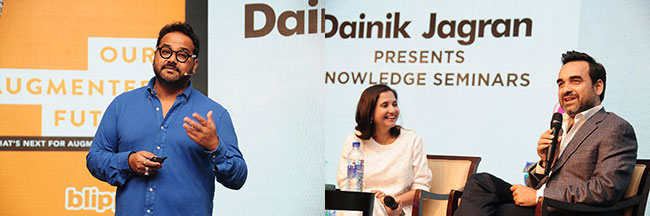
    Finally, Ambarish Mitra, co-founder of Blippar who spoke at the Jagran Knowledge Seminar had the audience in awe as he introduced them to the relatively new, hi-tech concept of augmented reality (AR). Mitra did this by virtually creating a retail store on stage complete with garments etc which he could literally sift through. According to Mitra, AR and visual reality (VR) were the fourth and latest stages in the evolution of computing interface.


    The final day also stood out with India’s boxing icon, Mary Kom surprising everyone by giving a near-professional rendition of the popular, Alanis Morissete song, “What’s going on!”. Likewise, Bollywood singer Mohammed Irfan and actor Pankaj Tripathi entertained everyone with their songs and anecdotes respectively.
     

  • Google and Facebook to make $176bn from advertising, pushing share of internet marketing to over 60%: WARC

    By A Correspondent


    WARC, the international marketing intelligence service, has found that of the $590.4bn spent on advertising worldwide last year, $144.6bn (24.5%) went to the Google and Facebook ‘duopoly’, which equates to almost one in four dollars. The duopoly’s adspend share is up from 20.3% in 2017 and is more than double the 10.8% recorded in 2014. WARC predicts a further increase to 28.6% ($176.4bn) this year.


    Looking only at the internet advertising market, the duopoly took over half (56.4%) of ad money in 2018, a share which WARC expects to rise to 61.4% this year. This growth, notes the report, is squeezing other online media owners, as the pool of ad money available to them is now in decline for the first time, down 0.7% to $111.0bn.


    Said James McDonald, Data Editor, WARC, and author of the research: “One of the main reasons for the duopoly’s success is their creation, and subsequent ownership, of the digital formats perceived to be most effective by adland’s decision makers: paid search and social. Several surveys in the past year have shown search and social to be highly regarded by advertisers in terms of meeting campaign objectives. Google dominates the search engine market, handling almost all mobile searches worldwide and nine in ten on desktops. Meanwhile, ad buyers can target Facebook’s 1.48bn daily users by leveraging a rich cache of personal data. Beyond major brands, the accessibility of the duopoly’s ad buying tools has attracted a long tail of small- and micro-advertisers, creating a competitive advantage which has been core to revenue growth.”

    Against this backdrop, WARC’s research on the duopoly highlights three key trends:

    Google and Facebook are directly competing for video dominance: The value of the online video market across WARC’s 12 key markets – Australia, Brazil, Canada, China, France, Germany, India, Italy, Japan, Russia, UK, US – is $30.2bn, which equates to 21.5% of linear TV, and is growing rapidly. Much of this money is spent on social media sites, including Facebook and YouTube (e.g. 86%, or £1.9bn in the UK).

    Both Google and Facebook hope to unlock brand budgets while also controlling the trade of targeted performance advertising. Regulation appears to be the principle threat to the duopoly’s growth, which currently shows no sign of a significant slowdown.


    Google is battling Amazon on two fronts to defend its search market dominance: Google handles 63,000 search queries per second – or two trillion in an average year – but its dominance of the paid search market may soon come under threat from Amazon. The e-commerce giant is developing its own search business, looking to pair advertisers with consumers close to the point of purchase.

    Whilst WARC expects Amazon to make $13.9bn from advertising this year (compared to Google’s $107.4bn), its ad business is growing much faster than Google’s, with 69% of marketers in a recent WARC survey stating that they intend to up their ad investment on Amazon this year.

    Amazon, which has a rich database of consumer purchasing habits, has also stolen a march on Google in the emerging area of voice search. Its Echo devices are used by 63% of American smart speaker owners, well ahead of Google’s Home devices on 26%.


    Younger Americans are leaving Facebook’s core platform for Instagram: Instagram is now the main driver of daily user growth for Facebook, with estimates suggesting that as many as 15m US users have left Facebook’s core platform since 2017.

    Instagram’s rise in popularity hasn’t gone unnoticed by marketers, with Instagram recording a net budget increase (the number of practitioners intending to increase budgets minus the number intending to decrease) of 67% in a recent WARC survey, ahead of Amazon on 63%, YouTube on 60%, and Facebook on just 13%.

    Facebook is responding by pivoting to an encrypted messaging service to regain consumer trust, and to build a secure environment for online payments. The company spent $1.1bn on advertising worldwide last year in the wake of the Cambridge Analytica scandal.


    Global media analysis – The Duopoly

    28.6% Google and Facebook’s combined share of global adspend this year, up from 24.5%in 2018

    41.0% search and social media’s share of US adspend

    51.8% share of attainable users Facebook reaches every day

    61.4% the duopoly’s expected share of the online ad market this year

    82.7% Facebook’s share of US social adspend in 2018

    86.0% social’s share of UK online video advertising spend

    Other key media intelligence new on WARC Data


    Seven in ten companies are not GDPR compliant

    TV’s reach key to cross-channel campaigns

    Flipkart lags behind Amazon India in adspend

    5G to triple mobile speeds by 2022

    94% of UK youth access TV streaming services

  • 1 Minute View: We can’t let anyone derail digital measurement

    1 Minute ViewKudos to Niraj Sharma of Best Media Info for bringing to the fore the issues of the delay in the functioning of the third party digital measurement (link: https://bestmediainfo.com/2019/01/commentary-ekam-stuck-is-isa-hand-in-glove-with-google-and-nielsen/).
    In his comment, Sharma has made serious allegations about the role of Google and the Indian Society of Advertisers (ISA). “ISA is not able to understand Google’s game, which is not playing the ball in a true manner. Why does ISA not understand that it should be independent third-party measurement and that Google’s measurement is not independent? Is this because ISA is hand in glove with Nielsen globally as it has some old deals with Nielsen?”

    MxMIndia has reached out to the ISA Chairman Sunil Kataria through his office and is awaiting his response.

    Meanwhile, there is a urgent need for powers that be across the media ecosystem to get cracking on achieving a robust third-party measurement system for digital. Soonest.


  • Social Beat hosts Digital Leadership Summit 2.0

    By A Correspondent


    Social Beat organised the second edition of its Digital Leadership Summit and saw a convergence of several business leaders across industries. The first edition took place at Chennai with a focus on driving ROI from digital marketing. One of the biggest talking points of the Summit this year was innovation through Voice, Video and Vernacular with CMOs from various sectors sharing their insights and experiences.


    The keynote speaker, Omkar Rajadyaksha, Managed Partners Lead – New Business at from Google, kickstarted the event on what businesses can scale up with Google in 2019. The Summit also focused on driving business results through digital marketing with marketers and brands voicing out common challenges they face and upcoming trends. While there are around 450 million internet users in India currently, this number is set to hit 650 million by 2021. These numbers prove even more significant as the vast majority of new internet users will come from Tier II and Tier III cities. The summit highlighted the importance of tapping into India’s next billion internet users by harnessing the power of Voice, Vernacular and Video for an effective digital marketing strategy.


    The keynote session was followed by a panel discussion on building a brand through digital marketing. This session included Ajit Narasimhan, CMO of Sundaram Mutual Fund and Vipin Guliani, Group Head – Digital Marketing at Piramal Group. Moderating the panel, Suneil Chawla, Cofounder of Social Beat, said: “Digital spending is expected to grow 2.5x from $40 billion to $100 billion. This goes to show how businesses are leveraging the power of digital and how it will only continue to grow.”


    Added David Appasamy, Head – Brand and Strategy: “Digital platforms have, over the last decade, redefined the way we communicate, build our businesses or entertain ourselves at anytime, anywhere. Now artificial intelligence and augmented reality are taking it to a whole new level in terms of efficiency and experience while vernacular is opening up the platforms to native language speakers and new markets.” Appasamy was joined by Channan Sawhney, Head of Digital Marketing at Johnson and Johnson and Pratyush Kukreja, Head – Product Monetisation at Haptic.


    The next session focused on measuring return on investment through digital marketing. The speakers of the session were Prashin Jhobalia, Vice President – Marketing Strategy from House of Hiranandani, Monish Ghatalia, Founder of Focus Communications and Pradeep Nidamarthi, Head of Digital at Reliance Capital. Moderating the panel, Vikas Chawla, Co-Founder, Social Beat, said, “Today we can track not just online customer acquisitions, but also store visits, leads, calls and brand awareness lifts. This allows marketers to truly attribute how much of an impact digital has on businesses across industries.” The Summit also had a session on how brands can grow and innovate through digital by Abraham Alapatt, Group President and Head – Marketing, Service Quality and Innovation at Thomas Cook.


  • Data-driven marketing strategies are the way forward: BCG & Google study


    By A Correspondent


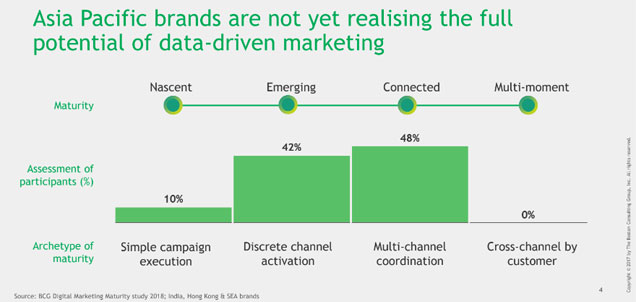
    Southeast Asia businesses are not fully tapping the potential of data-driven marketing strategies to increase their revenue and realize cost efficiencies, according to new research from The Boston Consulting group and Google.


    The research also found that the most digitally mature brands report significant benefits from data-driven marketing, with an average incremental 11 per cent revenue impact and 17 per cent in cost efficiencies.


    The ‘Digital Marketing Maturity Study’ surveyed over thirty brands across seven industries from Indonesia, Malaysia, Singapore, India and Hong Kong. It found that no brands have achieved the potential of multi-moment digital marketing in the region – that is, those that exceed consumer expectations by consistently delivering coordinated, relevant and sequenced experiences across a range of online and offline channels.


    “Brands in SEA are yet to reach the full potential of multi-moment marketing, which is an approach that optimizes single-customer business outcomes across multiple channels by delivering meaningful connections with consumers. In short, there is an opportunity to establish meaningful connections with today’s consumers to improve both cost efficiencies and revenue,” said Luc Grimond, Partner and Managing Director at BCG Singapore.


    The study assessed brands across industries and their maturity levels on a four-point scale. Companies at a nascent stage typically execute simple campaigns mainly using external data and direct buys, with limited links to sales. As brands mature, they improve discrete channel activation and then go a step further to more connected, multi-channel activation, with a demonstrated link to ROI and sales proxies. The study found that it is a progressive journey for companies to navigate through the four phases of digital maturity.


    “It’s like long-distance running. You need to focus on the next step rather than worry about how far you still need to go. It sounds like a cliche, but considering how many people are involved in enabling this change in an organization, it is important to break it down into bite-size pieces and make everyone part of the journey,” according to Tom Van Den Berckt, Head of Digital & Web Services at Maxis.


    Added Grimond: “In this study we identify the steps on a path to digital maturity. The least mature brands can get started by setting the foundations, including identifying a senior sponsor, leveraging partners to fill capability gaps, understanding available data and building on that by implementing the back-end technology and analytics required to progress.”


    BCG Google – India, Hong Kong and SEA -Digital Marketing Maturity Study – 2018

  • Google launches language support for Telugu ads

    By A Correspondent


    Google India announced the launch of Telugu language support for its advertising products – Google AdWords and Google AdSense to enable Telugu language web publishers and advertisers reach out to the large base of internet users in Telugu. With this launch, Google has now scaled up its support for Indian language advertising covering Hindi, Bengali, Tamil, and Telugu.

     

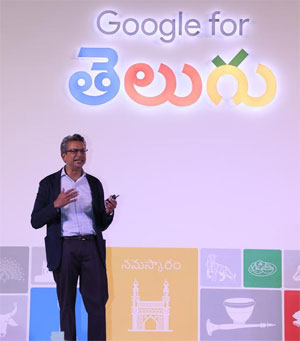
    Announcing the launch, Rajan Anandan, Vice-President, South East Asia and India, Google said:“Expanding support for local Indian languages on our ad platforms are aimed towards making India’s Internet more useful for a billion Indians. In the last few years, we have systematically addressed the barriers that prevent local language users in India to gain from the Internet. And the key to building a flourishing local language internet that serves India’s need – requires the Industry to come together and bring the richness of useful content that India needs. We hope this launch will enable publishers to create more content in Telugu language and help advertisers to connect with their users in local Indian languages.”


  • The Digital Duopoly targets a Billion-plus


    By Indrani Sen


    Last week,a roundtable discussion on ‘Disrupting Mobile Advertising Duopoly in the Indian Media Landscape’ was held in Delhi NCR, where experts from A&M industry shared their views on the future of the existing market duopoly of Google-Facebook in India. Most of them were of the opinion that the duopoly will continue to exist in India in spite of the growing competition in the market (http://businessworld.in/article/Challenging-The-Digital-Duopoly-Has-The-Change-Begun-/06-06-2018-151336/). A probability of a triopoly including Amazon and its marketing services was tabled by an expert with another expert adding that OTT platforms have began to challenge the duopoly. The need forbrand safe environment with created content rather than curated content and regulations like GDPR was tabled.

    Bharat Sanchar Nigam Limited, which has a limited tie-up with Baba Ramdev’s foray to mobile internet, has also partnered with Call2Action Communication India Private limited recently for launching a new mobile advertising platform. This platform is expected to create disruption in the Mobile Advertising Ecosystem by offering lucrative price points and challenge the duopoly of Google and Facebook in India as reported by the above article in www.businessworld.in.

    Both Google and Facebook have high business stakes in the Indian market and have been investing a lot of time, talent and funds in local development.  Some of these efforts are not well known to the advertisers and agencies that use the two platforms for digital marketing. The common users of the platforms are blissfully ignorant of the same.

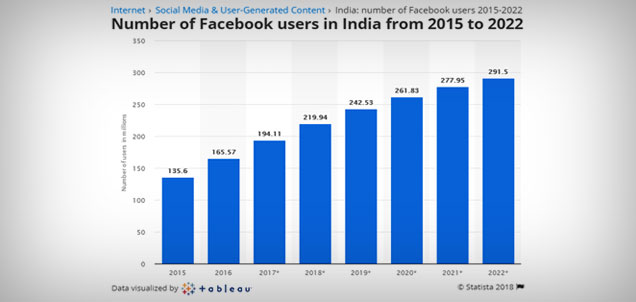
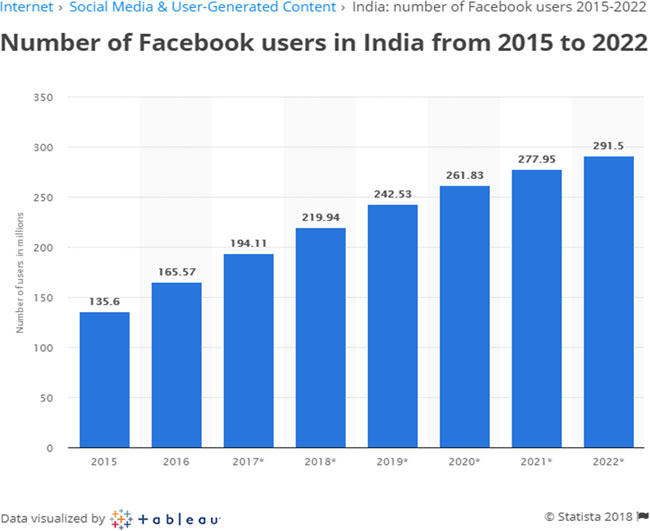
    India has been the country with the largest Facebook users since 2016. There were about 195 million Facebook users in India as of May 2016, against about 191 million in the U.S. and 90 million in Brazil (https://www.statista.com/statistics/304827/number-of-facebook-users-in-india/ ). The number of Facebook users in India is forecast to continue to grow in the coming years, and add up to nearly 320 million by 2021.The penetration of Facebook in India isexpected to jump from almost 15 percent in 2016 to around 23 percent in 2021.Facebook also owns three of the most popular social networks WhatsApp, Facebook Messenger and Instagram which help to increase its strong hold in the Indian market.

    Mark Zuberberg has claimed that globally, Facebook’s advertising-driven business has not been significantly damaged after the Cambridge Analytica bombshell dropped. Its share prices which dropped after March 2018 when the Cambridge Analytica reports broke, has climbed back to slightly above its price Facebook enjoyed before the news break.  Its ability to protect its users’ personal information shared and stored on its social network is yet to be proved to the complete satisfaction of the law makers across different countries

    Our Ministry of Electronics & IT has recently asked Facebook to explain if it allowed phone and other device manufacturers access its users’ data without taking their consent by June 20 following a recent report in media that Facebook has admitted to sharing information with a “small number” of companies including RBC Capital Markets and Nissan Motor Co., advertisers and other business partners (https://brandequity.economictimes.indiatimes.com/news/digital/facebook-kept-sharing-users-data-with-companies-even-after-saying-it-had-stopped-third-party-access-to-information/64516829).

    Google, the leading player in the Digital Duopoly, is comfortably settled in India. Google Search has 90% market share in India, Google’s Andriod OS is used by over 90% smartphone users in India, YouTube is watched by 80% of the internet users in India with a 225 million monthly user base, Gmail enjoys the largest user base in India and Google Map is consumer focussed and free to use. Google has been working steadily on India first tweaks and apps  such as offline videos for YouTube, two-wheeler navigation on Google Maps, Android Oreo (Go edition) to improve experience on low-RAM phones, Google Assistant for Reliance Jiophones, new apps like Google Go and Files Go, built from scratch, Google WiFi stations in partnership with Indian Railways and the mobile payment platform Google Tez, which within a month of its launch in September 2017, captured 60% share of m-payments in India.Facebook should take a lesson from Google and introduce some India specific social apps.

    India is a focus market for Google’s Next Billion Users Plan through which it aims to bring everyone online in India (https://brandequity.economictimes.indiatimes.com/news/digital/google-wants-to-bring-everyone-online-in-india-through-its-next-billion-plan/64457803). As a part of this initiative and based on intensive field research by its technical team, Google launched a multilingual app in Mumbai 10 days back (on May 31),  called ‘Neighbourly’ catering to only Mumbai.Thislocal discovery and community app works in English, Hindi, Marathi and six other Indian languages. The hyperlocal platform helps to find anything from a doctor, ATM or petrol pump to a mechanic or badminton coach, within 2 km radius.In coming weeks and months, Google plans to roll out the app across more cities in India.

    It is a difficult proposition to challenge Google’s total supremacy today In India as it is far ahead of its other competitors. Facebook, which has now become vulnerable, may have to deal with more competition in the sphere of social media. Itmay be compelled to spend comparatively more time to ensure protection of consumer data and implementation of its privacy policy, which may lead to erosion of its market share through competition in the global market. However, in India, there is minimal chance of a similar threat. So, the immediate future of the digital duopoly seems to be secure in India in spite of Baba Ramdev’s plan to relaunch Kimbho after a flamboyant launch followed by a silent withdrawal.


  • $100bn digital consumer spending potential by 2020: Google, BCG Report

    By A Correspondent


    Capturing the growth of digital influence and key consumer insights that will drive the next phase of digital consumer spending in India, Boston Consulting Group (BCG) and Google India released a report, ‘Digital Consumer Spending in India: A $100 Bn Opportunity’. The report projects that the potential for digital spending is expected to grow 2.5 times from ~$40bn to ~$100bn by 2020 led by sectors such as e-commerce ($18-45bn), travel and hotel ($11-20bn), financial services ($12-30bn) and digital media ($200-570mn). The report also finds that women, new users from non-tier 1 cities and 35+ years, shoppers will drive this growth.


    The report states that with deeper penetration of mobile phones and affordable data plans, the number of online spenders will not only increase over the next few years but there will be a dramatic change in the users’ profile. It also estimates that by 2020, the women shoppers will increase 2.5x and older shoppers will increase more than 3x compared to today. With the improvement of infrastructure, online shopping will take off in India from cities beyond metros and together it is expected to comprise more than 50 percent of the total online shopper base by 2020.


    Speaking about the key findings of the report, Nimisha Jain, Partner & Director, The Boston Consulting Group, India said: “There is a clear evolution as consumers move from awareness of online platforms to their first purchase and further down to become more frequent buyers – triggers and barriers to online purchase evolve with each stage. Very different actions are needed to unlock growth and move consumers from one stage to the next.”
    The report highlights that there are 75-80 per cent internet users who do not spend online currently. This underscores that even though the digital media has gained ground over the last few years, the actual digital spending is still in evolutionary stages in India. The BCG-Google report also outlays the key triggers and barriers at each stage of online consumer evolution with an aim to help drive digital spending. The report draws out implications for companies across each stage, with nuances highlighted to give a category perspective of relevant implications.


    Speaking about the key findings of the report, Nitin Bawankule, Industry Director, Google India said: “Digital spending in India are at a cusp of significant wave of change, while we have seen enthusiastic response to adopting newer forms of digital payments in the last few years, the base is still relatively small. The ecosystem needs to focus on creating a very targeted value proposition for different segment of users and across different categories to drive larger adoption. For example, in Food & Grocery category, convenience becomes a key trigger for frequent shoppers while discounts are important for occasional shoppers and quality is a key barrier among offline shoppers.”


  • Rahul Dravid & team do an act for Pixel 2

    By A Correspondent


    On the back of the launch of Google’s Pixel 2 has launched a new campaign featuring Rahul Dravid conceptualised and executed by Lowe Lintas, Delhi


    The three-minute film aims to showcase the user in a real manner, with Pixel 2 seamlessly being part of their life. Dravid, a cricketing legend and coach has been roped in by the brand to share real user’s experience in the film. The personality traits of Rahul – dependable, honest, passionate, genuine and one with a smart cricketing brain are a perfect sync with the smartness and simplicity Pixel offers and the brand attributes of Google.


    Said Sapna Chadha, Marketing Director, India and South-East Asia, Google: “The range of features such as Assistant, Maps, Search, Camera clarity, Unlimited storage through Photos, etc that Google’s Pixel 2 offers addresses consumer pain points and finds ways to ease our lives. Like everything we do at Google, Pixel is about the user. It’s a belief in the awesome things consumers can do with the best tools we can give them. The new campaign highlights and exemplifies that in an engaging way,”


    Added Joy Mohanty, Regional President (creative) North & East, Lowe Lintas: “It was interesting to see what lies on the other side of The Wall – Rahul Dravid, the Coach. We see him hang out with the new kids on the cricket block. And he shows them a trick or two. Aided all along, of course, by his superbly smart Pixel 2.”


  • Google’s Web Rangers makes a comeback with the third edition

    By A Correspondent


    Google has announced the third edition of its Web Rangers contest, an initiative that is designed to spread awareness about internet safety and promote digital citizenship. The competition aims to encourage teenagers to discover their hidden ninjas and unlock their creativity in highlighting the importance of cyber safety. After screening thousands of entries, the programme will reward seven Web Rangers — who know it all about staying smart, safe and savvy online.
     

    The contest is open to students across the country within the age group of 10 and 17 years. To take part, one has to run ones own internet safety campaign, either individually or as a team of three. It could be one large initiative or a collection of multiple projects like a social media campaign, a video series, awareness drives or all of them — there is no restriction on the format or the number of initiatives.The format is completely open – create a video, website, app or a game – but it should empower users to stay safe on the Internet and learn what it takes to be a good digital citizen.


    Said Sunita Mohanty, Director, Trust and Safety at Google: “With the Web Rangers contest, our idea is to promote safe use of the Internet among school students and create better awareness amongst the teenagers on how to be good digital citizen and staying safe online. We have seen an overwhelming response to our first two editions and the participation numbers are only growing. This year, we are ramping our efforts to reach more and more teenagers across India and will be hosting many online and offline events. As we celebrate the third edition of the Web Rangers contest, we can’t wait to see what the students have in store for us,”


    The deadline for submitting entries is January 15, 2018.


  • Ford EcoSport initiates innovation with Google Search

    By A Correspondent


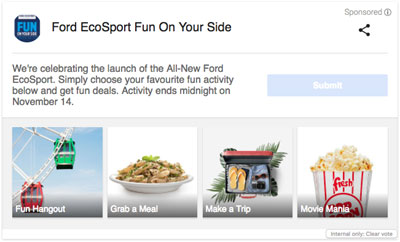
    To celebrate the launch of compact SUV Ford EcoSport, Ford India teamed up with Google to launch what it bills as a first-of-its-kind digital campaign in the automobile space in India.


    Titled “Fun on Your Side”the digital campaign aimed to bring different aspects of fun to lie that customer can experience with the all-new EcoSport even when they search for it online.


    The activity started on November 9 and will be on till November 15. Said Rahul Gautam, Vice President – Marketing, Ford India: “The car that started the compact SUV phenomenon in India is back to win many more hearts and minds. With the Fun with EcoSport campaign, we have worked with Google to ensure that the spirit of fun spreads beyond our dealership floors to everyone searching for it. With the New Ford EcoSport, our engineers have combined style, fun, and technology – all in one package – that we want our consumers to search and experience.”


    Commenting on the campaign, Vikas Agnihotri, Director Sales, Google India added: “Research shows 89 per cent of car buyer’s decision making is influenced through digital and majority of their journey starts from Google Search. The digital campaign for the launch of the new Ecosport combines strong intent cues from consumers with the innovative search voting feature to provide a fun-filled and memorable experience.”


  • Google launches new AdWords experience

    By A Correspondent


    With the aim of providing a faster and more intuitive AdWords for advertisers to reach their business goals, Google India has launched its new AdWords facility.


    Said Jerry Dischler, Vice President of Product Management, AdWords: “Since introducing AdWords 15 years ago, we’ve seen a fundamental change in the way people find what they want, when they want it. We now use multiple devices throughout the day, and watch more videos and visit more websites and apps than ever before. This rise in complexity has created the need to reimagine AdWords, and over the past year, our product teams have been thinking hard about how we can make AdWords as relevant for the next 15 years as the first 15. With the new AdWords, there is less clutter and more intuitive workflows, allowing advertisers to now quickly make the changes that will move their business forward.”