Tag: Google+

  • Steve Vranakis announced as D&AD Prez

    By A Correspondent


    Steve Vranakis

    Steve Vranakis, Executive Creative Director at Google’s Creative Lab, starts his tenure as the new President of D&AD. Harriet Devoy, Creative Director of Design, Marketing Communications at Apple Europe, has been appointed Deputy President. D&AD has also announced the establishment of a global Advisory Board. Regrettably, despite D&AD’s presence in India through the Kyoorius Creative and Design Awards, there is no Indian on this Board.


    In addition to Varanakis’ appointment, Harriet Devoy, Creative Director of Design, Marketing Communications at Apple Europe, has been appointed Deputy President.Kate Stanners, Global Chief Creative Officer at Saatchi & Saatchi, has been appointed to the Board of Trustees.


    D&AD has also announced its Advisory Board, which includes creatives in leadership roles from around the world (except India).


    Said Tim Lindsay, Chief Executive, D&AD: “Since its outset, D&AD has continued to encourage great work, set the bar high, inspire new generations of creative people, facilitate the exchange of knowledge and ideas, and acted in the best interest of the industry. Today, we are faced with unprecedented challenges, as an industry as well as a society. I’m excited to see Steve implement his programme over the next year to be more inclusive. Cross-disciplinary partnerships broaden horizons and breed innovation and creativity. It’s sure to be an exciting year ahead for D&AD… I’d also like to take this opportunity to thank outgoing President Bruce Duckworth for his unerring support and the leadership he has provided over the last twelve months.”

  • Google announces support for Bengali content creators and advertisers

    By A Correspondent


    Google India has announced support for Bengali for both Google AdWords and Google AdSense. Bengali being the sixth most spoken language around the world, publishers and advertisers can now reach a large audience globally and target them with Bengali-language search and display ads, notes a communique.


    Said Shalini Girish, Director – Google Marketing Solutions, Google India: “With the availability of Hindi, and today’s launch of Bengali language capabilities, we are working hard to ensure that digital advertising is keeping up with the needs of an evolving Internet audience. Over the coming months, we will share more about our efforts to further build on this.”

  • Khelo, India, Khelo!


    Republished from a KPMG-Google report on online gaming titled ‘Online Gaming in India: Reaching a new pinnacle’


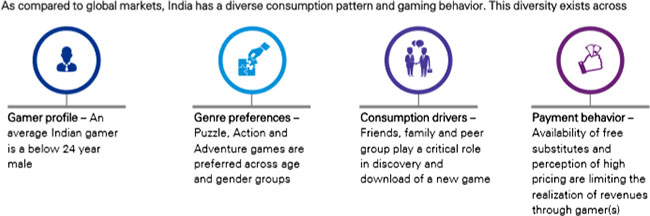
    The advent of India’s online gaming industry can be dated back to 2000s, when console and PC gaming brought several middle-income group Indians on digital gaming platforms. During mid 2000s, online gaming was largely in the form of social games. This adoption was facilitated primarily through global games by international developers. Indian development ecosystem acted primarily as service providers for international developers. Since then, India has been a volume based story enabled by rise in internet penetration and increase in smartphone user base.


    Online gaming market realised impressive volumes with 120 million online gamer(s) and market value estimated at ~ 290 million USD in 2016. The key driver of market volume was proliferation of low cost smartphones amongst urban and rural population. The monetisation is realized through revenue streams like in-app purchase, pay per download, subscription service etc. by gamer(s) and in-app advertisement, incentive based advertisement etc. by ecosystem. Today, monetisation is dominated by advertisers and publishers.


    However, challenges like limited local games development and monetisation of gamer(s) are still restraining the high potential. In recent years, local internet ecosystem has initiated the course correction by end to end local game development and adoption of digital payment solutions.


    The online gaming consumers market, characterised by large volumes, is rising fast in terms usage and monetisation. The local development is characterised by highly skilled manpower and expertise.


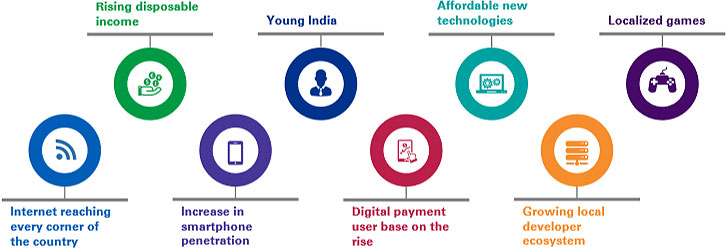
    In the future, India is expected to move towards value driving consumption and comprehensive local development. The industry is expected to gain momentum and reach a market value of 1 billion USD and ~310 million online gamer(s) by 2021. This ~28% CAGR growth will be driven by:


  • Google, Facebook top media owners


    By A Correspondent


    Google and Facebook together accounted for 20% of global advertising expenditure across all media in 2016, up from 11% in 2012, according to the new edition of Zenith’s Top Thirty Global Media Owners, published today (May 8).These two companies captured 64% of all the growth in global adspend between 2012 and 2016.


    The Top Thirty Global Media Owners report is Zenith’s ranking of the world’s largest media companies, and has been published since 2007. For this edition there’s an updated methodology and focus purely on media owners’ revenues from advertising, excluding revenues from all other activities, which gives the true measure of their status in the global advertising market.


    Google (under its holding company Alphabet) is by some distance the largest media owner in the world, attracting US$79.4bn in ad revenue in 2016, three times more than the second-largest – Facebook – which attracted US$26.9bn. The largest traditional media owner is Comcast, which takes third place in our ranking, with US$12.9bn in ad revenue.


    As stated in Zenith’s quarterly Advertising Expenditure Forecasts, internet advertising has overtaken television to become the world’s largest advertising medium this year. Accordingly, digital platforms that are funded by internet advertising dominate the top 30 ranking. As well as Alphabet and Facebook, there are five more pure-internet media owners in the top 30: Baidu, Microsoft, Yahoo, Verizon and Twitter. Between them, the seven digital platforms generated US$132.8bn in internet ad revenue in 2016 – that’s 73% of all internet adspend, and 24% of global adspend across all media.


    Verizon became a media owner in 2015 when it bought AOL, and if all goes to plan will become a much larger one when it acquires Yahoo later this year. Verizon takes 21st place in the current ranking; adding Yahoo to AOL would boost it to sixth.


    The fastest-growing media owner in Zenith’s list is Twitter, which increased its ad revenues by 734% between 2012 and 2016. Tencent is second, having grown by 697% over this period, and Facebook is third, with 528% growth. Two other media owners have more than doubled in size between 2012 and 2016: Baidu, which grew 190%, and Sinclair Broadcasting Group, which grew 171%.


    Most of the media owners in the ranking – 20 out of 30 – are based in the US. The US dominates for several reasons: the US has the biggest ad market, US companies have invested the most in extending their reach abroad, and Silicon Valley innovation has powered the growth of internet advertising. China and Germany each have three media owners in the ranking (Baidu, Tencent and CCTV for China, and Bertelsmann, ProSiebenSat.1 and Axel Springer for Germany). Then there are four countries with one media owners each: France (JCDecaux), Brazil (GrupoGlobo), Italy (Mediaset) and the UK (ITV).


    “The scale of the biggest platforms highlights the importance of building strong partnerships between agencies and media owners,” said Vittorio Bonori, Zenith’s Global Brand President. “Brands need to deal with these platforms to communicate with consumers effectively and efficiently, and agencies need to ensure they do so on the best terms available.”


    “Zenith’s new ranking demonstrates just how much the internet advertising platforms are setting the pace for global adspend growth,” said Jonathan Barnard, Head of Forecasting at Zenith. “Google and Facebook alone have accounted for almost two thirds of global adspend growth since 2012.”


    Ranking of Top 30 Global Media Owners 2017

    Rank Media owner Rank Media owner
    1 Alphabet 16 Advance Publications
    2 Facebook 17 JCDecaux
    3 Comcast 18 News Corporation
    4 Baidu 19 GrupoGlobo
    5 The Walt Disney Company 20 CCTV
    6 21st Century Fox 21 Verizon
    7 CBS Corporation 22 Mediaset
    8 iHeartMedia Inc. 23 Discovery Communications
    9 Microsoft 24 TEGNA
    10 Bertelsmann 25 ITV
    11 Viacom 26 ProSiebenSat.1 Group
    12 Time Warner 27 Sinclair Broadcasting Group
    13 Yahoo 28 Axel Springer
    14 Tencent 29 Scripps Networks Interactive
    15 Hearst 30 Twitter


    Advertising Revenues in US$ million
    Share of Global Advertising Expenditure (%)
  • Zenith turns Google search into voting engine

    By A Correspondent


    In a first-of-its kind creative association, the Google search results page for “Meri Maggi” was transformed into an innovative branding medium – one that registers live votes from consumers ahead of product launch. Zenith, part of Publicis Media India, conceived this campaign for Maggi and brought it alive in a unique creative association with Google.


    A search for ‘Meri Maggi’ on Google displays eight potential new flavours for users. The new product-line comes with names that are intrinsically Indian;  AmritsariAchari, Bengali Jhaal, Gujarati Khaman, Kashmiri Dum, Kochi Malabari, Mumbai Chatak to name a few. Of these, the user has to accurately guess the four flavours that Maggi will end up launching. Users could vote every day till midnight on Friday, April 21. Post voting, the user was diverted to the Paytm Maggi page for registration https://paytm.com/maggi and could avail a Maggi Goodie bag.


    Said Tanmay Mohanty, Group CEO, Zenith India: “Zenith develops brand experiences that maximise the value of the opportunity and builds rewarding relationships with valuable customers. This is an innovative campaign in which search has been transformed into a unique ‘Voting Engine’ and this initiative only harnesses the passion of Maggi loyalists. The preview on the new flavours adds to the buzz and anticipation among Indian consumers. Over the past 33 years, Maggi has become one of the most trusted brands in India. It has done this by keeping up with the changing Indian palette. ‘Maggi Masalas of India’ is a step in the same direction and we are pleased to engage with them on the same.”


  • Voot partners Google to launch VoD progressive web app

    By A Correspondent


    Voot, Viacom18’s ad-supported video-on-demand OTT service, has turned its mobile website into a Progressive Web App (PWA) using features such as ‘add to home-screen’and a service worker. PWA allows reliable, fast, and engaging experience for users on mobile web, notes a communique.


    Commented Gaurav Gandhi, COO, Viacom18 Digital Ventures: “In this business both content and technology have equal equity in realizing the potential of our Consumer Proposition. While content is our domain expertise, to push the envelope in terms of technology, we continuously work with partners from around the world. We are delighted to work closely with Google to launch VOOT on the PWA platform. This launch significantly enhances the experience for all VOOT users on mobile browsers and we believe this is a big step where users can have an equally rich experience of our service without downloading the app.”


    “We have moved the needle very significantly when it comes to user experience on the Mobile Web by adopting PWA,” said Rajneel Kumar, Head, Product and Technology, Viacom18 Digital Ventures, adding: “All the time and effort we’ve spent on technology and UI changes as well as optimisations seem to be showing very positive results. We are going to continue to refine this further and we are confident that we will continue to see significant consumer lift.”


    “We are delighted with the Voot implementation of a Progressive Web App. PWAs are well suited for India, where the mobile web allows publishers to reach a large audience across a highly diverse set of devices and bandwidth.  The early numbers on performance are very encouraging, and demonstrate the potential of mobile web media distribution” said John Pallett, Product Manager at Google.


  • Google releases ‘Better Ads’ report for 2016

    By A Correspondent


    Google has released its annual ‘Better Ads Report’ for 2016 where it states it took down 1.7 billion ads that violated its advertising policies, more than double the amount of bad ads it took down in 2015.


    “A free and open web is a vital resource for people and businesses around the world. And ads play a key role in ensuring you have access to accurate, quality information online. But bad ads can ruin the online experience for everyone. They promote illegal products and unrealistic offers. They can trick people into sharing personal information and infect devices with harmful software. Ultimately, bad ads pose a threat to users, Google’s partners, and the sustainability of the open web itself”, said Scott Spencer, Director of Product Management, Sustainable Ads.


    Last year, Google did two key things to take down more bad ads, notes a communique. First, it expanded policies to better protect users from misleading and predatory offers. For example, in Julyit introduced a policy to ban ads for payday loans, which often result in unaffordable payments and high default rates for users. In the six months since launching this policy, it disabled more than 5 million payday loan ads.


    Second, it beefed up its technology to spot and disable bad ads even faster. For example, “trick to click” ads often appear as system warnings to deceive users into clicking on them, not realizing they are often downloading harmful software or malware. In 2016, Google detected and disabled a total of 112 million ads for “trick to click,” 6X more than in 2015.


    According to the report, most common inappropriate online ads were Ads for illegal products. Google disabled more than 68 million bad ads for healthcare violations and 17 million bad ads for illegal gambling violations in 2016.


    Over the years, the communique adds, Google has been working to find ads that violate its policies and blocks the ad or the advertiser, depending on the violation. In 2016, it took action on 47,000 sites for promoting content and products related to weight-loss scams. It also took action on more than 15,000 sites for unwanted software and disabled 900,000 ads for containing malware. Around 6,000 sites and 6,000 accounts were suspended for attempting to advertise counterfeit goods, like imitation designer watches.


  • The 120 Media Collective rolls out Google’s new customer story for G Suite in India

    By A Correspondent


    The 120 Media Collective recently delivered Google Cloud’s new customer story for G Suite and the All Together Now campaign. The story features celebrity designer Manish Malhotra, showcasing his journey and how his team works using G Suite; a set of intelligent apps for businesses designed to bring people together. Directed by Karan Boolani, the commercial is conceptualized by Jack in the Box Worldwide and produced by Sniper, both part of The 120 Media Collective.


    G Suite’s new video is part of a global transitioning from Google Apps For Work to G Suite. With Jack in the Box Worldwide’s proven expertise creating top notch video content, they were chosen as the Indian agency of choice to create this local piece of stunning content. And with noted director Karan Boolani on its roster, Sniper’s production expertise went a long way in delivering a stupendous piece.


    Roopak Saluja, Founder & CEO of The 120 Media Collective, said, “It’s a privilege to partner with Google in their transition from Google Apps For Work to G Suite. Harnessing the collaborative power of Sniper and Jack in the Box Worldwide to deliver a great piece of work from The 120 Media Collective has been an awesome experience.”


  • Apple, Google hold top spots in ‘Best Global Brands Report’

    By A Correspondent


    Brand consultancy firm Interbrand named Apple, Google and Coca-Cola the three most valuable brands in its 2016 Best Global Brands report, with automotive and technology brands dominating the ranking—and Tesla and Dior entering the Top 100 brands. Now in its seventeenth year, the report reveals the anatomy of growth, and features an insider’s view of how great brands grow great businesses.


    “It’s clear the best global brands are not just weathering change, but driving it,” says Jez Frampton, Interbrand’s Global Chief Executive Officer. “They understand their Anatomy of Growth is complex, unique and personal; they look inward and outward, expand into new markets, and create better experiences to grow their brands and businesses.”


    For the fourth year in a row, Apple and Google claimed the top positions. Apple’s brand value grew by 5 percent to US $178,119m, while Google’s brand value rose 11 percent to US $133,252m. Coca-Cola, Microsoft, Toyota, IBM, Samsung, Amazon, Mercedes-Benz and GE round out the Top 10. Dior and Tesla enter the Best Global Brands report for the first time, at #89 and #100 respectively.


    The world’s five Top Growing Brands include Facebook (48 percent growth), Amazon (33 percent), LEGO (25 percent), Nissan (22 percent) and Adobe (21 percent).


    “There is an increasing shift from businesses leading brands to brands leading businesses. That opens clear avenues of growth. Brands grow businesses by building a strong culture, optimizing structures and governance inside the organisation, while anchoring differentiated experiences on the outside”, said Ashish Mishra, Managing Director, Interbrand India.


    With a combined 29 positions, automotive and technology brands dominate this year’s report. Retail is the Top Growing Sector, increasing 19 percent, followed by the sporting and luxury sectors—each experiencing a 10 percent increase.


  • Most popular ads of 2016 revealed… as viewed on YouTube

    By A Correspondent


    Google has released the YouTube Ads Leaderboard, a list of ads and promoted videos that resonated the most with Indian audiences during the first six months of the year. Showcasing the most engaging ads that people chose to watch, the ten ads clocked an astounding 4 lakh hours of watchtime, with over 60 percent happening on mobile devices.


    Storytelling emerged as the winning ingredient for Indian viewers, with six of the ten ads running far longer than the typical 60-second television commercial. Further, based on the average watchtime per ad, it is clear that customers are willing to invest their time and attention on advertising that is narrative-driven and takes audiences along on a journey. Bajaj, Hitachi, Royal Challenge Sports Drink and Ariel have taken this approach, and captured people’s attention. Testament to this is that two of the ads on the YouTube Leaderboard have been recognised at Cannes this year. These are the Bajaj V film which won the creative agency, Leo Burnett a Bronze Lion in the Promo & Activation category under Cars & Automotive Product & Services category, and the Ariel ad for which BBDO India was awarded a Bronze Lion in the Creative Effectiveness category.


    Talking about the campaign, Soumya Das, DGM (Marketing), Bajaj Auto said, “The genesis of Bajaj V came from our passion to keep alive the legacy of the invincible INS Vikrant in the form of a bike that lakhs of Indians can ride with pride. We’re extremely happy to know that the entire nation appreciates what we did. Youtube as a platform, with its targeting capabilities has helped us to connect with our TG more efficiently and made this campaign a bigger success.”


    #1  “Bajaj V – The Invincible” - Bajaj Auto #2 “#Apni Dukaan” - Amazon India
     
    #3 “#BefikarBookKar” – Make My Trip #4 “Fan Anthem #PlayBold India” – Royal Challenge Sports Drink
       
    #5 “#Nothing Dirty ft. Badshah – Hitachi Home #6 “Mauka Mauka” – Star Sports
       
    #7 “Coca Cola Supermarket” – Coca Cola #8”Pepsi thi jeet gaya” – Pepsi
       
    #9 “#Share The Load” – Ariel India #10 “Samsung Galaxy S7 and S7 Edge – Samsung


    #1  “Bajaj V – The Invincible”

    Bajaj Auto

  • Google unveils second edition of ‘Squared’

    By A Correspondent


    Google has announced the second edition of ‘Squared’ – an executive training program that enables advertising professionals to become digital ninjas. Over 50 marketing, media and advertising leaders in India — Dentsu Aegis, Group M, Interpublic Group, Madison, Onmicom Media Group, Starcom and ZenithOptimedia, Shop clues, Max Life — are participating in Squared this year.


    The program is designed to impart the next generation of marketing, media and advertising leaders with digital, technological and leadership skills through hands-on labs and mentoring sessions with experts and mentors from the global advertising industry, including Charlie Somers Cock, Head of Global Talent – Impact International , Kunal Shah, Founder – Free Charge, Sapna Chadha, Head of Marketing – Google, Archan Banerjee, Head Digital Marketing – Dabur, Nidhi Bisht, Co-Founder, Director – New Brain Theater Volks, Atul Chaturvedi, Joint Secretary, Dept. of Industrial Policy & Promotion, Ministry of Commerce & Industry, Government of India and others.


    Last year, 40 “Squares” went on to champion change in their agencies. For its second edition, the program will focus on using digital to create innovative and impactful marketing and advertising campaigns, with a particular focus on mobile, digital video and measurement. The two-week intensive residential training program is currently underway in Delhi and will run in Mumbai from July 11th – 22nd.


    Punitha Arumugam

    Punitha Arumugam, Head of Agency Business – APAC, Google commented, “Digital is already about 12 per cent of the total advertising spends in India, and is projected to be approximately 30 per cent by 2020. This creates an acute need for leaders who have the skills and expertise to harness the best of the medium. Through our intense focus on training programs such as Squared, we are empowering advertising professionals with deep digital, technical and leadership skills that will help them deliver powerful brand campaigns.”


    Squared was first piloted in the UK, where more than 300 professionals from 60 agencies and advertisers participated over a period of time. India is the sixth market of Squared’s global roll-out following London, Singapore, New York, Hong Kong, Germany, Thailand and Indonesia.


    Squared is just one example of Google working closely with the agency community in India. Programs like Planner’s Days, YouTube Bootcamps and Mobile Leadership programs aim to contribute to the growth of individuals and organizations. Over the past two years, 1700 Indian professionals have been trained in these programs.


  • Google unveils new campaign that emphasizes on fulfilling one’s dream

    By A Correspondent


    Keeping its focus on India, Google is trying to enhance consumer experience through their products and their effort to make internet more accessible to a larger pool of people. And, in order to do so, it has released its digital film titled ‘The Hero- A Bollywood story’. The film has been conceptualised by Lowe Lintas, Delhi.


    The agency had to crack an idea which not only impacted the masses but one that appealed to a wider audience across the country. They used the context, which most Indians can relate to- the context of unfulfilled dreams. Mostly, people tend to forget and move on from their unfulfilled dreams. The film highlights how Google, in its own way, can help you find that dream and chase it. To add a relatable and relevant touch, the agency has incorporated Indian cinema as a background. Bollywood is synonymous to hopes and dreams of thousands in our country, and through this film Google has tried to focus on cinema from a product perspective- enhancing film search results and create a range of search experiences especially for Indian cinema.


    Commenting on the new campaign, Sapna Chadha, Marketing Head, Google said: “Google has a long history of building products for India, and we wanted to make sure that when these millions of Indian cinema fans pick up their phone and ask Google about their favorite films, actors or songs, they get a delightful, local experience.”


    The film is about the journey of a father-son duo, where in the son is trying to fulfill his father’s long lost desire to work in movies. It is about them rediscovering dreams – Bollywood style – with Google Search by their side.


    Arun Iyer, Chief Creative officer, Lowe Lintas said, “With a nation that’s crazy about cinema, thousands of people land up in Mumbai every day to be part of this magical world. But very few get to live their dreams. This film was inspired by those lost dreams and new journeys. The story was created around the product that takes you on an emotional journey.”


    Commenting on the campaign, Naveen Gaur, President, Lowe Lintas said, “Nothing unites this nation like cinema does. So we took that as the context to expand the relevance of Search in people’s everyday life. Cinema is so engrained in us that we always endlessly want to know about films and the stars. Google with its enhanced search does a great job in helping people know anything about Movies and much more.”