Tag: Google+

  • GroupM teams up with Optimum Television for new show

    By Our Staff


    GroupM’s Motion Content Group, in partnership with Google and Meta, announces the launch of a new show, “Jai Ho! Bharat Ki Anant Yatra,” in collaboration with Optimum Television. The show, a tribute to the contribution that the Indian Civilization has made to the world, takes viewers on a journey through India’s past, present, and future.


    The show which will be available on Zee Network and can also be streamed on Google and Meta’s platforms is narrated by Sharad Kelkar and scripted by Prasoon Joshi.


    Ashwin Padmanabhan, President – Investments, Trading, and Partnerships, GroupM – India, said: “We are thrilled to announce the launch of Jai Ho! Bharat Ki Anant Yatra. This show is a celebration of the stupendous journey of Indian Civilization and its contribution to the world. The show also looks into what the future holds for India as an economic and cultural world leader. We are proud to collaborate with Google Cloud and Meta to tell this inspiring story of India on the cusp of our Republic Day on Jan 26th.”


  • The Future of Digital India lies in Voice, Video & Vernacular


    By Indrani Sen


    Indrani SenThe IAMAI-Kantar ICUBE report published in 2020 predicted that internet users in India would increase by 45% between 2021 to 2025 and will touch 900 million. The report also made a forecast that the growth will be driven by higher adoption of internet by users in small towns and rural areas. In 2020, two out of every five active internet users in the country came from small towns and there was a 13% growth in the number of rural internet users between 2019 and 2020. The report also estimated that by 2025, the number of rural internet users will surpass the number of urban internet users. In a country with 29 states based on linguistic divisions and 22 major regional languages (including Hindi), the emerging digital ecosystem is calling for urgent applications of voice and video in vernacular to reach out to the new internet users.


    An article in Economic Times by Rahul Sachitanand published on October 7, 2018 did an excellent analysis of India’s  changing internet landscape covering its past, present and future (https://economictimes.indiatimes.com/tech/internet/voice-video-and-vernacular-indias-internet-landscape-is-changing-to-tap-next-wave-of-users/articleshow/66102478.cms). The article talked about the three waves of internet adoption in India, the first wave (1995-2005) saw the arrival and early adoption of internet and digital content in India followed by the second wave (2005-2015) when internet took the centre stage and a variety of new businesses were built in travel, e-commerce and fintech riding on internet which not only attracted international players and investors but also laid the foundation of Digital India. The third wave, which began from 2015 (2015-2025), saw the validation of Indian Internet market with Flipkart’s sale to Walmart for $16 bn. Data prices crashed as reliance Jio entered the telecom market and mobile became the main device for accessing internet across the country breaking geographic and demographic boundaries.


    I wrote two articles here, the first one “The Deep Divide” published on February 5, 2018 dealt with the difference between the language of communication used by our advertising industry and the language understood and appreciated by their target audience across India in the digital age (https://www.mxmindia.com/2018/02/the-deep-divide/); and the second one published on November 4, 2019 dealt with the inevitable upcoming process of localisation of Indian digital market (https://www.mxmindia.com/2019/11/localisation-in-indian-digital-media-market/). However, in 2019 I was not able to foresee how fast the timeframe of reaching out digitally to the rural internet users would shrink during the three waves of the pandemic, national/ regional lockdowns and forced online education at primary and secondary school levels. A lot of water has passed under the bridge during the last two years and today a number of new entrepreneurs are ready to offer AI solutions for enabling Voice and Video in vernaculars for reaching out to the new Indian internet users from small towns and rural areas.


    The Indian internet which was initially designed in English for the top end of the market is now going through an explosion of vernaculars enabling usage of voice and video for enabling the new users to graduate from utility services to online transactions. Today, it is estimated that more than 60% of smartphone users in India consume various content in their mother tongue and about 30% consume content in multiple Indian languages along with English. Only 10% of the smartphone users consume content only in English and this percentage is expected to decrease with the increase in the number of smartphone users. According to Google, there has been a four-fold increase in rural internet users. India’s data consumption now can be easily compared with developed countries at an average of 8GB per month per user. The transacting audience kas gone beyond the large cities to touch 170 million. The next generation of Indian internet users would prefer to have content, communication and ecommerce in non-English vernaculars and would be more comfortable with voice rather than typing messages in their mother tongues.


    Google has introduced India First and India-only apps to bring in new users to its fold. It has launched support on its Gboard handset keyboard in all Indian languages; its voice assistant can understand and interact in eight Indian languages and its web browser Chrome can translate web pages into eleven Indian languages. More Indian languages would be added to the Google apps in near future.


    For over 10 years, Reverie Language Technologies, a vernacular language venture, has been building capabilities for search and discovery in multiple languages. They have gone beyond translation and have built interfaces to engage via voice the need of the new users of internet by focussing on customer relationship management (CRM) of this emerging digital consumer segments. Over the last couple of years, a whole new B2B sector with digital organisations like vernacular.ai offering AI enabled use of voice and video in vernacular has opened up.  VIVA or Vernacular Intelligent Virtual Assistant is one of the services which are offered by vernacular.ai today. All large ecommerce companies operating in India have started voice enabled transactions in vernaculars.


    YouTube, Hotstar, Voot, etc. along with first TikTok and then desi versions of TikTok have shown us the operations with videos, particularly videos in vernacular can reach a massive scale. Research has shown that close to 90% of marketing companies use videos as the main tool for digital marketing. More than 75% of all B2C content is delivered through videos which have higher engagement rate leading to greater penetration of the messages. In future with technological developments, search operations will be done through voice search or video search in multiple Indian languages.  While voice and video will be adopted in future by the entire digital world, Digital India will be clearly different market by the use of at least a dozen of vernacular platforms.


  • Homo Proxies: Beyond Income Inequality & The Digital Divide


    By Ashoke Agarrwal


    Ashoke Agarrwal“As for living, our servants will do that for us.”

    From the play Axel by Auguste Villiers de I’Isle-Adam. Also used by WB Yeats as an epigraph in The Secret Rose.

    To my mind, the invention of money is at par with the control of fire as a seminal development of human society. Capital produced the class system, which is the bedrock of modern human society’s economic, political and cultural structure.

    Many who ponder humanity’s future see the emergence of Artificial Intelligence (AI) as a development that will alter the core structure of human society.

    AI’s progress over the decades has been stop-start. For decades it has been the saga of a promise fulfilled more in science fiction than reality.

    Quite often, it has been a cliche with wannabe setup trying to pass off data analytics and second-order model-building as AI.

    However, over the past few years, the exploits of Google, Deep Mind (a subsidiary of Alphabet, Google’s parent company) and OpenAI have once again brought the promise and perils of AI front and centre in the popular imagination.

    In June 2022, Blake Lemoine jolted the world by claiming that Google AI engine LaMDA (Language Model for Dialogue Application) had turned sentient. The powers that be at Google denied the claim and sacked Mr Lemoine. Was Google upset that Lemoine pre-empted the announcement of what many would think is a seminal milestone in the development of AI? Or was Google upset by the revelation of a secret it would want to, for myriad reasons, keep from the world? Or was it simply that Mr Lemoine’s claim was hyperbolic and premature?

    Whatever the case, the media attention that Mr Lemoine’s claim got is symptomatic of the widespread realisation, conscious and sub-conscious, that AI is much more than just another technological development. On the contrary, it is a recognition of AI’s power to change the very dynamics of human society.

    I have been writing in this column about one aspect of how AI, as it develops, will change an individual’s life. In my January 6, 2022 column, I have written about Concierge Intelligence (CI). CI will augment the capabilities of an individual to deliver better outcomes for her – at work, in learning and in relationships. It will be the next big thing – a consumer service whose impact will be an order of magnitude higher than, say, the emergence of the personal computer or the smartphone.

    CI will be an AI companion of the individual, assisting her in all her interactions with the world. CI will enable the individual to communicate better, learn more and better, work better and even shop better. It will do so by developing a deep understanding of the individual’s capabilities, biases, needs and desires. CI will combine this depth of knowledge about the individual with near-encyclopedic knowledge and awareness of the world to deliver solutions and assistance at the speed of a computer.

    The overall impact of CI on society will be more or less egalitarian, as is increasingly the case with personal computers and smartphones. As the CI technology matures, most people who cross the poverty and subsistence lines will be able to afford CI.

    However, there will be an aspect of CI that has the potential to further immeasurably the class divide. This divide will go much beyond the divide of being able to afford a better brand of smartphone or PC. It will even go beyond the digital divide that separates people with access to the digital world and those deprived of it.

    The divide that a specialised aspect of CI can produce could be to create an almost different species of humans. Not yet Harari’s Homo Deus (as posited in his book ‘Homo Deus. A Brief History of Tomorrow’) but on the way. An era of Homo Proxies.

    ‘Proxies’ is the name I have given this species-creating aspect of CI. I have borrowed this concept from Jennifer Egan’s latest book, ‘The Candy House’. Egan comes to the idea of Proxies from a different technological development – the ability to download one’s memories – conscious and sub-conscious. In her imagining, Proxies are an escape hatch devised by those wanting to escape the tyranny of this technology.

    In that sense, I have only borrowed the label from Egan. In my imagining, Proxies are a result of CI, and a means for individuals to distort the technology to entrench their power and pelf further.

    Proxies will be a form of super CI that an individual will use to create multiple identities. As much of human society’s endeavours – economic, social, cultural and political – move online, an individual using Proxies will have the means to exist as multiple entities. Proxies will be a turbocharged CI – say a Super CI – that will enable an individual to digitally live and interact as multiple entities that multiply the time and the legal and social presence available to the individual. In that sense, Proxies go beyond the concept of fake identities.

    While this Super CI will be expensive, the inequality that will result from proxies goes beyond the cost aspect of it. Instead, it will be more to do with the individual’s capabilities. For example, proxies-driven multiple identities are valuable and produce more economic and social capital only if the individual is either a knowledge worker or an entrepreneur.

    Imagine a world where a class of individuals will enjoy unlimited “me-time” while their multiple proxies take care of worldly endeavours. It will create a different species of human beings way beyond the current divide driven by economic and social power.

    Dig below the anxiety that the coming age of AI produces among many, and you will find that the possibility of proxies is part of it.

    As the 21st century slips into middle age over the next couple of decades, a new leisure class will likely emerge. And to paraphrase Auguste Villiers, an elite who says, “as for earning fame and money, our proxies will do that for us”.


  • Emvies to be held on March 25

    By Our Staff


    The Advertising Club  is set to host the Emvies on March 25. With over 1000 entries this year, the event is scheduled to be held in open air. Mumbai from 6.30pm onwards.


    Said Partha Sinha, President, The Advertising Club: “It’s been a long break and we at TAC are eagerly waiting to see some of the great work that has been done in the last year and hope to recognise and reward the best of the best in each category. We have a special recognition – The Young Emvie of the Year, in honour of Pradeep Guha, a stalwart and legend in the world of Media and Entertainment. With Google being our presenting sponsor this year, it’s befitting that we’re looking for innovation at the heart of everything. We are excited and ready to get the ball rolling in earnest, move the inertia of the last two years into a juggernaut of momentum and host perhaps the grandest Emvies to date. All the best to every participant, may the best work win!”


    On being the Presenting Sponsor, Sapna Chadha, Vice President, Marketing – India, Southeast Asia and South Asia, Google Asia Pacific, said: “We are delighted to be partnering with The Advertising Club on the most prestigious and highly anticipated media awards. At Google, we incorporate innovation and creative strategy in everything we do and we’re eager to see what the young creative minds of India have produced in the past year. It is our absolute pleasure to be a part of this legacy and hope to see some great work being recognised.”


  • Digital Duopoly changes to Triopoly


    By Indrani Sen


    Indrani SenIt is established now, the Google and Facebook duopoly in digital advertising has been converted to a triopoly by Amazon. With the rapid growth of Amazon’s share, the global online advertising size is expected to cross $88 billion by end of 2021. Google and Facebook together hold above 50% market share with other major players like Amazon, Microsoft and Twitter competing with each other for the rest. The data released by eMarketer in October, 2021 for a period 2019-2023 shows that the combined share of Google and Facebook are going to decline further over the next two years to be just 50.5% in 2023 as against 55.2% in 2019. Along with Amazon, the triopoly will hold 65.1% share in the online advertising market in 2023. Industry experts feel that similar effects will soon be seen all across the world.


    A recent article (https://www.exchange4media.com/marketing-news/digital-advertising-is-not-a-two-horse-race-between-google-and-facebook-daryl-lee-117323.html) based on an interview of Darry Lee, the global CEO of IPG Mediabrands, was published using a quote from Darry Lee as the headline “Digital advertising is not a two-horse race between Google and Facebook.”


    In this connection, read recently an excellent analysis by P.K. Kannan, Dean’s Chair in marketing science in the Robert H. Smith School of Business at the University of Maryland, who analysed the impact of increased Amazon’s presence in digital advertising and the reasons behind Amazon’s success( https://www.clickz.com/amazon-presence-digital-advertising/220935/).


    Prof. Kannan argued that in order to understand the unique advantage of Amazon, we need to address the basic question of what marketers gain from advertising online, which is primarily acquiring customers at the lowest cost. He argued that “Google and Facebook provide marketers access to the online traffic they control and use sophisticated targeting algorithms to match a marketing message to the right set of online users.” However, as we all are aware the final effectiveness of this targeting is based on the motivations and inclinations of the online consumers as they surf through different websites on the internet. A consumer may just be interested in interacting with her friends on Facebook. A visitor at Google may just be looking for references related to his research studies. Against this the motivations for consumers on Amazon is either shopping or searching for making a decision related to shopping. So, the chances of a consumer reacting to a context-appropriate message is much higher for visitors in Amazon, which increases the click through rates. Internet users are also in the right mindset when they visit the Amazon site than when they are on Google and Facebook.


    As the platform itself is a marketplace, Amazon has a unique advantage of having previous knowledge of shopping behaviour of the consumer and can use that to position the message of the advertiser more effectively and also use AI and other techniques more effectively to provide recommendations to the advertisers. Prof. Kannan argues that “Amazon Prime shoppers are an especially attractive segment for marketers to go after, and Amazon could charge even more for online ads targeting them.” With precise targeting brands advertised on Amazon may become more prominent with the shoppers quickly. This has two built-in benefits. Firstly, it enables in relationship building with the consumers and secondly, it improves the organic search rankings.


    In addition, a marketer may have to worry about the type of user generated content his/her ad would appear on Google’s YouTube or on Facebook. Amazon, on the other hand has a complete control of all the content that appears on its own e-commerce platform. Advertisers may prefer Amazon as it reduces the risk of ads appearing in the wrong environment.


    So, it seems almost certain that the digital duopoly of Google and Facebook is in the process of changing to a triopoly not just in the US market, but across the world in developed and developing countries.


  • Google tops YouGov’s Best Brand Rankings in India

    By Our Staff


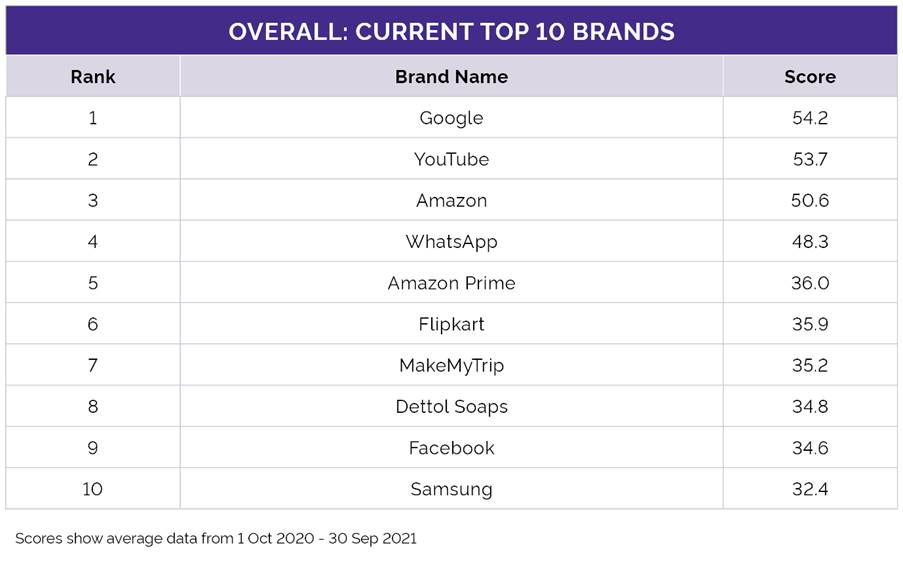
    Global internet-based market research and data analytics firm YouGov has announced its Best Brand Ranking. Search engine giant Google is the top-ranked brand in YouGov’s 2021 Best Brand Rankings for India for the third consecutive year.


    Google is followed by YouTube which is at #2 this year as well. Both WhatsApp and its parent brand Facebook recorded a decline to their scores over the past year, moving down one place and three places to fourth (48.3) and ninth (34.6), respectively.


    Technology giant Amazon moved up to third despite noting a decline in its year-on-year brand health score. On the other hand, Amazon’s video-on-demand streaming service Amazon Prime strengthened its brand health perception over the year, making an entry into the top ten list in fifth.


    Another new entrant in the list is Samsung. The technology behemoth has made large strides over the past year, securing itself a place in the 2021 top ten rankings.


    E-commerce major Flipkart has moved up three places in the rankings to sixth (35.9), with a marginal improvement (of +0.6 points) in its year-on-year brand health score. MakeMyTrip has also moved up one place to seventh (35.2) despite witnessing a decline (of -1.9) in its brand health score compared to last year.


    Dettol Soaps completes the Top 10 list, consolidating its position amidst the pandemic, climbing up two places to eighth in the 2021 rankings .


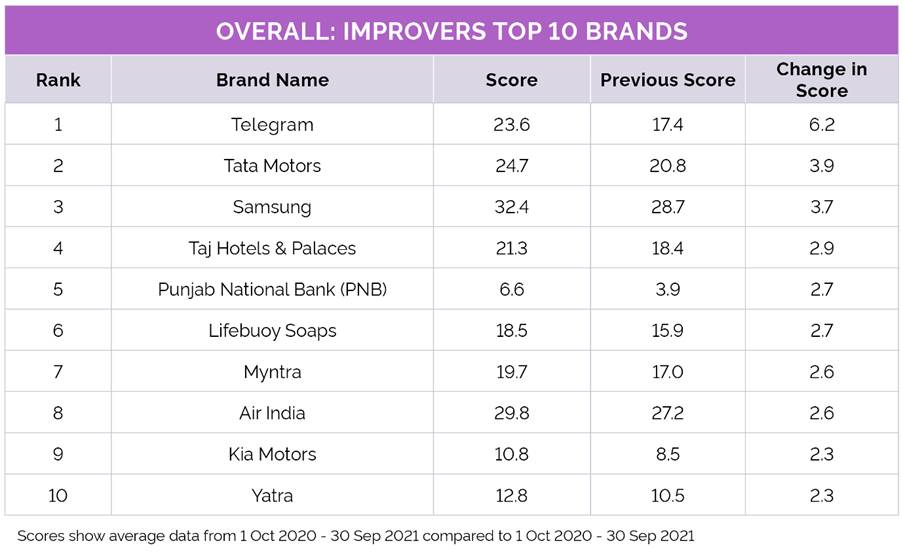
    The rankings also show the brands which have improved the most over the past 12 months. Telegram is the most improved brand of the past year, with a change in score of +6.2.


    Tata Motors is second (+3.9) in the list of improvers, followed by Samsung. Taj Hotels & Palaces took the fourth place, followed by Air India in eighth and Yatra in tenth place, respectively. Punjab National Bank, Lifebuoy Soaps, Myntra  and Kia Motors are other names that complete the list of Top 10 improvers in India.


  • Google, Facebook to strengthen ASCI board

    By Our Staff


    The Advertising Standards Council of India (ASCI) has announced two new appointments to add to its digital expertise as part of its vision for the future. Aditya Swamy, Director of Google India, has been appointed to the board of governors of ASCI, while Sandeep Bhushan, Head of India Global Marketing Solutions at Facebook has been appointed as special invitee to the board. The appointments also mark ASCI’s fast-widening focus on digital advertising and platforms, which began last year with a partnership with TAM to monitor 3,000 digital platforms for misleading marketing claims, as well as the launch of the Influencer guidelines and influencer monitoring through an AI platform.


    Said Subhash Kamath, Chairman, ASCI: “‘I’m delighted to welcome both Aditya and Sandeep to the board, this is a landmark moment. As we strengthen our roots in the digital space and streamline its functioning, it is extremely important that we collaborate with and learn from the leaders. Google and Facebook are the biggest digital players. We look forward to them helping us become a better conscience keeper of the industry.”


    Added Manisha Kapoor, Secretary-General, ASCI: “Having Google and Facebook on our board is a great start to the new journey ASCI is embarking upon. It is vital for us to have a keen understanding of digital operations. We will benefit greatly from the expertise that both these companies bring with them.”


  • Identity Crisis within Social Media

    Image courtesy: https://anchordigital.com.au/


    By Indrani Sen


    Indrani SenThe discussions about the identity crisis faced by the users of social media, particularly the younger generation, started almost from the inception of social media. Lately researchers, academics and industry watchers have been talking about other identity crisises within the social media. The first crisis relates to managing one’s identity on the internet across various work related and social media related accounts/ apps and it is often said that if a person has more than a dozen of such accounts with different IDs and passwords then the person needs a ‘password manager’. A movement has ben going on for some time advocating for an unique identity per every consumer on internet which will enable them to acces all internet accounts with the same ID and password. However, this may lead to a breach of trust between consumers and their individual internet accounts as all personal information shared by them on any account can be accessed through their unique identities.


    The second crisis is the intense identity aggregation of consumers by Google and Facebook which has started pushing some internet users from the two giants to other anonymous platforms. For the purpose of marketing through their networks Google and Facebook create such aggregated buckets of identities which many consumers find unacceptable.


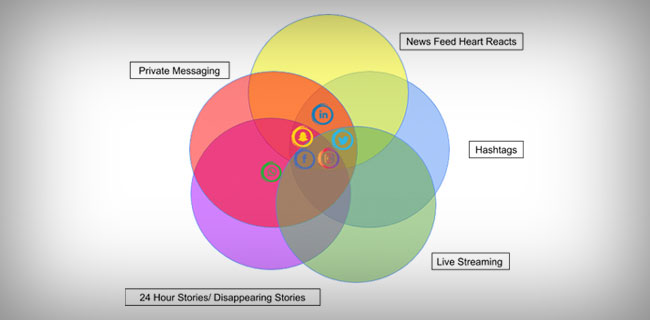
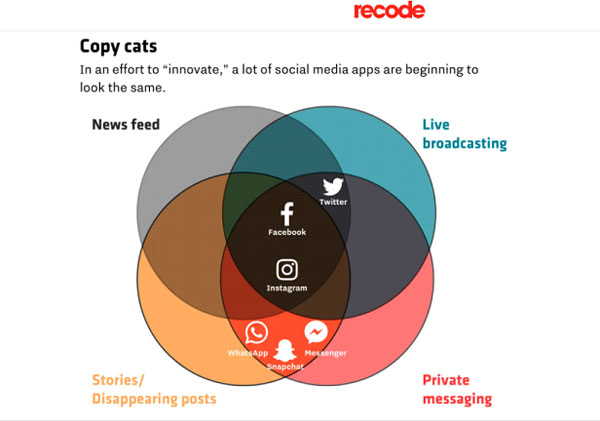
    The third and perhaps the biggest crisis is the loss of identity of different social networks / apps which has emerged during the last 5 due to the blatant copying or adopting of features of another social network. Last week I listened to an interesting podcast on www.emarketers.com talking about “…. what Facebook has become and is trying to be, what to make of social media platforms looking more and more alike, and which of these “copycat” moves might strike gold. We then talk about the significance of Nextdoor going public, how India’s social media content liability laws could impact Twitter (and others), and some changes as to what advertisers can, and can’t, do on social media.” The podcast can be accessed through the following link https://www.emarketer.com/content/podcast-facebook-and-social-media-identity-crisis-twitter-liability-retouching-ads?ecid=NL1009.


    Source: https://www.vox.com

    There is an extensive list of services/ features which have been copied since their introduction in one social media platform by others. In 2010 Instagram launched with the feature “double tap to heart react”. Instagram copied Snapchat’s stories feature first which was followed by Facebook adopting the same application from Instagram. In 2012, Facebook acquired Instagram and adopted the “heart react” feature from Instagram. In 2015, Twitter replaced it “star react” feature with “heart react”. In 2019 Linkedin introduced a set of “react” features including the “heart react”. There are many more such examples.


    In the digital age, we have seen a shift of power from organisations to consumers which has been labelled as ’transformed consumer contexts’ by Neil Perkin and Peter Abraham in their book titled Building the Agile Business Through Digital Transformation. Consumers once experiencing once a satisfactory service or a tool on a social network, expect the same capability from all other social media networks. As a result, this trend of extensively copying from each other has started in the social media sector for winning over the consumers. This trend has attracted lot of criticism as it is becoming increasingly difficult to differentiate among the social media platforms, but no immediate solution for countering this trend is in sight for reversing the identity crisis within social media.


  • Dentsu publishes guide for web tracking and privacy

    By Our Staff


    The media arm of Dentsu international published the first in-depth review of a cookieless future in the wake of recent Google announcements and timelines. The Cookieless World: A Guide for the New Era of Digital Marketing provides a deep dive into the impact on brands due to major changes in web tracking capabilities and enhanced privacy legislation. It will explore a range of areas including Data Management, Audience Activation & First-party Data Usage, Performance Measurement and Preparing for the Deprecation of Third-party Cookies.


    Last week, Google reset the clock for supporting cookies within its Chrome internet browser. The new report from Dentsu explores the knock-on implications for both consumers and brands, as well as the solutions its media agencies Carat, iProspect, and DentsuX can leverage to support the change.


    On launching the report, Rohan Philips, Global Product Officer, Media, Dentsu international said: “Across the globe, 91% of consumers are concerned about the amount of data companies can collect about them and 42% have taken steps to reduce the amount of data they share online. So, it’s no wonder all eyes are focused on this fundamental change in the way we all operate on the web. We now have the time and opportunity to make sure what comes next is the best solution it can be for our clients. With such a major upheaval to the long-established status quo, we understand there’s uncertainty and a lot of questions. The Cookieless World report is there to provide answers for marketers who need to wrestle with the big challenges facing their brands now and in the coming years.”


    Prerna Mehrotra
    Prerna Mehrotra

    Added Prerna Mehrotra, CEO, Media, Dentsu Asia Pacific: “With the most popular browsers ending support for third party cookies and the rise of other types of tracking prevention, the ability for brands to target consumers and measure campaign effectiveness will be impacted. This, coupled with the rise of global and local privacy legislations, will significantly change the fabric of digital marketing in the coming future. Brands will now need to relook at how they engage people online, while limiting some of the most widespread digital marketing tactics, such as personalised 1:1 targeting. The time is ripe for brands to rethink the next lap of their marketing practices.”


  • Zirca Digital Solutions becomes certified Google Partner

    By Our Staff


    Zirca Digital Solutions is now a certified Google partner to offer digital solutions to upscale its offerings.


    Said Karan Gupta, Managing Director, Zirca: “We are thrilled to announce this partnership as the team had worked really hard for this. We have vested in using the technology and platforms to help extend quality solutions to all our clients. With the rapid move to online platforms, we are looking for more meaningful ways to bring outcomes and strive for growth. This is a huge game changer for us and the kind of services we provide to clients”


    Added Neena Dasgupta, CEO and Director, Zirca Digital Solutions, added: “At Zirca, we always put our best on knowledge, research and insights driven decisions. Our google partnership reflects our commitment towards delivering smarter and holistic solutions to our partners. Zirca will always strive to present the industry and consumers with insights that will help them make better business decisions.”


  • Google is Most Valuable Media Brand


    By Our Staff

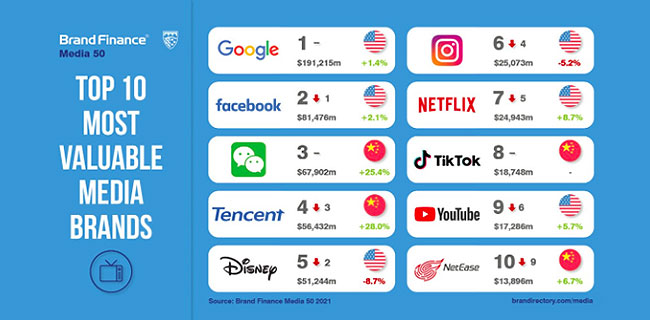
    Search engines included in Brand Finance’s annual ranking of world’s most valuable media brands for first time, with Google claiming top spot – brand value nearly US$200 billion. TikTok breaks right into top 10 most valuable media brands after its first brand valuation. Social media and gaming brands among fastest-growing in ranking, with Chinese newcomers Bilibili and Huya improving most – at 106% and 74% respectively. TV networks and film studios suffer in wake of pandemic – CBS fastest-falling brand in ranking, losing half of brand value over last year. WeChat named strongest media brand with elite AAA+ rating, while Facebook struggles to overcome reputational issues.

    View the full Brand Finance Media 50 2021 report here

    For the first time, search engines are included in Brand Finance’s annual ranking of the world’s most valuable and strongest media brands, with Google claiming the top spot, following a 1% increase in brand value to US$191.2 billion.

    Technology has become an integral part of all businesses, so Brand Finance has reclassified brands into the industries they are revolutionising. As a search engine, most of Google’s revenue is derived from advertising, leading to its inclusion as a media brand and the extension of the Brand Finance Media ranking to include 50 brands this year.

    Google also owns the majority of internet advertisement infrastructure – controlling about 90% of search ads, managing the main ad exchange and server, running popular browser Chrome, and dominating smart devices with its Android operating system. Moreover, it manages widespread data centres, as well as a large portion of the cloud, which is where most of the ad dynamics occur. In addition to capitalising on ad spend, Google has since expanded into a variety of fields such as hardware, entering the smartphone industry by releasing the Pixel, its first handset.

    The addition of search engine brands to the Brand Finance Media 50 2021 ranking follows expansions in previous years including streaming platforms, gaming brands, and social media as they continue to grow and carve out their own place in the media market, shifting the balance away from the networks, film studios, and publishers before them. Five further search engines feature in the extended ranking this year, with Yahoo! placing second highest after Google in 13th position with a brand value of US$9.4 billion.

    Said Richard Haigh, Managing Director, Brand Finance: “Significantly better at innovating than its rivals, Google changed the marketplace of search engines, spearheading the digital media revolution in a way that distinguishes the brand above all others. No better indicator of this is the fact that the name Google has become a verb – ‘I’ll Google it’ is quite arguably one of the most widely used phrases of the 21st century.”

    TikTok (known in China as Douyin) enters the Brand Finance Media 50 2021 ranking for the first time with a brand value of US$18.7 billion, launching into the top 10 most valuable media brands in 8th position.

    Another Chinese video sharing platform Bilibili has gained more in brand value than any other brand in the Brand Finance Media 50 2021 ranking, with an impressive 106% increase to US$1.9 billion. Despite being known for its cache of video content, Bilibili draws a large portion of its sales from smartphone games, which accounted for 40% of its revenues in 2020 versus over 70% in 2018, indicating an attempt to diversify its revenue stream. In the first quarter of last year alone, Bilibili reached 172 million Monthly Active Users (MAUs), placing it in the same class as video services operated by Tencent (up 28% to US$56.4 billion).

    Video game publisher Huya is the ranking’s second fastest-growing brand with an impressive 74% increase in brand value to US$1.6 billion. The brand celebrated an uptick in MAUs at the end of last year – reaching a total of 178.5 million people – as well as a boost to advertising revenues, primarily driven by its expanding and diversifying advertiser base.

    Other gaming platforms that performed well this year include South Korean NCSoft (up 68% to US$2.2 billion) and Kakao (up 49% to US$1.8 billion), as well as Activision Blizzard (up 20% to US$6.3 billion) and Electronic Arts (up 14% to US$4.4 billion).

    COVID-19 has exacerbated the widening gap between traditional media brands, with TV networks and film studios facing an uphill battle against online competitors. This is best exemplified by CBS being the fastest-falling brand in this year’s ranking, with a 49% decrease in brand value to US$5.9 billion, following a dramatic drop in advertising revenue and a disastrous merger with Viacom. However, CBS is not alone in its struggles, with NBC (down 44% to US$8.4 billion), 20th Television (down 25% to US$6.1 billion), and Universal (down 21% to US$11.6 billion) all seeing considerable declines in brand value as film and television production was halted.

    Comparatively, Netflix enjoyed a spike in usage, causing its brand value to increase by 9% to US$24.9 billion. Netflix has been a pioneering force in changing consumers’ viewing habits, taking over traditional television by providing a more appealing, flexible option in line with the modern fast-paced lifestyle. With 37 million new users by the end of 2020, Netflix’s success has driven improved revenue forecasts and brand equity scores. Despite this, the streaming platform’s growth was not as substantial as in previous years due to challenges posed by competitors such as Disney (down 9% to US$51.2 billion) and HBO (down 3% to US$4.0 billion), which recently started offering streaming services in a bid to remain competitive.

    Riding the airwaves of media revolution to offer more personalised, online consumer experiences, Spotify enjoyed an impressive 39% boost in brand value to US$5.6 billion. The music streaming platform has seen a significant increase in new users over the past year after expanding operations into 13 new markets. Spotify is now primed for further success as it continues to develop its capabilities, signing exclusive podcast contracts with Archie Comics and Joe Rogan, and acquiring Megaphone from Graham Holdings to improve its own podcast technology.

    Added Richard Haigh, Managing Director, Brand Finance: “Podcasts are one of the primary motivators for listeners to upgrade to paid subscriptions on music streaming platforms, with the global podcast industry expected to grow by nearly 30% over the next five years. With these forecasts, and rivals already showing market intent, Spotify’s reign as the leading music streaming brand will be difficult to maintain.”

    WeChat is the world’s strongest media brand with a Brand Strength Index (BSI) score of 95.4 out of 100. One of the world’s most popular social media apps, WeChat is also the strongest brand globally, according to the Brand Finance Global 500 2021 report, and one of only two brands in the media ranking to have been awarded the elite AAA+ brand strength rating, the other being Disney with a BSI score of 89.7 out of 100.


    Alongside revenue forecasts, brand strength is a crucial driver of brand value, and as WeChat’s brand strength grew, its brand value also enjoyed a rapid boost, increasing by 25% to US$67.9 billion. One of China’s home-grown tech successes with very strong equity, WeChat enjoyed high scores in reputation and consideration among Chinese consumers – according to Brand Finance’s original market research – successfully implementing a broad and all-encompassing proposition that offers services from messaging and banking, to taxi services and online shopping, becoming essential to many users’ daily lives.

    Said Richard Haigh, Managing Director, Brand Finance: “A beacon of innovation, WeChat has shown the value of constantly striving for technical development, particularly in the face of adversity. Though the company has done exceptionally well this year, lower levels of enthusiasm among younger adults in China may be a warning flag. It will be essential for WeChat to keep up its momentum to achieve similar successes in the year ahead.”

    In stark contrast, social networking site Facebook trails behind WeChat by almost 20 BSI points, scoring 77.0 out of 100. With 2.8 billion active monthly users, Facebook remains the most popular social media platform in the world. Despite recording a marginal increase in brand value and placing second overall in this year’s ranking, Facebook has battled widespread scrutiny over privacy issues and suffered significant reputational damage in the wake of several political and social scandals, ultimately damaging its brand strength.

    With an even lower BSI score of 72.5 out of 100, Twitter’s brand strength is similarly dented by issues with consumer trust and reputation. In the past year, the platform faced intense scrutiny over its handling of Donald Trump’s account, sparking raucous debate surrounding freedom of speech and accusations against the former US President for allegedly using the platform to incite violence and spread fake news.


  • KPMG & Infomo announce partnership to fight FB-Google duopoly

    By Our Staff


    KPMG in India and Infomo today announced its alliance to develop digital advertising solutions for enterprises and large publishers utilising the InfomoR3- a sell-side adtech platform.

    Notes a communique: “The current programmatic digital marketing value chain is currently plagued by ad-fraud and privacy issues (user data abuse). The KPMG in India – Infomo solution transfers total control back to the sell-side stakeholders and is a transparent real time alternative to advertisers and agencies.”

    Speaking about the partnership, KPMG in India’s Head of TMT sector- Satya Easwaran, said that as “digital marketing gains centrestage in advertising arena, publishers will need to strengthen their technology footprint to ensure there is a direct connect between the advertisers and the target audience. KPMG in India – Infomo solution, aims to do just that by providing performance marketing opportunities to advertisers.”

    Added KPMG in India’s head of Digital Consulting practice Akhilesh Tuteja: “KPMG in India-Infomo digital marketing solution is a comprehensive solution, which aims to maximize the effectiveness of digital interactions. It offers win-win outcomes to all the members of the ecosystem and including large publishers, enterprises, telecom carriers and consumers. The solution is innovative and enables direct interaction and engagement with advertisers, agencies, channel promotions and campaigns through digital channels.”

    Said Harsha Razdan, KPMG in India Head of Business Consulting practice: “By leveraging our telecom and media experience, we believe we can assist clients with their digital transformation journey enabling them to take control over pricing and monetise performance marketing opportunities.”

    Added Infomo Founder & CEO Ananda Rao: “By working closely with KPMG in India we address two critical components in our solution set that we offer, Strategy and Managed Services that will enable telecom operators and publishers to monetise their first party data but also offer new offerings to its enterprise and SME customers.” Speaking of the current limitations faced by the industry Rao said: “Advertisers in the digital world require extensive audience reach, known audience targeting, and measurable audience engagement. Our partnerships with telecom carriers and leading publishers around the world provide advertisers access to massive known audiences. Our platform provides a range of new and powerful capabilities enabling sell-side stakeholders to directly enable their inventory buyers to directly interact and engage the known consumer bases they bring to the table within the value chain.”