Tag: Google+

  • Kotak partners Google to unveil Querimetrix

    By A Correspondent


    Kotak Institutional Equities, a division of Kotak Securities Limited, in collaboration with Google launched Consumer Querimetrix — a tool that demystifies and predicts near-term Indian consumer behaviour by analyzing Google Trends data.


    Using machine learning techniques and merging big data from Google Trends, the first edition of Consumer Querimetrix provides consumer insights into India’s evolving car buying journey. Using Google Trends data, the tool enables ‘nowcasting’ (near-term predictions) on consumer activity, capturing inflection points earlier than traditional forecasting tools to give a complete picture — on car launches, last mile hiccups, cannibals and competition.


    Each edition of the Consumer Querimetrix series will focus on consumer behaviour in a different industry.


    Launching the report, C Jayaram, Joint Managing Director, Kotak Mahindra Bank said, “The digital wave is challenging conventional business practices across industries. Ground rules are evolving rapidly along with the consumer and those in the business of business intelligence need new tools to keep up with the changing landscape. Consumer Querimetrix is our step in that direction. Today, the sheer volume of consumer-centric search data available presents a tremendous opportunity to analyze and throw up actionable insights. These takeaways would be useful to both companies and investors. KIE research is highly valued by our clients and the launch of Querimetrix will further strengthen our ability to cover the Indian markets in a holistic manner.”


    The first edition of Consumer Querimetrix which focuses on the passenger car segment highlights the extent to which the Internet is altering the ground rules for vendors of cars and allied products/services. With growing access to easy information online, the Indian car buyer’s journey from a whim to final purchase has changed dramatically. More than 75 per cent of car buyers are researching online for reviews, comparative specifications, financial products and used car markets before making a purchase. The first edition of Consumer Querimetrix also explains how the traditional ‘funnel’ model is giving way to a more complex purchasing path where ‘initial consideration’ may not always guarantee sales.  Although higher auto-related searches correspond to higher demand for cars, this does not hold true on a brand-wise basis.


    Speaking about the trends for the passenger cars industry captured by analyzing Google Trends, Vikas Agnihotri, Industry Director, Google India said, “With over 300 million Internet users online and growing, India today has a sizeable population which accesses the Internet on a daily basis, making search queries as the most dynamic data input to arrive at consumer insights through machine learning as illustrated by Kotak’s research. If we look at the search trends related to car finance and car purchases, we’re seeing a 40% year on year growth in car purchase queries on Google in India. Over half of the people who evaluate car purchases change their consideration set during their research phase – adding two to three new car models in their consideration, the only non-negotiables are price and color of the car. This alone proves the growing complexity for car OEMs in the country. With this report we’re attempting to demystify this changing consumer behavior into actionable insights for the industry.”


    Saifullah Rais, Quantitative Analyst at Kotak Institutional Equities and the architect of Consumer Querimetrix said, “In the absence of conventional rules, traditional decision-support systems are not very effective. They fall short on scalability and adaptability. Machine learning algorithms learn from data and do not rely on explicit rules, making them the most effective method of dealing with data explosion.”


    The Consumer Querimetrix report outlines the influence of digital marketplaces and calls for carmakers to reassess conventional business practices. The effect is visible as car loans are increasingly being sourced outside dealerships. This trend can eat into financing margins earned by dealers and hurt profitability. On the other hand, carmakers with captive finance arms can use this opportunity to innovate and differentiate themselves during the evaluation process.


    The first issue of Consumer Querimetrix establishes that Google search volumes can be used as a gauge for assessing new car launches. The report underscores the linear relationship between search interest and advance bookings during a car launch. Interestingly, higher traditional media spends do not always guarantee higher search interest.


  • ZenithOptimedia and Google to host Zoogle Day on Feb 4

    By A Correspondent


    ZenithOptimedia Group and Google have partnered to present Zoogle Day, a first of its kind event on digital and mobile marketing. The event will unfold on 4 February 2016 at Le M’eridien, Gurgaon.


    The ZenithOptimedia leadership, along with top executives from Google will share learnings, insights and case studies where brands have taken the lead in a mobile inevitable world. Some of the subjects that the summit will focus on includes how mobile commerce is shaping up sectors such as banking insurance and telecom, how data driven planning driving programmatic, top trends in ecommerce, the success story of Alibaba and other future-facing business models that are reaping the benefits of a digital economy.


    The conference will also have a key address by Craig Greenfield, Chief Operating Officer of Performics Worldwide. Since 2005, Craig Greenfield’s expertise in scaling large client programs and developing company-wide processes and this has helped Performics successfully transition into the first truly global performance marketing agency. In his current position, Craig leads global technology and innovation; a dynamic network of change agents focused on identifying, evaluating and developing new products, services and systems to ensure competitiveness and improved operational efficiency.


    Craig works in tandem with Performics’s worldwide leadership, client teams and external partners to help clients identify and capture new business opportunities, negotiate strategic partnerships and enhance operational efficiency.


    Anupriya Acharya, Group CEO, ZenithOptimedia said, “ZenithOptimedia and Google host Zoogle Day in many top markets around the world and we are very excited to bring this premier event to India. Given the way mobile is increasingly shaping consumer behavior and commerce, we felt this is an opportune time for us to hold this event. Both ZenithOptimedia and Google are leaders in mobile marketing and have valuable lessons and insights to share on the transformation that India is witnessing.”


    Tanmay Mohanty, Managing Director of Performics and Resultrix says, “We share a long fulfilling relationship with Google and this event cements this relationship further. They, like us, are driven by the Live ROI philosophy, and have unique data driven insights that help clients derive sizeable share.”


    Punitha Arumugam – Director Agency Business India and SEA, Google says “With an estimated 5mn smartphone users being added very month, India’s online populations is expected to cross 500MN by 2018. The Zoogle day chapter we are extending to India is tailored to this reality and will address the mobile and commerce future of this market.”


  • GroupM brings back online Diwali mela with Google

    By A Correspondent


    Following the success of the 2014 edition, GroupM along with Google is bringing back India’s largest online Diwali celebration. This year, the online festival initiative has a new title sponsor in Askmebazaar.com. The other brands to come on board are Lakme, Horlicks, Kurkure and Hungama.com renewing their partnership with the Grand Diwali Mela and new partners Eno and Godrej Securities.


    Last year, the Grand Diwali Mela received over 5.5 million visitors in a course of 30 days. Over 150,000 samples were shipped across India, with 70 percent sample orders going to Tier 2 and Tier 3 towns. The samples ranged from make-up, skincare and household products.


    On the second season of the Grand Diwali Mela, CVL Srinivas, CEO, GroupM South Asia said, “After the success of the ‘Grand Diwali Mela in year one, we are excited to bring the online festival back again this year. With a clear focus on taking the festival to not just metros, but also Tier 2 and 3 towns, where the mobile phone is their window to the world, GroupM and our partners are integrating traditional print, TV and radio with mobile and digital marketing.”


    Said Punitha Arumugam, Director Agency Business, Google SEA & India: “As more and more consumer products companies embrace the internet to drive sampling and consumer engagement, we’re delighted to partner Group M to scale this initiative further and help brands make the most of the opportunity online.”


  • Zee TV introduces voting through Google

    By A Correspondent


    Through its strong presence across social media, smartphone apps and innovations in the voting mechanism of its reality shows, Zee TV continues to be at the helm of digital innovation in the Hindi GEC space. This year, Zee is set to introduce yet another exciting voting mechanism as DID Season 5 enters its voting phase. For the first time, viewers will be able to vote for their favorite reality TV contestant through Google search.


    With the idea to make voting easy, technology-friendly and progressive, the channel has introduced a search-based mechanism that will only simplify the voting process of Dance India Dance Season 5. All one needs to do is go onto Google and just search for DID5 and just vote for a favourite contestant on the voting panel right below the search bar. Each Google account is permitted 20 votes per week to either one or many contestants. Starting Saturday 19th September, the mechanism will be active from 9pm on Saturday till Tuesday 8am every week.


    Sorbojeet Chatterjee, Marketing Head ZEE TV said, ‘With rapid penetration of smartphones and the growing digital audience, we are always trying to raise the bar in terms of engagement and DID Dream Team and Google Voting is testimony of Zee TV being ahead of the curve! With each successive season of DID the objective has been to simplify the voting process for our consumers. The innovation on a global platform like Google will not only encourage wider participation but also give them an enhanced brand experience. We are pleased to associate with the extremely committed team of Google for the cutting-edge thought and a quick turnaround for the same.”


    James Rothwell, Head of Social Marketing, Google Asia Pacific said, “We’ve partnered with ZEE TV  to launch Google Search Voting platform in India through the show Dance India Dance and you can vote for free, for your favorite contestants on Google from your phone, tablet, or desktop.”


  • Tata Trust & Google team up to launch ‘Internet Saathi’

    By Dyanne Coelho


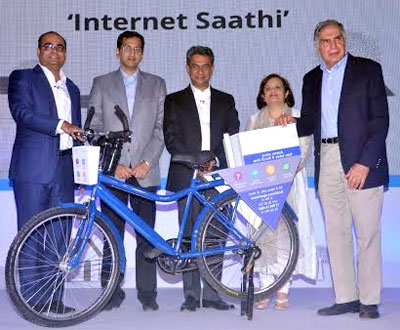
    Sandeep Menon, Country Marketing Director, Google, R Venkataramanan, Executive Trustee, Tata Trusts, Rajan Anandan, VP and Managing Director, Google South East Asia, Debjani Ghosh, Vice President SMG, Managing Director – South Asia, Intel & Ratan Tata, Chairman, Tata Trusts

    There was a time when one had to wait at least seven years to get a phone. Ratan Tata, Chairman of Tata Trusts, certainly remembers that time, and also acknowledges how far we’ve come today with the use of technology. Tata brought this up at the launch of ‘Internet Saathi’, an initiative put together by Tata Trusts and Google, and aimed at empowering rural women and their communities to use the internet to enable development. In fact, the initiative aims to bridge the rather large gender divide as well, when it comes to the use of technology.


    Studies show that only 12 per cent of internet users in rural India are women, according to Sandeep Menon, Country Marketing Director, Google.  said. He highlighted a study carried out in rural India to understand what it is that stops women from using the internet. The key findings were trouble knowing how to use it, the question of what’s in it for them, and lack of a point of access. “While women in the urban areas are making rapid progress using the internet, women in rural areas are getting left behind,” Rajan Anandan, VP and Managing Director, Google South East Asia pointed out.


    With enough statistics in hand to understand the urgent need of women empowerment in the rural areas, vis-à-vis technology, the team has designed a cart, built on the back of a cycle – akin to India’s traditional distribution system which is used to carry everything, from ice-cream to industrial supplies. The cart is fitted with internet-enabled Android One devices, tables and portable chargers, keeping in mind power cuts in many villages. Women will be trained to use these devices, but Menon highlighted that that is the most important thing as the women are curious to know more. “We’ve realised that all we need to do is spark curiosity, and then the women automatically take an initiative to learn the rest themselves and to teach others in the village as well,” he added.


    Debjani Ghosh, Vice President SMG, Managing Director – South Asia, Intel, quoted a UN report which said that across the world, about 25 per cent fewer women than men are using the internet, and the biggest reason for this is that women believe that it is not meant for them. Incidentally, Intel has been a long-term partner of Google India’s Helping Women Get Online (HWGO) initiative.


    Internet Saathi is set to kick off from Gujarat, Rajasthan and Jharkhand, and will eventually be rolled out across the country. It plans to reach 4, 500-odd villages and five lakh women and rural communities over the next 18 months. The internet cart will be available in the village for a minimum of two days every week for over a period of four to six months. It is aimed at creating awareness and will provide adequate training for using the devices. Once the cart has completed the training in a cluster of three villages, it will be moved to the adjoining cluster to complete a similar cycle. The initiative has roped in local self-help group federations and NGO members to help with the training programme.


    While many women in the rural areas still cannot read the language they speak, they use the internet to watch cooking videos or other such material that they find interesting, Ghosh explained, talking about previous initiatives undertaken in the rural areas.


    Asha Devi and Vimla Devi belong to a village called Varkheda in Rajasthan, and were present at the event. Clearly excited about the initiative, they said: “We will be able to get information that earlier we had to go to the city to get.” Added Vimla: “Even after they leave, we teach the other women [how to navigate the internet] and we try to spread the word.”


    “We have a commitment to educate [people] and create prosperity in the villages of India, and we will address it through education and expanding the knowledge base,” Ratan Tata said. “Philanthropy has changed in India over the years. Today, India is a different nation and people demand self-respect and want to be capable of enabling their own livelihood. There is a keen desire to be a part of the world that is today, not the world of yesterday. Digitisation is not only about opening up [a new] India to people, but it’s about connecting them to the rest of the world.” What better way than with the Worldwide Web.


  • HUL partners Star, YRF, Facebook, Google etc to weave its brands into their creations

    By Pritha Mitra Dasgupta & Sagar Malviya


    Toiletries-to-food giant Hindustan Unilever (HUL) is partnering over a dozen content creators — from Star Network and Yash Raj Films to Facebook and Google — to produce content across channels where HUL brands can participate, perhaps subtly, as part of the conversation.


    Last Friday, the maker of Dove and Rin invited 13 producers including broadcasters, radio channels, film producers and top-notch digital companies to its campus to ideate how they can seamlessly weave HUL brands in their content, messages and shows, instead of just product placement and brand plugs.


    “As media is changing, there is a skill that needs to get evolved — as content explodes, how to tell compelling brand stories and really cut through to consumers by making sure the brand is able to tell a story that consumer can relate to,” said Gaurav Jeet Singh, HUL’s head of media services in South Asia.


    While the latest move of HUL, the country’s largest advertiser, won’t replace advertisements, the company is trying to partner media channels beyond obvious marketing. “Through popular culture, how can we ride on content that is designed to entertain, engage and connect? Something that is not force fit. But something that naturally fits into the content and can carry the brand story seamlessly,” explained Singh.


    HUL’s media agency, Mindshare, is a partner in the initiative. “As the consumer’s media consumption habits change, we understand the need to create and curate differentiated communication platforms, to build lasting brands with an engaged audience,” said Prasanth Kumar, chief executive of Mindshare.


    “The consumer is no longer a passive viewer, but an active participant in the brand’s story-telling journey. Brand ideas and content that resonate with the audience are further seeded by them into their own circle of influence that has a far more powerful effect,” Kumar said.


    With over 35 brands across food, personal care and home care portfolios, cutting through structures and processes to execute an idea quickly becomes an issue. Hence, the company through ‘Content Day’ encourages brand team members to share ideas which can be approved or perfected quickly so as to become scalable.


    It wasn’t easy. In the last six months, HUL has been working on the novel concept — from identifying nearly a dozen brands to sending briefs to 35 content creators for ideas. The company that initially received around 300 ideas, narrowed it to 40 with 13 companies meeting individual brand teams on Content Day for possible brand integration.


    Two ideas from Star Network and one each from YRF and Disney made it to the top four, which were presented to the top management and the entire marketing team of HUL. “We want to create a strong ecosystem of for branded content as that is crucial to the future of marketing,” said Samir Singh, HUL’s executive director-personal care.


    Sample this. In the latest blockbuster Piku, while there were several brand integration, there were two that particularly stood out: Amul milk and Red Label tea. Both these products were placed on the dining table when the protagonists in the film were having breakfast and they effortlessly became part of the movie scene.


    “But they can be part of song lyrics, movie title, we can co-create product with the company and integrate the brand in several other ways depending on the marketing objective,”  said Ashish Patil, business & creative head and vice president at YRF. “The unique thing about Content Day is that it is not a random one off project, but HUL wants to make it an annual event. And, it’s a cultural shift for them. It is about looking at content differently, as an important marketing tool. And it is about infusing new thinking which they or their ad agency may not be geared to do,” he said.


    While executing ideas into branded content could be challenging, media partners are hopeful that HUL’s move will break the clutter. “There was no strict brief and it was unstructured and gave us a lot of freedom to do as we thought. It was a proactive and innovative idea. This is an opportunity that is more open about possibilities of collaborating across brands,” said Myleeta Aga Williams, MD of BBC Worldwide.


    Source:The Economic Times

    Copyright © 2015, Bennett, Coleman & Co. Ltd. All Rights Reserved

    Licensed to republish


  • Your phone is a surveillance device, your ISP a surveillance provider…: Pranesh Prakash

    By Dyanne Coelho


    “In India there is no special privilege for journalists over ordinary citizens,” Pranesh Prakash, Policy Director at the Centre for Internet and Society began at the workshop entitled ‘Digital Security for Journalists’ organised by the Mumbai Press Club and the Centre for Internet and Society.


    “Even if you don’t care about your own security/privacy, think about you sources. Your sources want privacy,” Prakash said as he began the workshop on how to assess security threats, how to protect sources and how to prevent your ISP from leaking out information. With the growth of the internet since the 1980s, we know we can’t trust everyone; police stations, governments, all engage in surveillance of some sort, he pointed out. Prakash went on to explain the ‘Threat Model’, wherein journalists ought to ask questions like what are you protecting, who are you protecting yourself against, what do you hope to achieve and to what lengths are you willing to go?All of the measures you are going to take to protect your source are going to be inconvenient. Security is always at the cost of convenience he reiterated.


    Data threat can be intercepted at two levels, Prakash explained; data in transit and data at rest. The important question to ask is which you wish to secure, because the means to secure both are very different.Emails being sent to someone can be intercepted by an outside source in transit. It is easier to secure you own data on your computer, but an email is so much more difficult to secure because there are multiple points where the information is stored. Targeted surveillance is much more difficult to protect yourself against than mass surveillance.


    For WiFi, password protected networks form an encryption, one more barrier to protect you. However, a WEP encrypted network is easy to break through. You need at least a WPAII to be secure enough. Airport networks usually ask for a password after connecting to the WiFi. That too is easy to see through. Avoid using these networks for sensitive work.


    One must keep in mind who they want to secure the data from; whether from a casual threat or an Intelligence Agency like the National Security Agency (NSA), National Technical Research Organisation (NTRO) or Intelligence Bureau (IB).Mass surveillance or non-targeted surveillance is not legal in India. However. the NTRO engages in mass surveillance, for which it was criticised in a Mint article, following which they shifted only to the national borders for surveillance. It is also possible for the NSA to tamper with your laptop before delivery.The NSA’s ANT catalogue has been working on a technology that has a device that can fit within the connector that connects to your keyboards and it can last there years and years without detection. Hence Prakash suggests that if a journalist is working on a sensitive story that if leaked could cause a ruckus, he/she would be safer buying a new computer and paying for it in hard cash.


    The more important a source is, the less you must use your phone, Prakash pointed out. Phones leak information time and again, information of time and location. The NSA uses it, the police use it. If you are meeting with someone and you both have your phone, then information that you have met is transmitted. Even without GPS it can track your location, when you receive/send a call/message, as your mobile network needs to access the cell tower you are around in order to reach you.


    Encrypted emails still leak identities. If the police look into an encrypted email, they will still know who you are communicating with. Background information you are doing on a story can also give away a lot you don’t want to be given away. Even with an encrypted email, they have access to your location, IP address, the sender and the receiver of the email, time stamp, Mac id and IMEI.


    End-to-end encryption is the way out here.This means that no one in the middle, including the company can read the emails you send from your company server. End-to-end encryption is the most inconvenient. End-to-end encryption means that you and the party concerned need to come up with a code that the other party needs to be able to decrypt. The software both parties use also needs to be compatible.


    “I recommend using WhatsApp over Viber and Line, Skype over other alternatives and Twitter is also safe, but never use Facebook for sensitive conversations that you don’t want to get out,” Prakash said. WhatsApp is safer than normal text messaging he points out. Prakash recommended an app called Conversations to use for messaging on your phone. It is safer than both normal SMSing and WhatsApp. An SMS leaks metadata, he explains, that’s why it is preferable to use data or apps that use the internet.


    In the 2G network space, only Airtel and Docomo use at least a weak encryption.All the rest use no encryption. Anyone can snoop in on your conversations. Instead one must use data-enabled apps for calling like RedPhone, he suggested. This is a great way to protect your source.


    Most people are known to repeat passwords for various accounts. Never repeat a password, Prakash advised. Maintain different passwords for all your accounts. It is the safest. And if you are unable to remember them all, then use password managementsoftware like LastPass or KeyPass. These enable you to key in and store all your passwords in one place and you only have to remember the password to your LastPass/KeyPass account. But if you forget your master password, then there is no way to recover all your other passwords.


    The session concluded with Prakash working hands-on with the journalists, helping them to download the required software on their laptops and mobile phones. This knowledge is vital for all journalists in order to protect themselves and their sources when doing a high profile, sensitive story, Prakash said.


  • Google partners with brands to launch #TogetherOnline initiative

    By A Correspondent


    In its efforts to gather support for more women to get on the Internet, Google India announced an initiative #TogetherOnline in association with Snapdeal, Axis Bank, HUL and GSK to encourage Internet users to step up and help a women get on the Internet and understand how she can use the web to get ahead in life.


    The nine week along initiative, will see a number of activities across India, starting with a concert with Farhan Akhtar to raise awareness amongst the youth in metro cities. Axis Bank, will host special digital literacy workshops for women customers in their branches across India. And Snapdeal will run awareness campaigns amongst its shoppers and educate women on the entrepreneurial opportunities on their platform. To take the initiative to interiors of India, Google will also launch custom designed 500 Internet carts that will reach out to 5000 locations to engage women in towns and villages across India.


    On the launch of this initiative, Sandeep Menon, Director Marketing, Google India said “Internet has completely transformed the way we live our lives. Everyday people are discovering new opportunities and finding newer and better ways of doing things on the web to get ahead in life. We want to encourage all these users to extend this power of the web to women in India. #togetheronline is an effort to empower women in India with the knowledge of Internet and how they can use it to do different things in their daily lives. We along with our partners will host a number of initiatives to play our part and we invite all Internet users to play their part and help get more women online.”


    In addition, to this Google has partnered with PopXo to cover easy to know & follow steps for day to day living for various categories. The aim of this partnership is to promote digital literacy amongst women.


    Rajiv Anand, Group Executive & Head – Retail Banking, Axis Bank said, “As Axis Bank, progress is a part of our identity, our DNA. And we believe that empowering women is integral to the progress of our society.With the Indian woman today transforming from being a key influencer to a decision maker, it is important for her to be empowered with information. We are proud to be championing this cause in association with Google, to bring knowledge at the click of a button and help get more and more Indian women online.”


    Prashant Pandey, Marketing Head, GSK Consumer Healthcare India said, “The bond between mothers and daughters has always been a unique and everlasting one. From 1896, Horlicks has been helping mothers make their daughters tall, strong and sharp. Today we are delighted to partner Google for their ‘Helping Women Get Online’ – an initiative that encourages daughters to help their mothers go online to stay aware and connected. This is yet another way of saying #LoveYouMaa like our recent digital film celebrating the universal truth that ‘only mothers can give what they don’t have.”


    Google has already introduced a number of initiatives to help get more women online through partnerships with various state governments and outreach efforts in the states of Madhya Pradesh, Tamil Nadu, Maharashtra, Uttar Pradesh and more recently in Andhra Pradesh. Under the initiative, Google has imparted basic Internet training across 950 educational institutes training over 45000 girl students and over 5000 teachers who can continue to educate and inform more girl students across India.


  • Hot, happenin’ and most wanted!


    By N Shivapriya


    Last week, early talks were reported between Google and ad tech firm Inmobi for a possible valuation of over Rs 12,000 crore. Inmobi founder Naveen Tewari later told employees that he was not looking for such a deal. The same day, it was also reported that e-commerce firm Snapdeal was looking to acquire Komli Media, another ad tech firm, for a potential valuation of over Rs 1,800 crore. Flipkart acquired Adiquity earlier this month.


    All this comes in the backdrop of a squeeze in the US. After an early flurry in 2013 and the first half of 2014, the number of ad tech initial public offerings have now dried up. But that hasn’t deterred new firms and existing ones from aiming for a slice for huge spends that are on stake as online ad spend continues to grow on the PC and mobile. It could also very soon enter the universe of wearables.


    inMobi: Going After Mobiles

    CEO: Naveen Tiwari, Employees: 900


    Last month, inMobi said it reached 1 billion unique mobile devices. This is precious real estate in the ad targeting world.


    inMobi connects those that want to sell ad space, like content sites, apps or game developers, with those that want to advertise on the mobile platform. Its technology helps to serve the right ad to the right user. For instance, when you are in your newspaper app you could be shown an ad for a bag you were planning to buy earlier on an e-commerce app. This is a simplistic scenario.


    inMobi builds audience personas and uses various targeting capabilities such as appographic targeting (based on a user’s app preferences) to determine the right user for the right ad.


    When the user engages with the ad by clicking on it, inMobi gets paid. Cost per click or cost per mille (mille referring to a thousand ad impressions) are some commonly used metrics.


    In addition to guaranteed engagement, there could other payment metrics such as guaranteed outcomes. For a game ad, the outcome could be a download, for an auto ad, it could a test drive query.


    A game developer who is an advertiser can also specify the goal of the campaign to be a certain number of high lifetime value users, who download the game and play it frequently by purchasing features such as lives and coins.


    “So as our ad network gets bigger, our knowledge about user behaviour gets better,” says Richard Sullivan, vice president and general manager, who attributes this and analytics and data sciences to better ad targeting and performance.


    To improve engagement, inMobi also innovates on how the ad is delivered. Native ads, where the ad looks and feels like the rest of the content on the page, although it is called out as an ad or sponsored content, is one such innovation that’s been found to increase user engagement.


    Komli Media: Helping marketers squeeze more value

    CEO: Amar Goel, Employees: 300


    It started as an ad network bringing together ad supply and demand for India and South East Asia. Today, Goel says part of its business is a demand-side platform and part of it is an ad network. The company is mostly about helping advertisers and marketers drive value through its offerings, such as the re-marketing demand-side platform, RevX, that is has developed.


    RevX is programmatically driven and is used by almost all the leading e-commerce firms in India and South East Asia, Goel says. The platform also integrates with customer relationship management data.


    The programmatic capabilities it is building are becoming a larger share of its business. It also executes rich-media campaigns and crossdevice campaigns, which are hard to do programmatically.


    Media.net: Money in Targeting at Scale

    CEO: Divyank Turakhia, Employees: 500+


    It is positioned as a contextual targeting specialist. Contextual targeting serves ads relevant to the context of the page as opposed to what the user was doing a while ago or a few days back. For instance, a user may have been on makemytrip.com to check out some flights. But if the user is currently reading an article on used cars, then contextual targeting will analyse the content of the page real-time to show ads relevant to it – an ad for a second-hand cars website, for example.


    “As of now the user may not be interested in seeing an ad about flights because he is researching cars,” says Turakhia. Most ad tech firms start with one niche and then expand to other areas, he adds.


    Media.Net gets a cut from what the advertiser pays the publisher. “Publishers will come to us only if we are able to offer them good rates and advertisers will pay more only if they get the desired results. So our targeting has to be really good,” says Turakhia.


    Source:The Economic Times

    Copyright © 2015, Bennett, Coleman & Co. Ltd.

    All Rights Reserved, Licensed to republish

     

    Future of Ad Tech Firms

    Globally, companies spent about $140 billion on digital advertising last year. One or more ad tech firms have a role to play in every one of these dollars spent. Going forward, ad tech will continue to play a crucial role in targeting ad spends precisely at the right consumers.


    “The key shift we are seeing is in making marketing personal again,” says Kirthiga Reddy, MD, Facebook India. She compares it to the convenience of a kirana store that can predict what you will buy and also suggest something new you may like, but with the scale of mass media.


    Facebook along with Google is leading the charge of ad tech with precise targeting and measurement capabilities in ways that weren’t possible earlier with a number of their products. They are the giants in the field. Every ad tech firm competes with them in some way but also collaborates with them because the size of the pie is so big.


    Of the $ 50 billion US digital ad spend, for instance, over 35% is with companies that are not household names like Google, Facebook, Microsoft and AOL, points out Divyank Turakhia, CEO of Media.net, an ad tech firm that runs the contextual ad programme for the Yahoo-Bing network. His firm serves ads on websites that are part of the Yahoo-Bing network.


    Ad tech firms – both big and small – are re-writing the rules of advertising, changing how online campaigns are created and priced and setting goals so precise that shopping for customers is no different from say, drawing up a grocery list.


    For instance, an advertiser may want to target, say, only South Korean men between the ages of 25 and 40 years and who have a taste for Indian food. The advertiser can also specify the purse: $100,000. After the campaign, the ad tech firm will return measurable results and any remaining dollars as well.


    The simplest kind is search targeting, where a person searches for a particular term. Here, the intent of the person and what he or she is looking for is clear. So the ads that come up are related to the search keywords. But a person searching for pizza delivery in Mumbai wouldn’t want to see an ad for a pizza delivery place in New York. This is where geo-targeting comes in, explains Turakhia.


    “Similarly, there is demographic targeting based on what your age group is or whether you are male or female. These are conventional ways of targeting that advertisers used for their campaigns. But today there are multiple mechanisms of ad targeting in so many complex forms, which combines all the data signals that are available,” he adds.


    A pizza delivery chain based only in New York can set a goal of 20 pizza deliveries for every $100 spent and the ad tech firm will try to get the results by optimising the ads to a suitable audience.


    Sophisticated ad buyers such as eBay India place several millions of ad bids a day based on multiple variables and parameters to get the best bang for its advertising buck. “On a daily basis, we place about 40-50 million bids. When you’re working with such large numbers there is no way it can be done manually,” says Shivani Dhanda, head – marketing, eBay India.


    It uses a bid management system that evaluates how much to bid for a particular user and if eBay wins the ad impression, the appropriate ad is dynamically put together. For instance, if the user is searching for a keyword ‘mobile phones’, the bid management system will consider various parameters such as if the user visited eBay, which phones he searched for and how likely he is convert before deciding how much to bid. The entire process from placing the bid in a realtime auction to when the ad is dynamically put together takes about 100-150 milliseconds and happens even as the user is entering a url.


    The tools that help advertisers do this are also supplied by ad tech firms. eBay, for instance, uses software from Pune-based firm Sokrati, founded by former Amazon executives, to manage its bids, along with an in-house bid management system.


    “Display (advertising) has risen from the ashes. Programmatic (real-time bidding) technology allows bidding for each of display unit on a one-to-one basis, recognising who the user trying to access the website is, what the context of the page is, and what the size of the ad unit is,” says Subra Krishnan, vice-president (products) at Vizury, a Bengaluru-headquartered ad tech firm, which has raised $27 million so far from multiple investors and has a presence in China, Japan, Korea and emerging markets such as India.


    Players are Evolving

    The industry has become so complex that most firms are reluctant to label themselves as anything more specific than ad tech players as they venture into areas that can add more intelligence and help in more relevant targeting of customers.


    Vizury, for instance, is known in India for its ad re-targeting products on the mobile and desktop. But it is now venturing into proprietary data and the kind of work that large software companies typically do with business intelligence software. Its newest offering integrates multiple customer data such as call centre and loyalty programmes to provide better market segmentation and targeting of the customer.


    “There are probably 100 different types of ad tech companies. It’s a kind of battlefield where various entities are trying to optimise various parts of the business and yet ultimately, there is the consumer who takes the final call,” says Tamara Gaffney, principal analyst, Adobe Digital Index, which provides research and insights on digital marketing.


    Adobe also has offerings in ad tech, which integrate a number of technologies.


    “It’s hard to explain but there would be players around targeting, optimisation, analytics… a good analogy would be the financial services industry where are buyers and sellers but many intermediaries,” says Amar Goel, CEO, Komli Media, which started off as an ad network bringing buyers and sellers together but is now building a lot of programmatic (realtime-bidding) technology and leveraging data.


    He declined to comment on reports of Snapdeal acquiring Komli. The driver for such ad tech deals, says Anupam Mittal, CEO of People Group and angel investor, is the access that large e-commerce firms like Flipkart and Snapdeal have to customer shopping patterns and behaviour. “These ecommerce firms have billions of page views. They know people’s shopping habits and what they are looking for, so they have some level of context just like Facebook and Google. They also want to acquire good teams that can help to build their own ad proposition to customers,” he says.


    Still, many listed ad tech firms have seen their market value fall on Wall Street. “Ultimately, there are two kinds of ad tech: one captures the intent of the user, and Google does that.


    The second is when you know so much about the user that you can present the relevant ads. Facebook does that. Everything in between is a promise of something that will be built. Margins are wafer-thin if at all they are there.


    Google and Facebook own their audience so their margins are much better because they are not sharing the outgo with the publisher,” adds Mittal (see table).


    However, it’s equally true that there are smaller firms building smart capabilities that the likes of Google, Facebook and Twitter are interested in. “The very fact that Google buys companies nearly every year shows that they are getting beaten at their own game,” points out the CEO of an ad tech firm, requesting anonymity.


    Google’s mobile ad platform, AdMob, was through an acquisition in 2009. Similarly, Twitter bought MoPub, a startup helping mobile publishers manage their inventory


    Consumer is The Sweet Spot

    Fashion e-tailer Myntra, which uses both Vizury and Komli, says it has translated to higher revenues. “Our pain point as an e-commerce player is we create the intent but the average conversion rate (people who buy after visiting the site) is only two out of 100,” says Priyanshu Kumar, digital marketing manager, Myntra.


    On January 3, when Myntra held its ‘End of Reason’ sale, it notched up a record Rs 100 crore in eight hours. At least 3% of that revenue could be attributed to the re-marketing campaigns run by Komli and Vizury on that day as they brought back potential customers who had visited the site but dropped off, says Kumar. “They were very aggressive going after the users who had visited our site but not converted,” he says. Myntra saw a conversion rate of 6% on that day as compared to the e-commerce industry average of 0.8% – 2.5%.


    The most reliable data about users online is first-party data, which is collected by the site you are browsing, says Gaffney. Second-party data is obtained from exchanges which, in turn, get the information from participating sites that sell their information to the exchange for a fee.


    Such success stories are also helping ad tech win new following among companies in manufacturing, consumer and other industries in India. “Three years back, only internet companies were the most visible users of our ad offerings. But since then we have seen traditional industries like auto, FMCG and the government take it up signficantly,” says Nitin Bawankule, industry director (Ecommerce, Local, Technology), Google India.


    Ford India has hiked its digital ad spends from 5% of its ad budget to 15%-20% in less than four years, says Anurag Mehrotra, director (marketing, sales and service). Tushar Vyas, head digital (South Asia) at advertising agency, GroupM, says digital ad spends are growing three times faster than the overall ad growth.


    The mobile is the next frontier in advertising with its ability to identify the user location as well as predict user behaviour based on the device being used.


    This could be the next level of evolution for ad tech firms. With the mobile, for instance, advertising technology can even find out if the user is standing or sitting, says an ad tech executive.


    “If the advertising landscape is complex, the mobile landscape will make it more so. When you combine the advertising technology landscape with the mobile technology landscape, you could end up with this almost supernova of advertising targeting and data collection opportunity,” says Gaffney. The launch of Apple’s smartwatch and other smartwatches could take that to another level. Ad tech is here to stay and grow.


    Source:The Economic Times

    Copyright © 2015, Bennett, Coleman & Co. Ltd.

    All Rights Reserved, Licensed to republish


  • Flipkart to pursue online advtg, brand consulting like Facebook, Google

    By Aditi Shrivastava & Harsimran Julka


    Flipkart will soon offer online advertising and brand consulting for vendors using its electronic marketplace, its diversification into fee-based businesses much like Google or Facebook aimed at chasing new high-margin revenue streams to accelerate profitability ahead of a potential public listing.


    On the commerce front, the company has picked furniture as a category it will seek to expand in as part of this thrust into higher margin areas, sources familiar with the company’s plans told ET.


    The diversification into publishing online ads and brand consulting follows a recent top deck rejig that had founder and Group CEO Sachin Bansal shift from daily operations to focus on strategic initiatives.


    He will lead the new advertising revenue thrust, which will see Flipkart, one of India’s most-recognised Internet brands with a large web presence, become also an online ad publisher much like Facebook and Google.


    Flipkart’s IPO plans are driving it to explore new avenues that would help it turn profitable or at least lower its losses, people familiar with the plan said. “They need to show some solid revenue ground apart from its marketplace to go public,” said one person aware of the developments.


    Flipkart is the sixth-most visited website in India, according to website ranking site Alexa. Google’s various sites, Facebook and Yahoo occupy the first five spots. It already carries ads on its website from brands such as Max New York Life, Reliance General Insurance, ICICI Prudential, Franklin Templeton India and Bharti AXA, but presently earns only a minuscule sum from this.


    “We know something about the most important decision that a consumer makes, that is purchase. What you like on Facebook versus what you spend your own money on, the value of that data is a lot higher,” said Mekin Maheshwari, chief people officer at Flipkart.


    NEW TEAM BEING HIRED

    Sachin, who is hiring a new team for the advertising initiative, is exploring opportunities to be able to personalise and create ads that would be relevant to both customers and advertisers, he said. “Overall, there is a great opportunity to increase their revenues, and coupled with the fact these ad revenues will be at very high margins, this will definitely help these businesses from a profitability standpoint,” said Kartik Hosanagar, professor of ecommerce at The Wharton School.


    Ravi Vora, senior vice-president (marketing), will head a newly formed brands consulting group that will work with small and medium businesses to build their brands online. “(The initiative) is broader than just Flipkart and may not be completely online,” said Maheshwari. “We will enable emerging brands in India to carve out their Internet strategy.”


    Flipkart has about 30,000 small and medium business sellers on its platform, and aims to grow that number to more than 1 lakh in the next 12 months.


    FOCUS ON FURNITURE TOO

    As for furniture, the company expects it to emerge as a large category in the online retailing market on the lines of other high-margin categories such as electronics and fashion.


    The furniture category is a highly profitable business with margins in the range of 40-60%. “We will have an added focus on furniture category on our commerce platform, which we look to build ground-up,” said Ankit Nagori, head of marketplace at Flipkart.


    It was reported recently that Snapdeal could record a five-fold increase in losses going up to $250 million (Rs 1,500 crore) for this fiscal year. Industry experts estimate Flipkart’s losses would be at least double that number (over $500 million), with the company expecting to sell goods worth $8 billion in 2015.


    Sunil Wattal, who teaches management information systems at Temple University in the US, said that by being able to show profits earlier, Flipkart will be in a stronger position when it offers the IPO, and could possibly even expedite the timing of the listing.


    DIVERSIFICATION RIGHT STRATEGY?

    Vivek Wadhwa, a fellow at Stanford Law School and director of research at Duke University, doesn’t think diversification is the right strategy.


    “This is a mistake that many Indian companies make: try to become conglomerates that are in several businesses. It has worked for a few old line companies but does not work in the Internet space. Here you need to focus and execute with precision,” Wadhwa said.


    Over the past year, Flipkart, Snapdeal and Amazon India have been engaged in a cash-draining battle to acquire customers. Flipkart in January recorded a gross merchandise value of $3 billion while Snapdeal was on a $2-billion run-rate that month and Amazon at more than $1 billion.


    The Indian ecommerce market is projected to reach $43 billion in value by 2019, according to Nomura.


    Last year, Flipkart raised a total of $1.9 billion, at a valuation of about $11 billion (Rs 69,000 crore). In December, the eightyear-old company announced a $700-million investment round. Its investors include Tiger Global, DST Global, Steadview Capital and the Qatar Investment Authority.


    Source:The Economic Times

    Copyright © 2015, Bennett, Coleman & Co. Ltd.

    All Rights Reserved, Licensed to republish


  • InMobi ‘pivots’ to take on online Ad giants like Google, Acxiom, Experian directly

    By Krithika Krishnamurthy & Peerzada Abrar


    Mobile advertising network InMobi is all set to woo large enterprises with a new analytics service that will mark a crucial shift in the business model of the eight-year old company that is looking to revive growth and investor interest.


    The move, termed as a “pivot”, will see InMobi ­ combine data from clients with insights on consumer behaviour that it has gathered ­ create new marketing strategies for enterprises. This will pitch the company into direct competition with global players such as Google, Acxiom and Harte Hanks.


    “The trials have already begun,” said a person with direct knowledge of the development. “This pivot will make In Mobi an early mover in this space.”


    Experts are of the view that for mobile advertising networks that are increasingly dependent on algorithms that churn out programmed output, looking beyond is proving to be crucial.


    “Companies like InMobi have to pivot because of the complex channels of data involved (online, offline, beacon, mobile),” said Michael J Becker, managing partner of mCordis, a consulting firm that advises companies on mobile trends and advertising strategies.


    InMobi has so far gathered data from third-party website and partners, and mostly competed with Google and Facebook. It will now not only push advertisements on smartphones but will run marketing campaigns through email and other channels. Manish Dugar, InMobi’s vicepresident for finance and legal, declined to term the new business model as a “pivot” saying “finding new initiatives and scaling them is a regular activity in our industry.” The company according to him follows an investment philosophy of 60:30:10. While the bulk of the money is used to run the existing business, a tenth of the money goes into trying out “moonshots” which are at an idea stage.The ideas that make it past this stage are then provided with investment to scale and commercialise the idea.


    “Big data analytics is one such initiative,” he said. The shift in business comes at a time when InMobi has been out in the market since last year to attract new funding of about $300 million (Rs 1,896 crore). According to people in the know, the company is seeking a valuation of $2 billion (Rs 12,640 crore) but not many investors have stepped up. SoftBank which invested $200 million (Rs 1,250 crore) in 2011 has since invested an additional’ . 30 crore so far.


    InMobi’s competitors are closely watching the new moves by the Bengaluru-based company.


    Mobile advertising company AdNear gathers both online and offline data, much like InMobi plans to do, and unlike InMobi, which is a third-party intermediary player, it works directly with brands.


    “It’s (InMobi) a good company, but it has grown too big to pivot at this stage,” said Anil Mathews, chief executive of AdNear, whose startup raised $19 million last October from Telstra Ventures and Global Brain.


    “The ad network business is dead. It’s gone long ago. The ‘network effect’ of an ad network doesn’t hold strength,” he said, referring to the emergence of exchanges that publishers and advertisers can plug into and bid for ads in real time. People with knowledge of the developments said InMobi’s CEO Naveen Tewari is trying to wooe investors with big-data analytics pitch.


    InMobi is also looking to raise funding through debt from foreign banks if it does not get the valuation it wants from the investors, according to a source with direct knowledge of InMobi’s funding plans. According to a senior executive, InMobi which has 900 employees has crossed revenue of over $200 million `1,264 crore). “We are com(.mitted to our business model which continues to deliver phenomenal results,” said Dugar, who said the company serves ads to 872 million monthly active unique (devices).


    The company announced that it turned profitable in the last quarter of 2014.


    Competitors however question the company’s ability to survive cut-throat competition from the likes of Google, Facebook, Microsoft, Millennial Media, Twitter and Yahoo. “I agree they were early movers in mobile advertising and ran it very well, but the entire industry has become programmatic. They need a brute force to catch up,” said another top executive at a rival firm who did not wish to be quoted.


    Source:The Economic Times

    Copyright © 2015, Bennett, Coleman & Co. Ltd. All Rights Reserved

    Licensed to republish


  • Google pays tribute to e-commerce delivery boys

    By A Correspondent


    Acknowledging their efforts and considering the thankless nature of the job, Google decided to celebrate the spirit of the delivery boys, the unsung heroes of the e-commerce ecosystem. A special gift in the form of a customised helmet with their name on it was delivered to the homes of these delivery boys.


    Said NavinTalreja – President, Mumbai & Kolkata, Ogilvy India: “Brands with a social conscience and a sensitivity to the ecosystems that make them work are being preferred (loved) by consumers across the world. Google is one such brand which has led many such initiatives. #SpecialDelivery is a special gesture by Google for the delivery boys who bring parcels of happiness to homes in India.”


    To encapsulate the entire activity, a short video which showcases the life of the delivery boy was commissioned.


    The objective of this activity was to simply urge people to say, “Thank you”, to these heroes. And make it a #SpecialDelivery. The helmet was not just personalised but also visually designed to celebrate their journey.


    Reasons Sandeep Menon, Director, Marketing, Google India: “The Great Online Shopping Festival (gosf) was a roaring success in 2014, with all partners seeing great engagements across product categories. We got a total of 1.4 crore visits to the site and the user engagement is up by 7 times compared to last year. All this was made possible due to collective efforts of all our partners. And this video is a small gesture to thank the unsung heroes who keep the wheels of this growing industry moving.


    Added Sukesh Nayak, Executive Creative Director, Ogilvy India: “Today, we all shop online and enjoy the comfort of it. But somewhere we forget to acknowledge the most important person in this – the delivery man. Our idea was to recognise them and thank these faceless people. The helmet was not just personalised but also designed to visually depict their amazing journey. The expression on their faces when we delivered this at their doorstep was just priceless. It made us realise, that a little thank you goes a long way.”


    CREDITS


    National Creative Director: Rajiv Rao

    President, Mumbai & Kolkata: Navin Talreja
    Executive Creative Director: Sukesh Nayak
    Head of Planning, Mumbai: Kawal Shoor
    Senior Creative Director: Talha Nazim, Manasi Kadne

    Art Directors: Nobin Dutta, Noothan PR

    Copywriter: Aratrika Rath

    Business Head: Hitesh Patel

    Account Management: Kunal Rasania, Madhavi Unni

    Production House: @Asylum

    Director: Raaj A Chakravarti