Tag: FMCG

  • Milagrow ropes in Debashis Das as CEO

    By A Correspondent


    Milagrow has announced the appointment of Debashis Das as its CEO. Debashis has previously worked with several industry leaders like Gillette, Perfetti, Dabur, Henkel, Mother Dairy, SC Johnson over the course of her career.


    Having worked for over 20 years in the field of FMCG Debashis holds an in-depth knowledge of business functions across Marketing and Sales. He is known for his unique take on brand creation and has particular expertise in delivering superior consumer benefits by transforming sharp consumer insights into product differentiators.


    Speaking on the announcement, Rajeev Karwal, Founder and CEO, Milagrow, said, “Debashis has, over his career, carved a niche for himself by redefining the very meaning of brand value and consumer connect. Bringing him on board as Milagrow’s CEO will aid the growth of our company by leveraging his invaluable experience in Sales and Marketing to further our brand proposition. With his success in establishing new brands as industry leaders and re-launching established brands with to new innovative strategies, Debashis is the perfect candidate to spearhead Milagrow on to the next phase of its growth.”


    A graduate from IMT, Ghaziabad, Debashis is credited for having created the liquid dish wash segment in the Indian market with Pril Utensil Cleaner and has several awards and recognitions for his work, being recognized as an industry front runner in 2008 by Business India.


  • Cleaning up India!


    By Ravi Balakrishnan & Ratna Bhushan


    The Swachh Bharat Abhiyan has been announced a while back. Why did it take you so long to come on board?

    First off all, I don’t think it took a while for us to get involved for the simple reason that we were doing it even before it was announced as an initiative by the government. While infrastructure is very important and necessary, it’s not sufficient. There has to be a change in habit, behaviour and in some very deeply ingrained beliefs. That’s where we come in. We have been thinking over what we need to do to leverage our expertise and make a positive difference. That’s where the seeds of Swachh Aadat leading to Swachh Bharat were sown.


    The inspiration came when we met Prime Minister Narendra Modi in February last year, when our global CEO Paul Polman was visiting. Mr Modi said you are doing so much work in rural India but what about urban India? Can you look at mass communication as a means of spreading the message? We went back to the drawing table, had a small team working intensively to understand this and came back with this urban behaviour change programme and mass media campaign. ‘Haath Munh aur Bum, Bimari Hogi Kum’ is something we want to see on everyone’s lips


    What sort of a role do you believe company like yours has in such an initiative

    Over 90% of households use one or more of our brands. Our reach is extensive and small actions make a big difference. Swachh Bharat Abhiyan is not something the government or a corporate can do alone. A company like ours understands our role in society. A healthy society is imperative for business to succeed. And that is ingrained into our ethos of doing well by doing good. Whenever we get into an initiative, it’s always thought through on how we make a meaningful impact and scale it up. We have been doing this and will continue.


    We don’t have a CSR department. We have integrated social responsibility into the conduct of our business. Unilever Sustainable Living Plan provides us the blueprint for us to achieve our purpose of making sustainable living commonplace.


    All our brand managers ask themselves how they can reduce the environmental footprint and improve societal impact of our brands. And so, the activities are in sync with the essence of the brand and not something superimposed or done as an afterthought. That’s where purpose becomes important: if it’s not linked, it then depends on the whims and fancies of a CEO or marketing head.


    How long before we start to see an impact?

    Mass communication on a campaign similar to Swachh Bharat continued for two decades from the 60s and 70s to the early 80s in the US before they could bring a change. We need to stay invested in this cause to be able to bring change in India on a mass scale.


    Source:The Economic Times

    Copyright © 2016, Bennett, Coleman & Co. Ltd. All Rights Reserved

    Licensed to republish


    Can Indian FMCGs do a #CleanIndia?


    By Ravi Balakrishnan & Ratna Bhushan


    How FMCG companies are getting their hands dirty to keep India clean


    Building Loos

    Reckitt Benckiser (RB): 25,000 toilets in partnership with the Swades foundation; adopting 200 villages to make them “open defecation free”


    HUL: Domex Toilet Academy builds toilets across MP, UP, Maharashtra, Odisha and Bihar in association with the World Toilet Organisation and social enterprise eKutir


    Dabur: The Sanifresh 700 se 7 kadam programme will construct toilets and is adopting fi ve villages to make them “open defecation free.” Catching Em Young:


    Catching Em Young:

    HUL: A pilot campaign in association with municipal corporations in Mumbai and Delhi aimed at school children, and reaching their parents via community programmes in slums:200,000 people by end 2015. HUL intends scaling up and expanding the programme through 2016.

    RB: Hygiene curriculum for 2.5 million school children comprising of 45 lessons over three years in four languages, covering personal hygiene, hygiene at home, school, the neighbourhood and during illness.


    Cleaning Hands:

    HUL: The handwash campaign has impacted 60 million people since 2010. In the model village of Thesgora, HUL claims to have brought down deaths by diarrhoea from 36% to 5%.

    RB: Distributed hand sanitizers and liquid handwash during the Kumbh Mela.


    During a brief stint in advertising, I worked on an AV to publicise an initiative one of our clients, a FMCG, had run in rural Bihar. Agency and brand had hit on the idea of pushing hair oil on the back of a cleanliness drive: hook the consumers in with messages and suggestions for a healthier life, and then switch to hard selling product. And yes, rope in some of the youngsters to be “cleanliness ambassadors”, rewarding those who volunteered with a goodie bag. It was hoped that the freebies would motivate them to drive cleanliness in the village long after the company with its vans and hectoring promoters moved on. The activity wound down in the early months of monsoon. But as we cut the AV, we thought it would be a good idea to check back with the volunteers and see how they’d been doing. It wasn’t.


    Let’s just say the volunteers, mainly young women, were motivated more by a tote bag than by an abiding commitment to sanitation. Many of them never expected to be asked to give an account of themselves, especially on camera, some five months down the line, and their only response to our questions was to stare in blank horror. The problem was less with the youngsters and more with the structure of the programme: a mistake that more companies than just this FMCG made.


    For too long marketers dallied with causes. Cleanliness, especially in the rural context, was and remains a perennial favourite. But very few firms have either the budgets or the commitment to see it through to the end. Mainly because there really is no end; at least none that’s in plain sight.


    Starting off on a slightly gimmicky note, with its selfies with brooms and a pay it forward style campaign liberally inspired by the Ice Bucket Challenge, the Swachh Bharat Abhiyan has finally got champions in the FMCG industry. Reckitt Benckiser was the first off the bat. And more recently India’s largest FMCG Hindustan Unilever has come up with a massive campaign driving the clean agenda, as has homegrown FMCG major Dabur.


    There are some obvious places to start and pretty much every FMCG worth its salt is partnering in educating people, particularly children and in the building of toilets (See Being Swachh). Not just FMCG; the Confederation of Indian Industry committed to building 10,000 toilets. Oil and coal PSUs claimed they’d build one lakh toilets in schools across the country in a year. The Bharti Foundation and TCS pledged Rs 100 crore each.


    However, the problem is not only about infrastructure. On a rural visit, Sanjiv Mehta, MD and CEO at HUL discovered that while several households had toilets, they weren’t used regularly. He got flippant responses from people who claimed they liked the idea of going to the bog in the open with their mates, but a response that resonated was from a person who said he didn’t want his wife to clean a toilet and so avoided using the one he had at home. A study by the National Sample Survey Office published in November last year found only 46% of the 95 lakh toilets built in rural India were used for their intended purpose. The problems range from the infrastructural: toilets with no running water to the ideological.


    Which explains why HUL opted for the multimedia and on ground Haath Munh Aur Bum campaign, focusing on handwash, pure drinking water and clean toilets, in the hopes that the same behaviour change model that got people to shift from soaps to shampoos may persuade them to adopt healthier habits. HUL is gunning for a 3% shift in awareness post the activation. The branding is, by FMCG standards, subtle. HUL is not ending its activations with sampling and sale, claiming it would rather people adopt habits than specifically push brands via this initiative. To the point where at a recent event in a school in Mumbai, when a few kids began to sing the Dettol jingle as promoters spoke of handwash, no attempt was made to “correct” them or push Lifebuoy instead.


    It’s of course a little too much to expect brands to do this for purely social reasons. Branding, though covert, is present in all HUL’s initiatives. Reckitt Benckiser managing director Nitish Kapoor says: “Over the last one year, we have made a considerable progress in driving behaviour change towards hygiene and sanitation.” But Reckitt-Benckiser has seen an uptick in sales too following its linkage to Swachh Bharat.


    The cleaning industry is poised to experience 30% growth according to Ken Research’s India Toiletries. Praveen Khandelwal, director at Pranay Impex, says: “The home cleaning equipment industry stands at Rs 4,500 crore and has potential to scale up 20%-30% annually.”


    Which is why marketing consultants like Market Gate’s Shripad Nadkarni believe the association with Swachh Bharat stands to benefit the brands to a greater extent: “Unless you are committing huge amounts of money that you’d normally put aside for CSR it becomes tactical. I think the issue with Swachh Bharat is more social than personal.”


    For years, marketing has laboured under the bad rap of being an industry that convinces people to “buy things they don’t need.” Which is a little disingenuous because people obviously need the products they buy for reasons that go past the merely functional. Beyond profit motives and good intentions, it boils down to this: do Indians believe they need cleanliness, hygiene and a Swachh Bharat as much as they need a new toothpaste? The behaviour change model touted by companies has succeeded since the changes were relatively easy to make. And setting aside the HUL catchphrase of Swachh Aadat leading to Swachh Bharat, there’s a yawning chasm between personal hygiene and a clean country, where our rivers and outdoors are not choked with trash. It remains an area where no brand, however intent it is on a Swachh Bharat, has dared to tread so far. Any takers?


    Source:The Economic Times

    Copyright © 2016, Bennett, Coleman & Co. Ltd. All Rights Reserved

    Licensed to republish


  • Demographic shifts, ecommerce, digital space to reshape FMCG: BCG

    By Ratna Bhushan


    Over the next decade, India is expected to see a 70% increase in income levels, leading to the emergence of a new middle class, urbanisation and emergence of new cities, with about 100 million being added to the workforce, a study by the Boston Consulting Group (BCG) and CII predicts. The combined impact of these demographic shifts, along with the emergence of new channels like ecommerce, proliferation of Internet connectivity and consumption of digital media, will reshape the FMCG sector, it forecasts.


    By 2020, close to 150 million consumers are expected to be digitally influenced in FMCG and these digital consumers alone would spend about $40 billion on FMCG categories, says the national FMCG summit report released by BCG and CII on Monday.


    “FMCG has to be re-imagined for a future world, owing to the varied changes and opportunities seen in this sector,” the report quoted PepsiCo India Chairman and CEO D Shivakumar as saying.


    BCG Senior Partner and Director Abheek Singhi said though the growth opportunity provided by this shift would be massive, the shape of it would be very different in the future. “We expect greater premiumisation, tier 2-4 towns to be the drivers of growth. The impact of digital would be profound.”


    The report, ‘Re-imagining FMCG in India’, assesses the impact of these trends and imperatives for consumer goods firms.


    According to the report, households with less than Rs 10 lakh annual income would account for close to 50% of the spending in the category, which would lead to premiumisation across categories – from unbranded to branded and “luxuriating” of products.


    While the digital space is attracting a lot of private equity and venture capital funding, most firms are unclear on the opportunity. The report suggests that FMCG companies need to examine how they can use digital to disrupt the way they do business.


    “The single most important challenge will be multiple usage of channels by shoppers and consumers,” Nestle Chairman and Managing Director Suresh Narayanan said in the report. “Ecommerce platforms will jostle for share of wallet traditionally going to unorganised and organised trade banners.”


  • Achche or Burre Din for FMCGs?


    By Sagar Malviya & Ratna Bhushan


    Chief Executive Officers of FMCG companies and market research firm are at loggerheads yet again, this time over what is an accurate measure of current growth in consumption.


    Nielsen data suggests the industry is experiencing a strong revival now, compared to last year which witnessed the slowest growth in a decade. It estimates that FMCG sales grew 11.8% in the first nine months of this calendar year compared to the 6.8% growth the industry experienced during the same months of 2014.


    But CEOs of FMCG companies dismiss these estimates as faulty. The market researcher is overestimating growth and is not capturing pricecuts accurately, they argue. “There are no signs of improvement and the market is not supporting demand revival,” said Sunil Duggal, CEO of Dabur.


    “We are well into the festive season and two weeks away from Diwali, but there’s no visible uptick in consumption. The outlook continues to look challenging,” he added.


    “Our sense is that demand revival is still a few quarters away,” the chairman of another leading foods maker said. “Nielsen is over reporting growth.”


    Dabur on Wednesday, reported a 5% domestic volume growth during the quarter ended September, but managed an 18.7% increase in consolidated net profit to Rs 341 crore.


    During the same period, HUL, Dabur and Jyothy Laboratories all reported sales growth that was substantially lower than the previous year. Godrej Consumer Products, with a slight improvement in revenue growth, was the only exception. Other companies are yet to announce their last quarter results.


    Sanjiv Mehta

    A fortnight ago, HUL’s CEO Sanjiv Mehta had said that Nielsen has failed to capture sales trend accurately for a year now. It is still showing price inflation when most companies are taking price cuts to post higher volume growth, not value growth, he had argued.


    Nielsen though is singing a different tune. “2015 has seen revival of conspicuous consumption. Positive macro environment, lower inflation and consumer confidence is leading to improved consumption across all key FMCG categories,” Vijay Udasi, senior VP, Nielsen India said. Nielsen said price growth rose 3.9% during last nine months ended September compared to 4.7% last year. However, companies including HUL, Procter & Gamble and Nestle have all taken average 10% price-cuts on most products from detergents and shampoo to dairy after commodity (crude oil and LAB) prices declined by 20- 50%. This, in turn, boosted growth for companies such as HUL and Godrej Consumers that saw last quarter performance entirely driven by volume growth.


    Consumer goods companies and Nielsen have had a love-hate relationship since more than five years, after HUL first disputed its data in 2009 when Nielsen contradicted the consumer product maker’s internal estimates as well as data from other research firms. Yet, most companies use their data regularly during presentations, especially when it shows an increased market share for their brands.


    But some are hopeful. “We remain optimistic that as the economy improves, the FMCG sector should see a gradual uptick in demand,” said Adi Godrej, chairman, Godrej Group, after reporting 9% increase in sales for the domestic market. The growth was entirely volume-led.


    Stockmarket analysts are enthused by growing sales, but they are trimming their profit estimates due to price-cuts. Still, the MSCI India Consumer Staples Index is currently trading at a 12-month forward price-to-earning ratio of 32.5x, a.29% premium to its 10 year average.


    “Despite sturdy commodity tailwind benefits, the sector’s margin expansion has not been striking. These elevated valuations warrant our cautious stance,” said Nitin Mathur, an analyst at French financial services firm Societe Generale.


    Source:The Economic Times

    Copyright © 2015, Bennett, Coleman & Co. Ltd. All Rights Reserved

    Licensed to republish


  • It’s Hindustan like never before for HUL


    By Kala Vijayraghavan & Sagar Malviya


    In February 2014, a manager of Hindustan Unilever Ltd (HUL) doing his rounds in Medaram village in Warangal district of Andhra Pradesh (now Telangana) stumbled into Sammakka Sarakka Jatara, a biannual tribal religious congregation. Some 10 million people had gathered at the festival that year. The manager was quick to alert the head office of the potential of the four-day festival. It fitted well with a new initiative that Sanjiv Mehta, CEO since 2013, was planning to kick off at the home & personal care giant. Called ‘Winning in Many Indias’, or WIMI, its objective was to transform HUL from a four-branch structure at the front end into 14 distinct consumer clusters.


    The new structure will see many HUL managers spending more time out of their cubicles to cover smaller markets across India. The hope is that this will make Unilever’s India subsidiary nimbler and more proactive in responding to insights from the market, and to competition, particularly of the regional variety.


    The Jatara in Warangal was perhaps the first experiment with the WIMI initiative: HUL undertook a sampling exercise at the festival for Rs 5 packs of Fair and Lovely that are meant for rural markets. The stall activation, sampling and sales, say HUL officials, resulted in an instant bump in the franchise’s numbers (the company won’t share exact figures). By the fourth quarter of 2014-15 (January-March), WIMI – along with 2,000-odd HUL managers – was on its way.


    The 14 clusters are based out of seven physical locations and five sales branches; a new fifth branch for the central region has been carved out from the Hindi heartland of central Uttar Pradesh, Madhya Pradesh, Rajasthan, Bihar and Chhattisgarh, comprising over 500 million people. The first step for WIMI was a pilot that was done in the south branch by creating separate consumer clusters TAP (Tamil Nadu and Andhra Pradesh) and KK (Karnataka and Kerala).


    The HUL mangers mobilised for the initiative began to move quickly. For instance, two of them on field duty in Punjab fed an insight about a significant mass market for tea in the ‘Punjab and Hills’ cluster. HUL was quick to respond, re-launching the Taaza brand after changing the blend to suit the local taste, and communicating aggressively on radio and in local media. This, claim HUL marketers, led to a spike in Taaza volume growth.


    Similarly, Pepsodent clove oil and salt toothpaste was launched in south India; small packs of tea and unique sampling trade deals were offered in coastal Andhra Pradesh; variable price points were created in the laundry segment to shift consumers from local brands to Rin in Uttar Pradesh; and detergent brand Wheel, which was competing with a local label brand in the mass powders segment in Telangana, was relaunched with an improved formulation, pricing and communication customised for the new state.


    “The numbers (of the June-ended quarter, in which total income grew by 5 per cent, in line with analysts’ expectations) reflects that the strategy is working in terms of volume growth and share,” says Mehta, who is keen to encourage a startup culture at the marketing behemoth and get young managers to keep their ears to the ground across India’s diverse markets. “It is imperative to win in all parts of our business and across all channels and geographies, in order to win decisively. We want to have the soul of a small company where speed is the currency, bias for action is the norm, where people are empowered on the frontline,” adds Mehta. “WIMI has helped us understand finer nuances about local consumers and provide us a more granular understanding of the market.” The cluster strategy is also leading to better productivity and accountability of managers across branches.


    At a time when rural markets – which bring in roughly a third of HUL’s top line – are experiencing a slowdown, HUL claims WIMI helped 90 per cent of the portfolio gain market share last year, much of it from regional brands. The marketer now has six brands that have crossed Rs 2,000 crore in sales, five brands that are over Rs 1,000 crore and six that have hit Rs 500 crore.


    Long-time HUL watchers who have seen CEOs come and go don’t rule this out as yet another ‘do, delete, redo’ strategy of a new CEO. For instance, if MS Banga (CEO between 2000 and 2005) had his ‘power brands’ strategy, his predecessor Keki Dadiseth almost single-handedly pursued acquisition-led growth. “Every new CEO brings in a new style of functioning, but I guess so long as the long term results are positive, it is good for all stakeholders,” is how an HUL veteran puts it.


    Mehta for his part is clear that he wants his managerial team to represent the whole of India. “Our internal population represents the different clusters of the country and we don’t just have talent from urban India but people who represent the whole ethos and fabric of the country. Insights from these young managers are being taken right into the boardroom to ensure that our execution reflects such understandings.”


    The 14 clusters have resulted in the creation of 14 new leadership positions to empower talent within the system. Typically, a young manager (in his 30s) leads each cluster. His mandate: to understand the local demand and competition and drive growth in non-metro geographies.


    “Mehta ought to be credited for understanding that focus shoots up when you break geographies into smaller markets. Managers on the ground and in touch with consumers in a diverse market such as India can throw up huge opportunities for HUL,” says Amin Babwani, a former HUL marketer who now consults consumer companies.


    Nitin Mathur, research analyst who covers consumer companies in emerging markets for Société Générale, says HUL has laid out a clear strategy to counter regional competition. “With 14 clusters, the focus is to increase the quality of distribution and increase bespoke products and strategies to counter local competition.” A recent JM Financial report said the central India cluster accounts for 40 per cent of the country’s population but has only 22 per cent share of the country’s GDP, which offers it (HUL) a much higher opportunity for growth relative to the rest of the country.” Small wonder then that that Mehta says he wants HUL to be “future-ready” to tap that opportunity.


    Source:The Economic Times

    Copyright © 2015, Bennett, Coleman & Co. Ltd. All Rights Reserved

    Licensed to republish



  • Big Data trends spotted on engaging and leveraging social media analytics

    By A Correspondent


    Big data analytics is steadily emerging as a viable means of generating actionable business intelligence. Wikibon has predicted that the big data market will top $84 billion by 2026. Although adoption of big data is on the rise, its utilization is less impressive with Gartner predicting that 85 per cent of Fortune 500 companies will be unable to exploit big data for competitive advantage in 2015. Needless to say, the scope for brands to indulge in big data analytics is huge. KonnectSocial – India’s fastest growing social listening and analytics platform has identified these key trends –


    – Brands are eager to embrace big data in exchange for actionable insights

    A 2014 study by IDG Enterprise observed that 70 per cent of enterprise organizations have either deployed or are planning to deploy big data-related projects and programs. Several Indian brands have showed inclination towards harnessing big data analytics. They want to achieve homogeneity of data obtained from their current systems and big data. Trend spotting, demographics and psychographic evaluation are the key areas where big data analytics has been deployed.


    – Customer centrism is paving the way for big data applications

    Mass marketed brands are taking their customer centric approach to the next level by engaging in social listening. Here’s how different sectors are going about it –

    A. BFSI – Brands from this sector are punching bags for a variety of reasons such as allegations of fraud, negligence & unauthorized transactions. Currently the social listening approach taken by leading brands from this sector revolve around managing the brand’s reputation. As these brands get comfortable with brand reputation, social listening as a means of identifying sales leads and gaining real time market insights will go mainstream. This is mostly because big data applications already have analytics features built into them. Social media teams simply need to warm up to the advanced applications of such tools.

    B. Telecom – This sector is perennially plagued by complaints. For brands from this sector response management is of great importance as customer attrition is high. This is mostly attributed to TRAI mandated MNP facility which allows consumers to change mobile operators while retaining the same mobile number. Not only is it critical for telecom brands to respond to every grievance, they also need to be efficient at resolving them. Social CRM workflows are need of the hour to track the response team’s turn around time and manage conversations from every online avenue.

    C. FMCG – FMCG brands rely on market intelligence to launch new products and gauge sentiment for course correction. With listening tools they can now gather such intelligence in real time. We are going to witness a lot of brands engaging in social listening for accurately building psychographic profile of their TGs to drive brand engagement. Crisis management is also something brands can do much more efficiently with such big data applications.


    – Mass marketed brands will lead the march towards big data adoption

    Due to the proliferation of social media, the impact of social conversations on reputation is felt by all leading brands. In order to enhance and safeguard their reputation, several brands have an active presence on social media. They have also subscribed to listening tools for discovering brand conversations and acting on them. The benefit of such big data tools is that the data from them can be churned to gain market intelligence in real time. They bring previously unknown correlations to fore. Some leading brands have started to make optimal utilization of such tools to generate predictable & tangible benefits. The benefits gained by them will serve as case studies for laggards to follow suit.


  • HUL plans to let other firms use its mobile marketing channel Kan Khajura Tesan

    By Delshad Irani


    One of the country’s biggest FMCG companies, Hindustan Unilever (HUL), plans to open its mobile-based marketing platform Kan Khajura Tesan (KKT) to external advertisers. KKT, the fully advertiser-funded, entertainment-on-demand initiative helps HUL brands like Lux and Fair & Lovely engage with rural consumers in media-dark areas.


    These are villages that cannot be reached via traditional media like TV, radio and print, but where at least one member of the household is a mobile phone owner. “These consumers are still significant (more than 200 million in total) contributors to the sales of FMCG brands. They also happen to be key growth markets for Unilever. Reaching out to these consumers with our brand communications and offerings remains a big challenge,” an HUL spokesperson said.


    The KKT initiative was first piloted in Bihar, followed by Jharkhand, Uttar Pradesh, Madhya Pradesh and Rajasthan. The mobile-radio channel, which is telecom-company agnostic, has since been extended across India.


    In fact, KKT is the most popular radio station in the northern state of Bihar. Here’s how it works. Callers give a missed call on 1800-30-000-123 (the call disconnects automatically after two rings) and in return the caller receives capsules of entertainment that includes primarily local and Bollywood music, with a strong preference for 90s movie hits, and comedy shows.


    Besides entertainment, HUL has also added a devotional section. Of course, item numbers and devotional content are interspersed with brand communication from HUL. In the coming months, however, the channel will also air brand messages from other advertisers. But the company is keeping under wraps advertiser profiles, the exact nature of media deals and just how it’ll affect programming, if at all, in the future.


    “In the journey of taking Kan Khajura Tesan forward as an ever growing marketing platform we are now opening it up for brands beyond HUL’s own. This will allow the platform to grow and help marketers reach out to media dark consumers who were difficult to reach before,” the company spokesperson said.


    “The nature of the tieups will be on a case-to-case basis as per the requirement of the partnering brands. We have had a similar approach internally through which we have helped our brands like Lux, Closeup, Fair & Lovely use Kan Khajura Tesan to connect with consumers and make a positive impact on their equity.”


    The campaign, if you can call a veritable radio channel that, was conceptualised and executed in collaboration with media agency PHD India and creative agency Lowe Lintas.


    KKT now has the capability to push personalised content as per the user preference in addition to voice recording and voice recognition technology. HUL’s decision to throw open up the marketing medium to brands other than its own could spell the beginning of a new era for the FMCG behemoth — one that takes it from big-ticket advertiser to a media owner.


    Source:The Economic Times

    Copyright © 2015, Bennett, Coleman & Co. Ltd. All Rights Reserved

    Licensed to republish

     

  • MEC wins media mandate for Global Consumer Products

    By A Correspondent


    MEC India, a leading media agency,  have been awarded the media duties for Global Consumer Products. The account will be led from MEC’s Bangalore branch.


    Started by FMCG stalwart and a serial entrepreneur, A Mahendran (former MD Godrej Consumer Products), Global CP  is a ‘’synthetic’’  start up all set to make its foray in to the FMCG market with product offering in chocolates, confectionery, beverages (juices, mineral water) as well as snacks. Incepted a year ago with an investment of Rs. 315 crore from Goldman Sachs and Mitsui Ventures, the company has built its management team with FMCG professionals from reputed multinational and Indian organizations. The first brand to roll out is LuvIt – a new brand in the chocolate market with an extensive portfolio of 9 variants and 14 SKUs.


    Commenting on the win, T. Gangadhar, MD, MEC India said, “It is a privilege to be partnering Global Consumer Products on this exciting journey. We have a ringside view of Mr Mahendran’s grand vision and it is absolutely inspiring”.


    Anuradha Narasimhan, EVP – Sales and Marketing says, “As a start-up, we are looking for agency partners who will think proactively for our brands and will work with us to grow our business. We are delighted to be working with MEC who bring in media as well as activation expertise in the offline and online spaces”.


  • Harshad Jain made CEO at Fever FM

    By A Correspondent


    Harshad Jain

    HT Media Ltd. has elevated Harshad Jain to CEO of Fever. Prior to this promotion he was Business Head, Radio and Entertainment, HT Media Ltd. He has been working with HT Media for the last four years and will lead the business which now moves into an expansion stage with M&A and Phase 3 licensing round the corner and will involve building partnerships and expanding Fever brand into new geographies and beyond FM into entertainment and digital space.


    Talking about his new role, Harshad Jain, CEO – Fever, said “I’m humbled by this new role. Fever is a vibrant and dynamic organization, which has witnessed tremendous growth over the past few years. My focus will be to lead fever to the next level of growth and innovation and tap newer opportunities in the digital and entertainment space and phase 3 of FM radio.”


    Harshad brings with him over 20 years of cross-sectorial experience in the FMCG and media and entertainment spaces. On completion of his business studies in Sales and Marketing he joined PepsiCo and was with them for 14 years in roles across sales, marketing and business at regional and corporate level.


  • Indians cut spending on discretionary goods. Consumption at 10-yr low. Sale of consumer goods down to 7.5% in FY15

    By Ratna Bhushan and Sagar Malviya


    Sales of consumer goods have slowed the most in about a decade, suggesting that Indians are making cuts in spending — especially on discretionary products — amid high inflation and a sluggish economy. Most company bosses expect things to get better soon, but a bad monsoon looms as a threat over rural consumption.


    The overall consumer products market slowed to 7.5 per cent in the year to March from 10.6 per cent in the previous year, according to Nielsen data. The declining pace is across urban and rural markets and covers all three broad categories — food, home and personal care, and over-the-counter products.


    “The last time FMCG (fast-moving consumer goods) saw singledigit sales growth was in 2004-05 when it grew 8 per cent soon after a drought situation,” said Abneesh Roy, associate director at Edelweiss Securities. “Hence, last fiscal’s growth is the slowest in over a decade after strong double-digit growth of 15-17 per cent, especially with the rural market opening up.”


    The trend has hit consumer stocks — the BSE FMCG index rose 13 per cent in the year compared with a 63 per cent jump in the Sensex.


    “A lot of discretionary spending slowed down because economic sentiment hasn’t been positive for the most part of last year,” said Chittranjan Dar, CEO of ITC Foods, which makes Sunfeast biscuits and Bingo snacks. Things may be turning around, he suggested. “Indicators that things are looking better, though, are reflecting in the latest quarter and we should see a brighter picture going ahead.”


    Annual performance figures also reflect the direction of the market. Nestle and Godrej Consumer posted decade-low sales growth in FY15. Dabur posted its lowest revenue in nine years. Hindustan Unilever’s income growth in the past two fiscal years was its worst since 2005.


    Within the overall picture, companies report two contrasting trends — a shift to the value segment and premiumisation, or higher-priced products in the same category.


    “Over the past two years, the market has shifted more towards mass and popular pricing and towards sachets as opposed to large packs,” said HUL Managing Director Sanjiv Mehta. “(But) there are consumers who still have the capacity to consume brands such as TRESemme (hair care products) and Magnum (ice cream). We focus a lot on unlocking the potential not just at the bottom of the pyramid, but also at the top end of the fill.”


    More pain could be in the offing if predictions of a deficient monsoon come true, derailing any positive growth sentiment. Consumer goods firms are taking steps to hedge themselves against this risk, especially since the Nielsen data suggest rural market growth has outpaced that of urban areas, albeit on a smaller base.


    Leaning on urban demand

    Companies are leaning on urban demand to improve the numbers as it accounts for nearly 65 per cent of the total market. “We believe revival in the FMCG sector will be led by urban markets as the sector is expected to be at the forefront of development and growth,” said Sunil Duggal, chief executive of Dabur, the maker of Vatika hair oil and Real juices.


    He too is optimistic about things improving soon. “While the overall macro environment continues to remain challenging, consumer demand has started showing signs of a recovery,” he said. A gradual improvement in the consumption environment has helped the company perform well on several operating parameters.


    Dabur has piloted a new sales and distribution initiative, called ‘Project 50/50’, aimed at leveraging the potential of the top 130 towns that account for 50 per cent of urban consumption. The project involves segregating the grocery channel teams for wholesale and retail as both trades have differing requirements. “At the same time, rural demand has proved to be resilient, and we plan to focus on 60,000 high-potential villages over two-three years,” Duggal said.


    The economic situation has meant that the urban poor, who account for nearly 20 per cent of the market for most consumer product companies, have been facing a squeeze.


    “A lot of the urban poor or people like construction workers, because of job challenges, ended up moving back to villages or cutting down spends,” said Godrej Consumer Managing Director Vivek Gambhir. “While we would all love to see much faster growth, at least it is trending in the right direction with higher growth every quarter. It is achallenging environment.”


    Some analysts have been sounding a note of cautious optimism.


    “Consumption demand, until recently, was seeing a continuous decline despite lower inflation and improved consumer sentiment. However, Q4 results imply that demand in at least consumer staples has clearly bottomed out. The worst is possibly over (if monsoon is normal), but it would be a long wait before the party begins,” Axis Bank analysts Sanjay Singh, Ajay Thakur and Mihir Shah wrote in a recent investor note.


    Source:The Economic Times

    Copyright © 2015, Bennett, Coleman & Co. Ltd. All Rights Reserved

    Licensed to republish


  • DDB Mudra West appoints Manoj Bhagat as GCD

    By A Correspondent


    Manoj Bhagat

    DDB Mudra West has recently roped in Manoj Bhagat as Group Creative Director.


    Manoj joins the agency’s Mumbai office from Greenapple Design where he was appointed as a Creative Director for close to three years. Over his decade long experience, he has worked with reputed agencies such as Grey Worldwide, L&K Saatchi & Saatchi and Access Leo Burnett, Nairobi. He’s worked with DDB Mudra Group’s Bengaluru and Mumbai office at two different stints during his career.


    Rahul Mathew

    Manoj has worked on numerous multinational brands in the telecom, FMCG, automobile, financial and corporate sector. His key client roster includes brands like Orange Telkom, Deutsche Bank, Sony Walkman, Tata Motors, Haig-Diageo, EDW, Big Bazaar, PE Bags, Indus Pride, Cadbury, Corolla, Prada – Toyota, Suzlon Energy Ltd. to name a few.


    Rahul Mathew, Creative Head, DDB Mudra West, said, “Our journey over the last year has been one of reinventing ourselves and our creative product. Manoj is another step in this direction. Am sure he will help us see newer and better ways of creating solutions for our clients.”


  • Adspend to grow 9.6% in 2015: Madison


    By Labonita Ghosh


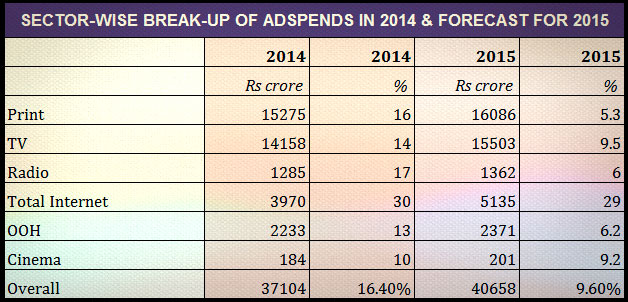
    The advertising industry is likely to grow 9.6 per cent this year, says the Pitch Madison Advertising Outlook Report 2015 released last Friday. While this looks like a tepid sequel to a blockbuster year – in 2014, the industry grew by a whopping 16.4% – the forecast is not without promises. For one, the slight uptick takes the total advertising market to Rs. 40,658 crore by end of 2015, from Rs 37,103 crore last year. Last year’s spurt was largely because of the spend on the Lok Sabha and some Assembly elections, says Sam Balsara, CMD of Madison World, which put the report together along with Pitch magazine. “The projection for 2015 is bullish, though tempered by the fact that this is not an election year,” says Mr Balsara. “There are other options, like the World Cup, the continued aggressive push by e-commerce companies, the launch of new channels and the emergence of new advertisers and new brands.”


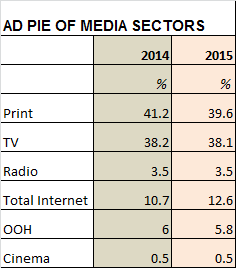
    Among the more significant findings, print media continues to be the largest sector in advertising, and is expected to grab a 40% share this year. Brand advertising in print is likely to exceed Rs 16,000 crore. TV is next in line, and expected to touch Rs 15,500 crore. Digital, which has grown phenomenally in the last five years, is now larger than Outdoor, Cinema and Radio put together, will corner 12.6% of the market.


    The report finds that the FMCG sector, which has always been a dominant player on TV (contributing over 50%) is now also the largest contributor to print media for a second successive year. Though this contribution is just 13%. “Projections for the FMCG sector appear rosy, which is heartening,” says GK Suresh, Head of Marketing (Foods Division) at ITC, adding: “If this continues, I don’t see any reason media spends should not keep increasing as well. This provides a lot of confidence to manufacturers to launch new products, and companies to invest more in existing brands. I think the report forecast is fairly accurate; perhaps even a little conservative when it comes to FMCG.” While the print market constitutes many categories, FMCG, auto, education and real estate together contribute 43% of the total. For TV, the big players are telecom, digital, e-commerce and auto.


    “I would’ve expected FMCG spends in print to grow more rapidly,” adds Mr Suresh, “mainly because it offers many more opportunities to sharp-focus your advertising, and has less wastage than TV. But we in FMCG are really struggling with digital media right now. Everybody knows it’s growing and we need to be out there, but many of us are using it as just another medium.”


    According to Piyush Mathur, President, Nielsen India, the 9.6 % projection, close to a double-digit growth, is a realistic one. “A lot is riding on e-commerce, which is at an early stage and that means a lot will happen in 2015 and 2016,” he says. “As e-commerce companies get bigger valuations, there will be more spending on advertising.”


    Still, there are a few things advertisers need to do differently, says Mr Balsara. According to him, they should focus on effectiveness, and not just on efficiency, while always keeping in mind that the reason they advertise, is to increase their brand parameters. “I have seen marketing teams to be painfully slow on certain media decisions,” he adds. “We often suffer from analysis-paralysis.” Mr Balsara says most brands fail to take full advantage of what the media has to offer by under-resourcing their campaigns. “They will be well advised to focus on fewer brands of theirs, ignore some brands and advertise those few brands heavily,” he adds. “A corollary to this is that since budgets are often limited by P/L considerations, you need to prioritise markets sharply. Spend and exposure in Priority One markets should be at least three times that of Priority Three markets. Otherwise prioritisation is meaningless, and only remains in the hands of the brand manager.” Worryingly, Mr Balsara says he also finds that as media spends get larger and larger, media decisions get taken at lower levels. “These require greater involvement of the corner-room,” he says, and more participation by senior media agency leaders.


    This story first appeared in ‘dna of brands’ issued dated Febuary 23, 2015