Tag: FMCG

  • IAA unveils 21 categories for leadership awards

    By A Correspondent


    The International Advertising Association’s India Chapter has unveiled the 21 categories for which its now-annual leadership awards will be held on March 1 in Mumbai. Presented by general entertainment channel Colors, the following are the 21 categories:


    1. Marketer of the Year – Banking

    2. Marketer of the Year – Insurance

    3.Marketer of the Year – Auto: 2 Wheeler

    4. Marketer of the Year – Auto: Passenger Vehicles

    5. Marketer of the Year – Mobile Services

    6. Marketer of the Year – Mobile Devices

    7. Marketer of the Year – FMCG: Personal Care, Laundry and Toiletries

    8. Marketer of the Year – FMCG: Foods & Beverages

    9. Marketer of the Year – FMCG: Consumer Durables

    10. Marketer of the Year – Home Improvement

    11. Marketer of the Year – Household Products

    12. Marketer of the Year – Ecommerce

    13. Media Agency Head of The Year

    14. Creative Agency Head of The Year

    15. CEO of The Year

    16. Media Person of The Year

    17. TV Anchor of The Year

    18. Editor of The Year

    19. Hall Of Fame

    20. Brand Ambassador OF The Year – Male

    21. Brand Ambassador OF The Year – Female

     

    Srinivasan Swamy

    Announcing the categories, Srinivasan Swamy, President IAA India and VP-Development, IAA Asia Pacific, and Chairman, R K Swamy BBDO commented: “After the great response we received for the first edition of the IAA Leadership Awards, we have made some marginal changes in categories this year to take into account some feedback received. The final winners are being determined now on a number of product and service categories and of course some Awards for senior practitioners. The IAA Leadership Awards is our endeavour to recognize and salute these outstanding talent which has made impactful contributions in the market space and the companies and brands they led.” I&B Minister Manish Tewari will be the Chief Guest at the awards event.

     

    Manish Tewari

    Three categories have been removed from last year’s list. These being: Marketer of the Year in Auto Commercial Vehicles, Travel & Hospitality and Media & Entertainment. The Marketer of the Year – Telecom Products category is now broken up into Marketer of the Year – Mobile Services and Mobile Devices. In addition, thee will be a Marketer of the Year for Home Improvement and E-commerce.


    The scope of the Marketer of the Year – FMCG: Personal Care category has been expanded to Marketer of the Year – FMCG: Personal Care, Laundry and Toiletries.


    To ensure the authenticity and credibility of the awards and maintain the highest level of transparency at all stages, IAA  looked at various performance criteria in every category under consideration, like revenue/market share growth, marketing initiatives undertaken, innovative schemes, launches, advertising spends etc to shortlist the nominees. Nielsen India was engaged thereafter to have the nominees voted upon by senior marketers from the same industry to pick the final winner. Ernst & Young has been commissioned to look at the process to satisfy itself of fairness and to officially tabulate the results.


    The IAA Leadership Awards, this year, are scheduled to be held on 1st March 2014 at Grand Hyatt, Mumbai. Honourable Union Minister of State for Information and Broadcasting, Sri Manish Tewari will grace the occasion as the Chief Guest. The awards night will be attended by the crème de la crème of the marketing, advertising and media fraternity to see some of their leaders carry home coveted trophies.


    The following were the winners of the IAA Leadership Awards 2013:

    Categories

    Winner

    Media Agency Head of the Year Sam Balsara, Madison World
    Creative Agency Head of the Year Piyush Pandey, Ogilvy & Mather India
    Marketer of the Year: Media & Entertainment Gayatri Yadav, Star India
    Marketer of the Year: Banking Sujit Ganguli, ICICI Bank 
    Marketer of the Year: Insurance Rita Bhattacharya, LIC 
    Marketer of the Year: Auto Passenger Vehicles  Mayank Pareek, Maruti Suzuki
    Marketer of the Year: Auto Commercial vehicles  UT Ramprasad , Tata Motors
    Marketer of the Year : Auto Two Wheeler Anil Dua, Hero Motocorp
    Marketer of the Year: Household Products Amit Syngle, Asian Paints
    Marketer of the Year: FMCG – Food & Beverages Chandramouli Venkatesan, Cadbury Kraft India
    Marketer of the Year: FMCG – Personal Care  Arun Srinivas, HUL
    Marketer of the Year: FMCG – Consumer Durables  Rahul Saighal, Samsung Appliances
    Marketer of the Year: Telecom Products  Anuradha Aggarwal, Vodafone
    Marketer of the Year: Travel & Hospitality  Manish Kalra, Make My  trip
    Best CEO  Y C Deveshwar, ITC
    Editor of the year  Jaideep Bose
    News Anchor of the year  Rajdeep Sardesai
    Mediaperson of the year  Shobhana Bhartia
    Brand Endorser of the year – Male  Salman Khan
    Brand Endorser of the year – Female  Katrina Kaif
    IAA Hall of Fame  Pradeep Guha


  • GroupM estimates: TV degrows, Digital, print grow


    By Rishi Vora


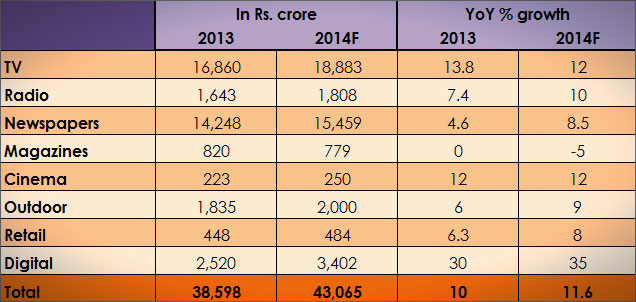
    At the launch of GroupM’s This Year Next Year (TYNY) Report  2014,  chief executive officer CVL Srinivas, while presenting the report to a media gathering in Mumbai, stressed on the media agency’s renewed focus on digital, and the need for a change in approach and mindset in order to be relevant with the changing business scenario.


    Mr Srinivas, of course, stated that in the context of GroupM’s advertising expenditure (AdEx) 2014 where digital is the fastest growing medium with a 35 per cent growth rate, followed by TV with an estimated growth rate of 12 per cent. It may be noted that TV’s growth has reduced from 13.6 per cent in 2013 to 12 per cent in 2014.


    Sector – wise growth


    Elections

    With general elections and 5 state elections on the anvil, government spending and political party election spending adding significantly to the AdEx of all media. It is estimated that the government spending will lead a 2.5 per cent growth in the industry.


    FMCG

    FMCG will continue to be an important sector for the industry as it accounts a 29 per cent share in total ad spends this year due to the following factors:

    [] Volume growth back for FMCG companies on the back of good monsoon and hence good rural income


    [] Raw material prices benign and hence more flexibility with advertisers


    [] Ad spends of most FMCG companies on the rise to ride on the back of higher disposable income due to election spending


    Retail

    The retail industry will experience growth from the entry of new players into the food and beverage segment, growth in E-commerce, and regional retailers  expanding their reach across markets in India.


    Auto

    Despite slowdown in the  four-wheeler segment, there is growth for entry level cars, sports and multi utility vehicles.  Two-wheelers to continue the focus on small town and rural India.


    Competition is likely to intensify  on the back of recent market developments leading to more launches by existing players, which subsequently mean higher ad spends.


    Telecom

    Smartphones penetration  is on the rise, however, stiff competition in the segment will continue. Phablets  and connected devices will gain popularity in 2014.


    Cellular phone service providers too will witness growth in revenue.  Service providers will bring down the price points for 3G, therefore completion is more likely to intensity.


    Banking, Financial Services & Insurance

    For the Banking and Financial Services and Insurance industry, year 2014 will see a revival happening with a likely reduction of interest rates. IPOs to pick up pre-election owning to better market sentiments.


    Recent RBI policies will result into a more favourable business environment and new bank licenses will push advertising expenditures of the category.


    The report estimates  that print will grow at  8.5 per cent in 2014 as against the 2013 estimate of 4.6 per cent, thanks to the growth in vernacular print publications across the country. The report also states that while newspapers  are to grow by 8.5 per cent, magazines will witness a negative growth of 5 per cent.  Outdoor will grow at 9 per cent, Cinema 12 per cent and Retail 8 per cent, states the report.


    If one looks at the sector-wise break up of spends, FMCG constitutes a majority share (29 per cent) followed by Consumer Durables (22 per cent)  and retail (12 per cent).


    CVL Srinivas

    Commenting on the growth prospects for the industry in 2014, Mr Srinivas said: “It’s going to be an okayish year for the media industry. I’m saying this because the 11.6 per cent growth estimate also accounts for the 2.5 per cent growth that will come from advertisements from political parties as the elections are around the corner. If you take elections out, which is a one-off event, the growth in 2014 is about 9 per cent.”


    He further noted that the growth of the industry will also depend on how things are panned out on the measurement front, on IPL’s success or failure and the outcome of the elections, which will have an impact on government policies.


    In his final remarks, Mr Srinivas said that the year 2014 will be remembered for two reasons — one being the fast growth of digital at 35 per cent as is estimated, and also the fact that the industry will cross the Rs 40,000 crore mark in 2014 from its current size of Rs 38,000 crore.


  • Higher smartphone use rings in FMCG mobile ad growth

    By Samidha Sharma


    Consumer goods companies upped their media spends on the mobile platform in the past one year as smartphone penetration, coupled with a spurt in data usage, grew exponentially in the country. InMobi, a mobile advertising network, said spends by FMCG companies, which are clubbed as traditional advertisers, grew 175 per cent on its network last year. Similarly, Vserv.mobi, another mobile ad network, registered a 300 per cent increase in ad dollars while Vuclip, a mobile-focused aggregator of video content, saw its FMCG clients double their ad spends in 2013.


    In India, FMCG saw a high uptake in the last two quarters of 2013, as five major advertisers including ITC, Reckitt Benckiser, HUL, Mondelez and Nestle ran more than 30 campaigns at a reasonably good scale as opposed to 2012 where only one consumer goods company utilized mobile effectively, said Dippak Khurana, CEO & co-founder of Vserv.mobi.


    Buoyed by a slew of mobile-only content, the Indian mobile advertising market is estimated to reach Rs 2,800 crore by 2016 from a mere Rs 180 crore according to estimates by Avendus Capital, a Mumbai-based financial advisory firm. The Indian advertising industry is pegged at around Rs 28,000 crore with FMCG as the biggest contributor on mediums such as television and print as well.


    “With the growth of mobile solutions companies, apps and other mobile technologies, we have seen FMCG advertisers tap the mobile in a big way over the past year. With over 800 million mobile subscribers, these advertisers targeting rural consumers find the medium extremely effective as mobile reaches even the remotest geographies,” said Basabdutta Chowdhury, CEO of Platinum Media, a division of Madison, which buys media for FMCG majors like P&G, Marico and Godrej.


    What is significant is that India could currently have as much as 50 per cent or more mobile-only internet users, much above the global number, making the medium an attractive one for even traditional advertisers.


    Consumer products companies are increasingly adopting a mobile-first strategy. Our growth has come from engagements with more than half of the top 25 FMCG brands, including a partnership with Unilever, said Atul Satija, VP & MD (Asia-Pacific and Japan) at InMobi.


    Source:The Economic Times

    Copyright © 2014, Bennett, Coleman & Co. Ltd. All Rights Reserved

    Licensed to republish


  • The Great CEO Churn: 16 CEOs from FMCG, auto & telcos switched jobs in 2013!

    By Kala Vijayaraghavan, Lijee Philip & Deepali Gupta


    At least 16 high profile CEOs from three consumer facing industries – FMCG, automotive and telecom – switched jobs in 2013. Volatile market conditions, demanding stakeholders and in some cases, poor performance, led to the unprecedented churn at the top, say industry leaders and top officials at executive search firms. “Companies doing badly tend to rope in a new CEO hoping for a turnaround from somebody with a fresh perspective,” says RC Bhargava, chairman of Maruti Suzuki. A few changes though were also routine rotations made by multinational companies.


    Many other changes in the FMCG sector, executive search firms say, have been almost incestuous, with companies tapping a very limited pool of tried and tested CEO talent. For instance, when Anand Kripalu moved from Mondelez India to Diageo, former Pepsi CEO Manu Anand moved in as Mondelez CEO and former Nokia India MD D Shivakumar filled the vacancy Anand left at Pepsi.


    “Three CEO changes can lead to CEO changes in 10 other companies,” says Navnit Singh, Managing Director-India Korn/Ferry International. “Usually, only a few known faces are part of this merry go round. We have been advising companies to ensure that there is a strong succession pipeline within.” The same trend was also partly visible in the automotive sector, where Maruti Suzuki, Volkswagen, Toyota Kirloskar, Ford, Skoda and Fiat and Chrysler all saw new CEOs this year.


    A shallow talent pool, particularly of senior managers, is providing top executives opportunities to move across companies. These external CEO replacements are a reflection of the senior-level gaps in organisations, says RR Nair, ex-HR head of HUL and a CEO coach and advisor. “Organisations also opted for talent with an outsider perspective to drive change at a faster rate,” he adds.


    Several other consumer-facing companies also had new CEOs – Sanjiv Mehta at HUL, Gopal Vittal at Bharti Airtel, Varun Berry at Britannia, and Vivek Gambhir at Godrej Consumer Products. Nestle India predictably placed another expat Etienne Benet as the MD. He took over from Antonio Helio Waszyk, another expat.


    Britannia CEO Berry attributes the big changes to “very tough economic conditions and intense competition that have forced consumer goods companies to fight for a share of meagre growth”. For example, Indian subsidiaries of Volkswagen and Toyota Kirloskar have initiated major reshuffles in the top management as the two car makers take fresh guard to tackle the slowdown.


    Uncertainty and slow growth which marred the business environment during the past six months to a year could be one reason behind the churn, adds Sunil Goel, MD, GlobalHunt. Mahesh Kodumudi, president and MD of Volkswagen India, has just taken on additional responsibilities at Volkswagen Group after Gerasimos Dorizas, the chief representative of Volkswagen Group India, left citing personal reasons. The changes are coming when the group’s mass market brands have seen a decline in sales. “There is a lot of pressure to generate and sustain revenues. Organisations expect leadership to be innovative,” says Global-Hunt’s Mr Goel.


    Toyota Kirloskar MD Hiroshi Nakagawa is moving back to Japan and is expected to be replaced by Yoshimasa Ishii. And at Maruti Suzuki, the country’s largest car maker, Kenichi Ayukawa succeeded Shinzo Nakanishi as the new MD this May. At Ford India, Joginder Singh succeeded Michael Boneham about a year ago. Fiat and Chrysler appointed Nagesh A Basavanhalli as president and managing director.


    2013 was a forgettable year for consumer-facing companies, says Sunil K Alagh, chairman of SK Advisors. “There were arrogant innovations and a lack of communication with consumers. New CEOs have to quickly understand consumer needs and work out a refreshing growth strategy,” he says.


    In the telecom sector, a different set of dynamics was at play, causing CEO-level churn. Except for Airtel and Jio Infocomm, all other CEO changes in this sector have been through internal promotions as companies deal with regulatory uncertainties and an urgent need to arrest losses.


    Russia’s Sistema, which operates under the MTS brand, replaced CEO Vsevolod Rozanov with Dmitry Shukov. The change of guard was on account of Rozanov being promoted to group CFO. In Rozanov’s words: “I came here because I wanted a challenge. Now, I need a new challenge and Dmitry is here.” Yogesh Malik, the India head of Norway-based Telenor’s Indian arm, quit only five months after taking charge. Asia head Sigve Brekke is stand-in chief for now.


    Most of Aircel’s top management quit over the last two years, and stand in chief Kaizad Heerjee, was promoted from COO to CEO after a year’s trial and achieving operational breakeven.


    Source:The Economic Times

    Copyright © 2013, Bennett, Coleman & Co. Ltd. All Rights Reserved

    Licensed to republish


  • Grey to acquire a majority stake in RC&M

    By A Correspondent


    WPP announces that its wholly owned operating company, Grey, the advertising network of Grey Group, has agreed to acquire a majority stake in RC&M, one of the country’s largest rural communications and marketing services firm.


    Founded in 1990, RC&M has been delivering integrated activation solutions, encompassing creative designing to production and implementation. With a formidable reach across 400,000 Indian villages and 5,000 towns, the company is a leader in the organized rural/semi-urban activation market. RC&M is headquartered in Delhi, with offices in Mumbai and Bengaluru. And its unaudited revenues for the year ending March 31, 2013 were approximately Rs 36 crore. The company employs more than 320 people and services clients in the automotive, industrial automation, FMCG and durable sectors.


    RC&M marks WPP’s 12th acquisition in India in the last nine years.


  • The Outsider as the Captain


    By Dibeyendu Ganguly


    Till he took charge as CEO of Air Asia India, Mittu Chandilya experience with the airline industry was somewhat tangential. As the China head of the air compressor division of Ingersoll Rand, he was responsible for ground equipment services to several airlines. Later, as the head of the services practice at headhunting firm Egon Zehnder, he handled several airline clients. And of course, he was a frequent flyer, with lots of ideas on how airlines could improve their services. But these were not the factors that led to the Air Asia board inviting him to take up the top job in its start-up venture in India. “They hired me for my entrepreneurial background,” says Mr Chandilya. “I had experience with start-ups, running a profit & loss centre, managing large teams. That counted for more than my knowledge of the aviation industry.”


    Mr Chandilya admits to having a few misgivings when he accepted the assignment, but he found some comfort in the fact that he already had experience heading businesses much larger than what Air Asia India will be in two years time. Since then he’s been learning on the job and says, “A CEO has to be a good manager, a people leader. Working across industries actually helps develop these skills.”


    Air Asia India is one of the more dramatic examples, but many company Boards today are putting their faith in CEOs recruited from wholly different sectors. Not surprisingly, many of these companies are new ventures, where startup experience counts for more than industry experience. They include global firms like Roland Berger Strategy Consultants, which recently recruited Wilfred Aulber, the managing director of Mercedes Benz India.


    Mr Aulber joined the research and development (R&D) wing of Mercedes Benz soon after obtaining a PhD in solid state physics from Ohio State University in 1996 and thereafter worked in the global CEO’s office in Stuttgart. In 2005, he was deputed to India as country head (the fact that his wife’s name is Rekha may have had something to do with it), responsible for setting up a 100 million euro greenfield project at Chakan, near Pune.


    Earlier, Aubler had also played a role in setting up the company’s R&D operation in Bengaluru. “I have always considered myself an entrepreneur. That means I worry about everything, about every expense incurred,” he says. It is this mind set, as much as Aubler’s experience in the automobile industry, that prompted the Munich-based Roland Berger to offer him the top job of managing partner in India two years ago. “They took a risk,” he says. “I had experience in sales, marketing, production, R&D. But what really counted was my experience in setting Indian operations for Mercedes Benz, where I had done a reasonably good job.”


    But running a consulting firm is very different from running a manufacturing operation and Mr Aubler has had his hands full learning the tricks of his new trade. “As someone who has moved into a new industry, I have to catch up. The peole you deal with here are very different and you have to get used to the fact that you are just an advisor. The client may or may not accept all your advice. You have to live with that and go on regardless.” Changing industries is certainly no cakewalk, especially at CEO level, and Mr Aubler grumbles he hasn’t taken a weekend off in ages, no small sacrifice for a German CEO.


    It’s the same with Ramesh Krishnan, though he’s probably more used to it. Mr Krishnan quit Samsung as head of the home appliances division three months ago to take charge of Geosansar, a company promoted by a British family of Indian origin.


    Under licence from nationalised banks, Geosansar provides banking services at the bottom of the pyramid, to the urban poor who are normally excluded from the system. It’s very satisfying work, so it’s no wonder that Mr Krishnan, a 1989 batch IIM-Bangalore graduate, should have opted for it over Samsung. But what did he bring to the table? “I think they were looking for people with a business management background, with retail experience. The Reserve Bank of India (RBI) estimates that 145 million households remain excluded from banking services, so this is a sunrise industry. Geosansar is not an NGO, but a profit-making organisation,” says Mr Krishnan.


    Banking is very different from selling refrigerators, washing machines and airconditioners and Mr Krishnan has been burning the midnight oil, pouring over voluminous documents on the RBI website to get a better grip on the rules and regulations that govern his new industry.


    True to his marketing background, he’s out in the field every day, talking to various public sector bank executives, trying to learn as much as he can through their experiences. “For a CEO, there’s no induction programme,” he says. “Now that I’ve moved to a new industry, I have to both learn and unlearn things. In banking, you don’t get to decide what to do, like in the white goods business. You have to get permissions from the regulator at every stage.”


    It is this trait – a willingness to learn and the ability to learn quickly – that corporates look for in CEOs hired from outside the industry. “A CEO hired from outside has to demonstrate a certain amount of humility,” says Vivek Gambhir, managing director of Godrej Consumer Products, who joined from the consulting firm Bain & Company. “They have to be able to put together a team that complements their strengths. Companies today hire a CEO on the basis of fit and potential, not domain expertise.”


    Generalists were in vogue in the 70s and 80s, when companies (and business schools) believed that a good manager – like a good Indian Administrative Services officer – should be able to manage any industry. That changed in the 90s, when b-schools began producing functional specialists and the public sector gradually gave up the practice of installing IAS office officers as CEOs of public sector companies.


    Mr Gambhir says today’s generalists are different – they are integrators, with a talent for bringing together disparate processes. “There a huge amount of industry convergence today,” he says. “FMCG is not about manufacturing products anymore. The boundaries have blurred. It has converged with on-line and off-line retail to become a service.


    In such a scenario, generalists would do well.” Mr Gambhir himself had wide experience consulting with the FMCG industry before he joined Godrej as Chief Strategy Office in 2009. Would Adi Godrej have hired him directly as the CEO? “Not likely,” he says. “It’s always good to have a transition period And I was fortunate I had that.” For some, the challenge of changing industries – and the learning opportunities that go with such a move – provides a rush.


    Amit Shukla, a 1989 batch IIM-Ahmedabad graduate, has changed industries whenever he’s changed jobs, which is often.


    Starting with Zydus Cadila, where he was in charge of the cosmetics division, he moved to United Breweries and then to Bharti Airtel and then to the Deccan Chronicle group, where he was CEO. Today, Mr Shukla heads the consulting firm of Strat Team Advisors in Gurgaon and says, “Cross-industry experience gives you a width of perspective that can come in very useful. What may be an ‘impossible obstacle’ in one industry is a ho-hum solved problem in another.”


    Will we be hearing of more and more corporates hiring CEOs from outside the industry in the near future? Air Asia’s Mr Chandilya doesn’t think so: “Most companies are still traditional. They wouldn’t take the risk. Still, there are some who will take a chance on people like me. I would say the ratio would be 80:20 in the future.”


    Source:The Economic Times

    Copyright © 2013, Bennett, Coleman & Co. Ltd. All Rights Reserved

    Licensed to republish


  • MoCoupons will be boon for FMCG companies: Sandeep Goyal

    By Gulveen Aulakh


    Since selling his 26 per cent stake in Dentsu India in 2011, former chairman of the company and adman Sandeep Goyal wrote the CAT exam at the age of 50 for admission into FMS, Delhi, launched a food channel on television with Sanjeev Kapoor and then floated Mogae Media for venturing into the nascent mobile marketing and advertising sector.


    He has since raised Rs 100 crore from private equity players for the new venture.


    In a conversation with, Mr Goyal said that his company is inventing ways to monetise the ubiquitous mobile phone and has come up with mobile-couponing or MoCoupons – the most direct way for brands to reach out to consumers without spending a bomb on advertising. Excerpts:


    How does mobile couponing work?

    Companies spend large amounts on TV and print media marketing campaigns to prompt customers to buy a product. Today, it can be done far easier, more cost effectively and time efficiently, using mobile phones. This is how it works: A brand sends out coupons to consumers using a telecom operator’s database. The operator knows where the telecom subscriber lives, works, his monthly ARPU, a good surrogate of spending, the type of handset owned, a good indicator of affluence, and hundreds of pieces of information.The coupon can be sent to all consumers in a specific geography, say NCR or just Gurgaon, or while the consumer is entering a mall using a geofenced solution that serves the coupon in real time based on location of the customer. The consumer then takes coupon to the participating merchant, gets an instant discount or gratification . The MoCoupon system reimburses the merchant on the brandowner’s behalf through the mobile money account.


    How will it work in India where not everyone has a data connection?

    Consumers don’t need a smartphone or data connection. Mobile coupons can be sent as an SMS or USSD (text message based interactive system) with an alpha-numeric code that merchants can authenticate.


    What benefits do corporates see in associating with mobile couponing? Have you signed up any clients?

    MoCoupons is an end-to-end couponing ecosystem that allows brands to access consumer base of the mobile phone company and target consumers by geography, time-of-day, location, ARPU, handset and a host of other tags. No such system of such magnitude and reach exists in India. For FMCG companies, this is a boon. We have signed up 1,500 grocers in Delhi, which will swell to 2,500-3,000 by end September across NCR (national capital region). By end of the year we will have 5,000 grocers, general merchants and above-the-counter pharmacies in the system. Post Diwali, we will reach out to the other metros. In 2014, we’re aiming for a base of 30,000 grocers in 20 cities.


    How will customers benefit from mobile couponing? Please share some instances.

    Customers (those who are not on DND) will receive offers or discounts from their favourite brands above and beyond those offered to other customers. Recently, a pizza brand used us to send out MoCoupons in a select business district of Gurgaon between 11 am and 12 30 pm, pre-lunch. Customers got a dessert free with the pizza. We are currently working with a large multinational bank for a promotion at Palladium Mall, Mumbai, where the bank’s credit card users get an extra 10-20per cent off at 40 participating outlets. But the big impact will come once we have a large enough base of grocers so that FMCG companies can run promotions on every day products. For instance, offering Rs 10 off on a toothpaste or Rs 20 off on (a bottle of) ketchup.


    Does Mogae Media plan to reach out to a multi-operator base?

    We are today forging many alliances that will allow us to reach out to different type of customers across geographies, as well as income strata. We are integrating with the point of sale systems of modern retail to allow seamless and quick couponing.


    Source:The Economic Times

    Copyright © 2013, Bennett, Coleman & Co. Ltd. All Rights Reserved

    Licensed to republish


  • FMCG majors feel the pinch as consumers cut spending

    By Sagar Malviya


    It’s official: rising prices and slowing growth are making Indians check their household shopping list from soaps, shampoos and skincare to packaged groceries and food items.


    Market researcher Nielsen’ data shows that sales growth of more than a dozen key consumer goods categories in the June quarter was lower than both the previous quarter and the year-earlier period, more than one industry insider said.


    Overall FMCG sales grew 11% in value terms in the June quarter, down from 12% in March and 17% in June last year, they said, quoting Nielsen data. Consumer goods companies confirmed the slowdown in demand. “The overall FMCG sector is seeing a slowdown in the last few quarters from double-digit growth few quarters ago to around 2% volume growth now,” Harsh Mariwala, chairman at Marico, said.


    Combined sales of companies including Hindustan Unilever, Dabur, Godrej Consumers, Emami, Marico, GSK Consumer, Nestle India, ITC and Colgate India grew 13% during the quarter ended June, down from 15% a year earlier and 22% in June quarter 2011. Mr Mariwala expressed hope that good monsoon rains and a boost in manufacturing will check the slide.


    “With a good monsoon and boost in manufacturing sector, we don’t expect demand to deteriorate further,” he said. With the rupee on free fall, however, not all share Mr Mariwala’s optimism. Analysts say the Indian consumer industry fundamentals are deteriorating and the tailwinds that supported the sector during the last couple of years are waning.


    “With sharp rupee depreciation and essential commodities like crude and palm oil firming up, the headroom for gross margin improvement looks a lot smaller in second half than in the first half of this fiscal year,” a JP Morgan report dated August 19 said.


    According to data, growth in overall non-food segment slowed to 13% in the year ended June from 15% in the year ended March. The biggest fall was in the male grooming segment where sales growth almost halved to 6% in June from 11% in March.


    Nitin Paranjpe

    Nitin Paranjpe, CEO of the country’s largest FMCG firm Hindustan Unilever, while declaring the company’s June quarter numbers last month had said, “There is a general slowdown across categories. We are witnessing a significant slowdown from early 2013 to the middle of 2013.” To overcome the slowdown in demand, companies are looking to increase or at least maintain their margins.


    “For the first time, we are offering incentives to our sales force to sell higher margin products and have constructed three buckets – gold for high margin, silver for medium margins and bronze are lower margin,” Sunil Duggal, CEO of Dabur, said. Salespeople get more money if they sell gold products.


    Companies with mass-market portfolios hope that consumers will continue to buy staples, even as they check spends on discretionary or premium products.


    Vivek Gambhir, managing director of Godrej Consumer Products, for example, said a lot of the growth slowdown has been at the premium end, and hence his company has been insulated by overall slowdown thus far.


    Source:The Economic Times

    Copyright © 2013, Bennett, Coleman & Co. Ltd. All Rights Reserved

    Licensed to republish


  • Attracted by self-service format, more men take to shopping

    By Writankar Mukherjee & Sagar Malviya


    Most daily-use product advertisements might still be talking to housewives but, hey, it’s men who now do most of the shopping in FMCG, grocery and food segments. Sales data obtained from leading food and grocery retail chains including Future Group, Spencer’s Retail and Aditya Birla Retail shows that single male shoppers account for 40-45% of their total customers, more than double the number of single female shoppers at 20%. And up to 70% of their shoppers are male consumers, be it single, with family or friends. Just four years ago, women shoppers would account for around 55% of the consumers in modern retail.


    Retailers attribute this new trend to social changes with men sharing household responsibilities with their partners and many men cooking at home, buoyed by a flurry of television cook shows.


    “The social change and modern retail has turned grocery shopping into a weekly activity unlike earlier when men used to consider it as a boring chore,” Devendra Chawla, president (Food Bazaar) at the country’s largest retailer Future Group, says. “In fact, men now actually look forward to shopping in super markets,” he adds.


    Mohit Kampani, president and CEO at Spencer’s Retail, says the key reason for growth in male shoppers is self-service format, which has made shopping more convenient and delivering wide assortment at one location. “In fact, male shoppers are making a transition to self-service retail away from the traditional formats,” he says. This is good for retailers because men are impulsive shoppers than women and they like to experiment with newer products.


    Male shoppers tend to buy more of vegetables and impulse-driven categories such as confectionery, biscuits, frozen food, drinks and juices and skin care products than their female counterparts, Kampani says. As per Spencer’s Retail estimates, male consumers shop frequently for topping up the monthly shopping basket, while female customers tend to purchase monthly requirements.


    Russell Berman, CEO (hypermarkets) at Aditya Birla Retail, says male shoppers also enjoy the process of picking and sorting and are aware of quality choices like texture, size of grain and smell, that are mandatory checks when purchasing loose produce. “Men are also open to trying out new products and their basket sizes are larger than those of women shopping alone,” he says.


    Mr Chawla of Future Bazaar says the dominance of male shoppers is driving growth of newer categories like gourmet food and grooming products. A recent study by TNS in partnership with IIM-A, KiE Square and OgilvyAction reveals that men don’t care much about the pack size or product format.


    “All they care about is the brand. And if a small pack of their favourite brand is all they can afford, they’ll go for it even if another brand offers a larger pack size for the same price. This is an advertiser’s dream,” the study notes.


    It also says that even female consumers buy more when they bring a male along. “In their company, women spend between 30% to 50% more than they would have spent if alone. In fact, women spend the least when shopping alone and the most when shopping with their spouse,” the study says.


    Source:The Economic Times

    Copyright © 2013, Bennett, Coleman & Co. Ltd. All Rights Reserved

    Licensed to republish


  • Will the ad switch-off get broadcasters to revert to weekly ratings?


    By A Correspondent


    Logically, ads of FMCG majors who sent letters to eight broadcast group on Friday evening should’ve been off air from late last night, but given that there was a Sunday in between, the 72-hour notice given is being considered to be 72 working day hours.


    The advertisers have decided to take on the broadcasters head-on. “We’ve decided we don’t want to get bullied any longer,” one big spender told MxMIndia, adding that the channels need to acknowledge that until there is enough money from distribution, it’s the ads that are funding their business.


    While broadcasters have adopted a wait-and-watch game, privately, they admit that they are cornered this time around. Moreover, a Colgate needn’t worry about Oral B using this opportunity to over-advertise because both Colgate and P&G have sent us pull-out letters, one channel revenue head told us.


    However, the real losers, as industry analysts tell us, are the broadcasters because the revenue loss will be real when it actually starts. “Since most broadcasters are CEO-run or are publicly listed, the stakes are lower for CEOs,” the analyst told us. Except for Zee and Sri Adhikari Brothers, a blip is not a huge worry for MNC-owned or listed company CEOs. “It’s only when the losses mount that the international/regional headquarters will start putting the pressure.”


    Meanwhile, another analyst MxMIndia spoke to reasoned that broadcasters will lose out by asking for monthly data. “The monthly release is not going to be a combined number for 30-31 days. It will give you the same weekly break-up. So it’s in a sense a case of deferred live.” Advertisers and media agencies can still review the numbers and nail the channels sales team, he said. “The problem is also for the channel programming team and bosses because in the absence of weekly data, they will not be able to tweak content if ratings are going south and it’s tougher doing it after month,” said the analyst.


    The industry-watchers we spoke with believe that for advertisers the issue is now of their egos being hurt by the insistence of broadcasters to go monthly. The demand to refer the matter to the BARC technical committee has been shot down because there is a feeling that the switch to a monthly release of numbers will not get a two-thirds majority that may be deemed imperative for changing the ‘technical’ framework of measurement.


    Meanwhile, the offensive against broadcasters was raised last evening by the Advertising Agencies Association of India issuing  a statement on the current impasse on Television Audience Measurement. Said Arvind Sharma, President of the AAAI: “For fourteen years, TAM has been the TV Audience measurement system in the country. It has been the currency on the basis of which advertising planning, buying and selling have been conducted. We all agree that this measurement system needs to evolve. That is the common goal towards which broadcasters, advertisers and advertising agencies came together to create Broadcast Audience Research Council (BARC). BARC will take 10 months or so to start generating its audience measurement data. In the meantime, however, if individual broadcasters try to force unilateral changes in the current system, as some have tried, it will result in a disorderly and hybrid measurement system. It will become impossible for advertising agencies and advertisers to plan and therefore, buy TV spots. In this scenario, it is natural for advertisers to begin to question the value of advertising in this medium at all. Cancellation of TV releases by many advertisers on eight network groups that have insisted on unilateral changes is a natural outcome of that. More clients are following”.


    The statement added: AAAI believes that any change in the TV measurement system needs to be thought through and to have support from all the three industry constituents – Broadcasters, Advertisers and Advertising Agencies. “We continue to be firmly of the belief that dialogue among all constituents is essential for evolving the system. We remain open to discussions, as always,” said Mr Sharma.


    Hinting at the broadcasting fraternity’s refusal to budge, Mr Sharma said: “This does require similar openness across all constituents. We will continue to work towards a dialogue.”


    What all stakeholders are hoping for is the emergence of a back-channel to negotiate a settlement between the stakeholders. Watch this space for more.


  • Bang, Bang! FMCG majors slug it out via ads

    By Ratna Bhushan, Sagar Malviya & Writankar Mukherjee


    On February 18, when British PM David Cameron visited the headquarters of Hindustan Unilever, the firm’s legal cell was busy finalising the documents for dragging the Indian unit of the UK’s Reckitt Benckiser to court over disparaging comparative advertising. Not that this came as a shock to the maker of Dettol and Harpic. The company’s top management had instructed its team to ‘go for the kill’ with its Dettol Kitchen dish-washing liquid ad campaign, despite knowing its ads could land in court.


    Less than 10 days ago, GlaxosmithKline Consumer Healthcare announced the launch of Parodontax toothpaste, its global brand, targetted at customers with bleeding gums. The response of Colgate-Palmolive, the oralcare market leader was swift and emphatic. Two days ago, it began advertising its own variant through full-page ads, claiming its product was the best.


    Welcome back to the world of marketing wars and aggressive competitive advertising in the consumer goods market. After a lull of almost two years, high-decibel ad campaigns have made a comeback across categories ranging from toothpastes and biscuits to dishwashers and mobile phones. Consumer demand may still be subdued, but companies are hiking ad spends in the hope of stepping up consumption, garnering market share, and creating a buzz around their products.


    Sam Balsara, chairman and MD of Madison, which buys media for tobacco-to-biscuits major ITC and telecom services provider Bharti Airtel, said there is increasing realisation among companies that they can’t take growth for granted in a cautious economic environment and with more brands entering the market. “We see an escalation of ad spends, especially among consumer companies, this year,” he said.


    But do high-voltage ad campaigns work? “The cola wars of the 1990s did not help either Coca-Cola or Pepsi. What they did was create excitement in the category,” said Santosh Desai, CEO of Future Brands. “While different brands would have different reasons to come up with competitive advertising, what it does is create either new categories as in the case of specialist oralcare or smartphones, or create excitement in existing ones as in the case of biscuits.”


    Newer categories like smartphones are being particularly aggressive. Last month, Apple kicked off an ad blitzkrieg on EMI schemes for the iPhone 5. Samsung, the smartphone category leader, responded by launching a big-bang print ad campaign that announced the revival of its EMI schemes for six premium Galaxy phones. Sony has roped in Katrina Kaif for two years to promote its Xperia smartphones and decided to triple its marketing budget for smartphones to Rs 300 crore for next fiscal.


    “The smartphone war will further heat up. Z10 will give a tough fight to competitors and will help us gain consumer franchisee and share that may have been lost to Apple or Samsung,” says BlackBerry India MD Sunil Dutt. Blackberry launched the Z10 smartphone in India on Monday.


    Comparative Advertising

    India is an underpenetrated and underserved market where advertising has traditionally been directed at consumers and not competition. But this is gradually changing. Reckitt Benckiser’s Dettol Kitchen dish-washing liquid ad showed Vim up front and disparaged the HUL product. HUL has hit back with full-page ads saying ‘antiseptic is for cleaning floors and wounds, not utensils’, a thinly disguised attack on Dettol.


    HUL dragged Reckitt Benckiser to the Calcutta High Court, which has ruled that the latter needs to modify its ads and remove the visual of quantum of germs killed by use of the two competing products, though the ads can continue to compare Dettol Kitchen with Vim.


    Earlier this month, for the first time since it came to India, UK biscuits maker McVities began airing ads claiming it is the ‘only biscuit without maida’ – indirectly taking potshots at established biscuit makers. “The commercial elevates the digestive category compared to regular biscuits by honing onto a relevant category truth. The objective is to tell consumers why McVitie’s is better,” said Jayant Kapre, president, United Biscuits. “In the heat and dust of the marketplace, you do have skirmishes now and then,” said Sameer Satpathy, marketing head of Marico.


    Arvind Sharma, chairman and chief executive officer of ad agency Leo Burnett, said the best way for a new entrant to gain market share from the leader is to claim superiority.


    “When there is a new entrant, the best way to gain market share from the leader is to claim superiority. If your claim is based on facts, then it is legitimate because consumers would like to know more about the products they are using,” said Mr Sharma, who is also the chairman of the Advertising Standards Council of India (ASCI), the advertising watchdog. In the quarter ended December 2012, 18 out of top 20 consumer companies hiked the absolute ad spend to support new launches and counter slowdown and competitive pressures. Even as a percentage of sales, 12 out of 20 companies increased their ad spending. According to estimates by Madison World, the share of FMCG companies in the total TV and print ad market went up from 52.8% to 54.4% and from 8.9% to 10.3%, respectively.


    Source:The Economic Times

    Copyright © 2013, Bennett, Coleman & Co. Ltd. All Rights Reserved


  • FMCG brand extensions 5 times more successful than new launches: Nielsen study

    By A Correspondent


    Arthur C Nielsen

    Extensions of existing fast moving consumer goods (FMCG) brands are five times more successful than launching a new brand in India, according to a new study released today by research major Nielsen.


    Nielsen’s study of top brands in 46 FMCG categories and 82 brand extensions in food and non-food categories shows that in addition to promoting brand equity, brand extensions can grow incremental sales up to 38 percent and contribute as much as 30 percent to parent brand sales.


    “Innovations are driving FMCG growth in India,” said Arun Chogle, client business partner, Nielsen India. “Brand extensions, or stretching your existing brand, increase your chances of innovation success. Not only do brand extensions leverage the equity of the parent brand, but they also lead to faster adoption and deliver higher marketing efficiency.”


    Nielsen identifies five ways brand extensions are successful in India:

    1. Brand stretches gain share and build distribution faster than new launches. One example from Nielsen’s review of brands launched in the past two years shows that while eight new, national body lotion brands reached a share of 0.3 percent, seven national brand extensions increased that figure almost four-fold, delivering a four percent market share.

    2. Brand stretches are two times more likely to succeed in a highly fragmented category.

    Nielsen’s findings show that developing categories with fragmented shares, or developing categories with lower penetrations, were more successful than established category sizes of greater than Rs 3000 crore.

    3. Sixty-five percent of successful brand stretches have a premium index lower than the parent brand. Keeping under the price premium index of parent brands is likely to increase the chance of success. Nielsen’s results show that brand leaders that priced below the parent premium at the entry stage were more successful than those priced above the parent brand.

    4. Strong parents beget strong children. Nielsen’s study shows that when the parent brand was a leader in the category, 59 percent of brand extensions were also successful. When the parent brand was not among the top five players, 35 percent of brand extensions were successful. “Building the core is important, but advertising support is critical for both the parent and the child,” said Mr Chogle.

    5. Successful stretches leverage four factors: Advantage-delivers new, or distinct, benefits to the category. Recognition-ensures strong parent-brand awareness levels in terms of functionality, imagery and personality. Relevance-makes certain parent attributes relevant in the new category and Credibility-delivers on brand promises.


    “To successfully unleash the power of your brand stretch potential, determine your brand’s leverage power by reviewing its advantage, recognition, relevance and credibility,” said Mr Chogle. “Understand the market structure of the new chosen category to determine both its fragmentation and penetration among consumers and most importantly, establish your company’s executional competence to create the right product offering, deliver distribution muscle to reach consumers and stay invested in ad spending and support levels.”