Tag: FMCG

  • WARC’s Best of the Best


    WARC has released a ‘Best of the Best’ ranking of campaigns, agencies and brands showcasing the best all-round performances in the automotive, drinks, financial services, FMCG, food and retail sectors.


    The six separate product category reports are based on the analysis of the combined data of the three annual WARC Rankings — the Creative 100, Effective 100 and Media 100 rankings — compiled from the results of the most prestigious and rigorous award shows of 2018.


    Said Amy Rodgers, Managing Editor, Research & Rankings, WARC: “These sector analyses, the last of a series of reports produced based on the results of the WARC Rankings, provide category intelligence and an industry benchmark showcasing the top all-round sector performers across creativity, effectiveness and media excellence.”


    Automotive category highlights:

    With Audi topping two of the three automotive rankings, it is no surprise that Audi not only ranked #1 as a brand, but its owner Volkswagen Group came out as top automotive advertiser.


    This success is reflected through the companies who worked with Audi, with BBH London ranked as the #1 agency with its campaign ‘Clowns’ topping the automotive creative ranking. Strong performances from PHD Worldwide agencies drove the network to the number one spot.

    #1 campaign for creativity: Clowns, Audi, BBH London

    #1 campaign for media: Lead Generation, Kia, Havas Media Madrid

    #1 campaign for effectiveness: Beauty and Brains, Audi, BBH London / Salmon London / MediaCom London / PHD London

    #1 agency: BBH London

    #1 agency network: PHD Worldwide

    #1 brand: Audi

    #1 advertiser: Volkswagen Group


    Drinks category highlights:

    In the top ten agencies for drinks, there is a three-way split between Auckland (3 agencies), London (3 agencies) and Latin America (3 agencies), with MediaCom Mexico City taking first place and Africa São Paulo second. Touché! Montreal is the only agency representing North America.


    With campaigns featuring in two of the three drinks rankings, Coca-Cola has topped the brands list and is ranked #2 in the drinks advertisers list. Anheuser-Busch InBev is in first place.


    In the drinks category, MediaCom Mexico City tops the agency list and its network, MediaCom, ranks #4. BBDO Worldwide leads through the contribution of a range of agencies including AMV BBDO London (#7) and Colenso BBDO Auckland (#8).

    #1 campaign for creativity: Tagwords, Budweiser, Africa São Paulo

    #1 campaign for media: The Awesome Is Here, Cerveza Victoria, MediaCom Mexico City

    #1 campaign for effectiveness: No More Excuses, Heineken, Publicis Milan / POKE London / Starcom Amsterdam / Publicis London

    #1 agency: MediaCom Mexico City

    #1 agency network: BBDO Worldwide

    #1 brand: Coca-Cola

    #1 advertiser: Anheuser-Busch InBev


    Financial Services category highlights:

    Due to the long-term success of Fearless Girl, which topped both the Creative and Effective 100 for financial services, State Street Global Advisors ranks #1 for brands and its owner State Street Corporation leads the advertiser rankings in the financial services sector.


    Following on from this success, McCann New York, which worked on the campaign, tops the agency ranking and McCann Worldgroup is ranked #1 network with its agencies in Sydney, New Delhi and Mumbai also contributing to its success

    #1 campaign for creativity: Fearless Girl, State Street Global Advisors, McCann New York

    #1 campaign for media: The Animals’ Own Emergency Number, DNB, TRY/APT Oslo

    #1 campaign for effectiveness: The Impact of Fearless Girl, State Street Global Advisors, McCann New York

    #1 agency: McCann New York

    #1 agency network: McCann Worldgroup

    #1 brand: State Street Global Advisors

    #1 advertiser: State Street Corporation


    FMCG category highlights:

    With Colenso BBDO and AMV BBDO London taking first and second place in the FMCG sector agencies’ ranking, it is no surprise that BBDO Worldwide is the top network, ahead of MediaCom in second.


    Whilst Pedigree topped the FMCG brands list, this performance could only drive its owner Mars to #3 advertiser with Procter & Gamble ranked #1 through the performance of brands including Gillette, Procter & Gamble and Tide.

    #1 campaign for creativity: #Bloodnormal, Bodyform/Libresse, AMV BBDO London

    #1 campaign for media: I Don’t Roll On Shabbos, Gillette, MediaCom Connections Tel Aviv

    #1 campaign for effectiveness: Healthy Hands Chalk Sticks, Savlon, Ogilvy Mumbai

    #1 agency: Colenso BBDO Auckland

    #1 agency network: BBDO Worldwide

    #1 brand: Pedigree

    #1 advertiser: Procter & Gamble


    Food category highlights:

    Skittles is the top brand with campaigns featuring across all three food rankings: Exclusive The Rainbow #1 for creative, Let Out The Sour #1 for media and Breaking Conventions With Pride joint #4 for effectiveness.


    The agencies that worked on the winning Skittles campaigns all feature in the top ten agencies’ league table. The highest ranked is adam & eve DDB London, with work for Skittles as well as Marmite. DDB Chicago, which worked on the Exclusive The Rainbow is ranked #2. The success of these agencies alongside DDB’s offices in Paris, Johannesburg, Mexico and Moscow propelled DDB Worldwide to top network.

    #1 campaign for creativity: Exclusive The Rainbow, Skittles, DDB Chicago

    #1 campaign for media: Let Out The Sour, Skittles, MediaCom Dubai

    #1 campaign for effectiveness: Cheetos Museum, Cheetos, Goodby Silverstein & Partners San Francisco / OMD New York

    #1 agency: adam&eveDDB London

    #1 agency network: DDB Worldwide

    #1 brand: Skittles

    #1 advertiser: Mars


    Retail category highlights:

    Mindshare Shanghai tops the agency list for retail having contributed to three of the top ten campaigns in the category in the Media 100 ranking, driving Mindshare Worldwide to #2 network.


    Ogilvy is ranked #1 retail network, in part due to DAVID Miami’s work on Google Home of the Whopper, which came second in both the retail Creative 100 and Effective 100. This, along with Scary Clown Night (#1 creative campaign) meant that Burger King topped the retail brand list, with it’s owner Restaurant Brands International leading the retail advertisers table.

    #1 campaign for creativity: Scary Clown Night, Burger King, LOLA MullenLowe Madrid

    #1 campaign for media: Turning KFC Into Gamers Playground, KFC, Mindshare Shanghai

    #1 campaign for effectiveness: How Lidl Grew A Lot, Lidl, TBWA\London / Starcom London

    #1 agency: Mindshare Shanghai

    #1 agency network: Ogilvy

    #1 brand: Burger King

    #1 advertiser: Restaurant Brands International


    Download a sample report of the ‘Best of the Best’ in automotivedrinksfinancial servicesFMCGfood and retail sectors.


    The full reports for each of the six sectors are available to WARC subscribers and include the top ten campaigns across creativity, media and effectiveness, as well as agencies, networks, brands and advertisers. Additionally, the story behind four top ten ranked campaigns for each sector are featured, including information on the challenge, strategy and results.

     

  • 14.3% adspend growth forecast for 2019: GroupM


    By A Correspondent


    Okay, we’ve cheated. We know GroupM publishes a propah India-specific report in Februrary, but we’ve noticed over the years that the global This Year Next Year report released in Decemeber is also fairly detailed.


    So while we carry the report now, please do note that there may well be a full-blown one in the coming months. So here’s the report:


    “The IMF expects real GDP to grow 7.4% in 2019 (12.1% nominal), driven mainly by services and private consumption; manufacturing and agriculture are likely to see moderate and low growth, respectively. Bank balance sheet repair and GST reform is likely to start yielding results sometime in 2019, accelerating a reviving investment cycle, but downside risks remain: continued global trade conflicts and high oil prices are likely to impact the exchange rate, trade deficit, liquidity and inflation.


    Auto advertising growth is expected to be high, as car, scooter, luxury bike and commercial vehicle segments will see good sales growth in 2019, driven by urban demand and infrastructure spending. Rural-led motorcycle sales will be monsoon-dependent.


    BFSI adspends will be moderate to high, as bank adspends remain subdued but insurance and financial services spend robustly to expand penetration, with the government-led health insurance scheme also providing a boost to growth. Digital payments are expected to touch $500 billion by 2020, and insurance to be a $280 billion sector by 2020.


    Consumer durables ad monies will see moderate-to-high growth: low penetration in consumer appliances, shorter replacement cycles in consumer electronics, robust replacement demand overall and unexpected/extreme weather – hotter summers, hazier winters – will all contribute to spends.


    E-commerce adspends will grow fast: a report cites the sector to touch $100 billion GMV by 2020, while Morgan Stanley predicts it to touch $200 billion by 2026 and expects ~50% of India’s internet users to have matured by 2019/20 (five years or more of internet use). Online shoppers are expected to increase from the current 14% of internet users to 50% by 2026. Strong consumer expenditure growth should lift Retail advertising in the order of 12-14% year over year between 2017 and 2020, and the explosion of modern retail, expected to nearly double in size between 2016 and 2019, will drive ad monies.


    FMCG adspends will grow fast, as key drivers remain strong: expanding rural penetration, strong rural demand supported by increased welfare spending in a busy election year in 2019, and steady urban sales and growing interest in luxury and health-wellness products.


    Services ad growth should be strong, as the major segments of travel and hospitality, health care and logistics are all expected to perform well in 2019. The travel market is tipped to reach $40 billion by 2020; logistics are expected to hugely benefit from GST.


    Telecom ad growth will be driven by mobile handsets. 2017 saw 288 million shipments (124 million of which were smartphones). The IDC predicts mid-teen growth in 2019-2020, led by low-priced handsets. Telco spends will be conservative, as incumbents face continued pressure on margins due to intense competition – likely to continue till ~2020.


    TV: sports and elections will drive advertising. Print to grow at a slower rate, losing share to digital; election spending will provide some relief. Radio is expected to do well from auto, mobile handsets and a revival in FMCG, real estate and government spends. Cinema & outdoor will continue to grow, as technology adoption improves ad visibility and from the growth of organised retail. Digital: will see high double-digit growth backed by video (with OTT players/AVOD gaining traction) and other premium inventory.”


    And here’s the final analysis:


    “It will be a toss-up with China for 2018, but this year and next India could remain the world’s fastest-growing large economy, with only the Philippines on its heels. Despite two successive quarter-point repo rate rises in 2018 (to 6.5%), the rupee has depreciated 10% versus the US dollar in the year since our December 2017 forecast, in line with the average of the currencies in our country set. The rate rises were a response to CPI creeping up, and there may be more to come. This reflects the health of India’s domestic demand: like the USA, it is a relatively self-sufficient, low-trade economy, which is a strength when global trade is contracting. HSBC predicts India’s consumer demand growth will peak at an impressive 9.1% (real terms) in 2018 before moderating to around 7%, which only China is likely to beat. However, no country is immune from the demand-sapping effect of pricey oil and a runaway dollar, which would only encourage capital flight from the developing world back to the rising-rate USA.”


    And here’s how India fares in the global perspective:


    India’s prospective 2019 growth this year is the same order as Australia, Russia and Brazil combined, even though India’s ad economy is only a quarter of the others’ combined heft. Such is the arithmetic of 14% ad investment growth with its roots in 7% real growth in India consumer spending (after 9% in 2018).


  • Wipro Consumer Care appoints OMD for media

    By A Correspondent


    OMD India has been appointed to manage the media duties for Wipro Consumer Care, which will be serviced by a dedicated team of media, strategy and data specialists out of the network’s Bengaluru office. The scope of work covers the planning and buying duties for both offline and digital channels for all of Wipro’s iconic brands– Yardley, Glucovita and Safewash – as well as any future product launches targeting urban consumers.


    Wipro Consumer Care is among the top FMCG and the fastest-growing companies in India, with its products sold in over 40 countries worldwide. Having established a strong consumer base for its personal and skin care products in South-East Asia and the Middle East, Wipro has also gained a global footprint by acquiring Singapore’s Unza Holdings Ltd and LD Waxsons, and Yardley’s businesses in India, Middle East, UK and Europe.The accounts were previously managed by Wavemaker, who held the business for the past five years. The appointment is seen as further evidence of a new OMD India, firing ahead on all cylinders.


    “We are delighted to have the opportunity to work with Wipro and its amazing portfolio of brands,”added Priti Murthy, CEO, OMD India. “This collaboration will give us the opportunity to create interesting, challenging and effective work in the constantly changing marketing and media ecosystem. By leveraging our deep analytical capabilities, performance-based media channels and media creativity, we are well prepared to drive tangible business results and growth for Wipro.”


  • Wipro consolidates media duties with Lodestar UM

    By A Correspondent​


    Indian IT and FMCG ​major Wipro has shifted​ a major part of its Consumer Care media business to Lodestar UM. The decision comes on the heels of an extensive and exhaustive multi-agency pitch. Under the new arrangement, in addition to Santoor that consists over 70% of Wipro’s media spends, Lodestar UM will also handle Chandrika and Enchanteur range of products.


    Talking about the business win, Nandini Dias, CEO, Lodestar UM said, “Wipro is one of our oldest clients and we have been handling the business for the last 25 years. We are truly delighted that in this next phase of growth Wipro has chosen us to be its media partner​,” adding: “In the last decade, Wipro’s business has grown over 16 times. The company made two significant acquisitions in the last two years L D Waxson Singapore and Yardley UK business have considerably added to the global footprint. Lodestar UM has been instrumental in making Santoor the number 1 brand in AP, Karnataka, Maharashtra and Gujarat through our differentiated strategic thinking. And over the years LUM has become integral part of overall Wipro marketing team and the collaboration extends beyond media responsibilities.”


  • LookBack 2017: Struggling & Taxing year for A&M


    We kick off our ‘LookBack 2017’ series with veteran adperson and MxM columnist Indrani Sen reflecting on the all-important AdEx barometer


    By Indrani Sen


    During December, 2017 we have seen quite a few industry reviews about estimated adverting expenditure for 2017, a struggling and taxing year for the Media & Advertising Industry in India. On December11, 2017 we learnt that AdEx for the year 2017 will probably be less than industry expectation, but industry is hopeful that AdEx will revive next year.


    The industry was on a roller coaster ride of growth from 2013 to 2015 when the annual growth rate of advertising expenditure went up from 11.3% growth in 2013 to 16.5% in 2014 to 17.6% in 2015 (Pitch Madison Reports). The sudden assault of demonetisation drove the growth rate down to 12.5% in 2016, but as predicted by the Pitch Madison Report in February 2017, industry was expecting an increase in growth rate to 13.5% in 2017. However, the early estimate of AdEx indicates that the growth rate will drop by at least 1% to 12.5%, or perhaps more. Recovery from the effects of demonetisation has taken longer time than expected by the industry analysts; on top of that the GST imposed from April 2017, created enough confusion in the market place and arrested the growth of advertising expenditure. It is now expected that the growth rate will be 11/5% or less.


    The entire retail and distribution system of FMCG sector in India use to run largely on the system of cash transactions. Demonetisation imposed in November 2016 created total disruption in that system which was carried forward to 2017. Subsequently, the introduction of  GST added more confusion. From the manufacturing companies to the distributors to the retailers to the small kirana shops, all of them and their tax consultants /accountants are still trying to understand the implications of the new tax system. During 2017, the consumers recovered from the effects of the cash crunch induced by the demonetisation, but the choking of the distribution system has led to decline in sales affecting the advertising expenditure.


    It is not only the distribution system of the FMCG sector which has been affected. Distribution of other manufacturing sectors and agricultural goods are also riding the same rolling boat in troubled water. There used to be a lot of cash transactions in agricultural sector which is still exempted from income tax. The entire sector is trying to come to terms with making payments through banks (not to mention the digital transactions preferred by the government) and the new tax regime of GST.


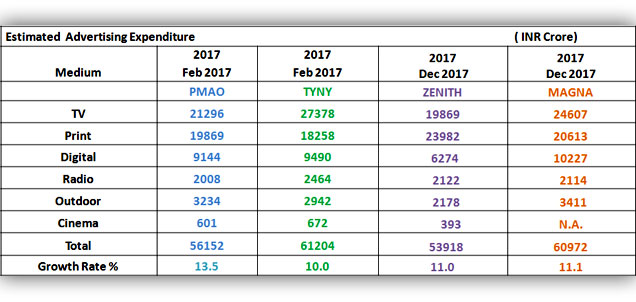
    Recently on December 4, 2017, Zenith predicted the market value of AdEx as INR 53,918 crore. Zenith report was first published in June 2017 and revised in December, 2017. It was followed by another report by Magna, the centralised IPG Mediabrands resourceon December 11, 2017 with a prediction that ad expenditure in 2017 will be INR 60,972 crore. The DAN (Dentsu Aegis Network) report published in afaqs in June, 2017 predicted a 13.5% growth for the year, same as the Pitch Madison predicted rate. Earlier in February, 2017 the reports by GroupM and Pitch Madison were published with prediction of varying projections.


    While, the industry agrees that 2017 saw a decline in growth rate of advertising expenditure from 2016, the estimates for the growth rate and industry size vary from one source to the other as indicated in the following table.

    Estimated Advertising Expenditure     (INR Crore)
    Medium 2017

    Feb 2017

    2017

    Feb 2017

    2017

     Dec 2017

    2017

    Dec 2017

    PMAO TYNY ZENITH MAGNA
    TV 21296 27378 19869 24607
    Print 19869 18258 23982 20613
    Digital 9144 9490   6274 10227
    Radio 2008 2464    2122   2114
    Outdoor 3234 2942    2178   3411
    Cinema 601 672       393 N.A.
    Total 56152 61204    53918 60972
    Growth Rate % 13.5 10.0 11.0 11.1


    GroupM and Magna have estimated Indian advertising expenditure in 2017 as around INR 60,000 crore, while the estimates by Zenith and Pitch Madison hovers between INR 54,000 crore to 56,000 crore. While Madison predicted a growth of 13.5%, the other three agencies predicted growth of 10% to 11% in 2017 over 2016.  It is acceptable that estimates made by different agencies will vary to some extent. It would be a more comfortable situation for all of us if the ranking of ad expenditure on different medium remain in the same order. Currently, there is a difference of opinion on which medium has the highest share in the Indian advertising pie.


    As per an earlier Pitch Madison forecast, the industry was also expecting the AdEx to cross comfortably the mark of 50,000 crore in 2016, which fell short by few crores. In 2017, that mark will definitely be crossed, but without any fanfare as the overall moodin Media and Advertising industry is depressing. 2017 will go down in the history of Indian Advertising as an extended aftermath of demonetisation, which coupled with the woes of GST, slowed down the growth. Let us hope that in 2018, the industry will come to terms with GST, the distribution system will recover, the overall market situation will improve and growth rate of AdEx will rise.


  • Online FMCG will outpace offline in 5 yrs: Nielsen


    By A Correspondent


    Growth in the online FMCG sector has been outpacing offline FMCG growth, with e-commerce sales growth all set to get past traditional retail sales growth within the next five years, according to a new report released by Nielsen, the What’s Next in E-Commerce Report. While total FMCG retail sales growth currently sits at around 4% per annum, total retail e-commerce is predicted to grow by 20%, or an additional $2.1 trillion, by 2020.


    The latest trends in consumer purchasing online within the FMCG sector point to strengthening growth in online adoption and spend around the world according to the report. The report illustrates that while FMCG has historically trailed many other categories such as electronics, mobile goods and travel when it comes to online spending, that trend is set to change in the coming years.


    As many of the existing barriers to e-commerce adoption are overcome, such as retail infrastructure and supply, environmental and cultural factors like credit card fraud, and logistics to support the ‘last mile’, e-commerce is set for exponential growth. These factors are being compounded by surging consumer demand for anywhere, anytime convenience.


    The Nielsen report highlights four key influencers significantly impacting e-commerce growth trends around the world:

    • E-commerce is growing rapidly, but the growth factors are not uniform:Connectivity and accessibility to cheaper data and handsets play a key role in shifting consumer behaviour, and to a large extent smartphone reach is an early indicator of potential e-commerce growth. However, connectivity alone isn’t sufficient to drive e-commerce penetration. Supply factors and cultural nuances also influence consumers’ online purchase behaviour.


    • Drivers and barriers are similar, with one exception:The number one driver across most countries for e-commerce purchases is convenience, with the exception of the U.S. where consumers are more motivated by deals. Conversely, there are three key considerations when examining barriers to e-commerce. Firstly, the desire to examine an item before buying it – from grocery to apparel. Secondly, the lack of trust that retailers will meet expectations around freshness. And thirdly, concern over the level of quality of products bought online vs. in-store. Retailers need to alleviate these barriers to drive their share of the consumer e-commerce wallet.


    • The ability to win the elusive food basket will be key to success in retail e-commerce:The food basket, due to its reptitive purchase pattern, is the Holy Grail for retailers, however, food items remain largely absent from e-commerce sales. Winning the food basket is critical to succeeding in the online FMCG sector.


    • Wooing the omnichannel consumer:When it comes to retail e-commerce, Convenience, Price/Value, Assortment and Customer Experience are the highest-ranked considerations driving consumers’ online purchasing decisions. In order to develop a winning e-commerce strategy, retailers need to ensure they are prepared to over-deliver against each of these four drivers.


    For an in-depth look at e-commerce trends around the world and the factors driving growth across the online FMCG sector, download the Nielsen What’s Next in E-Commerce Report.


  • Online ads to touch Rs 9,700 cr by Dec 2017


    By A Correspondent


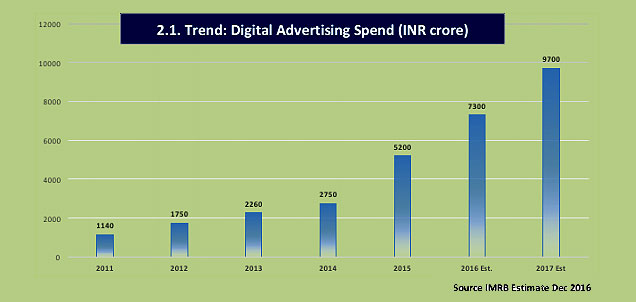
    The digital advertising spend in India was estimated to be around INR 7,300 crore at the end of 2016, growing at a rate of 40% over 2015. The growth in spends on digital advertising is expected to continue at a CAGR of 33% to touch INR 9,700 crore by December 2017. The digital advertising market was pegged at INR 5,200 crore by the end of December 2015. These are the latest findings of the ‘Digital Advertising in India’ report, jointly published by the Internet and Mobile Association of India (IAMAI) and Kantar IMRB Kantar.


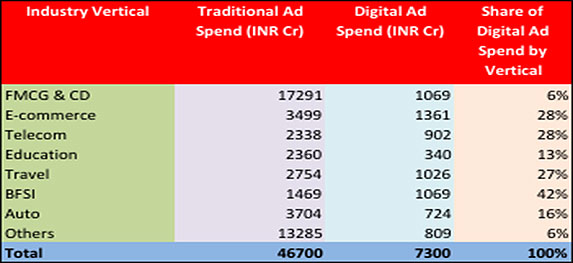
    The report finds that the digital advertising spend is about 14% of the total advertising spends in the country. In terms of volume, E-commerce leads the digital advertising spends with around INR 1,361 crore, followed by FMCG, Consumer Durables and BFSI. However, a comparison of these verticals in terms of share of spends on Traditional vs Digital show that BFSI organisations incurred the highest share on digital advertising spends. 40% of their overall advertising spend was on Digital followed by E-commerce, Telecom and Travel.


    Share: Traditional vs Digital Advertising Spends by Verticals

    Source IMRB Estimate Dec 2016

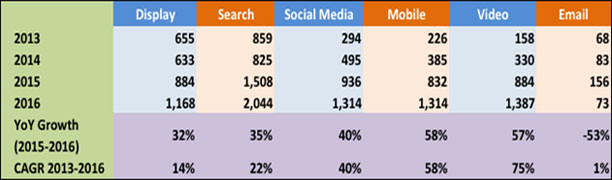
    In 2016, it is estimated that Search ads (close to INR 2,044 crore) constituted 28% of the overall ad spends followed by Video (close to INR 1,387 crore) which contributes to around 19%; Mobile and Social Media (close to INR 1,314 crore) each are at around 18% and Display ads (close to INR 1,168 crore) at 16%. Spends on Video ads have shown a significant increase and accounted for 19% of the overall spends in digital advertising. In all likelihood, this has been driven by new online entertainment (movie, TV series) channel launches, by enhanced monetisation across various platforms and high CPMs on premium content. This category is estimated to witness significant growth till 2020. Spend on mobile advertising (SMS/in-app ads) also recorded high YoY growth of 58% from INR 832 crore in 2015 to around INR 1,313 crore in 2016. Spending on email ads has reduced substantially (-53% YoY) and is now estimated at only INR 73 crore.


    Spend by Ad Avenues & CAGR (INR crore)

    Source IMRB Estimate Dec 2016


  • GST and its impact on advertising: EY


    With GST just around the corner, most media companies are trying to understand the impact it will have on advertising budgets. EY has done a detailed analysis to understand how GST will impact advertising across industries. While sectors like FMCG and Consumer Durables show a positive impact on advertising spends, EY anticipates a negative impact on sectors like eCommerce and Banking and Financial Services. Sectors like Real Estate, Telecom and Insurance are not expected to have any significant impact. Over to the EY presentation for more…


    GST How it will impact advertising budgets_june2017


  • Ad Club’s ‘Marquees’ to celebrate gamechanging stories of brands

    By A Correspondent


    After conducting events as big as the Abbys, Emvies and Effies, The Advertising Club unveiled at Goafest 2017 an all-new annual property called ‘Marquees’ which addresses the needs of marketers who form a large constituency of the Advertising Club.
     

    The Awards intend to recognise brands for excellence in marketing, but also those who have come out successful despite facing numerous adversities iterating the well-known adage “That which does not break you only makes you stronger.”  The debut edition of The Marquees is slated to premiere in August 2017. Network18 has come on board as presenting partner.


    Speaking about the newly constituted awards, Raj Nayak, President, The Advertising Club said, “Brands operate in a dynamic and evolving environment where challenges are manifold and mostly unpredictable. It is hence important to recognise and honor creativity and effectiveness of brands that take challenges to their stride and emerge triumphant. The Marquees will play the role of acknowledging and cheering brands and marketing initiatives that have been gamechangers.”


    Commenting on the raison d’être of the awards, Partho Dasgupta, Chairman Marquee Awards said: “We believe that brands are a force of change and influence in society. The awards will recognise all the elements of marketing with communication being just one of them. We are sure that the awards will emerge as an ultimate benchmark for excellence in marketing.”


    Apart from the regular category awards for sectors such as FMCG, Banking, Auto, Insurance, Telecom & DTH, Consumer Durables & E-commerce. The Marquees will also have “Marquee Special Awards” and will recognise brands who have made a name for themselves differently. Some of the examples of the special awards are: conquering an impregnable fortress, riding on an emerging wave, reinventing for the better, carving out a niche and traversing unchartered waters.


  • Muted growth for TV adspends forecast: Kotak


    The ‘Media’ report by Kotak Institutional Equities reached our inbox on Friday and at first we ignored it as one of the several reports we receive from financial analysts and brokerage companies. But the subject grabbed our attention, and we decided to push the scheduled story for today by a day and publish the report as is:


    Here is the report:

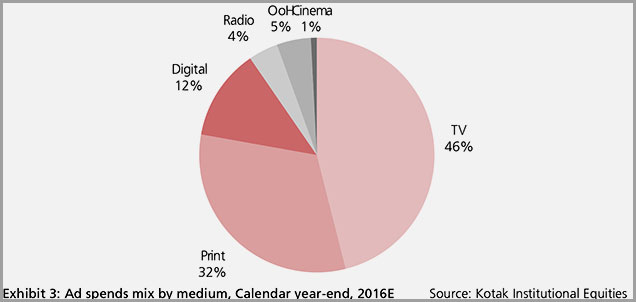
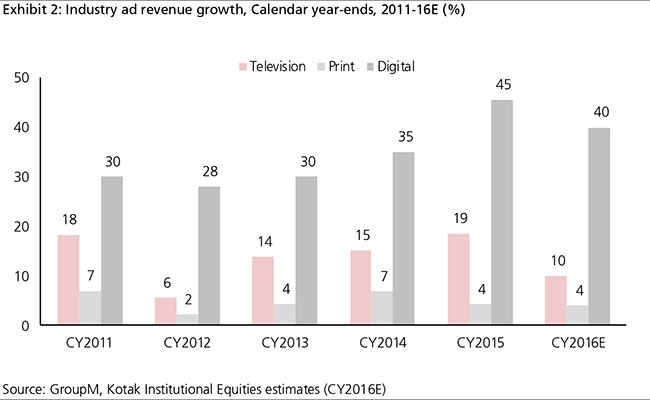
    TV advertising: CY2016 review, CY2017 outlook. We expect TV ad spends growthto be a tad soft at 10/13% in CY2017/FY2018 notwithstanding the low base given weak underlying trends in FMCG and some let up in competitive intensity. The outlook can improve during the year in the event of any stimulus from the government to boost consumption. We moderate FY2018E ad growth forecast for Zee but maintain earnings in view of margin levers available to protect earnings. We recommend adding Zee in the event of any near-term weakness in advertising growth /stock price.


    Television ad spends- a round-up of CY2016

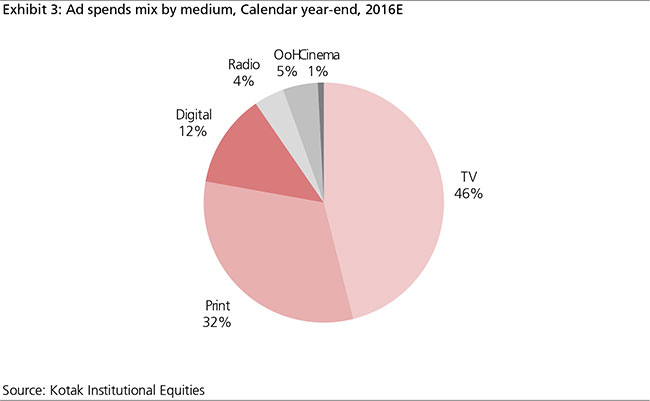
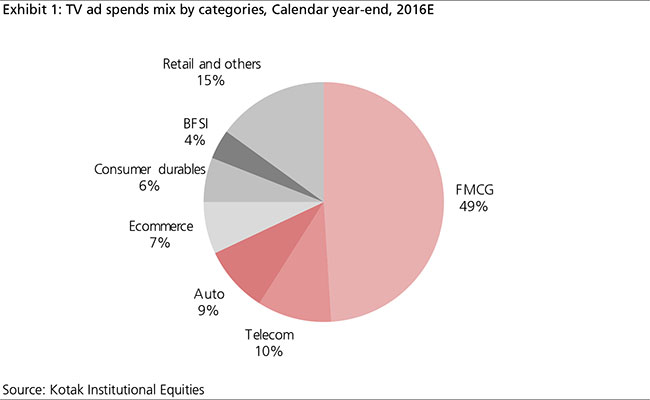
    TV industry ad spends in India grew by about 10% in CY2016E, below our beginning-of-the year expectation of 15% growth. Negative surprises during the course of year were from (1) demonetization (250 bps impact), (2) weak ad spends from FMCG category (50% of TV ad spends) as gross margin expansion paused and volume growth decelerated. The impact was partly offset by sharp increase in ad spends from Patanjali; (net impact 200 bps), and (3) delays in RJio launch and lower than expected ad intensity in telecom (10% of TV ad spends) thereafter (100 bps impact). On the bright side, auto (9% of TV ad spends) category grew in mid-teens. Internet/ecommerce (7% of TV ad spends) category growth moderated to a single digit on consolidation and constrained funding but held well on high base partly aided by heavy advertising by mobile wallets post demonetization. We estimate print/digital ad spends growth at 4%/40% in CY2016 as against beginning-of-the-year industry forecast of 6%/47%.


    CY2017 outlook- recovery in FMCG volume growth essential for strong ad growth

    TV ad spends growth is a function of (1) growth and profitability outlook of consumption categories (ad budgets are pegged as a percentage of revenues and tweaked based on profitability outlook), (2) competitive intensity (new entrants/ launches boost ad intensity in a category). We see moderation in both these trends in CY2017 after 3-4 good years. Key drags

    (1) FMCG: ‘weak volume growth + RM inflation (on the margin)’ environment can put pressure on ad budgets, (2) Internet/ecommerce: ad budget optimization can continue on funding constraints and consolidation. Given this, TV ad spends growth could be muted at 10/13% in CY2017/ FY2018 despite the low base as compared with 14-19% growth over the past 3-4 years. That said, we note there are several potential triggers that can spring a positive surprise in 2HFY18— (1) strong government stimuli to boost consumption, (2) acceleration in unorganized-to-organized shift after implementation of GST, and (3) rise in ad intensity led by Patanjali, Reliance Jio and/or Alibaba. We will keep a close eye on these variables.


    We continue to like Zee given comfort on long-term strategy, execution and profitability

    We expect Zee’s ad growth outperformance of 3-4% over the industry to continue in FY2017-18E led by (1) ratings share gain in Tamil, and (2) expected recovery in Zee TV’s ratings in 3-6 months. We moderate FY2018E ad growth forecast (ex-sports) for Zee to 17.5% (including 1.5% inorganic)


    A round-up of CY2016 TV ad spends

    TV ad spends in India increased by about 10% (KIE) in CY2016, below our beginning-of-the year expectation of 15%. The negative surprise in ad spends growth was due to

    (1) About 2.5% impact of demonetization.

    (2) Weaker than expected ad spends growth of several large FMCG players on account of weak volume growth and a pause in gross margin expansion (Exhibit __). The impact was partly offset by sharp 30%+ increase in ad spends by Patanjali.

    (3) Delays in launch of Reliance Jio and lower than expected advertising intensity in telecom vertical even after the launch.

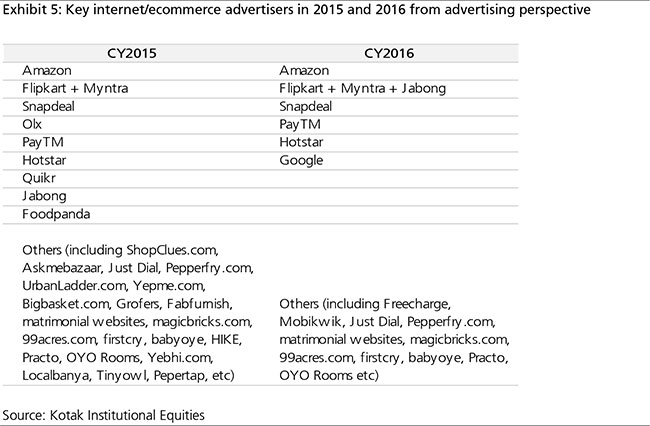
    (4) Internet/Ecommerce segment ad spends growth moderated to a single digit on expected lines given funding constraints and consolidation. We note that the growth was on a high base— ecommerce ad spends on TV grew more than 50% in the previous year. Additionally, several advertisers cut ad budgets or were shut down or acquired in CY2016 (Jabong, Foodpanda, Quickr, Housing.com, Fab furnish and Urban ladder). The impact was partly offset by ad spends growth from mobile wallets and a big campaign by Snapdeal in the December 2016 quarter.

    (5) Auto category reported healthy 15%+ ad growth led by new launches and maintenance campaigns.


    CY2017 TV ad spends outlook

    Ad spends depend on underlying strength in consumption demand, profitability outlook and competitively intensity. In uncertain environments such as the present, several advertisers refrain from finalizing annual ad budgets and instead budgeting is done on a quarterly basis and at times tactical approach is taken. Given many moving parts, forecasting ad growth is a tricky exercise. With that caveat, we detail our thoughts on ad outlook of key categories


    > FMCG (49% of TV ad spends): FMCG ad spends growth decelerated in CY2016 due to weak volume growth followed by impact of demonetization. We expect recovery from demonetization over the next 2-3 months or so, but recent increase in RM prices can put some pressure on margins which in turn could constrain double-digit increase in ad budgets in CY2017/FY2018.


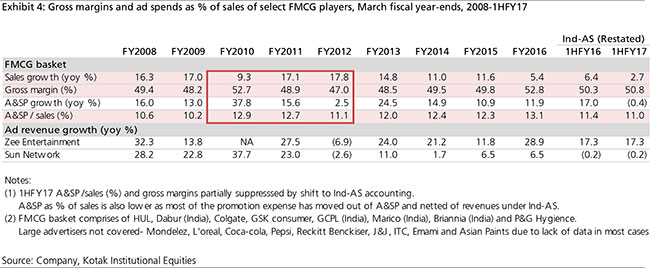
    We highlight (Exhibit 4) (1) Gross margins of FMCG companies expanded by 300 bps over the past 2 years allowing them to invest RM cost savings in AS&P spends. Consequently, AS&P as a percentage of revenues expanded by about 80 bps for our FMCG basket in FY2016. This benign RM cost tailwind has receded and can become a modest headwind. As per KIE’s consumer analysts (please see 16th Dec 2016 consumer sector note ‘Marginrisks underappreciated’), several raw material prices have moved up on yoy basis and atcurrent prices, RM inflation could impact gross margin by about 100 bps for many companies, (2) RM inflation cycle in CY2010-12 resulted in a cut in AS&P as a percentage of revenues with some lag. Volume growth during that period was strong.


    At present, FMCG industry is facing weak volume growth and modest inflation in RM costs. It is tricky to predict whether companies would be tactical and cut AS&P as a percentage of spends to protect margins or change Advertising/Promotion mix to push volumes. Another variable is ad intensity— it has to be seen if Patanjali continues to advertise at 30%+ as was the case in CY2016.


    At a broad level, underlying trends for FMCG are not robust. However, even as near-term outlook is weak, FMCG ad spends can positively surprise 6-9 months out in the event of

    (1) any recovery in volume growth boosted by government stimuli, (2) acceleration in unorganized-to-organized story post implementation of GST. Any signs of this could propel FMCG to increase ad intensity, and (3) higher than usual ad intensity triggered by Patanjali. Further, we note that weak FMCG ad spends would be in the base to some extent starting 2QFY18E.


    > Internet/ecommerce (7% of TV ad spends): Funding constraints, lack of improvement in economics and consolidation will weigh on ad growth from this category. We note that internet/ecommerce ad spends grew many fold during CY2013-15 and boosted TV ad spends growth. This category grew marginally below industry in CY2016 even as it saw closures, ad budget cuts and consolidation thanks to the step up in advertising from mobile wallets. We expect this category to underperform TV industry in CY2017 as well, unless there is a meaningful rise in ad intensity induced by Alibaba (likely to entry Indian Ecommerce space directly or through its investee companies in PayTM and Snapdeal).


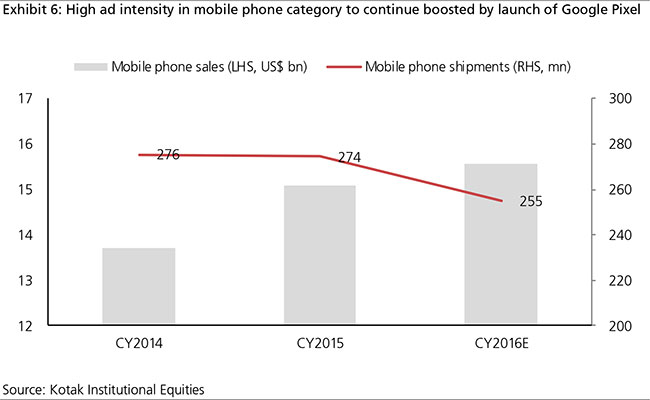
    > Telecom (10% of TV ad spends): This category comprises Telecom service providers, mobile handset manufacturers and DTH players. We expect strong growth led by (1) full-year impact of Reliance Jio and possible increase in ad intensity across telcos, (2) recent entry of Google in mobile handsets augurs well for the category even as absolute growth in smartphone sales value is negligible.


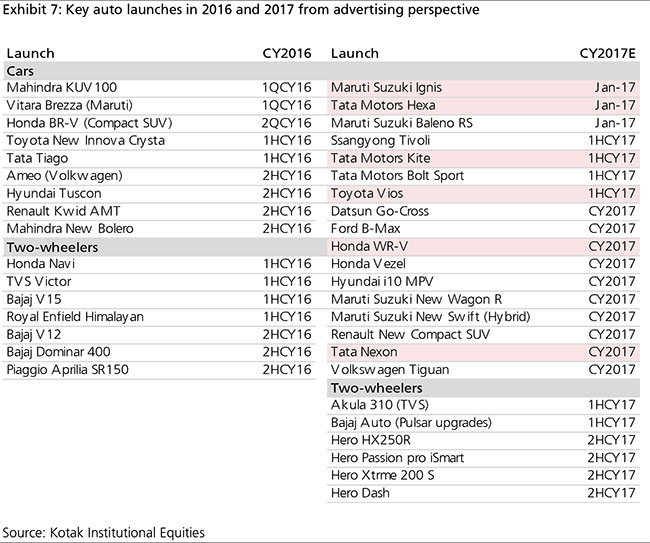
    > Auto (9% of TV ad spends): Auto ad spends growth is a function of new launches and maintenance campaigns. This category reported healthy double digit growth in CY2016 aided by new launches and high activity on maintenance campaigns from Maruti, Tata, Hyundai and Volkswagon. We believe the launch pipeline for CY2017 is stronger than for CY2016. Expect buoyancy in ad spends to continue.


    > Other categories. We expect steady growth in BFSI (4% of TV ad spends) and muted growth in consumer durables (6% of TV ad spends). Government ad spends (1-2% of TV ad spends) could grow 40%+ largely led by 30%+ increase in DAVP advertising rates. Growth in Retail category will depend on the impact of GST.


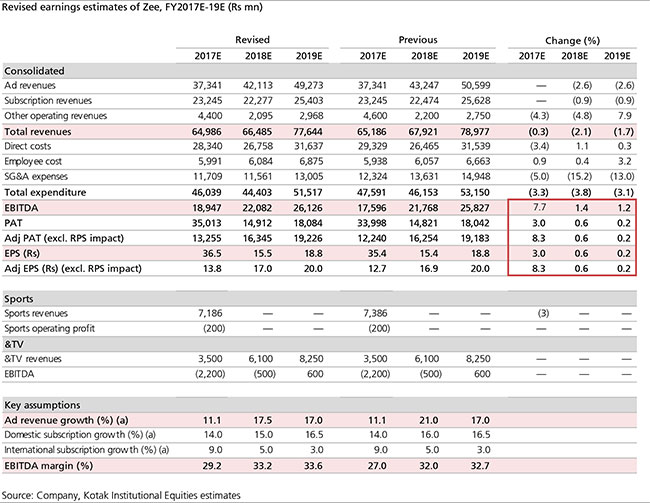
    We moderate ad growth forecast for Zee but broadly maintain EBITDA and earnings

    We trim FY2018E ad growth forecast for Zee to 17.5% (including 1.5% inorganic from RBNL’s channels) as we build lower ad growth for the industry (13% in FY2018E versus our earlier expectation of 15-16% given the low base). We broadly maintain our EBITDA and earnings estimates and build higher margins. We believe Zee has enough available levers (especially ad and publicity expense of more than Rs4.5 bn) to protect earnings and surprise on profitability. Strong growth in domestic subscription revenues aids profitability– Zee will likely report 14% growth in domestic subscription revenues in FY2017E and simultaneously 15-20%+ decline in carriage costs. We raise our FY2017E estimates as we expect much lower impact on EBITDA and earnings as against our earlier expectation.


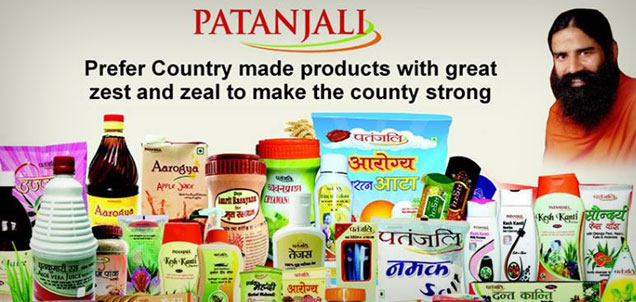
  • Patanjali as 5th largest Indian FMCG?


    By Namrata Singh & Partha Sinha


    At Patanjali Ayurved’s manufacturing facility in Haridwar, there is brisk activity as cartons of freshly made products are being loaded onto trucks to be dispatched to stores across India. With the financial year nearing a close, an official pointed explained, all hands are on the deck to help the company achieve its targeted turnover of Rs 5,000 crore this fiscal.


    For a manufacturing company set up about 10 years ago, achieving a Rs 5,000-crore turnover is not easy. However, for Patanjali Ayurved, which is breaking conventional marketing norms, sales are inching up month on month. Sources in the know believe Patanjali could have clocked monthly sales of around Rs 600-700 crore in January and February, which means Baba Ramdev’s baby could become a billion-dollar entity, with its annualised turnover expected to cross the Rs 7,000-crore mark before the end of fiscal 2017.


    Brand Patanjali driving buzz on social media


    By Anumeha Chaturvedi


    Brand Patanjali generated around 15000 conversations on Twitter in the period between August 2015-January 2016, according to data compiled by social media analytics firm Blueocean Market Intelligence.


    Chatter around Patanjali was largely around its competitiveness (60%) as an FMCG brand. Some discussions were also led by the indigenous nature (17%) of the brand, the quality of its products (13%) and its marketing strategy (10%).


    In many instances, discussions/posts around the brand referred to Baba Ramdev thereby indicating that the brand is strongly associated with Baba Ramdev and he is a strong brand ambassador driving the brand’s image.


    A lot of buzz was observed around Patanjali becoming a strong threat in terms of market share to rival MNCs such as Colgate, HUL, ITC and Emami, in the FMCG space.


    Discussions touched upon Patanjali emerging as a strong player in the FMCG market; particularly its soaring sales graph gathered a lot of attention.Many consumers were seen commenting on how their products, particularly noodles and honey were not only cheaper but also better than those of other competitors. Few consumers went to the extent of expressing their wishlist of products such as sanitary napkins, fairness creams, that they expect in future from Patanjali. Top trending hashtags for the brand were Patanjali, Ramdev, and Babaramdev, according to Blueocean.


    In terms of its marketing strategy, discussions centered around Patanjali’s tie-up with Future Group. This partnership was seen as a sound approach to further strengthen the brand’s foothold in the FMCG market through Future Group’s outlets such as Big Bazaar and Easyday.


    Furthermore, efforts such as launching Patanjali Atta Noodles in the absence of Maggi noodles in the market, targeting market segments dominated by MNCs, direct marketing, seeking exclusive space at stores, were appreciated as compelling and strategic marketing moves


    The brand’s marketing related update that it is focusing on advertising and has kept aside Rs 300 crore for advertising and promotion, also gathered some attention according to the research.


    Which means, Patanjali could become the fifth largest FMCG company in the country, after Hindustan Unilever, ITC, Nestle India and Britannia Industries. This would bring it well ahead of traditional FMCG players like Dabur, Godrej Consumer Products and Marico.


    In an exclusive interview at the company’s headquarters, Acharya Balkrishna, MD, Patanjali Ayurved, said in the current fiscal, as of early-March, the company’s turnover has already crossed Rs 4,500-crore and is cruising at a monthly rate of about Rs 500-550 crore. “Our target is to go be yond Rs 500 crore a month.Because we are also making plans for future expansion, we are moving in line with the target,“ he said.


    “We may even reach Rs 600 crore a month mark -that will give us an annual turnover of approximately Rs 7,000 crore,” said Balkrishna.


    Even at the current level of Rs 4,500-crore turnover, Patanjali has paced ahead of oral care leader Colgate-Palmolive (India), challenging it which its `Dant Kanti’ toothpaste.


    Given that Patanjali has been grabbing eyeballs through its advertising, industry experts believe the company could soon even reach Rs 10,000 crore turnover, which would make it as big as ITC’s non-tobacco FMCG sales.But Balkrishna said that would take time. “We have to plan, right from procurement of raw materials to processing to manufacturing and marketing. We work on a single channel right from the farmer to the end consumer and that is the real reason why our quality and costs are under control. There are very few companies in the world which may be following such a system,” he said.


    “We buy raw materials directly from the farmer. In other companies, raw material sourcing and marketing of products are done by different entities. So we don’t have sudden peaks and troughs in growth, we plan a steady growth. It’s not like a share market where one day there is growth and the other day a slump,” Balkrishna said.


    The rural market is another area where FMCG biggies could face a tough challenge from Patanjali’s products, which are priced below regular brands because the company consciously operates on thin margins. “We are expanding our reach through tempos which can go deeper into rural markets. We will begin with 500-600 tempos and will gradually expand the network,” said Balkrishna.

    Source:The Economic Times
    Copyright © 2016, Bennett, Coleman & Co. Ltd. All Rights Reserved
    Licensed to republish

  • Triumph appoints Fountainhead MKTG to handle its PR

    By A Correspondent


    Triumph International (India) has roped in Fountainhead MKTG, a recent venture between Dentsu Aegis Network, New York-based lifestyle marketing agency MKTG and the event management company Fountainhead Entertainment, to handle its PR mandate. The agency’s PR division won the account following a multi-agency pitch.


    Triumph enjoys a presence in over 120 countries with the core brands Triumph and sloggi. It is a member of both the Business Social Compliance Initiative (BSCI) and the Global Social Compliance Programme (GSCP).  The brand is currently present in more than 1000 points of sale across India including leading large format stores, multi-brand outlets and multiple e-commerce portals.


    Under the guidance of Shalindra Fernando, General Manager India & Sri Lanka, Triumph International and Jennifer Kapasi, Head of Operations, Triumph International (India), the brand aspires to enable Indian women to feel comfortable and confident in what they wear without feeling conscious about how they appear from outside. In India, women are waking up to and loving the benefits that perfect lingerie can bring to their lifestyles. Today they see their choice of lingerie as an inspirational key factor in the confidence they radiate.


    Shalindra counts over 14 years of experience in Fashion Retail, FMCG and consulting across Asia and Africa. He has been at the helm of Triumph International India since April 2012 after completing 5 successful years with Triumph International Sri Lanka as General Manager.


    Jennifer counts over 10 years of diverse experience in Retail, Fashion, FMCG and Consumer Electronics across key markets such as Europe, India and the Middle East. She took over the role as Head of Operations in August 2014 and currently successfully manages Triumph’s entire sales and marketing organization across India. She initially headed Triumph’s modern trade, as well as franchise retail and online business channels.


    Sharing her thoughts on the association, Jennifer Kapasi, Head of Operations, Triumph International (India) said, “We are glad to be associated with Fountainhead MKTG. Triumph is world’s largest intimate apparel company and enjoys presence in over 120 countries. We at Triumph have a great team who are young, passionate, enthusiastic and thrive to bring global collections to the Indian market, combining perfect fit, ultimate comfort with the latest international trends.  With this association, we are looking forward to the same passion and enthusiasm that the team will bring to the table and collectively work towards achieving our goals to enrich our brand presence.”