Tag: FMCG

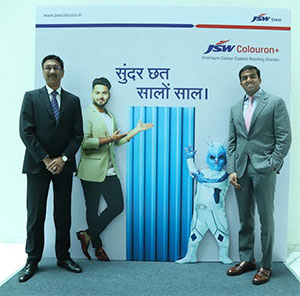
  • JSW Steel signs Rishabh Pant as brand ambassador

    By A Correspondent


    JSW Steel has signed cricketer Rishabh Pant as its brand ambassador to promote its steel products which include JSW Colouron+ colour-coated sheets and JSW Neosteel TMT bars, for a three-year period.


    According to Parth Jindal of JSW Group: “JSW Group’s philosophy – ‘Better Everyday’ guides us to positively improve all the lives we touch. It enables us to hold a unique and differentiated place in the minds of our customers. Our continued focus on making high quality products and ensuring that they are easily accessible to consumers across India lets us to participate in building a modern India. As a brand we believe that we are young, hungry, fearless and world class, the same traits we see in Rishabh Pant. We are thrilled to have Rishabh as our brand ambassador and have no doubt that this partnership will be beneficial and increase the recall for the JSW Neosteel and JSW Coloron+ brands.”


    Added Harsh Bhatt, Executive Vice President: “Unlike advertising for FMCG and Durables, advertising for a category like coloured steel roofs and TMT bars is always unique given the low consumer involvement in these categories.  Our first strategic intervention was to look for a sweet-spot that impacted the consumer enough to care for these purchases and willing to pay a premium for them. JSW Colouron+ roofing sheets and JSW Neosteel TMT bars have a distinct quality advantage over other product offerings in the market. All we had to do was communicate that in an exciting way. The addition of Rishabh Pant in the mix made matters a lot easier for the creative team where facets of grip, durability and strength of the products were compared to everyday things. The quirk in the situations are intentionally exaggerated to make the right point.”


  • P&G’s Kainaz Gazder named Jury Head at APAC Effie

    By A Correspondent


    Effie Asia Pacific has announced Procter & Gamble’s (P&G) Kainaz Gazder in its third set of Heads of Jury for the 2020 APAC Effie Awards.


    Kainaz Gazder

    With nearly 25 years in the FMCG industry, Kainaz Gazder has built a track record in launching new brands, turning around struggling businesses and taking strong businesses to greater heights. Starting out with P&G India in 1996, Gazder has been credited for numerous business-building and award-winning brand campaigns.


    Commenting on her appointment, Gazder said: “An Effie award is a global symbol of achievement, representing ideas that build brands. As a brand builder for over 20 years, I am thrilled to help champion the most effective ideas as a Head of Jury for the APAC Effies.”


  • 12 Super Bowl Ads You Must Watch


    By Sanjeev Kotnala


    If you are in Marketing and advertising, you would have watched all the Super Bowl ads by now. Every year around this time, the heat is on between brands to make an impression and get maximum instant reach for their messages. Some try being playful, some introduce new themes, and some try to provoke.

    In all, a total of more than 50 advertisements get released in the Super Bowl at an astronomical figure (by Indian standard) of $5.6 Mn per 30 seconds. Most brands must be finding it relevant and efficient, as some brands always have spots aired with the  Super bowl. The inventory is almost sold by November of the previous year.

    Brand, creative and media specialist mourn the absence of any such opportunity in India. Neither the pre-festival advertising in October nor the hyped-up IPL. And let us not talk of the opening episodes of any of the famed reality shows like KBC, KKK or Bigg Boss – none have the oomph, aah and wah of a Super Bowl.

    Not unexpected there is beer advertising as a category dominating the super Bowl commercial. And surprise, everyone investing what we would call a long story format to get their simple message across.

    When brands invest in an immediate reach build-up with an event that guarantees a massive number of eyeball, it is good to see them invest big. The super bowl spots maybe shorter version, but these extended versions show the intent.

    Like every Super Bowl event, many brands spots are just nice or templated around their style of storytelling. They made you smile and at the same time got the brand message across. All under one roof. You can watch all these spots at Adweek.

    ……………………………………

    So here are my 12 favourites brand spots. That’s a high percentage of likability from the commercials aired during the Super Bowl. They are rightly messaged, superbly crafted and executed.

    While watching the Super Bowl, the consumer mind aperture is open for entertainment and excitement. Hence, the ads that have a similar story presentation style that stimulates and engages are contextually better placed than others trying to present the message in a different way.  And one who use the context and the DNA of the event best, win.

    ……………………………………..


    MICROSOFT screened a lovely commercial. The protagonist Katie Sowers- first female super bowl coach, explaining that she wants not to be the best female coach but the best coach. People expect women to do certain things and do not expect to do many other things. However, the first in the filed opens the arena for others. That is like ENCOURAGED BETI ENCOURAGED FUTURE. An attitude we mostly miss in advertising. It is one of the best-crafted spots. It is my Favourite ad.


    https://youtu.be/_xPn4DXIj5w


    GOOGLE has this ad about how people lived before Alexa. It is contextually better placed in the event environment. It is humorous with some crazy situations to drive home a simple point of what Alexa can do.


    https://youtu.be/RF9t2rFmTVE


    GOOGLE has another emotionally powerful linking ad. It is very product dominant in all its visual impact and experience and hence my favourite Number II. ,


    https://youtu.be/6xSxXiHwMrg


    So, how can beer as a category be away from the super bowl?


    BUD LIGHT two spots, INSIDE BRAIN, are highly engaging and entertaining.


    https://youtu.be/wsnnU3fJTWg


    https://youtu.be/pj1meOmpezs


    Then there is BUDWEISER, identifying Typical American with their beer. And I am partial to beer advertising.


    https://youtu.be/yt-zXuAAD6Q


    MICHELOB ULTRA does it one better with its simple message, ‘it is only worth it if you enjoy it.’


    https://youtu.be/U7h6Vls-uO8


    MICHELOB ULTRA PURE GOLD makes a passionate appeal to pick 6 packs and see how it can change American farming. I literally love this very Patriotic beer ad.


    https://youtu.be/ANarZ_113Xc


    Another category that uses Super bowl best is cars. Here HUMMER ELECTRIC makes an impactful promise and delivers message quite soundlessly.


    HYUNDAI SONATA is not far behind in its impact with self-parking demonstration has an extra edge on conversation and experience. It is nothing new, but it engages because of the conversation and the way it clarifies self-parking at any place.


    https://youtu.be/85iRQdjCzj0


    But PORSCHE, Wins the category battle of commercial with THE GEIST. It is so captivating and smart. My favourite number, -3.


    https://youtu.be/FJNmHwBgV4M


    In FMCG, coke, Pepsi, Doritos, Mountain Dew, Cheetos, Sabra SodaStream and others were there. But there was not much excitement around them. They were what they were.


    HEINZ innovative ‘four in one’ commercial does stand out. However, it is a bit disorienting to see them simultaneously- but does that matter?


    There was this REESE’S TAKE 5 with ‘The best bar that you have never heard of’. Likeable but then you have seen Bars and chocolates in that territory so many times. For me, SNICKERS beat it hollow any day.


    https://youtu.be/SLAV4LYO-yU

    ……………………………………………………….


    And the last one for Milo Kotnala, the WEATHER TECH spot.


    ……………………………………………………….

    What say, will we see such hype with brands and IPL, I doubt, but one never knows. Why do you think, IPL will never reach this type of hype as a powerful window with such a hype?


  • The Four Giant Leaps


    By Indrani Sen


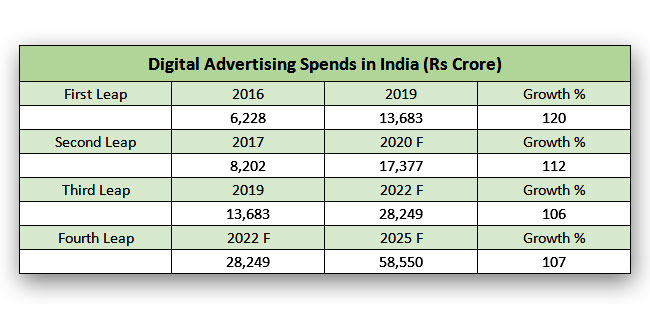
    According to the DAN Digital Advertising Reports, spends on digital advertising in India is increasing by 100%+ every three years and is poised to cross the 50,000 crore milestone before 2025. It was only in the second half of the last decade, the Indian advertising industry crossed the milestone of 50,000 crores, so it seems strange that the newest and youngest competitor for the share of the advertising pie will be crossing that same milestone by middle of this decade! We have already witnessed the first giant leap from 2016 to 2019 and it seems quite possible that in three more giant leaps digital advertising will achieve this fantastic growth.


    Digital Advertising Spends in India (Rs Crore)
     First Leap 2016 2019 Growth %
    6,228 13,683 120
    Second Leap 2017 2020 F Growth %
    8,202 17,377 112
    Third Leap 2019 2022 F Growth %
    13,683 28,249 106
    Fourth Leap 2022 F 2025 F Growth %
    28,249 58,550 107

    Source: DAN Digital Advertising Reports


    The question which comes up next is which industry verticals are contributing to this spectacular growth of digital advertising? An analysis of the DAN Digital Advertising Reports show that almost across all industry verticals, advertisers have been increasing their spends across various platforms of digital advertising. The following table shows the comparative weightage on digital advertising by industry verticals in their total advertising budget in 2017 and 2019. Except Media & Entertainment where the weightage has remained 23% and miscellaneous small categories grouped under “others” where the weightage has gone down, across all other industry verticals, advertisers stepped up their expenditure on digital media. Digital media is no longer a myth; it is a reality now competing for share of the advertising pie and propelling the growth of advertising in India.


    Weightage on Digital Advertising
    2017 2019
    FMCG 7% 19%
    Auto 12% 16%
    E Commerce 30% 37%
    Retail 16% 20%
    Telecom 28% 35%
    BFSI 24% 42%
    M&E 23% 23%
    Consumer Dur 19% 38%
    Others 9% 4%

    Source: DAN Digital Advertising Reports


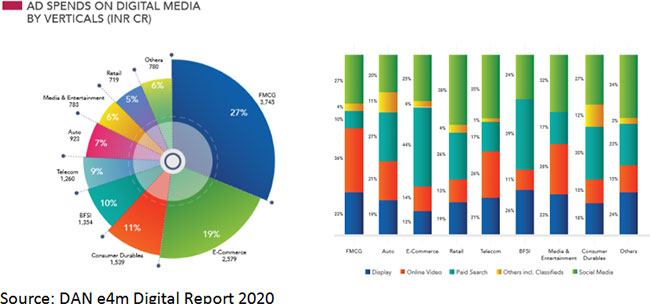
    Though FMCG as a category spends 19% of their advertising budget on digital media, it contributes 27% of the total digital advertising pie, followed by E Commerce 19%, Consumer Durable 11%, BFSI 10% and Telecom 9%, followed by others as shown in the chart below on the left. So, across all industry verticals, advertisers have got into the Indian digital bandwagon.


    The next chart on the right shows that based on the target audience and their use of different digital media, the various industry verticals use the different digital formats for advertising; while E Commerce and BFSI rely more on paid search, Retail and Telecom rely on Social Media. However, a comparison of 2017 and 2019 shows that the share of formats in digital advertising have hardly changed except video increasing at the cost of classified and paid search.


    2017 2019
    % %
    Social 28 28
    Paid Search 26 25
    Display 21 21
    Video 19 22
    Classified 6 4

    Source: DAN Digital Advertising Reports


    In 2017, 43% of the digital advertising was through mobile, which increased to 47% in 2019 and is expected to grow to 53% in 2020. Clearly, the mobile revolution in India has contributed in a large way to the growth of digital advertising. By the time digital advertising crosses the 50,000 crore mark mobile will have 60% + share in that revenue. Programmatic buying has also been growing year on year and by 2020 direct buying will be 44% with programmatic buying going up to 56%.


    The digital media industry still faces many challenges, but apart from a detail discussion on ROI for digital advertising, the current report does not touch on the other issues like ad fraud, ad blocking software, lack of metric for measurement etc. On the whole, the DAN e4m Digital Report 2020 is an informative and excellent resource and the advertising and marketing industry should be thankful to the leadership of Dentsu Agies Network for sharing it free with all concerned.


  • 10 Takeaways from DAN Digital Report 2020


    The headline was digital media is expected to cross the Rs 50k crore mark by end-2025. But, then, there was a lot more in the report. Here are key highlights and takeaways:


    Anand Bhadkamkar, CEO, Dentsu Aegis Network India: “2019 was a challenging year for the Indian advertising industry as well. With the economic slowdown, advertisers decided to cut back on spends, consumers decided to wait-and-watch, market sentiments reached a new low and India’s Ad Expenditure (AdEx) witnessed a consequential fall. But even in the midst of it all, digital continued to grow. Digital is a masterstroke in advertising and Dentsu Aegis Network recognizes this strength. We also recognize the need for an industry level report that can give directions toward which this industry is moving. While with every new edition, the DAN Digital report has been upping its rank in quality, range and comprehensiveness, we welcome sincere feedback and inputs from the entire industry to help establish a robust eco-system for this fast growing and increasingly important industry channel, so that all of us can progress together!”


    Ashish Bhasin, CEO, APAC and Chairman, India – Dentsu Aegis Network: “The Media and Advertising industry is shifting at a rapid speed and Digital is certainly taking charge. Consumers are leaving behind huge digital footprints and there is a lot more emphasis on managing data and developing martech capabilities, now. 2020 is expected to witness a major change in advertising in India, with digital becoming a bigger medium. In fact, by 2021, it’s growth should surpass that of print. Yet, despite this progressive swing, the industry has failed to come together to agree upon a common measurement metric for digital. As leaders in digital, Dentsu Aegis Network today stands at the forefront of this evolution and understands the need to have more information on Digital. The DAN Digital report, now in its fourth edition, is exhaustive, systematic, thorough and meets this need gap brilliantly. The report has now become the most credible source of information when it comes to digital in India.”


    1. The Indian advertising industry has grown at a rate of 9.4% over 2018 to reach Rs. 68,475 Crore by the end of 2019. The industry will grow by 10.9% to reach Rs. 75,952 Crore by the end of 2020. It is expected to grow at 11.83% CAGR to reach a market size of Rs. 1,33,921 Crore by 2025.

    2. By the end of 2019 the digital advertising industry stands at Rs. 13,683 Crore, up at a rate of 26% from Rs. 10,859 Crore in 2018. It is expected to grow at 27% to reach Rs. 17,377 Crore by the end of 2020.

    3. Advertising spends on Digital media is expected to grow at a CAGR of 27.42% to cross the Rs. 50,000 Crore mark and reach an industry size of Rs. 58,550 Crore by the end of 2025. This sustained growth can be attributed to the technological advancements, improvements in data science & analytics, introduction of policies & regulations among others.

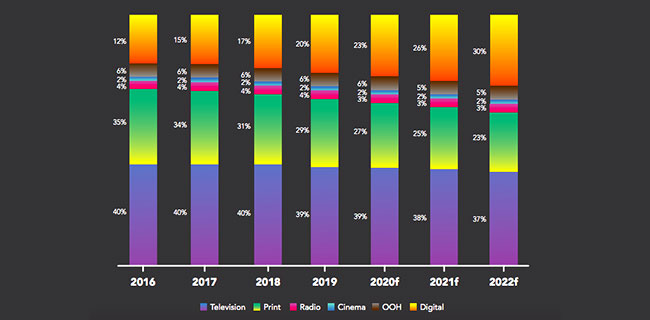
    4. Television takes the largest share of media spends at 39% (Rs. 26,869 Crore) followed by print media (29%, Rs. 20,110 Crore) and Digital Media (20%, Rs. 13,683 Crore). In the year 2020, spends on Television media is expected to grow at 10% and its share will remain steady while that on Print media is expected to grow at 3% with this share declining to 27%.

    5. Across various industry verticals, FMCG sector spends the highest by contributing 30% (Rs. 20,182 Crore) to the advertising industry. Next to FMCG stands with 10% contribution by E-commerce (Rs. 6,915 Crore) followed by Automotive sector (8%, Rs. 5,797 Crore).

    6. Among the various industry segments, FMCG has the highest expenditure on advertising i.e. 30% (Rs. 20,182 Crore) followed by E-commerce (10%) and Automotive segment. FMCG spends a large majority of their advertising budget on television (61%) while Retail, Automotive and Retail spend a large share of their advertising budget on Print. The biggest spenders on digital media are BFSI (42%), Consumer Durables (38%) and E-commerce (37%).

    7. Advertising spends on Digital Media is led by Social media with the highest share of 28%, contributing Rs. 3,835 Crore to the Indian digital advertising pie. This is followed by spends on Paid search (23%), Online Video (22%) and Display media (21%). Display media, online video and social media are expected to have the fastest growth in 2020. The share of paid search is expected to reduce from 25% to 23% by the end of 2020.

    8. FMCG segment spends a large share of their digital media budget on online video (36%), while E-commerce, consumer durables spend a mostly on paid search and social media.

    9. By 2020, advertising spends on Mobile devices is expected to grow by 41% to have a share of 52% to the digital advertising market, overtaking spends share on Desktop. Furthermore, the expected spends on mobile devices will reach a share of 64% by 2022.

    10. Advancements in marketing technologies and subsequent fusion with marketing creativity, along with the advent of 5G technology and increased adoption of E-commerce advertising will lead to the evolution of content for the next 500 million Internet users, thereby catapulting the digital media industry towards the Rs. 50,000 Crore milestone by the year 2025.


  • A Wishlist from the New Decade


    This is the sixth (and the last) in a series of decade-ender lists in this column. The previous lists:

    The most-defining Hindi TV shows of the decade

    The most-defining Hindi films of the decade

    The most successful OTT brands of the decade

    The most successful TV channels of the decade

    The most important emerging trends of the decade


    By Shailesh Kapoor


    It’s only 17 days old, but 0.46% of the new decade is already over. Last week, I wrote about the important trends that emerged in the Indian Media & Entertainment space over the last decade. While writing that, I wondered: Can we even begin to imagine what an equivalent list will look like in Jan 2030, for the 2020-2029 decade? That would certainly be ambitious, almost foolhardy, to attempt. But a more realistic exercise would be to list what one would wish from the new decade.

    So here are five things, in no particular order, that I wish happen to the Media & Entertainment industry in India in the coming decade. And hopefully, in the early parts of it.


    A Regulation-Free TV Regime

    The new decade has started with more chaos on an issue that’s been artificially manufactured and then incessantly fueled by Government of India and its agencies. After the New Tariff Order (NTO), there’s NTO 2.0, and the arbitrary TRAI guidelines continue to get more bizarre by the day. Interference of the government in private television has been an irksome factor the TV industry has learnt to live with over the years. But this time, they have rightly taken TRAI to the court.

    There’s little argument in favor of price regulation in a category that offers the best value-for-money compared to any other form of entertainment available. By subjectively questioning the price points every now and then, TRAI continues to baffle us. In a free market, the consumer will dictate the ideal price points. Channels have the option of being free-to-air, and eventually, the market will find segments and niches that are willing to pay a lot more or a lot less than the median.

    I hope we are not discussing NTO 8.0 in 2030. But something tells me that we may just be doing that!


    Better Marketing Quality

    The quality of marketing in the Media & Entertainment industry is arguably poorer than most other sectors. While the creative output (trailers, posters et al) may range from very good to very poor, the real bone of contention I have is with their aversion to strategic marketing. Very few media brands or products approach marketing in the classical FMCG way. Marketing objectives are too transitional and tactical, and almost never strategic. Ironically, the industry, especially some companies in the television space, is fairly good at content strategy. But marketing strategy approaches being used are highly nascent, and have almost a college-project-like feel to them. Be it television’s unidimensional obsession with the ratings data or film producer’s obsession with following the standard marketing template being used for almost all films now, there’s jadedness around.

    The silver lining is that there are a few companies and professionals who recognise this, and are consciously working on changing the marketing rules of this sector. More power to them in the new decade!


    An Oscar, Maybe?

    The Indian Oscars story over the last 18 years has been a dodgy one. After Lagaan won a nomination, and lost to a tough competitor, there hasn’t been much to show by the way of Oscar nominations, let alone an award. There is no need to be obsessed with the Oscars, some argue. While that’s correct, not being able to feature in the top international films for 18 years in a row is a worrying comment on the quality of cinema being produced in India, when benchmarked globally. Our theatrical business has been stable over the last decade, and India remains one of the few countries whose cinema has managed to stay strong despite the Hollywood superhero invasion. Surely, we can do better in terms of our global representation.


    OTT Measurement

    The OTT content factory has flourished in the last three-four years. In April 2017, BARC India announced its digital measurement initiative. After multiple delays, the initiative seems to have lost prominence now, and doesn’t seem to be in sight anytime soon. The absence of a consolidated digital measurement metric can be a deterrent in the growth of the AVOD business, which relies on advertising, in the coming years. Even from a content perspective, absence of clear knowledge on what’s working and what’s not can only hamper the quality of content being churned out. In the current scenario, no one else except BARC India seems to be in the pole position to make this happen. Hope they have this high on their priority list.


    Better News: Wishful?

    Traditionally, there have always been news platforms that are pro- or anti-establishment. But now, we have right-aligned and left-aligned news platforms (currently, the former enjoys a clear majority), and the masks are off too. Ideological colouring of news is extremely worrying in today’s times, when news consumption and its impact is at an all-time high. In the early half of the last decade, television news saw the emergence of the debates format. News got louder first, and then got ideologically colored too, and in no subtle way on either count. Arnab Goswami, the flagbearer of this decadence, is probably the most impactful television celebrity of the last decade, along with Kapil Sharma. The new decade needs to find its own Arnab. One who’s more assertive than loud, and more conscientious than coloured.


  • Venkatesh Babu joins Aqilliz as Chief Revenue Officer

    By A Correspondent


    Aqilliz, a blockchain-enabled digital marketing solutions provider, announced the appointment of ex-Coty Regional Sales Director for Southeast Asia Venkatesh Babu as Chief Revenue Officer (CRO), effective January 1, 2020. With an established career in the fast moving consumer goods (FMCG) sector spanning almost 25 years, Babu has held roles at multinational cosmetics, fragrance, and skincare conglomerate Coty and leading global multinational FMCG corporation Procter and Gamble (P&G). In his capacity as Chief Revenue Officer, Babu will be responsible for all the go-to-market initiatives at Aqilliz across key geographies in the Asia Pacific region, in order to drive long-term growth and scalability.


    Said Babu: “CROs have seldom been associated with the emerging tech sector but the rise of direct-to-consumer businesses has prompted a change––the ability to foster profitable yet meaningful customer relationships is everything. At Aqilliz, I am excited to be joining the team as we continue to refine our go-to-market strategy. By establishing new partnerships and ensuring that we deliver maximum value to our partners’ and their customers’, we can hope to translate this meaningful growth to revenue as we expand to new geographies.”


    Prior to joining Aqilliz, Venkatesh most recently served as Coty’s Regional Sales Director for Southeast Asia for the past four years.


  • Nielsen India predicts the scope of e-commerce sector in India

    By A Correspondent


    Nielsen India expects the fast-moving consumer goods (FMCG) sales coming from the e-commerce channel to grow to $4 billion by 2022. The channel contributes 2 per cent to the current FMCG market. These are insights from Nielsen’s recently launched E-Trak Index – a measurement solution that tracks the FMCG E-Comm industry.


    Metros lead the e-omm FMCG race with a 6 per cent contribution from the channel to total FMCG sales. Amongst these, Foods is the biggest contributor with 44 per cent; then it is personal care (40 per cent) and household care (13 per cent).


    India’s first such solution is created using aggregated ePOS (electronic point of sale) data from cooperating E-commerce players and data science backed estimation for non-cooperating E-commerce players in India. The index adds a crucial element to the Retail Measurement Services that Nielsen provides by adding a view of the FMCG E-Comm space for All India Metros currently – with monthly read for Total FMCG, Super-categories, Category level for about 20 categories and for 11 categories at a top manufacturer level. Manufacturers and marketers get data, information and insights that can be further used to hone their E-Comm channel sales strategy to help shape a smarter market.


    Announcing the launch of E-Trak, Prasun Basu, South Asia Zone President, Nielsen Global Connect, said: “Measurement is necessary. Measurement is difficult. Best possible measurement.” Explaining this further he added “Data and insights from Nielsen’s Retail Measurement Services continue to provide an essential foundation for manufacturers and marketers to understand their market. In this rapidly evolving world of commerce, India’s FMCG industry is now making its presence felt in the E-Comm channel – appealing to consumers’ need for convenience, and in sync with increasing smartphone and internet penetration. To give a truly complete picture of the changing marketplace, we are happy to announce that Nielsen India has launched a specific E-Trak index that will now measure FMCG consumer offtake in the E-Comm space – marrying this with trends seen in modern and traditional trade to get a read on omnichannel in the country.”


    Added Sharang Pant, Head-Retail Measurement Services and Retailer Vertical, South Asia, Nielsen Global Connect: “While the foundation is taking shape, E-comm’s dynamic nature has made it a disruptor in the marketplace. E-Comm has seen a transformative journey and is now a $1.2Bn Industry growing from 0.5 per cent contribution in 2016 to a 2 per cent contribution in 2019, and slated to be 5 per cent in 2022 – this is in half the time that brick and mortar retail took to evolve. That said, these channels are not cannibalizing each other, and all continue to grow with E-Comm outpacing modern trade and traditional trade. The view that Nielsen presents on understanding channel, category and consumer trends will directly help players understand the right strategy in terms of assortment, pricing and positioning to win with the evolving consumer”


    Said Nitya Bhalla, Head- Data Science, South Asia, Nielsen Global Connect: “Given the significance of the channel from both a current as well as future perspective, Nielsen has built a unique state of the art hybrid model for estimating this dynamic and growing channel. The methodology involves leveraging data from key collaborating E-tailers in the FMCG space. We then use crowd sourced data coupled with machine learning techniques from a panel of 200K+ consumers to estimate the Ecommerce sales for FMCG products.”


  • Nielsen’s innovation awards nnounced

    By A Correspondent


    Nielsen BASES (Innovation Practice) announced the Breakthrough Innovations Awards for India, 2019 to recognise and reward diverse innovation strategies for the FMCG space. The awards celebrate recent product innovations across various categories in the fast moving consumer goods space in India.


    Said Nidhi Srivastava, BASES Lead, Nielsen South Asia: “We are very excited to announce Nielsen’s Breakthrough Innovation Awards for India. 64 per cent of Indians love trying new products, which is almost twice that of developed markets. This year we celebrate innovations that took different and unique paths to success in a market that is experiencing both consumer, market and retail disruption. It is increasingly important to recognize that good  innovations go beyond mass market appeal and can achieve success through incrementality, category distinction and connecting to a scaled target.”


    The list of winners:


    EMERGING PLAY


    BRAND GROWER


    TARGETED PLAY


    CROWD PLEASER


    SHORT TERM PLAY


    SUPERSTAR


    Epigamia Greek Yoghurt


    Dettol Squeezy Liquid Handwash


    Beardo


    Bingo! No Rulz


    Cadbury Dairy Milk Silk Heart Pop


    Chupa Chups


    NESCAFÉ Ready-To-Drink Cold Coffee


    Harpic Bathroom Cleaner


    BROOKSIDE Chocolates


    Cadbury Fuse


    KitKat Duo


    Engage ON


    RAW Pressery


    Kellogg’s Chocos Fills


    Good Knight Fabric Roll-On


    MAGGI Masalas of India


    Godrej Aer Pocket


    Vicks BabyRub


    Pass Pass Pulse


    Surf Excel Matic Liquid


    Too Yumm!


  • Alpino Health Foods rolls out digital campaign

    By A Correspondent


    Alpino Health Foods has launched a digital campaign titled #BeBetter and stars Shweta Mehta of MTV Roadies fame. Conceptualised and executed by Surat-based Gemius, the campaign focuses on educating their consumers on the high nutritional value and the absence of harmful fats and cholesterol, hence providing better health for better performance.


    Said Chetan Kanani, co-founder of Alpino Health Foods: “With the launch of #BeBetter campaign and having Shweta Mehta on-board, we want to spread a message that protein-rich foods if taken in the right way and the right quantity can help you perform better and gain a better health – #BeBetter!”


    Highlighting the creative thought process behind the campaign, Saurabh Pacheriwal, co-founder of Gemius added: “Alpino resonates better health and strives to create an impact in the community by offering products which makes one fitter, everyday. The Peanut Butter is revolutionary and a rich source of protein. We wanted to set the brand messaging clear while also connecting with the audiences from fitness and FMCG worlds, together. Shweta rightly resonates with the messaging and the audience connect as well.”


  • Warc reveals the ‘Best of the Best’ across six key categories

    By A Correspondent


    Warc has released a ‘Best of the Best’ ranking of campaigns, agencies and brands showcasing the best all-round performances in the automotive, drinks, financial services, FMCG, food and retail sectors.


    The six separate product category reports are based on the analysis of the combined data of the three annual Warc Rankings — the Creative 100, Effective 100 and Media 100 rankings — compiled from the results of the most prestigious and rigorous award shows of 2018.


    Said Amy Rodgers, Managing Editor, Research & Rankings, Warc: “These sector analyses, the last of a series of reports produced based on the results of the Warc Rankings, provide category intelligence and an industry benchmark showcasing the top all-round sector performers across creativity, effectiveness and media excellence.”


    Automotive category highlights:

    With Audi topping two of the three automotive rankings, it is no surprise that Audi not only ranked #1 as a brand, but its owner Volkswagen Group came out as top automotive advertiser.


    This success is reflected through the companies who worked with Audi, with BBH London ranked as the #1 agency with its campaign ‘Clowns’ topping the automotive creative ranking. Strong performances from PHD Worldwide agencies drove the network to the number one spot.

    #1 campaign for creativity: Clowns, Audi, BBH London

    #1 campaign for media: Lead Generation, Kia, Havas Media Madrid

    #1 campaign for effectiveness: Beauty and Brains, Audi, BBH London / Salmon London / MediaCom London / PHD London

    #1 agency: BBH London

    #1 agency network: PHD Worldwide

    #1 brand: Audi

    #1 advertiser: Volkswagen Group


    Drinks category highlights:

    In the top ten agencies for drinks, there is a three-way split between Auckland (3 agencies), London (3 agencies) and Latin America (3 agencies), with MediaCom Mexico City taking first place and Africa São Paulo second. Touché! Montreal is the only agency representing North America.


    With campaigns featuring in two of the three drinks rankings, Coca-Cola has topped the brands list and is ranked #2 in the drinks advertisers list. Anheuser-Busch InBev is in first place.


    In the drinks category, MediaCom Mexico City tops the agency list and its network, MediaCom, ranks #4. BBDO Worldwide leads through the contribution of a range of agencies including AMV BBDO London (#7) and Colenso BBDO Auckland (#8).

    #1 campaign for creativity: Tagwords, Budweiser, Africa São Paulo

    #1 campaign for media: The Awesome Is Here, Cerveza Victoria, MediaCom Mexico City

    #1 campaign for effectiveness: No More Excuses, Heineken, Publicis Milan / POKE London / Starcom Amsterdam / Publicis London

    #1 agency: MediaCom Mexico City

    #1 agency network: BBDO Worldwide

    #1 brand: Coca-Cola

    #1 advertiser: Anheuser-Busch InBev


    Financial Services category highlights:

    Due to the long-term success of Fearless Girl, which topped both the Creative and Effective 100 for financial services, State Street Global Advisors ranks #1 for brands and its owner State Street Corporation leads the advertiser rankings in the financial services sector.


    Following on from this success, McCann New York, which worked on the campaign, tops the agency ranking and McCann Worldgroup is ranked #1 network with its agencies in Sydney, New Delhi and Mumbai also contributing to its success

    #1 campaign for creativity: Fearless Girl, State Street Global Advisors, McCann New York

    #1 campaign for media: The Animals’ Own Emergency Number, DNB, TRY/APT Oslo

    #1 campaign for effectiveness: The Impact of Fearless Girl, State Street Global Advisors, McCann New York

    #1 agency: McCann New York

    #1 agency network: McCann Worldgroup

    #1 brand: State Street Global Advisors

    #1 advertiser: State Street Corporation


    FMCG category highlights:

    With Colenso BBDO and AMV BBDO London taking first and second place in the FMCG sector agencies’ ranking, it is no surprise that BBDO Worldwide is the top network, ahead of MediaCom in second.


    Whilst Pedigree topped the FMCG brands list, this performance could only drive its owner Mars to #3 advertiser with Procter & Gamble ranked #1 through the performance of brands including Gillette, Procter & Gamble and Tide.

    #1 campaign for creativity: #Bloodnormal, Bodyform/Libresse, AMV BBDO London

    #1 campaign for media: I Don’t Roll On Shabbos, Gillette, MediaCom Connections Tel Aviv

    #1 campaign for effectiveness: Healthy Hands Chalk Sticks, Savlon, Ogilvy Mumbai

    #1 agency: Colenso BBDO Auckland

    #1 agency network: BBDO Worldwide

    #1 brand: Pedigree

    #1 advertiser: Procter & Gamble


    Food category highlights:

    Skittles is the top brand with campaigns featuring across all three food rankings: Exclusive The Rainbow #1 for creative, Let Out The Sour #1 for media and Breaking Conventions With Pride joint #4 for effectiveness.


    The agencies that worked on the winning Skittles campaigns all feature in the top ten agencies’ league table. The highest ranked is adam&eve DDB London, with work for Skittles as well as Marmite. DDB Chicago, which worked on the Exclusive The Rainbow is ranked #2. The success of these agencies alongside DDB’s offices in Paris, Johannesburg, Mexico and Moscow propelled DDB Worldwide to top network.

    #1 campaign for creativity: Exclusive The Rainbow, Skittles, DDB Chicago

    #1 campaign for media: Let Out The Sour, Skittles, MediaCom Dubai

    #1 campaign for effectiveness: Cheetos Museum, Cheetos, Goodby Silverstein & Partners San Francisco / OMD New York

    #1 agency: adam&eveDDB London

    #1 agency network: DDB Worldwide

    #1 brand: Skittles

    #1 advertiser: Mars


    Retail category highlights:

    Mindshare Shanghai tops the agency list for retail having contributed to three of the top ten campaigns in the category in the Media 100 ranking, driving Mindshare Worldwide to #2 network.


    Ogilvy is ranked #1 retail network, in part due to DAVID Miami’s work on Google Home of the Whopper, which came second in both the retail Creative 100 and Effective 100. This, along with Scary Clown Night (#1 creative campaign) meant that Burger King topped the retail brand list, with its owner Restaurant Brands International leading the retail advertisers table.

    #1 campaign for creativity: Scary Clown Night, Burger King, LOLA MullenLowe Madrid

    #1 campaign for media: Turning KFC Into Gamers Playground, KFC, Mindshare Shanghai

    #1 campaign for effectiveness: How Lidl Grew A Lot, Lidl, TBWA\London / Starcom London

    #1 agency: Mindshare Shanghai

    #1 agency network: Ogilvy

    #1 brand: Burger King

    #1 advertiser: Restaurant Brands International


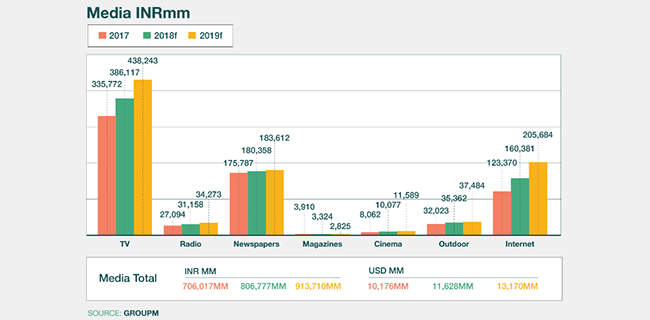
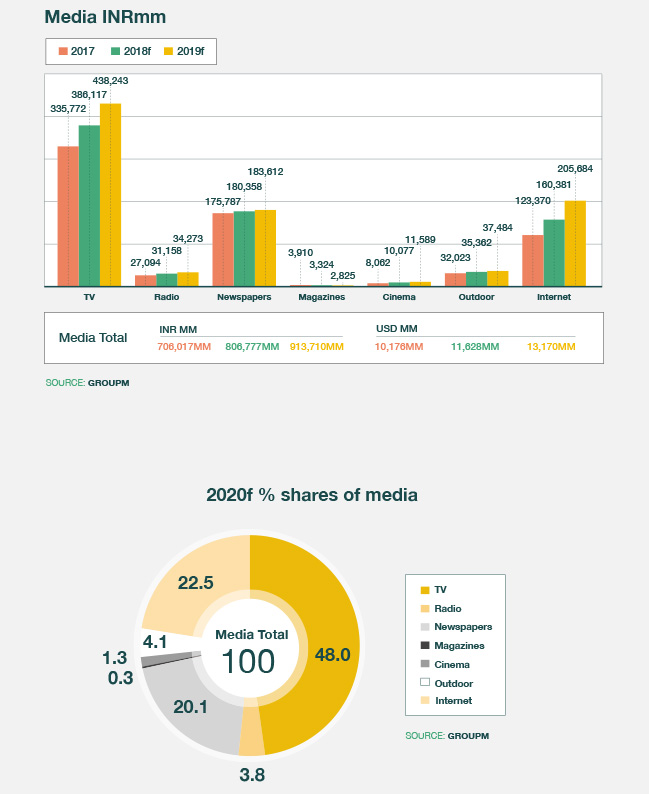
  • Digital spends may overtake print in 2019: GroupM report


    From GroupM’s This Year Next Year report for June 2019 published on June 13:

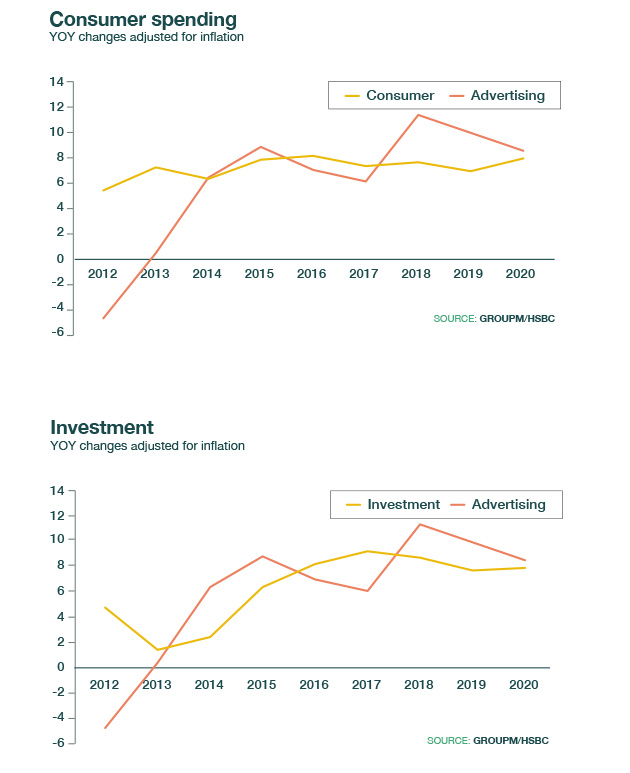
    Economy Recent downward revisions notwithstanding, India is expected to grow 7.1% – 7.5% in FY 2020–2021 (Fitch/IMF), with an investment cycle revival and sustained consumption being the key drivers. Downside risks remain: rising protectionism, a possible slowdown in global economy, and bad debt on bank balance sheets continue to hamper domestic investment. Inflation and deficits will, we think, remain largely under control, as public investment will grow only modestly.


    Auto: modest-to-high adspend growth Recovery is expected in 2020 after a slowdown in 2019. Clearance of old stocks before new emission standards come into effect (April 2020) will boost sales in Q1. As usual, demand for motorcycles and tractors will be linked to a normal monsoon, improvement in farm/rural incomes and job creation – all of which remain uncertain at this point. Passenger vehicle, scooter and commercial vehicle advertising should see modest to high growth.


    FMCG: high adspend growth FMCG will see robust volume growth as demand will remain broad-based. Rural demand will grow much faster than urban demand, aided by direct benefit transfers, farm support prices and other government schemes that increase household income. Urban demand will remain steady as a growing preference for premium and natural/ chemical-free products boosts volume.


    E-commerce: very high adspend growth Robust double-digit growth is likely as e-commerce expands to smaller towns, more millennials/GenZ go online and consumers adapt to digital payments. Internet and smartphone penetration growth will continue at a fast pace, leading to huge opportunities for e-comm players.


    Retail: high adspend growth Consumer trends of experiential shopping and the need for wellness and premium products will drive good volume growth. Foreign brands entering India, consolidation among established players and e-commerce buying stakes in established names are all likely to support growth in retail advertising investment.


    Services: modest-to-high adspend growth Services have been driving the economy over the last few years and will continue to do so in 2020. The major segments of health, travel & tourism and transport will see good growth as consumers’ aspiration to travel and gain new experience rises with income.


    Telecom: modest adspend growth Telecom will remain mixed: Handsets will see tremendous volume growth (especially low-to-mid-priced handsets), but incumbent service providers will see low-to-moderate revenue growth as they fight to retain market share.


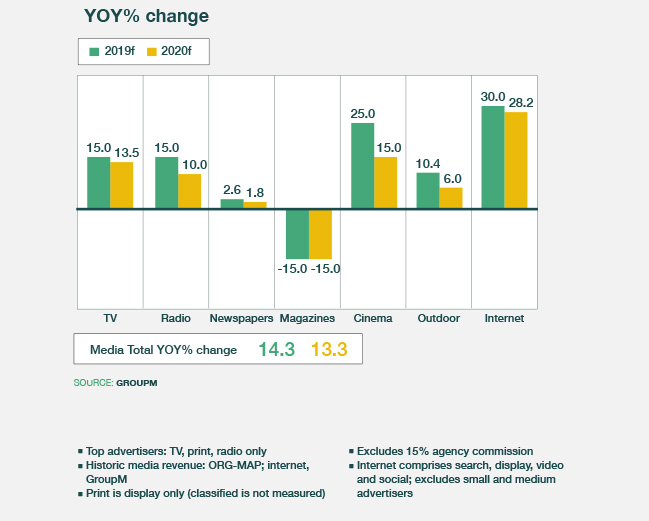
    Media: TV will have good adspend growth across key categories; the T20 cricket World Cup will be a fillip. Print will record minimal growth on the back of Hindi and regional language dailies; English will decline. Radio will remain a key medium for localized, tactical advertising and will be driven by auto, retail and FMCG. Cinema and outdoor will see robust growth as more people flock to cinema screens, the number of multiplexes increases and theatre owners use better AV tech to attract audiences. As for digital, strong double-digit growth driven by video and e-commerce display may result in digital spends overtaking print at some point in 2019.