Tag: FMCG

  • TV Ad Volumes up in H1 2021 over last 2 years


    By Our Staff


    Advertising volumes on linear television have grown in the first half of 2021 over the last two years. This has been reported by BARC India’s latest report titled ‘TV Ad Volumes Insights – The Mid-Year Analysis’.


    The ‘Think’ report indicates that H1 2021 witnessed higher growth with 12% and 37% increase in ad volumes if compared to 2019 and 2020 respectively. Said Aaditya Pathak, Head – Client Partnership & Revenue Function, BARC India: “Ad volumes for H1 2021 is promising and encouraging for the industry as a whole. The number of active advertisers and brands are also picking pace. There is a sharp increase in Ad Volumes from the top three advertisers and while FMCG continues to dominate by share, e-commerce category continues to see strong growth year on year. The auto sector has also made a comeback despite the impact of the second wave. Data for the first half of 2021 reinstates that while new advertisers have turned to television for widespread reach, existing ones continue to increase their attention to the medium.”


    FMCG continued to lead the share in H1 2021 with 566 mn seconds, a growth of 40% over H1 2019. Building sector registered 30.7 mn seconds of Ad Volumes; a 24% growth in H1 2021 versus H1 2019. Ad Volumes for BFSI sector grew by 7% over H1 2019 with 14.5 mn seconds in H1 2021.


    In fact volumes registered in June 2021 is the highest if compared to the same period for 2019 and 2020 despite the impact of the second wave of Covid-19. With a 6% growth in Ad Volumes over June 2019, June 2021 saw a total of 1839 advertisers and 3074 brands advertise on television.


    After a dip in June 2020, the auto sector made a strong comeback in June 2021 by registering a growth of 74%. With 3.94 mn seconds in June 2021, the auto sector is at par with the ad volumes it registered in June 2019. More impressively, the sector achieved 128% growth over May 2021. Likewise, Ad Volumes for the Telecom sector almost doubled in June 2021 over May 2021 and has registered 2x growth in June 2021 over June 2019.


    With 15.4 mn seconds in June 2021 alone, ad volumes for the E-commerce sector have registered a whopping growth of 56% when compared to June 2019. Currently at all-time high, the category constitutes a 12% share in the total ad volume pie.


    TV Ad Volumes, Insights: The Mid-Year Analysis

  • Former ASCI secy gen Shweta Purandare launches ‘Tap-a-Gain’ consultancy

    By Our Staff


    Shweta Purandare
    Shweta Purandare

    Former Advertising Standards Council of India (ASCI) secretary general Shweta Purandare has launched ‘Tap-a-Gain’, a boutique consultancy service based in Mumbai. Tap-a-Gain will engage with advertisers, agencies, and small business owners to help them get their advertising communication “First time right” and compliant with advertising regulations.


    As was reported by MxMIndia last month, Purandare quit Diageo India where she was heading Corporate Brand and Communications.


    As Secretary General of ASCI, Purandare led its transformation over a period of eight years wherein MOUs were established with key regulators such as Department of Consumer Affairs, FSSAI, Ministry of AYUSH and interactions with the Ministry of Information and Broadcasting.


    Over her 28+ years career, has experience in product evaluation, product endorsements, advertising claim support, regulatory compliance, Government affairs, Social Media strategy, Grievance redressal and consumer advisory services. She has experience across  multiple sectors such as FMCG, Beautycare, Personal Hygiene, Home care, OTC/ Healthcare, Food and Beverages. She was also the Scientific Director at L’Oreal India heading their product evaluation Centre and Consumer Complaint department. She was a Regulatory Affairs expert at Procter & Gamble India.


  • Effects of Covid-19 on M&E in 2021


    By Indrani Sen


    Indrani SenThe second wave of the pandemic is spreading all across the country and we are seeing state after state imposing various restrictions like night or weekend curfews, conditional lockdowns etc. The central government has decided not to impose a nationwide lockdown like last year which paralysed the entire Indian economy. The decision to impose restrictions for curbing the spread of the second wave has been left to the state governments. As the pandemic situation stands now in the second month of the April-June quarter, our economy is likely to see a contraction in this quarter which will have a cascading effect on M&E industry as advertisers will spend less on promoting their products and brands.


    Till now, most economists have predicted that the effect of the second wave of COVID 19 will be less on India Inc. than the effects of the first wave when we had a national lockdown for 70 days. However, it is too early to be assured about that prediction. The outbreak of Covid-19 is no longer concentrated in urban areas, it has been spreading virulently across villages, particularly in the Hindi hinterland of Uttarakhand, UP, MP, Bihar and Chhattisgarh. The rural areas of other states, particularly the states which recently held Assembly elections, are also experiencing a surge of the pandemic.


    Urban India contributes to 60%-65% of the sales of FMCG companies while rural India accounts for the balance 35% to 40. In certain FMCG categories the share of urban and rural is 50%: 50% or even tilted a bit more to the rural sector. Last year, when the lockdown had affected the sales of FMCG industry in urban areas due to restricted consumer spends, Bharat or Rural India spurred the growth of FMCG companies. An article published on February 28, 2021 in www.livemint.com  said: “To be sure, companies are betting on large swathes of consumers in rural India switching from unbranded, loose products to branded ones over the next few years. This gives them room to push their soaps, shampoos, biscuits, beverages and packaged staples in India’s villages, albeit at lower price points. Demand in rural markets has outstripped sales growth witnessed by companies in urban markets over the last several quarters. Companies expect India’s smaller cities and villages to continue driving growth.”  (https://www.livemint.com/companies/news/why-are-fmcg-majors-chasing-growth-in-rural-india-11614504243913.html). At the beginning of 2021, most economic analysts expected the momentum of sales in rural areas to continue. However, the ground realities have already turned out to be different which will affect not just the sales of FMCG products in rural areas, but also the production of Argo industries.


    The controversies over vaccination between the Centre and the states coupled with shortage of oxygen supply and inadequate health infrastructure have given a different dimension to the Covid-19 crisis induced by the second wave. Middle class urban families are spending their live savings, begging and borrowing to try and save their near and dear ones, in the process reducing their subsequent purchasing power. Upper class affluent urban families have realised suddenly that the big fat medical insurance in which they invested are not of any use to them if they cannot get their relatives admitted to any hospital or nursing home. Many insurance companies are refusing to give coverage for Covid treatment. These rich people are feeling the need of having large amount of cash in hand for emergency treatment of Covid, which will reduce their disposable income and affect the sales of consumer durables.


    The pandemic has already managed to disrupt our cricket calendar by postponing the IPL 2021 indefinitely to another venue in another country and it is unlikely that T20 World Cup will be held in India in 2021 which has affected the tourism and hospitality industry, the on-ground display, etc. The advertisers having peak season during summer months are putting a brake on their TV expenditures due to state level lockdowns, restricted movement of transport for delivering of goods and reduction in consumer spends due to very small windows of time available for daily shopping.


    Medical experts are predicting a third wave of the pandemic around September, 2021 which may result in further contraction of the economy in the October-December quarters, in spite of the festive season. Lack of economic recovery in the next two quarters will result in further loss of business for the M&E industry. As per the Pitch Madison Advertising Report 2021, overall AdEx de-grew by 20% and traditional media AdEx degrew by 29% in 2020 with only digital media growing by 10% during the same period. The PMAR 2021 predicted that in 2021 overall AdEx will grow by 26% touching the 2019 level. In the second month of the second quarter of 2021, it is too early to predict the overall effect of Covid-19 on the M&E industry over the entire year. The current signs indicate that it will be difficult for the AdEx to jump back to the 2019 level in 2021.


  • PHD Media bags mandate for The Laughing Cow

    By Our Staff


    Omnicom Media Group’s PHD Media India has bagged the media mandate for Bel Group India’s brand The Laughing Cow. The Bel Group plans to add value to the cheese and healthy snack category in India with new product launches under The Laughing Cow brand.


    Said Alamjit Singh Sekhon, Commercial Director, Fromageries Bel India: “India is a key focus market for the Bel Group. Our range of delicious cheese (Creamy Triangles, Slices, Blocks, Spread, and Cubes) under The Laughing Cow Brand has a taste that caters to the Indian palette. The entire range is nutritious, being made from cows’ milk with added fortification. Consumers find the Laughing Cow Creamy Cheese triangles to be unique as they are the only soft, spreadable portions of cheese in India. We believe that PHD’s data centric and uniquely innovation approach to media and communication will help amplify our presence. We are confident that this partnership will help accelerate our journey in India and grow the cheese category by creating impactful brand awareness.”


    Added PHD Media India CEO, Monaz Todywalla: “This is a major win for us, and we’re looking forward to making strides in the dynamic FMCG segment which is always an exciting prospect because of the sheer volume of opportunities out there. The Laughing Cow is an iconic cheese brand and we are delighted to win media mandate in India. We are confident that this will be a journey of mutual growth and are eager to get started on a thoughtful, data-driven storytelling strategy for the brand.”


  • FMCG adspend expanding by 14% a year in India: Zenith

    By Our Staff


    Media agency network Zenith has forecast that fast-moving consumer goods (FMCG) food and drink brands will increase their ad expenditure on digital channels by 7% a year to 2023, according to its Business Intelligence – FMCG Food and Drink report, published on Monday. That’s well ahead of the 4% annual growth forecasts for FMCG adspend as a whole in the 12 markets included in this report.


    Zenith has forecast that India will be the fastest-growing market by some distance over the next three years, with FMCG adspend expanding by 14% a year. It will benefit from blossoming consumer demand as disposable incomes rise rapidly, coupled with the catch-up expansion of the underdeveloped ad market: advertising accounts for only 0.3% of India’s GDP, less than half of the global average of 0.7%. All of the other markets in the report are predicted to grow steadily at between 2% and 5% a year.


    Said Jai Lala, CEO, Zenith India: “FMCG growth will continue to be robust considering various reasons. Firstly, despite the pandemic, it is one category where the demand is constant, if not seen increasing. Secondly, with evolving consumer demand, FMCG continues to see a slate of new product launches and category expansion. Lastly, with the vast population being in Tier 2 and rural areas – it is one untapped potential market where the FMCG brands continue to increase penetration.”


    Meanwhile, FMCG brands still rely heavily on traditional TV, spending 39% of their budgets on television advertising in 2020, compared to 24% for the average brand. Excluding China, where FMCG brands have already adopted digital advertising as their main form of commercial communication, FMCG brands spent 52% of their budgets in television, compared to an average of 26%. Their principal goal is to maximise brand awareness and reach so they are front of mind at the point of purchase for as many consumers as possible. This is something that TV has historically excelled at, but its declining reach – particularly among the young – is making it less effective.


    “FMCG brands need a new comprehensive approach to reach-based planning,” added Ben Lukawski, Global Chief Strategy Officer, Zenith. “That means combining TV, paid advertising in online video, virtual placement in SVOD platforms and perhaps even a presence in gaming, using first-party and second-party data to prevent duplication and optimise incremental reach.”


    FMCG brands are therefore following audiences to digital channels. Zenith forecasts that FMCG digital adspend will increase from US$12.3bn in 2020 to US$14.9bn in 2023, and that its market share will rise from 46% to 49%. After the pandemic gave FMCG ecommerce its urgent stimulus in 2020, brands will look to support and expand their ecommerce capabilities, channelling consumers to DTC operations or retail partnerships. But the big challenge will lie in using digital to replace television effectively – creating large-scale brand awareness while managing frequency. The rise of Subscription Video on Demand (SVOD), which locks away high-value audiences from direct advertising, will make this even harder, as will the end of third-party cookies.


    Out-of-home is the exception to the declining reach of traditional media. As traffic returns to normal after the COVID-19 slump, the spread of digital displays will make it even more effective at reaching consumers with targeted and relevant ads near the point of sale. FMCG out-of-home advertising is forecast to grow by 9% a year from 2020 to 2023, while its market share rises from 6.1% to 7.0%, slightly ahead of its pre-pandemic share of 6.8% in 2019.


    Ad expenditure by FMCG brands fell more sharply than the ad market as a whole in 2020, shrinking by 10.7% to US$26.7bn. This was not because of any shortfall in demand. On the contrary, demand soared as people stopped eating in restaurants, cafes and bars and shifted consumption to the home. Instead, FMCG companies were faced with the challenge of ramping up production while supply chains were disrupted, and using limited available distribution to get their products onto shelves in stores, or to consumers’ homes. Many FMCG companies therefore cut back on promotional activity for products they couldn’t get to consumers quickly enough to satisfy demand, and invested in distribution infrastructure instead, especially ecommerce operations and partnerships.


    Zenith forecasts that the recovery of FMCG adspend will roughly track the market as a whole in 2021-2023. A bounce-back is almost inevitable in 2021 given the comparison with the sharp drop-off in 2020, particularly during Q2, though it will still be 6% below 2019 levels. FMCG companies face uncertainty over how quickly consumers will return to shops, and how much their behaviours have been permanently affected by the pandemic. However, now that FMCG ecommerce infrastructure is being put in place, brands will need to increase their investment in advertising to support it. Zenith forecasts 4.4% annual growth in FMCG adspend between 2020 and 2023, reaching US$30.3bn in 2023. At this point it will have fully recovered from the pandemic-induced drop in adspend, exceeding 2019 levels of spending by US$0.5bn.


    China stands out as the market where brands have most rapidly embraced ecommerce and digital advertising. In 2020, Chinese FMCG brands spent 71% of their budgets on digital advertising, compared to 46% across all 12 markets. Here, these brands focus on online video, which has a high and broad reach, and is open to commercial partnerships. This can mean advertising in online shows, or special livestreams by influencers, in which viewers can directly purchase the items being demonstrated. They also routinely advertise on ecommerce platforms to drive sales at the point of purchase. Chinese FMCG brands spent 35% of their total budgets on online video and 13% on ecommerce advertising in 2020.


    “Ecommerce will be the key battleground for FMCG brand growth over the coming years,” said Jonathan Barnard, Head of Forecasting, Zenith. “Western brands should look to China for best practice in using digital communication to drive FMCG ecommerce sales.”


    *The 12 markets included in this report are Australia, Canada, China, France, Germany, India, Italy, Russia, Spain, Switzerland, the UK and the US, which between them account for 73% of total global adspend. FMCG food and drink includes all packaged foods and soft drinks.


  • Pitamaas films for Bonn Foods

    By Our Staff

    Bonn Group of Industries, a FMCG brand in the food products, has announced the launch of its new ad film campaign Khayal Apno Ka. Through this campaign, created by Pitamaas, Bonn Group intends to draw more attention to its core value of timeliness, personal care and connecting people in a striking, unconventional and appealing manner.

    Said Amrinder Singh, Director, Bonn Group of Industries, said, “Bonn Group is considered one of the most reliable brands when it comes to food products. Through the campaign, we wish to put emphasis on Bonn Group’s products, which are amongst the largest selling breads, biscuits and buns in the country. We are thankful to our factory workers and the delivery personnel for their continued patronage and extra-ordinary dedication to the brand despite the extreme conditions. We are extremely hopeful that the AD FILM campaign will help us building a greater brand connect with our end users.”

    Added Pitamaas MD Ritaz Maini: “Either breads, buns or biscuits are essential components of our first meal of the day. It’s a common story of every household. We all eagerly wait for our bread delivery guy every morning. We had a very interesting brief which was single mindedly emphasized on the brand’s core values. We took this as an opportunity to humanize the product and bring about humor and nostalgia alongside our key proposition. We have attempted to make it crisp and universally understood. We had a great time working on the creatives as it brought out the child in all of us and we hope that it brings out the same emotion in everyone who sees it.”


  • Carat India appoints Dipika Bhasin as Exec VP

    By Our Staff


    Carat India has appointed Dipika Bhasin as Executive Vice President. In her new role, Bhasin will lead the agency’s North and East offices and focus on developing and managing Carat’s senior client relationship in addition to helping the agency drive the growth for its North and East markets. She will report into Anita Kotwani, CEO, Carat India.


    In her previous stint with PHD Worldwide, Bhasin held the position of Senior Vice President and was responsible for media management. She pivoted the digital media operations and their effectiveness for marketers in the media mix. She has worked on top brands like LG, Vivo, Royal Enfield, HP, SC Johnson, Perfetti, Maruti, Snapdeal, SAP, Adidas, Nissan and also various non-profit organisations. Additionally, she has also worked with Aircel and on brands that include consumer durables, FMCG, e-commerce and auto.


    Anita Kotwani
    Anita Kotwani

    Speaking on the appointment, Kotwani said” “As we strengthen and reshape the Carat offering for the Indian market, we needed a leader who is well networked, connected and understands the nuances of the Northern markets. Dipika, with her expansive & stellar work done across brands and categories, was our ideal choice as she brings in an integrated experience of the new-age eco-system. Her strong connections with the brands and marketers will ensure that the growth path crafted for Carat gets delivered in this market.”


    Dipika Bhasin
    Dipika Bhasin

    Added Bhasin: “I am excited to be part of Carat India and to be working with an inclusive and diverse team. I would want to focus on expanding our footprint by strengthening seamless planning, digital transformation and innovation in the media space to help our clients grow. The commitment of the Carat team to deliver value for clients and partners are reckoned by the industry. It is a homecoming for me and I really look forward to strengthening the portfolio of our team offerings in collaboration with dentsu international. Looking forward to partner at all levels and deliver growth and value consistently.”

  • JF-2021 is ‘Swell’ Time for TV Advtg: BARC data

    By Our Staff

    Advertising volumes for Jan-Feb 2021 are the highest since 2017. FMCG and ECOM categories grew by 36% and 21% respectively during this period compared to 2020.

    Advertising revival has evidently seeped into Jan-Feb 2021, catapulting Ad Volumes, at the start of the year, by 21%, thus making it the highest since 2017.

    Said Aaditya Pathak, Head – Client Partnership and Revenue Function, BARC India: “Continuing the momentum built in H2 of 2020, TV Ad Volumes have had the most promising start with January and February Ad Volume levels of 2021 being the highest ever in 5 years. A lot of sectors/categories, and key non-FMCG brands, also seem to have increased their presence on TV during this period which augurs well for the medium.”

    Among the top genres, Movies & Music + Youth registered higher growth than the average growth in Overall Ad Volumes (25% & 24% respectively), followed by GEC & News with 21% & 18% growth respectively, during Jan-Feb 2021 over the same period in 2020.

    While the Top 10 Advertisers drove the TV Ad Volumes with 45% contribution and 35% growth, the next 40 Advertisers rode alongside, garnering 25% growth during Jan-Feb this year.

    The year 2020 witnessed new entrants in TV Advertising and the rise of the Advertisers in the digital segment, especially the ECOM category. This phenomenon holds true for the current period in consideration as well. ECOM grew by 21% in Jan-Feb 2021, showing a consistent growth YOY in TV Advertising. Other Categories like Retail and Building, Industry & Land Materials, are increasing spends this year, compared to 2020.

    While brands like Lizol, Dettol and Harpic emerged as the most advertised brands during Jan-Feb 2021, many Non-FMCG Brands have also increased their presence on TV during this period.

    TV Advertising has set the bar high for the year that remains. The upcoming big National and International Events are likely to keep TV as the platform of choice for advertisers in reaching out to the millions of homes across India.


  • Dalda Vanaspati ropes in Sanjeev Kapoor

    By Our Staff

    Dalda Vanaspati has roped in chef Sanjeev Kapoor as its brand ambassador. Kapoor will be seen in a series of videos in the brand’s upcoming campaign #JaanchParakhLo.

    Said Milind Acharya, Head of Marketing, Bunge India: “When we talk about authentic Indian taste, there are only two names that come to my mind, Dalda Vanaspati and Chef Sanjeev Kapoor. While there are many brands which have been there for decades and are going strong but a cooking medium brand belonging to the FMCG sector which has lasted this long, itself speaks volume of credibility and reliability of Dalda. And when it came to communicating the brand message, there couldn’t have been anyone else other than the Chef Sanjeev Kapoor, who is recognized across the country as the quintessential face of high-quality Indian cooking and someone who himself believes in Dalda Vanaspati.’

  • Wondrlab to boost Emami’s Navratna

    By Our Staff

    Wondrlab has bagged the creative duties for FMCG giant Emami’s power brand Navratna. The business will be looked after by Wondrlab’s content platform. The new mandate covers integrated duties for two of Emami’s flagship brands, Navratna Cool Talc and Navratna Cool Oil. To kickstart this association, Wondrlab will conceptualise a high-decibel summer campaign for both brands.

    Said Anupam Katheriya, Associate Vice President – Marketing and Business Development, Emami Limited: “We are happy to be associated with Wondrlab.  They bring on board new energy and methods on brand building in marketing communication which would be of great value.”

    Added Rakesh Hinduja, Co-Founder and Managing Partner, Content Platform, Wondrlab: “Navratna is an iconic brand with strong mass appeal throughout the country. We are very excited to build on the strategic focus, storytelling narrative and apply new age thinking to this portfolio and come up with brave exciting solutions to achieve business objectives. Very glad to work with an open-minded client who gives us the creative freedom to think big.”

  • Dentsu Digital Report 2021

    By Our Staff


    The Dentsu Aegis Network unveiled its annual Digital Report for 2021.


    Here are some takeaways:


    The Indian advertising industry currently stands at Rs 56,490 crore and it has witnessed de-growth of 17.5% over 2019 due to the pandemic. The advertising industry is expected to make a come-back and will grow by 10.8% to reach Rs 62,577 crore by the end of the year 2021. Furthermore, it is expected to grow with a CAGR of 11.59% to reach Rs. 70,343 crore by 2022.


    The digital advertising industry has witnessed growth in market size from Rs 13,683 crore by 2019 to Rs 15,782 crore by 2020, growing by 15.3% from the previous year. Digital media will grow at 20% to reach a market size of Rs 18,938 crore by 2021 and with a CAGR of 22.47% to reach Rs. 23,673 crore by 2022.


    Television has the unparalleled reach in the media market and contributes to the largest share of media spends at 41% (Rs. 23,201 crore) in 2020. Followed by spends on digital (28%, Rs. 15,782 crore) and print (25%, Rs. 13,970 crore).


    Currently, FMCG has the highest expenditure on advertising with a contribution of 20% (Rs. 11,554 crore) closely followed by e-commerce (17%, Rs 9,788 crore) and consumer durables (10%, Rs. 5,751 crore).


    FMCG spends a large majority of their advertising budget on Television (64%) while Retail, Automotive and Media and Entertainment segments spend a large share of their advertising budget on Print. The biggest spenders on Digital media are BFSI (57%), Consumer Durables (45%), Telecommunications (40%) and E-Commerce (39%).


    Digital is growing rapidly and the pandemic has propelled the adoption. Advertising spend on digital media has increased from a share of 20% in 2019 to 28% in 2020. It is further expected to reach 34% by the end of 2022.


    Said Anand Bhadkamkar, CEO – India, Dentsu: “2020 presented a monumental challenge to us – as individuals, business and society. It made us witness time and space in ways that many generations had only read about in textbooks or had heard of from aging bystanders of yester-history. Yet, I must reiterate that despite all the aching that this hailstorm of a year introduced into our lives, 2020 was also maleficently unique. It forced us into depths of insights that we could never have comprehended otherwise. It also reminded us of what the human spirit could eventually endure and the magnificent resilience that it is capable of. Dentsu is over-invested in digital. Of our 3000 people, more than 1800 are in our digital companies. Additionally, more than 50% of our revenue comes from digital at a time when the market average in India is still 10-12 per cent. We, at dentsu, expect 2021 to witness a colossal rise in digital advertising. We also recognise the need for a business intelligence report that can give directions toward which this industry is moving with ever-changing client demands and market scenarios. We look forward to your thoughts and opinions to help sharpen our approach towards this fast-growing industry as we strive to expand, together.”


  • GEC AdEx in 2020: Commercial ads: 55% share, Promos 45%


    By Our Staff

    TAM AdEx has released the second of its reports on 2020 for television advertising. This time it focuses on advertising on general entertainment channels.

    Here are some highlights

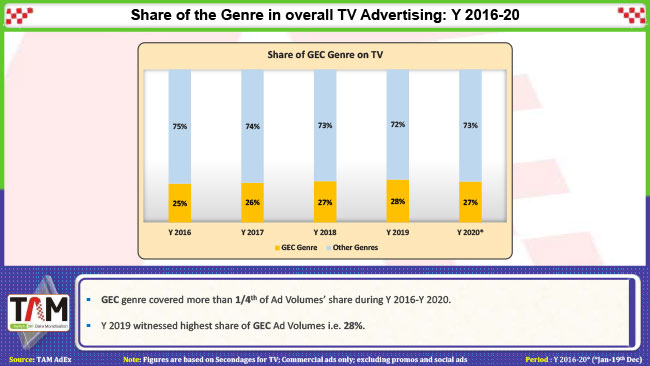
    GEC genre covered more than 1/4th of Ad Volumes’ share during Y 2016-20.

    True Shield Hand Sanitizer was the top brand during Apr’20 to Jun’20 & Aug’20 in GEC Genre.

    Toilet Soaps leads among the Top 10 categories of GEC Genre with 9% ad volume share in Y 2020.

    Ecom-Media/Entertainment/Social Media saw highest increase in ad secondages during Y 2020 compared to Y 2019 in GEC Genre.

    In GEC genre, HUL topped among the GEC advertisers followed by Reckitt Benckiser on 2nd position during Y 2020.

    6 out of Top 10 brands on GECs were from HUL and 3 were from Reckitt Benckiser.

    1.3K+ advertisers & 2.7K+ brands exclusively advertised during Y 2020 on GECs compared to Y 2019.

    Primetime is the most preferred time-band on GEC genre followed by Afternoon and Morning time-bands.

    20-40 second ad commercials were most preferred for advertising on GECs during both Y 2019-20.

    Commercial advertising added 55% share of Ad Volumes on GECs whereas Promos had 45% share in Y 2020.

    Highlights of the report are Advertising Trend during Lockdown versus Unlockdown, Covid Prevention categories, Celebrity Endorsement, Social Ads by Govt. etc.

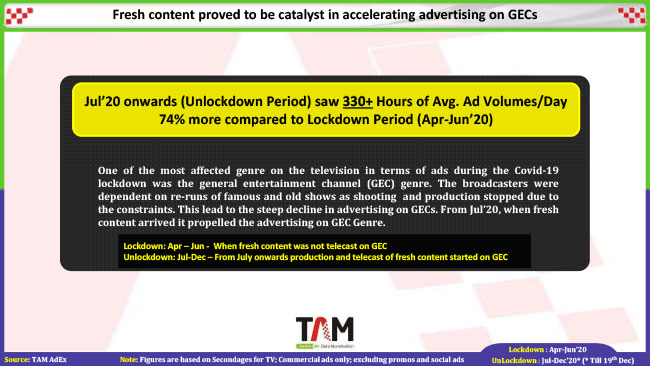
    According to the report, advertising volumes in 2020 saw a marginal rise versus what it was the previous year (2019). Average ad volumes in the all-important fourth quarter of the year rose 39% over the average ad volumes in the first three quarters of the year. There was 90% growth in Average Ad Volumes/Day witnessed during Post Lockdown period.

    FMCG players ruled the list of Top 10 advertisers with HUL leading the list. Four of the Top 10 brands advertised were from Hindustan Unilever and three were from RB. Personal Care/Personal Hygiene sector had 20% share of Ad Volumes followed by F&B with 18% share.

    Please click on this link for the report:

    TAM AdEx – Mirroring Y 2020 for GEC Genre