Tag: flipkart

  • Day1@Goafest: E-commerce calls the shots at Industry Conclave

    By Rahul Chandawarkar


    E-commerce held centre stage on Day 1 of Goafest 2019 which kicked off at the Grand Hyatt hotel in Bambolim, Goa on Thursday, April 11.

    Sponsored by Discovery Channel, the Industry Conclave had the marketing chiefs of the leading e-commerce brands, Amazon, Flipkart and Myntra explain to the audience the dramatic changes that have taken place in the field of digital marketing.
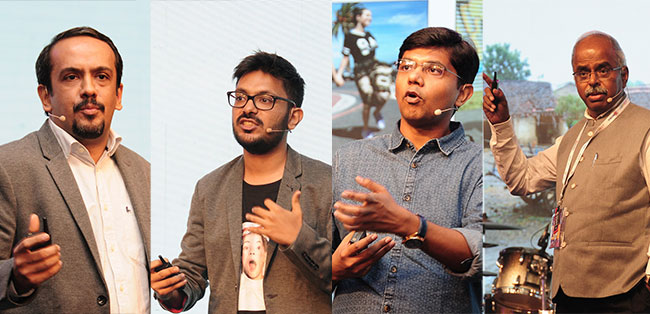
    Ravi Desai, Vijay Sharma, Achint Seti and Velumani

    Ravi Desai, director, mass and brand marketing, Amazon India explained how the old system of ‘pen portraying’ a customer was completely passé now. Desai said that Amazon India had created a mind-boggling 1,00,000 digital advertisments during Diwali 2018 to address hundreds of customer-types across multiple segments.

    Desai explained how primetime TV advertising was also passé. According to the senior executive, the modern-day, urban consumer was consuming content in very different ways. Desai demonstrated with the help of a video clip, how consumers were comfortable directing Amazon’s artificial intelligence device, Alexa to play songs of their choice on Amazon’s Echo, smart speaker system. “If consumers are hooked to this, we need to devise ways and means to catch their attention on this platform,” Desai said.

    Citing the example of his teenaged son and his friends, Desai said that multiple TV channels did not interest these teenagers anymore. “They were more keen to play PUBG ( Player Unknown’s Battleground), the popular, online multiplayer game and live streaming video games. Our advertising needs to cater to these new trends,” Desai said.

    Quoting Amazon founder Jeff Bezos, who said, “Focus obsessively on customers,” Desai explained how building customer loyalty was a prime objective at Amazon. According to Desai, the ‘Amazon Prime’ programme where a customer paid INR 129 every month to avail of a free and fast delivery, advertisement free video streaming, audio streaming and exclusive deals was a step in this direction.

    Likewise, Vijay Sharma, associate director, brand marketing and head digital media, Flipkart said that digital marketing and digital brands had changed the face of modern-day marketing. According to Sharma, fast moving consumer goods (FMCG) like Coke and Pepsi had made way for brands like Apple and Google as the world’s leading brands.

    Explaining the challenge of digital marketing, Sharma said that artificial intelligence was being used extensively by Flipkart to run its latest advertising and marketing campaign, ‘The Big Billion Days’.

    Multiple celebrities and models were roped in to run the popular, ‘Ab Hoga (name of city) budget se mukt!’ digital marketing campaign, which was made to reach a wide audience across the entire country.

    In a similar vein, Achint Setia, vice president – marketing, Myntra, explained how the modern-day customer was consuming information across a wide variety of platforms like the internet, television and the android phone. “In such a scenario, we necessarily have to use artificial intelligence to make a customer experience a joyful moment with the mere touch of  button,” Setia said.

    Explaining that Myntra was a cool and youthful brand, Setia said that the company had put a customer loyalty programme titled, ‘Myntra Inside’ in place. With the help of a video clip, Setia demonstrated how the programme treated the customer to a personality make-overs, gifted new dresses and curated the experiences of the customers using cutting edge technology. Myntra also gifted select customers overseas trips.

    Earlier in the afternoon, popular singer Shaan regaled the audiences with many of his hit Bollywood songs and also sang several English-Hindi medleys.

    The audiences were also regaled and kept spellbound by a very peppy presentation made by Dr A Velumani, creator and managing director of Thyrocare, the company which has made a mark in the field of healthcare. Velumani touched many a chord when he narrated his rags to riches story. Advocating the philosophy of frugality, Velumani explained how he did not own a home despite being very rich. “As an entrepreneur I feel it is more important to grow my business and create more employment,” Velumani said.


    Rahul Chandawarkar, a former newspaper editor, is a communications strategist and superactive triathlete based in Goa. He has been covering Goafests for MxMIndia since 2017.
     

  • Flipkart and Dentsu Webchutney drive new campaign for gender equality

    By A Correspondent


    Flipkart and Dentsu Webchutney have announced a new initiative that tells all how they’d like kids to be raised.


    Said Prashant Gopalakrishnan, Sr.Vice-President, Client Services, Dentsu Webchutney: “Look around you. Do you have a son, daughter, niece, nephew, or a friend’s child born a few years after the millennium? They are all part of #GenerationEqual. Real change will happen when we collectively decide to make the same rules that influence their lives. And as far as we can, let’s keep those rules the same for both boys and girls. That is the most real way to ensure our biases don’t pass on to them.”


    Added Apuarv Sethi, Director – Brand Marketing at Flipkart: “As parents in 2018, we’d like to be progressive in letting our child choose for themselves in several aspects, so that they get to do what they love. Let the child experience the hobbies, passions, interests, and personality traits that come naturally to them… whether it’s a boy who wants to learn cooking, or a girl passionate about collecting superhero toys. And the other way around too.”


  • Network18 Digital announces launch of ‘India Ka Fashion Capital’

    By A Correspondent


    Network 18 Digital has announced its new content offering – India Ka Fashion Capital, powered by Flipkart Fashion and produced by Firstpost Studio.


    Commenting on the show, Azim Lalani, Business Head of English General News Cluster, Network 18 said: “Our priority has always been to engage a diverse set of audience with strong, original and one-of-its-kind content. Our offerings to our viewers are accentuated by effective collaborations with brands such as Flipkart. It’s a two-way association where our content significantly highlights the brands’ efforts and assists them with achieving their communication goals. For Flipkart’s India Ka Fashion Capital we have creatively reinforced the platform’s standing as one-stop-destination for all things fashion. Along with delivering an innovative marketing solution to the brand we are sharing excellent content for our discerning audience that diligently follows fashion trends. The unique show also adds to our repertoire of path-breaking digital offerings.”


    Sharing his perspective on the show, Sushanth Ravikumar, Associate Director – Brand Marketing, Flipkart said: “India’s local fashion markets play an integral role in molding the country’s fashion culture. Flipkart aims to recreate and improve on the best aspects of these markets. This web series explores what makes Flipkart Fashion ‘India Ka Fashion Capital’ in a manner that is genuinely interesting and our partnership with Network18 Digital enables us to reach a diverse audience with quality content. ”


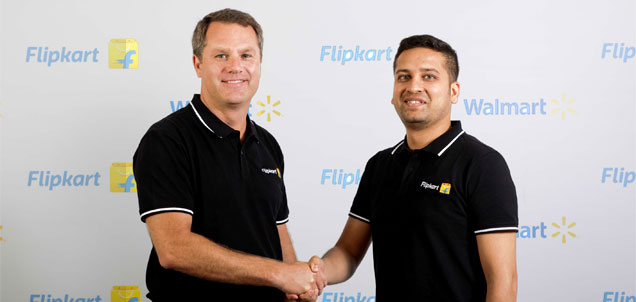
  • With Flipkart, will Walmart finally compete with Amazon in online space?


    By Prabhakar Mundkur


    For a long time now, Amazon has been a pain in the side of Walmart. Largely because Walmart has been the traditional brick-and-mortar retailer, who hasn’t yet made the kind of inroads they would have liked to make in the online space. But they have tried hard, even to the extent of letting you place your orders online so that you can just collect your shopping from the nearest Walmart store. In its first fiscal year after the Jet.com acquisition, Walmart online sales grew 44% to hit $ 11.5 billion. However, in the fourth quarter of 2017, it grew just 23% rattling investors and bringing down their stock price by almost 10%.
     

    But is Jet a good fit with Walmart? One is not sure. Jet has higher income consumers who are urban in their profile. In fact, analysts have questions about how Walmart will integrate Bonobos and Modcloth, its other online acquisitions into the main brand Walmart. But the challenge for Walmart remains. How can it play catch-up with the world largest online store in the world which is Amazon? And how can it make a dent in what it has identified as its key growth market i.e. China and India? Compared to its other acquisitions Flipkart seems like a perfect fit. And there will be very few integration problems with the brand Walmart.


    The problem is not just the fact that Amazon has a headstart in establishing an online business. There is also the question of the brand Amazon versus the brand Walmart. Younger consumers somehow prefer to shop at Amazon rather than Walmart which has to do with the essential personality of the Amazon brand rather than anything else. Walmart has positioned itself through its tagline ” Save money. Live better”. While this might be true, that is also what Amazon offers without saying it quite so explicitly.


    In this context, the acquisition of Flipkart makes great sense. It gives them a foothold in India, one of their priority growth markets. It gives them growth in online sales, something that has eluded them in spite of their other acquisitions in the online space. And lastly, it positions them as a formidable competitor to Amazon in India, something they have not managed in any other country in the world. So, with the acquisition of Flipkart, they lock horns with Amazon for a piece of India’s growing retail sector. The online sector has always been something of a challenge for Walmart. Doug Chief Executive of Walmart is known to have said ” “We’re learning something new . . . has not been our historic competency.”


    Why Flipkart?


    Source: Walmart

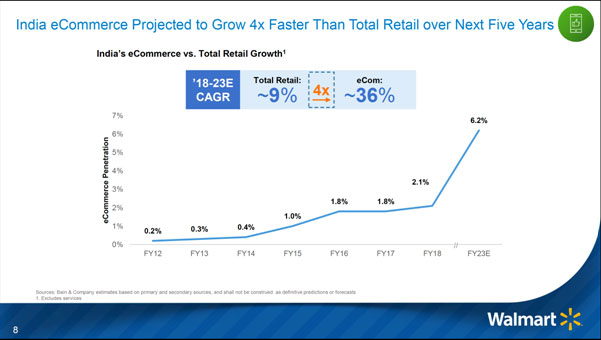
    First of all, India is a growing market with GDP growth rates which are amongst the best in the world. Secondly, India is a young market and has the largest number of millennials and Gen Z accounting for almost 66% of the population. This gives Walmart access to a young market which has hitherto eluded them in the core North American markets of Mexico, Canada, and Central America. India is the second largest internet market in the world and still growing furiously. And lastly, India will have almost 58% smartphone penetration by 2020 easing the way for online sales. And lastly in the future offline retail is likely to show good growth and online retail will be a multiple of offline retail growth. All this makes Flipkart a very attractive proposition.


    Source: Walmart


    Besides being an attractive market the acquisition of Flipkart gives Walmart access to Myntra and Jabong which is India’s leading fashion online destination.


    In many ways, therefore, this seems like a marriage that has been made in heaven.


  • Flipkart reinforces its fashion focus

    By A Correspondent


    As a step-up from its ‘Be Trendy. Always’ campaign last year, Flipkart has recently launched a multi-film campaign aiming to establish itself as an ultimate destination for trendy and affordable fashion.


    Conceptualised and executed by Lowe Lintas Bangalore, this year the brand has moved a step forward to establish itself as an ultimate destination for every kind of fashion shopper, notes a communique.


    Explaining the rationale behind the campaign, Shoumyan Biswas, Vice President, Brand Marketing, Flipkart said: “Flipkart is the leader for fashion in the e-commerce space and our vision is to be India’s most preferred destination for trendy and affordable fashion.  We have worked on this vision for past one year and delivered campaigns like ‘If it’s trendy, it’s on Flipkart’ and ‘Be trendy. Always.’ which has given us phenomenal business results. On the back of deep consumer research, we understood that every fashion shopper has a different method to get what they want from fashion. Being relevant to every kind of fashion shopper, Flipkart can be the best place for everyone to look their best. Our new campaign ‘The best way to look your best’ is centred around this insight and brings alive different fashion shopper archetypes in a fun and interesting manner.”


    Highlighting the campaign thought, Rajesh Ramaswamy, Executive Director, Lowe Lintas said: “Not everyone has the same fashion needs. Some people look for exclusive stuff. Others look for the latest trends. Or the biggest brands. And so on. Working off this insight, we decided to position Flipkart as the perfect ‘hack’ for every kind of fashion shopper. Across five films, we showcased how Flipkart had everything anyone could ask for in the world of fashion, making it the perfect fashion destination for everyone.”


  • Flipkart fashion tells users how to look their best

    By A Correspondent


    Flipkart has launched its latest campaign that reinforces its claim to be the preferred destination for any kind of shopper, from celebrity fashion lovers or brand enthusiasts or exclusive fashion lovers etc.


    Speaking on the campaign, Shoumyan Biswas, Head of Marketing, Flipkart said:“Flipkart is the leader for fashion in the ecommerce space and our vision is to be India’s most preferred destination for trendy and affordable fashion.  We have worked on this vision for past one year and delivered campaigns like ‘If it’s trendy, it’s on Flipkart’ and ‘Be trendy. Always.’ which has given us phenomenal business results. On the back of deep consumer research, we understood that every fashion shopper has a different method to get what they want from Fashion. Being relevant to every kind of fashion shopper, Flipkart can be the best place for everyone to look their best. Our new campaign ‘The best way to look your best’ is centred around this insight and brings alive different fashion shopper archetypes in a fun and interesting manner.”


  • Flipkart back with campaign for Big Billion Days 2017

    By A Correspondent


    It’s time yet again for Flipkart’s The Big Billion Days (BBD) which will be a five-day shopping festival.


    Conceptualised and executed by Lowe Lintas Bangalore, the campaign is a series of eight films, set in eight relatable, humorous situations that will be visible on and offline.


    Highlighting the creative thought process Arun Iyer, Chairman and CCO, Lowe Lintas said: “At a time when rising prices are on everyone’s minds, I think it’s quite cool that Flipkart is making it possible for people to afford the things they’ve always wanted. That’s where the line “Ab mehengaai giregi” comes in. Our intention was to make BBD more than just a mere sale event. Which is why we tackled the cultural problem of ‘mehengaai’ as a whole. We had a blast shooting these different situations, especially with Abhinay, who brings his own magic to everything he does.”


    Added Shoumyan Biswas, CMO, Flipkart:“Over the years Flipkart Big Billion Days has grown from the largest shopping carnival in India to being synonymous to #1 festive sale in the country. All of India will see prices drop on things they desire the most and exclusive deals and products unlike anywhere else. Our campaign ‘Ab Mehengaai Giregi’ puts out the biggest offers that are not just worth the claim but also address the daily life woes of every Indian about ‘Mehengaai’. Nothing is ordinary about the Big Billion Days for us, and we are well prepared to reach out to our consumers with highly engaging communication and epic offers”.


  • Patanjali is #4 in Ipsos’ India’s Most Influential Brands study


    By A Correspondent


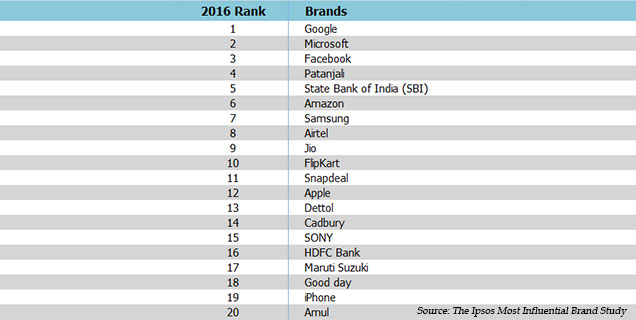
    Global research company Ipsos has unveiled its now annual Top 20 Most Influential Brands in India for 2016.  Google occupies the number one position followed by Microsoft and Facebook at number two and three respectively. Homegrown brands, Patanjali and Jio make an entry into the Top 10 ranked at fourth and ninth place respectively showing the enormous amount of influence that these brands wield in a short span of time. Both brands did not figure in the previous edition of the study.


    Among the Top 10 brands, Flipkart dropped three spots to take the tenth place while Amazon climbed a couple of steps to take the sixth place. Leading bank State Bank of India, which has been on a consolidation mode, move up four ranks to take the fifth place and is the only financial brand in the top 10.


    The Ipsos Most Influential Brand Study evaluates 100-plus brands across 21 countries and involved 36,600 interviews. In India the research covered more than 1,000 Indians online to assess 100+ brands.


    Said Parijat Chakraborty, Executive Director, Ipsos Public Affairs & Loyalty: “The Most Influential Brands are larger than life. They are aspirational. They enhance our lives – make it better. We trust these brands. We connect with them emotionally and cannot imagine our lives without them – they are influential”.


    The goal of the study, notes a communique, is to define and measure influence; to rank brands according to their influence within each country; rank brands according to their influence globally and identify what factors explain or drive the current level of influence for each of the brands at the country level and at the global level.


    Adds a communique:

    “It is important to note that the Ipsos study has measured the biggest, most well-known and/ or highest spending brands only. As a result, the Ipsos Most Influential Brand Study did not look at the entire market.

    “Interestingly, all brands that have featured in the Most Influential Brands List are those that consumer engages with on-a-daily-basis; a constant companion; an extension of consumer – Google, Microsoft, Facebook, Patanjali, State Bank of India, Amazon, Samsung, Airtel, Jio and Flipkart – if we look at the Top 10 list.

    “Next 10 – 11 to 20 too echoes the same story – these brands help the consumer define themselves better –  Snapdeal.com, Apple, Dettol, Cadbury, Sony, HDFC Bank, Maruti Suzuki, Good Day, iPhone and Amul.”

    “It’s impossible for consumers to imagine their lives without these brands.  The formula for success of Influence rides on those 5 pillars of trustworthy, engagement, leading edge, corporate citizenship and presence, “added Chakraborty.


    About the Ipsos Most Influential Brand Study (as per a communique):

    All data was collected via online panels by Ipsos across 21 countries and involved 36,600 interviews. In India the research covered 1,000 Indians online to assess 100+ brands.

    The sample is reflective of population where possible via online methodology. Within each country data is weighted back to either census population or the online age population where the representation of age groups online is skewed to younger population.

    At the Global level, countries are assigned a weight based on GDP, with higher GDP countries having a greater impact on the global influence score.

    A factor analysis was conducted using the 57 statements in the questionnaire and a total of six factors were revealed from this analysis. One of these factors contained 11 statements and was clearly the “Influence” factor. The average score across the 11 statements in the Influence factor was defined as the Influence Score for any given brand. The score was then converted to an index by dividing by the average Influence Score across all brands, multiplied by 100.

    The five remaining factors were used as attributes to help explain what makes each brand influential (as it varies from brand to brand). These five factors are: Leading Edge, Corporate Citizenship, Trustworthiness, Presence, and Engagement.


    What builds influence? How do some brands stand out from the rest? The Ipsos Most Influential Brands study shows there are five key factors that are the building blocks of influence.Trustworthy: Influential brands are trustworthy – consumers trust their message, proposition – that faith leads to consumption, patronage & relationship.

    Engagement: Influential brands engage with consumers across different consumer touchpoints. Consumers love them and want to stay connected. Brands stay relevant and constantly innovate to keep the relationship going.

    Leading Edge: They are model brands – iconic – they don’t toe the line, they are leaders – they stand out and define new paradigms – they grow the category – others emulate them and derive inspiration from them.

    Corporate Citizenship: Influential brands give back to society. Consumers patronize them as they are socially more responsible. It’s built in their ethos. Driven from the top.

    Presence:Influential brands play it big. They have astronomical marketing spends – are visible across consumer touch points with inspiring communications, visuals, adverts that are highly impactful, generating a strong consumer pull. It all hinges on placement, promotion and people.


  • Flipkart, Rivigo in Interbrand’s Breakthrough Brands


    By A Correspondent


    Interbrand has announced its second annual Interbrand Breakthrough Brands report in partnership with Facebook, New York Stock Exchange (NYSE) and Ready Set Rocket. The 2017 report recognises 40 next-generation, disruptive brands that define progress and the potential to grow. The report complements Interbrand’s annual Best Global Brands report, now entering its 18th year, by putting a spotlight on emerging brands—those that are affecting change and embodying growth.


    “There are moments throughout the life of your business when you enter a new stage of growth,” said Jez Frampton, Interbrand’s Global CEO. “For Breakthrough Brands, it’s realizing there’s a gap or a need in the marketplace, and filling it. These brands are catalysts as they are not just setting new standards for other brands, they’re breaking them.”


    After analysing over 350 submissions from global influencers and open public submissions, 40 brands were selected as this year’s Breakthrough Brands; amongst which India’s start-up poster-brand Flipkart and technology-enabled logistics start-up Rivigo have also been featured. Paperboat by Hector Beverages has also been mentioned as one of the exemplified brands for appealing the rising middle class consumer in the APAC countries; by prioritizing craftsmanship and personalization, with an authentic and differentiated story.


    As per the report, Flipkart has a staggering valuation of USD $11,600 million and a funding of USD $4,550 million. The Bangalore based brand has become a hallmark of growth in Asia. It has changed the e-tail landscape in India, providing access to goods in both urban and rural communities at prices that were once unimaginable. Flipkart is also investing in payment and retail tech across the continent, making it one of the region’s biggest Breakthrough catalysts. Recently receiving USD $1.4 billion in funding, the brand is set to break through globally.


    On the other hand, Rivigo has been valued at USD $1,880 million and its funding is recorded at USD $114.9 million. According to the report, Rivigo isn’t just about logistics: it’s about people. The India-based brand improves the working lives of the humans behind its delivery fleets by using big data, IoT sensors, and AI to monitor and manage driver stress and fatigue. With a team of top data scientists, Rivigo is creating systems that increase distance covered and improve turnaround times up to 70 percent—driving productivity for both its people and its clients.


    This year’s report divides the Breakthrough Brands into seven key insights:

    :: The working future: An increased focus on individuals and what they need to be fulfilled within their careers and their lives especially as they become increasingly intertwined, such as Rivigo, Slack and General Assembly.

    :: From lifehacking to better living: Brands that are looking to improve our lives by removing concerns, obstacles, and unnecessary interactions. The good life is not about more, but better; Thrive Global and Sea for example.

    :: Not so artificial intelligence: Brands that are leading this charge—by both creating and harnessing these new tools—are going to dictate the future with this breakthrough technology; like Face++ and Clarifai.

    :: Meaningful mobility: It’s not about the journey or the destination, it’s about fundamentally changing how we move people and things, with the aim of improving our environment, society, and lives through brands like Didi and Ofo.

    :: Funding change: The focus in finance is truly personal, as brands find breakthrough ways to align with individuals’ values, and empower people to take greater control of their financial futures with brands like Square and Wealthsimple.

    :: Experiences on demand: Some brands make it easier to get what we want, others make it easier to find what we want, but all are helping us live an on-demand lifestyle, which is what brands like MikMak and Flipkart look to do.

    :: Health in your hands: By leveraging tech innovation and pooling huge, previously unmanageable amounts of information, these new brands are improving the entire spectrum of care like Babylon and HumanCharger.


    When selecting the brands to be featured in this report, these criteria were key:

    Criteria & Methodology

    :: Age: Is the brand 10 years or younger?

    :: Change: Is the brand driving change by responding to a unique marketplace need, generating a new experience for consumers, disrupting an industry, adopting a new business model or developing a new technology?

    :: Growth: Is the brand demonstrating its ability to grow? Is it operating as a successful business? Is it stretching into new product or service categories—or new geographies? Is it attracting top talent?

    :: Buzz: Is the brand grabbing attention and gaining momentum?

    :: Originality: Is the brand presenting a unique business model that challenges the traditional way of doing things?


    Commenting on the Indian contenders and the overall Breakthrough Brands in the local market, Ashish Mishra, Managing Director, Interbrand India said: “India is emerging as a crucible for the Breakthrough Brands due to our demographic, social, expressive and experiential evolution leading to cross fertilisation of new consumers, markets, lifestyles and touch points. There is a genuine need of improving lives across business and life-critical areas of money & mobility on one hand, health & lifestyle on another. The other big phenomenon is the merging of the breakthrough mindset with traditional organisations. We are seeing many traditional companies spawning breakthrough businesses within their folds. Indeed, it’s no longer about start-ups anymore but about inculcating the breakthrough mindset no matter what you do and who you are.”


  • ICLP survey reveals encouraging findings on retail shopping

    By A Correspondent

    Global loyalty marketing agency ICLP reveals research showing where different retail sectors are performing most strongly in building loyalty with their customers. While online retailers including Amazon and Flipkart were shown to be performing best in customer recognition and personalisation, multi-brand retailers including Big Bazaar and Shoppers Stop were shown to have built strong trust with Indian shoppers. They were also effective at encouraging their customers to make recommendations to friends and family.

    For example, when it came to personalisation and customer recognition, 70 per cent of Amazon and 67per cent of Flipkart customers said that they were provided with relevant recommendations for products and services that were of interest to them. Furthermore, 63 per cent of Amazon and 58 per cent of Flipkart shoppers said that their chosen retailer had taken the time to really get to know them and understand what they want.

    Meanwhile, multi-brand retailers have built strong relationships based on trust with their shoppers. 60per cent of Big Bazaar customers and 88 per cent of Shoppers Stop customers said that the products offered by these retailers were of consistent quality and value for money.

    The results show the extent to which different retail sectors in India can learn from one another as they look to build loyalty and closer relationships with their customers. Working with Prof Rogge of the University of Rochester, ICLP, a Collinson group company, applied Sternberg’s Triangular Theory of Love to the relationship between shoppers and brands, and defined the ideal, or ‘devoted’ relationship, as one where shoppers feel passion, intimacy, and commitment towards the brand.

    As part of the research, ICLP asked shoppers questions to ascertain how they felt about the relationships they had with particular brands and their associated loyalty programs. The results demonstrated the areas where all brands could improve, despite their success in building strong relationships so far:

    - Retailers still have room for improvement: Indian shoppers do feel attached to the brands they shop from most often, but when looking at all retail brands, only 21% are currently in a devoted relationship

    - Programmes could do more to reward personal recommendations: Just 44% of Indian shoppers say that they are rewarded if they make a personal recommendation to one of their friends

    - Personal data should be used to full effect: Only 56per cent of Indian shoppers said that their chosen brand made relevant recommendations for products and services that interest them based on their personal data

    - Rewards need to be more tailored: Fewer than half of Indian shoppers (47%) said that they were rewarded with offers tailored to their individual needs

    Commented Anurag Saxena, Country Head and GM at ICLP: “Indian retailers are generally doing a good job when it comes to building strong and lasting relationships with their customers. However, in order to ensure that as many customers as possible are in a truly devoted relationship, different retail sectors can learn from one another.

    “Multi-brand retailers should look at how ecommerce brands have leveraged customer data points and segmented them on the basis of likes, preferences, shared interests on social media and their involvement in groups and communities. Meanwhile; ecommerce players need to understand that as gratifying as it is to receive a discount, a memorable experience with the brand is far more valuable. Giving customers unique experiences as rewards strengthens the emotional bond customers have with the brand, ensuring the relationship continues long after the experience itself.”


  • Jaisurya Das: Careers at stake as startup financials fail

    By Jaisurya Das


    Yet another robust member of the famed startup ecosystem in this country just announced an 87 per cent cut in its workforce. Almost overnight the HR department handed out pink slips with 90 days’ severance pay.


    In 12 calendar months starting January 2016, over 11,000 employees of the startup ecosystem have been rendered jobless. Check the headlines: Snapdeal decides to get lean, Flipkart’s valuation takes yet another downsizing…


    Are we seeing yet another dotcom bubble on its way to extinction or is this much-touted ecosystem just losing focus?


    It’s interesting how a lot of young entrepreneur startups behave the moment they get their first round of funding. It’s almost magical, the old Accents are replaced with spanking Audis and Mercedez cars, cursory exploratory trips move from Indian cities to NYC and other exotic locations.


    No, I don’t envy them one bit despite their in-the-face display of opulence.My heart goes out to the investors and VCs who saw merit in a fancily packaged presentation and let their flood gates swing open.


    Great ideas and slick packaging isn’t a sign of maturity any longer. I wish a lot of these young companies had the ‘sphericals’ to weather the market. Unfortunately, they did not as a majority of them are built on the promise of community building beyond what is humanly possible.


    For long, valuation was the game and then came the dotcom crash and the ground realities brought people back to brick and mortar. And now, it’s come full circle again with exponential expansion and million in sales numbers bandied around as success.Enter the downsizing era now and every conceivable “successful startup” is busy crunching numbers to figure its relative staying power. What is the perfect business model then? And why do VCs believe in them? Maybe its time to examine the very fabric of business in today’s environment.


    As a keen marketwatcher, I can say with vehemence that a lot of the companies that are currently figuring the way ahead have majorly flawed business plans and projections. Unreasonable may be too kind a word for the sheer creativity used in their Excel-powered forecasts.


    All fine for the men at the helm for they have probably encased out but what happens to the thousands who are unleashed into the market in search of new employment? Is it time for regulation to avoid such bloodbaths? I seriously think a lot of this needs a closer look before a few more companies shut shop or downsize to dwarfed numbers.


    Several crores of rupees are borrowed and spent on higher education and all this seems comes crashing down when the fancy employment is pulled under their legs overnight.

    1. At the risk of sounding myopic, today I seek answers to these questions of every startup that’s touted “a success story’.
    2. How well do you know the audience of today? Do you know how irrationally their neural networks work?
    3. With such price-points, where do you ever see breakeven from a sustainable business point of view?
    4. You’re keeping the consumer happy, your brand is all over town but when will you deliver to your VC?
    5. How important is your personal gain in this enterprise? Shouldn’t this be linked only to profits and not revenue much like taxation ? Or are you a significant cost that the VCs need to fund despite horrid bottom lines?
    6. What is a successful business finally? Shareholder value? Consumer benefit? Employee Satisfaction? Or Principal Shareholder Wealth?


    To be honest, I haven’t got answers for these questions from all the discussions I have had with eminently successful startups that I have met.


    Yes, most are armed with fancy cars, internationally designed workspaces and an amazing work culture that comes pre-loaded with a generous wad of pink slips to meet that eventuality, but do they possess the craft and grit to sustain?


    Right at this moment while I write this, I hear of another telecom major Le-Eco firing 85% of its staff in India and two of its senior most resources have exited with immediate effect.


    Maybe it’s time they wake up and smell the coffee.


  • Dentsu Webchutney, Flipkart launch trend chain campaign on Instagram

    By A Correspondent


    Dentsu Webchutney and Flipkart have taken the traditional Indian game ‘Antakshari’ to the next level. Recently, WebChutney, along with Flipkart, teamed up with some top fashion social media influencers in India to launch the Instagram campaign ‘Never Ending Trending’. The innovation engaged with users in real time wherein fashion icons showcased Flipkart’s trends via velfies and engagement posts on theirInstagram handles.


    The ‘Never Ending Trending’ campaign brought together 15 fashion influencers, who nominated each other to flaunt trends from Flipkart Fashion stores and keep the fashion trend chain alive. This was then amplified by influencers who interacted with users on the photo-sharing platform via a contest that drove engagement on a day-to-day basis.


    Said Kartikeya Bhandari – Senior Director, Marketing, Commerce Platform, Flipkart:  “Flipkart always looks to innovate on social media and engage with customers in fresh ways. In continuation with innovations like Big Billion Days – FB 360 video and Big Shopping Days – Offers Sneak Peek through FlipBot, Never Ending Trending has pushed yet another boundary and we are happy with the traction it is gaining. We will continue to do many more out-of-the-box initiatives for Flipkart Fashion in near future.”


    “Brands have built their presence on Instagram by means of influencer campaigns before. But the one thing that’s been missing lately is innovation in leveraging the influencers’ success on Instagram. That’s why we felt Never Ending Trending was a game-changer. The engagement levels speak for themselves; it’s more than double-taps and comments,” added PG Aditya, Creative Director, Dentsu Webchutney.