Tag: BARC

  • Republic TV, the New #1?


    By A Correspondent


    BARCIndia, the joint industry body, that measures television audiences in India hasn’t released its data to the media as yet. But they have reached subscribers as of 11am today (May 18), and the numbers have now been claimed by Republic TV on its broadcast.

    Note, while we have no reason to disbelieve Republic, these numbers are not verfied by MxMIndia, and BARC has not shared its numbers with MxMIndia – under embargo otherwise.

    The claims:

    * Republic viewership is 51.8% in its debut week (Week 19 as per BARC data readings). The second best channel has 25% viewership.

    * Republic has 60 per cent viewership

    * Republic viewership is more than 550 times that of the third channel

    According to a statement on the channel, founder, chief promoter and editor-in-chief Arnab Goswami said: “Deeply grateful to people of India”

    The second and third channel being references to Times Now and India Today.

    Please await detailed and official numbers by 1.30pm today

  • Analysing the MxMIndia-MRSSINDIA Poll on English News Channels


    By A Correspondent


    We can be sure to see a lot of action over the next few days as BARC releases its data for English news channels. Already, there are reports on news broadcast organisation NBA complaining about the presence of multiple feeds of Republic.


    Sadly, the complaint has raised questions on NBA’s impartial conduct but that’s an issue for the channel-managers to decide and sort out.The complaint is bizarre, and one isn’t sure if the TRAI should get into all of this. But, of course, if it does set a rule, it will be applicable to one and all.


    Meanwhile, the MxMIndia-MRSSINDIA poll on English news channels has had huge traction in the media, advertising and marketing communities.


    And the study itself deserves an analysis.

    While commissioning the research, one does of course factor in the issue of how well does research on a sample reflect the mood of the entire viewing population. But, then, that’s how surveys are conducted, and it has been statistically proven that surveys are scientific. Loads of $$$s are spent on research worldwide, and the findings do help guide corporate decisions.


    In the past, a similar factor is attributed to the efficacy of audience measurement tools like the one from BARC India, TAM and IRS.


    Be that as it may, the findings of the study are interesting.Here’s the summary of the findings that we published, and our analysis below that in italics:


    :: Majority of English news channel viewers mentioned they are aware of ‘Republic TV’ English news channel and most of them (41%) perceive it to be ‘Better than Others’.


    Since the measurement data seen for English news channels is for 22-year-plus in cities with a population of more than one million homes, this data is critical. However, in the data thrown in the study, Times Now isn’t too far behind Republic. So the BARC numbers could well be interesting to look at.

    :: Centre wise, Mumbai (41%) perceive it as ‘More Credible’, Delhi (39%) find it ‘Old Wine …’, Bengaluru, Chennai, Kolkata and Ahmedabad English news channel viewers find Republic TV ‘Better than others’.


    This had us puzzled. The viewer in Delhi thinks Republic is Old Wine, but the one in Kolkata – who one would assume is more discerning – doesn’t think it’s old wine at all. However, Kolkata viewers find the noise factor very high. It’s important to note that Mumbai finds Republic more credible, given that RajdeepSardesai is the Most Trusted Anchor here. Kolkata trusts Arnab more, nothwithstanding the noise.


    :: Aggressive approach is found more appropriate for Debates, Breaking news and Analysis & interpretations. whereas, softer approach is found more appropriate for News deliver, soft news, sports and business news.


    Well, it’s interesting to see how Kolkata doesn’t mind a noisy and aggressive debate. So obviously some variance from an early view.


    :: Most viewers look at News channels to be opinionated but there is also a strong sense of believe that news channels should also play a vital role in bringing about political or social changes.


    It’s interesting that a majority Mumbai and Delhi viewers don’t think news channels should be opinionated and activisty. However, it’s not a very wide margin.


    :: Overall, print is a more trusted source (51%), closely followed by News channels, currently online (websites) are not considered a trust worthy source. News paper is more trusted by viewers in New Delhi, Bengaluru, Kolkata and Chennai. News Channels are considered better trusted source by viewers in Mumbai and Ahmedabad.


    This is the status as of today, and one is certain that online sources will rise significantly in the future.


    :: When it is need to verify news, the first source is News Television (54%). This is more in Chennai (54%), Kolkata (68%) and Ahmedabad (67%).


    These throw some interesting insights on the choice of media of news followers. Once again, expect the numbers to grow for digital offerings in the next two years.


    :: ArnabGoswamiand RajdeepSardesaiare considered the most trusted news anchor by close to 1/3rd of the viewers. BarkhaDuttcomes at third place. While Goswamileads comfortably in Bengaluru and Kolkata. Sardesai has higher trust value in New Delhi, Mumbai and Chennai. Duttis relatively strong in Ahmedabad and Chennai.


    This is a worry for Times Now as its key anchors don’t fare well here. There’s also an opportunity for India Today with Rajdeep Sardesai scoring high across the cities surveyed.


    :: Among the English news channels visited in last 1 week, Republic TV was 41%, Times Now is 35%, followed by NDTV 24×7 is 32%.


    This is a data point that could obviously change in the BARC numbers. But it’s interesting that Republic TV is ahead of Times Now in this sample, albeit not very significantly.


    All in all, even as we say this ourselves, the MxMIndia-MRSSINDIA study builds the excitement for the numbers that are expected on Thursday and in the forthcoming weeks.


     

  • Viacom18 announces Colors Tamil, to launch in Q4/2017

    By A Correspondent


    Viacom18 has announced the upcoming launch of Colors Tamil, its seventh regional general entertainment offering. Viacom18 successfully operates GECs in the Kannada, Marathi, Gujarati, Odia and Bangla markets. The network has been bullish on the future prospect of regional entertainment and had launched a second GEC – ColorsSuper – in the Kannada market, in July 2016. Sun TV is currently the #1 Tamil general entertainment followed by KTV and Star Vijay.


    Sudhanshu Vats

    Commenting on the impending launch of Colors Tamil, Sudhanshu Vats, Group CEO, Viacom18, said: “Driving regional aggressively is one of our foremost strategic thrusts. Given that almost 60% of our country speaks in regional languages and this market is under-indexed on television, it is imperative that this segment will continue to grow rapidly in the years ahead. While Colors Super was aimed at deepening our presence in the Kannada genre where Colors Kannada is an undisputed leader, the launch of Colors Tamil is a step towards widening our reach in regional markets by entering the largest regional market in the country. The Tamil content market is highly competitive and well-primed for disruption, making this the opportune time for our entry. We look forward to delighting the Tamil content aficionado with the latest offering from the house of Viacom18.”


    As per BARC data of Week 16 (April 15-21, 2017), Sun TV is the clear leader in Tamil Nadu and Pondicherry followed by KTV which is a distant second and Star Vijay being a distant third. Zee Tamil is #4 and Polimer is #5. In fact other than the periods when where there is an overdose of cricket (like it’s on currently), Sun is the leading channel across channels of all genres and languages.

  • Indrani Sen: Will Ekam provide the missing links in digital measurement?

    By Indrani Sen


    Digital media measurement has been breeding a sense of dissatisfaction among global marketers.  Recently, Procter & Gamble chief brand officer Marc Pritchard, was quoted in media that he was tired of waiting for digital platforms to get their measurement act together http://www.thedrum.com/opinion/2017/03/28/why-marketers-should-follow-coca-cola-and-pgs-lead-overhyped-digital. Pritchard complained about the inadequate viewability data from Facebook, Snapchat, Google, and others who are reaping the benefits of the advertising spends in digital media by all leading brands. The article also referred to Marcos de Quinto, Coca-Cola’s global chief marketing officer, who a few months back criticized his company’s history of digital spending, and stated that TV advertising is still the best investment for brands.


    Jeri Smith, chief executive of Communicus, wrote in the above article “So far, only de Quinto has opened up his brand’s books to show evidence of effectiveness. Stating that “TV still offers the best ROI across media channels,” he revealed that Coca-Cola has reaped a return on TV investment of $2.13 for every dollar spent. Their return on digital? Only $1.26 per dollar spent.”


    In August 2016, Sir Martin Sorrel had cited the example of Procter & Gamble planning to cut investment in digital ad spends while predicting that the digital ad spend to slow over the next few years https://www.marketingweek.com/2016/08/24/sir-martin-sorrell-brands-are-starting-to-question-if-they-have-over-invested-in-digital/. All these comments make one wonder if digital media is really overhyped and why the digital industry is unable to get the their measurement act together.


    Digital media haveplenty of measurable metrics and other analytical data available in real-time, but a comprehensive measurement of these data across different digital platforms is lacking. The metrics are generally categorised into three groups, according to the flow of any digital marketing campaign from traffic generation to conversion to revenue. Overall site traffic, traffic sources, click through rate, cost per click are typically the traffic metrics which progresses to conversion metrics like conversion rate, cost per lead, average page views per visit, average cost per page view, average time on site, bounce rate, rate of return visitors, etc., followed by calculations of return on investment and cost to acquire a customer. With all these metrics being flaunted by the digital media and organizations like comScoreproviding measurement for cross platform audiences in digital media, why are the global advertisers complaining about the lack of measurement?


    Last year, when BARC announced their plan for measuring digital viewership and going beyond audience measurement of broadcast media, it also claimed that BARC will be the first to provide a TV+ Digital viewership measurement service across the globe. The press release issued data “BARC India to Solve the Digital Puzzle with its “EKAM” range of products” announces certain unique offerings in digital measurement. Ekam range of products needs to be studied in greater details through interactions with representatives of BARC to understand their full implications. We will have to wait for another 18-20 months for the reports to roll out before we can sample the results and proclaim it as “EkamevaAdvitiyam” of digital measurement.


    The irony is that better tools and techniques of measurement of digital media may not be able to improve on the ROI as the consumer becomes more and more elusive. In the digital age, we are getting bombarded by consumer-led demassification of media which is shrinking the value of the advertising budget. The return on media investment is bound to fall in future with proliferation of media types and vehicles in spite of best efforts through programmatic media planning and buying.


    Indrani Sen is an advertising and media services veteran and now an academic. The views expressed here are her own


  • BARC India sets up independent disciplinary council under Justice Mukul Mudgal

    By A Correspondent


    BARC India, the joint industry body running television and soon digital measurement, has set up an independent disciplinary council to further strengthen transparency and credibility of its measurement system. The six-member BARC India Disciplinary Council (BDC) will investigate and address complaints related to viewership malpractices and tampering of BARC India’s measurement system.


    The BDC will be headed by Justice Mukul Mudgal, Former Chief Justice, Punjab & Haryana High Court, and has D Shivanandan, Former Mumbai Police Commissioner and DGP Maharashtra, and Paritosh Joshi, Independent Technical Expert as its members. Sujeet Jain, Group General Counsel and Company Secretary, Viacom18; CVL Srinivas, CEO South Asia, GroupM and PankajPhadnis, AVP Corporate Legal, GCPL are the other members, representing the three stakeholder bodies – IBF, AAAI and ISA.Justice Mudgal, it may be recalled, headed the committee to look into inefficiencies in the 2013 edition of the Indian Premier League. Meanwhile, Paritosh Joshi has held senior positions in the broadcast sector including helming India TV recently and now as an advisor to the Sun TV network. Joshi was part of the BARC technical committee from the time it was set up.


    The committee, it is learnt, shall ordinarily meet once in a month or at any other frequency as required but the Chairperson may at any time call an extraordinary meeting, if he considers it necessary to do so. Most meetings will be held at BARC’s office in Mumbai, but they could also be conducted via video conferencing, we hear.


    BARC India has already set up a Vigilance Team to probe viewership malpractices complaints, as well as investigate abnormal viewership data recorded from BARC India Panel Households. The Disciplinary Council will independently examine Vigilance Team reports, and where culpability is clearly established, it will be empowered to order punitive action appropriate to level of offence. The action could range from written warning and a fine for first level offence, to suspension of viewership data for three months, leading up to termination of BARC India’s contract with subscriber.


    Alongside setting up of the high-level BDC, BARC India has re-drafted terms of the contract it signs with its subscribers. This has been done to address limitations in the current End User License Agreements (EULA) and strengthen legal provisions that will allow the BDC to act against viewership malpractices. The updated EULA will soon be circulated to all BARC India subscribers, and they would be required to sign them.


    “The BDC is a step forward in our commitment to ensuring transparency, and eradicating this long existing malpractice of panel tampering. We hope to build further credibility in our processes and systems under guidance of JusticeMukulMudgal. The independednt council will also benefit from the advice of a seasoned law enforcement expert like Shivanandan, and the continued support of industry stakeholders,” said Partho Dasgupta, CEO, BARC India.


  • BARC shows it has b*l*s. Suspends measurement of India News, TV9 & V6 for 4 weeks

    By A Correspondent


    In our April 1 ‘All Fool’s Day’ edition, we had carried a news report that BARC CEO Partho Dasgupta was going to be given Z-plus security given that he was threatened with crazy consequences.


    On Thursday, Dasgupta and the BARC bosses did the impossible: pulled the plug off three leading channels for four weeks. Yes, India News, TV9 and V6 will not be measured for four weeks due to “suspected malafide practices”. The channels have reportedly shown some hugely abnormal sparks in recent times, and there are some who say this would’ve happened without tampering of meters.


    A move as significant as this couldn’t have happened without the blessings of the BARC board which is populated by some of the biggest names in the business. BARC ownership lies 60% with broadcasters, 20% each with advertisers and advertising agencies. All three represented by IBF, ISA and AAAI.


    India News, which also runs NewsX is a formidable player now as are TV9 and V6 in Telugu. Expect some fireworks soon.


  • BARC makes Media Workstation (BMW) online certification test free

    By A Correspondent


    After having successfully launched BARC India Media Workstation (BMW) online certification test for the benefit of over 5,000 media professionals on the BMW platform, BARC India has now decided to make the test free for all its BMW subscribers across broadcasters, media agencies and advertisers.


    BARC India had launched the test on July 20,, 2016, based on industry feedback on the need for a standardised testing and certification tool that would enable professionals as well as employers/organisations to evaluate their media proficiency.


    BMW is a specialised software application specially designed to analyse media and advertising audience results, and subscribers are regularly trained so that they may make productive use of the application.


    BMW online certification test was launched with an aim to provide a standard for skill measurement and certification of professionals engaged in TV viewership measurement, research & analytics, media planning and sales & marketing. By making the certification free, BARC India aims at attracting more media professionals to appear for the test.


    This free certification initiative for BARC India’s BMW subscribers will not only benefit BMW users by improving their employability quotient, but will also help an organization appraise the skill level of their employees with the help of a pan-industry measurement standard.


    Partho Dasgupta

    “We are pleased with the response we received from the industry when we launched the certification test. While the certification test was initially launched as a pay service, we have now made it free for all our subscribers. This has been done to encourage more professionals to take the test and benefit from it,” said Partho Dasgupta, CEO, BARC India.


  • India Today TV overtakes Times Now, as per BARC data

    By A Correspondent


    India Today TV has put up good ratings in the megacities as per the latest BARC ratings in week 29. The channel takes the lead from Times Now with a market share of 29.5 per cent (Source: BARC, Mega cities, 15+ M NCCS All, Wk 29’ 16, 02:00 -26:00, Share per cent calculated based on 5 English News Channels). India Today TV also leads in the TG with coverage of 617 cov’000 and 121Gross Impressions’000.


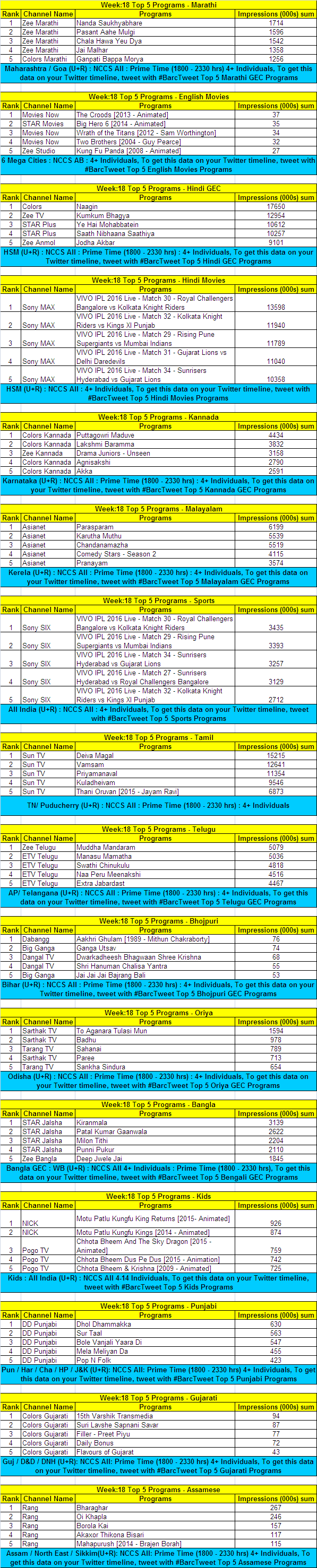
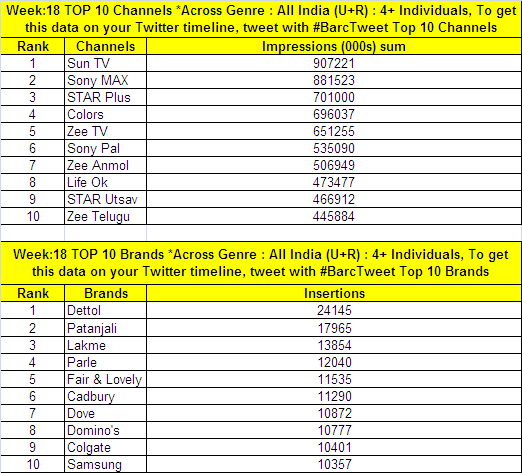
  • BARC Week 18 Data (April 30-May 6)

    By A Correspondent


    Here are viewership numbers from BARC for Week 18 of 2016 – that’s April 30-May 6, 2016)


    Note these numbers are combined for urban and rural audiences, and subscribers to the data will know how the rankings are dramatically different for urban audiences.​ And ditto for rural or free-to-air audiences.


    Enjoy!​​​​​


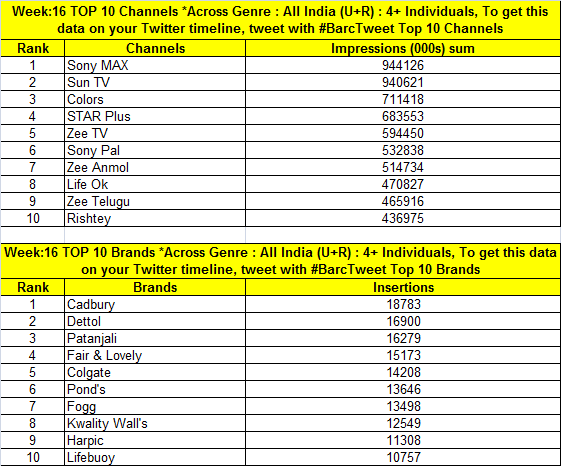
  • Lifestyle, Punjabi, Assamese & Gujarati channels wef BARC Week 16 data (April 16-22)

    By A Correspondent


    As BARC completes a year of release of data, here are viewership numbers from BARC for Week 16 of 2016 – that’s April 16 to 22. Starting this week, BARC has added lifestyle, Punjabi, Assamese and Gujarati language channels to the weekly ratings.


    Note these numbers are combined for urban and rural audiences, and subscribers to the data will know how the rankings are dramatically different for urban audiences.​ And ditto for rural or free-to-air audiences.


    Enjoy!​​​​​


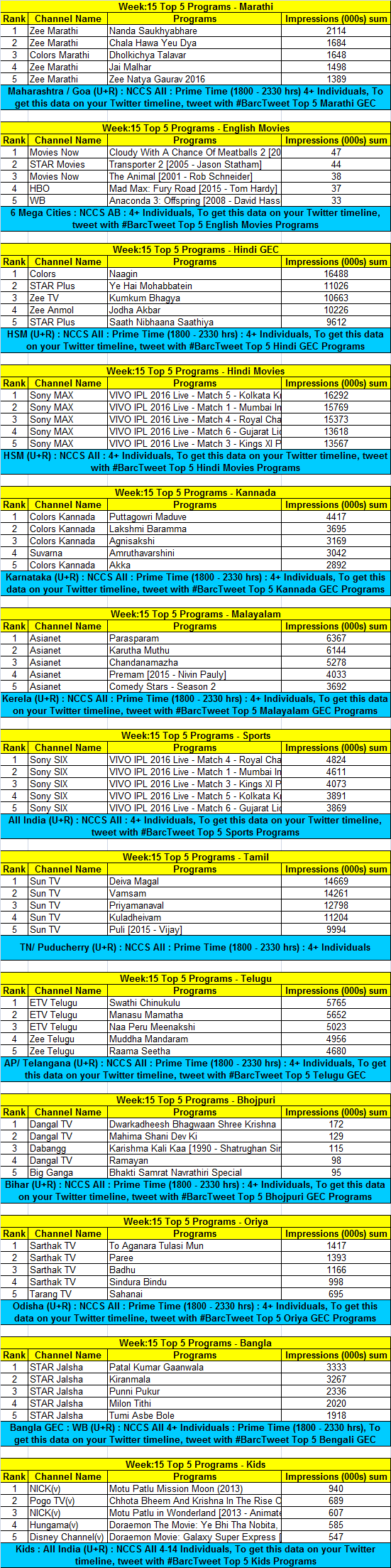
  • BARC Week 15 Data (April 9-15)

    By A Correspondent


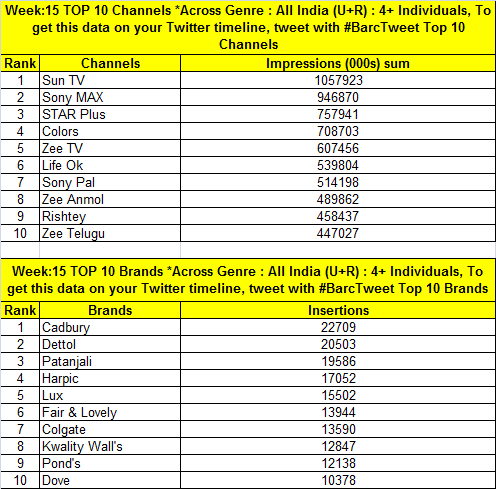
    Here are viewership numbers from BARC for Week 15 of 2016 – that’s April 9 to 15.


    Note these numbers are combined for urban and rural audiences, and subscribers to the data will know how the rankings are dramatically different for urban audiences.​ And ditto for rural or free-to-air audiences.


    Enjoy!​​​​​


  • Government, leave BARC alone!


    By A Correspondent


    The all-important inauguration of FICCI-Frames 2016 on Wednesday was marred by a sweeping statement by telecom minister Ravi Shankar Prasad. Minister Prasad is known to have strong views on measurement in the past too.


    Understandable. He has been I&B Minister in the past, and coincidentally his sister Anuradha Prasad runs BAG Films which runs the channels News TV and E24.


    Prasad said he wasn’t happy with the performance of TAM in the past and the alternative right now.  We really don’t know why he said that. It’s not that people have not had issues with BARC data. People have had, and the BARC team has cleared the air, and also corrected things if and when needed. One can be sure that BARC Chairman Punit Goenka must have faced some opposition within the Zee group when his channels didn’t fare too well in the first weeks of data releasing. But did he delay the release of the numbers? He didn’t.


    Evidently the telecom minister doesn’t agree with the I&B minister who is reported to be happy with the performance of BARC.


    We asked BARC CEO Partho Dasgupta for a comment on the minister’s statement. And this is what he said:


    “We believe the Hon’ble Minister expressed a view on improvements and changes in TV audience measurement in India with the launch of BARC India’s services.


    BARC India strictly follows government guidelines on the matter. We have expanded the coverage – with a doubling of sample homes to 20000 within the first year of launch, and inclusion of rural India for the first time ever. We have plans for expanding the panel as per government guidelines too.


    We are a Joint Industry Body and the number of meters are guided by Industry’s affordability and statistical needs. The number is as agreed by all stakeholders of the industry. Industry has welcomed and accepted BARC India data’s robustness and fidelity.”


    Frankly, we don’t think BARC must toe the government line. That it is following the guidelines is a bonus. The government has no role in television audience measurement.  Remember, the measurement is done for the benefit of a channel’s content and business teams to understand its viewers and more importantly by advertisers and media agencies who invest loads of advertising $$$s. If the broadcasters and advertisers don’t have a problem, why should the government poke its nose?