Tag: BARC

  • Is TRAI justified in damning BARC?


    By Your Editor


    The Telecom Regulatory Authority of India (TRAI, in short) has been accorded the dual responsibility of the broadcast policy-maker and regulator. Note broadcast (and radio) are the only media entities that are governed so actively and aggressively. Print is dealt with kid gloves, as always. Radio also has suffered thanks to excessive government intervention, and an active social media has ensured that the government can’t do much with digital media. Save GST.


    Hum Aapke Hain Koun?

    For many, many years, there existed a measurement system governed by TAM – a joint venture owned by WPP-owned Kantar and independent research major Nielsen. TAM won the mandate of broadcasters, advertisers and ad agencies to run the measurement system, and although there may not have been very active handholding by industry representatives, the fact that TAM owed its survival to subscription monies from broadcasters and other stakeholders, it couldn’t afford to mess things. Hence, the market ensured that it behaves and operates well.


    But, first, let’s understand who and why we need audience measurement?

    In order to get to the bottom of the problem, let’s understand why we need measurement. It’s simple: broadcasters air content. They say their wares are very popular, but there needs to be some tool for them to convince advertisers about this. This tool could be inhouse, but then will advertisers trust it? Hence, a third party measurement system. Now, if I am a large network of media agencies – like GroupM or IPG Mediabrands or a large advertiser like Hindustan Unilever or even the annoying Trivago, I can have my own team or firm doing this exercise of measurement. But these media agencies chose not to do so and relied on another body – in the case of television, TAM earlier and now BARC.


    If GroupM/ IPG Mediabrands/ HUL… even Trivago had their own measurement firms, could the government/TRAI police them?

    Of course not! How advertisers spend their money is their business. And how media agencies spend the money of their advertiser clients is their problem. Ditto with the measurement mechanism. Clearly, there is no role for government to police measurement. Yes, the government can set up its own measurement mechanism – like TAM or BARC – and hope and pray that they have enough paying subscribers to be able to run a tool. But they’ve been running Air-India, operating hotels and doing several things they shouldn’t be getting into.


    The genesis of the problem?

    What if you get bad marks in an exam? You grin and bear it. Curse your luck. Resolve to study harder. Or complain to some authority. The government. The local goon. Whosoever. Now this is what happened in the not-too-distant past. There were some influential channels which complained against TAM about the measurement mechanism. They said the process was flawed. That the boxes could be tampered with. That some broadcasters got to know where the boxes were placed and hence influenced the individuals living them. There were also a few people who complained that the content of news and entertainment channels had dipped considerably as some channels were tailoring content only to garner higher ratings. “Hey, we’d love to have shows talking about the chick pea crop, but kya karein, thanks to ratings we need to focus on chicks instead,” was the kind of reply one would get.


    Both situations were not far from the truth. Yes, there was tampering, and, yes, there some broadcasters who influenced panel homes. But does this mean that the government should get into the act? Should the government concern itself with the content quality of channels? If there are takers for dumbed down content, let there be.


    Hey, aren’t there industry bodies for broadcasters, ad agencies, advertisers?

    Of course they exist. And they are all headed by very senior and respected industry folk. One must also reiterate: not only are they currently headed by senior/respected folk, even in the past they were spearheaded by senior/industry folk. So why did they allow the government to intervene (or interfere)? Why did they allow policy-makers to let TRAI to govern them. We don’t have answers to these questions.


    Broadcasters do owe it to the government for uplinking/downlinking…

    Since the government gives the licence to broadcasters to uplink and downlink signals, it can lay conditions. But in the case of BARC… what’s the government got to do with viewership measurement?


    If broadcasters, advertisers and advertising agencies are unhappy with BARC, they’ve got the remote control in their hands. They can express a loss of confidence, debate/ discuss, put them on notice and if they are still unhappy, they can stop their subscriptions. It’s as simple as that.


    Could the problems have been eliminated if BARC wasn’t a monopoly?

    Competition always helps, but it must be remembered that television viewership measurement is an expensive proposition. Setting up measurement meter boxes isn’t cheap. Clearly there is no stopping multiple bodies in the business of viewership measurement. But, then, will people subscribe to them?


    When TAM existed, there was another measurement firm called aMap which existed but thanks to lack of patronage, it had to shut shop. So, while the more the merrier, does the industry have the appetite to pay for multiple players?


    So should the government/TRAI intervene?

    This question doesn’t need a wordy response. The answer is simple. No. Let me repeat: No. Yet again: No. Nahin, Nako, Na, Illai….


    Now what’s the current problem?

    The government, via the TRAI, thought it would be a good idea to administer a new Tariff Regime for channel subscriptions. That one can pick and choose channels, a la carte. All of this has led to some upheavel in the availability of channels and millions of homes have now been subject to the non-availability of some popular channels. While the problem is not as severe for DTH subscribers, for those connected to cable operators (like this writer), things are not as simple.


    Therefore, the viewership of many channels has been impacted with the change of regime. Since it typically takes four to eight weeks for life to settle down, various broadcast stakeholders decided that it would be incorrect to base buying decisions on the current set of numbers, and BARC decided that while it will give out viewership numbers to its subscribers, it will not publish them on its website or via Twitter.


    TRAI wants BARC to publish on website?

    We don’t really know why. The numbers on the BARC website are only very indicative, and are topline. Advertisers and agencies do not base their buying decisions based on these numbers.


    If the website data is inconsequential, why raise BP levels… just go ahead and publish them!

    True. But it’s got nuisance value. And if a channel has dropped its leadership position only because of some subscription issues, it’s unfair to make things public because they could be misused.


    The questions posed in the headline and summary: Is TRAI justified in damning BARC? Conversely, is BARC right in showing the finger to the broadcast regulator?

    No, TRAI isn’t justified. And, yes, BARC is right in showing the middle finger. But, but, but, BARC’s stakeholders must share the blame for the current stand-off. If they had resisted all the pressures earlier, they (and we) wouldn’t have suffered today.


     

  • Comment: TRAI barks at BARC, incorrectly

    By Your Editor


    So telecom-and-broadcast regulator has pulled up measurement body BARC India (short for Broadcast Audience Research Council) for non-publication of ratings and viewership data. Which we believe is incorrect because BARC has only not been publishing the data on the website. All subscribers – broadcasters, adverisers and ad agencies – are still getting the data, though part-owner Indian Society of Advertisers has advised its members not to use the data for making decision on buying advertising. The IBF, representing the interests of its members, has been troubled that the transition has hampered the viewership numbers of a large number of channels.


    According to a report released on wire agency PTI, the TRAI has asked BARC to comply or face action. This is grossly unfair, a BARC subscriber told MxMIndia requesting for anonymity, adding that the TRAI has not been able to administer an effective transition to the new tariff regime and a large number of subscribers still don’t get all channels. “The delay of the last date to March 31 has only extended our miseries,” the subscriber averred.


    The PTI report can be accessed here: https://www.dailypioneer.com/2019/business/trai-directs-barc-india-to-publish-rating.html

  • Election semi-final sees growth for news channels

    By A Correspondent


    If it was a semi-final for the political parties, it was a testing ground for the news channels too. The frenzy in the run-up to the elections in the five states of Mizoram (why should it always come last!), Telangana, Chhatisgarh, Madhya Pradesh and Rajasthan happened on telly as much on the ground.


    The viewership numbers for the news channels have come in, and we sought the numbers from BARC. The tables below tell the story:


    1. HINDI NEWS
    Avg. Impressions  
      Tuesday 11th Dec 2018 Prev 4 Tuesday Growth
    HSM 402.9 Mn 106.4 Mn 3.8 times
    MP/Chhattisgarh 132.2 Mn 16.1 Mn 8.2 times
    Rajasthan 33.6 Mn 8.7 Mn 3.9 times
    Assam/NE/Sikkim 5.9 Mn 2.1 Mn 2.8 times
    AP/Telangana 1.8 Mn 532 K 3.4 times
    TG: 15+/ respective market


    1. ENGLISH NEWS
    Avg. Impressions  
      Tuesday 11th Dec 2018 Prev 4 Tuesday Growth
    India 1.4 Mn 413K 3.5 times
    MP/Chhattisgarh 86K 30K 2.9 times
    Rajasthan 25K 11K 2.3 times
    Assam/NE/Sikkim 146K 34K 4.3 times
    AP/Telangana 137K 37K 3.7 times
    TG: M 22+ AB/ respective market


    1. REGIONAL NEWS


    Avg. Impressions  
      Tuesday 11th Dec 2018 Prev 4 Tuesday Growth
    Telugu News 227.6 Mn 45.2 Mn 5 times

    AP/Telangana 2+


    Avg. Impressions  
      Tuesday 11th Dec 2018 Prev 4 Tuesday Growth
    Rajasthan Regional Hindi News 43 Mn 5 Mn 8.9 times

    Rajasthan 15+


    Avg. Impressions  
      Tuesday 11th Dec 2018 Prev 4 Tuesday Growth
    MP/Chhattisgarh Regional Hindi News 23 Mn 2 Mn 9.4 times

    MP/Chhattisgarh 15+


  • BARC bags accolades at CII Awards 2018

    By A Correspondent


    BARC India bagged the ‘Most Innovative Company in Service – Medium Enterprise Category’ at the CII Industrial Innovations 2018 awards. In addition, BARC also been recognised as one of the ‘Top 25 Most Innovative Companies in India’. The announcement was made at the fifth CII Industrial Innovation Awards 2018 held in New Delhi on December 3..


    The Industrial Innovation Awards identify and celebrate innovative Indian enterprises across various sectors. The award has been instituted by the Confederation of Indian Industry (CII), and is one of the most coveted innovation awards in India.


    Said Shashi Sinha, BARC India Technical Committee Chairman and CEO, IPG Mediabrands:  “BARC India was set up with the aim to give the industry a measurement system that it deserved, and this could not have happened without having a strong technology backbone. The team at BARC India has been able to give the industry a technology marvel which is capable of providing the industry a representative data that helps them take better business decisions. The CII Industrial Innovation Award is proof of the great work done by the team.”


    Added BARC Chairman Nakul Chopra: “BARC India has been a key change agent in the viewership measurement space, and its initiatives have already started to redefine the industry. Since its inception, BARC India has tackled several challenges. But, considering we work in a dynamic industry, these challenges are never-ending. The key to success is to constantly keep innovating and be the change-maker. BARC India has been successful in doing so. We are now looking at implementing some key future projects such as Unified Video Measurement and Return Path Data, which will bring another paradigm shift in the industry.”


    Said Partho Dasgupta, CEO, BARC India: “In future, technology will disrupt every single business, be it Cement, Retail, Telecomm, E-Comm or Media. It is therefore important to keep pace with the changing technology. As is said, in tomorrow’s world, the big fish will not eat the small fish, but a fast fish will eat the slow one. We at BARC India firmly believe that innovation is imperative and not a choice. We also believe that it is important to be the fearless first to inspire change and not be a mere follower. I am delighted to see that our efforts have been recognized by CII. We shall continue to empower the industry with our robust measurement,”


  • Government, leave BARC alone!


    By Pradyuman Maheshwari

    MxMIndia has been consistent on its position that the government mustn’t have a role in the television ratings process. And we were appalled when on Monday, the government-owned Telecom Regulatory Authority of India issued a Consultation Paper of Review of Television Audience Measurement and Ratings in India.

    While a review of how BARC is performing is good to do, did it require a TRAI to step in to do it? Couldn’t the joint owners of broadcasters, advertisers and advertising agencies have conducted this? After all they run businesses of over crores of rupees and are mostly fair in their decision-making. Mostly fair, because we’ve seen some regressive acts in the past like not stepping in to disallow news channels from opting out of watermarking and boycotting BARC one-and-a-half years back post the launch of Republic TV. It may be noted that the BARC Board – the meetings of which happen very regularly – is constituted of members of all stakeholders.

    But back to our concern that the government shouldn’t be getting involved in measurement. Vested interests have evidently got onto the act and prevailed upon the government to do this.

    MxMIndia has maintained in the past that part of the problem with TAM was a creation of the industry. Just how many times did the TAM technical committee meet to advise the joint industry-appointed measurement body on how it should conduct its measurement. Or what changes should it bring about. From what one remembers, the techcom advising TAM fizzled out a few after it was set up. Later, it was for the TAM management and the wise women and men in the industry to shape the measurement business. A not-so-little birdie in the techcom tells me that the government representative present on the techcom is conspicuous by his absence in most meetings. MxMIndia was unable to procure the attendance roster of Board and Techcom meetings to get an indicator of the participation levels of industry players.

    In my limited understanding of the nuances of the business, I believe the industry – broadcasters, advertising and advertising/media agencies – have let down BARC miserably. And if they don’t step in and do what they ought to do, BARC could well be an exercise in futility. Television measurement could see the same fate as print. Or radio which after all these years still doesn’t have a 100% buy-in from all players or internet measurement which is so opaquely transparent. Or transparently opaque.

    The genesis of the problem is the unity (or lack of it) amongst and within the three constituents. The Ravana in the Room is clearly the lot of news channels and some of the smaller, fringe players. Unfortunately, they have access to big and mighty in, as Arnab Goswami loves to term it, Lutyen’s Delhi. Now, Ravana, we all know, was a learned man. Except that his ways were, well, wicked.

    It’s perhaps incorrect to give a Ravanesque hue to all news channels. Some of them are indeed progressive and think in the larger interests of the business. But, ask any one who knows the trade, the only reason why TRAI has got into the act is because of the pressure from news channels. News channel bosses are influential, and governments over the years are under pressure directly and from politicians to peruse issues which it shouldn’t waste its time on. Had BARC (and earlier TAM) not measured news channels, it would’ve been smooth sailing all through.

    Among the various misgivings – perhaps not spelt out loud and clear – is that the community of smaller channels believe that BARC is only a body of the biggies. But then that’s something they must get their industry association to work upon. It may be good for BARC to proactively have a separate tech sub-committee for small and medium-sized channels, advertisers and ad agencies.

    The contention which I hear has been expressed in some quarters that the BARC fees are very high is perhaps incorrect. At the lowest end, BARC fees are in the region of Rs 15 lakh plus GST. Which given the business they are in is fair money for data that could bring in 10x the amount.

    In the days of TAM, one of the major misgivings was the number of panels in existence. In India, for a TV AdEx of 3,364 million, the panel size in terms of approximate individuals is 135,000. Contrast this with China where AdEx is 20,105mn and the panel individuals size is just 29,361 (source: EuroData Study 2017).

    There is also a view that there must be more than one player measuring TV data. Competition is always good in any business. But it may be remembered that even aMap, when it existed as a counter to TAM not too long ago, had to shut shop because of lack of patronage. Will the various entities – broadcasters, advertisers and agencies – be willing to pay subscription fees to two measurement companies? My view is they won’t.

    In sum, the government-appointed TRAI should not have any role in the television audience measurement. Just as it doesn’t have any role in print, radio and internet audience measurement. There is some bizarre view that the reason why the government is involved is because its ads buying arm – the DAVP – loses monies because of incorrect measurement. So what about print, which earns its largesse? The government is scared of the big print players and isn’t able to bully them the way they are able to control the TVwallahs.

    The data that’s thrown up by measurement is used by advertisers (and hence ad agencies) to decide on advertising and by broadcasters to aid its content and distribution. And since successive governments are aware that the media ecosystem is divided and people love to pull down others, it’s taking advantage of the situation. Look at print: even though an HT may hate Times, a Dainik Bhaskar may take on Dainik Jagran or Rajasthan Patrika, all rivals are almost always on one page when it comes to warding off government influences.

    The ecosystem is so divided that it will not even invest the monies to hire a lawyer like the Raja of PILs Prashant Bhushan to ask the government: Hum Aapke Hain Kaun!

    By putting BARC on notice, TRAI will kill measurement. And the industry will allow it to be killed. Perhaps that’s what some want.


  • Maximising adsales in the festive season


    Text courtesy BARC, slightly edited for the introduction


    TV in India remains the most penetrated medium at 66% and with 100 million households yet to own a television it will only soar further. The year-on-year growth is seen across viewership – content and ads; as well as across the number of advertisers and brands wooing these growing viewers. While spikes in viewership could be fuelled by unplanned happenings and topical events, there are special events where television plays the role of a common entertainer for the entire family where collective television viewing by the family members becomes a part of the festivities.


    Broadcasters on their part, make these days attractive for the viewers through compelling and clever programming and scheduling. Increase in viewers results in increase in advertisers as well. As we step into the festive season, BARC helped in decoding the advertising juggernaut and shed some light on how the viewers and advertisers evolved during festivals especially in the high decibel festival season from September to December.


    Television viewership has been rising over the last three years. The average weekly viewership of ads in India is growing steadily each year as well. From 2016 to 2018, the advertising impressions has increased by a phenomenal 45% from 521billion to 755billion with 2018 yet to witness its festive season. For the Jan to Aug 2018 period the average ad duration stands at 31 million per week, taking the total advertising volume to 1.07 billion for the same period.


    This growing viewership has seen endorsement from the advertising fraternity as well, with average weekly advertising volume clocking 31 million seconds from January to August 2018. The trend line for the last 36 months plotted against the monthly advertising volume is also on a growing trajectory.


    The peaks in advertising coincides with planned tentpole events – be it related to sports or national interest topics like budget and elections, or with the festive season. Please click on the link below for a more detailed account on advertising in the festive season over the last three years.

    Advertising During Festivals

  • BARC partners Airtel DTH for RPD

    By A Correspondent


    BARC India has taken a big step towards using Return Path Data (RPD) for TV viewership measurement. BARC India has tied up Airtel Digital TV, Airtel’s DTH arm, for including its subscriber homes into the BARC India RPD Panel. This partnership will provide fillip to BARC India’s plan of scaling up panel homes to multiples of the mandated 50,000.


    It may be noted that in October last year, BARC India had signed on multi system operator DEN Networks for measuring TV Viewership using RPD. By tying up with Airtel Digital TV, BARC India has successfully added a significant DTH subscriber base to its proposed RPD panel. BARC India will use a portion of Airtel Digital TV’s subscriber base to measure TV viewership via RPD.


    Romil Ramgarhia

    “Our partnership with Airtel Digital TV will strengthen our RPD rollout plan. Panel home expansion is absolutely critical for us considering the diversity in the country which is visible even in the way TV content is consumed. RPD, will give the industry a cost-effective way of expanding panel home size. The distribution platform owners too will benefit with RPD. It will give them a better understanding into what their subscribers are consuming on TV. This will help the industry at large,” said Romil Ramgarhia, CBO, BARC


    Sunil Taldar

    Added Sunil Taldar, CEO – DTH, Bharti Airtel: “We are pleased to partner BARC India and support their endeavour of compiling robust TV viewership insights. A credible resource like this will benefit the entire ecosystem including content producers, marketers and help in enhancing the experience for customers.”


    It may be recalled that on Monday, Dish TV had announced its decision to launch hybrid set-top boxes which will facilitated RPD. Tata Sky has already mandate WPP’s Kantar Media to research its RPD numbers.


  • @FICCI-FRAMES18: ​How Ratings Reflect Real Viewership


    By A Correspondent


    Partho Dasgupta

    On Day 2 of FICCI-Frames 2018, BARC CEO Partho Dasgupta addressed delegates in the session titled ‘The Future of TV’. The speech was interesting as it drove home the point – based on data of course – that ratings is impacted considerably on viewership behaviour and patterns. The presentation below is self-explanatory, hence we haven’t transcribed his speech here.


  • 160-plus and booming


    By A Correspondent


    The last decade-odd has seen the booming of news channels in India, and with the next general elections as also elections in key states not very far away, the focus on the news channels genre is set to grow. Given this, a BARC report titled ‘Breaking the News Story’ assumes importance as it dissects some interesting facets of the business.


    While we recommend a close look at the full report (link: http://www.barcindia.co.in/resources/Breaking %20the%20News%20Story.pdf), here’s a summary of the report that we have culled from the pdf:

    [] News is the third largest genre on television in terms of viewership, with 160+ channels across English, Hindi and Regional languages.

    [] The News genre has witnessed an overall growth of 15% in the number of channels from previous year. English News channels have witnessed the maximum increase compared to Hindi and Regional News channels.

    [] As compared to Total TV viewership, News Genre audience is skewed towards Males, age group of 22+ years and NCCS A & B.

    [] News is a dynamic and event driven genre. Politically significant, scheduled events, such as State election results have consistently led to spikes in news viewership.

    [] Some unforeseen events also lead to massive spikes in news viewership, due to high intensity and impact. For example- Demonetization, demise of Jayalalitha, Surgical Strike Operation.

    [] The immediate effect of a big news story can be gauged by the corresponding rise in viewership. But, while more number of people tune in, the viewing trend by daypart remains similar to the general trend. i.e. Viewership peaks once in the morning and once in the night. A slight increase is also observed in the afternoon.

    [] It appears that in the case of unscheduled events, viewers prefer quick takeaways and therefore consume short formats such as news bulletins, but in case of scheduled news events, viewers may also be interested in more detailed formats viz. Interviews/ studio discussions etc.

    [] The breaking of a big news story impacts the genre composition on Television, as viewers start moving to news channels for updates. In case of demonetization, News genre gained 10% share of eyeballs and became the second most viewed genre on the day following the announcement.

    [] News events also have varied impact on advertising. In some markets, the programming share on news channels increased on election result day, to keep viewers hooked. However, in one market, an increase in break duration was also observed. This may be a strategy of increasing ad inventory for advertisers to reach the high number of audiences that tune in.

    [] In case of an economic event such as demonetization, Total ad FCT on news channels went down by 13%. However, some categories such as ATM, Anywhere Banking Services, and Online Shopping benefitted from the situation and increased their ad insertions to promote their services.


  • Withdraw watermark and we could ban data & login access for 6 months, says BARC in new policy

    By A Correspondent

    Television audience measurement body BARC (short for Broadcast Audience Research Council) has had a policy for channels that withdraw the watermarking from their signals. But BARC did not administer the policy when a few news channels withdrew the watermarking a few weeks back.

    But now, in a policy that  supersedes all other policies pertaining to intentional watermark switch off by a subscriber, it has expressly stated that any missing watermark for a duration greater than 12 hours, which cannot be resolved by the subscriber, would be treated as a case of intentional switch off.

    Notes an announcement: “In such cases, BARC India’s Technical Team would establish the same and report such cases to the Management. The Management would certify the incidence to be a case of intentional switch off and report the same to the Chairman and the CEO of BARC India. The Chairman and the CEO would jointly decide to proceed with a response from BARC India. The response to such incidences is outlined below –

    • BMW data of the channel(s) for which the watermark has been switched off will not be released at any point for the period when the watermark is missing.

    • Subscriber login for the network would be deactivated from the moment intentional switch off has been established

    • Once the watermark is switched on, both BMW data for the channel and subscriber login for the network would not be available for a further period of 6 months.”

  • BCCL fires fresh salvo against Republic. ET report raises doubts on timespent in BARC data

    By A Correspondent

    Bennett, Coleman & Co Ltd, the owner of The Times of India, Economic Times, Times Now and a slew of topselling media brands, has fired a fresh salvo against former Times Now editor-in-chief and President News’s entrepreneurial venture, Republic TV.

    The clip of the report on Page 8 of The Economic Times Mumbai dated June 12, 2017

    Since the data for the first week of Republic TV’s launch, Times Now, which was the highest rated amongst English news channels, found itself ousted from the top spot by Goswami’s channel. Consequently, the channel along with a few others, prevailed upon the News Broadcasters Association to act on the usage of dual LCNs and advise that they remove the watermarking on their channels thereby opting out of the BARC measurement.

    Other than NBA, many channels are also part of the Indian Broadcasting Federation (IBF). Interestingly, IBF in turn is 60 per cent owner of BARC India, which is a joint industry body.

    The channels came back to the BARC fold after they felt assured when Republic TV is said to have told the Court that is not taking multiple LCNs. Interestingly, India Today TV also filed a complaint with TRAI about Times Now using the dual LCN route to boost ratings.

    Last Thursday, BARC released date for Week 22 which marked the return of all English news channels to watermark-led measurement.

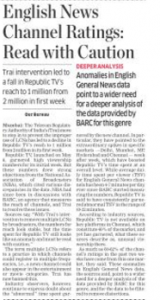
    While there is a sentiment that even this data is boosted by channels employing landing pages, an Economic Times report has cautioned media buyers and advertisers that all isn’t well with BARC viewership data. It is evident from the report that the high timespent of Republic is a sore point and Times Now hasn’t gone up in terms of timespent.

    There are questions that need to be addressed now:

    01.Will BARC probe the charges in the ET report?

    02.What does BARC think about the ET report? While ET is not indicting BARC in any direct way, the fact that the timespent data has been questioned, it impacts the reputation and credibility of the joint industry measurement body. What do BARC and owners IBF, ISA and AAAI have to say on this?

    03.Is this a misuse of sibling media by Times Now? If it was such a grave issue, how come other business dailies haven’t taken it up?


    It’s perhaps time for NBA and/or IBF to bring order in the house. It should bring together the four or five top English news channels and get them to stop throwing muck at each other and more importantly conduct their business in a fair manner.


  • NBA backs TRAI move, damns Republic

    By A Correspondent


    Ashish Bagga

    Ashish Bagga, President, News Broadcasters Association (NBA) issued a statement on Friday that it was major victory for the News Broadcasters Association (NBA) that the Telecom Regulatory Authority of India (TRAI) has issued a mandate against Multi System Operators (MSOs) regarding the usage of multiple LCNs.


    This mandate was released within two weeks by TRAI on representations made by NBA, notes the statement.


    And this is the rest of the statement:

    “NBA had filed a complaint with TRAI against unethical distribution practices adopted by a new entrant in the English news genre: Republic TV, to boost its Rating Points (TVTs). NBA had also appealed to BARC not to release data for the English general news category for Week 19, 2017 as the rating was corrupted due to unfair distribution tactics. Consequently, major English news Channels who are also members of the NBA had opted out of the measuring system to protect themselves from being measured in a non-level playing field and had clarified that they would return only after the unethical practices had been stopped.


    “After a series of discussions and complaints to BARC and TRAI, the English news broadcasters have resumed their Watermark last Friday night subjecting themselves to ongoing measurements as they were sufficiently satisfied that due to TRAI’s intervention the malpractices were discontinued. This was confirmed by most MSOs. Mr Ashish Bagga, President, NBA, stated that the NBA’s stance today stands vindicated. Not only had TRAI released this important mandate, it had also aggressively followed up with MSOs about putting a stop to malpractices.


    “The NBA is grateful to the TRAI for taking swift measures to stop malpractices. TRAI in its recent mandate to the Multiple System Operators (MSOs), also emphasized on ensuring that all channels falling in a particular genre appear in its (MSO’s) network’s electronic programming guide (EPG) under that genre, to make services more consumer friendly. As a result of TRAI’s mandate and action, the rating of Republic TV have gone down by over 50% after the malpractice was discontinued. This drop in rating brings Republic TV closer to realistic levels of weekly reach of general English news channels which is an average of 0.6 to 0.8 million. MrBagga stated that this would not have been possible without the timely intervention of TRAI on NBA’s complaints.”