Tag: BARC

  • 10 Takeaways from the recent NBA-Republic-BARC face-off


    By Pradyuman Maheshwari


    The last fortnight has seen many developments on the English news broadcast front, which was decidedly the most forgettable episode in recent media history. MxMIndia has been on the forefront on reporting these and also commenting on them. We believe that as a mature voice of the industry, it is important that we should comment on issues, and even if it means that we are the only ones in the business doing so.


    Now that the dust is beginning to settle on the controversy, we list here 10 takeaways from the episode:

    1. The IBF has curiously been very quiet on the entire development. We are sure (and hope) it’s been working in the background, but a public statement would’ve ensured that we know that IBF, as the apex body of broadcasters, is non-partisan on the issue.

    2. The NBA issued a statement on Friday, but there was no remorse or regret on opting out of BARC’s measurement system. This even a day after BARC chairman Sudhanshu Vats issued a statement which said: It is unfortunate that some members have taken issue with the use of multiple LCNs when many have themselves set the precedent for it – either as a promotional or as a defensive tactic.

    3. Multiple LCNs isn’t the only inorganic booster employed by the broadcast fraternity. Landing pages are looked at by not just the newswallahs, but the general entertainment channels too. There needs to be a standard policy for all such inorganic measures for boosting viewership.

    4. Republic TV is not yet a member of the NBA, the apex body of news broadcasters, which is also recognised by the government. The NBA has also promoted a self-regulatory body – the NBSA. That Republic isn’t a member of the body doesn’t augur too well for both. And most importantly given its non-membership, Republic is not subject to a self-regulatory mechanism. This could work against it in the short and long run. In case it chooses not to join the NBA, Republic must have its own ombudsman and self-regulator.

    5. NBA must cease to be seen as partisan. Its statement issued on Friday, specifically points to Republic, which is a non-member and has been serious competition to some key NBA members like Times Now and India Today. The heads of both these organisations are the two top NBA officebearers. Even though the CEOs of both networks are seasoned and respected professionals, there have been doubts expressed about NBA not being exactly neutral in this episode.

    6. Most of the key news channels are members of the IBF. The IBF and NBA must enforce the rules laid by BARC on advertising on all its members. Perhaps either of the bodies must have a ‘fair play ranking’ like the IPL has, with a roster on how members have been faring on certain parameters

    7. BARC has been forgiving and not imposed its own ruling of reprimanding channels that remove the watermark. By doing so, it has possibly lost an excellent opportunity of telling erring channels/networks that what they did was incorrect. Now just in case a single channel or a group does something similar in future, it will have to condone that act too!

    8. Going to the TRAI and MIB for stuff is not good. These are things that broadcasters must settle amongst themselves. But by according TRAI a key role in their lives, the broadcasters  – the newswallahs in particular – could well be playing with fire

    9. The secretariats of the various industry associations must be made stronger and with people who can deal with things independent of their elected masters. That’s the only way associations will be considered neutral and that’s the only way in which industry associations can be relevant.

    10. Lastly, in love and as in war, there are no permanent friends and enemies. In fact often the two sentiments can co-exist. As we saw in the current episode where at one level India Today and Times Now had combined forces on Republic TV’s multiple LCN deployment and on another India Today complained against Times Now for also deploying multiple LCNs. Imagine if Republic was also a member of the NBA… there could’ve been one complainant…


    Pradyuman Maheshwari is Editor-in-Chief and Founder, MxMIndia. The views expressed here are his own


  • Wrong to have dragged BARC into controversy: Chairman Sudhanshu Vats on dual LCN issue

    By A Correspondent


    Sudhanshu Vats, Chairman – BARC, has issued a statement on the recent note from regulator TRAI (short for Telecom Regulatory Authority of India) on the multiple LCN (logical channel numbers) issue that recently derailed the broadcast media industry ecosystem.


    The statement form Vats, Group Chief Executive Officer, Viacom18, assumes importance as other than being BARC chairman, he is also Chairman, National Committee on Media & Entertainment, Confederation of Indian Industry and Vice President, Indian Broadcasting Foundation (IBF). This is the statement:

    “The recent note from TRAI on the LCN issue (titled ‘Listing of TV Channels on Electronic Programme Guide) is a welcome step in the right direction. It provides all market players with much-needed clarity and clearly spells out the regulator’s view on the issue. Once again TRAI has taken the ‘consumer lens’ and ensured that she remains at the center of the discourse.


    As the dust settles on the matter, three key truths have been proven. The first pertains to BARC and its methods to measure what India watches. In that context, it is safe to say that watermarking is a modern, robust technology that has held the industry in good stead.  In record time, BARC has earned a fair share of its currency of trust and all its stakeholders are committed to its mission, including the IBF which backs it in entirety. To be frank, it was wrong to drag BARC into the issue in the first place. The second truth requires us to introspect as an industry. It is unfortunate that some members have taken issue with the use of multiple LCNs when many have themselves set the precedent for it – either as a promotional or as a defensive tactic. While this should now abate given the recent direction from TRAI, moving forward, all market players must create consensus internally rather than squander away the valuable time of the courts. Our ‘shared credibility’ as an industry should never be dented – especially not by our own actions. Finally, as we look towards a ‘multi-screen future’, ‘Total Audience Measurement’ (i.e. measurement of content consumption across devices including handheld, desktop, TV etc.) will become the norm. In such an environment, all content players will look at innovative ways to increase their reach and sampling while focusing on delivering winning content. This is the new normal that we all need to prepare for.


    I’ve always thought of our industry as a large family with members who often quarrel but eventually come together. This time will be no different.”


  • Stakeholders can ask BARC Board for change of policies: Partho Dasgupta


    When the industry chose Partho Dasgupta to head BARC or Broadcast Audience Research Council, they obviously knew that while Dasgupta realises that BARC is a joint industry body and like any such grouping, it has many masters, egos and all that goes with it, he’s not one to get bullied easily.To his credit, Dasgupta, joint recipient of the MxMIndia Mediaperson of the Year Award 2015, has stuck his ground on issues that merit the need to stand up to the biggest (and often most feared) names in the business.


    And this is how the BARC top brass reacted to the offensive from the News Broadcasters Association and its constituent English news channel members (except WION) on the evening of May 28. The channels took the extreme step of removing their watermarking as a mark of protest against BARC, only to return with watermarking at around 12am on Saturday, May 27.


    Given that it’s a sensitive issue and possibly best forgotten now that the channels are back, we thought Dasgupta would duck our request for an interview, and have us chase the elected/appointed officebearers. Instead he took the questions from Pradyuman Maheshwari head-on. Read on…


    It’s heartening to note that the English news channels have returned to the BARC fold by watermarking their channels. Your thoughts on the episode. Actually more than thoughts, your sentiments – when you heard of it first and now?And who do you think won? You (as in BARC)? The English news channels? Or would you say the industry lost?

    This is not about winning or losing. BARC stood by its principles of being unbiased and transparent. BARC was formed by the industry to measure ‘What India Watches’ and we continue to do so.


    What the news channels have done by undertaking this one-week-one-day pull-out doesn’t augur too well for the entire ecosystem as a whole. What if another channel does it in future – equally aggrieved, etc.? The English news channel – under the patronage of the NBA – have, sadly, shown the way.

    Content is the king and good content is always appreciated by viewers. BARC India only measures ‘What India Watches’. We do not have control on who is watching what and neither can we change that. If viewers decide to watch a particular channel in a week and the viewership spikes, we cannot start questioning it. It is for the industry to handle it in a mature and professional way.

    Frankly, our stand on measuring channels doesn’t change with turn of events. We are guided by TRAI and MIB guidelines and any policy that we put in place has sign off from all our stakeholders and Board. I believe questions with regards to our data can be resolved through discussions based on logic and fact, and faith in the system which all the broadcasters are a part of.


    There is a sentiment that the standpoint of BARC has been very black-and-white. That despite seeing rampant abuse of distribution practices, BARC has turned a blind eye to the malaise. And while earlier it was only individual channels that may have objected, here the apex association of news broadcasters made an earnest request, ahead of the release of the data. Also, while there exists a clear clause on your site on the issue of multiple LCNs which we have seen, couldn’t you have been a little more accommodative?

    I would want to reiterate our statement: we only measure TV viewership, irrespective of the platform or the number of instances it is available on. We are a joint industry company and not a regulatory body. Even the Delhi High Court has clearly said that the matter is between the broadcaster, MSOs and TRAI to resolve. TRAI has been investigating this much before the court case came up. We should have faith in the regulator.

    There was full faith in the numbers for the last two years and people were using it to market and sell; suddenly when the landscape changes due to new entrant, one blames the same system?

    We know that a lot of FMCG brands take up more than one shelf to promote a certain product. What do you do then? Hold up the supermarket for allowing them to take that space? How is this any different? If a broadcaster decides to take up more than one slot to improve the opportunity to see, it is absolutely their call. We have measured and reported data for channels basis watermark code and the viewership recorded and this time was no different. The stakeholders can always approach the BARC Board for any change of policies they may suggest.

    Saying that we turn a blind eye is absolutely wrong. If you remember, we were the ones who had stopped releasing data of channels we found were involved in meter tampering. We were questioned even then. It seems like “Shoot the Messenger” has become easiest way to resolve an issue these days. BARC India was set up to give the industry the data that is robust and we are doing that and will continue doing that.


    We have seen in the case of Republic TV as well as several times in the past channels disobeying the BARC guidelines on advertising data. Now by the time ASCI, the advertising self-regulator, is able to issue a diktat, the channel would’ve done its job making a claim that works against the BARC guideline.

    My first question: Is it a guideline or a directive. As in does breaking of the guideline amount to the act of advertising an improper message mean it is an offence? And second, while it’s not BARC’s job to police channels, but since it is a contravention of BARC guidelines, shouldn’t there be a provision for a penalty?

    Again, as I said earlier, we are not a regulator. We have issued a guideline and it is for broadcasters to self-regulate. If they don’t, there is a body that can regulate them. In this case, ASCI. The fact that we have come out with a guideline is in itself a proof that we do not favour such marketing campaigns.

    And let’s face it, before it comes to BARC or ASCI, broadcast channels should have their own methods. They should self-regulate within and arrive at a consensual approach. If they agree on and adhere to their own bounds; BARC, ASCI, TRAI, courts etc. need not come into the picture at all.


    It is clearly mentioned in your terms with the subscribers – specifically broadcasters – that pulling out the watermarking could lead to the suspension of data from a login for six to eight months. Will you be now doing that with the channels which have pulled out – for the channel itself and for others in the network using the same login id? And why not? Wouldn’t this mean that channels unhappy with BARC data in the future for whatever reason could do the same? Wouldn’t it have been good to have shown the stick to the broadcasters who pulled out? Or at least been tough with them? Or are you now planning to remove the clause?

    We believe in talking first than in taking recourse to legal action. But if necessary we won’t shy away.


    We’ve seen a similar sentiment being expressed by a few media entities with the IRS for print some years back. And we are seeing a similar outburst now from broadcasters who weren’t happy with data. I am sure the pressures over the last week-odd would’ve been major on you and the team. Would you say this is part of the game… just as if you’re in the kitchen, you have to face the heat, in an audience measurement firm, one has to be ready to face disgruntled, angry and sometimes unruly subscribers?

    (laughs) Yes, it has been pretty rough for all of us. We knew we were right, it was all about making people understand that. We first did that in the Delhi High Court and then to news broadcasters. It is sad that you are pulled up for doing your job right. But as you said, it is about facing the heat being in the measurement business.


    Often, when one loses a match, the pitch or the umpire is blamed, right?

    (laughs) No comments


  • 10 Reasons why English News Channels have been generating a Frown…


    By Pradyuman Maheshwari


    If you’ve been subjecting yourself to the developments of the last few weeks, you would possibly be left wondering whether the same news media that sermonises on what’s wrong and what’s right in India has embarked on a path that’s very uncool. Uncool is perhaps too soft a word. As the road sign says: Danger lies ahead.

    Let’s start with the beginning:

    01. Shout as if there’s no tomorrow: I was among the first commentators to applaud Arnab Goswami in 2008 for asking the tough questions. But is it right to forever keep raising your voice – with 6 to 8 talking heads screaming and shouting? Perhaps not. And even on nationalistic issues, if Pakistan is Enemy #1, why call people from there? How about some neutral, global commentators? And look at what’s happened when Goswami left Times Now? Another bunch of noise-makers!


    02. There’s no really neutral English news TV channel. Sadly, there is no clearly neutral English television channel. NDTV 24×7: Appears neutral only because it doesn’t gush about the government, but clearly left liberal. CNN-IBN is mostly neutral and isn’t obviously pro-Modi even though it’s Mukesh Ambani-owned, but given its ownership, it can’t obviously be neutral. Must say that it hasn’t been tested on this score yet. India Today: Rajdeep Sardesai is exceedingly neutral, but Gaurav Sawant? And why did they need to cover Yogi Adityanath live for nearly two days. And Times Now: unlike the paper, the channel is pro-BJP, and in my mind, it’s to the extreme. Sorry, I don’t watch enough or any of NewsX and WION to comment on them, but from what I remember of it, NewsX isn’t exactly neutral and WION is as of today too insignificant to matter


    03. Legit, but unfair distribution marketing: Using multiple frequencies to promote themselves on different genres is wrong as per the rules, but almost every channel has been reported to have indulged in it – in the distant and recent past. At one level, it’s an unfair practice. But why should the government or TRAI bother. An activity likes this costs top $$$s (in fact $$$$$$$$$$s), and a channel can’t do it forever, unless it cares a damn about its bottomline. Crying to the quasi-government TRAI and the ministry too often can backfire bigtime!


    04. Pulling out from the BARC ratings is incorrect. The joint industry body was set up by the ecosystem – broadcasters, agencies and advertisers. And the setting up was accelerated because of a news network’s angst against the earlier measurement firm (TAM). The likelihood of relative errors is a reality, and needs to be factored in at all times. Does this mean one must pull out of the measurement system. What the News Broadcasters Association (NBA) has done doesn’t augur too well for the entire ecosystem. In fact it was Regressive. Let’s capitalise that: REGRESSIVE!


    05. While television channels can be aggrieved, industry associations should be above interests of individual channels. The NBA erred on that. NBA President Ashish Bagga, is also CEO of TV Today Network, which runs the India Today channel and the decision to advise member English news channels to pull out was taken under his leadership. From what I hear, NBA may not be a divided house on this decision, but it’s clearly not united on it. There are some who believe that the episode could’ve been handled better. Meanwhile, I believe constituents of the ecosystem mustn’t handle them with kid gloves, as I think they have been.


    06. The secretariat of the two key industry associations could do with some attention. The reason why NASSCOM or the much larger FICCI and CII are so successful is not because of the Chairman or Presidents, but because of the Secretary Generals or whatever the head of the secretariat is designated. The IBF, which is 60 per cent owner of BARC, chose to stay mum on the issue. And the NBA secretary-general chair perhaps needs a new occupant. The issue could’ve been handled better had there been a more dynamic head of both these bodies


    07. Times Now has been making optimum use of its siblings The Times of India and Economic Times for promotion. What it doesn’t realise is that its readers see through the negative propaganda and every printed report actually gives more publicity to Arnab Goswami’s Republic TV. While it’s got India’s most celebrated journalist as a mascot, Republic got a major shot in the arm with all the publicity in the #1 paper of the country. Earned media or whatever it’s called! PS: the page slug on the ET page that carries the report today says: Pure Politics.


    08. Cross-ownership issues have sprung up again with the Times of India and Economic Times offer prime space for negative stories on Republic TV. The stories make for good fodder for a trade site, but for a broadbased general news or a business daily? Had it been any other country, there would’ve been complaints on cross-media ownership. In India, no such luck. Governments are just too scared of the print mediawallahs


    09. BARC guidelines not followed on advertising: This is something that Republic TV is going to get nailed on. By promoting viewership numbers for just one or two weeks, one is going against the guideline of advertising viewership numbers. The problem is that the reprimand, if any, happens when the damage is done. And the only way in which this malaise can be corrected if an industry association issues a diktat and imposes penal action.


    10. The NBA and all the English news channels must realise that while the wars may have resulted in greater viewership attracting undue attention can be counter to their overall interests. For instance, the repeated statements by various people that the English news channels audiences don’t really matter. Etc, Etc. In the longer run, the perception sticks while making advertising decisions. And all of it is very bad for the genre as a whole.


    Pradyuman Maheshwari is Editor-in-Chief, MxMIndia. The views expressed here are his own


  • Just in: BARC can release data. Eng channels set to return fm Week 22

    By A Correspondent

    We weren’t there for the deliberations ourselves. But according to very reliable information we have received, the law-makers have told a petitioner that BARC can release data in regards to audience measurement of English news channels. The decision, a copy of which we’re going to receive soon, says that the discussion must happen with TRAI and the channels. the audience measurement body set up by the IBF, AAAI and ISA, can release the weekly measurement data.

    With this it’s expected that the English news channels which regressively removed the watermarking necessary for BARC to measure audiences  will now be back for the ratings regime starting Saturday, May 27…. that’s Week 22.

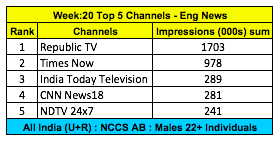
  • It’s an encore for Republic TV in Week 20! 1.74x of Times Now

    By A Correspondent

    The BARC Week 20 numbers for various channels have been published. Week 20 = May 13 to 19. And this is how it looks for English news channels:


    However, on the evening of March 18 when some of the English news channels regressively pulled out of BARC ratings. This was done at the behest of the News Broadcasters Association, the apex body of news channels which is recognised by the government.

    Hence the ratings above are for seven days of Republic TV and a little less that six of some others.

    It may be noted that for Week 21 of BARC ratings which is due out next Thursday, the numbers of the English news channels that have pulled out of BARC watermarking will not be available.

  • Chintamani Rao: NBA vs Republic TV – Pot calling the kettle…?

    Apart from being a former Chairman of BARC, Chintamani Rao has been a veteran mediaperson – working in advertising for many, many years (37!) and later in the news broadcasting (six years) as also a stint at RK Swamy Media after which he based himself in Delhi NCR as strategy and media consultant. This article first appeared in The Hoot, and we are republishing it with permissions as part of our continuing coverage of English news channels boycott of BARC ratings. Read on

    It was inevitable. It was only a question of who would be first to pull the trigger, and when.

    Two years ago, almost to the day, I raised the red flag – even before BARC started publishing data. Asked in a Q&A with The Hoot about the watermarking technology to be deployed by BARC, I had said (in part) the problem with it is that the broadcaster controls the switch. If you’re disgruntled and don’t want your channel to be measured you can simply stop watermarking, and the system will not be able to read your channel. That will distort the picture, and a major network doing that could hold the whole system to ransom.

    Last week it happened. All English news channels turned off watermarking, and with that BARC’s ability to measure and report their viewership. All except Republic, that is, which was the cause of the action. The other English news broadcasters want BARC, or someone, to take action against Republic for multiple placement of the channel on distribution networks – having multiple LCNs, as it is termed.

    Let’s rewind a bit.


    “He that is without sin among you…”

    As Republic was gearing up for launch the word went round in the business that it had acquired multiple LCNs on several distribution networks. Perturbed, the News Broadcasters Association (NBA), of which Republic is not a member, wrote to BARC not to report its data. NBA also complained to TRAI.

    Republic went on air on Saturday, 6th May. (Saturday is a good day to launch, because BARC’s reporting week is Saturday-Friday and you get a full week of data from your very first week. Data for the week are published on the following Thursday.) Accordingly, data for Week 19 (6th to 12th May) were published on 18th May – and all hell broke loose.

    Republic was reported to have had, in its very first week, a 51% share of viewership of English news channels. Unthinkable, and unacceptable.

    Times Now, long the undisputed leader in English news, had been widely expected to crash when Arnab Goswami quit. Everyone watched keenly but  week after week it remained no. 1, to the utter surprise and frustration of its competition. Then Goswami came back on air, now as the face of Republic, and – lo! – promptly that channel appeared on top while Times Now slid to second place. Worse, the viewership of Republic was 80% higher than that of Times Now, and twice that of the next three combined. No ifs and buts: Republic was it.


    “Yes, the same India Today which had done the same thing two years ago, when Healines Today was rebranded and relaunched as India Today.”

    Meanwhile India Today TV also complained, to both BARC and TRAI, about Times Now too engaging in the same practice, of multiple LCNs. Yes, the same India Today which had done the same thing two years ago, when Headlines Today was rebranded and relaunched as India Today. According to a Chrome Data Analytics report at the time India Today TV was on dual frequencies on each of 70 cable networks, giving it an additional 22% reach. At a cost, of course: by some estimates, 50%  over its normal carriage fee.
    Nor were they shy about what they had done. Ashsih Bagga, CEO of India Today Group, was quoted commenting on it, and expressing his delight with the outcome in viewership and market share. Alas, the glory was shorlived: the channel was no. 1 for one week, before dropping back to its usual place in the pecking order. An expensive, if happy, week.

    Times Now did not deny India Today’s charge, only justified it as a “defensive manouvre”.


    “BARC chose to do nothing about either complaint – NBA’s against Republic or India Today’s against Times Now – and for very good reason.”

    BARC chose to do nothing about either complaint – NBA’s against Republic or India Today’s against Times Now – and for very good reason. They said they were aware of broadcasters engaging in this practice in the past too, and took the position that they “… measure viewership of channels basis their unique Watermark ID, irrespective of the platform the channel is available on or the number of instances within the platform.” And, quite rightly, that “BARC India is not the regulatory body for resolving issues concerning multiplicity of LCNs for a channel.” Unexceptionable, on both counts.
    In fact BARC’s policy already states that, “Regulatory issues pertaining to this, if any, would lie within the domain of the Ministry of Information & Broadcasting (MIB) and/or Telecom Regulatory Authority of India (TRAI).”

    Reacting to what they saw as BARC’s inaction against Republic, all other English news channels stopped watermarking, thus effectively pulling out of the BARC system and rendering it unable to measure and report English news viewership at all.

    Now it is reported that TRAI will conduct an enquiry. Into what and to what end remains to be seen.


    Heads, they win; tails, we lose

    Matters are now rather interestingly poised. For all the sound and fury the anchors display on their nightly shows, English news is a very tiny genre in the overall context of Indian TV: less than 0.1% of total TV viewership. Even within the news category itself all of English news is only about 8% of the leading Hindi news channel, Aaj Tak – which itslelf is only about 9% of the leading Hindi GEC, Star Plus.

    So what does that imply for the current impasse?

    The most important reason for audience measurment is for advertisers  to know where to put their money. If the channel or the genre is important enough they manage without data because they cannot afford to miss the audience it delivers. That is what they did during the painful period of transition from TAM to BARC: they bought on the basis of old data.

    In this case, though, it’s not just the absence of current data: the whole category has been disrupted. Data up to Week 18 does not feature Republic, while data with Republic is available only for Week 19 and cannot be comapared with earlier weeks. So there is, in effect, no data at all.

    Nor is English news is central to any advertiser’s plans: it is just too tiny. There is probably not a single media plan in the country which would be disrupted in its absence. That is not to say that advertising on English news is useless: just that it’s not essential. And what it adds to a media plan – frequency, impact and delivering a focused audience – it does at a relatively high cost, getting as it does 22-25% of what advertisers spend on news channels for delivering a tiny fraction of the news audience.

    The affected broadcasters are caught in a cleft stick. Unless a knight in shining armour – the government, TRAI or the courts – charges in to their rescue, they have two choices: make some face-saving gesture, get back in, and risk having the Week 19 kind of data again; or stay out and risk advertisers pulling out in the absence of data. While they have acted as a subset of the NBA all of them are also members of the IBF, the biggest shareholder in BARC, and a couple of them are on its board. What they do have going for them is of course the clout of the news media, which can often induce matters to take an unpredictable turn.

    BARC, on the other hand, is not immediately affected. The largest part of its revenue comes from broadcasters, and of about 900 TV channels in India only 6 are in English news. Their broadcasters cannot afford to pull out of BARC fully because all of them have other channels, for whcih they need the data.

    BARC’s other source of revenue is media agencies, on behalf of advertisers, who can afford not to buy English news. This means the absence of data on English news will not materially affect the value and usefulness of BARC data to its subscribers, and therefore will not affect BARC.

    If TRAI does uphold the complaint against Republic and orders it to operate on a single LCN, it is highly unlikely that the broadcaster will snap to attention and comply: they are bound to fight any adverse ruling through all the appelate processes available to them. In other words, whatever Republic is doing or has done is not going to change in a hurry.

    For the present, then, BARC is safe, advertisers are unaffected, and it is the English news channels which have something to think about: they got themselves into this situation and they have to dig themselves out of it.


    But that is only for the present

    What this standoff has done is to expose the weaknesses of the system, the better to be exploited by those better placed to do so.

    First, that BARC can be held to ransom. This time it has been challenged by a small genre that does not materially affect it or its other stakeholders, but what’s been done once can be done again: next time by a single broadcaster or a group of them whose absence is keenly felt and forces BARC to the negotiating table.

    Second, the practice of multiple LCNs is out in the open. It’s not financially viable on an ongoing basis but is a useful way to get a temporary blip in ratings for the launch of a new show, for example. It distorts the data but BARC will – even if rightly – do nothing about it. So, unless there a law or a court ruling to prevent it, it’s here to stay.

    The advantage of a system run by a vendor – like TAM – is that the vendor has no role in the business except to provide data. They are answerable to the industry  and the survival of the system depends on their being able to keep the stakeholders satisfied.

    On the other hand, the problem with an industry-owned and –driven system like BARC is that the players have interdependent relationships outside of the measurment system and have conflicting stakes in the business. Worse, in the case of BARC the ones being measured not only control the system, but also individually have the power to opt out of it at will. That cannot be a sustainable situation.

    BARC as an entity is not responsible for the shenanigans of broadcasters, but those very broadcasters own (60 per cent of it) and drive it. They are the plaintiff, judge and jury. Unless it finds a solution outside the judicial system in which affected parties – which would most often be the constituents of its own shareholders – can approach an objective, independent body of third-party experts, the audience measurment ecosystem can look forward to the proverbial interesting times.


    Chinatamani Rao is a Strategic Marketing and Media Consultant living in New Delhi NCR. He is a former Chairman of BARC and has served on the IBF and NBA Boards.  He has headed Times Global Broadcasting and India TV as also RK Swamy Media Group, MAA Bozell, McCann after spending nearly 11 years at Ogilvy as Executive Director and earlier as Associate Director at Lintas for six years. He is a PGDBM from XLRI and graduated from St Stephen’s College, Delhi


    This article first appeared in The Hoot at http://www.thehoot.org/media-watch/media-business/nba-vs-republic-tv-pot-calling-the-kettle-10106. Republished with permission form the publisher and the writer. 

  • BARC mulls debarring networks of all channels who have pulled out (for 6-12 months)

    By A Correspondent

    In what can have very far-reaching repercussions in the media ecosystem, it is learnt that BARC (short for Broadcast Audience Research Council) is mulling the exercise of a significant clause in its bilateral agreement with members.


    The clause reads:

    Neither SUBSCRIBER, nor its employee, agent, contractor or any person shall switch off the Watermark at any point in time during the Term. In the event the Watermark is swiched off by SUBSCRIBER, BARC shall be entitled to forthwith deactivate SUBSCRIBER’S Login, Remote Login for period of 6 to 12 months, to be determined by BARC in its sole discretion, and SUBSCRIBER shall not be entitled to access the Licensed Data in any manner whatsoever.


    Despite repeated attempts, BARC CEO Partho Dasgupta was unavailable for comment. However, according to the information provided to MxMIndia by a broadcaster, this agreement has been signed by all broadcasters with BARC.


    Now where this gets tricky is if the subscriber and remote login are the same for the entire network. This means that by doing this channels belonging to a network – some of them in leadership positions and making a lot more revenue than the channels that are pulling out – will get majorly affected. We cannot name names because some sensitive souls may initiate legal action but assume Network Q has channels E H and B. E is English, H is Hindi and B is Business. Now if H and B are the cash cows, and the problem is actually with E which has pulled out, the network loses the ratings for the Channel H and B too.


    This may very adversely impact the business and erode shareholder value of the channel.


    When MxM spoke to another broadcaster, he told us that this may well be BARC flexing its muscles. But according to information, there is a section of BARC subscribers who are determined to teach the erring channels a lesson and may prevail upon BARC to administer this.


    “If BARC doesn’t debar them, we may have to initiate action against it for not administering the rule as it ought to,” we were told.

  • Hang your heads in shame, NBA Board!


    By Pradyuman Maheshwari

    The News Broadcasters Association has some really big industry folk on its managing committee… the Board of Directors as they call it.

    At a personal level, they are all achievers, and I respect them. Click here for the list. Now, let me first say very unequivocally: I hold no brief for Republic TV. I must confess I am not really a huge admirer of the Arnab Goswami school of journalism. MxMIndia – with our Consulting Editor Ranjona Banerji chiefly and myself – has damned his shows enough when he was on Times Now.

    But that’s my – or our – personal view. We believe it’s a free world, and if he does transgress – as in, cross the line, there are enough forces – political, business and legal to correct him. For the now, the masses are lapping him up. He’s the voice of the new Indian.

    The fact of the matter is that the Arnab Goswami brand of news television has worked wonders. And this not just in terms of viewership or ratings, but also with those with the monies. Republic TV’s list of benefactors tells the story.

    So when he decided to start his own channel, there were worrylines all over. Here was a man who could rewrite the rules of the business if he has enough staying power – moneywise.

    Remember just having a credible, independent voice is not enough. If that was the case, MxMIndia would’ve been super-super-successful revenue-wise. But that’s not the case, we don’t aggressively solicity advertising. We just nudge. Those who believe in us, back us.

    But this is not our story. This is the story of an industry association leadership that must indeed hang its heads in shame.

    Or perhaps wear bangles, like this:


    Gosh, have we gone too far… bahut ho gaya?

    Nahin. Nooooo. Do you recall the disrobing of Draupadi in the Mahabharata? What happened on Thursday evening is something as bad as that.

    Or let’s look at another example. We all know that the examination-oriented system of education has major problems. We also know that papers leak. We also know that kids cheat. But do we just exit the system screaming “Screw it!”. Will a school or a parents’ association advise students not to take their exams because the Class 10 or 12 exams are a sham?

    Well, we can exit the education system. It’s possible to flourish without the degree or certificate. But you’ll need to figure how the world will assess you.

    I am not convinced that the News Broadcasters Association – which is headed by some very discerning names – could be buckling under pressure from some members who perceive Republic TV as competition.

    If it genuinely felt aggrieved, there were other things that NBA could do. Like when it realised that BARC was going to go ahead with the release of ratings, if it felt it had a genuine case, it could’ve approached an appropriate Court of law (and not the Courts set up by some of our anchors across various channels) and urged for a stay!

    Why didn’t it do that?

    Why doesn’t the NBA issue a diktat to all its members asking them to not go in for any ratings-boosting activity like dual LCNs, landing pages/slotsetc?

    As I write this, I am aware that some advertisers are reconsidering their advertising on the English news channels. They may threaten a pull-out very soon. And much as I would like every media entity to flourish, the English news channels who have pulled out of BARC ratings need to see reason. Or be shown the stick.


    Here’s what needs to be done:

    1. The NBA must reverse the advisory to its English news channels to pull out of BARC

    2. The English news channels must get the watermarking back

    3. The NBA, ISA and AAAI must convene a special meeting – which may be convened by the CEO of a network/channel who has no skin in the game – like NP Singh of Sony Pictures or any other respected industryperson like, say, Sameer Nair (now CEO of Balaji). Note I have not mentioned the names of Star India Uday Shankar because he is a former news television CEO. Also the Zee and Viacom18 heads have sibling channels in the news business.

    4. All broadcasters must take a joint decision on the issue of dual LCNs, landing slots

    5. The AAAI must be urged to only deal with channels/entities that are affiliated to the IBF or NBA, so that it will ensure that all channels toe the IBF/NBA line

    6. All advertisers on television channels (Patanjali included) should be convinced to become ISA members to ensure that the rules are followed. Similarly, broadcasters should only deal with AAAI-membered agencies.

    7. IBF and NBA must admit members provisionally without any delay, on clearance of cheque/RTGS/NEFT etc

    8. Since NBA has limited number of members, and there can always be charges that all the channels can gang up against a new entity, there should be a recourse available to an aggrieved member to go to a joint committee of the IBF, NBA, AAAI and ISA which may be set up

    9. Meanwhile, BARC must set up a clear deterrent as a rule that if any channel decides to opt out of its ratings, it will not be allowed to return for a period of one year or payment of Rs10-25 crore or some such

    10. IBF and NBA must ensure that the BARC advisory/guideline on channels advertising is followed strictly. Those who are repeated defaulters should be penalised in the form of a lower payout of advertising monies on the channel. And eventual debarring of payment.


    All of the above needs to be actioned before the Week 20 BARC numbers are released.


    Pradyuman Maheshwari is Editor-in-Chief, MxMIndia. The views expressed here are his own


  • And now, India Today complains to TRAI & BARC on Times Now using multiple LCNs; Times Now says it did it in self-defence

    By A Correspondent [updated]


    Even as English news channels got together on Republic’s ratings, India Today has complained to TRAI and BARC on Times Now also choosing to be piped out via multiple LCNs.

    According to documents in the possession of MxMIndia, India Today has been very scathing in its complaint on Times Now. It has in fact even urged BARC, to stop publishing data for Times Now with immediate effect.

    The development has got some industry seniors to wonder why the two channels – India Today and Times Now – who have joined hands to fight Republic are now fighting each other. Or at least India Today is fighting Times Now.

    When asked to comment on the India Today complaint, this is what a Times Now spokesperson told us (via mail): “Times Now did a defensive manoeuvre. We have never been an advocate of multiple LCNs and have NOT run our channel that way till last week. In fact we have been an affected party more than once and raised this issue at various levels. It was only after a desperate and aggressive move was made by Republic TV on the ground that we upped the ante in self – defence. As part of NBA, and as a responsible brand, we endorse strict action against such destructive and diversionary tactics. Times Now is NOT playing on multiple LCNs anywhere in the country as of now. The impressions of week 19, including our own are tainted and not dependable due to this reason and we had joined the NBA in raising it to BARC earlier this week.”

    However, according to unverified information received by MxMIndia, Times Now is reported  to have taken up dual LCNs… around the time of the launch of India Today channel and also the UP elections.

  • Future Shock?! Channels opting out of BARC could lose ad revenue


    By A Correspondent [updated thrice, last update: Saturday, May 20]

    The decision of certain English news channels to opt out of BARC measurement could lead to a huge negative fall-out. The channels which do it stand a chance of advertisers renegotiating their deals and even stopping advertising forthwith.

    MxMIndia spoke to a cross-section of the community, and they believe the decision is regressive and could set the advertising clock back for news channels irreparably. Earlier in the week, News Broadcasting Association (NBA) complained to the TRAI about Republic TV’s alleged usage of multiple LCNs for distribution. It later appealed to BARC, urging it to not release data for English news channels pending the verdict from TRAI. And when BARC chose to release the data yesterday (Thursday), the association secretary general sent a mail to BARC CEO Partho Dasgupta as per an Economic Times report. The mail noted: “Given your indifference to the serious situation at hand, we are left with no option but to advise some of our aggrieved members to opt out of BARC’s watermarking system with immediate effect until there is appropriate redressal of our grievance.“

    A reference was made to how print advertising has gone down in the absence of a currency (IRS) over the last two years. “While the advertising for English nosedived, regional is still holding fort,” a senior industryperson told MxM, hours after the news of the NBA’s surprise mail to BARC was shared with select media.

    Shashi Sinha, CEO of IPG Mediabrands and Chairman of the BARC technical committee, was visibly upset with the development. “I don’t know what the hoopla is all about,” he said, adding: “Everyone has done it on different occasions – around their launch or on special days. If at all anyone has not done it, it’s NDTV,” he said.

    Another senior industryperson told MxMIndia that if the English news channels were so aggrieved, they should have opted out of BARC measurement before the data was released. “Now the world knows that Republic TV is ahead of all others, and there has been enough noise about it on the channel and in terms of advertising on other media,” she said.

    And how will media agencies react to the decision? A senior buyer who requested on anonymity as he is not authorised to speak said that if it’s a one- or two-day gimmick, it’s fine. But if it continues, there’s a problem as there is a lot of accountability in terms of deliverables. So if there is no viewership data, advertising may exit from channels who are not able to supply data.

    Industry captains we spoke with also dismiss the decision to look at multiple distribution points (LCNs) as a marketing tactic around launches or induce sampling. “After a few days or weeks, the real picture shows up, and this is what the aggrieved channels ought to have done.”

    Meanwhile, from the BARC India point of view, it has a steady policy on the matter, we were told. And this has been displayed on the measurement body’s website.
    http://www.barcindia.co.in/resources/pdf/Policy%20for%20Measuring%20Viewership%20of%20Channels%20Available%20on%
    20Multiple%20Frequencies-%20Sept%202016.pdf

    On previous occasions too – when a channel has relaunched, or done a special campaign around the UP elections or around the Union Budget, BARC has reported the data in its entirety. However many be the distribution points.

    BARC has been consistent, a senior industryperson told us. But networks haven’t been so. For instance, while a leading business news channel chose the multiple LCN route around the Union Budget this year, it has now opted out of BARC ratings for its general news channel. A case of double standards, perhaps.

    Meanwhile, BARC has issued a statement (Friday, May 20, 5.20pm). Here goes:

    “BARC India was set up with the mandate to measure What India Watches, and our measurement system delivers exactly that.

    We have a transparent policy on the matter of measuring channels, (which is available on our website http://bit.ly/2dllmIp). This policy has been consistently applied to all channels who subscribe to our measurement.

    The fact is that this is a common distribution strategy among various TV channels, particularly News Broadcasters, to place their channels on multiple LCNs and across genres in the past, and they continue to do so even now.

    Based on information collected from various monitoring agencies we have seen that multiple English news channels on different occasions have placed themselves on multiple LCNs viz across 64 distribution networks during rebranding/revamp, across 16 networks during budget coverage, across 12 networks during UP elections etc. It has become a usual practice.

    We are clear about our position – we measure viewership of channels basis their unique Watermark ID, irrespective of the platform the channel is available on or the number of instances within the platform. For channels having same watermark on more than one LCN, viewership gets aggregated and reported as a single channel and not multiple channels. BARC India neither monitors channel placements across the various DTH platforms/cable head-ends in the country, nor does it have the mandate to do so.

    In the past, we have measured multiple LCN instances of channels as per our policy, and reported them as one channel and the same principle has been applied to our data released yesterday. BARC India is not the regulatory body for resolving issues concerning multiplicity of LCNs for a channel.

    Ideally these issues should be sorted among broadcasters themselves rather than dragging BARC India into these.

    BARC India will continue to measure what India watches.”

    MxMIndia also spoke with Nakul Chopra, senior industryperson and President of the Advertising Association Agencies of India, the apex body of advertising agencies in the country, and this is what he said: “It’s one industry. Differences will always be there. It’s better to let things settle down, take a deep break and let sanity prevail. Having said that we are a 100% behind BARC and what  BARC has said in its statement.”  When asked on what the AAAI advice would be to member-agencies on the decision to advertise on channels that have pulled out of BARC measurement, Chopra said: “We are discussing amongst ourselves and with the ISA (the Indian Society of Advertisers) and will give our formal response very soon.” Any timeframe, we asked. “Next week,” he said.

    And this is what Sunil Kataria, President, Indian Society of Advertisers, the apex body of advertisers: “Any advertiser wants to put money behind TV media which delivers audience viewership and that metric is available through TV ratings. Hence TV ratings are the sole metric for making advertising spend decisions. BARC has already issued a statement on their policy of measuring what India watches and  hence measuring the viewership as per their stated policy. We are closely monitoring the situation and hope the issue gets resolved. In the meanwhile, we are also in talks with AAAI and would come with our formal statement next week .”


  • Republic TV trounces Times Now to be #1 in debut week


    By A Correspondent

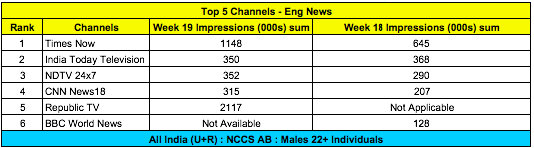
    The all-important BARCIndia numbers for Week 19 are out. BARC, short for Broadcast Audience Research Council, the joint industry body that measures television audiences in India, has released its data for Week 19 that’s May 6 to 12.

    It may be remembered, Republic launched on May 6, the first day of Week 19. So it was a ratings-friendly launch, and with a bang given ‘super-exclusives’ every day.

    Note, we normally do not like to report on the ratings of just one week, so it would be incorrect to say that Republic TV is the new #1 English News Channel. That statement is best made after numbers for four straight weeks are out. However, it would be right to say that Republic TV has trounced Times Now to be the #1 in Week 19.

    Interestingly, if you look at the table above, the impressions for Times Now have also leapfrogged, and so have the number for CNN-News18 and NDTV 24×7.

    The numbers of course are thanks to the until-so-far-not illegal way of making use of distribution dynamics which allows for multiple distribution points by way of negotiations with the last mile.

    Said Arnab Goswami, Founder, Republic TV:  “I feel blessed with the love, support and the massive viewership that Republic TV has received. It reaffirms my faith that people watch what they find credible. I am deeply grateful to the people of this country for making Republic TV, the No. 1 news channel in India.”

    Added Vikas Khanchandani, CEO, Republic TV said, “We attribute our success and the channel’s credibility, strong line-up of experienced journalists led by fantastic leader and managing editor. Our cohesive & motivated team has worked tirelessly to get us here. Content is king and differentiated content is God and Republic has managed to connect with audiences across age profiles which differentiates us from all the rest in the genre.”