Here’s BARC data for Week 39 (Sept 26-Oct 2, 2015)for general entertainment channels and and more!


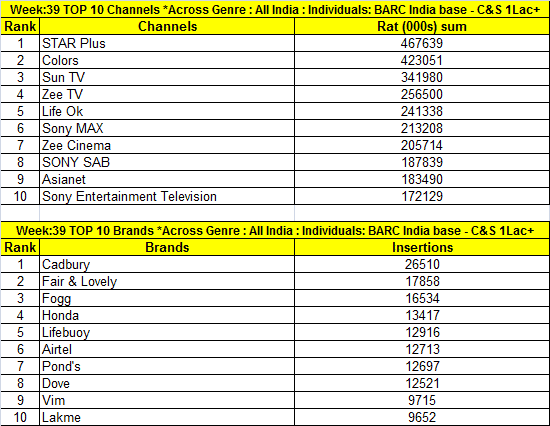
Here’s BARC data for Week 39 (Sept 26-Oct 2, 2015)for general entertainment channels and and more!

Rural Ratings Delayed, But Are Broadcasters Rural-Ready? By Shailesh Kapoor By Shailesh Kapoor
The delay in the release of the rural ratings has been a topic of chatter in the broadcasting corridors over the last fortnight. Since a definitive date was announced, the delay has led to speculations, even rumors, including some that are imaginative and absurd in equal measure.
Over the last year, since it became evident that rural ratings will be a part of their lives sooner than later, broadcasters have spent considerable resources in becoming “rural-readyâ€. The main area of focus has understandably been distribution. The other emphasis has been on consumer research. Having studied LC1 consumers extensively over the last few years, rural research is not entirely alien territory for broadcasters.
But is that all that’s there to being rural-ready? Distribution is an enabler and consumer research is an input into programming and marketing. Hence, unless the rural-readiness reflects in content and brand strategies, it is not in place in real terms.
That raises the pertinent question: Has anything changed on-air? Besides some of the GECs extending their primetime to ensure an early start (5pm/ 6pm), no other visible change reflects rural-readiness on-air. If anything, some changes have been a bit “anti-rural†in nature. A sizeable proportion of new launches over the last year are urban-skewed in their theme and treatment. It is evident they will lack rural traction.
Stereotyping problems have continued, such as assumption that non-fiction viewers would rather read English than Hindi. Presentation language, as a result, continue to be inconsistent on-air, not just for GECs but even for movie channels. Liberal usage of English mars comprehension of several shows, including some fiction ones, even in the urban centers, and this has not changed either.
The approach seems to be that of ‘be ready and then wait-and-watch’. The first ratings, whenever they are out, will mean a shift of gears. With channel and programme level data available to act upon, and the weekly clock ticking by, it would be time to act on high priority. All the rural research reports, from studies conducted in late 2014 and early 2015, will then come in handy.
The genres that are likely to be least impacted from a content perspective are news and kids. Though both of them may lose overall TV viewing share in rural, like most other non-GEC genres, their rural content profile is likely to be similar to the bigger urban centers. A few other genres, especially infotainment and music, will have to take decisionson whether they want to invest resources in the rural markets at all.
All this shall unfold when the rural ratings are released. Till then, the question of why they did not release on schedule, and what the new date is, will continue to keep us busy.
|
So what’s delaying BARC’s rural ratings?By A Correspondent
The much-awaited release of rural ratings data from Broadcast Audience Research Council (BARC), the joint industry body mandated by broadcasters, advertisers and advertising agencies to measure television audiences looks likely to be delayed.
According to sources, broadcasters body Indian Broadcasting Foundation of which Star India CEO Uday Shankar is President, has written to the BARC board asking for the rural data to be delayed. The reason: there is need to let the current the data stabilise given some complaints of volatility. BARC started releasing its data from end-April 2015.
BARC was scheduled to release the rural data by end-September and conducted road shows across major centres (Disclosure: MxMIndia had partnered the promotion of these roadshows).
However, according to industry grapevine, there is more to the delay than the reason to stabilise. Sources have told MxMIndia that certain members of the ecosystem are dismayed with the delay and have questioned whether a leading channel whose ratings have been put to test by competition is behind the effort to delay the rural release.
According to information we have received, Doordarshan officials are unhappy with the delay, and it is felt that if BARC pushes the release of rural data indefinitely, the I&B ministry may also step in.
The BARC Board is scheduled to meet next week and will possibly deliberate on the issue.
|
 By Indrani Sen
In his recent digital pitch with media bosses in New York, our Prime Minister claimed that unlike manufacturing, in the world of media, India is almost as evolved as any other country. Does his observation hold good for our print industry on which the sun continues to shine? The print majors are basking in the comfort of the findings of FICCI-KPMG and other such industry reports which are predicting growth, but a comparison of the CAGR percentages projected over the years reflects erosion.
| Projections of Print CAGR | CAGR 2011 to 2015 | CAGR 2011 to 2016 | CAGR 2012 to 2017 | CAGR 2013 to 2018 | CAGR 2014 to 2019 | |
| Total Print Market |
10% |
9.10% |
8.70% |
9% |
8% |
|
| Source: FICCI-KPMG Reports |
2011 |
2012 |
2013 |
2014 |
2015 |
|
So, it is obvious that slowly but steadily the global trends have started to creep into Indian print industry. Accelerated penetration of mobiles in smaller towns and rural areas will support the growth of digital and social media and may result in faster erosion of CAGR in the print market and the CAGR 2020 to 2025 may come down drastically.
Instead of strengthening their arsenal with readership currency for protecting their share in the total advertising revenue, currently the Indian print industry seems to have taken up a negative stance against the IRS. Agreeably, many publications had genuine grievances against the findings of IRS 2013, but that should not be a legitimate reason for withdrawing their support from the readership survey. When the TV Industry has got a brand new currency from BARC which uses superior technology than its predecessor, the print Industry needs to rally around MRUC to ensure that IRS can also claim similar upgradation by introducing improved methodology.
In a large scale ongoing quantitative survey, teething problems and relative errors are quite normal. Perhaps the magnitude of the errors in IRS 2013 crossed the tolerance level of some print majors, but they should recollect that initially NRS findings also had many issues which got corrected over the years. We saw emergence of MRUC and IRS as a protest against the methodology and findings of NRS and subsequently the merger of the two surveys. We are witnessing now a dark period of three years in print currency as IRS 2013 was rejected by the print Industry, IRS 2014 (based only on fieldwork of one quarter) has not been taken seriously by the advertisers and agencies, and the field work for IRS 2015 has not yet commenced. In a developed country, such a gap in a media currency is unheard of. The sooner all the stakeholders of MRUC resolve their differences and kickstart the field work, the better it would be for second and third line publications who are likely to suffer more due to lack of readership data. The media planners and buyers cannot determine the incremental reach/ OTS/ CPT for adding more than one publication in the plan and are likely to limit their print campaigns to only the established market leaders.
Indian newspapers need to take up two challenges at two ends of the audience market. Firstly, they must try to reduce the gap between the literate population and the number of newspaper readers. Secondly, they must improve and promote their web editions and convert the internet savvy Indians to online readers. The concept of “Integrated Newsroomâ€, which is being advocated by many researchers and industry observers, is essential for achieving these two diverse tasks.
According to IRS 2012, approximately 44 percent of literate Indians do not read any newspaper. This average percentage decreases as one climbs up the SEC ladder and increases in small towns and rural areas. It is obvious that the current combination of regional, national and international news dished out by most newspapers is not acceptable reading material by a large chunk of Indian population. Special, smaller editions with more emphasis on hyper-local news may be more acceptable in the small towns and rural areas.
Most Indian newspapers have launched their e-editions, but there is lack of efforts in promoting as well as making them user friendly and interactive, perhaps due to the apprehension that the growth of online readership will cannibalize readership of the hard copies. There is a huge scope of growth for web editions of regional newspapers if they plan to ride on the growth of computer literacy in secondary schools in small towns and villages. Innovative marketing tie-ups with mobile manufacturers and service providers can increase the initial trial and subsequent conversion rate of the e-editions.
In this connection, it will be pertinent to note the new trends in readership surveys in developed countries, particularly in UK, as we have traditionally followed the example of UK for setting up our media infrastructure, media regulations, etc. In the 1970s, Indian National Readership Survey was also modeled largely on the Readership Survey of UK. NRS PADD was introduced in UK in September2012 to provide a unique measure of combined print and online audiences to cater to the demand of a dynamic and changing digital media age. It is a fusion of data by RSMB from two independent surveys, print readership survey by Ipsos MORI and comScore digital survey. It provides a single database for planning across print and digital platforms of NRS publisher brands. (Source: http://www.nrs.co.uk). Apart from full NRS demographic and classification data for profiling and targeting, the NRS PADD provides the unduplicated reach of a print publication and its website, duplication of print titles and websites – which websites do a publication’s readers visit, and vice versa. NRS PADD: Mobile was launched in September 2014. The future lies in combining readership research across the print and digital platforms. The opinion leaders in the print Industry must realise that the digital trends are irreversible and steer the industry in that direction.
The Global Media Report 2014 by Mckinsey & Co. predicted “Digital advertising is becoming a dominant force in the global media advertising market. Excluding the online and mobile components of TV advertising, in 2017 digital advertising will overtake TV, which for decades has been the largest advertising medium……….We project digital advertising to continue to increase at double-digit rates, growing 15.1 percent compounded annually to 2018 and accounting for 65 percent of the total increase in global advertising over the next five years. Most of that gain will come as advertisers substitute away from print media.†In India, the above trends are not likely to set in before at least another 5 years. Indian Print Industry needs to utilise this time period from 2016 to 2020 for protecting their future by ensuring immediate availability of print media currency, developing and promoting the websites and last but not the least, effectively converting more literates into readers.
Indrani Sen is a veteran media agency and marketing services professional. She is currently an Independent Consultant and Adjunct Faculty, Media Management at Symbiosis Institute of Media & Communication, Pune. This column will appear fortnightly. The views expressed here are her own.
By Indrani Sen
The Broadcast Audience Research Council (BARC) has churned the ocean of Indian TV audience and has found the nectar of rural market reach for our marketing and advertising industry. Startling trends about urban plus rural combined TV Audience Measurement, based on data collected over 22 to 31 weeks, were revealed at the BARC Road Show in Mumbai on September 7. Adding of Bharat (rural) to India (urban) in the survey has increased the average daily reach of TV by 3 times to a whopping 450 million!
The 30-minute total (urban +rural) gross impressions is 19.5 billion with urban share of 10.6 billion. Rural India has clocked 8.8 billion impressions against 7.7 billion clocked by 1 lakh+ C&S towns in urban!! Moreover, rural rat (number of individuals in 000s of a target audience who viewed an “event†on TV, averaged across minutes) contributes more than 50% in some large regional demographics – AP/TL 53%, RAJ 54%, UP 55% and PHCHP 59%. In the Hindi Speaking Markets (HSM) all states have 50%+ rural rat except MP and JH. In Western India, both MH and GUJ have rat shares tilted towards urban (64% in each state). In Southern India, rural rat ranges from Kerala 45% to TN 46% to KAR 48% to AP/TL 53%. Eastern India is divided into two pockets with three states (Assam &NE, Bihar and Odisha) having 50% + rural rat and the other two states (WB and JH) having around 40% rural rat.
Among the highlights of the findings presented by BARC at the Road Show, rural rat shares of 41% in Hindi Movie genre and 45% in Hindi GECs genre were expected after viewing the shares across the states. The real shocker to the audience at Nehru Centre was 45% share of rural rat in English Entertainment genre! In the post-IPL weeks (22 to 31 weeks) 48% rural rat in Sports genre also came as a surprise. Among the various language news genres, rural rat of Hindi is 37% , followed by Tamil 38%, Telegu 42%, Kanada 45% and Malayalam 48%. Rural rat of Marathi and Bengali news genres have scored respectively 34% and 31%. With poor penetration of newspapers in rural India, it is disappointing to note that the rural rat is not showing higher share in the regional news genre. Kerala stands out as an exception with high rural penetration of Malayalam newspapers as well as Malayalam news channels.
The advertising industry will have to sacrifice reports for ‘Below 1 lakh’ towns in order to get the rural data as BARC will report the all=India TV ratings by four pop strata, ie. Mega cities, 10 to 75 lakh towns, Below 10 lakh urban areas and rural. Currently, out of 22,000 BARC meters, 16,000 are deployed in urban and 6,000 in rural areas covering population in 1000+ villages. The ratio is opposite of the ratio of number of people/ households in urban and rural India.  Census 2011 over Census 2001 showed a 75% growth in proportion of TV HHs in rural India. BARC has reported 153.5 million TV HHs, of which 77.5 million (50.5%) are in urban and 76.0 million (49.5%) are in rural. As mentioned before, 8.8 billion (45%) of half-hour impressions are coming from the rural sector. It may not be long before the industry urges BARC for reviewing the distribution of meters across urban and rural India and increasing the proportion of meters in rural India.
For some time,we have seen the writing on the wall about the growth in our rural market potential as reported by many independent market surveys and realised by marketers from their own sales reports. BARC quoted some such findings in its presentation to lay the foundation for its discovery. Yes, it is a discovery as these findings will now help our marketing and advertising industry to reach the rural audience effectively through a mass media for the first time, delivering numbers which print can not deliver. Marketers will put on their thinking caps and rewrite their media briefs, plan for better distribution channels in rural India as well as logistics for reaching out faster to the rural consumers. The TV industry will rethink its programming strategies with a large chunk of viewers following the “early to bed and early to rise†policy and spending 41 minutes less time daily on viewing TV than their urban counterparts. As the combined BARC Ratings roll out on a week-to-week basis, TV programmes will also start rolling across timebands/slots trying to balance between the viewing preferences of urban and rural viewers. The ranking of the TV channels by genres may also see some ups and downs as channels struggle to understand the viewing habits of Bharat v/s India. With Rural TV Ratings becoming a reality, media agencies and media channels will engage in qualitative research to understand the TV viewership habits and preferences of our rural audience about which we do not have much clue.
The BARC Road Show also covered the formation of the Meter Company (for lack of a given name) and re-confirmed that 12,000 TAM meters will be duly acquired and overlaid on their existing sample structure with TAM having only the responsibility of running the data files from the meters to BARC. Responsibilities for all other functional areas covering from establishment survey to sampling design to processing, validating and publishing of data stay with BARC, which emerges as the sole TV ratings provider. Between the sections on Meter Company and highlights of all India findings, BARC talked about the fidelity in its data which has been noticed during last few months. BARC cited the Nepal earthquake, Dr Abdul Kalam’s demise, the Gurudaspur Terror Attack, etc. as examples for breaking news or topical news which caused immediate spikes in viewership.  It was also pointed out how the absence of celebrity anchors (Kapil Sharma and Arnab Goswami) led to a substantial drop in the ratings of the respective channels (Colors and Times Now). It was interesting to note the presence of Technical Committee stalwarts and senior BARC consultants on the stage during the Q&A session which followed the presentation. However, the questions raised by the audience were more general than technical which did not relate to range of relative errors or comparative stability of data, etc.
Finally, BARC deserves an applause for its performance in delivery of TV ratings and brilliant marketing strategy. During this year,it first released the HH level data in April followed by individual level data in June and now in September it is releasing the all-India level data covering urban and rural. 2015 is not a “Year of the Rat†by the Chinese Zodiac Calendar, but the way rat’000 figures released by BARC have been jumping over the industry from week-to-week, Vanita Kohli Khandekar may perhaps like to describe 2015 as “The Year of BARC RATs†in the next edition of her book The Indian Media Business.
Indrani Sen is a media services veteran, having worked with JWT, later Mindshare and then with Emami. In recent years, she is an independed consultant and academic. She is Adjunct Professor in charge of the Media Management programme at the Symbiosis Institute of Media & Communication, Pune. The views expressed here are her own.

We don’t know whether you would consider this news good or bad.
But here’s a fact: despite all that some of us may say about the Arnabification of television news, he rules the English news space. He dominates cooler conversation and college canteen chatter. His Newshour clearly sets the agenda for what India chats about the night and morning after.
The other day, one overheard this conversation between two professionals on a Mumbai-Bhubaneswar flight. “Arnab dekha. Kya chutney banaya woh guest ka!â€
We now have data to prove that when there’s no Arnab Goswami on Times Now, viewers go elsewhere.
We also requested BARC on looking at how other English news channels fare when Arnab is also absent. Interestingly viewers do move to other channels, though that’s not the case in the Hindi general entertainment channel (GEC) space where the absence of Kapil Sharma may have impacted Colors, but didn’t see other GEC ratings leapfrog.
Go through the slide show. And, yes, Times Now may as well call itself ‘Arnab Now’.
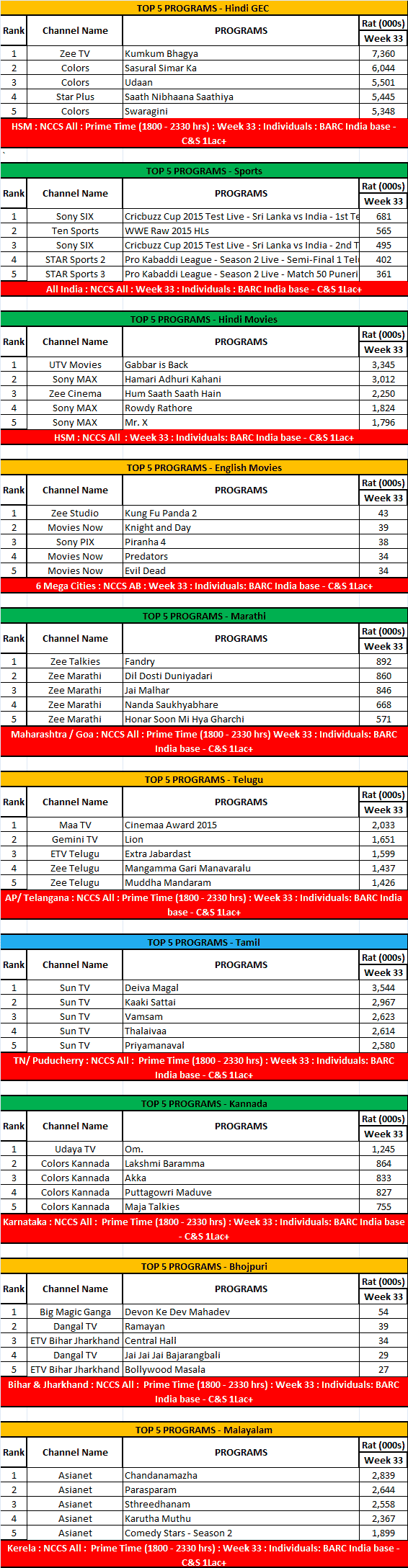
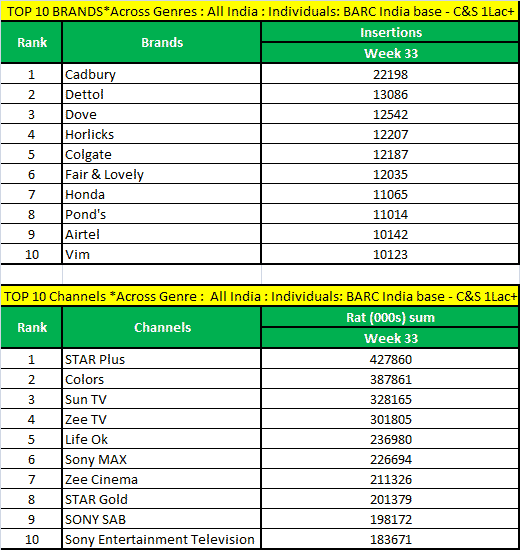
Okay, so after the first one or two weeks of BARC data, we are now bringing you the lowdown on all channels, as provided by the BARC, the joint industry body of key broadcast stakeholders for audience measurement.
We were reluctant initially to provide this as it’s topline data and is available on the BARC website and even via tweets. However, given a request from some channels and our readers, we are presenting these.
In the coming weeks, we hope to be able to provide more information.
Please note that the source is BARC, so it’s official. And we are publishing it as is, there’s no human intervention. You may, if you’d like, also visit Barcindia.co.in to reconfirm the numbers. We would also advise subscribing to the data, if you aren’t doing so already, because it’s only then that you can actually appreciate the viewership data.


By A Correspondent
The evening was organised to celebrate GroupM’s continuing dominance in the country, but there were just two things that were being discussed in not-very-hushed tones at a cocktails hosted by Mark Patterson, APAC CEO of the media services giant.
The first was the INX Media founder Indrani Mukerjea with whom many of adland’s swish set had a muah-muah relationship, and the second was of course something that’s virtually as big a story as a Coca-Cola buying over Thums Up in the 1990s. That BARC has got TAM out of the audience measurement business in India in the form that it has been doing. And not just TAM, but even if it’s co-owners the WPP-owned Kantar Media and Nielsen.
For BARC, it’s a huge win.
1. It ramps up current meter strength of 22,000 to 34,000
2. It kills a huge competitor in TAM
3. Subscribers – channels and media agencies – will now not be able to compare the two systems, as TAM will cease to exist in the audience measurement space
4. Having been around for a while, the TAM system is a well-oiled machinery
5. It’s a no cash deal. Earlier, it was rumoured that TAM wanted Rs 70-odd crore for selling out completely. Now, it emerges that BARC is not paying any dosh upfront. But it needs to share 49 per cent of the spoils on the sourcing of the raw data, which may get diluted as BARC’s boxes increase if Nielsen-Kantar don’t invest more monies
For TAM, it’s not a bad deal
1. It’s an honourable exit
2. Agreed it’s not going to make money upfront, but the 49 per cent (as against Rs 70crore upfront) isn’t a bad sum. The 49 per cent may get diluted to 25-odd per cent if its joint owners don’t put in any more money to grow the number of meters to 50,000
What’s not been spoken about
1. The announcement is following the signing of the term sheet. It’s going to take a minimum of three to four months for things to really happen. Until then it’s business as usual
2. There are some 900-950 people in the PeopleMeter business. While a lot of them will be absorbed in some way by the new company, there may be some who will not be
And the million dollar question
What happens to LV Krishnan?
The new truncated TAM Media is too small an operation for someone like LV Krishnan to run. For, even though he’s young too be called that, but he’s surely the Father of TV Audience Measurement in India though of course some folks like Praveen Tripathi etc were around in the early days (and is now associated with BARC). From what we heard earlier, LV will help in the transition and get absorbed in the Kantar-WPP fold. Or he may well be hired by a broadcaster to help interpret numbers. Or he may set up his own consultancy.
What we do know about LV is that he is not just a fighter, he’s got the endurance. From a record 56 push-ups at MCA Club in Bandra, to loooooong meetings with stakeholders, you’ve got to acknowledge that he is – as of today – the best in the business. He can tire you down, but he seldom gets tired of work.
Back to the GroupM party, it’s ironical that the discussion and the clinking of glasses to celebrate the announcement happened for an organisation which reportedly batted much for TAM in the BARC boardrooms in the early days. Interestingly though it’s after sibling GroupM unsubscribed from TAM that people said BARC has arrived.
PS: MxMIndia has been at the forefront of the coverage on the measurement business. Some of the best interviews given by all stakeholders have been published by us at MxMIndia, including the tearjerker of an interview of LV Krishnan that appeared a day before BARC ratings were launched. We will continue in our coverage. Accurate and fair. Keep the faith!
By A Correspondent
BARC India, the joint industry body formed by broadcasters, advertisers and advertising agencies will acquire the Peoplemeter boxes of TAM India, the television audience measurement joint venture between Kantar Media and Nielsen Kantar. This was announced with the formation of a new meter management company which will run the meter operations and will supply raw data to BARC India. Thus the BARC data will be the sole audience measurement currency in India.
It may be noted that MxMIndia was the first report that BARC was in discussions for the buying out of TAM. Well, the tie-up is not exactly the same, but we will wait to see what happens.
Commenting on the development, Punit Goenka, Chairman of BARC India said, “This partnership is a big step forward and in this era of cooperation, we welcome this move forward as a joint industry body. The technology and methodological prowess of BARC, combined with the extra meters and the field force will definitely help the industry progress.â€
“This new venture represents our organization’s commitment to providing precise and stable data around the world, and draws strengths from both BARC India and TAM India,†commented Steve Hasker, Global President, Nielsen. “We look forward to the great coverage and representation this new partnership will deliver.â€
Eric Salama, CEO of Kantar said: “We are happy to cooperate with BARC India to be able to provide clarity and a large single sample for the industry and to keep India as a key market for us.â€
The meter company will have the meter assets and panel management operations of the present BARC Indiaand TAM India panels,which will be jointly owned by BARC India, Nielsen and Kantar with management control resting with BARC India. Â To start with, the company will have 34,000 meterscovering all of India,and will supply raw data to BARC, which will use its own statistical processes and sampling design.The details of the formation and roll out of this new company will be shared in the coming weeks.
TAM India will continue to provide its non-TV ratings services to the market, notably AdEx – Advertising Expenditure for TV, Print, Radio, RAM – Radio Audience Measurement, Eikona – PR Audit, TAM Sports Measurement and S-Group Consulting.
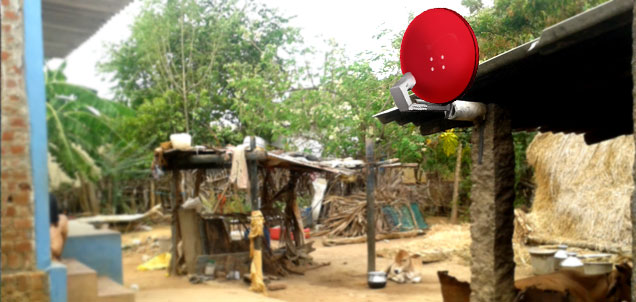
By Shailesh Kapoor
It’s not been long since the official TV ratings of the media industry shifted from TAM to BARC. But BARC has moved ahead at good speed. When it was first announced that BARC will report only 1Lac+ towns data initially, and that urban LC1 (<1Lac) towns and rural will be added later, one was prepared for a long wait.
But it’s good to be pleasantly surprised. As per a recent announcement, we may see urban LC1 and rural data as early as September 2015. Well done, BARC!
Urban LC1 is not unfamiliar territory for broadcasters. TAM started covering this pop stratum in 2013, and broadcasters, especially the mass players, have made considerable investments in distribution, marketing and research in these markets since then. I’m sure BARC would refrain from the nomenclature “LC1â€. I have been told it stands for two different things: Less Than Class 1 (Towns) and 50-100K population towns (L being 50 and C being 100 in Roman numerals). I suspect the former is the more accurate description. But who dreams up names such as “LC1†anyway?
The addition of rural markets, in contrast, is an absolute first. There is no taste of rural ratings from the past, and there’s a mystery box feel to the whole thing. In one of their roadshows, BARC indicated that 50% of the universe would be rural, though the sample would be more skewed towards the more heterogeneous urban markets. We can expect ‘Urban+Rural’ and ‘Urban Only’ data cuts to be available soon.
The inclusion of rural may not impact several genres, including those based on the English language, infotainment, lifestyle, etc. But it could wreak potential havoc for mass channels, read GECs and Movies. Two other categories that are likely to be impacted are News and Kids, though many advertisers may continue to buy them on Urban Only data.
Impact on programming is likely to be significant as well, especially if the 50% weightage indeed becomes reality. Early prime is bound to gain more importance, and we should be prepared to see more mythology, culture reinforcement and patriarchy. It may not seem like a step in the right direction, but if it is closer to an accurate representation of what India watches, we can’t fault the logic.
In a parallel universe, the internet and smartphones are enabling content consumption for a sizeable audience base (at least 10% of the Indian population). This content, as we know, looks nothing like what’s on TV. With the addition of rural markets to measurement, the gap will widen even more.
At some stage then, an advertiser may have to choose which India it wants to target. Most research worldwide shows that television and Internet are complimentary media, and not competing ones. But the India story can pan out differently. We shall wait and watch.
For now, it’s time to welcome Rural India to the world of television ratings. It was long overdue.

The common perception, that AAAI is only about organising events like Goafest is wrong. Veteran adperson and current President MG Parameswaran tells Pradyuman Maheshwari that there is a lot more that the apex advertising body does, from redressing disputes redressal to skill development. In this freewheeling interview, he also comments on the functioning of BARC, the fact that broadcasters have more stake than ad agencies and advertisers, on IRS, IAMAI and digital agencies and advertising education. Read on, but bring in a large coffee… this interview is some 4000 words long J
Most people know it, but for the benefit of a large number of our readers who don’t: what is role of the Advertising Agencies Association of India (AAAI/3As of I) as the apex association of ad agencies in the country?
AAAI is for the betterment of the advertising business. One avowed mission of AAAI is to improve professional standards in the industry, so we welcome anybody who is organising training, knowledge seminars and dissemination of information and knowledge to young people in the advertising industry. Whether it is Kyoorius, Afaqs, Exchange4media, Kulzy, MxM, Campaign India or IAA, all of them are welcome to provide affordable, valuable training for youngsters in advertising today. I’d say even older people in the industry need inputs; we don’t know everything.
AAAI was also set up to look at issues cropping up between advertisers and media owners, and resolve them. Do you think that the perception of AAAI, as the organiser of Goafest, has become bigger than the rest of its functions?
We do a lot of work which isn’t in the public domain, for obvious reasons — client agency disputes, issues agencies are having with the media etc. Unfortunately, what comes into the public domain at regular intervals is Goafest, which is organised by us. A lot of youngsters in advertising believe our job is to only organise Goafest, which of course isn’t true. We have a managing committee that meets every month for at least three or four hours, and Goafest takes up less than 10% of our time. About 80-90 per cent of the time is spent on other issues, a number of which also get tabled.
In terms of revenue, how much does Goafest contribute?
It’s significant.
Is it more than 50%?
Yes, about that much.
So since it’s a significant contribution to the AAAI coffers, it makes sense for you to host Goafest…
Yes, it gives us some surplus which we can then plough back into setting up a training centre, like we’ve done. The other thing is that it’s held in Goa, not in Mumbai, and people can fly in from all over the country to be here. Third, we do spend a lot of money to get good speakers, senior clients and to bring industries together. We’ve had to pay for some speakers, and some have requested that we contribute to a charity of their choice. We’ve done all that.
Do you think it helps to have a single, private organisation hosting an event? Internationally, we’ve seen that something like a Cannes is more successful than what industry associations can put together…
There are pros and cons. The private organization can charge whatever it wants to, and may be arbitrary about how much it charges people and how many free passes it distributes. As an industry body, we are audited. We have a 22-member managing committee that asks questions! Any event organised by an industry body has to go through a process of approvals, so we may not be agile when taking decisions, but we are transparent and fair. Second, the surplus we generate goes into the advertising association kitty and will get re-deployed into things for the industry.
Since Goafest is such a large event, do you think–
Are you going to talk only about Goafest?
No, I’ll move to other things. But then it’s so big and prominent…
It’s not. But it’s good if people think so…
Back to my question. Since Goafest has become such a large event and the 3As of I makes good monies on it, do you think the planning must start much earlier?
Last year, we started planning in October, which was early. I think it paid off and Nakul Chopra put his shoulder to the wheel to get the momentum going. In fact, he had finalised on the event agency in December. Obviously, you can plan even earlier. But having done this for many years, there will always be some last-minute cancellations and requests, so we have to juggle that.
There are people whose calendars are planned well in advance.
We’ve realised that sending a request in August for an event in April gets you no response. The right time to send a request probably is early December. Before people go off on their Christmas vacations. We’ve realised that sending requests in March is very late. Sending the requests in October is too early.
All of you’ll have day jobs and their pressures are tremendous. Everybody has international networks to answer to. Hence, the thing of whether there is a need for appointing someone within your team or outside of it to look at Goafest affairs?
I think there is a merit in bringing someone on board. Hopefully, we’ve got a very good event company on board this year. Hopefully, they’ll be able to add value next year as we go forward.
You mentioned various educational activities of 3AS of I. I remember you conducted a very successful copywriting course. What are the other activities AAAI does?
AAAI has four or five broad agendas. One is handling client agency issues, particularly to do with clients who don’t pay and run off to other agencies. A lot of our time goes in managing these disputes. We’re an industry body and 85 to 90 per cent of all advertising is through our members. So if a client parts ways with one agency and goes to another, we can put pressure to get the client to come to the table and talk. We spend a lot of time doing that.
The other issue is between media agencies and print and TV organisations. We set up a good system to manage disputes between television channels and media agencies. Every month we have a committee meeting with the IBF. If the client hasn’t paid, they bring the client to the meeting. It has been working like clockwork. In case of print, we’re talking to the INS for setting up something like that.
A lot of business now goes directly from clients. Even media companies deal with clients directly too.
You’d be surprised! At least in the last 2, 3, 4 years where I’ve been seeing stuff… whichever agency brings a dispute to the 3S of I, we’re able to find a solution. Even big issues are being sorted out.
In terms of media companies where they try to bypass the media agency… they go to get a client directly… that’s where a lot of disputes also exist. Right?
Client-agency issue is one. The other issue is between our media agencies and the various media organizations which is print & TV. Actually, we’ve set up a pretty good system to manage disputes between television channels & media agencies. So every month we have a committee meeting with IBF. If the client hasn’t paid, they bring the client to the meeting. It has been working like clockwork. In case of INS, again we’re in dialogue with them for setting up something like that.
INS is obviously a well oiled machinery.
Yes, but even with them, there is a talk that we need to setup some process in place to handle wrong reporting, incorrect reporting etc. INS, of course, has a long history behind it. So, the issues with INS are different in nature. But, with IBF, we’ve covered a lot of ground. One is client-agency issues and 2nd is agency media issues. A lot of our time & effort goes in handling these things. It may look small to you… but these are money issues.
That’s why people are members of 3S of I.
They come to this body for that and that’s the role we have to play. In the last 3 years… AAAIis a body that’s involved with media research and in the last 2,3 years, we’re very heavily involved with BARC. Members of AAAIon the BARC board are adding value to BARC. The Comm chairman again a AAAInominee. Hopefully, BARC has started and it will be…
Are you happy with the way BARC is performing?
Yes, I think so.
Do you think the fact that BARC is still 40% not 60% owned by broadcasters is a little flawed?
Look at the economics of it. For every Rs 100 spent in media, over 85 goes to broadcasters. And if you look at the old rating system, more than 90% of the revenue from the old rating system went from broadcasters. In a sense, broadcasters having 60% equity is lower than what they actually pay, in terms of data. They pay for about 85 to 90% of the cost of data. It was set up as a joint industry body between IBF, ISA Â and AAAI and I think we it worked out what I feel is a fair shareholding agreement which is 60-20-20 though the technical committee chairperson is from 3As of I.
Will it always be so?
As of now it is. The shareholders will take a call when the current chair’s term expires. I think ISA and AAAI would obviously want an AAAI nominee. But it’s up to the Board to decide finally who it will be.
But conceptually, for the future health of the process, is it fair to let broadcasters have the upper hand?
The board composition in 60-20-20 and any major decisions will have to go to the Board. In the Board, you need a 76% vote to pass anything. I think it’s a nice balance of power.
In South Africa or some place there’s a small fee levied on all advertising spends that should go for research or measurement. Do you think that’s a better way to do it?
Each country has it’s own system of managing it. There’s nothing like a perfect system. So, with BARC we’ve evolved a particular way of managing how IBF members, media agencies will pay. This system will get iterated because currently, we’re at 15,000 meters… it will go to 20,000… 25,000 in the next few months. It’s already at 17k I think, now. I think at the end of the day, all of us have been somewhat involved. I’ve only been involved for the last one year. But, people like Uday Shankar, Puneet Goenka, Shashi Sinha and Vikram Sakhuja before that have produced a great product. It’s a world class product. We keep discussing that can associations create products… do you need quick decision-making? But, in this case you’ll see actually three associations actively involved. Bharat Patel has been involved right through. It’s admirable they’ve created a world class product! Will there be some niggling problems? There will be. but, we’re committed we’ll ensure these problems will be solved.
When the BARC report was out, everything appeared to be topsy turvy. For instance, Zee had been at No. 3 for long and suddenly was at No. 4 even though at primetime it was still in the Top 3. The reaction to it was dramatically different from what we saw last year in the IRS…
I don’t think it’s fair to compare IRS with BARC. Maybe in the case of BARC, we had the power of hindsight. As a result, we put some precautions in place which helped us to avoid the pitfalls. Having said that, it’s still early days for BARC, and I believe the IRS will get it together. Because we need a good readership measurement system; 45% of advertising spends depend on old data.
With growth of print going down, more than ever before, the industry needs a good readership study.
Absolutely! Which is probably the reason we need to start putting it on the top of agenda soon.
If a media agency comes to you and says ‘How do I take the right decision to advertise in print?’, will the AAAI do anything about it?â€
As of now, no media agency has approached us. If they do, we’ll discuss it and we’ll give them an answer. We won’t do anything proactively.
What about digital? How many members of AAAI’s managing committee are active on digital?
All the members have digital arms and the AAAI has an agreement with Internet and Mobile Association of India, and meets with them every quarter to discuss disputes. Unfortunately, the IAMAI doesn’t have full control over some of the big digital players. So we’ve been trying to persuade them that it’s in their interest to join the IAMAI and get into a dialogue with us. In a country like India, even the biggest of players will need an association [to support them].
When I look at the managing committee of AAAI, you have agencies who have digital arms, but, there are no specialized digital folk there…
This is why this year we’re in the business of setting up digital forums. One forum is the outdoor forum where we will get outdoor arms of all our key agencies to sit together and discuss issues. The next on the cards will be a digital forum where, to start with, we will have the digital arms of all the key agencies sit in. If you look at it, several large digital agencies today are part of a group. It could be IPG… they’re all part of the group. They’ll all start coming, attending and contributing.
For instance a Leo Bennett or a Publicis have digital arms, but the digital guys don’t come and attend the meetings.
Exactly, which is why the thought is you set up a digital forum, create a forum which meets once in two months to start with; purely digital people. You set up a forum of purely outdoor people who sit & discuss issues concerning outdoor agencies. So, only issues concerning digital agencies. What are the issues?
Can digital outdoor agencies become a part of AAAI?
We have three categories of members: Full service agencies, Creative agencies and Media agencies.
Even creating these 3 categories took us a lot of time. For a lot of time, we were not sure who to let in & who not to.
Is there a resistance, like the Rotary Club had towards women until the 1980s?
The reason is simple. If you become a member of AAAI, a media member… you automatically get credit from IBF, you automatically start being eligible for some credit from IBF. Which is why, we have to be careful to not let in someone who will us the AAAI to run off big bills and tomorrow we’ll be held responsible.
No, but for instance, I’m an advertising agency in digital.. can I become a member?
You can become a creative member. Nothing stopping you from becoming a creative agency member.
In the digital space, everyone is full-service
That’s the thing. If we get an application from a pure digital agency, today we can admit them as a creative agency. We can’t admit them as a full-service agency because they won’t be able to get credit from IBF or IRS etc. etc. So, it’s a little complicated. I think, in the not-too-distant future, we’ll have to expand the member category and we’ll have to look at that. Maybe, in a year or so.
The media landscape is changing rapidly…
The fact is that so many creative agencies are being acquired as we speak. They’re all becoming a part of GroupM, IPG and Publicis.
Given the fact that mobile has become the biggest media, it’s unfortunate IAMAI is unable to become as big as the IBF.
That’s the problem. If IAMAI can bring all the digital, media, mobile vehicles under one roof, it’ll solve our problem.
Like, for instance, as a digital publication, MxM isn’t a member. The fees are so high! Why should I pay Rs. 25,000 to IMAI where for my magazine activity I can become a member at just Rs 5,000-odd a year?
But then tomorrow, if IAMAI tells you that you become a member and I’ll ensure agency money will come to you in 90 days or 120 days… won’t you? Why did IBF happen? There was a benefit for everyone concerned. That television channels bill correctly, on time… which helps agencies and as a flip agencies therefore tell their clients to pay in a particular time. It helps the whole ecosystem. You bill on time, bill accurately, you get paid on time. And everyone has to start doing that. Today, we are not.
Obviously, I shouldn’t advise you what you should be doing… but, isn’t there a need for more aggression for making AAAI more inclusive and all of that?
We are planning to do three or four things. One is will collaborate with the Subhash Ghoshal Foundation to have the Subhash Ghoshal memorial lecture every year. The other is, we’ll use the facility in our new office to start offering specific training useful for industries. For example, in June, we’ll conduct a one-day course, using international experts, in negotiation skills. We’re in talks with Rajan Nair to scale up his copywriting course. AAAI used to have a copywriting course run by Jameel Gulrays, Larry Grant and Neville Gomes. We wanted to convert it to an online course. The advantage is, you can be anywhere in India and participate in this course. This should, hopefully, help us create other online courses which we might seed-fund through scholarships.
We want to create an ecosystem to bring in more talent to the industry. The advertising agency business in India is a 100 years old, and a lot of Indian industries which have come up later (like radio and TV), have borrowed much from it. The CEOs of most television and radio channels have an advertising background. Today, lot of new talent in Bollywood does too. Advertising is a great industry which grooms talent and, as an industry body, we will try to do whatever we can, to further that.
When it comes to accepting agencies as members, we have certain criteria because we often take up for them in a dispute with clients. So we need to make sure the agency has a clean record. We insist on a lot of paperwork — balance sheets for three years, profit and loss statements, income tax returns, letters from clients and media etc. Unlike an Ad Club, which is an association of professionals and doesn’t mediate in industry-related disputes.
Given that a lot of digital agencies are new, they can’t become AAAI members for a year?
No agency can become our member in Year 1. We ask for 3 years balance sheet and profit & loss. We can let you in as a provisional member, but, we’ll watch you and make you a full member. We have to be very careful and sure about the person’s financial standings.
I was there at an event two years back where some small agencies suggested an association or grouping of smaller ad agencies. It emerged from there that there is a sentiment among small agencies that AAAI is an agency for the big ‘agencywallahs’
I think it’s a good point. We have small agency people. There is Vinod Nair. Every year we do one or two small agency meetings outside Mumbai because this year, we’ve done a meeting in Delhi. We’ll try and do meetings in Bengaluru. We’ll definitely do meetings in Delhi. I think we need toi make this more collective.
You have such a terrific Ad Club in Chennai!
Small agencies one day have to become big. Small agencies will only be able to solve small problems. If they want to solve big problems, they have to come and sit with them. It’ open! We write to our members every month asking them if they have any problem with any broadcast bill, any INS member. We’ll go to battle for you. Right now, we’re helping someone from Chennai who’s client has been playing truant, including confidentially talking to the VC firm which is funding the client. Sometimes, there are allegations that this is a big boys club! It’s not! There are 24 people.
Isn’t there need to be more inclusive, for some amount of spreading of the message. Because, increasingly advertising is growing and new agencies are surfacing throughout the country. AAAI, it appears, doesn’t represent more 25% of ad agencies in the country?
But our throughput is close to 80-85% of the total advertising spends. The largest amount spent is through AAAI agencies.
There are a lot of clients and a lot of publications. INS and IBF members today are approaching clients directly. Given the economic conditions over the last few years, many agencies find they haven’t been paid. Do you talk to an ISA or clients to advise them to do business only through agencies, or is that not really your problem?
Our stand is clear. We cannot stop any media owner from approaching a client. Our only directive to media owners is, please tell the client to route the business through the media agency. It’ll help them both, and we can ensure the money is paid up. But there are complexities in the media business, like barters which cause their own problems. It’s then left to individual media agencies to handle it with the individual clients.
In case of sponsorships, the deals are done directly…That’s difficult to manage, right? It’s all directly done! Which is why, today as we’re seeing, the industry is getting more organized. Television is, print is, digital is a bit disparate, outdoor is a bit disparate, we expect outdoor to get organised in the next five years. We expect digital to get organised in the next five years. Hopefully, all these associations will become strong and therefore we’ll have a clear association-association understanding.
Do you think five years is a decent window?
I’d like it to happen in two years. Five years is a bit too long.
What else do you plan to do with AAAI during your presidentship?
I’d definitely like to give a thrust to skill development, which is why I’m trying to drive this negotiation skill and copywriting workshops. These are things I think the association should do on a regular basis.
There’s not much research done in advertising. You’ve done a doctorate in marketing. Is there any encouragement from agencies to educational institutes on this… whether it’s the IIMs or or Symbiosis…
NMIMS had started a two-year course which used the surplus from the AdAsia 1982 to fund that. But, they’ve collapsed that into their regular MBA programme. We haven’t done anything until now. Recently, someone sent me a proposal for a PhD on doing a comparison across multimedia, effective as a multimedia channel and they said, “Can AAAI partly fund it?†We haven’t looked at it, yet. Those are the kind of things we may… for example, create a best research award to people who do research in the area of advertising.
Given the fact that advertising has been there for a long time… education in the field hasn’t really picked up very much across the country. There are various advertising schools and programmess but quality is very suspect.
That’s why we’re trying this online experiment. If this succeeds, we’d probably like to do this more and more & you may be doing MBA from whichever business school in India, but you can go online and do this course on strategic planning, creative judgment or on media planning.
Online is fine, but nothing to beat classroom teaching!
Nothing to beat classroom, but, where is the faculty?
From your own agency…
Agency people are working very hard. The clients won’t let you go into such things. Online is one solution, that may not be the only one, but it’s a very powerful solution. We’re trying something. Let us see how it goes!
One last question: when you move on from the AAAI President’s job, what would you like to be remembered as having achieved?
That I gave a thrust to skill development. When I was in Ad Club, we had 10 programmes on Ideation, Strategic Planning. Marketing Research and other topics. I’d like to do that if possible in AAAI, through a mixed online, offline approach.
A shorter version of this interview appeared in dna of brands dated June 1, 2015