 By the time you read this, the world’s biggest democracy would have played out its biggest festival. The outcome will most likely be in line with the foregone conclusion, with the magnitude of the victory being a subject of primetime debate.
With the internet and social media being our biggest mediums of consumption, the sheer excitement of going to a rally to hear a politician speak is something that most of middle-class India and Gen X have no idea of. Ask us quasi-senior citizens. I vividly remember each of the three times I went to a rally. the first was in Allahabad in 1977 to hear Hemwati Nandan Bahuguna arouse, the second in New Delhi in 1980 to hear Atal Bihari Vajpayee mesmerize and the last in 1990 in Jamshedpur to hear Jyoti Basu enliven.
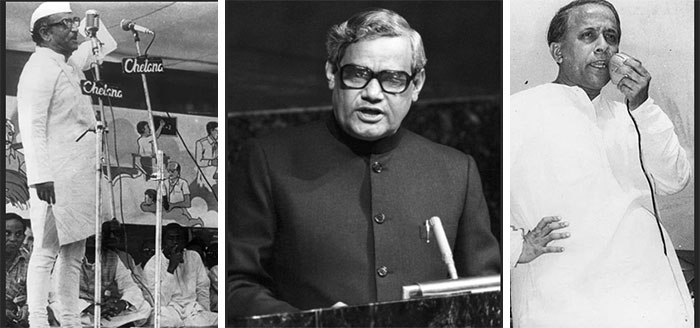
On the first two occasions, my father had taken me to hear people who were “experts in Hindi oratory”, to improve my own Hindi [something he needed more than I] and experience a level of narrative that does a young nation proud. Mind you, we were just 30 years young in 1977. I do not remember specific words or idioms or phrases either Bahuguna or Vajpayee used but I was sure caught in the electric atmosphere. I remember the huge silent crowd listening to what they had to say and only clap on occasions.
In fact, on the third occasion, I happened to hear Jyoti babu by sheer chance. It was election time and there were rallies everywhere, including one close to where I studied. I asked a local as to whom had he come to listen to. “Bangaal se Jyoti Basu aaya hai. Bahot achcha bolta hai.” [Jyoti Basu from Bengal is here. He speaks very well.] Now, Jyoti babu spoke no Hindi, but the crowd had gathered to hear a leader speak as he spoke “very well”. That possibly is what defined political oratory till recently.
I remember that on all three occasions, they spoke of the future, a better future with them in power, without any unparliamentary mentions of the opposition, forget about being abusive or vitriolic about specific people. Even the thought of target specific segments of society was unthinkable. The only specific mentions were of the poor, the farmers and the industrial workers. The crowds went back with more positive thoughts than depressive ones. They went back with more answers than questions. They understood that the nation’s key enemies happened to be the same as theirs – poverty, misgovernance, unemployment, inflation, lack of health and education facilities. The key divisions in society were between poor and rich, have-nots and haves, jobless and employed, malnourished and healthy, uneducated and empowered.
My history teacher in high school told us that the political campaigns and speeches were an expression of the “state of the nation”. Politicians spoke in a language and tone of voice that the electorate would identify with and further amplify within families and friends. They raised issues and created platforms that resonated with the common man and woman on the street and in the village. The ugly speeches were aberrations. The overall intent was constructive, to create one’s own vote base on positive issues and promises, however unmet for decades. It was all about hope, ensuring that the fundamental ethos of “India” is preserved and promoted.
Marketers could actually take leaves out of the political manifestos and speeches to learn how to craft strategies of market acceptance and leadership by creating the right narrative.
Things changed with Y2K hitting us. The quality of the narrative took a downward direction. Both in content and intent. Years of unmet promises and perpetuation of poverty and deprivation led to the political campaigns and speeches becoming uncouth and ugly by the day, across political parties and ‘isms’.
Initially the decline happened in the lower rungs of the leadership, at the panchayat, state assembly and regional levels. Gradually within a decade it escalated to the national level politicians and the leadership, whether in government or opposition. Decades of a faulty education system and scarcity of employment created a new section of the electorate that was shed of all decency and optimism. This voter base does neither understand not appreciate the nuances in oratory or the veiled sarcasm in pricking the opposition. This voter base is brazen, frustrated, depressed and prone to violence without a care for the outcome. Do not confuse them with the Naxals of the 1960s who were brilliant students from the best colleges of India shedding blood for a cause, however unjustified or utopian. The foundation of education, knowledge, spirit of enquiry and dialectics is totally missing here.
The narrative is now nasty, naked and necrotic.
The way the political leaders, across parties, speak and comment on social media makes one cringe. I just wish some social anthropologist undertakes a detailed study about the state of the nation in the context of the quality of the narratives that are woven and amplified.
The current election possibly creates a benchmark of sorts, in terms of how divisive, derisive and derogatory political speeches and social commentaries can be. One cannot talk of a single political party that has chosen not to fall into this trap and continue to uphold the true spirit of the democratic process. One cannot point out to a single politician who has not used derogatory remarks, abused sections of society, driven fear into communities and indulged more in making the opponent look like scum rather than talking only about one’s own ‘report card’. This is not the traditional battle of the poets where one competed on the quality of composition and repartee, eventually to hug each other whatever be the outcome. This is like the pathetic cock fights with each having deadly blades tied to their feet, out to simply kill each other with the mob enjoying the blood sport.
This year also happens to be the 100th birth anniversary of Abu Abraham, one of our finest ever political satirists and cartoonists. And the 60th death anniversary of Jawaharlal Nehru. While a certain sane part of India celebrated the former with an exhibition of 300 of his best in Kochi, the larger insane India possibly gave a fitting tribute to the man who had once expected us to rise to life and freedom as the world slept. As a certain Robert Allen Zimmerman sang, “Its not dark yet, but it’s getting there…”