 We had yet another “Earth Day” on April 22 this year. Every year it falls on April 22, so no surprises there. Every year there is a theme. This year the theme is ‘Planet vs Plastics’ with the objective to build awareness and action in reducing plastic production by 60 percent by 2040.
Which is why phasing out of single use plastics by 2030 is one key policy measure proposed under the Earthday.org ‘60×40 framework’. India had gallantly joined in on this wagon a few years back and took to banning plastic straws and shopping bags under a certain micron thickness. There was a lot of fanfare around this in 2022. Now India has decided to take it easy and made it clear we will not be able to meet those targets. Quite obviously, the industry, led by large organisations from all sectors, would have given the Ministry of Environment a hard stare.
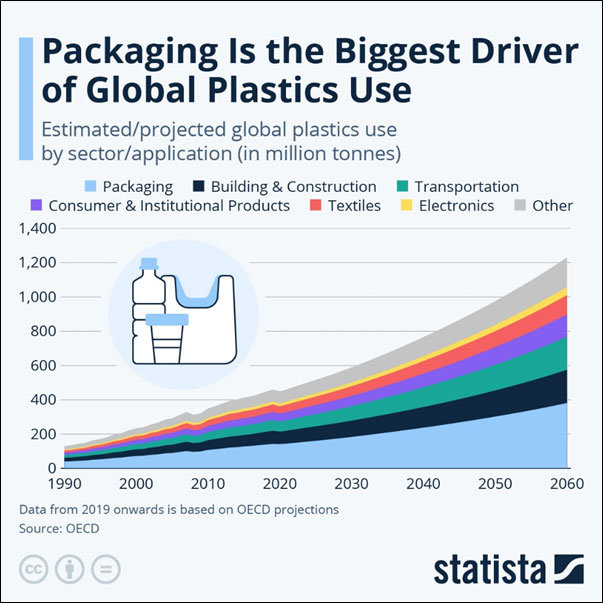
This chart from Statista based on OECD projections is telling. Packaging will continue to be the biggest cause of plastic pollution, seeing a 67 percent increase in global plastics use by 2040 and a whopping one billion tonnes of plastics being used by 2052.
While the increased use of plastics in building and construction, transportation and electronics will not be of single-use but for substitution of metals and light-weighting [like in electric vehicles], the increased use in packaging and textiles are criminal.
And this is where the blatant hypocrisy of some of the world’s biggest brands in talking sustainability while continuing to use plastic in their packaging and all communication applications comes out in the open.
Just because our rules on the use of plastic are comparatively lenient compared to developed and more socially conscious economies, many brands otherwise espousing the cause of preserving the earth and following the ESG norms, seem to forget their tall claims of greater purpose and refuse to reduce use of plastic.
All beverage brands offer small servings in plastic bottles. They cannot kid themselves in saying those bottles can be used over and over again. The quality of plastic is such that long-term exposure to the Indian heat anyway is said to make them cancerous.
Almost every consumer personal care product comes in plastic bottles, wrapped in plastic. While the bottles might last longer than the beverage ones, the wrappers are a sheer waste.
All automobiles, at time of sale, have their seats wrapped in metres and metres of plastic. The excuse is that Indians do not wish to get their seats dirty hence keep the plastic covers on for a long time.
Almost all tyres, especially the passenger car ones, come wrapped in plastic, carrying large plastic labels. The excuse given once again is that the consumer wants a clean tyre and the tyre retail environment is typically not very clean.
We boast of being a 700 million smartphone market, now have many plastic sleeves are chucked as soon as we unbox the phone?
Almost every consumer durable comes wrapped in sheaths of plastic, ably supported by generous helpings of thermocol or polystyrene. Very few have a policy of encouraging customers to return the plastic packaging, be it a Mother Dairy milk pouch or a Samsung television ‘protective’ cover.
Fast fashion is another culprit growing like a hydra. An Earth Day report says that people globally buy 60 percent more clothes than 15 years ago but keep them for only half as long as before. More than 85 percent of the disposed garments end up in landfills or incinerators while only 1 percent is recycled. “Thrifting” as a fashion concept applies only to high-end labels and is a fad of the rich.
One can find rampant use of single-use plastic in almost every consumer product sold in this country, where waste management is an almost non-existent concept and almost all the plastic goes into landfills. Delhi has created three artificial hillocks of plastic waste in Bhalswa, Ghazipur and Okhla giving competition to the country’s oldest one in Deonar in Mumbai. The regular fires that erupt in such places put lives of thousands at risk while gradually reducing that of millions through the poisonous smoke.
Adding to products either housed in plastic or wrapped in it, is the irresponsible use of plastic flex films for advertising, signage and branding. Just see the millions of billboards sheathed in flex. Just see all the branding at any conference in flex. Just see almost all the retail signage in flex. Just see every cricket stadium holding IPL matches swathed with millions of metres of flex. This is more than being callous. This is being totally insulting of the need to reduce use of plastic and petrochemical products. No use of cotton, jute or hemp here. On the one hand we preach switching to electric vehicles to save fossil fuel while on the other we are absolutely comfortable with ordering flex banners by the thousands for our company promotion.
Regulations will take time to be in place in our country due to vested interests. We need social activism to call out such hypocrisy. There needs to be an independent rating done of brands across different categories on their use of sustainable packaging and advertising material. Customers need to demand that brand walk the talk on reducing use of plastic as a corporate performance indicator than mere social responsibility lip-service.
If we, as consumers do not act now, we will be damaging the eco-system of our future generations. As individuals we work for or with some brand on another and each of us should bear the responsibility of working towards lesser plastic, whatever be our function. For the brand marketers, it is time to rise above narrow corporate walls and really work for the greater good of community. You can force your operations into becoming more responsible in the way you pack, ship, display and deliver your products.
As Pete Seeger once said, “If it can’t be reduced, reused, repaired, rebuilt, refurbished, refinished, resold, recycled or composted, then it should be restricted, redesigned, or removed from production.”
Avik Chattopadhyay is a Gurugram-based business strategist and commentator. He is currently also working along with XLRI to set up the Indian School for Design of Automobiles. He writes on MxMIndia every other Thursday. His views here are personal.