By Avik Chattopadhyay
 Independent India was formed on August 15, 1947.
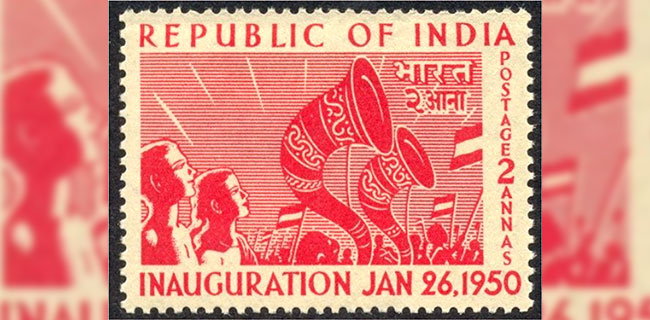
Brand India was created on January 26, 1950.
Since the “dominion” of India was created on the day the Indian tricolour was hoisted at Red Fort, we continued to be a constitutional monarchy with George V as the head of state and Mountbatten as the Governor-General till the 26th of January 1950 when we adopted our own constitution. It was only on that date that we had our first President in the form of Babu Rajendra Prasad. Till then this newly formed nation was governed by the Government of India Act of 1935.
So, the significance of our Republic Day assumes greater importance when we realise that it was on that day, after two years, five months and 11 days of having become independent that we decided what exactly we would become in terms of a nation. The product India was rolled out as a prototype on August 15, 1947. The final production version, after all tests and validations, was finally launched for the citizens and the world at large, as a brand that said “Republic of India” on January 26, 1950. Till that day, no common citizen was aware of what exact shape and form we would take in terms of purpose, promise, values and personality. This task was entrusted to a team called the Constituent Assembly, a 308-member team made up of 21 committees headed by some of the sharpest minds like Jawaharlal Nehru, Vallabhbhai Patel, KM Munshi, HC Mookerjee, Bordoloi, BN Rau and GV Mavlankar submitting their reports to the drafting committee headed by BR Ambedkar. They met for 166 days painstakingly putting together the Constitution that was finally adopted on November 26, 1949.
In an organisational context, it is almost like all functional teams providing their inputs to the brand strategy team that finally prepares the brand book, to be presented in a townhall before all employees for their feedback and necessary modifications before the entire organisation adopts it as its credo and ethos.
The Preamble is the brand essence.
It encapsulates all the pages that follow with their numerous chapters, schedules and articles. It describes the purpose, the promise and the operating values. In fact, all organisations in India could as well study the unique structure of the Preamble to design their own, in terms of brevity of expression and clarity of purpose.
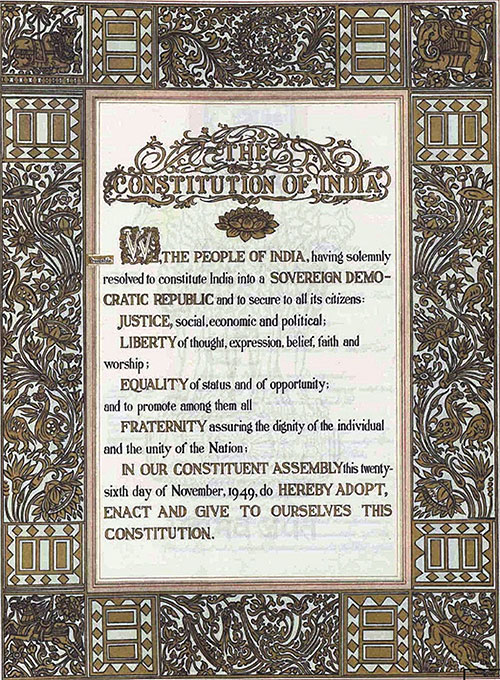
Of the Preamble, Ambedkar said, “It was, indeed, a way of life, which recognises liberty, equality, and fraternity as the principles of life and which cannot be divorced from each other: Liberty cannot be divorced from equality; equality cannot be divorced from liberty. Nor can liberty and equality be divorced from fraternity. Without equality, liberty would produce the supremacy of the few over the many. Equality without liberty would kill individual initiative. Without fraternity, liberty and equality could not become a natural course of things.”
As a part of the debates before its final adoption, there was a proposal to call ourselves the ‘Union of Indian Socialist Republics’. Also, some had proposed that ‘God’ and ‘Gandhi’ be incorporated in the text. Thankfully, all such proposals were struck down as each would have been paradoxical to what we had aspired to nurture ourselves into as a nation.
By the 42nd amendment of the constitution during the Emergency of 1975, the words ‘socialist’ and ‘secular’ were added to describing the republic over and above being sovereign and democratic. The brand purpose was expanded in scope. However, the promises of delivering justice, liberty, equality and fraternity remained as before, except for the word “integrity” being added to unity to describe the fraternity we aspired for. Very similar to what happens when the second or third generation of the founding family wishes to ‘revisit’ the brand purpose and ‘contemporise’ it, in sync with an evolving market and customer behaviour.
These very later insertions or modifications are subjects of heated debates today. The brand purpose is being questioned by the new leadership. Like most organisations, the new CEO, especially if brought in from outside, wishes to leave a mark on the key aspects of the brand, especially the ‘vision’ and ‘mission’. That it typically the legacy the leadership wishes to create for posterity to marvel at.
Even if those ‘controversial’ words are to be removed, the essence of the Preamble does not change one bit. In its very construct it espouses the fundamental principles of socialism and secularism. The word ‘socialism’ is part of the Directive Principles of State Policy and implies social democracy and distributive justice. The word ‘secularism’ implies that there is no state religion and that the powers of the state and any religion are clearly separate. The former cannot be partial towards any particular religion or religions while the latter cannot dabble or interfere in the functioning of the state. Reminds me of the occasion when MA Jinnah in 1919 implored Gandhi not to support the Khilafat movement as “mixing politics and religion” would have disastrous outcomes.
Brand India is at the crossroads right now. The very brand purpose is being challenged by various factions and fringes by their operating principles [or lack of them] and socio-political acts. There has been no direct attempt to alter the fundamentals of the Republic but subaltern and diversionary tactics are certainly being used, citing the need to go back to our “pure past” to rediscover ourselves and reclaim our greatness as a teacher of the world. We are certainly at the crossroads as we enter the 75th year of being Brand India.
I will conclude by quoting Ambedkar once again from his last address to the Constituent Assembly on November 25, 1949:
“On the 26th of January 1950, we are going to enter into a life of contradictions. In politics we will have equality and in social and economic life we will have inequality. In politics we will be recognising the principle of one man one vote and one vote one value. In our social and economic life, we shall, by reason of our social and economic structure, continue to deny the principle of one man one value. How long shall we continue to live this life of contradictions? How long shall we continue to deny equality in our social and economic life? If we continue to deny it for long, we will do so only by putting our political democracy in peril. We must remove this contradiction at the earliest possible moment or else those who suffer from inequality will blow up the structure of political democracy which this Assembly has so laboriously built up.”
Jai Hind.
Avik Chattopadhyay is a senior business strategist and commentator based in Gurugram. He writes on MxMIndia every other Thursday. His views here are personal