Tag: AI

  • On-Device Edge AI – The B2C AI Business Waiting to Happen

    On-Device Edge AI – The B2C AI Business Waiting to Happen

    Image generated with prompts to Meta on WhatsApp


    Ashoke AgarrwalAs the ChatGPT excitement fades away, the capital markets are beginning to wonder whether the LLM gold rush is a bust.

    Over the past two years, Big Tech – Google, Meta and Facebook – have sunk hundreds of billions of dollars each in training LLM models and continue to burn hundreds of millions more in inference computing every week as hundreds of thousands of users freeload (or pay pennies) to flood the model with queries that are mostly borne out of curiosity or laziness with not real economic, quality or productivity value add. Further, hundreds of angels and VCs have pumped billions into thousands of AI-driven or AI-adjacent start-ups.

    Although trillions of dollars have been invested in the LLM ecosystem, the business and economic case has yet to emerge.

    In the B2B segment, corporations are busy building machine learning (ML) models that sit atop their proprietary datasets and whatever other data they can access. The ML models (the line between ML and AI) are, in essence, semantic until the day AGI emerges. Predictive pattern building based on complex, structured data and signals will be at the heart of these models. These models will access available LLMs but at the periphery to absorb unstructured data and speed up documentation.

    In the academic and professional world of science and technology research, deep-learning-based ML/AI is an increasing reality. For example, AlphaGo is at the core of research into discovering and synthesising new proteins that will drive the cutting edge of genetics and drug discovery.

    By contrast, the economic case for AI in the B2C arena still needs to be clarified.

    The trillions being spent on creating LLM models and inference testing them by offering them free (or nearly free) to millions of consumers can be likened to the early days of optical-fibre-based bandwidth building, much before the emergence of the deluge of mobile Internet, video-sharing, and streaming. In the final years of the nineties and the early oughts, many wrote off the vast investments in the optical fibre network as white elephants.

    History proved otherwise.

    Device-based Edge AI will create an economically viable future for AI in the B2C arena. This future will be predicated on the investments being made today in LLMs, which have an exponentially increasing number of parameters, increasingly customised hardware and software, and a wide variety of specialist AI agents sitting atop increasingly capable LLMs. Breakthroughs in design will decrease the cost of specialist LLM cloud farms and their environmental impact through greater energy efficiency and better green energy solutions.

    The contours of the device-based Edge AI that will drive the emergence of a viable B2C market for AIs are beginning to emerge.

    Samsung and Google have launched smartphones that are touted to incorporate device-based AI. A slew of laptop brands are also touting AI credentials. However, by the use cases these brands tout, they are marketing gimmicks that harm instead of heralding the B2C AI era.

    Apple’s Intelligence could be the actual start of the device-based Edge AI (EAI) B2C era.

    The launch event of the iPhone 16 mentioned the phone’s AI capability but did not present any use cases. In all the usual slickness of the launch, what went almost unnoticed is that while the hardware and probably the operational software were on the phone, Apple Intelligence would be ready for the consumer to use only a few months down the lines. The reasons could be Apple’s philosophy of not putting out anything half-baked and even regulatory approval.

    Reading between the lines, Apple Intelligence (AI) is the first AI engine focused on deciphering the individual, unlike the written/spoken word, visuals, and video at large that the LLMs are focused on.

    Smartphones are rich repositories of an individual’s lifestyle, interests, attitudes, and behaviour–a finer-grained repository permanently etched. Further variables like smartwatches and fitness rings will continue to add vital data to this repository. With the individual’s permission, the on-device AI can capture more information from conversations, laptops, office computers, and the increasingly innovative IoT devices at home.

    A smartphone-based Edge AI can then be the counterpart of the LLM – the Deep Personal Model (DPM) that is continuously trained to predict and anticipate. An individual needs to interact with her and the world to meet them. For example, if an individual is preparing for an educational test, the DPM could decipher her areas of weakness, alert her to them and provide specific inputs to overcome them. It could create a section of the DPM, her avatar as her professional – an architect, a journalist, a management consultant. This professional avatar could handle her professional communications and routine tasks.

    Another use case is for the DPM to detect signs in her vitals and situational stress and correspond with her doctor’s professional DPM avatar to get remedial recommendations.

    The DPM could take over the essential consumer functions of anticipating and ordering products within set limits and in interactions with market-facing AIs that allow her to access all relevant market knowledge.

    Of course, the consumer will be in complete control of the DPM regarding what personal data it can access and what functions it can perform for the consumer. She would also have the option to turn off and turn on the DPM. She decides based on her perception of access and utility trade-offs.

    The DPM will be charged as a service, much like Apple, at various subscription levels. A few years into the emergence of device-based DPMs, the device could come free with a subscription to a DPM, making the DPM market the largest B2C category in the world.

    The crucial aspect of a DPM’s success is the assurance of privacy and control for the individual. That’s why the DPM must reside on the device, not the cloud. Equally important will be trust in the brand offering the DPM. Apple with its brand positioning on privacy and its track record on that aspect has a leadership advantage in that area


    PS: I first wrote about a concept called “Concierge Intelligence” in my first MxMIndia column published on Jan 6th 2022; thirty-two short months later, the idea of what I now call DPM seems to be around the corner.

  • Paris Olympics 2024: Faster, Higher, Stronger… and more data-driven

    Paris Olympics 2024: Faster, Higher, Stronger… and more data-driven

    By Andy Miah

    For the first post-Covid Olympics, there are some major changes now in place at the Paris 2024 Games. First of all, there are no physical tickets for visitors. All tickets are digital, but spectators can separately purchase an additional paper souvenir ticket for their event. While this is significantly a Covid legacy, it’s also a sign of the times, as more of the Olympic Games moves into the digital world.

    If we dig deeper, we see how the DNA of this transformation is a story about data and its expansion – and how the ability of the Olympics to grow economically relies on it being harnessed and exploited. As AI steadily changes the strategic positioning of all aspects of life, the sports world has rapidly begun a similar journey. AI is now playing a key role at the Olympics across many areas, including performance analysis, doping checks, security threats, athlete comfort, sports reporting, and broadcasting.

    The Olympic Games have been quick to respond to the rapidly developing technological environment. Gone are the days where the International Olympic Committee (IOC) talked about its impact in terms of television viewing figures. Now, it’s all about the live views across all channels, and a looming presence at Paris 2024 is the prominence of TikTok, which itself is driving a huge amount of Olympic athlete content. It is even an official partner of Team GB.

    At a session before the opening ceremony, the IOC unanimously supported the creation of the Olympic Esports Games, due to take place for the first time in Saudi Arabia in 2025, building on five years of developing esports in the Olympic programme. It will consist of competitions in familiar computer games formats such as Fornite, along with some new gaming titles which are aligned with traditional sports, including taekwondo, in virtual reality.

    This new event ends speculation about whether esports will ever make it into the Olympic Games. Planned to happen every two years – when the Olympics and Winter Olympics aren’t taking place – it signals a major step change in how the sports world interacts with gaming and esports.

    Underpinning a number of these changes is the IOC’s realisation that the economic model underpinning the Games needs to evolve. With 61% of the income generated from television rights, and TV’s future looking ever more uncertain, the IOC is betting on gaming and streaming platforms becoming a major feature of its future economy.

    Another major innovation this year was the creation of a ticketed experience in Imax cinemas in the US for the opening ceremony, following the model of national theatres around the world.

    These new kinds of audience experiences may signal the end of the traditional family-viewing-at-home era. Instead people are more likely to either watch on their own on a personal computer device, or collectively in large groups. Similar shifts are taking place more widely in other major events, from Eurovision to the Euros.

    Over nearly two decades, this shift in audience experiences has been driven by the rise of social media and, perhaps more critically, mobile viewing experiences. With platforms such as YouTube, Instagram and Meta driving a vast amount of activity to mobile audiences, the Olympic movement has become increasingly reliant on their platforms to grow their audiences.

    In the run up to this year’s Olympics, some athletes used social media platforms to share the beginnings of their journey to Paris. It’s the kind of content that many fans wanted to see – but never could until now.


    Will AI squeeze out the human element?

    The IOC launched its Olympic AI Agenda in June. In Paris, AI is being used to assist in performance analysis, raising questions also about whether it could further be used to judge sports. For instance, might AI be more able to scan a dive and assess its quality? These are some of the applications being discussed at these Olympics, but there is some division over its use, with fears that AI may replace human judgement in the field of play.

    AI has also been used to design personalised bedding for athletes in the Olympic village, add colour to old black-and-white archival footage of Olympics past, and create new forms of sports reporting – such as using AI-generated results stories and commentary.

    While so much of this change is driving greater openness and awareness about the Olympic Games, there is also a deeper question we face about the role of professional journalism in the making of sports history.

    As more brands become concerned about anything negative surrounding their industry, and the numbers of journalists on news payrolls diminishes, there are worries that the elevation of technology-driven reporting could lead to a loss of independent, investigative journalism. This could have a serious impact on securing a fair record of events like the Olympics.

    The extension of this into AI could exacerbate these fears, jeopardising the traditional view of journalists as necessary witnesses to historic events. These matters become increasingly worrisome when this means that officials who oversee such events are not sufficiently interrogated to ensure accountability.

    Yet, the motto of IOC president Thomas Bach over the past four years – during which he has driven his reform agenda to ensure the Olympic movement modernises and remains a world-leading community in the 21st century – has been “change or be changed”. It is a mindset that must shape how we think about the future of entertainment as we see new formats of experience being created.

    It may not be too far off that viewers will be able to watch Olympic athletes as digital avatars – highly precise computer-generated animated versions of themselves – and this might create new and younger audiences who have grown up on computer games.

    Alternatively, active esports are leading to new hybrid sports, where athletes compete in virtual worlds against each using full body tracking technology, competing from anywhere in the world all linked up through the Cloud, which was tested with great success during the COVID restrictions.

    The advent of AI occurs at a defining moment in Olympic history, as it becomes an event embracing new technologies. Its major worldwide partners are companies driving new standards in technological innovation – the economic powerhouse underpinning the Olympic industry and shaping the character of the Games in the 21st century.The Conversation


    Andy Miah is Chair in Science Communication & Future Media, University of Salford. This article is republished from The Conversation under a Creative Commons license. Read the original article.

  • Can India be an MaI and AdI Powerhouse?

    Can India be an MaI and AdI Powerhouse?

    Ashoke AgarrwalThe world awaits the paradigm-shifting potential of Machine Intelligence (MI) and Advertising Intelligence (AI).

    MI and AI are foundational technologies like electricity that need to be deployed for specific purposes to generate economic and social value.

    The competition is fierce, with established corporations and countless start-ups worldwide vying for a piece of the MI and AI pie. With its unique strengths, India can make a significant mark in this arena.

    This column briefly explores India’s opportunity and potential to be a leader in applying MI and AI to marketing and advertising—a field I term as MaI and AdI.

    The first requirement for MaI and AdI is the accumulation of relevant data, including public-facing data like syndicated market, media, and consumer data compilations and research and, to the extent possible, private data on sales, consumer profiles, and research with brand owners from across the world.

    Developed on this data, MaI and AdI engines can offer a brand owner the following based on deep and evolving consumer insight:

    • Fine-tuned and dynamic marketing mix plans that maximize ROI
    • Messaging templates that turbo-charge the marketing mix
    • Product enhancement and development ideas

    Can India become a global leader in this game?

    Yes, if we move fast and move-wise.

    The first step would be to test and perfect new modes of collecting consumer data.

    The internet, the smartphone, MI, and AI promise a new age of syndicated consumer research. Currently, syndicated consumer research sits in silos. Sales numbers are compiled through retail audits. With retail worldwide increasingly dominated by e-commerce and big-box retail, retail audits largely fail as market share indicators simply because e-commerce and big-box retailers treat sales data as a valuable resource and loathe sharing it with third parties.

    Conventional media research needs to be improved. The increasingly dominant digital powerhouses like Alphabet and Meta think of audience data as the engine central to their business, and they have it at a level of granularity that no conventional research technique can match.

    As OTT platforms like Netflix and e-commerce giants like Amazon muscle into advertising, they will keep their audience data close and be equally impenetrable to conventional research.

    Media research focused on traditional mass media has a utility and funding problem. As a hangover from the halcyon days of advertising agencies when they fed at the 15% trough, brands wanted the agencies to fund media research and who, in turn, twisted the arms of media houses to share the costs. Audience research for traditional media thus came to be split into silos – press, TV and even radio, OOH and cinema – had research funded and controlled by narrowly focused bodies.

    As the percentage of marketing communication budgets allocated to traditional media continues to shrink brand, mass media owners and media agencies are finding it hard to continue funding research and the brand managers who are increasingly used to the clarity of performance marketing and pay-per-click contracts, wonder whether bland broad-brush data of who watched what is adds any edge to their marketing data.

    The third data dimension is brand lift. Marketing is going down the AIDA funnel – from awareness to consideration set to intention to purchase, with the final sale, satisfaction, brand loyalty and advocacy culminating in the process. Currently, very little syndicated consumer research is available in this area. The big brands invest in privately funded research to track this dimension, with others adopting a set-of-the-pants approach to this crucial aspect.

    The answer to the challenges above is developing a technology-led process in which the consumer is the direct and single source for all three data dimensions—brand lift, 360-degree media exposure, and purchase. The two critical issues to be resolved are compliance, incentives, and data privacy regulations. The answer lies in innovation in technology, including LLMs and contractual relationships. In the spirit of full disclosure, my partners and I are experimenting with one such system in collaboration with a UK-based company.

    A critical element differentiating successful brands is a nuanced understanding of what works and what does not in advertising and other marketing communication for a particular product category, geography and consumer segment. Ogilvy, in its heydays, used to generate multimedia Magic Lanterns for product categories of interest that laid out, with examples, the dos and donts when creating advertising for a particular category. These Magic Lanterns were assiduously produced by a cell of PhDs running factor analysis on advertising from across the world and some measure of the efficacy of each ad.

    The single source data envisaged above will produce multidimensional efficacy data for campaigns across categories, markets and segments. A state-of-the-art AdI engine could be developed that uses Deep Learning to pinpoint what works and what doesn’t.

    While MaI and AdI will be the first generation of AI in marketing, the third generation will likely result in AI avatars of brands.

    Parallelly as the Siris and the Alexas of the world will, over decades, morph into Concierge Intelligences (CI) that will become AI avatars of individuals. I have written about the idea of CIs in an earlier MxMIndia column. In the age of AI, marketing and marketing communication will evolve to primarily be an interaction between the AI avatars of brands and the AI avatars of consumers.

    In the near future, the single source would meld with the client’s private data, providing a never-before-used base for effective marketing planning.

    There is scope for more than one Indian player to make India the single-source powerhouse of the world for the following reasons:

    • India has the technology nous in the high quality, low-cost quadrant.
    • India is an evolved B2C and B2B market that can support the development of single-source-research-based MaI and AdI systems.

    Since the single-source system will be digital, India can market its fully developed MaI and AdI systems worldwide.

    Single-source data coupled with MaI and AdI are the future of marketing and advertising, and India, on its way to Viksit Bharat, can own it.

  • WPP and IBM team up on AI

    WPP and IBM have announced the launch of a new business-to-business (B2B) solution powered by ’s AI and data platform Watsonx designed to reinvent how B2B marketers identify and engage clients and prospects across the buying journey.

    Alan Webber, Program Vice President – Digital Platform Ecosystems at analyst firm IDC believes “this product and partnership have the potential to be an exponential force multiplier for the Fortune 1000.” Said Stephan Pretorius, Chief Technology Officer at WPP: “Our clients want to get in front of the right people, at the right time, on the right channels, with the right message. However, most solutions in the market today are designed for consumer marketing, targeted at sole decision-makers at a single point of purchase. WPP Open for B2B, and our collaboration with IBM and LinkedIn, will help solve some incredibly complex challenges in the B2B marketing space, using the best of WPP and IBM technology and expertise.”

    Added Jonathan Adashek, Senior Vice President of Marketing and Communications at IBM:“B2B marketers have been focused on creating truly personalized, relevant and consistent experiences for buying groups at scale for years. Our collaboration with WPP and LinkedIn provides real-time, actionable insights that are based on trusted data. We are excited to create and use these new, powerful and trusted AI solutions to deliver a force multiplier for B2B marketing.”

  • Copyright in AI-Generated Content: Originality, Creativity, and Human Origin

    Copyright in AI-Generated Content: Originality, Creativity, and Human Origin

    Sanjeev KotnalaThe excitement around AI-generated content is palpable. AI promises to fulfil a wide range of creative and functional needs quickly and efficiently. It can write books, blogs, and articles, design advertisements, create social media posts, develop visuals, and more. However, the surge in AI-generated content raises questions about originality and copyright protection for commercialising the content.


     

    Sourcing v/s Plagiarism

    Based on human prompts, AI generates content by accessing a vast repository of digital material and synthesising it into new works. This process often involves repurposing existing material, raising concerns about plagiarism. The AI doesn’t create original content; instead, it reconfigures what already exists, often from sources with copyright protections — something human creators are not allowed or expected to do. Genuinely speaking, it is a new form of an old problem- plagiarism.

    Before you point out, let me say that many human creators do the same! For example, I accessed many articles for this column, assimilated my thoughts, and then presented my point of view. So, what’s wrong if AI does the same? The AI does not superimpose its thoughts and thinking while recreating- recrafting what it proposes.


    Shaky on Copyright

    Copyright protection hinges on three main criteria: originality, a tangible medium, and human authorship. While AI-generated content might meet the requirement of being in a tangible medium, it falters on the other two fronts. AI content lacks originality since it is derived from existing works. Remember, the test of originality looks at substantial similarities and not differences. And it definitely fails the test of human authorship as algorithms, not humans, generate it.

    Unless the rules are changed- the AI-generated material cannot be commercially protected, which may be why most Generative AI programs promise the user the freedom to use or say they own the content!  However, if you were to try copyrighting it- you would be disappointed.


    The Debate on AI vs Copyright Continues

    The debate around AI and copyright is ongoing and complex. Some argue that traditional notions of copyright are becoming obsolete in a rapidly evolving digital landscape. Others believe in democratising content and universal ownership, valuing productivity and accessibility over strict copyright enforcement. You can ignore this debate if you feel the same way.

    It’s important to note that the debate on AI Content Copyright and the rules to harness AI capabilities within a safety net of universally accepted guidelines are ongoing and of significant relevance. This is a topic that we will be actively discussing and trying to resolve for some time.


    Case for a Disclaimer

    To maintain transparency, content creators should disclose the use of AI in their work. This would help differentiate between predominantly AI-generated content and content primarily created by humans with some AI assistance.

    Some digital content creators do mention if AI was used in content development. It may not be a case like the News and Advertorial, but the audience has the right to know. What do you think?


    Humanising AI Content

    Many creators use AI for initial content generation but rely on human creativity to edit and refine the final product. This practice, while common, does not solve the issue of originality since the AI’s role in content creation remains significant. Do not consider it a possible escape route to claim the originality of content. It would not pass the test.


    Individual Point of View

    Opinions on AI-generated content vary widely. The lack of consensus on copyright and commercial protection for such content leaves many questions unanswered. The debate will continue until the lawmakers and stakeholders work towards a shared understanding and framework- which is not expected soon.

    Possible solutions include stricter regulations on using copyrighted material in AI training, more explicit guidelines on the attribution of authorship in AI-generated content, and the development of AI-specific copyright laws.

    Many question the futility of such a debate. They question if it matters when the content is relevant, impactful, and to the brief. Is there a problem if no one objects and claims copyright?


    Net-net: AI Is trained on Pre-Existing Content

    AI training involves using pre-existing, often copyrighted content without explicit permissions or commercial transactions. This practice can lead to a homogenisation of creative works, potentially stifling originality and creativity in the long run.

    Many global and national content creators refuse AI permission to access their content for training. Is that a step in the right direction?

    Or would you want to access AI and check the politically correct stance and response?


    DISCLAIMER. This article first had 1063  words, then AI condensed it to 383. What you read is the Humanised version (741 words) of that condensed article- as the condensed version lacked and blanked out many human thoughts- still with the use of AI- I do not claim to be the sole creator of this particular piece of work.

  • Arkreach’s AI-powered tool for Contextual Sentiment Analysis

    Arkreach, a communications analytics product company, has unveiled a new AI-powered feature for Contextual Sentiment Analysis.

    Commenting on the success of the new AI feature launch, Vishal Sharma, Chief Strategy Officer at Arkreach, said: “In the digital era, communications metrics must evolve – the global PR software and media intelligence market is expected to be worth US$17,569 million by 2027, indicating a massive utilisation of the technology advancements. Arkreach’s Contextual Sentiment Analysis, powered by Artificial Intelligence, seeks to revolutionise the field of communications analytics. This novel approach transcends conventional metrics by incorporating granular, context-specific understanding derived from News Consumption Behavioural Data.”

    Added Neeraj Kumar, Chief Technology Officer, Arkreach: “The significance of contextual sentiment analysis, for a long time, had remained secluded in the conventional tools. Arkreach gives you pinpoint-accurate sentiment on any issue, but that’s not all. It also decodes the WHY behind the context. For clients, this translates into rocket-fueled communication strategies.”

  • Is Marketing coming Full Circle?

    AI-generated image


    Ashoke AgarrwalTime was when marketing was confined to the bazaar. Goods and services were sold in one-to-one transactions between a buyer and a seller. More often than not, the buyer and the seller had a relationship, if not of trust, then at least of familiarity.

    Then, the eras of mass manufacturing and mass media dawned. After World War II, the industrial age shifted into high gear, leading to a proliferation of products and services. The prosperous 1950s and 60s, driven by the economic boom in the USA, marked the birth of the consumer era.

    Marketing underwent a significant transformation, shifting from the traditional model of building one-to-one relationships to a new era of mediated one-to-many brand-building. Modern media made this shift possible, revolutionizing how mass audiences could be reached.

    Marketing and media forged a symbiotic relationship, each playing a crucial role in the other’s success. With its ability to attract and retain audiences, media provided the platform for marketing to communicate its messages. In turn, through advertising, marketing financed the accumulation of these audiences, ensuring the continued viability of media.

    In the initial days of mass media marketing, brands were the pegs through which information about the product or service was conveyed. In the early days of the consumer age, many products and services had differentiated features, and advertising was then the art of conveying unique selling propositions (USPs) memorably.

    A few decades into the consumer age, as categories matured, competition heated up, investment flowed into consumer businesses, contract manufacturing emerged, and brands in many categories didn’t have differentiating features to hang their stories.

    Brands morphed away from information providers to signalers of personas and lifestyles. For example, the Nike user was a never-say-die enthusiast, while the Adidas guy strived for perfection.

    Brands’ dependence on mass media increased. Signaling a persona or a lifestyle on mass media allowed the entire market–loyal users of your brand, potential users of your brand, and, as importantly, loyal users of your competition–to know what your brand stands for. Brand equity was built on what the brand stood for and what it did not. The acceptance among loyal users complimented the rejection by the faithful users of the other brand. Pepsi’s equity depended not just on its persona but as much of the persona of Coke.

    While mass media might have been primarily financed by marketing, its importance went well beyond its role as a vehicle for advertising.

    In its heyday, mass media offered society a shared cultural arena that builds societal cohesion. Most religiously read the same one or two newspapers in the morning covering the same news, watched the same prime-time TV programs and went to the same movies.

    The arrival of Facebook and the subsequent social media juggernaut fractured this cohesion. Today, the average person gets his information, views, entertainment, and cultural content from various social media and OTT sources that may have little in common with those in his family, his colleagues, or his neighbors. The cohort that shares his principal information, entertainment, and cultural sources is not a community in the traditional sense – they might not reside in the same city or even country, they might not share the same profession or educational level, and they may not be even in the same age group. The only thing they have in common is the echo chamber of partisan views and attitudes they share. They are the modern tribe – divorced from the shared everyday space and civic responsibility that defined traditional communities.

    This fracturing of societal cohesion has also fractured the rationale that drives modern brand-building.

    The core function of a brand as a widely accepted signal of a persona or a lifestyle is fast losing its potency, mainly because, in post-modern society, there is little that is widely accepted. In an era when even facts have alternate facts, what chance does a brand have as a widely accepted symbol?

    In light of failing mass media, brands have shifted their marketing resources to new media. However, the paradigm that drives their brand-building effort remains the same as in the modern era. By and large, they are yet to find a new paradigm that better suits the changed reality.

    Lately, I have heard murmurs from the marketing fraternity that perhaps digital and social media are better suited to “performance marketing” (another name for baiting someone to click on a link) than brand-building. And they must reweigh their mass media spending to strengthen their brands.

    Instead, the new reality calls for re-examining the very purpose of brands. Instead of brands being broad-based signalers of lifestyle or persona to a market, brands in the emerging new marketing era become builders of permission-driven one-to-one relationships with their consumers. Like the shopkeepers and the shoppers of the bazaar of the old days, a brand and its consumers must develop an interactive relationship of trust and constantly deepening understanding of each other.

    With the maturing of Big Data, a digital-immersed consumer, e-commerce, and the economies of scale of cloud computing, marketing can today shift to a paradigm where a brand can build and nurture a one-to-one relationship with consumers at scale.

    Given my current obsession with AI, as marketing reverts to building one-to-one relationships, the day is close when the one-to-one relationship will be between the brand’s AI avatar and the consumer’s AI avatar, as I have written in many of my MxM columns, starting with the first one.

    Marketers at the cutting edge, including many D2C start-ups, have started working on this new paradigm.

    Post-modern marketing could address another shift. The younger generation of consumers – Gen Z and, over the next decade, the Alphas (those born after 2010) – are opposed to marketing messages touting lifestyles and personas and, simultaneously, intensely devoted to a chosen cause. Can tomorrow’s brands be built based on a cause it espouses, not just in communication terms but through on-the-ground action? An exciting area to ponder in a MxMIndia column to come?

  • Artificial Intelligence: The Road Ahead

    Artificial Intelligence: The Road Ahead

    Kunal SinhaInvestor enthusiasm for artificial intelligence (AI) soared to unprecedented heights last week, fuelled by remarkable performance from chipmaker Nvidia, which propelled stockmarkets across three continents to historic highs. The surge, commencing on Thursday and extending through Friday, saw Nvidia surpass Google’s parent company, Alphabet, to claim the coveted position of the third most valuable company in the US, boasting a market capitalization of $2 trillion, second only to tech giants Microsoft and Apple.

    Nvidia’s significance in the AI landscape cannot be overstated.

    The company produces chips essential for training and operating AI systems, facilitating rapid data processing crucial for applications like chatbots. As demand for such infrastructure skyrockets with major tech players entering the AI arena, and with consumer interest in AI-driven products like ChatGPT and Midjourney surging, Nvidia’s robust performance underscores the thriving demand for AI technology, inevitably attracting the attention of investors.

    The artificial intelligence (AI) boom has raised many questions, not least over safety and the impact on jobs, but there are also concerns that it might be driving unsustainable market exuberance.


    What do consumers think of AI?

    Consumers are still in a wait-and-watch mode with respect to AI, with feelings
of both awe and distrust.

    This is driven by the concern that it could replace
a human they can connect with. The desire for human connection reflects in their channel preferences, too – with most still preferring to interact with human channels over digital, especially for high-stakes tasks like resolving an issue with a bill, and switching to digital for simpler, transactional activities like checking an order status. Human interaction remains a top choice when considering aspects of decision-making, customer support, and returns or cancellations.

    There is also enthusiasm. Around 57% Indian consumers would prefer using Artificial Intelligence (AI) tools rather than to engage in human interaction while looking for products and services online, findings of a recent Adobe survey reveal. Recent research by Qualtrics tells us that 73% of consumers are fine interacting with AI is getting status updates on an order placed; and 48% of people are comfortable interacting with an organisation/ brand’s AI.


    Where are businesses with AI adoption?

    While shoppers try to work out exactly what to think of these technologies, the businesses that move quickly to incorporate AI and new data strategies into their operations will be best poised for success. In the early days of gen AI, it feels a lot like giving a toolbox to every employee and allowing them to experiment with what they could build, and possible gains in productivity and cost. As business use cases become clearer, we should be able to see how brands discover opportunities to drive innovation.

    Offering a consistent and accurate customer support experience is one of the main challenges which businesses face.
This is where businesses in India are still in the early stages of AI deployment.

    Only 15% Indian brands are leveraging generative AI to enhance customer experience (CX) initiatives compared to 18% globally.

    41% of Indian brands are seeing CX as a business priority today.

    87% of Indian brands are prioritizing CX enhancements over other business goals.

    76% of brands already have or will pilot GenAI solutions to support CX.

    Overall, 53% of Indian brands want to improve GenAI capabilities in the next 12 months.


    Bridging the gap between intent and action is going to be a priority in 2024.

    As consumers go from making a purchase to resolving an issue online, the customer journey often breaks down –
with satisfaction 22 % points lower compared 
to making a purchase.

    AI and Customer support

    For companies that get digital support right,
there are significant rewards. One study found customers are 2.7X more likely to return after a positive digital support experience — the highest of any channel and journey studied.

    Marketers must look to AI to empower their frontline teams with the tools, time, and insights to build stronger connections with customers and make that a better experience, too.

    While AI will undoubtedly help businesses make simple, repeatable tasks more efficient – something consumers welcome -
an effective AI strategy is not simply deploying more chatbots and automating tasks.

    Blinkit, the quick commerce platform of Zomato has introduced a new feature called ‘Recipe Rover’ driven by the most popular AI models ChatGPT and Midjourney. Recipe Rover displays multiple recipes related to the food items which the customer searches for in the app. The company also plans to integrate generative AI into product photography, customer support, etc. Zomato’s massive customer database can be effectively deployed to create more customer-friendly features in the future.

    Using data to predict customer needs

    Data will dictate how to best use gen AI – for both customer and business needs. While businesses are still in
the experimental phase, the push to monetize gen AI investments and quantify their value is becoming stronger. Leading that charge are decisions around how to use valuable internal data to maximize the value that generative AI is creating.

    AI’s predictive power enables brands to get ahead of customer needs through analytics of behaviours, interactions and preferences. It identifies subtle shifts that human analysis alone could miss, such as churn risk, service issues, up-sell opportunities or optimal times for engagement.

    These insights allow brands to engage contextually at just the right moments. Inevitably, while booking a flight ticket, the AI nudges me to book travel insurance as well. It makes excellent recommendations for hotels at the destination, often offering up significant discounts.

    Identifying customer needs through prediction is just the first step, though.

    Leading insurance tech company Policybazaar has been using AI tools for fraud detection using an AI-based risk framework that checks for liveliness and avoids deep fakes. It also uses AI tools for motor vehicles inspection where the customer can make a video of the vehicle and upload it while the AI does the damage assessment.

    The company has also developed predictive AI for voice to text conversion which can be used to gather consumer data and be used to assess consumer behaviour.

    Firing up Contextual Personalisation

    Companies that grow faster drive 40% more of their revenue from personalisation, according to a report by McKinsey & Company. But tailoring engagement across channels and customers is enormously difficult. AI systems can take individual customer insights and orchestrate relevant cross-channel personalisation at scale. The result is a tailored, proactive experience for every customer.

    When you think of your best customer experience, you realise that the brand seemed to truly understand and cater to you – personalised engagement is the magic behind this experience. It’s impactful, and it matters. It not only elevates the customer experience but also results in better business growth, because they return and keep ordering.

    An e-commerce platform can use real-time behavioural analysis to recommend products to a user based on their current browsing pattern. When a user looks at sports shoes, the platform can immediately recommend relevant products, such as sports socks or training equipment. This immediate, relevant personalisation improves the user experience, leading to greater engagement and potential conversion.

    With 62% of consumers comfortable booking an airline ticket through AI,

    MakeMyTrip, one of India’s leading travel booking companies has collaborated with Microsoft to use generative AI to introduce voice-assisted booking in Indian languages. It helps users by offering personalized travel recommendations based on their preferences, curating holiday packages and booking them.

    Being mindful of privacy

    While AI offers immense potential, it also brings significant risks if ethics and consumer privacy are neglected. Around 59% Indians do not feel positive about buying from a brand that isn’t transparent about the use of their personal data.

    To maintain ethical integrity, brands must establish clear guidelines for unbiased, transparent and privacy-focused use of customer data. Rigorous testing is essential to eliminate bias in predictive algorithms.

    There are three essential steps that companies can take to find the sweet spot between personalisation and data privacy.

    • Only collect data that’s essential to creating a better customer experience. Begin with the experience you want to deliver and then define the data required to deliver it.
    • Allow your customers to customize their experience. Let them choose how much personalisation they want and how much of their data they are happy sharing.
    • Be transparent about how their data will be used. Once they understand that, they will be more likely to share their data willingly.

    In a nutshell, think of AI as the neighbourhood chacha (uncle) at the kirana (mom- and-pop) store. They have all your weekly transaction data. They know everything about you and your family. And they use that information to give you personalised, unmatched customer service, while maximizing their profit.

    Pretty basic, right?


    Kunal Sinha is a senior strategy and foresights executive based in Jakarta, Indonesia. He is the author of several books including The Future of India’s Rural Markets and Raw – Pervasive Creativity in Asia. He writes for MxMIndia every other Monday. His views here are personal.

  • As AI surges, tough times for news biz

    By Nic Newman

    News organisations are bracing for serious disruptions as a result of the increasing influence of artificial intelligence (AI) – both on the way that they work and the way their audiences consume news. As part of our latest journalism trends report, my colleagues and I at the Reuters Institute for the Study of Journalism found that less than half (47%) of 314 editors, CEOs and other digital leaders from more than 50 countries say they are confident about journalism’s prospects in 2024.

    The report details a tough period for the news industry over several years. A decline in online advertising, slowing growth in subscriber numbers and rapidly declining referrals from social media have fed into dramatic falls in revenue.

    Industry data shows that Facebook referrals alone fell by 48% in the past year, and many fear that search traffic will be next. Google and Microsoft, among other tech giants, are expected to roll out AI-driven, chat-based interfaces that have been trained on publisher content – mostly, or so the publisher of the New York Times alleges, without their permission.

    But it is not just internet search. We are also seeing a proliferation of conversational AI assistants built into computers, mobile phones and even cars that will change the way we discover and consume content of all types. Queries about the news are increasingly answered directly by the AI interface. Links to sources of the news on publisher websites, meanwhile, disappear into the background. As a result, far fewer audience eyeballs will find their way to each publisher’s site.

    Against that background, it is not surprising to find that some publishers such as AP and Axel Springer have already done deals with AI companies. The New York Times, meanwhile, is taking legal action over what it says was the unauthorised use of published work to train AI technologies.

    Many publishers hope that this time round, the outcome will benefit publishers of original and high-quality news and information. “There is an opportunity for the industry to work with AI players to design a symbiotic ecosystem and that’s an opportunity we must not squander,” says the chief operating officer of a leading UK news provider, who wishes to remain anonymous.

    Most publishers in our survey, however are not optimistic that this new phase of negotiations will work out well. More than one-third (35%) of respondents felt that only a few big media companies would benefit, while around half (48%) predicted that ultimately there would be little money available for any publisher.


    Publishers are not confident about funding from big AI companies

    Industry concerns are not just about money. More than two-thirds (70%) of respondents think that widespread availability of generative AI could reduce trust in the news. “The explosion of crap content definitely has the potential to shake the trust,” says Christoph Zimmer, chief product officer at German news company Der Spiegel.

    Zimmer highlights concerns about the use of deep fakes and other synthetic media, even as he hopes that the widespread availability of such second-rate content could also “allow [trusted] news media to differentiate ourselves more clearly”.

    Trying to adapt

    While the risks around business models, platforms and trust need to be managed, publishers know there are also significant opportunities to make their newsrooms more efficient. In our survey, we found the majority of publishers (56%) are focusing on back-end automation this year – using AI to help with copyediting, metadata creation and translation – with the next most common AI-related aim being identifying better ways to recommend content (37%).

    “The most compelling user case for AI in newsrooms is in the automation of routine tasks,” argues Ed Roussel, head of digital at The Times and Sunday Times. “We do not believe that AI is a substitute for reporting stories, which will continue to be done by journalists.”


    Which newsroom uses of AI will be most important in 2024?

    This focus on back-end automation is partly because news executives recognise the reputational risks in using AI for content. But that won’t stop others pushing ahead. Nordic publishers are routinely adding AI written summaries to their stories, while one German newspaper uses an AI robot to write 5% of its articles, albeit with human oversight.

    NewsGPT is the world’s first 24-hour TV news station created entirely by AI, and Channel1.ai, due to launch this year, promises a personalised news channel that can speak in any language.

    Rapid developments in AI are disrupting many industries, not just journalism, but news executives know they can’t just bury their heads in the sand. Rather than using AI to create volume, forward-thinking news organisations should be looking to build unique content and experiences that can’t be easily replicated by AI – think curating live news, deep analysis, and human experiences that build connection between audiences and the news provider.

    But they’ll also need to use AI technologies to make their businesses more efficient, as well as more relevant for audiences, in an era when many are turning away from the news.

    The impact of AI on the provision of online content in general is harder to predict. Much will depend on emerging public attitudes to the technology, but also on how responsibly the platforms that share this content behave. Equally important is the outcome of the legal cases around intellectual property, which could open up – or severely restrict – the way news content can be used for training AI models without proper compensation.

    We’re still at the early stages of the AI revolution but this is a year in which many of the rules and approaches are likely to be set. Against that background, journalists and news organisations need to proactively rethink their role and purpose with some urgency.The Conversation


    Nic Newman is Senior Research Associate, Reuters Institute for the Study of Journalism, University of Oxford. This article is republished from The Conversation under a Creative Commons license. Read the original article.

  • ‘Data privacy biggest bottleneck in AI adoption’

    Figure 1: Gen Z vs. Millennials Hopes


    By Our Staff


    For consumers, AI is serious business, reveals a new survey by Cheil India. Titled AI & I – What Indian consumers feel about, and expect from AI in 2024, the quantitative online survey, administered to 1000+ respondents across different age groups, examines the attitude of people towards AI.


    Said Lim Seob Chung, MD, Cheil India on the survey: “Unlike other recent trends that dominated tech headlines, AI has become mainstream and is here to stay. Its appeal cuts across age groups and gender with each coterie having their own views on it.”


    Added Sanjeev Jasani, COO, Cheil India: “It is a first-of-a-kind survey by Cheil India that draws attention to what consumers are feeling about AI given its outsized impact on our life. A good heuristic for many things that hasn’t been captured about it so far.”


    Hopeful – for a better future with AI:

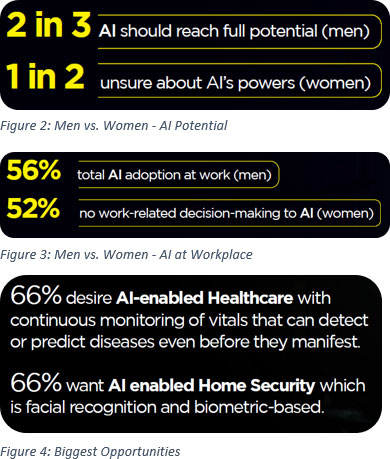
    Six out of 10 people realise the transformative powers of AI and are eager to see and experience its full potential. However, there are key differences across generations & gender.

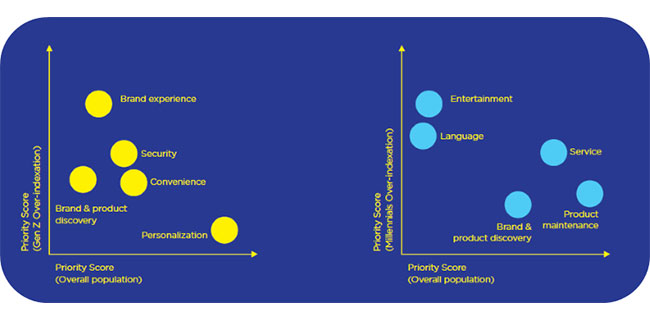
    Millennials feel AI will make their life easier & more fulfilling, by automating menial tasks, and help in fostering connections.

    Gen Z wants AI to help them live life the way they want, on their own terms, and prioritizes AI applications that customise and personalise the way they experience the world.


    While men are somewhat over-excited by AI, women are taking a more measured approach.
     

    Consumers prioritise life-enhancing experiences over just gimmicks across different facets of life like home security, smart home, personalised recommendation for entertainment, customer service and AI generated content.


    Across categories, Personal Security comes out as the biggest opportunity area. This has two key aspects – Health and Home.


    “The ongoing conflicts around the world, and the resulting economic uncertainties, coupled with the harrowing experience of Covid-19, have brought personal & financial safety to the forefront,” opines Arnab Datta Chaudhuri, GM, Integrated Planning.


    Watchful – about how AI is being deployed

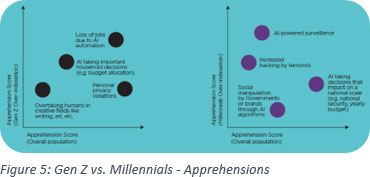
    Data privacy has emerged as the biggest bottleneck in AI adoption – 64% of respondents think that if they start using AI, all their data will be exposed to AI companies, while 70% are worried about those companies misusing the data they share.


    Apart from privacy, multiple concerns loom large. Gen Z is most apprehensive about the loss of jobs due to AI automation and AI overtaking humans in creative fields like writing and Art.

     

    Millennials, on the other hand, believe that bad actors misusing AI are the real problem. Increased hacking by terrorists, social manipulation through AI algorithms, and AI-powered surveillance, are some of the things they caution against.


    Never lose the human touch

    The survey highlights the fact that, while we expect AI to improve our experiences, it is imperative that we don’t let go of human interactions across all aspects of life. Sourav Ray adds, “We want AI to give us security, personalization, convenience. However, interference in emotional aspects, particularly human relationships and intimacy, are clearly off the table. This report will give brands an understanding of how open consumers are to adopting different AI technologies, and what could the key talking points be, as & when they keep adopting these new technologies.”


  • Brand Lift, Consumer Research & Digital Marketing


    By Ashoke Agarrwal


    Ashoke AgarrwalDoes John Wanamaker’s lament, “Half my advertising spend is wasted; the trouble is I don’t know which half.” hold in the digital marketing era?

    First, the question to ask is whether Wanamaker knew what waste meant.

    Did Wanamaker measure the efficacy of his advertising spending over a given period -weekly, quarterly or yearly- in terms of sales in the immediately subsequent period? Or did he also take the brand lift – changes in his brand’s top-of-mind, unaided and aided awareness and share of the consideration set -into account? Wanamaker probably did not. Sales figures are always at hand, and brand lift needs consumer research. And Wanamaker probably had another zinger ready about the cost and efficacy of consumer research.

    However, the fact that brand lift is a second-order metric does not detract from its importance. In FMCG categories, brand lift determines a brand’s position and potential shifts in the Markov Chain that determine stable shifts in market share. In categories with longer purchase cycles, low or negative brand lifts in one period could lead to a loss of market share in the next.

    In the early days of the Internet and social media, the promise was that marketing would evolve into an interactive one-on-one relationship between brands and their consumers. But then, with the arrival of the third-party cookie, this early promise crumbled.

    Digital Marketing evolved into a click-baiting exercise driven by algorithms that stalked people until they could lure them to click. The AIDA (Awareness-Interest-Desire-Action) model at the core of marketing fell by the wayside, along with concern for brand lift and consumer research. Digital marketing aided by third-party cookies continued to thrive and take an increasing share of overall spending as the ROI in immediate sales was directly visible in terms of cost per click and conversions per click and profitable. A digital-age Wanamaker would know which part of his digital campaign generated more clicks and clicks from which source led to better sales.

    Big consumer marketing companies that built brands in the mass media era embraced digital marketing while retaining the core principles of marketing.

    They encouraged their digital agencies to focus their messaging and targeting on creating positive brand awareness and consideration. In effect, these companies gave equal importance to the impact of a digital message and campaign on those who didn’t click.

    Some digital metrics measure brand lift. One such is the number of Google search words containing the brand name measuring against the searches with the category name and searches with competitive brands.

    The big established brands also had consumer research that regularly measured brand lift.

    The digital era has seen the emergence of digital-native or digital-first brands. For these brands, digital was their raison d’etre. It was digital that allowed them to be as small or niche a market; it was digital that allowed them to bootstrap; it was digital that allowed them to experiment and evolve.

    Many of these digital brands fell by the wayside. Others were like meteors, burning bright and then fading away. Quite a few lasted long enough to ask questions like where to go from here – when they start pondering growth beyond the next quarter, brand loyalty, brand equity, etc. Now, is when some of them turn to digital metrics that measure such things and even consumer research. Some of them, I can attest, take to the fundamentals of old-fashioned marketing with a vengeance.

    Though I am still waiting to see concrete data in this regard, the general sense is that digital marketing ROIs are beginning to fall. If true, the reasons are two-fold – the ongoing abolition of third-party cookies and increasing digital clutter.

    As a result, even new digital-first brands are beginning to evaluate their digital campaigns the old-fashioned way – giving importance to immediate sales and brand lift, leading to adtech and consumer research innovation.

    Tech start-ups offer SAAS solutions to marketers, and agencies are emerging, which enables them to fine-tune their campaigns to optimise between brand lift and sales. Some of these solutions sit atop the Demand Side Platforms (DSPs) within the programmatic buying ecosystem.

    In digital messaging, content marketing has become a core part of the digital communication strategy besides messaging that drives clicks and sales.

    Will the emergence of AI in marketing accelerate this brand-building trend in digital marketing? Or will it result in a virulent reversal to the click-bait era aided by the superior pattern-recognition ability of Machine Learning? On the other hand, AI may give rise to an entirely new marketing era, an era in which the AI avatar of a brand markets directly to the AI avatar of a consumer, fulfilling, in a way, the initial promise of the digital area – one-to-one AI-to-AI marketing! I wrote about such a situation in a blog post in February 2022 -“The Post-Digital Age and the Coming of Concierge Intelligence.” We live in interesting times.


  • EY launches unifying AI platform

    By Our Staff


    The EY organisation (EY) has announced the launch of a new and fully integrated marketing campaign entitled ‘The Face of the Future’. Through this campaign, EY wishes to promote its recently launched unifying artificial intelligence (AI) platform, EY.ai, highlighting the need to put humans at the centre of the AI transformation to help deliver on the exponential value the technology provides.


    Said Nicola Morini-Bianzino, EY Global Chief Technology Officer: “Building confidence in AI requires a holistic and people-centred approach. As global leaders, organisations and entire industries contemplate the transformative capabilities of AI, we are helping EY clients face the future with confidence by emphasising this exact approach to AI-enabled business transformation. This campaign reflects the power of EY people, augmented and empowered by AI, in driving the change to build a better working world.”


    Added John Rudaizky, EY Global Brand & Experiences Leader: ‘The Face of the Future’ is not only an extension of the EY long-standing commitment to AI innovation but underlines the organisation’s belief that people must be augmented by technology, not in service of it. EY aspires to build a brand that is synonymous with leading on AI and this campaign will serve to show EY clients, people and communities alike how we are doing just that – by placing people at the centre of AI to create exponential value.”