Category: RESEARCH

  • Fake news still a concern: Ormax Media study

    By Our Staff


    Media consulting firm Ormax Media has announced the launch of the third round of its report titled ‘Fact Or Fake?’. The report measures the credibility of various news media, as well as the perception around ‘fake news’, through a survey of 2,000 news consumers across 15 states in India. The first edition of the report was released in September 2020, followed by the second edition in April 2021.


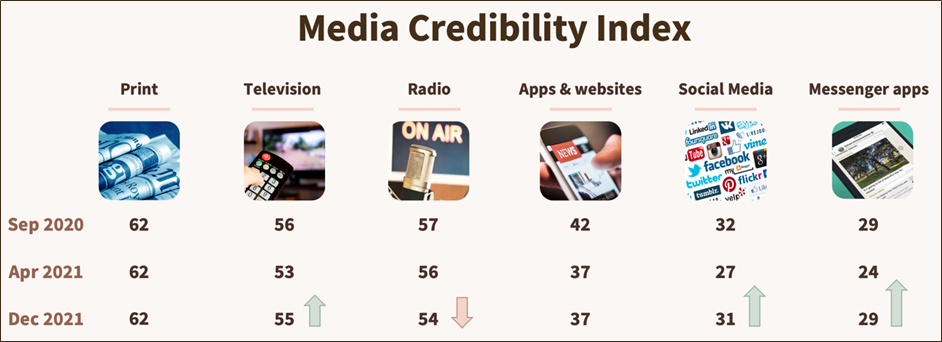
    According to the third edition, 64% Indian news consumers see fake news as a major concern. The News Credibility Index is unchanged since last track (65%), highlighting that fake news continues to be a huge concern amongst Indian news consumers.


    Print media continues to lead, with a Credibility Index of 62%, followed by Television (55%) and Radio (54%). Traditional media have higher news credibility than digital media, though most digital media have seen a marginal improvement in their credibility in this track.


    Twitter continues to remain the most credible digital medium for news, albeit with a drop in its Credibility Index over time: 57% (Sep 2020) to 47% (Apr 2021) to 42% (Dec 2021).


    Shailesh KapoorCommenting on the findings of the report, Shailesh Kapoor, Founder & CEO – Ormax Media said: “Fake news, and lack of news credibility in general, continues to be a growing concern globally. Almost 2 out of 3 Indians see fake news as a problem, and that should be a major cause of worry for all news companies. We launched this report in 2020 to enable more informed conversations on this topic. In the subsequent editions, we plan to study these indices by languages, to understand if there’s a difference in news credibility between Hindi, English and other major Indian languages”.


  • Customer satisfaction dips for Indian brands


    By Our Staff


    Havas CX, the Havas Group’s global customer experience network, has launched the X Index Report 2022. The report indicates that trust, inclusivity, always being of service, and going above and beyond are now major factors in creating the most meaningful customer experience.


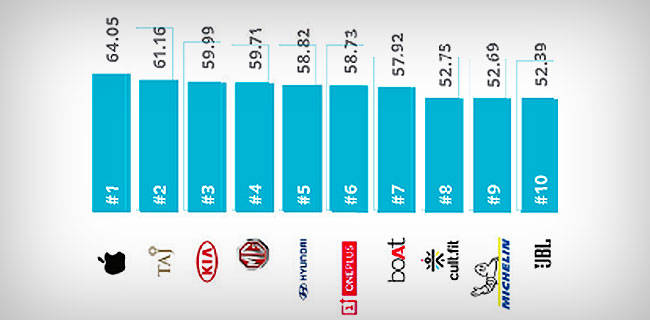
    According to the X Index India report parameters, the #1 brand is Apple followed by Taj Hotels, KIA, MG, Hyundai, OnePlus, Boat, Cult.fit, Michelin and JBL.


    Fifty leading brands across 13 categories including retail, fashion, financial services, automotive, entertainment, hospitality, beauty, health, and more were studied from India for the recent study. What’s interesting is that among the six countries also surveyed a year earlier, only India registered a lower overall score in 2021 compared with 2020. The higher scores in the other five markets (China, France, Portugal, UK, and the US) point to rising satisfaction with the customer experience. What this means is that while most geographies were able to leverage the new normal to cement their CX and deliver on consumers’ rising expectations, Indian brands were not as agile to keep up with the rising expectations. This makes it even more critical for Indian brands to now recognise that customer experience is synonymous with brand experience.


    For the second consecutive year, brand image has emerged as the strongest competitor to the X Index, representing 46% of India’s score. This hints at the fact that while ecosystems and the touchpoints were expanded during this new normal, brands also need to maintain continuous engagement to reinforce their image while also making it part of their CX.


    Despite heavy customer experience investments by brands, there’s still room for improvement with only a global average of 40% of consumers thinking the brands they interact with are “cantered on their needs as a customer.” This year’s research reveals that increased consumer expectations around trust, sustainability, and inclusivity are now impacting the evaluation of customer experience, with brands being assessed on the concrete actions they deliver to create a welcoming experience for all – shifting the traditional idea of customer experience to citizen experience.


    Said Prashant Tekwani, EVP & Business Head, Havas CX India & Havas Worldwide, West: “The pandemic has brought about a sea-change in consumer shopping behaviour. Brands now need to evolve their thinking from customer experience to citizen experience by making seamlessness and inclusivity their priority. According to the latest X Index report, India is the only country to register a lower overall score in 2021 in comparison to 2020. There is a gap that needs addressing for brands in India to score high in the CX journey. This shows how the understanding of the evolving expectation of the consumers is critical to maintaining the health of CX, growth and brand imagery. While meeting functional criteria around seamlessness, simplicity, and efficient customer service, brands must also go the extra mile to make a lasting impression in their customers’ minds.”


    Added Sumeer Mathur, National Strategy Head & Managing Partner, Havas Worldwide India: “Interestingly, out of all the parameters that we measure to arrive at a final score, the Brand image has emerged as the strongest contributor to the X Index, representing 46% of India’s score. This hints at the fact that while ecosystems and the touchpoints were expanded during this new normal, brands also need to maintain continuous engagement to reinforce their image while also making it part of their CX. Conversely, it could also mean that Indian brands are under leveraging other parameters and relying too heavily on the brand image alone to determine the customer experience.”


    The X Index identified four key principles to create a best-in-class citizen experience:


    Trust comes first: Brand trust is the most powerful denominator around the globe in the customer journey. Brands build trust by keeping their commitments to customers and being there in times of crisis. For example, brands that optimized their shopping experience during the COVID-19 pandemic saw better results; these optimizations included moving many traditionally in-person services online (consultations, etc.), and taking advantage of new platforms to integrate community building and social components. Brands also build trust with transparent business practices and by making commitments to social causes.


    Build an all-inclusive experience: For customer experience to become a citizen experience, brands must be inclusive. According to the X Index, consumers evaluate brands at every step of the journey, including the way they treat their frontline employees, foster inclusivity and break taboos in representation and marketing. Inclusivity also means enabling customers to participate in a community, with some brands introducing forums, clubs, and apps for customers to connect and interact with each other.


    Always be of service: Customer service is now defined by the speed of reaction to customer demands. It is one of the key discriminating factors. In addition, when it comes to staff and salespeople, consumers not only expect them to be efficient but also knowledgeable.


    Provide for the age of extra: When it comes to satisfying customers, going the extra mile is of paramount importance for brands. A key part of going above and beyond in making sure the experience feels extra personal.


  • Indian ad industry nears 100k cr milestone


    By Indrani Sen


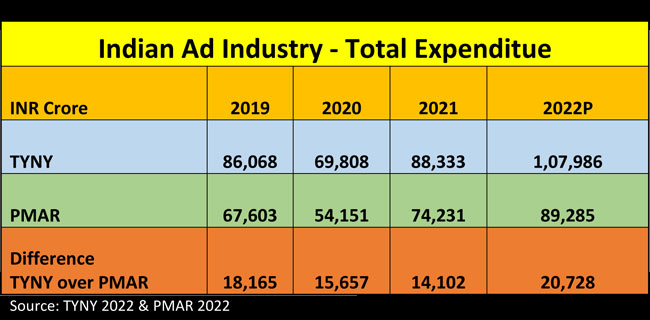
    Indrani SenLast week, both GroupM’s This Year Next Year (TYNY) and Madisons Media’s Pitch Madison Advertising Report (PMAR) got released and their basic findings have already been reported by all business and trade media. The general mood in the advertising industry is exuberant as both the reports have confirmed that AdEX zoomed in 2021, by 37% as per PMAR and by 26.5% as per TYNY in spite of the third wave of the pandemic. In 2021, India was the fastest growing market in the top 10 countries, ranking 9 globally and ranking 5 on incremental ad spend predicted for 2022.


    The current year also promises to be a good year for Indian ad industry with PMAR predicting 20% growth and TYNY predicting 22% growth in adspend in 2022 over 2021. However, this year the two reports raises a paradox, will the ad industry cross INR 100,000 crore milestone in 2022 as predicted by TYNY or touch 90,000 crore as predicted by PMAR? It seems that we will be celebrating the milestone of achieving INR 100,000 crore ad expenditure twice, once in 2022 by GroupM, its constituent agencies and clients and once again in 2023 by another large part of the industry who prefers to use PMAR.


    It is acceptable that two or more research studies done by different agencies may yield different estimates of adspends by media and as long as the trends are the same, all such estimates can be used by the industry. Indian media, advertisers and agencies have learned to live with different estimates for the industry size, growth rates as well as predictions from different sources including TYNY and PMAR. However, as the difference of almost INR 21,000 crore between the estimates for 2022 in the two reports is huge, it may be prudent to analyse the macro level statistics of PMAR and TYNY to find out the source of such huge difference.


    As digital, TV and print account for a total share of 94% to 96% of the total ad expenditure in both the reports, a review of the adspend across these three media will suffice for finding out the sources of the difference in estimates.


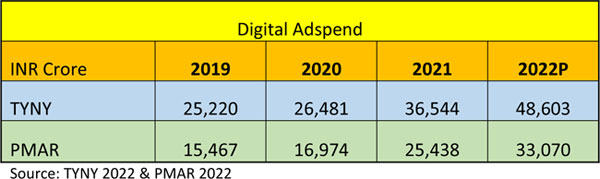
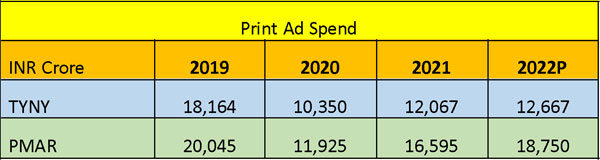
    Both GroupM and Madison Media have reported digital as the fastest growing media in 2021 and a continuity in the momentum of growth in 2022. In TYNY, digital adspends has equalled the TV adspends in 2021, where as in PMAR the digital adspends will equal or cross TV adspend in 2022.  Over the last three years, TYNY has been consistently reporting about INR 10,000 crore more in digital media ad spend than PMAR. In 2022 the ad spend in digital media is estimated to be INR 15,533 crore higher in TYNY than in PMAR.


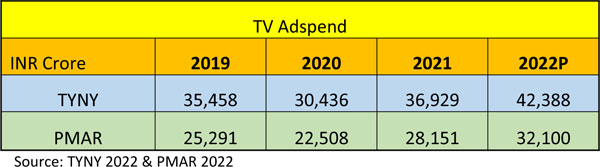
    Similarly, in case of TV adspend, the estimate by TYNY was higher than TYNY by INR 10,000 crore in 2019, which reduced to INR 8000 crore in 2020 and 2021. However, in the estimate for 2022, the same has again become higher by INR 10,000 crore. So, the estimates for digital and TV taken together account for a difference of INR 25000 crore between TYNY and PMAR in their predictions of 2022.


    When it comes to print adspend, the table is turned as PMAR has been consistently estimating higher spends in print than TYNY. In 2022, PMAR’s prediction for print ad spend is INR 6000 crore higher than that of TYNY. So, by combining print with digital and TV and other traditional media, the difference of INR 25000 crore gets reduced to INR 21000 crore.


    Source: TYNY 2022 & PMAR 2022


    It seems a bit unfair that TYNY has condemned print adspends in India to almost zero growth in 2022. As TYNY is done as a global report, has this estimate for Indian print ad spend been influenced by the global scenario where in most countries print ad spends have been steadily declining for years?


    I have written about the difference in the findings of TYNY and PMAR earlier in www.mxmindia.com. I know that we will never really get to know the reasons for such huge differences between the estimates of TYNY and PMAR, but it is becoming increasingly difficult to explain the reasons for the same to students of media management in a classroom as there is a danger that they may get confused and lose faith in media research.


    Read past commentary by Indrani Sen at:


    https://www.mxmindia.com/2021/02/so-how-do-the-groupm-madison-forecasts-compare/

    https://www.mxmindia.com/2020/02/a-roller-coaster-ride-of-adspends/

    https://www.mxmindia.com/2020/02/well-pitched-delivery/

    https://www.mxmindia.com/2019/02/indian-ad-industry-are-happy-times-really-here-again/

    https://www.mxmindia.com/2018/02/indrani-sen-mind-the-tv-adex-gap/

    https://www.mxmindia.com/2017/02/what-is-the-real-size-of-indian-ad-industry/

    https://www.mxmindia.com/2016/02/indrani-sen-boomtime-for-media-a-review-of-the-pitch-madison-advertising-report-2016/


  • Tailored digital ads and ecommerce to drive 8% growth in OTC AdEx: Zenith


    By Our Staff


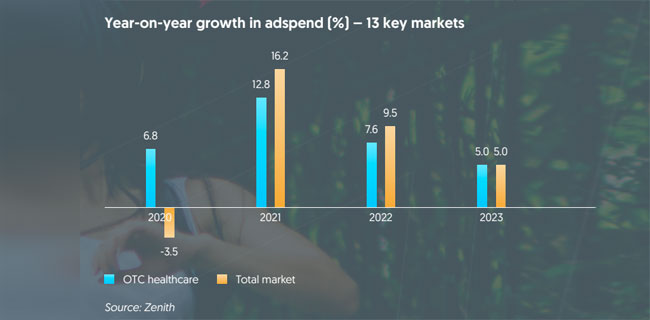
    Advertising expenditure by over-the-counter (OTC) healthcare brands in 13 key markets (including India) will expand by 7.6% in 2022 and 5.0% in 2023, according to Zenith’s new Business Intelligence – OTC Healthcare report, published today. This growth will be driven by tailored digital brand advertising, as well as performance advertising driving traffic to OTC ecommerce platforms.


    OTC advertising grew throughout the pandemic. OTC adspend expanded by 6.8% in 2020 while the market as a whole shrank by 3.5%, as healthcare messages soared in relevance for consumers. Demand for cold and flu remedies sank sharply as social distancing cut their transmission, but most other sub-categories continued to grow, and sales of sleep aids spiked. When the pandemic hit, brands in many categories cut back or even ceased their communications, concerned that their messaging was no longer appropriate, or in some cases counterproductive in the new context. This gave OTC brands the opportunity to use plentiful cheap media to reinforce their contribution to consumers’ health and wellbeing.


    “The continued shift to digital allows OTC brands to use smart segmentation and dynamic creative to market the same products to different people with different needs, within the framework of regulations for digital advertising in this category,” said Benoit Cacheux, Global Chief Digital Officer, Zenith. “The gym-goer with muscle ache, the office worker with a headache and the parent whose child has growing pains all need pain relief, but brands need to talk to them in different ways to persuade them most effectively. This ability to tailor the creative to the needs of the audience gives digital advertising an advantage that traditional media never had.”


    “The pandemic has focused consumers’ attention on their health and disrupted their reliance on traditional OTC distribution channels,” said Jonathan Barnard, Head of Forecasting, Zenith. “Brands will continue to step up their investment in digital advertising as the rise of ecommerce gives it a greater role in driving OTC sales and brand growth.”


    From the communique issued by Zenith:

    OTC advertising then rose a very healthy 12.8% in 2021, though in this case its growth was slightly behind the overall market, which had its lost ground to make up. Zenith forecasts growth in OTC advertising to remain healthy over the next two years, as brands defend their price premiums and ecommerce platforms compete to establish dominance.


    OTC has lagged some way behind the market as a whole in embracing ecommerce, but the lockdowns and other restrictions led to a leap in OTC ecommerce in 2020. Now that more consumers are aware of and comfortable with the option of shopping for OTC products online, it will become an ever more important sales channel over the next few years. This means traditional distributors such as pharmacies and supermarkets are facing new competition from digital ecommerce platforms, and brands have new opportunities to launch new partnerships or even direct-to-consumer ventures. The increased competition for traffic and sales will fuel continued growth in brand and performance advertising.


    Zenith forecasts that OTC healthcare adspend will grow from US$20.1bn in 2021 to US$22.7bn in 2023, 36% above pre-pandemic spending level of US$16.7bn in 2019.


    Shift to digital helps brands tailor messaging to consumers’ specific needs: When consumer first buy an OTC product, they often spend time researching the purchase and discussing it with family, friends and trusted advisors like pharmacists. However, after the first purchase, buying OTC products quickly becomes routine, part of the regular shop. The fundamental role of OTC advertising is therefore to maintain brand awareness at the point of purchase, much like FMCG advertising. Similarly, OTC healthcare makes heavy use of television for its high-impact mass reach. OTC advertisers spent 38% of their budgets on television advertising in 2021, compared to 21% for the average advertiser across all categories. OTC brands also spend more on radio and magazines – radio for its mass reach and magazines for their high impact.


    Until recently, it was difficult to use digital advertising to create emotional connections and lasting brand awareness. The rise of high-quality advertising environments, online video and retailer media – ads that appear on retail websites and ecommerce platforms – means brands can use digital to convey brand values effectively right through to the sale. Brands are also spending more on performance advertising as OTC ecommerce scales up.


    Zenith forecasts that OTC brands will increase their digital adspend at an average rate of 11% a year between 2021 and 2023, while radio grows by 5%, television by 3%, and magazines shrink by 3%. Digital will account for 49% of OTC advertising in 2023, up from 46% in 2021.


    *The 13 markets included in this report are Australia, Canada, China, France, Germany, India, Italy, Poland, Russia, Spain, Switzerland, UK and USA, which between them account for 74% of total global adspend. The report covers medicines and remedies sold over the counter, including cold and allergy remedies, contraception, digestion care, eye care, oral care, pain relief, skin care, sleep aids, stop-smoking aids and wound care.


  • TV Ad volumes post double digit growth in 2021: BARC


    By our Staff


    The year 2020 was a subdued one for television advertising, leading to a decline in total Ad Volumes across the year despite the record stay-at-home rise in viewership. 2021 has bounced back with a substantial double-digit spike, delivering an all-time high of 1824 million seconds of Ad Volumes during the year. This translated into a 22% and 18% growth over 2020 and 2019, respectively. The Top 10 advertisers accounted for 780 million seconds of Ad Volumes, and the Next 40 accounted for 340 million seconds.


    FMCG brands continued to lead in share across categories and Hindi channels continued to dominate across languages.


    New advertisers and brands consistently jumped in throughout the year, thus playing an important role in the advertising volume growth witnessed throughout 2021.


    Commenting on BARC India’s latest Think Report, 2021 – A Voluminous Year (Yearly Ad Volume Report 2021) that analyses television advertising volumes for the past year, Aaditya Pathak, Head – Client Partnership & Revenue Function, BARC India said: “2021 certainly brought in much needed cheer to the broadcast industry. The year started off on a positive note and also ended on a high with the festive quarter. Year on year, despite pandemic impediments, television has repeatedly proved effective for every penny spent for advertisers and brands. 2021 saw over 9000 advertisers turn to television with a significant number of new entrants. Overall, 2021 was a positive year for the industry as a whole that witnessed growing value for both advertisers and broadcasters.”


    Here are highlights of the report:


    Advertisers & Brands Count

    TV had a total of 9239 advertisers and 14616 brands advertised on the medium in 2021, of which, 49% i.e., 4483 were either new advertisers or returning ones. Similarly, for brands, 51% i.e., 7470 were new or returning brands.


    Categories

    The FMCG category continued to lead with an enormous share of 1117 million seconds of Ad Volumes in 2021, followed by Ecommerce with 185 million seconds and Building, Industrial, & Land Materials/Equipments with 60 million seconds. Television also understandably continued to be an important medium for the Corporate Brand Image category which registered 2x growth over 2019 with 24 million seconds.


    The Ecommerce category had a total of 587 advertisers in 2021 of which, 65% were new entrants or earlier advertisers returning to TV in 2021, registering a growth of 51% over 2020 and 26% over 2019. Media/Entertainment/Social Media, Education, Online Shopping, Matrimonials and Financial Services were the top 5 sub-categories within Ecommerce. Ad Volumes for Education grew by 461% and Financial Services by 153% over 2020.


    Languages

    While Hindi continues to play a dominant part of the language mix, regional language channels recorded strong growth as well across 2021. Ad Volumes for Bhojpuri language channels doubled over 2019 and Punjabi, Marathi, Gujarati and Assamese language channels posted over 40% growth over 2019. South language channels i.e., Tamil, Telugu, Malayalam and Kannada, grew by 26% over 2020.


    2021 – Quarterly Analysis

    Q1 2021 kickstarted on a positive note having registered 24% growth over 2020 and 21% growth over 2019. Despite the sporadic and partial lockdowns on account of the second wave of COVID-19, Ad Volumes for Q2’ 21 were relatively higher at 417 million seconds as compared to Q2’19 which recorded 399 million seconds. Q4’21 brought in cheer for broadcasters with a bumper festive season that recorded 489 million seconds of Ad Volumes, the highest quarter ever. New advertisers continued to flock to television for effective communication with Q4’21 welcoming 2156 new advertiser or earlier ones returning to the medium, the highest for the year.


    After a marginal decline in Q2 2021 on account of the lockdowns, regional language channels experienced steady growth in Q3 and Q4.


    SD & HD Channels

    Ad Volumes for HD channels in 2021 grew by 11% over the previous year and SD channels grew by 22% in 2021 over 2020 and by 20% over 2019.


    TV Commercials

    TV commercials with an Average Commercial Duration of under 30 seconds, were most favoured by advertisers while spots more than 60 seconds were least preferred.  The Average Commercial Duration has been reducing Y-O-Y. The Prime-Time band, i.e., 20:00 hours to 24:00 hours enjoyed the maximum share of Ad Volumes at 27%. The share of Ad Volumes for the four time bands, viz 08:00 – 12:00 hrs, 12:00-16:00 hrs, 16:00-20:00 hrs and 20:00-24:00 hrs, continued to stay the same since 2019. TV Commercials in local languages on regional channels are consistently increasing since 2019.


    IPL 2021

    IPL 2021 registered a total of 1680 thousand seconds of Ad Volumes with 119 advertisers and 228 brands in all. There were 59 new advertisers and 158 new brands for the season. The Top 10 advertisers for the season contributed 35% of the Ad Volumes.


    Tokyo Olympics

    With 466 thousand seconds, Ad Volumes for the Tokyo Olympics were almost at par with Rio Olympics that was held in 2016. There were 34 advertisers and 61 brands that advertised during Tokyo Olympics. Significantly, 31% of the Ad Volumes during Tokyo Olympics featured Olympians.


  • Will BARC’s new policy for news ratings clear the mess?


    By Indrani Sen


    Indrani SenThe announcement was long overdue. Finally on last Thursday, the advertising and media industry was glued to the release of TV news channels’ ratings which was released by Broadcast Audience Research Council (BARC) after 17 months starting with Week 10, 2022.


    BARC announced that an Augmented Data Reporting Standards for news and special Interest genres has been developed and tested over some weeks before releasing the ratings to the industry. The revised approved standards prescribes that the audience estimates for these genres will be released every week based on a rolling average of ratings of 4-weeks to meet with the industry’s needs. BARC briefed their shareholders in details about the new method through webinar and Q&A sessions.


    The release of the ratings for week 10, 2022 was followed by the release of the past data for the previous 13 weeks from Week 49, 2021 to Week 9, 2022 though the ratings were not available from week 40, 2020 to week 9, 2021. It is to be noted that the channels within the news and special interest genre subscribing for BARC ratings were given an option to opt out form getting the details of the past data and consequently they have been clubbed together as “other channels” in the reports of the past 13 weeks.


    The renewal of reporting of the ratings of the news channels has come at a time when most of the annual deals for TV channels across different genres are planned and negotiated. Lately the free to air news channels have been up in arms against BARC accusing them of delaying tactics by not releasing the ratings of the news channels before the crucial period when decisions about annual distribution of TV ad revenues are made. BARC defended themselves with the argument that data processing as per the new methods and testing of the data had to be given adequate time.


    The document on ‘Policy for Augmented Data Reporting Standards for News & Special Interest Genres’ is available on the website of BARC India and clarifies the definitions of

    1. Genre-Language Classification of Channels and

    2. Definition of News and Special Interest Genres


    It also details out Augmented Data Reporting Standards which has been developed “In order to preserve data security and integrity and keep the cadence of advertisement planning consistent for all channels” (Source: https://www.barcindia.co.in/policy-updates/barc-india-policy-for-augmented-data-reporting-standards.pdf)


    Every week, BARC will release two databases of which the currency data will be a “4-week rolling average channel level audience estimates for the News and Special Interest genres and regular daily unrolled audience estimates for all other genres/channels.” This currency data will be available to all subscribers in the YUMI software and will be used for all transactions including rate negotiations. The second database will be weekly unrolled data and will be released only to broadcasters having one or more channels in the news and special interest category through a separate YUMI database and license. The broadcasters will only get to see the unrolled data for their own channels and not for their competitive channels. This unrolled data cannot be used for transactional purpose, but only for analysis of performance of own channels and future planning for the same. Many features of the currency data will not be available for the unrolled data. Respondent Level Data (RLD) audience estimate will be available for the news channels only on a rolling average of 4 weeks basis and under currency data and will not be given under unrolled data.


    The new policy has provision for Customized Event Reports (CER) with well defined target groups for different genres. It also provides Currency Data Usage Guidelines to the news and special interest genres. Finally, it has provisions for News Query Resolution for Current & Past Data with rules and regulations applicable for the same.


    On the whole, it seems that BARC India has come up with a technology driven solution for taking care of the issues of high variance and bounce found earlier in the audience estimates of News and Special Interest genre channels. The problem was largely related to low sample size tuned to these channels and their specific target audiences. Let us hope that this new policy would satisfy the channels in the News and Special Interest genre and will end their grievances against BARC India.


  • 2022 Priorities for CMOs


    By Our Staff


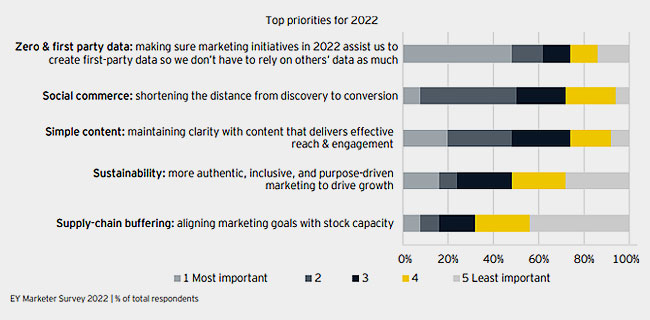
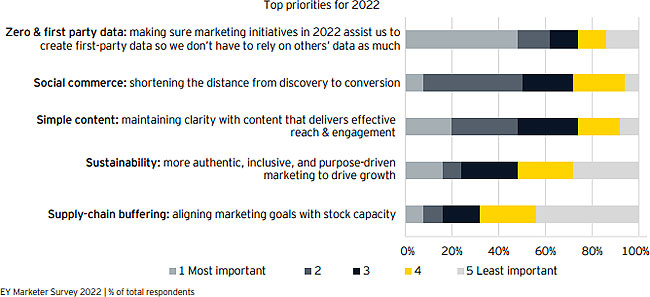
    In the EY-FICCI report for 2022 which was released with much fanfare on Monday, we found an interesting two-pager on the Priorities for Chief Marketing Officers for the year 2022. The entire EY-FICCI 2022 M&E report is available at https://assets.ey.com/content/dam/ey-sites/ey-com/en_in/topics/media-and-entertainment/2022/ey-ficci-m-and-e-report-tuning-into-consumer.pdf and the content below is on Pages 251 and 252


    Zero and first-party data is by far the most important priority for 2022


    • Most Important amongst marketer priorities for 2022 was creating zero and I irst-party data to enable efficient targeting of consumers, particularly given the challenges posed by cookie-less advertising and data privacy regulations

    :: Suggestion 1: Create a fair value exchange for your consumers

    :: Suggestion 2: Step up interactivity and gamification


    • Social Commerce has become an effective way to reduce the time between discovery and conversion and marketers need to understand its nuances and implement social sales channels for their brands at scale

    :: Suggestion 1: Create automatic bot check-outs

    :: Suggestion 2: Maximise role of influencers, tracking their Rol


    • Interestingly, many respondents identified effective content (and its ability to build reach and engagement) as a key priority for 2021

    :: Suggestion 1: Make content purposeful and personalised, based not on what people are searching for, but why

    :: Suggestion 2: Challenge yourself to think about the way stories are being presented [voice, video, visual via mobile and social], while keeping the art of storytelling alive [the heart of the message]


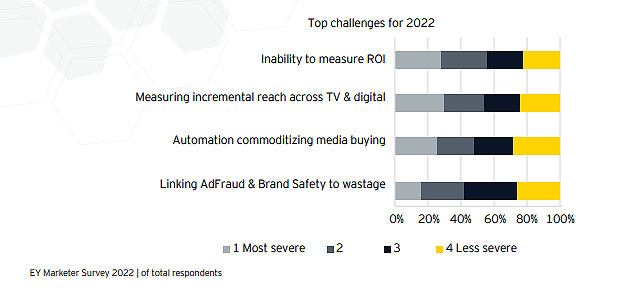
    Inability to measure ROI continues to be most severe challenge for marketers


    • Despite the overload of data generated by digital media, respondents identified measurement of marketing Rol as their number one challenge for 2022

    :: Suggestion 1: Build SMART (specific, measurable, achievable, relevant, time-bound) objectives to justify investments in full-funnel marketing, linked to clear KPls and use evolved attribution models

    :: Suggestion 2: Designate independent, objective owners of the Rol tracking technologies and processes


    • The lack of a common metric across TV and digital campaigns has most markets evaluating their campaign performances separately, and this led to concerns on the genuine incremental reach provided by digital to TV campaigns:

    :: Suggestion 1: Invest in modeling that provides directional guidance on investment strategies

    :: Suggestion 2: Build ways to collect deterministic data sets (actual households or individuals associated with an ad exposure) as a reliable way to control frequency


    Over 70% of respondents had ad fraud management in their top 3 challenges for 2022; yet the problem of linking adfraud and brand safety to wastage is seen as least severe amongst marketer problems. In there, lies an opportunity that must be addressed by the industry at large

    :: Suggestion 1: Continuously detect and protect against fraudulent traffic; boosting standards of measuring digital effectiveness

    :: Suggestion 2: Certify platforms that can demonstrate a proven ability to prevent fraud

  • 41% trust TV as a medium, 60% seek new info on internet


    By Our Staff


    Axis My India, a leading consumer data intelligence company, released its latest findings of the India Consumer Sentiment Index (CSI), a monthly analysis of consumer perception on a wide range of issues. The month of March highlights that a combined 43% prefer Television and Digital mediums for watching IPL this season. In addition, 60% seek out new information on the internet while 41% consider television as the most trusted medium, digital is second in terms of trust at 33%. 55% of families mentioned their media consumption has remained the same as last month. At an overall level, the Consumer sentiment is at the highest in last one year.


    The April net CSI score, calculated by percentage increase minus percentage decrease in sentiment, was up/down to +19, from +9 last month and reflecting the highest increase in last one year.


    The sentiment analysis delves into five relevant sub-indices – Overall household spending, spending on essential and non-essential items, spending on healthcare, media consumption habits & mobility trends.


    This month, Axis My India’s Sentiment Index delved deeper to comprehend consumer’s behaviour with regard to current world affairs, IPL consumption and information- seeking motivations. The survey further revealed summer- specific holiday/leisure plans and product preferences of consumers.


    The surveys were carried out via Computer Aided Telephonic Interviews with a sample size of 10086 people across 36 states. 67% belonged from Rural India while 33% belonged from urban counterparts. In addition, 63% of the respondents were male while 37% of the respondents were female. In terms of regional spread, 24% and 21% belonged to the Northern and Southern parts of India while 25% and 30% belonged to Eastern and Western parts of India. In terms of the two majority sample groups, 31% reflects the age group of 36YO to 50YO and 27% reflect the age group of 26YO to 35YO.


    Commenting on the CSI report, Pradeep Gupta, CMD, Axis My India, said: “With mounting geo-politics tensions, opening up of economies and diminishing fear of Covid-19, Indian consumers are showcasing confidence and overall sentiment is at the highest in last one year. While they are seeking out every new information with the help of the ever increasing penetration of internet, a majority of the population still relies on traditional media such as television to seek accuracy of this information. Even the government’s decision to abstain from voting resonated with the country’s sentiment basis welfare and security concerns of the Indian community in Ukraine and awareness of long standing political and strategic ties with Russia. Increasing expenditures across categories, domestic travels and coming together for IPL further captures the sentiment of an optimistic consumer. It reflects their intent for an improved life and lifestyle.


    Key findings:

    • Consumption of media has increased for 22% of the families reflecting the same as last month. Consumption remains the same for a majority of 55% of families. The overall, net score which was at +1 in the last month is -1 this month

    • Overall household spending has increased for 62% of families which reflects an 8% increase from the last month. The net score which was at +43 last month as increased by +10 to +53 this month.

    • Spending on essentials like personal care & household items has increased for 48% of the families which reflects an increase by +5 as compared to last month. Spends however remain the same for 33% of the families, reduced by -5 from last month. The net score which was +24 last month has increased to +29 this month.

    • Spends on non-essential & discretionary products like AC, Car, Refrigerator has increased for 13% of families reflecting an increase of 5% from last month. Spending nevertheless remains the same for 82% of the families. The net score has improved to +8 this month as compared to +3 in the previous month.

    • 89% of families said that they are going out the same for short vacations, malls and restaurants. Increased travel is reflected only among 6% of families, an increase by +1 from last month. The overall mobility net score is at 0

    • Consumption of health-related items more or less remains the same for 46% of the families, while decreased consumption is witnessed among 16%. The health score which has a negative connotation i.e., the lesser the spends on health items the better the sentiments, has a net score value of -22 this month.


    On topics of current national interest:

    • In an attempt to understand consumer’s behaviour on information seeking, Axis My India discovered that 60% depend on the internet while seeking new information. However, 41% reports Television as the most trusted source of information followed by digital medium– the view of 33% and print – the view of 22%. This draws an interesting co-relation between the nature of the medium and the kind of need it fulfils of a consumers. While Digital caters to urgency, television caters to accuracy and honesty needs of the consumer seeking information.

    • Catching the excitement and thrill around the IPL, the survey discovered that a huge 33% will be watching the season on television at home or outside (mall/pub/friends’ place) while 10% showed interest in digital viewing. Only 2% reported enjoying the match live from the stadium. Marketers are thus expected to park a huge percentage of their ads on Television and Digital platforms being the most preferred medium as per the survey.

    • Axis My India further evaluated consumers’ views on the Russian invasion of Ukraine and the crisis that followed. Gauging consumers’ view on India’s stand, the survey discovered that 55% believe that India was right in not criticising Russia over the invasion of Ukraine. This reflects the countrymen’s confidence in the governments to take decisions based on national and strategic interest

    • Assessing consumers’ views on buying non-essential summer- related products, Axis My India’s survey found out that 18% are planning to buy air-conditioners/fridge or replace an old one this summer season. However, 65% are still maintaining caution

    • The CSI – Survey furthermore captured consumer’s views on summer vacation/holiday plans. 13% are considering domestic travel while only 1% is looking to go for an international trip. A majority of 84% is still averse of major traveling for leisure.


  • Indian M&E to grow at 8.8% CAGR by 2026: PwC


    By Our Staff


    India’s media and entertainment industry is expected to reach INR 4,30,401Cr by 2026 at 8.8% CAGR. These figures come from PwC’s Global Entertainment & Media Outlook 2022-2026, the 23rd annual analysis and forecast of M&E spending by consumers and advertisers across 52 territories.


    Said Rajib Basu, Partner & Leader – Entertainment & Media, PwC India: ”The Indian Media and Entertainment outlook for the next few years is quite unique. There is an exciting pace of growth of digital media and advertising led by the deeper penetration of internet and mobile devices in our market. At the same time, traditional media will hold their steady growth rate over the next few years. We shall see a very different profile of media and entertainment related businesses and revenue models emerging in the digital space once we have the rollout of 5G.”


    Key findings for India in this year’s Outlook include:

    OTT Video: Total OTT revenue more than doubled in 2020, partly driven by the absence of public entertainment and additional time at home. This trend continued in 2021, with revenue nearly doubling again. While growth rates will slow, the market will still expand at an impressive 14.1% CAGR to reach INR 21,032Cr in 2026. It is subscription services that are driving this rapid growth, accounting for 90.5% of revenue in 2021 and set to account for 95% in 2026.


    Newspapers & consumer magazines: India will see an increase in total newspaper revenue at a 2.7% CAGR from INR 26,378Cr in 2021 to INR 29,945Cr in 2026. India, which will leapfrog both France and the UK to become the fifth-biggest newspaper market by 2026, will also be the only country to grow total newspaper print revenue consistently across the five-year forecast period. India will also be the only country in the world to grow daily print newspaper copy sales (by volume) during the forecast period. The increase at a 1.3% CAGR – to an average of 139mn daily average print newspaper sales in 2026, one-third of the global daily total – will mean that India will overtake China as the biggest world market for print edition readership in 2025.


    Out-Of-Home Advertising: India’s out-of-home (OOH) advertising market is demonstrating one of the strongest comebacks globally and is predicted to grow at 12.57% CAGR to reach INR 5,562Cr in 2026. Total OOH revenue recovered by 63.4% in 2021 over the 2020 levels which was one of the steepest downturns of any market and the biggest fall in revenue among the world’s major economies. In 2021 total OOH revenue was up to INR 3,076Cr. The momentum of this rebound will carry over into 2022, and by year-end the market will be at the value INR 4,084Cr.


    Video games & esports: India’s total video games and esports revenue was INR 16,200Cr in 2021, and is forecasted to reach INR 37,535Cr by 2026, increasing at a 18.3% CAGR. While still a fairly small market for the country’s size and population, India is the third fastest-growing video games market in the world, after Turkey and Pakistan. India’s video games market is predominantly geared towards social/casual gaming. With revenue of INR 13,244Cr, social/casual gaming made up 83.9% of India’s total video games and esports revenue in 2021. Expanding at a 20.6% CAGR, social/casual gaming revenue is expected to reach INR 34,581Cr by 2026. A big enabler of this segment will be the emergence of 5G technology in the market.


    TV advertising: After several years of rapid expansion, India’s TV advertising market was hit by the Covid-19 recession in 2020, causing a -10.8% decline over the 2019 levels. This proved to be a temporary setback. With the country’s return to economic growth in 2021, this segment grew by 16.9% to INR 32,374Cr. The market will expand further at a 6.3% CAGR to reach INR 43,410Cr by 2026. At this time, India will be the fifth-largest TV advertising market globally, after the US, Japan, China and the UK.


    Cinema: India is the third-biggest market globally in terms of admissions after China and the US in 2021 and is set to grow at the highest growth rate amongst all the segments at a staggering 38.3% CAGR in the forecast period to reach INR 16,198Cr by 2026. In 2021 more than 379mn cinema tickets were sold in India, a healthy increase year-on-year on the 278mn admissions in 2020 (and higher than the 226mn admissions in the US in 2020) though that had been a huge (-85.4%) drop as compared to the 1.9bn tickets sold pre-pandemic.


    Internet advertising: India’s Internet advertising market is set to increase at a 12.1% CAGR to reach INR 28,234Cr by 2026. Given India’s mobile-first Internet access market, the mobile sector dominates the country’s Internet advertising market, accounting for 60.1% of total revenue in 2021, rising to 69.3% by 2026. Display advertising dominates the mobile sector, accounting for 90.7% of revenue in 2021 though its share will fall to 88.9% of the total in 2026. India’s wired Internet access revenue amounted to INR 6,379Cr in 2021 which is predicted to increase at a 6.3% CAGR to reach INR 8,829Cr by 2026.


    Music, Radio & Podcast: India’s music, radio & podcast segment grew at 18% in 2021 and is set to grow at 9.8% CAGR to reach INR 11,536Cr by 2026. India’s Recorded Music industry (which is a key sub-segment) is making steady progress at a CAGR of 13.6%, thanks to streaming models. Here the revenue has grown from just INR 1,663Cr in 2017 to INR 2,568Cr in 2021, and is expected to continue on this path to INR 4,849Cr by 2026.On the other hand the country’s Live Music industry remains small, and it shed two-thirds of its revenue in the first year of the COVID-19 pandemic. Revenue ticked up in 2021 to INR 434 Cr and is forecast to grow to revenues of INR 1,052 Cr in 2026, increasing at a 19.2% CAGR.


    Other factors impacting the global M&E sector:

    Global Revenue – Fastest growing segments

    After a stellar 2021, virtual reality (VR) continues to take steps towards becoming a mass-market proposition. VR gaming content is the primary contributor to total revenue, bringing in US$1.9bn in 2021 and highest CAGR for the forecast period. Total cinema revenue will rise globally over the forecast period, and the pandemic-driven losses experienced in 2020 will be reversed, with the market hitting new heights in 2023. Box office revenue is set to reach US$49.4bn in 2026. Internet advertising comfortably leads the way as the largest advertising segment. An exceptional 31.6% year-on-year rise in 2021 put total global Internet advertising revenue at US$468.4bn, up more than US$112bn in absolute terms in 2020.


    The metaverse awaits

    In the not-too-distant future the metaverse could become a stunningly virtually realistic world where individuals access immersive virtual experiences, through VR headsets or other connecting devices. Because the metaverse is an evolution that may profoundly change how businesses and consumers interact with products, services and each other, its potential financial and economic value goes far beyond VR. In time, much of the revenues associated with video games, music performances, advertising and even e-commerce could migrate into the metaverse.

    How big is the E&M opportunity in the metaverse? The fast-growing market for VR is a starting point to consider. It is currently one of the smaller segments tracked, but the 36% rise in global spending over the past year is a hint of its long-term potential. The global installed base of stand-alone and tethered VR headsets is projected to grow from 21.6m in 2021 to 65.9m in 2026.


    Werner Ballhaus, Global Entertainment & Media Industry Leader, PwC Germany, said: “Industry press tends to focus on the companies that have dominated the E&M industry. But it is the choices that billions of consumers make about where they will invest their time, attention and money that are fueling the industry’s transformation and driving the trends.  We are seeing the emergence of a global E&M consumer base for the coming years that is younger, more digital and more into streaming and gaming than the current consumer population. This is shaping the future of the industry.”
     

  • MRSI AGM elects officebearers

    By Our Staff


    Market Research Society of India (MRSI), the industry-led market research body, has announced the formation of the Managing Committee for the tenure of 2022-2024. Manish Makhijani, Global Insights Director of Hindustan Unilever Ltd. was elected as the new President and takes over from Sandeep Arora, Executive Vice President and Global Head – Research & Analytics Solutions, Datamatics Global Services.


    Additionally, Paru Minocha and Saurin Shah were elected as Vice-Presidents, Prashant Kolleri as the Secretary, and Nitin Kamat as the Treasurer for MRSI. The election of the new Managing Committee members was held at MRSI’s 34th Annual General Meeting on July 7 in Mumbai.


    On being elected as MRSI’s President for the next two years, Manish Makhijani, Global Insights Director, Hindustan Unilever Ltd. said: “I am incredibly privileged to carry forward the legacy of so many stalwarts in the industry. Our industry has come a long way and sits at the intersection of changing consumer behaviour, technology, and marketing solutions. It is now up to us to really bring out the contribution of insights into the growth of the business in this complex and evolving world.”


    MRSI’s Managing Committee Member for the term of 2022-2024

    Sr No Name Organisation
    1 Arora Sandeep Datamatics Global Services
    2 Bhattacharya Arindam Lucid Holdings India Pvt. Ltd.
    3 Banerjee Shuvadip ITC Ltd
    4 Chakraborty Parijat Ipsos Research Private Limited
    5 Chanana Dixit Toluna India Private Limited
    6 Gautam Mukul Purple Audacity
    7 Gray Derrick BARC
    8 Grover Sameer Crownit
    9 Kamat Nitin TAM Media Research Pvt Ltd.
    10 Kolleri Prashant NielsenIQ (India) Pvt Ltd
    11 Makhijani Manish Hindustan Unilever Ltd
    12 Malhotra Vivek TV Today Network Ltd
    13 Mishra Amitabh Dr.Reddy’s Laboratories
    14 Minocha Paru Kantar
    15 Namakkal Sathyamurthy DDB Mudra Group
    16 Nijhara Praveen Hansa Research Group
    17 Samuel Stephen Kantar Analytics Practice
    18 Shah Saurin Godrej Consumer Products Ltd.
    19 Upadhyay Girish Axis My India


  • Ukraine, cost-of-living & climate changes concern areas for India


    By Our Staff


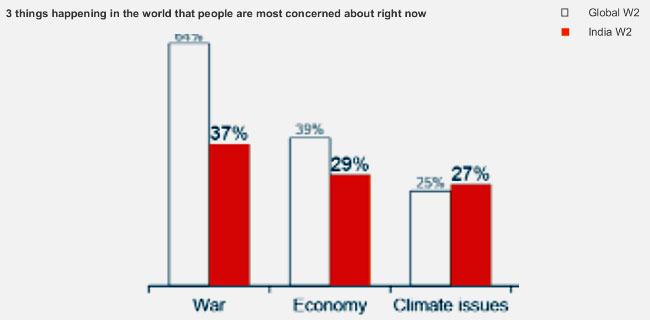
    Kantar’s Global Issues Barometer has found that the invasion of Ukraine remains the #1 concern of people in India followed by economic worries and the cost-of-living crisis. Asked to share their concerns, 37% of people mentioned the war, followed by 29% mentioning economic issues, as their top concerns currently. Climate and environmental issues have also emerged among Top 3 concerns. Covid-19 is no longer seen as a pressing issue like rest of the world, except in China where lockdowns are just lifting.


    Kantar’s Global Issues Barometer study is a detailed analysis of 800 people’s attitudes in India contrasted to 11,000 people across 19 countries (representing 68% of global GDP. The study asked open-ended questions to understand peoples’ real opinions and used Kantar’s TextAI technology to understand and analyse the responses.


    The war in Ukraine

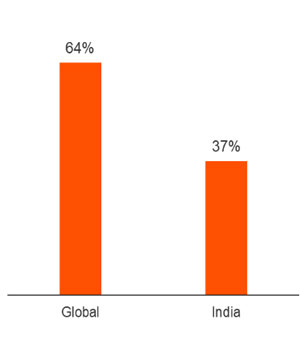
    The war in Ukraine is currently the biggest concern in India like every geographic region surveyed. As expected, the concern is much lower than the European counterparts. There is a high correlation between concern and proximity. 64% of people across the Globe mentioned the war as a concern while only one in three of India’s (37%).


    Figure 1: % Mentions of War


    The cost-of-living crisis

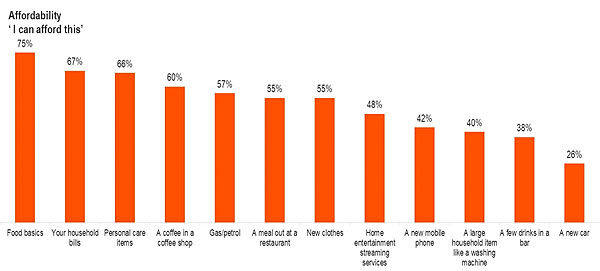
    The cost-of-living crisis is #2 on people’s minds. Price increases in fuel, food & drink and household bills have been noticed the most. Compared to the world, Indians feel the pinch of price increase on white goods more.


    While 35% of the population report their household financial situation is deteriorating, 46% believe the general economic outlook of their country is negative right now. People are struggling to meet their living costs, with 32% of households experiencing difficulties meeting their monthly outgoings and 11% unable to meet their commitments. The problem looks set to continue, a further 71% of people believe inflation will continue to rise even further.


    But there is sliver of hope as two-third of people in India feel secure in their jobs and expect pay rise that will match inflation.


    Figure 2: Affordability


    Eco-anxiety

    Climate inaction is causing remarkably high levels of distress with more than half of people experiencing eco-anxiety.


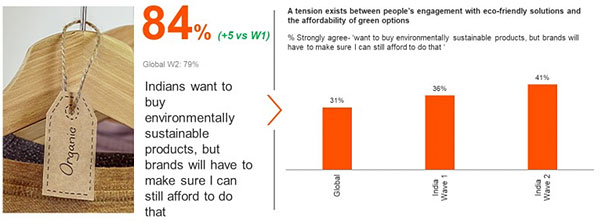
    Two-thirds of the population believe businesses have a responsibility to solve the climate crisis, while 84% of consumers want to buy environmentally sustainable products but need brands to do more work on affordability.


    Figure 3: Eco-anxiety


    Discussing the findings, Soumya Mohanty, Managing Director, South Asia, Insights Division, Kantar, observed: “The current tempest of global events is affecting long-term plans as well as short-term behaviour of Indians. Beyond making cutbacks on general expenditure, people are rationalizing their future savings and working harder.


    Luxury goods, entertainment and holidays look likely to be the sectors to suffer next. Almost half of households (41%) are considering economizing subscriptions to entertainment subscriptions- one industry that did well during the pandemic. Longer-term, almost three fourth of people say the current turmoil is impacting their big life plans; saving for big future life events (47%), children’s education (27%) and retirement plans (24%). So, the impact of this crisis lies in the future as much as in the present and can influence not just financial but also emotional well-being. Brands must therefore recognize what matters in people’s lives and examine brand’s relevance in supporting people overcome these challenges”


    Added Deepender Rana, Executive Managing Director, South Asia, Insights Division, Kantar: “Brands that can offer Green Affordable Solutions are likely to be favoured and become mainstream. With inflation rocketing, in their daily lives, consumers are considering solutions that can help reduce energy and fuel expenditure. They expect brands to do the same and be more efficient, while simultaneously raising the bar on ethical production. If anything, the cost-of-living crisis has reminded people that green products/services shouldn’t come at a premium. Insights from Kantar’s Global Issues Barometer can help brands and businesses understand how to navigate during these uncertain and fast changing times”.


    More on the study at https://www.kantar.com/campaigns/global-issues-barometer 


  • Wunderman Thompson launches a global trends report

    By Our Staff


    Wunderman Thompson launches ‘Inclusion’s Next Wave’, a global trends report outlining the driving forces behind the next wave of inclusion. The report reveals the powerful role brands can play by putting inclusion at the heart of their business, in storytelling, design and in the workplace, creating authenticity and reflecting life as it is lived. Through extensive research, Wunderman Thompson Intelligence has identified key trends in inclusion that are on the rise, and 10 actions authentically inclusive brands and businesses can take from the office to the Metaverse, to show up for their audiences.


    Eight-two per cent of the study’s respondents feel that actions on inclusion and equality should be integrated throughout the entire business, with 63% more likely to buy from brands that made more effort to represent people like them. Customers will reward brands that deliver on inclusion, with 66% of people agreeing that they are more inclined to buy from companies who speak out on issues of equality and inclusion, and 60% of people agreeing that brands who do not deliver on inclusion will become irrelevant.


    The study also brings to light issues that are rising in a rapidly changing era, such as how brands must now pivot to ensure that they are building safe, accessible, inclusive, and democratic digital spaces (82% who have heard of the metaverse believe that companies should make special efforts to ensure digital worlds are accessible to everyone). On the other hand, 83% agree brands should not use digital spaces as an excuse to avoid providing accessible spaces in the real world.


    Said Marie Stafford, Global Director at Wunderman Thompson Intelligence and Editor-in-Chief of ‘Inclusion’s Next Wave’: “Businesses and brands will not hit the mark if they don’t hire, collaborate with, and support marginalised groups. Recent events have intensified existing inequalities and the global conversation is gaining momentum, but this new research shows just how much consumers want to see more inclusive actions from brands. They have a powerful role to play in building a truly inclusive world, and those who take this into consideration can deliver authenticity and better reflect the real world, and in turn, reap the rewards of doing so.”


    Key trends in inclusion that are on the rise:

    Intersectional Storytelling: Diversity both on-screen and behind the camera is shaping a new era of inclusive storytelling

    Inclusivepreneurs: Entrepreneurs from underserved communities are innovating for themselves

    Mass inclusive design: Accessible products and services are hitting the mainstream as brands target mass distribution

    Meta-inclusion: As we build new virtual worlds, brands have an unprecedented opportunity to build in inclusion, accessibility and equity from the start

    Revolutionary Rest: Exhausted from constantly fighting their corner, marginalized communities are giving themselves permission to focus on rest


    Josh Loebner, Global Head of Inclusive Design at Wunderman Thompson commented: “Driven by a range of external factors, the next wave of inclusion is upon us. But the journey is just beginning, and there is a huge opportunity for brands to deliver better products, spaces, and experiences by putting inclusion at the heart of their business to ensure they stay relevant and capture both consumer attention and spending power.”


    Vignettes of companies breaking inclusion barriers appear throughout the study, from a lingerie brand that democratised desire among the disabled community and people over 50, movements shining a light on men’s mental health, and stories of digital sanctuaries for segments of inclusive communities to be themselves. It outlines rising trends in inclusion, how inclusion affects product development, workplace dynamics and the bottom line, and includes first person accounts of challenges and benefits from people with full spectrums of identities from around the world.


    Wunderman Thompson also studied representation in media such as TV and film. Of the groups that feel most underrepresented, 46% of neurodiverse respondents say there aren’t enough characters depicted on screen that share their traits; followed by 45% of disabled people; 42% of people with mental health issues; 35% of LGBTQ+ and 35% of people aged 60 and over; and 32% of underrepresented racial groups.


    The report is fully accessible, with Wunderman Thompson working with accessibility experts who used multiple accessibility measuring tools to identify usability issues. For example, experts deployed colour contrast checkers to verify the design palette, to help readers with colour vision deficiency to clearly distinguish between texts and backgrounds; the typeface that has been adopted – FS Me – has been researched and developed by charity Mencap to improve legibility for people with learning difficulties; and captions and descriptive alt. text have been added to all essential images, charts, and graphs to allow readers with visual impairments to listen to the PDF document. The artwork for the report was inspired by the work of Charlie French, an artist with Down Syndrome who shared his art with the team.